March 10, 202621 min read6 sections
What Is Strategic Positioning And How To Master It In B2B
By Fame Team
Key Takeaways
- Strategic positioning helps businesses own a valuable market corner that competitors can't easily enter.
- It involves identifying a specific group of customers and creating products or services that solve their problems.
- A clear strategic position builds a moat around a business, making it difficult for others to challenge it.
Strategic positioning isn’t some fluffy marketing term. It's the cold, hard decision to own a specific, valuable corner of the market that your competitors can't easily muscle in on. It's your answer to where you’ll play and how you’ll win.
This is the blueprint that guides every single move you make, from the features you build to the content you create.
Understanding Your Place In The Market
Think of your market like a crowded beach on a scorching day. Most businesses are all lumped together near the entrance, fighting over the same sandy real estate. It's loud, and it’s messy.
Strategic positioning is about taking a look down the shore, spotting a better, quieter spot, maybe with a nice breeze and calmer water, and deciding, "That's where we're setting up shop."
It's not just about being different for the sake of it. It’s about being different in a way that a specific group of customers actually cares about. For a B2B company, this core choice dictates everything:
- Who you serve: Getting laser-focused on your ideal customer.
- What you offer: Building a product or service that solves their specific problems, not everyone's.
- How you compete: Deciding if you’re the cheapest, the best, the most specialized, or the most innovative. You can't be all of them.
- How you communicate: Crafting a message that hits home with that one group you chose to serve, often through strategic thought leadership.
Without a clear strategic position, you’re just another voice in the noise, forced to compete on price until your margins evaporate. With it, you build a genuine moat around your business, making it a real pain for anyone else to challenge you.
Differentiating Key Positioning Concepts
The word "positioning" gets tossed around a lot, which creates a ton of confusion. Let's clear this up. Strategic, brand, and market positioning are all related, but they are not the same thing. Nailing the difference is critical.
For a deeper look at how the story part comes to life, you can explore various brand positioning strategies that build on this foundation.
Even for a giant like Microsoft, this stuff is vital. CEO Satya Nadella once wrote in a memo that in an industry with no "franchise value," a company's "strategic positioning" and growth are the only things that define its success. If it's that important for them, it's definitely important for you.
To make this crystal clear, let's break down these concepts side-by-side.
Positioning Concepts At A Glance
Here's a quick cheat sheet to help you distinguish between these crucial ideas. They all work together, but they each have a distinct job to do.
| Concept | Focus | Objective | Example |
|---|---|---|---|
| Strategic Positioning | The company's core game plan and unique place in the overall market | Build a sustainable competitive advantage by deciding where and how to compete | A SaaS company focuses exclusively on legal technology, using AI for document analysis instead of serving every industry |
| Brand Positioning | The customer's perception of your brand compared with competitors | Own a distinct and memorable position in the minds of your target audience | The same SaaS company positions itself as "The AI Partner for Elite Law Firms," emphasizing expertise and exclusivity |
| Market Positioning | A product's features, pricing, and value compared with competing products | Show why your product is the best choice within its competitive category | The product is priced above generic AI tools but differentiates itself with case law integration and predictive analytics |
Think of it this way: your strategic position is the fundamental business decision you make in the war room. Your brand position is the story you tell customers about that decision. And your market position is how your product is priced and packaged on the shelf next to the competition. Get the first one right, and the other two become infinitely easier.
Finding Your Unique Space With Positioning Frameworks
Trying to land on the right strategic position isn't a "throw spaghetti at the wall" exercise. It’s a structured process, and thankfully, smart people have already built the roadmaps for us.
These frameworks are the tools you use to cut through the noise, get a clear picture of the market, and; most importantly, find a spot where your company can actually win. They turn your big ideas into a concrete battle plan.
One of the most battle-tested frameworks comes from Michael Porter. He laid out three core strategies for gaining a competitive edge. These aren't just dusty old business school theories; they're practical blueprints for deciding who you are and, just as crucially, who you aren’t.
Michael Porter's Generic Strategies
These three plays offer very different paths to building a position you can defend.
- Cost Leadership: This is all about being the cheapest game in town. It demands ruthless efficiency, massive scale, and a laser focus on cutting costs so you can offer prices your competitors simply can't match without going broke.
- Differentiation: Here, the goal is to be unique in a way your customers genuinely care about. This could be anything from a superior product, legendary customer service, game-changing features, or just a brand story that really connects. This is often achieved through thought leadership content.
- Focus: This one is about owning a very specific corner of the market. You pick a narrow niche and serve them better than anyone else. A focused company tailors everything; product, marketing, sales; to the unique needs of a single buyer type, geography, or industry.
For most B2B companies, a Focus strategy is pure gold. Instead of building a generic tool for everyone, you become the undisputed expert for one specific, underserved industry. To go deeper on this, check out these actionable niche marketing strategies for B2B growth.
This whole process, from market analysis to brand identity; isn't linear, but it does follow a logical flow.
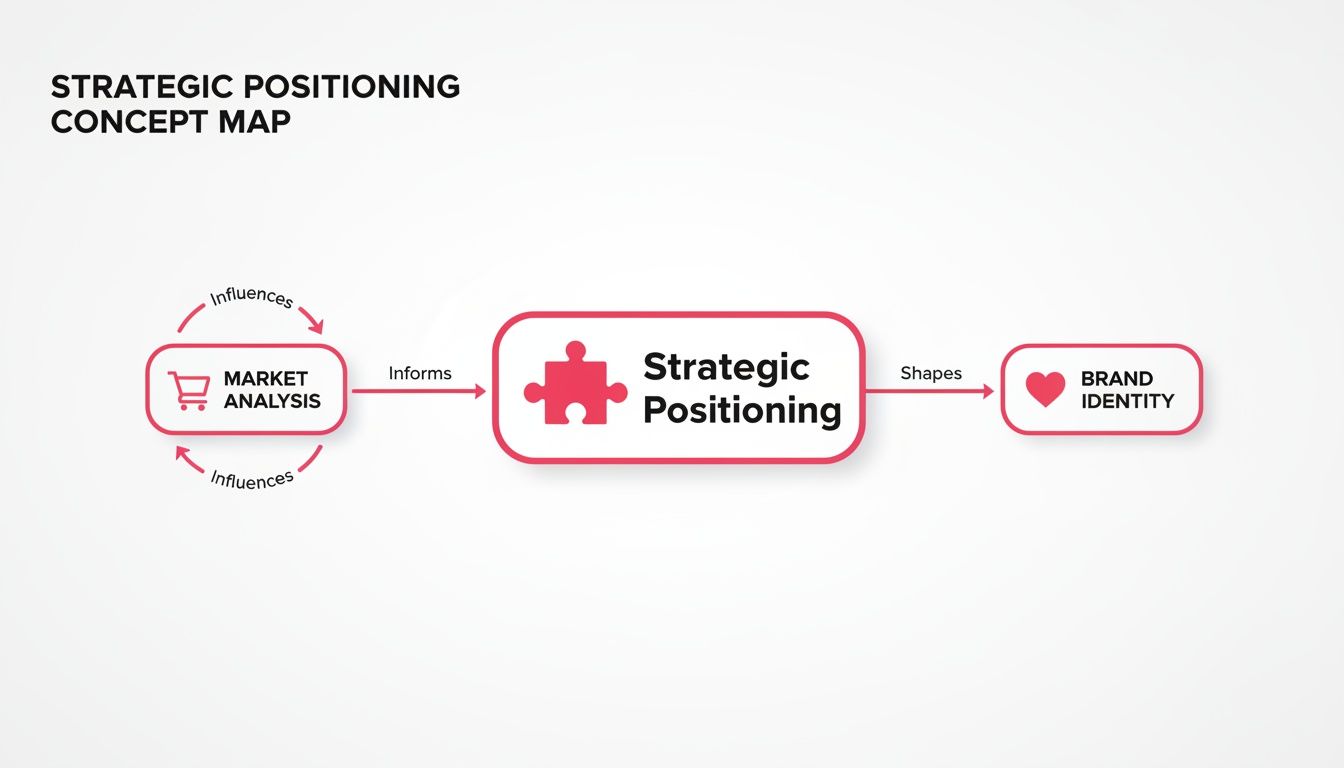
As you can see, it all starts with deeply understanding the market. That understanding informs your strategic choices, which then get translated into the brand your customers actually see and feel.
Using Perceptual Maps To Find Your Opening
Another killer tool for visualizing what is strategic positioning is the perceptual map (sometimes called a positioning map). Think of it as a satellite view of the competitive landscape, drawn from your customer's perspective.
First, you have to figure out the key attributes customers actually use to make decisions in your space. For a B2B software company, this might be "Ease of Use" vs. "Raw Power," or "Price" vs. "Quality of Support."
Then, you plot your company and all your rivals on a simple two-axis grid based on those attributes. The whole point is to find the "open water", a quadrant that represents a mix of valuable attributes that no one currently owns.
By visually charting out the market, you can spot the gaps where real customer needs are being ignored. This isn't just a classroom exercise; it's a practical way to pinpoint a valuable, defensible position you can claim as your own.
Once you find that open space, you’ve found your marching orders. You can now build your product, tune your marketing, and train your sales team to fill that specific gap, making you the obvious choice for that group of buyers.
The B2B Podcast: Your Ultimate Positioning Tool
So you’ve found that perfect, underserved gap in the market. Now what? How do you actually own that space and become the go-to name?
Forget shouting into the void with interruptive ads. The most actionable playbook for dominating your strategic position in B2B today is launching a podcast.
A B2B podcast completely flips the script. Instead of hunting down customers and pitching your features, you create a show they want to listen to. By educating potential customers and peers, you stop being another vendor and become the #1 educational resource and leading voice in your niche.
Host conversations with industry leaders, happy customers, and even friendly competitors. Suddenly, you're not just selling a product; you're at the center of your industry’s most important conversations, showing your expertise without ever having to "sell."
From Vendor to Indispensable Voice
The whole point of a B2B podcast is to educate your market so effectively that when it comes time to buy, your brand is the first one they think of.
Think about it. When your ideal clients are wrestling with the exact problems your podcast talks about week after week, who do you think they’ll call?
“The goal is to educate your ideal customers so well that they feel guilty for not buying from you when they are in the market. The best B2B marketers focus on education first, which leads to demand.” - Tom Hunt, Founder of Fame
This builds a level of trust and loyalty that old-school marketing just can't touch. You’re not just another name on a list. You're the guide who's been helping them all along. This is what modern B2B positioning is all about: building authority by being generous with your expertise and unifying your branding and content marketing efforts.
Podcasts are perfect for this. They allow for deep, nuanced conversations and authentic stories, a human connection that cements your status as the definitive voice in your space. For a deeper look at this, it’s worth exploring the many benefits of a podcast for B2B brands.
Building a Content Engine to Fuel Your Marketing
A podcast is so much more than an audio file. It’s a content engine. One single conversation can be sliced and diced into dozens of assets that hammer home your strategic position across every channel.
This solves the relentless "what do we post today?" problem. Your podcast becomes the heart of your marketing thought leadership, consistently pumping out top-tier material.
Here’s how it works:
- Record one awesome conversation. That's the core. Produce a single, insightful episode on a topic your audience needs to hear about.
- Create short video clips. Pull the best 30-60 second moments for LinkedIn and YouTube Shorts. These are your hooks, showing off your expertise and pulling people into the full episode.
- Write detailed blog posts. A full transcript becomes an in-depth article, complete with key takeaways. This is SEO gold and a great resource for people who'd rather read.
- Craft engaging social posts. Use killer quotes, stats, and ideas from the episode to fuel your social media calendar for days. You can even use a specialized B2B social media agency to get these in front of the right eyeballs.
- Share exclusive insights in a newsletter. Give your email list a behind-the-scenes look or a summary of the most important points. A dedicated B2B email newsletter agency can help turn your subscribers into a real community.
This system ensures your message, that you are the authority; is everywhere your ideal clients are. It pulls all your marketing together, making your strategic position impossible to ignore.
How To Build Your Strategic Position With A Podcast
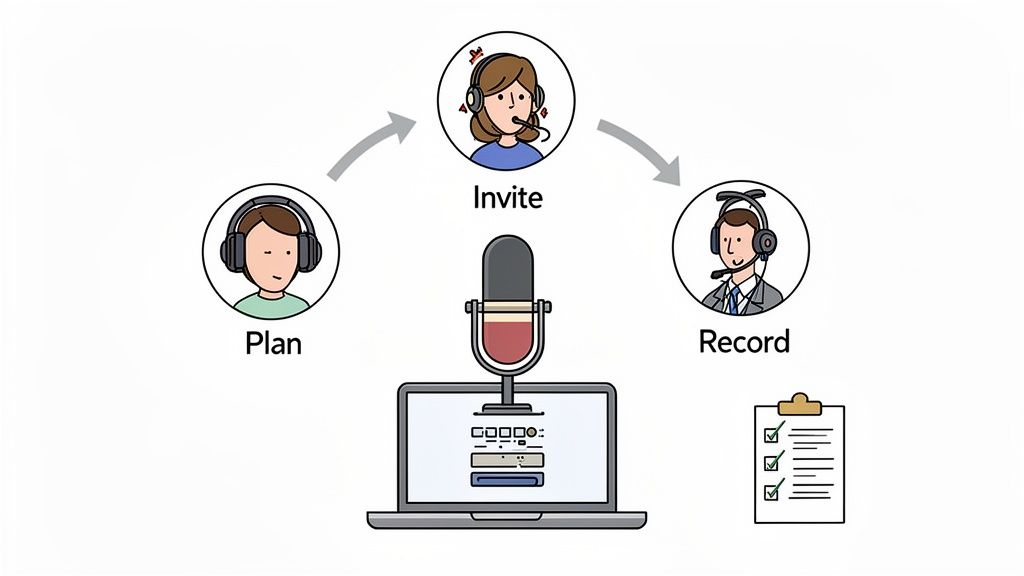
Theory is one thing; putting it into practice is another. Knowing what is strategic positioning is a great start, but actually building it demands a practical tool. For a B2B brand, a podcast is that tool; a platform to actively shape how the market sees you and cement your authority, one episode at a time.
This isn't about just hitting record and rambling. It's a calculated move based on a solid podcast strategy. The real goal is to create a show so genuinely valuable that it becomes the center of gravity in your niche, pulling in your ideal customers, peers, and even industry heavyweights.
When you get it right, your podcast doesn't just support your strategic position, it builds it from the ground up. Let's walk through the actionable steps to launch a show that carves out your unique spot and turns your company into the leading voice in the room.
Define Your Podcast's Unique Angle
Before you even think about buying a microphone, you need a compass. Your podcast's angle has to be a direct reflection of the strategic position you're trying to own. Are you the go-to innovator for enterprise tech? The trusted advisor for small businesses? The absolute specialist for a hyper-specific vertical?
Start by asking yourself: "What's the one conversation we can own that no one else is having?"
Your answer should point you toward a concept that is incredibly narrow and deep, not broad and shallow. If your position is being the top B2B brand for tech services, your podcast can't just be about "business." It needs to be something laser-focused, like "Scaling Tech Services" or "The Future of B2B Tech." This is the first step in how to start a B2B podcast.
A podcast's power in strategic positioning comes from its specificity. It's your chance to plant a flag and claim intellectual ownership over a very specific topic that matters deeply to your ideal customers.
This focused approach makes sure every single episode reinforces your expertise exactly where you want to be seen as the leader. For a much deeper dive into this planning stage, you can explore an effective B2B branded podcast framework.
Assemble Your Tools And Technology
Nothing screams "amateur" faster than terrible audio. If your podcast sounds tinny and unprofessional, your brand will too. The good news is, getting professional-grade sound is easier and cheaper than ever. You don't need a full-blown studio, but you absolutely have to nail the basics of what equipment you need for a podcast.
Here’s a quick rundown of what you really need:
- A Quality USB Microphone: Models like the Blue Yeti or Rode NT-USB+ are fantastic starting points. They give you crisp, clean audio without a complicated setup.
- Headphones: You need these. They're critical for monitoring your audio as you record and stopping that annoying echo during remote interviews.
- Recording & Editing Software: Tools like Audacity (free) or Descript (paid, but with amazing transcription features) are industry standards for a reason.
- A Quiet Room: This is your most important, and cheapest, piece of gear. Find a space with soft surfaces, minimal echo, and zero background noise.
With remote work being the new normal, learning how to record podcasts remotely is a non-negotiable skill for producing a show that signals credibility.
Invite Guests Who Amplify Your Authority
Your guests are a direct reflection of your brand. The people you have on your show tell the market what league you're playing in. Inviting influential peers, respected analysts, or even your most successful customers does more than just fill an episode, it's a powerful form of borrowed authority.
When you host a top mind from your industry, their credibility rubs off on you. Plain and simple. Their audience gets introduced to your brand in a context of expertise and trust, which is a massive shortcut to expanding your reach and solidifying a premium position. Learning how to prepare for a podcast guest appearance yourself can also give you valuable perspective.
Start putting together a "dream guest" list that aligns with your strategic goals. Who does your ideal customer already respect and follow? Reaching out with a clear, professional pitch that highlights the value for them is the key to getting a "yes" and ultimately learning how to become a thought leader.
Prioritize Education Over Sales Pitches
This is the cardinal rule of any podcast built for positioning: educate, don't sell. Your show is not a 30-minute commercial. It's a platform to deliver genuine value and build unshakable trust. The second your listeners feel like they're being sold to, they're gone. And so is your authority.
Build your thought leadership content strategy around solving your audience's biggest problems and answering their most burning questions. Share your expertise generously, with no strings attached. This is how you build true loyalty and become the first name they think of when they are actually ready to buy.
By consistently being the most helpful and insightful voice in their ears, the sale becomes a natural, welcome conclusion, not a forced, awkward pitch.
Your B2B Podcast Launch Checklist
Ready to put this all into action? A checklist can help you move from idea to execution without missing a beat. This table breaks down the key phases and actions to ensure your podcast is built on a solid strategic foundation from day one.
| Phase | Action Item | Key Consideration |
|---|---|---|
| 1. Strategy & Planning | Define the podcast's unique angle and target audience. | Does this angle directly support our desired strategic position in the market? |
| 1. Strategy & Planning | Set clear goals (e.g., audience growth, lead generation, brand authority). | How will we measure success? Define primary KPIs before launch. |
| 1. Strategy & Planning | Create a "dream guest" list of 50–100 names. | Prioritize guests who strengthen your authority and already have the audience you want to reach. |
| 2. Pre-Launch | Purchase and test all required equipment (microphone, headphones, recording setup). | Ensure audio quality is clear, professional, and consistent before recording. |
| 2. Pre-Launch | Design podcast cover art and write a compelling show description. | Keep branding aligned with your company's visual identity and positioning. |
| 2. Pre-Launch | Record and edit the first 3–5 episodes before launch. | A content backlog ensures consistent publishing and reduces launch-day pressure. |
| 3. Launch | Submit the RSS feed to Apple Podcasts, Spotify, and other major directories. | Allow 1–2 weeks for platform approvals before your planned launch date. |
| 3. Launch | Execute a coordinated launch campaign across all marketing channels. | Activate employees, customers, partners, and email subscribers to maximize early downloads. |
| 4. Post-Launch | Maintain a consistent publishing schedule (weekly or bi-weekly). | Consistency is one of the strongest predictors of long-term podcast growth. |
| 4. Post-Launch | Promote every episode through social media, email, blogs, and short-form content. | Repurpose each episode into clips, quotes, articles, and other reusable marketing assets. |
| 4. Post-Launch | Review analytics regularly and collect listener feedback. | Track downloads, audience retention, reviews, and engagement to continuously improve performance. |
Following this checklist won't just help you launch a podcast; it will help you launch the right podcast, one that systematically builds your strategic position and turns listeners into loyal advocates for your brand.
Amplify Your Position With A Content Engine
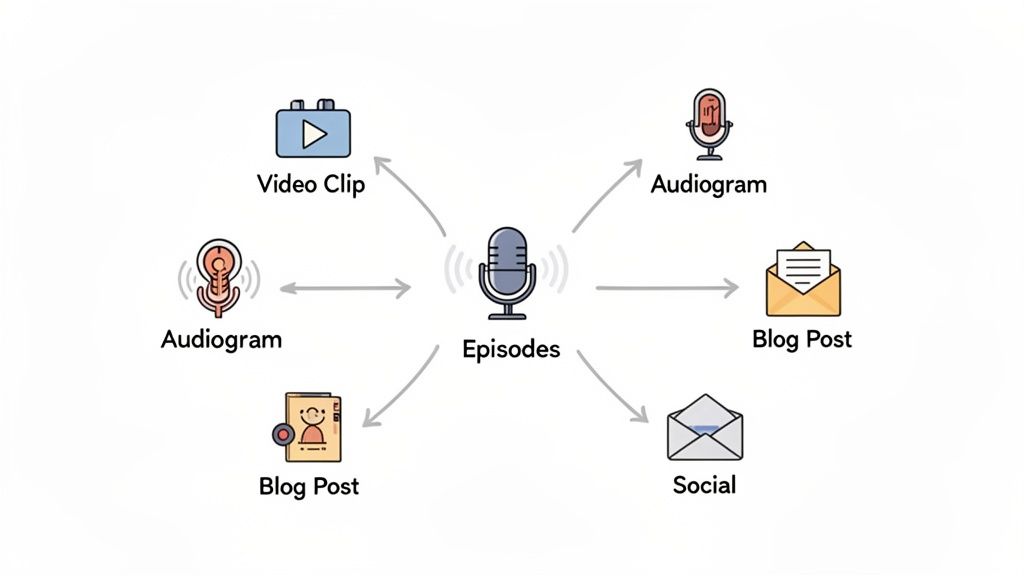
A B2B podcast shouldn't be a one-and-done marketing event. Think of it as the heart of a powerful content machine. The real magic in shaping your strategic position happens when you repurpose each episode into a full-blown campaign.
This system turns a single conversation into a steady stream of assets that hammers home your authority on every channel your audience touches. It solves the endless scramble for fresh, high-quality content. Instead of staring at a blank page, you have a repeatable podcast production workflow that mines a wealth of material from one core piece of IP.
This consistency makes sure your unique message is heard loud and clear, solidifying your position as the go-to voice in your industry. The goal is to be everywhere, but in a way that actually adds value. Your podcast becomes the central pillar, feeding every other channel with authentic, expert-driven insights.
Turning One Episode Into A Full Campaign
Imagine this: a single one-hour podcast episode fuels weeks of marketing activity. This isn't just about recycling content; it's about translating your core message for different platforms and how people consume them. Doing this right maximizes the reach and impact of your thought leadership, with great thought leadership examples often starting as a single podcast conversation.
This process is what turns your podcast from a simple audio file into a true strategic asset.
- Compelling Video & Audio Clips: Find the most potent 30-60 second moments from your episode. These become hard-hitting video clips for LinkedIn and audiograms for other social platforms. They’re the hooks that show off your expertise and pull traffic back to the full episode.
- Detailed Blog Posts & SEO: Your episode transcript is an SEO goldmine. Transform it into a detailed blog post, packed with key takeaways, quotes, and show notes. This is how you capture search traffic and serve audiences who prefer to read.
- Engaging Social Media Content: Pull out memorable quotes, surprising stats, and actionable tips from the conversation. Each one can be a standalone social media post that keeps your brand top-of-mind and sparks discussion.
- Exclusive Newsletter Insights: Use your email newsletter to share exclusive insights or behind-the-scenes stories from the episode. This rewards your most loyal followers and deepens their connection with your brand.
To really stand out and build a defensible asset, you can take this further by engineering a content moat for your content engine, creating a library of proprietary data and unique insights nobody else has.
Professional Execution For Maximum Impact
Running this content engine professionally is non-negotiable if you want to reinforce a premium strategic position. Clumsy editing, inconsistent branding, or a messy distribution strategy can do more harm than good, chipping away at the very authority you’re trying to build. This is where specialized expertise from a B2B podcast production service is a game-changer.
The content engine model ensures that the effort you put into creating one great piece of thought leadership pays dividends across your entire marketing ecosystem. It's the ultimate amplifier for your strategic position.
A slick, professional execution makes your podcast the unshakeable pillar of your thought leadership. It ensures every piece of content works together to establish your company as the definitive authority in your space. Want to see how this model works at a higher level? Check out our guide on how to scale content marketing.
Alright, you've launched your podcast. Nice one. But that's just the starting pistol. How do you know if it's actually doing its job and carving out your strategic position?
Hint: it’s not about staring at your total download count. That’s a vanity metric. True influence is about engagement, the authority you build, and the real-world business it brings in.
So, how do you measure if your podcast is truly building your authority? It all comes down to tracking the right KPIs, the ones that prove you're becoming the voice in your market.
The KPIs That Actually Matter
Forget the fluff. These are the numbers that will give you a real picture of your podcast's ROI and its impact on your strategic goals.
- Audience Growth Rate: Are you getting more listeners month after month? A steady increase shows your content is hitting the mark and your influence is spreading. We aim for a 10% monthly download growth for our clients because it's a core sign of a healthy, growing show.
- Guest Caliber: Look at who you're interviewing. Are you landing bigger and bigger names over time? Getting top-tier industry leaders on your show is a direct signal that your authority is rising and your platform is seen as valuable.
- Inbound Lead Mentions: When new prospects get in touch, are they mentioning the podcast? Simply tracking the answers to "How did you hear about us?" draws a straight line from your content right into your sales pipeline.
- Repurposed Content Engagement: What about all the video clips, blog posts, and social media updates you’re creating from your episodes? If those are getting a lot of traction, it's a great sign your message is cutting through the noise on more than one front.
A winning podcast isn't measured by downloads. It's measured by the conversations it starts, the people it attracts, and the inbound opportunities it generates. That's the real proof of a strong strategic position.
Common Mistakes That Will Kill Your Authority
Even the best-laid plans can get derailed by sloppy execution. A few common slip-ups can seriously damage your brand and undo all your hard positioning work.
Steering clear of these is non-negotiable if you want your podcast to be a strategic asset, not just another thing on your to-do list.
- Inconsistent Publishing: Dropping episodes whenever you feel like it is a huge red flag. It tells your audience you're not committed, and they'll quickly lose interest. A consistent schedule is everything for building a loyal following and looking like a pro.
- Awful Audio Quality: Nothing screams "amateur hour" louder than bad audio. If your recordings are fuzzy, echo-filled, or too quiet, you're making your show unlistenable and tanking your credibility. You have to invest in the right podcast equipment needed. It’s essential.
- Being Too Salesy: Want to lose listeners in record time? Turn your show into a 30-minute commercial. Your job is to teach, to help, to build trust. When you become the most helpful person in your space, the sales will come to you.
Before You Go: A Few Final Questions
Still have a few things rattling around in your head about strategic positioning and using a podcast to build it? Let's tackle the questions we hear most often.
Strategic Positioning vs. A Mission Statement: What's The Real Difference?
Think of it this way: your mission is your North Star. It’s the big, audacious reason your company exists. Strategic positioning is the battle plan you draw up to navigate by that star. It's the 'how' and 'where' you'll win on the ground, in your specific market.
For instance, your mission might be "to make B2B marketing more human." That’s your ‘why’. Your strategic position, however, could be "the only B2B podcast production service that guarantees audience growth for B2B tech brands." See the difference? The position is the sharp, actionable strategy that actually makes your mission a reality in a crowded field.
How Long Until A Podcast Actually Moves The Needle On Positioning?
Let's be real: building authority is a marathon, not a sprint. You'll see promising early signs; social media buzz, a trickle of new listeners, within the first 3-6 months. But a real, noticeable shift in your market position? That takes time.
You'll know you're getting there when a steady stream of inbound leads starts flowing and you're seen as a genuine market voice. This usually kicks in after 12-18 months of dropping consistent, high-value episodes. The trick is to treat your podcast like a long-term strategic asset. It builds compounding value over time, just like a great investment.
Can A Small B2B Company Really Compete Using A Podcast?
Yes. And honestly, it’s one of the best weapons in your arsenal. A smaller B2B company isn't going to outspend the giants on ads. It's a losing battle. But you can absolutely out-think them by owning a niche conversation.
A niche podcast lets you become a big fish in a small pond. You're not shouting into the void; you're establishing deep expertise and trust with a specific, highly-relevant audience. It's a direct line to your ideal customers, letting you build a loyal following in a way that big-budget, generic marketing just can't match.
This levels the playing field. Your authority is built on the quality of your insights, not the size of your bank account. For a deeper dive on this, check out these modern B2B brand awareness strategies.
Ready to stop being just another vendor and start being the authority in your B2B space? At Fame, we help B2B brands build their strategic position with podcasts that drive real business results. Learn how we can build your authority and grow your audience.
Want us to run this for you?
Fame starts and grows B2B podcasts that generate pipeline. Tell us who you are trying to reach and we will send a costed proposal within 48 hours.
Related content
- Read moreFame Team · July 16, 2026
10 Account Based Marketing Tactics For B2B Growth In 2026
Discover 10 actionable account based marketing tactics for B2B tech. Learn to use podcasts, data, and targeted content to close high-value accounts. - Read moreFame Team · July 16, 2026
The 8 Best Brighton Podcast Agency Picks For 2026
Find the best Brighton podcast agency for your B2B brand. Our 2026 guide reviews top 8 agencies for production, growth & ROI. Expert analysis here - Read moreJune 10, 2026
20 Best Podcast Production Agencies For 2026 (And Why Should You Hire One)
Global podcast and vodcast ad revenues are on track to hit $5 billion in 2026 , up 20% year-on-year. - Read moreApril 13, 2026
Leadership In Marketing: The B2B Podcast Playbook
Most companies still confuse leadership in marketing with job titles, org charts, and budget control. That's outdated.