December 20, 202518 min read6 sections
How To Scale Content Marketing With A Repeatable System
By Fame Team
Key Takeaways
- Creating more content just for the sake of it can lead to inconsistent quality, a chaotic workflow, and a lack of real impact in content marketing efforts.
- A volume-first strategy can result in wasted resources, inconsistent messaging, and difficulty in measuring what drives results, ultimately leading to a creativity crisis in B2B content marketing.
- Building a content engine around a high-value source, such as a B2B podcast, can help create more impact from a single source and generate leads for years, rather than just filling a calendar with low-impact content.
If you're trying to figure out how to scale your content marketing, the first thing you have to do is ditch the one strategy that burns out even the best teams: creating more content just for the sake of it.
It’s an easy trap to fall into. More blog posts, more social updates, more webinars, that has to be the growth path, right? But this frantic race to publish more stuff is a direct route to inconsistent quality, a chaotic workflow, and a frustrating lack of real impact.
The real goal isn't creating more assets; it's creating more value.
Why the 'More Is More' Approach Never Works
When your team is constantly chasing deadlines for one-off assets, quality is the first thing to go. The pressure cooker environment leads to shallow, uninspired pieces that don't resonate with your audience and certainly don't rank for anything meaningful.
This frantic pace makes it nearly impossible to build a cohesive brand narrative. One week you’re talking about one thing, the next week something completely different. It’s a mess.
The Pain Points of a Disconnected Plan
A volume-first strategy creates tangible frustrations that probably sound familiar. Resources get poured into assets that are used once and then completely forgotten, left to die in a content graveyard on your blog.
Without a unified system, your messaging becomes inconsistent across channels, confusing potential customers and watering down your brand.
And measurement? It’s a nightmare. When every piece of content is an isolated project, how can you possibly track what’s actually driving results? You're left guessing which efforts are moving the needle and which are just adding to the noise. It’s a common struggle, contributing to what some see as a need for fixing the creativity crisis in B2B by getting away from these generic, high-volume tactics.
The real cost of a volume-based strategy isn’t just the wasted budget; it’s the opportunity cost. Every hour spent on a low-impact blog post is an hour not spent creating a cornerstone asset that could generate leads for years.
Ultimately, the "more is more" mindset isn’t a system; it’s a hamster wheel. It drains your team’s creative energy and financial resources without building any lasting momentum.
To truly scale, you have to shift from creating more things to creating more impact from a single, high-value source. You need to build an engine, not just fill a calendar.
Building Your Content Engine Around a B2B Podcast
The alternative to the chaotic "more is more" content hamster wheel is to build a content engine. It’s a system where one big, high-value piece of content becomes the raw material for dozens of smaller assets. You end up with a waterfall of authentic, expert-driven material.
This model solves the constant “what should we create next?” problem once and for all. It gives you a repeatable, efficient workflow that just works.
At the heart of the best content engines is the B2B podcast. It’s uniquely suited for this role because a single conversation with an industry expert naturally produces everything you need: real insights, compelling stories, and a genuine human voice. This isn't just an audio file; it’s the foundational pillar for your entire content strategy, establishing your brand’s voice and building authority.
From one 45-minute interview, you can genuinely get an entire month's worth of marketing assets, audio, video, written, and design. That single recording session can be systematically repurposed into video clips for social, SEO-optimized articles, quote graphics for LinkedIn, and deep-dive newsletter content. You stop creating from scratch and start deriving from a source of proven value.
Why a Podcast Is the Ultimate Content Pillar
The true power of a podcast is its versatility. Unlike a static blog post, an interview is dynamic and multi-format from the second you hit record.
- It captures authentic expertise. You're not just writing about your industry; you're having actual conversations with the people shaping it. This builds authority and trust almost instantly.
- It generates multiple media types. You get high-quality audio, video (if you record it), and a full transcript, the raw materials for pretty much any marketing channel you can think of.
- It scales human connection. A podcast gives your brand a literal voice, creating a much deeper connection with your audience than written content alone ever could.
This is the typical path of content failure, where the pressure to create more leads directly to low quality and team burnout.
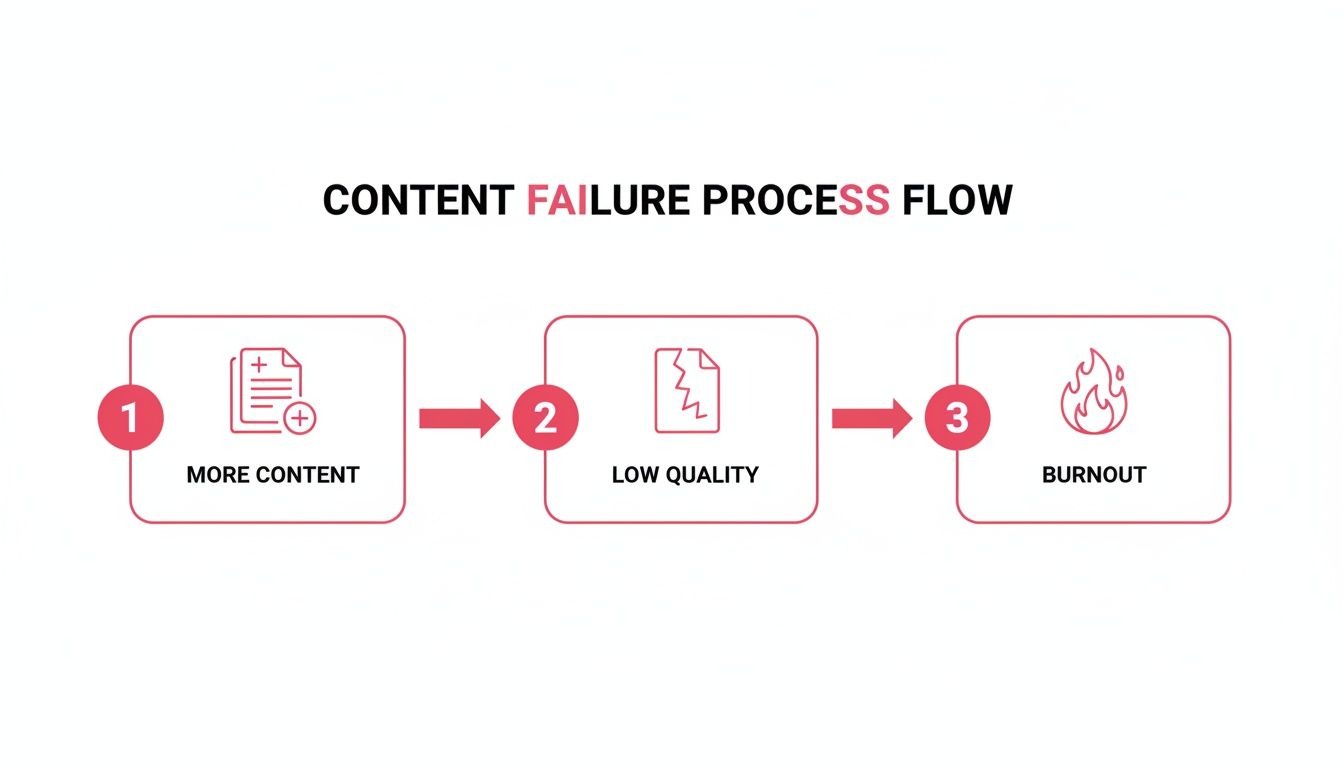
The podcast-as-an-engine model is the antidote to this. It forces a focus on deriving maximum value from one quality source instead of producing tons of disconnected assets.
Turning Conversations into a Content Ecosystem
When you build your strategy around this pillar, every piece of content you produce is interconnected and reinforces the others. This creates a powerful flywheel effect. A video clip on LinkedIn drives traffic to the full YouTube episode. The YouTube episode links to a detailed blog post summarizing the key takeaways. That blog post then encourages readers to subscribe to your newsletter for even more insights.
This method isn't just more efficient; it's flat-out more effective. Our founder, Tom Hunt, has always said that a B2B podcast is the fastest way to build a brand's voice and establish its authority in a crowded market. You’re consistently putting out expert-driven content that is genuinely helpful, which is the cornerstone of great marketing. For a deeper look, explore our guide on how podcast content marketing can become your most powerful asset.
The goal is to stop thinking in terms of one-off "content pieces" and start thinking in terms of a "content ecosystem." Your podcast is the sun, and all the other assets are the planets orbiting it, each drawing energy from the core.
As the largest producer of B2B podcasts in the world, we've seen this model work for over 100 shows at the same time. It allows us to rapidly test and refine strategies, making sure every single interview generates maximum marketing impact. This system turns content creation from a constant struggle into a predictable, scalable process that consistently delivers. You finally get off the hamster wheel and onto a clear path for growth.
Structuring Your Team for Scalable Production
A powerful content engine doesn't run on autopilot. If you want to consistently turn your B2B podcast into a marketing machine that works across every channel, you need a team. And not just any team, you need one with crystal-clear roles and responsibilities that all connect.
But here’s the thing: scaling production isn't about hiring a ton of people. It's about getting the right people focused on the right tasks.
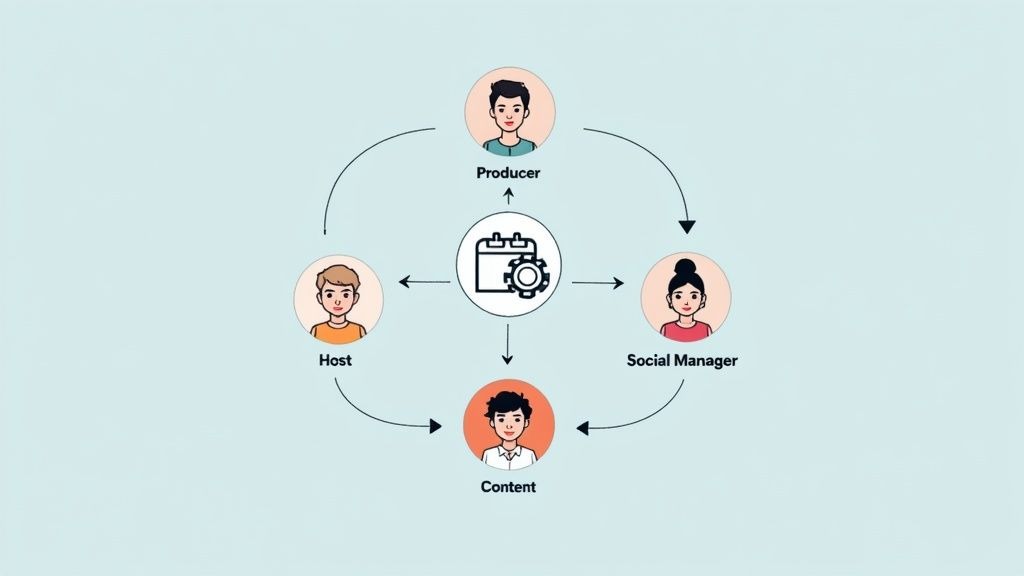
This kind of system ensures every single podcast episode gets squeezed for all its worth. You're transforming one conversation into a sustained campaign that builds real authority and drives demand. The whole structure is designed for flow, not friction.
The Core Roles in a Podcast-Powered Team
Forget the traditional, siloed marketing titles. A scalable content engine operates more like a production studio, where each role feeds directly into the next. Even a small, lean team can pull this off if everyone knows exactly what they own.
Here are the essential functions you need covered:
- The Producer/Showrunner: This is your podcast's project manager. They own everything from guest outreach and scheduling to pre-interview prep, making sure the entire process is seamless from start to finish.
- The Host: The voice and face of the show. The Host's job is to steer insightful conversations and pull out those golden nuggets of content that can be repurposed later. They're the subject matter expert guiding the discussion.
- The Content Repurposer: This role is the beating heart of your content engine. They take the raw recording and transcript and strategically slice them up into articles, social media clips, quote graphics, and newsletter snippets.
- The Social Media Manager/Distributor: This person is responsible for getting all those repurposed assets in front of your target audience. They manage the publishing calendar for channels like LinkedIn and YouTube, engage with the community, and amplify every piece of content.
A huge mistake I see teams make is keeping these responsibilities vague. For this system to click, each person must own their part of the process, from the producer handing off the recording to the repurposer, who then delivers finished assets to the distributor.
In-House vs. Agency When Scaling Content
One of the biggest decisions you'll make is whether to build this team internally or partner with a specialized agency. Going in-house gives you total control, but it's a massive investment of time and resources to hire, train, and manage the right people. The learning curve can be steep, and frankly, expensive.
Brands that nail their distribution strategies succeed 3x more often, a massive advantage as global digital ad spend rockets toward $740.3 billion. To make your team more efficient, it's worth digging into ideas like unlocking automation and scale in marketing with Agent SEO to see how you can automate parts of the grind.
Partnering with a B2B podcast agency like Fame puts the entire process on the fast track. An agency brings a pre-built team of experts who already have refined workflows for production, repurposing, and promotion. At Fame, we're the largest producer of B2B podcasts, managing over 100 shows. That kind of scale lets us iterate on what works at a speed you just can't match in-house, getting you better results, faster.
We essentially become your accountability partner. We set a goal of 10% month-on-month download growth. If we don’t hit an average of 10% monthly growth over the first six months, the seventh month is on us. This model removes the operational headache and risk, freeing you up to focus on strategy while we execute a proven system for scaling your content.
For a deeper dive into how you can set up your team, check out our guide on building an effective content marketing team structure.
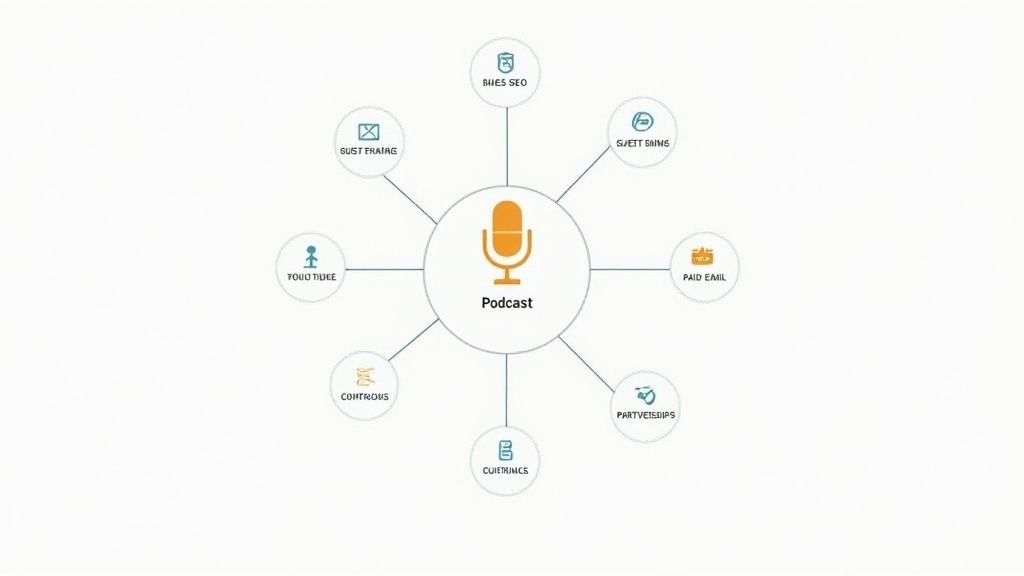
Mastering Content Distribution with the 8 Pillar Framework
Recording a killer podcast episode is a huge win, but honestly, it's just the starting line. The real secret to scaling isn't just creating great content; it's getting that content in front of the right eyeballs and into the right ears. A brilliant episode nobody hears is a tree falling in an empty forest. To avoid that, you need a bulletproof, repeatable distribution plan.
This is where a systematic framework is non-negotiable. Forget random acts of sharing and praying for traction. A structured approach ensures every single asset you spin out from your podcast gets maximum exposure. It turns one recording session into a full-blown, multi-channel campaign that actually drives results.
Pillar 1: Video, Audio, and Written SEO
Search engine optimization is your long game. It's the engine that makes sure your content keeps getting discovered months or even years after you hit publish. This all starts with getting inside your audience's head and figuring out what they're typing into Google.
Actionable Steps:
- Find Keywords: Use a keyword tool to identify relevant search terms for your episode's topic.
- Optimize Podcast Platforms: Incorporate your primary keyword into the episode title and description on platforms like Apple Podcasts and Spotify.
- Create an SEO-Driven Blog Post: Turn the episode transcript into a comprehensive article targeting a cluster of related keywords to capture long-term organic traffic.
When you hit SEO from all three angles, audio, video, and written, you create this powerful, compounding effect that just keeps building over time.
Pillar 2: Organic Social
Your social channels are where you build your tribe and spark immediate conversation. This is about more than just posting a link; it's about creating native content that stops the scroll.
Actionable Steps:
- Publish the Full Episode on YouTube: Optimize the title and description with keywords, and add timestamped chapters so viewers can navigate easily.
- Create Micro-Content: Select the most valuable 1-2 minute sections of the podcast and turn them into video snippets for YouTube Shorts and social posts for channels like LinkedIn.
- Build a Community: Create a dedicated LinkedIn page for the podcast to foster a focused community around your show's topics and guests.
Pillar 3: Guest Sharing
Your podcast guest is your number one distribution partner. They have a built-in audience that already trusts them. Your job is to make sharing an absolute no-brainer for them.
Actionable Steps:
- Create a Guest Promo Kit: Before the episode goes live, send your guest a package with ready-to-share assets.
- Include Multiple Formats: Provide video clips, quote graphics with their most powerful lines, and pre-written social media copy that they can easily adapt.
- Make It Frictionless: Give them one clean link to the full episode and blog post, removing any work on their end.
By removing all the friction, you make it incredibly easy for them to blast the content across their networks, giving you a massive reach boost with a perfectly aligned audience.
Pillar 4: Partnerships and Communities
To really scale, you have to tap into existing audiences. This means finding other creators and communities in your niche who serve a similar crowd but aren't direct competitors.
Actionable Steps:
- Identify Potential Partners: Connect with other podcast hosts, influencers, and blog authors in your space.
- Arrange Guest Appearances: Pitch your host to be a guest on other relevant shows to reach new, engaged audiences.
- Engage with Writers: Secure listings for your podcast by engaging with writers who cover top podcasts in your field.
Remember, this isn't about one-off shoutouts. The goal is to build long-term, mutually beneficial relationships that create a network effect, amplifying everyone's reach.
Pillar 5: Paid Platforms
Organic is great for building a foundation, but paid promotion is how you pour gasoline on the fire. Set aside a budget for targeted ads on platforms where your ideal listeners spend their time.
Actionable Steps:
- Allocate a Test Budget: Start with a small, dedicated budget for platforms like LinkedIn, YouTube, or even Reddit.
- Use Precise Targeting: Target users based on job titles, industries, and interests to ensure your content reaches your ideal audience.
- Partner with Niche Influencers: Leverage their credibility and reach by sponsoring posts that promote your podcast to their dedicated followers.
Pillar 6: Paid Podcasts
If you have the budget, advertising on other podcasts in your niche is one of the most direct routes to new listeners. You're reaching a high-intent audience that is already in the habit of consuming audio content.
Actionable Steps:
- Identify Relevant Shows: Find podcasts whose audience overlaps with yours.
- Inquire About Sponsorships: Reach out to hosts or networks to get their media kit and sponsorship rates.
- Track Performance: Use a unique URL or promo code to measure how many listeners you gain from each ad placement.
Pillar 7: Cold Email
Don't sleep on the power of a well-crafted email. A direct message to a curated list can be incredibly effective for promoting new episodes.
Actionable Steps:
- Build a Targeted List: Gather emails from your website visitors or use platforms like Apollo.io to find contacts that match your ideal listener profile.
- Segment Your List: Group contacts based on interests or engagement levels to send more relevant content.
- Write Compelling Copy: Craft emails with enticing subject lines that highlight the unique value of a specific episode and include a clear call-to-action to listen or subscribe.
Pillar 8: Existing Company Assets
Your company's existing digital footprint is a promotional goldmine. Weave your new podcast content into the assets you already have to create a seamless journey for your audience.
Actionable Steps:
- Update High-Traffic Blogs: Find your most popular articles and embed the podcast player for related episodes directly within the content.
- Create Cross-Links: Add links from older blog posts to newer, relevant podcast episodes to guide readers to your show.
- Integrate Everywhere: Add your podcast to your website's main navigation, include it in your email signatures, and feature it on your social media profiles.
Explore these tactics and more in our complete guide to content distribution strategies.
The 8 Pillar Content Distribution Framework
This table breaks down the core strategies we use to make sure our podcast content and all its derivatives get seen and heard by the right people, driving maximum impact.
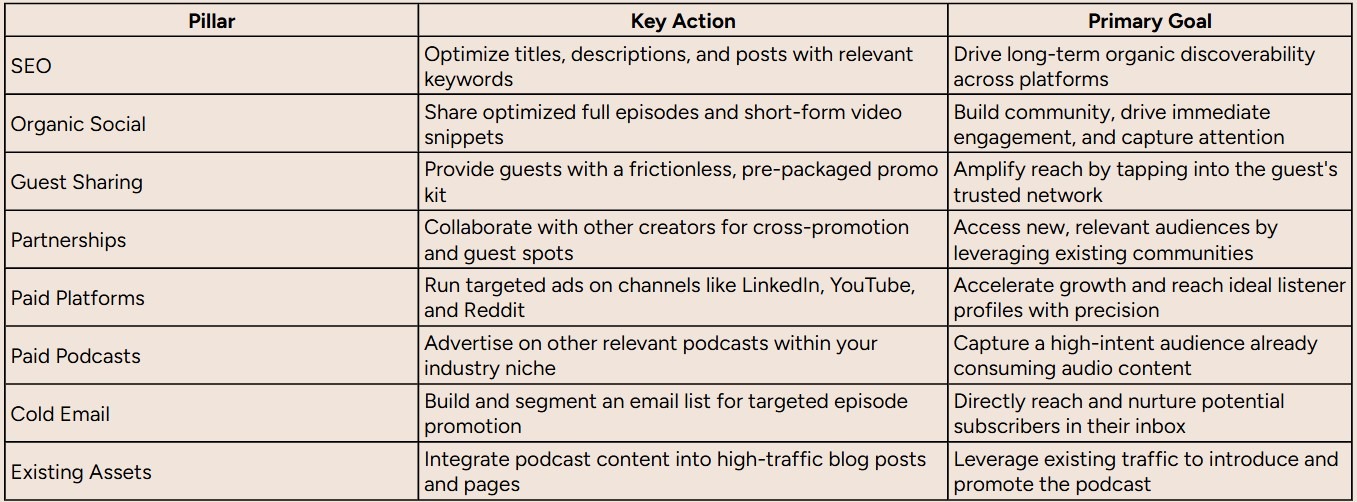
By consistently executing across these eight pillars, you move from just creating content to building a true content engine that drives scalable, predictable growth for your business.
Measuring the ROI of Your Content Engine
Let's be honest. Scaling your content marketing without a clear way to measure its impact is just a more expensive way of making noise. Once your podcast-powered engine is humming along, you have to move beyond vanity metrics like social media likes and start tracking what actually proves your investment is paying off.
This isn't just about justifying your budget; it's about creating a data-driven feedback loop. One that lets you double down on what works and kill what doesn't.
When you're running a podcast-centric strategy, you get a unique set of metrics that tell the full story. It’s never about one magic number. It’s about connecting the dots between your podcast, your video clips, your articles, and your social posts to see how they all work together to hit your business goals.
Beyond Vanity Metrics: The KPIs That Matter
To get a real handle on performance, you need a mix of leading and lagging indicators. Leading indicators, like download growth, show you early momentum. Lagging indicators, like attributed revenue, prove the long-term business impact. It’s a classic one-two punch.
Here are the KPIs we obsess over when scaling content:
- Monthly Download Growth: This is the pulse of your podcast. A steady climb shows your content is resonating and your promotion is hitting the mark. It's the most direct measure of audience growth you have.
- Audience Engagement Rate: Don't just look at downloads; look at listen-through rates on platforms like Spotify. This tells you if your content is actually holding people's attention or if they're bailing after the first five minutes.
- Engagement on Repurposed Assets: How are those video clips and social posts performing? Track the views, comments, and shares. High engagement here is direct proof that your repurposing strategy is working.
- Website Traffic from Content: Fire up your analytics. How many people are your podcast show notes and related blog posts sending to your website? This is the bridge connecting your content engine to your main digital asset.
- Lead Generation and Attribution: This is where the rubber meets the road. You need to know how many leads are coming from your podcast assets, whether that's from a CTA in the show notes or a form on a related article.
The real goal is to build a narrative with your data. For example: "Our podcast downloads grew 15% this month, driven by a series of LinkedIn video clips that got 25,000 views. Those clips sent 500 new visitors to our website, resulting in 12 demo requests."
Setting Accountable Growth Goals
Tracking metrics is one thing. Being held accountable to them is another.
At Fame, we set clear, ambitious, and measurable goals for our clients. We’re so confident in our process that we actually guarantee performance.
We commit to a goal of 10% month-on-month download growth for every single B2B podcast we produce. This isn't some hopeful target we pluck out of the air; it's our benchmark for success. Every month, we report on whether we hit it. If we miss, we break down exactly what we learned and what we’re changing to crush the target this month.
That level of accountability is non-negotiable if you're serious about scaling. It's why 98% of our clients see 10%+ download growth every month in their first six months. The average client hits 18,957 downloads in the first six months and 68,524 downloads in the first year.
We even back it up with our wallet: if we don’t hit an average of 10% monthly growth over the first six months, the seventh month of our service is on us. To dig deeper into this, check out our complete guide on measuring content marketing ROI.
Building Your Data-Driven Feedback Loop
Ultimately, measurement is about informing your strategy. By tracking these KPIs consistently, you create a powerful feedback loop that fuels constant improvement and helps you scale smarter, not just bigger.
When a particular episode drives a spike in downloads and leads, you need to tear it apart. Was it the guest? The topic? The promotional angle? Use those insights to shape your future content calendar. If certain video clips get way more engagement, your audience is literally telling you what they want more of.
This data-first approach transforms your content strategy from a series of creative guesses into a repeatable, scalable process for generating real business results.
Frequently Asked Questions
Alright, let's tackle some of the common questions that pop up when B2B marketers start thinking seriously about building a content engine around a podcast.
How Much Does It Cost to Scale Content with a Podcast?
This is always the first question, and the answer is... it depends. But thinking purely in DIY terms can be a trap.
Sure, you can get a decent mic and some editing software for not a lot of money. But that's not the real cost. The real cost is your team's time, time they're spending on tasks they aren't experts in, like audio engineering, video editing, and promotion. That time adds up fast, and it's often unsustainable.
To do this right and actually scale, partnering with a specialist is almost always the more efficient path. While some brands try to get by on less than $1,000 a month, effective scaling means a real investment in top-tier production, strategic repurposing, and a distribution plan that actually gets you heard. A partner handles that whole workflow, giving you predictable costs and a straight line to ROI.
How Long Until I See Real Results?
Scaling content is a long game. This isn't about hitting this quarter's lead number with a quick campaign. It's about building a sustainable asset for your brand.
You'll see early signs of life, like your audience growing and downloads climbing consistently, within the first 3-6 months. It's proof that you're on the right track.
At Fame, we see this play out constantly. 98% of our clients hit over 10% download growth every single month in their first six months. The average client sees 18,957 downloads in the first 6 months, and a whopping 68,524 downloads in the first 12 months.
The bigger business impact, like a reliable flow of inbound leads and being seen as the authority in your space, really starts to compound over the first 12-18 months. That's the payoff for consistently showing up, delivering value, and building a library of content that works for you around the clock.
Can This Model Work Without a Podcast?
Absolutely. The core principle of a "content engine" is creating one big, valuable piece of content and slicing it up into smaller assets. You could just as easily build your engine around other formats:
- A massive, data-heavy research report.
- An in-depth webinar series with industry titans.
- A live event or a virtual summit.
The key is picking a cornerstone asset you can systematically break down for different channels.
That said, the B2B podcast is just uniquely built for this. It's wildly efficient. The conversational format naturally spits out authentic audio, video, and written content from a single recording session. You're capturing raw expertise and personality all at once, giving you a goldmine of material to fuel your entire marketing ecosystem with far less friction than other formats.
Ready to build a content engine that actually drives growth? Fame is the world's largest B2B podcast agency, and we're so confident in our process that if we don’t hit an average of 10% monthly download growth over the first six months, your seventh month is free. Book a call to learn more.
Want us to run this for you?
Fame starts and grows B2B podcasts that generate pipeline. Tell us who you are trying to reach and we will send a costed proposal within 48 hours.
Related content
- Read moreFame Team · July 16, 2026
10 Account Based Marketing Tactics For B2B Growth In 2026
Discover 10 actionable account based marketing tactics for B2B tech. Learn to use podcasts, data, and targeted content to close high-value accounts. - Read moreFame Team · July 16, 2026
The 8 Best Brighton Podcast Agency Picks For 2026
Find the best Brighton podcast agency for your B2B brand. Our 2026 guide reviews top 8 agencies for production, growth & ROI. Expert analysis here - Read moreJune 10, 2026
20 Best Podcast Production Agencies For 2026 (And Why Should You Hire One)
Global podcast and vodcast ad revenues are on track to hit $5 billion in 2026 , up 20% year-on-year. - Read moreApril 13, 2026
Leadership In Marketing: The B2B Podcast Playbook
Most companies still confuse leadership in marketing with job titles, org charts, and budget control. That's outdated.