March 4, 202623 min read12 sections
10 Actionable Sales Enablement Best Practices For B2B Growth In 2026
By Fame Team
Key Takeaways
- Sales enablement is a strategic function that equips sales teams with content and training to build relationships.
- Using a B2B podcast can be an effective sales enablement tool to build trust and rapport with key decision-makers.
- Inviting ideal clients as podcast guests can create a non-salesy context to understand their challenges and establish a strong relationship.
Sales enablement is no longer just about providing slide decks and battle cards. It’s a strategic function for equipping your sales team with the content, training, and processes they need to build genuine relationships and close complex deals. Modern sales enablement best practices must acknowledge that B2B buyers are more informed and skeptical than ever; they demand authentic expertise, not a rehearsed pitch.
This guide moves past generic advice to deliver ten actionable strategies that empower your sales reps to become trusted advisors. We’ll cover essential frameworks like content mapping and competitive intelligence, but with a specific, modern twist. Our focus centers on an underutilized yet powerful tactic: using a B2B podcast as the ultimate sales enablement engine.
You will learn how to build immediate trust by inviting ideal clients as guests, a strategy that warms up accounts in a non-salesy setting before you ever make an offer. We’ll also detail how to nurture a dedicated audience of ideal customers over time, using your podcast content to drive warm leads directly into your marketing funnel. From initial outreach to tracking ROI by adding "Podcast" to your "How did you find us?" field, you'll discover a complete blueprint for integrating audio into a high-performing B2B sales process. These methods provide your sales team with a steady flow of leads who are already familiar with and receptive to your company's point of view.
1. Leverage a B2B Podcast as a Relationship and Lead Engine
Among the most effective sales enablement best practices is one that flips the traditional outreach model on its head: using a B2B podcast as a relationship-building tool. Instead of cold calls and emails, you invite key decision-makers from your target accounts to be expert guests on your show. This creates a non-salesy, high-value context to build genuine rapport and understand their business challenges directly.
This strategy works in two distinct phases. In the first six months, the primary goal is guest conversion. By providing a platform for your ideal customers to share their expertise, you establish a strong relationship. Later, you can introduce a preferential offer as a thank you for their participation. This approach has proven highly successful; for example, the EHS platform Yellowbird converts 20% of its podcast guests into customers. You can see exactly how they built their guest conversion strategy to turn conversations into contracts.
After six months, as your podcast develops a dedicated following of your ideal buyers, the focus shifts to inbound lead generation. Your audience is already familiar with your brand and perspective, making them warm to your solutions.
Actionable Steps
- Invite Your Ideal Clients as Guests: In the first 6 months, focus your outreach on decision-makers at companies you want to work with. The goal is to build a relationship in a non-salesy setting.
- Follow Up with a Preferential Offer: After the episode, leverage the rapport you've built. Reach out and offer them a unique deal on account of being a valued guest.
- Create a Lead Magnet for Your Audience: From month 6 onwards, create a valuable resource (e.g., a free template, discount code) and offer it in the podcast show notes. This will convert your listener base of ideal buyers into leads.
- Promote the Lead Magnet In-Episode: Mention your lead magnet in the intro or outro of your show to drive sign-ups and move listeners into your marketing funnel.
- Attribute Your Success: Add "Podcast" as an option to the "How did you find us?" question in your sales and marketing forms. This allows you to directly attribute new customers to the podcast and measure its ROI.
2. Implement Sales Collateral Development and Organization Systems
A core pillar of any effective sales enablement strategy is a well-organized system for sales collateral. When sales reps spend less time hunting for the right case study or one-pager, they spend more time selling. This practice involves building a structured, easily accessible library of materials and implementing systems for version control, search, and discoverability, directly boosting team productivity.
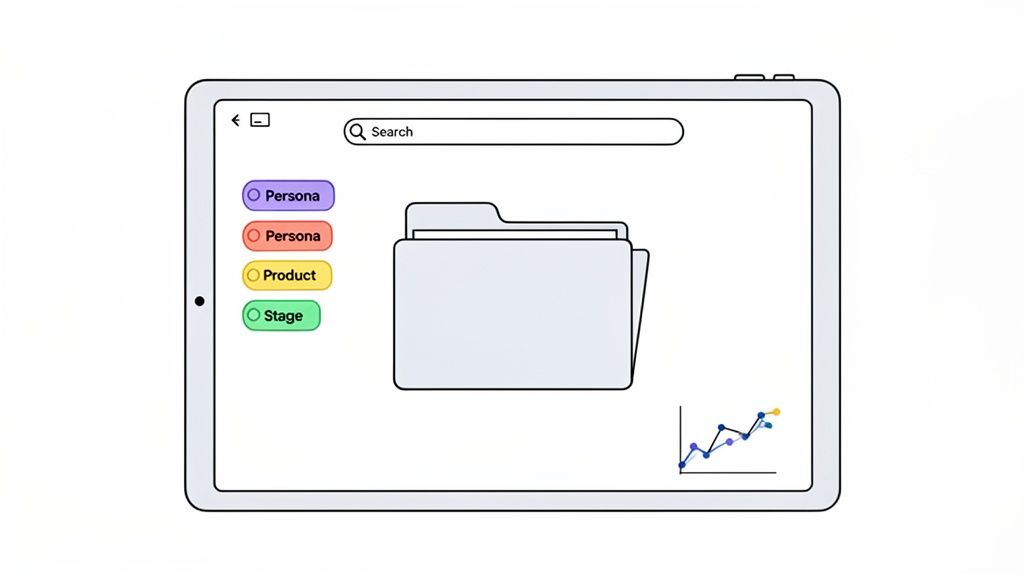
This approach moves teams from chaotic shared drives to a single source of truth. Leading companies demonstrate its power: Salesforce uses Highspot for dynamic collateral management, and Gartner’s advanced resource library supports over 5,000 sales professionals with precise, relevant content. The goal is to surface the most impactful asset for any given sales scenario instantly. This is a crucial element of sales enablement best practices because it equips your sales team with precisely the right tool at the right time, shortening sales cycles and improving win rates.
Organizing your library also helps identify content gaps. For instance, if reps consistently search for a competitor comparison guide that doesn't exist, this creates a clear directive for the marketing team. For a deeper understanding of how to build materials that resonate, you can learn more about creating sales enablement content that actually closes deals.
Actionable Steps
- Audit and Purge: Begin by auditing all existing materials. Eliminate duplicates, consolidate similar assets, and archive outdated content to create a clean foundation.
- Create a Tagging System: Implement a logical tagging structure based on key attributes like product line, buyer persona, industry, funnel stage, and use case. This makes content discoverable.
- Establish Clear Ownership: Assign ownership for each content category. Define a clear process for creation, review, approval, and updates to ensure all materials remain current and on-brand.
- Track Performance Analytics: Use your system to track which materials are used most frequently and which are correlated with closed-won opportunities. Share these insights with both sales and marketing.
- Build a Feedback Loop: Create a formal channel, like a dedicated Slack channel or a form, for the sales team to request new collateral or provide feedback on existing assets.
3. Competitive Intelligence and Battle Card Frameworks
A critical sales enablement best practice is arming your sales team with targeted competitive intelligence through well-structured battle card frameworks. These one-page reference guides equip reps with concise messaging, feature comparisons, objection-handling scripts, and customer proof points, giving them the confidence to win deals against specific competitors. Instead of fumbling for answers, they have a playbook ready for any competitive scenario.
These frameworks are not static documents but dynamic tools that evolve with the market. Companies like HubSpot manage battle cards for over 50 competitors, while Gong’s competitive framework helps its team navigate more than 40 different rival scenarios. The goal is to distill complex information into a digestible format that a sales rep can quickly reference during prospect research or even mid-conversation, ensuring they stay on-message and effectively position your solution as the superior choice.
Integrating this intelligence with other enablement efforts can be particularly powerful. For instance, when producing a podcast, you might invite a guest who recently switched from a key competitor. Their on-air story provides authentic, powerful content that can be repurposed directly into your battle cards as undeniable social proof.
Actionable Steps
- Interview Top Performers: Start by interviewing your best sales reps. Ask them how they naturally handle questions about competitors and document their winning phrases and strategies.
- Keep It Concise: Restrict each battle card to a single page. This makes it easy for reps to use in the field without getting overwhelmed by information.
- Integrate Customer Proof: Include direct quotes and video testimonials from customers who have switched from competitors. A customer’s own words are far more persuasive than internal marketing claims.
- Update Regularly: The competitive landscape changes quickly. Review and update your battle cards quarterly, or immediately following a significant competitor move like a product launch or pricing change.
- CRM Integration: Connect your battle cards directly to your CRM. Configure them to appear contextually when a sales rep is viewing a prospect's record, especially if a competitor is mentioned in their notes.
4. Sales Training and Onboarding Programs with Reinforcement
A core pillar of any successful sales enablement strategy is a robust training and onboarding program designed not just to teach, but to embed skills for the long term. This practice moves beyond one-off training events by combining initial onboarding with continuous reinforcement. It uses microlearning, structured coaching, and practical role-play to accelerate new hire ramp-up and ensure the entire sales team maintains a consistent level of high performance.
This approach is about creating a culture of continuous improvement. Instead of overwhelming reps with marathon sessions, knowledge is delivered in digestible, role-specific learning tracks and reinforced through consistent application. Companies like Salesforce with its Sales Cloud University and LinkedIn with its Sales Navigator training have demonstrated how structured, ongoing education creates highly proficient teams. The goal is to make learning a recurring, integrated part of a rep's workflow, not a separate, infrequent event.
Actionable Steps
- Tailor Onboarding from Day One: Conduct a skills assessment during the hiring process. Use the results to customize the intensity and focus of each new rep's onboarding plan, pairing them with a top performer for structured mentoring during their first 30-60 days.
- Use Spaced Repetition: Implement microlearning modules (5-10 minutes weekly) that use spaced repetition to reinforce key concepts from initial training. This is far more effective than a single, intensive training day.
- Create Role-Specific Learning Tracks: Develop distinct training paths for different sales roles, such as enterprise versus mid-market, or new business versus account management. This ensures the content is always relevant.
- Reinforce with Real Scenarios: Don't just teach theory. Use real customer situations from won and lost deals as case studies for monthly coaching and role-play sessions. This makes the training directly applicable to their daily work.
- Track and Measure: Monitor training completion, assessment scores, and a "Podcast" lead source in your CRM. Correlate this data with performance metrics like time-to-quota, quota attainment, and retention rates to measure the program's business impact.
5. Account-Based Selling (ABS) and Opportunity Management
Another core component of modern sales enablement best practices is the strategic alignment of marketing and sales through Account-Based Selling (ABS). This approach shifts focus from a wide net of individual leads to a coordinated effort targeting a select group of high-value accounts. Instead of treating every prospect the same, you treat each target account as a market of one, delivering highly personalized campaigns and outreach to key stakeholders.
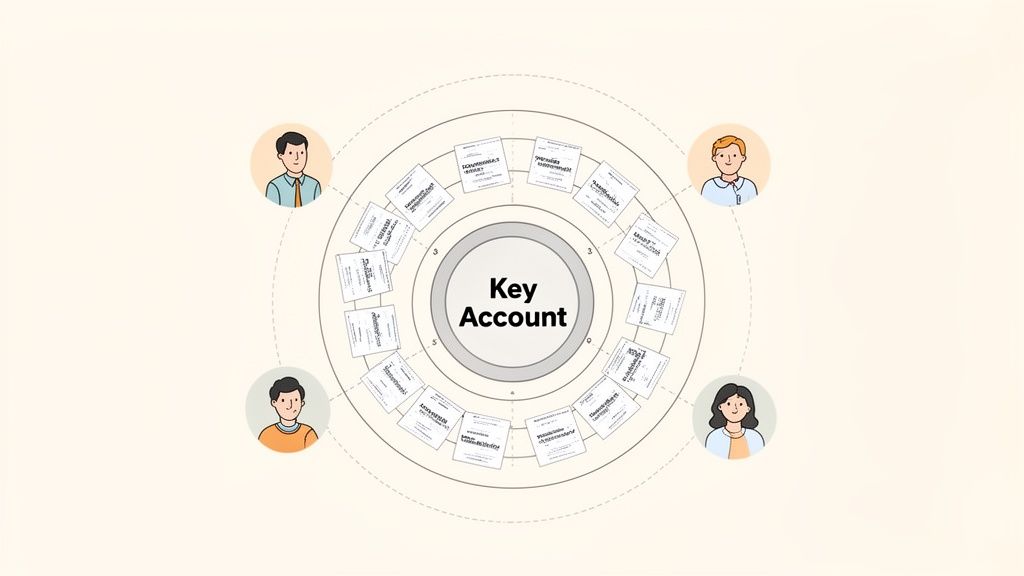
This methodology is about quality over quantity, requiring deep collaboration to identify, engage, and close deals with companies that fit your Ideal Customer Profile (ICP) perfectly. By focusing resources on accounts with the highest revenue potential, teams can improve deal sizes, shorten sales cycles, and increase ROI. Tech companies like Okta and Drift have famously used account-based strategies to drive significant growth. To see how this targeted approach works in practice, you can explore various account-based marketing examples from successful brands.
A B2B podcast is an excellent tool within an ABS framework. You can strategically invite multiple stakeholders from a single target account to be guests on your show over time. This creates multiple, non-salesy touchpoints, allowing you to build relationships across the buying committee and gather invaluable account intelligence directly from the source.
Actionable Steps
- Define Target Accounts: Start small with a list of 20-50 high-value accounts that closely match your ICP. Quality is more important than quantity.
- Map Stakeholders: For each account, create a detailed map of the buying committee. Identify decision-makers, champions, influencers, and potential blockers.
- Develop Account Playbooks: Create specific engagement plans for each account. These playbooks should detail personalized messaging, content recommendations, and outreach cadences tailored to the account's industry and pain points.
- Align Sales and Marketing: Establish bi-weekly joint planning meetings between sales and marketing to coordinate efforts, review account engagement, and adjust tactics.
- Personalize Every Touchpoint: Go beyond using a contact's first name. Reference their company's specific challenges, recent news, or industry trends in your emails, calls, and content.
- Track Account-Level Engagement: Use your CRM and marketing automation platform to monitor engagement across the entire account, not just at the individual contact level. This provides a complete picture of interest and intent.
6. Formalize Sales and Marketing Alignment (Smarketing) Processes
One of the most foundational sales enablement best practices is breaking down the historic silos between sales and marketing. This alignment, often called "Smarketing," involves creating formal processes, shared metrics, and consistent communication cadences. When both teams operate from the same playbook, the result is higher quality leads, shorter sales cycles, and a direct impact on revenue.
This unified approach ensures marketing generates leads that sales actually wants, and sales provides critical feedback to refine marketing's strategy. Companies like HubSpot have shown that a strong smarketing framework can lead to significant revenue growth by ensuring every marketing effort directly supports sales objectives. The core idea is to move from a linear handoff to a continuous, collaborative loop.
A well-aligned go-to-market motion also makes content initiatives, like a B2B podcast, more effective. Marketing can use sales insights to choose episode topics that address real customer pain points, and the sales team benefits from engaging with leads who are already familiar with the company's perspective.
Actionable Steps
- Establish a Service-Level Agreement (SLA): Document clear expectations between teams. The SLA should define what constitutes a marketing-qualified lead (MQL) and a sales-qualified lead (SQL), and set targets for the quantity and quality of leads marketing will deliver.
- Run a Weekly Smarketing Huddle: Schedule a recurring 30-minute meeting with key members from both teams. Use this time to review lead flow, discuss feedback on lead quality, and address any immediate friction points.
- Share a Single Source of Truth: Both sales and marketing must work from the same data within your CRM and analytics platforms. This shared visibility into the entire customer journey is critical for diagnosing problems and celebrating wins.
- Create Collaborative Feedback Loops: Implement a formal process for the sales team to report on lead outcomes. This intelligence helps marketing understand which campaigns are driving revenue, allowing them to double down on what works and fix what doesn't.
7. Build Objection Handling and Win/Loss Analysis Programs
A critical component of any sales enablement best practice is transforming losses and objections into actionable intelligence. By creating structured programs for objection handling and win/loss analysis, you systematically capture the real reasons prospects buy or walk away. This feedback loop is essential for refining everything from sales training and content development to your competitive positioning and even your product roadmap.
This process goes beyond simply asking reps why a deal was lost. It involves formal, often third-party, interviews with buyers to uncover the true decision drivers. For instance, Salesforce famously uses its win/loss program to directly inform product prioritization, ensuring its development aligns with market demand. Similarly, AI tools like Gong and Outreach can automatically analyze call transcripts to identify recurring objections, providing a real-time pulse on market sentiment without manual effort.
These insights allow you to proactively address concerns. If your podcast audience, composed of ideal buyers, hears you openly discuss and solve a common objection they secretly hold, it builds immense trust. By understanding why deals are won and lost, you equip your entire organization with the knowledge to improve performance across the board.
Actionable Steps
- Formalize the Interview Process: Aim to interview buyers from 30-50% of your lost deals each quarter for statistically relevant data. Consider using a neutral third-party firm, as customers are often more candid with them than with your team directly.
- Ask Specific, Probing Questions: Go beyond "Why didn't you buy?". Ask targeted questions like: "What alternative did you ultimately choose and why?", "What was the single biggest factor in your decision?", and "What one thing could have changed the outcome?".
- Use AI for Real-Time Analysis: Employ AI-powered speech analytics tools like Gong or Chorus to automatically tag objections and key topics in sales calls. This provides a scalable way to track objection frequency and resolution rates.
- Create and Distribute Battle Cards: Based on your analysis, develop battle cards that directly address the top 3-5 recurring objections. Share these, along with anonymized win/loss findings, with the entire sales team and leadership to ensure alignment.
- Track "Podcast" as an Insight Source: When analyzing conversations, note if a prospect mentions your podcast. This helps you understand how your content is shaping perceptions and preemptively addressing objections before a sales call even happens.
8. Sales Performance Analytics and Dashboards
Data-driven decision-making is a cornerstone of modern sales enablement best practices. Implementing real-time analytics and dashboards gives sales leaders clear visibility into team performance, pipeline health, and individual rep productivity. This practice moves management from gut-feel to fact-based coaching, enabling precise interventions that drive predictable revenue growth.
By tracking key metrics like activity volume, conversion rates, and pipeline velocity, managers can spot trends and address issues before they impact the bottom line. For instance, tools like Gong analyze sales conversations to identify behaviors that correlate with winning deals, while platforms like Salesforce Einstein Analytics can predict pipeline risks. These insights allow for highly targeted coaching that helps reps improve specific skills. The goal is to create a culture of continuous improvement, where data is used for development, not punishment.
This data-centric approach also connects sales efforts directly to marketing outcomes. By tracking metrics back to their origin, you gain a clearer picture of channel performance. For example, if your podcast listeners are converting at a higher rate, that data validates the channel's effectiveness and justifies further investment. For a deeper dive into this, you can learn more about measuring marketing effectiveness and applying those principles to your sales data.
Actionable Steps
- Start with Core Metrics: Begin by tracking fundamental leading indicators like calls, emails, and meetings, alongside lagging indicators like conversion rates and revenue. Avoid overwhelming your team with too much data initially.
- Define Success: Before deploying dashboards, clearly define what "good" looks like for each metric. Establish benchmarks based on historical performance or industry standards.
- Train Your Managers: Equip sales managers with the skills to interpret dashboard data and use it to facilitate constructive coaching conversations. The focus should be on diagnosing challenges and collaborating on solutions.
- Set Up Alerts: Configure your analytics tool to send automated alerts for critical anomalies, such as deals stalling in a pipeline stage or a rep falling significantly below their activity targets. This enables proactive management.
- Conduct Data-Driven Reviews: Use the dashboards as the centerpiece of your weekly pipeline review meetings. This practice ensures conversations are grounded in objective data, making it easier to surface and solve problems early.
9. Thought Leadership and Expert Positioning Programs
A potent sales enablement best practice involves building programs that position your executives and key employees as industry authorities. This strategy goes beyond traditional marketing by establishing deep credibility and attracting inbound interest organically. By consistently placing your leaders on prominent stages, in respected publications, and on influential podcasts, you create a powerful asset for your sales team: a brand that commands respect and trust before a conversation even begins.
This approach transforms executives from internal leaders into external magnets for high-quality opportunities. When your CEO, like Salesforce's Marc Benioff, becomes a visible force at major events, or your founders, like the leaders at Stripe, establish industry authority, sales conversations start from a position of strength. Prospects are already familiar with your company's perspective and are often pre-sold on your vision, which dramatically shortens the sales cycle and improves conversion rates.
The core idea is to equip your sales team with the ultimate "social proof." When reps can point to a recent keynote by their CEO at a Gartner conference or share an original research report that's making waves, their outreach becomes far more compelling. This program turns executive visibility into a tangible sales tool, enabling teams to open doors that would otherwise remain closed.
Actionable Steps
- Identify and Frame Experts: Select two to three key executives (typically the CEO and one or two functional leaders) to be the face of your program. Develop an executive positioning framework for each, defining their core messages, areas of expertise, and key topics they will own.
- Target High-Impact Platforms: Focus on quality over quantity. Target top-tier speaking opportunities, pitch your executives to major podcasts your audience listens to, and aim to publish original articles in publications your target buyers read.
- Create Cornerstone Content: Develop one to two original research reports annually to establish your company as a source of definitive industry data. This content becomes a foundational asset for speaking engagements, articles, and media pitches. If you're looking for guidance, you can learn how to become a thought leader with a structured approach.
- Arm the Sales Team: Brief your sales reps on executive availability for key customer meetings. Keep them updated on the 6-12 month content pipeline of speaking events, published articles, and podcast appearances so they can use these activities in their outreach and conversations.
- Measure the Impact: Track metrics that directly reflect the program's success, such as the number of speaking invitations, media mentions, and inbound inquiries that can be attributed to your executives' heightened visibility.
10. Sales Tool Stack Integration and Workflow Automation
A disjointed sales tool stack is a major drain on productivity, forcing reps to spend more time on manual data entry and context-switching than on selling. A core sales enablement best practice is to build an integrated ecosystem where tools communicate seamlessly. This involves connecting your CRM, email, calling, scheduling, and proposal software to automate repetitive tasks and create a single source of truth for customer data.
The goal is to eliminate friction. When a rep can send an email, log a call, schedule a meeting, and generate a proposal without ever leaving their primary workspace, they reclaim hours for revenue-generating activities. For instance, platforms like HubSpot and Salesforce offer vast marketplaces with pre-built integrations, while tools like Gong automatically sync call recordings and analysis to CRM records. This unification turns a collection of separate tools into a powerful, automated workflow engine.
This approach is critical for scaling sales operations. It ensures data integrity, improves the accuracy of forecasting, and gives leadership a clear, real-time view of team performance. By automating the low-value tasks that bog reps down, you enable them to focus on what matters: building relationships and closing deals.
Actionable Steps
- Audit and Consolidate: Before buying new software, audit your existing tool stack. Identify and eliminate redundant tools to reduce costs and complexity.
- Map Your Data Flow: Create a master integration map that shows how data moves between tools. Establish a "source of truth" for each data type (e.g., contact information lives in the CRM) to prevent conflicts.
- Connect Your Tools: For tools without native integrations, use middleware platforms like Zapier or Make to build automated workflows between them.
- Train for Automation: Don't just teach reps how to use a tool. Train them on the specific automation opportunities that will save them time, such as one-click meeting scheduling or automated follow-up sequences.
- Centralize Communication: Use a platform like Slack or Microsoft Teams as a central hub. Integrate your sales tools to send real-time notifications for new leads, signed deals, or important customer activities, keeping everyone informed without switching apps.
10-Point Sales Enablement Best Practices Comparison
| Item | Implementation Complexity 🔄 | Resource Requirements ⚡ | Expected Outcomes ⭐📊 | Ideal Use Cases 💡 | Key Advantages ⭐ |
|---|---|---|---|---|---|
| Content Mapping to Buyer Journey Stages | Medium–High, buyer journey mapping, content tagging, and lifecycle planning | Medium–High, content creation, CRM tagging, and ongoing optimization | High, more relevant messaging, shorter sales cycles, and higher win rates | B2B companies with structured buying journeys and marketing-sales handoffs | Delivers the right content at every stage, improves personalization, and streamlines handoffs |
| Sales Collateral Development & Organization Systems | High, asset governance, approval workflows, and DAM implementation | High, asset management platform, content curation, and team training | High, faster asset discovery, stronger brand consistency, and improved conversions | Scaling sales teams needing centralized sales enablement resources | Centralized content library, version control, searchability, and usage analytics |
| Competitive Intelligence & Battle Card Frameworks | Medium, competitor research and cross-functional collaboration | Medium, ongoing intelligence gathering and regular updates | Medium–High, higher competitive win rates and faster objection handling | Organizations competing in crowded markets with frequent head-to-head deals | Consistent competitive messaging, quick rebuttals, and product insights |
| Sales Training & Onboarding Programs | High, curriculum development, onboarding, and reinforcement planning | High, trainers, coaching platforms, and dedicated enablement resources | High, faster ramp time, higher productivity, and improved sales consistency | Growing sales organizations hiring new representatives at scale | Accelerates onboarding, reinforces skills, and improves long-term performance |
| Account-Based Selling (ABS) & Opportunity Management | High, personalized account orchestration and cross-functional coordination | High, account research, tailored content, and sales-marketing collaboration | Very High, larger deal sizes, higher win rates, and stronger account penetration | Enterprise sales targeting strategic accounts with multiple stakeholders | Focuses resources on high-value opportunities and improves sales efficiency |
| Sales & Marketing Alignment (Smarketing) | Medium, shared processes, SLAs, and cross-team collaboration | Medium, recurring meetings, shared dashboards, and executive alignment | High, higher-quality leads, faster sales velocity, and reduced friction | Organizations with disconnected marketing and sales teams | Shared accountability, aligned messaging, and improved pipeline efficiency |
| Objection Handling & Win/Loss Analysis Programs | Medium, structured interviews, CRM tagging, and recurring analysis | Medium, customer interviews, analytics, and enablement resources | Medium–High, stronger objection handling, improved win rates, and actionable insights | Sales teams seeking customer feedback and competitive intelligence | Identifies real buying objections and creates continuous product and sales improvements |
| Sales Performance Analytics & Dashboards | Medium–High, BI integration, reporting, and dashboard development | Medium–High, analytics platforms, data engineering, and manager adoption | High, improved forecasting, coaching effectiveness, and pipeline visibility | Scaling organizations requiring data-driven sales management | Early issue detection, accurate forecasting, and measurable performance improvements |
| Thought Leadership & Expert Positioning Programs | Medium, executive positioning and long-term editorial planning | Medium, executive participation, PR support, and content production | Medium, long-term brand authority, inbound pipeline, and premium positioning | Companies building executive visibility, fundraising, or category leadership | Strengthens credibility, attracts high-quality opportunities, and differentiates the brand |
| Sales Tool Stack Integration & Workflow Automation | High, CRM, marketing automation, and sales tool integrations | High, IT support, middleware, implementation, and change management | High, reduced admin work, cleaner data, and faster sales execution | Organizations managing multiple sales tools and manual workflows | Automates repetitive work, improves data accuracy, and enables scalable operations |
Turn Your Enablement Strategy into a Revenue-Generating Machine
We’ve explored a detailed roadmap of ten critical sales enablement best practices. These aren't just isolated tactics; they represent an interconnected system designed to build a high-performing revenue organization. From meticulous content mapping and organized collateral systems to robust competitive intelligence and continuous sales training, each practice contributes to a larger goal: making it easier for your sales team to have valuable conversations and close deals.
The common thread weaving through these strategies is a fundamental shift in approach. Instead of merely pushing products, modern enablement focuses on pulling prospects toward you with genuine value and expertise. You move from a company that sells to a resource that solves. This is where the power of a targeted B2B podcast becomes undeniable, acting as the content engine that fuels your entire enablement program.
The Podcast as a Catalyst for Growth
Think of your podcast as the central hub for your thought leadership and expert positioning. The authentic conversations with industry leaders and ideal clients don't just create audio content; they generate the raw material for everything else.
- Content Creation: A single podcast episode can be repurposed into blog posts (supporting your content mapping), social media snippets (fueling smarketing alignment), and key quotes for sales battle cards.
- Relationship Building: In the early stages, your podcast guest list is your prospecting list. Inviting ideal clients to be guests, as seen in the Yellowbird case study where they achieved a 20% conversion rate, is a powerful way to build rapport in a non-sales setting. This directly supports your account-based selling efforts.
- Lead Generation: As your show builds an audience of ideal buyers, it becomes a direct channel for lead generation. Offering a valuable lead magnet in your show notes and mentioning it in your intro or outro creates a warm inbound pipeline. When these leads enter your funnel, they are already familiar with your company's point of view and expertise, making the sales team's job significantly easier.
Making It All Work Together
The true measure of a successful enablement program is its integration. The objection handling insights you gain from win/loss analysis should inform the topics of your podcast and the focus of your sales training. The data from your performance analytics dashboards should show you which pieces of collateral are most effective, guiding future content creation. And crucially, adding "Podcast" as a source in your CRM helps you attribute revenue and prove the ROI of your content efforts.
Implementing these sales enablement best practices is not a one-time setup. It's a continuous cycle of creation, measurement, and refinement. By committing to this system, with a strategic podcast at its core, you are not just supporting your sales reps. You are building a sustainable, scalable revenue engine that turns your organization's expertise into your most powerful competitive advantage. You create a program that doesn't just enable sales; it attracts, educates, and converts your best customers.
Ready to build a sales enablement engine powered by authentic conversations? Fame helps B2B companies launch and grow podcasts that attract ideal customers and build brand authority. Let us handle the production, so you can focus on building relationships that drive revenue.
Want us to run this for you?
Fame starts and grows B2B podcasts that generate pipeline. Tell us who you are trying to reach and we will send a costed proposal within 48 hours.
Related content
- Read moreFame Team · July 16, 2026
10 Account Based Marketing Tactics For B2B Growth In 2026
Discover 10 actionable account based marketing tactics for B2B tech. Learn to use podcasts, data, and targeted content to close high-value accounts. - Read moreFame Team · July 16, 2026
The 8 Best Brighton Podcast Agency Picks For 2026
Find the best Brighton podcast agency for your B2B brand. Our 2026 guide reviews top 8 agencies for production, growth & ROI. Expert analysis here - Read moreJune 10, 2026
20 Best Podcast Production Agencies For 2026 (And Why Should You Hire One)
Global podcast and vodcast ad revenues are on track to hit $5 billion in 2026 , up 20% year-on-year. - Read moreApril 13, 2026
Leadership In Marketing: The B2B Podcast Playbook
Most companies still confuse leadership in marketing with job titles, org charts, and budget control. That's outdated.