February 27, 202620 min read6 sections
What Is Sales Enablement Content That Actually Closes Deals
By Fame Team
Key Takeaways
- Sales enablement content provides reps with resources to close deals faster.
- It includes case studies, battlecards, and demos that build trust and show value.
- Effective sales enablement content shortens sales cycles and increases win rates.
Imagine your top chef walking into a kitchen. They don’t start by dicing onions or peeling potatoes; that's all been done. Their station is perfectly prepped, letting them focus on creating the masterpiece. Sales enablement content is that prepped station for your sales team, giving them exactly what they need to close deals faster and better.
What Exactly Is Sales Enablement Content?
At its heart, sales enablement content is the arsenal of high-impact resources your reps use to have better, more valuable conversations with buyers. We’re talking about the case studies, battlecards, ROI calculators, and tailored demos that move a deal forward.
Think of it as the strategic bridge connecting marketing’s big-picture insights to the real-world, in-the-trenches problems your sales team faces every single day.
This isn’t about just cranking out more stuff for the sake of it. It’s about creating the right stuff. While your general marketing content is designed to attract a wide audience, sales enablement content is purpose-built for a salesperson to use at a specific moment in the sales cycle. Its only job is to build trust, crush objections, and show undeniable proof of value.
To get a clearer picture, here's a quick breakdown of what this type of content does, who uses it, and the impact it has.
Sales Enablement Content at a Glance
| Core Function | Primary Users | Business Impact | Common Formats |
|---|---|---|---|
| Arm reps for sales conversations | Sales Reps, Account Executives, Sales Development Representatives (SDRs) | Shorter sales cycles, higher win rates, and increased deal sizes | Case studies, competitor battlecards, ROI calculators, email templates |
| Provide proof and build trust | Sales Engineers, Customer Success Managers (CSMs) | Reduced buyer friction and increased customer confidence | Testimonials, technical one-pagers, product demos, security documentation |
| Handle objections with data | Sales and Marketing Leadership | Improved sales and marketing alignment with better forecasting | Objection handling guides, industry reports, data sheets |
| Educate buyers on solutions | All customer-facing roles | More qualified leads and stronger buyer-seller relationships | White papers, webinar recordings, targeted presentations |
This table shows how each piece of content is a tool with a specific job, designed to make your sales process smoother and more effective from start to finish.
From Pitch to Partnership
The real goal here is to shift conversations from a generic pitch to a genuine consultation. When a rep can pull up the perfect case study that mirrors a prospect's exact problem, the dynamic changes instantly. They're no longer just selling; they're solving. That’s how you build a foundation of trust that leads to long-term partnerships.
With the right enablement content, your sales team can:
- Answer tough questions with data-backed one-pagers and technical guides.
- Demonstrate clear ROI using interactive calculators and financial models.
- Outmaneuver competitors with detailed battlecards and comparison sheets.
- Validate your solution’s success through compelling customer stories and video testimonials.
This targeted approach means your team always has the right tool for the job, no matter where they are in the deal.
Sales enablement isn't just a strategy; it's a fundamental shift in how sales and marketing work together to drive revenue. By arming sales teams with intelligent, timely, and relevant content, companies can dramatically shorten sales cycles and improve win rates.
Why Enablement Is a Bigger Deal Than Ever
Equipping sales teams isn’t a niche strategy anymore; it's becoming standard practice for any company serious about growth. The market is catching on fast: a well-supported sales team is a high-performing one.
In fact, projections show that over 90% of global businesses will have dedicated sales enablement teams or programs by 2026. That’s a seismic shift, proving just how critical this content is for closing deals smoothly. This trend highlights a move away from static PDFs and toward dynamic intelligence that reps can use in real-time. If you want to dig deeper, you can get more details on sales enablement statistics.
This all proves one thing: investing in a solid library of sales enablement content isn't a cost-it's a direct investment in your company's revenue engine. It makes your sales process more efficient, your reps more confident, and your customer conversations far more impactful.
Mapping Essential Content to Every Buyer Stage
Trying to close a deal by sending the right content at the wrong time is a bit like showing up to a first date with a closing contract. It’s awkward, premature, and a surefire way to kill the mood-and the deal. To give your sales team a real advantage, you have to arm them with assets that perfectly match where a prospect is in their decision-making process.
It all starts with a deep understanding of what is customer journey mapping. This isn’t just a marketing exercise; it’s the blueprint for ensuring your reps are always having the right conversation, building trust and momentum instead of creating friction.
Let's break down the typical B2B buyer's journey into its three core phases-Awareness, Consideration, and Decision-and pinpoint the exact content needed for each one.
The hierarchy below shows how sales enablement content really works-it’s the foundation that empowers your team to drive real business impact.
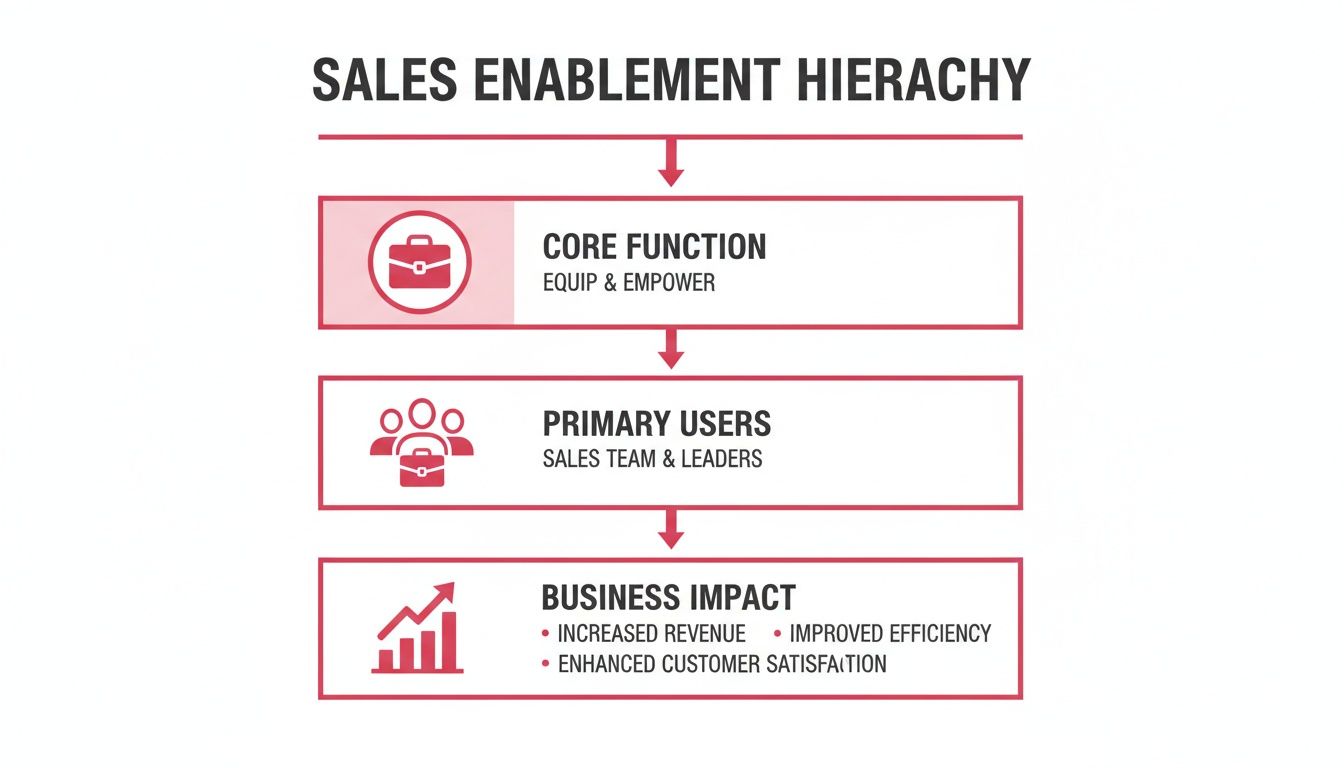
This visual is a great reminder that every single piece of content, no matter the stage, has one job: help your sales team win.
To bring this to life, here’s a quick breakdown of how specific content types align with each stage of the buyer's journey.
| Buyer Journey Stage | Content Purpose | Content Examples |
|---|---|---|
| Awareness | Educate prospects about their problem while positioning your brand as a trusted authority. | Blog posts, research reports, podcast episodes |
| Consideration | Demonstrate why your solution is the best fit for the prospect's identified challenge. | Case studies, product comparison guides, ROI calculators |
| Decision | Remove final objections, build confidence, and make the buying decision easy. | Competitor battlecards, proposal templates, security documentation |
This mapping isn't just theory; it's a practical framework for turning scattered content into a strategic sales weapon. Now, let’s dig into what this looks like in practice.
Awareness Stage Content That Educates and Establishes Authority
In the Awareness stage, your prospects are just starting to realize they have a problem or an opportunity. They aren't looking for a sales pitch; they're hungry for education and context. The goal here is to establish your brand as a helpful guide and a trusted authority in their world.
Your sales team needs assets that answer the big "what" and "why" questions. Think of it as giving them a map and compass before they even know their destination.
- Insightful Blog Posts: These articles should tackle high-level industry pain points and trends, helping prospects put a name to the challenges they're facing.
- Original Research Reports: Nothing says "thought leader" like data. These reports provide valuable, shareable insights that kickstart meaningful conversations.
- Industry-Focused Podcast Episodes: Podcasts are brilliant for exploring complex topics in an accessible way. They build a connection and showcase your expertise long before a prospect even thinks about becoming a lead.
This kind of content warms up the market, so when a sales rep eventually reaches out, the prospect is already familiar with your brand and receptive to the conversation. For a deeper look at this, our guide on B2B customer journey mapping is a great resource.
Consideration Stage Content That Builds a Business Case
Once a prospect hits the Consideration stage, they've defined their problem and are actively researching solutions. The conversation needs to shift from purely educational to gently persuasive. Your content must now clearly show how your solution solves their specific problem better than anyone else.
The name of the game is providing the proof and data they need to build a business case internally and get their stakeholders on board.
- In-Depth Case Studies: These are your secret weapons. A powerful case study tells a relatable story of a similar company that conquered a similar challenge using your product.
- Product Comparison Guides: Help your reps navigate a crowded market with fair, transparent guides. These should highlight your unique strengths without coming off as overly aggressive.
- ROI Calculators: Make the financial impact of your solution tangible. An interactive calculator can turn an abstract benefit into a concrete number that gets a CFO’s attention.
These assets empower reps to turn a casual interest into a serious evaluation by providing the hard evidence needed to justify a purchase.
Decision Stage Content That Closes the Deal
In the final Decision stage, the prospect is ready to pull the trigger. They have a shortlist, and your content’s job is to squash any last-minute doubts and make saying "yes" as easy as possible. This is where you roll out the tools that address risk, clarify details, and streamline the whole procurement headache.
These assets are the closing tools that get contracts signed.
- Competitor Battlecards: Arm your reps with concise, powerful talking points on how you stack up against key competitors, with a laser focus on what makes you different.
- Customizable Proposal Templates: Make it dead simple for reps to generate professional, on-brand proposals that clearly lay out the scope, pricing, and terms.
- Security and Compliance Documentation: For many B2B deals, this is a non-negotiable. Having clear, comprehensive security docs ready to go removes a major potential roadblock before it even comes up.
By aligning your content to each stage, you transform the sales process from a series of disjointed pitches into a guided journey. Each piece of content serves a specific purpose, systematically moving the buyer closer to a confident decision.
Interestingly, while a wide range of content is valuable, some of the most-used assets are the everyday tools that reps rely on for remote selling. These include email templates (53%), call scripts (39%), product demos (36%), and case studies (32%). But here’s the kicker: a staggering only 30% of marketing-created materials are ever actually used by sales. This highlights just how critical a well-mapped and truly aligned content strategy is.
Building Your Sales Enablement Content Strategy
A powerful content library is built by design, not by accident. Just churning out more assets without a clear plan is a recipe for wasted effort. In fact, research shows a staggering 65% of marketing content is never even used by sales teams. It just sits there, collecting digital dust.
To avoid this all-too-common fate, you need a deliberate strategy-one that’s grounded in the real-world needs of your reps. This isn't about marketing making assumptions; it's about building a system based on what actually helps close deals.
And the process doesn't start with a blank page. It starts with what you already have.
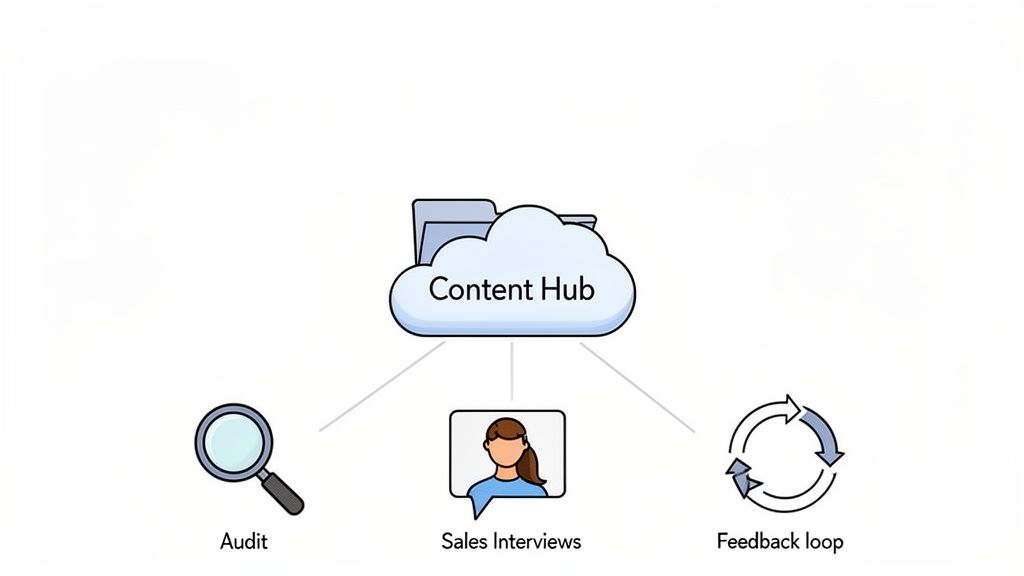
This diagram nails the core components of a living strategy: auditing what exists, listening to your team, centralizing everything, and creating a feedback loop so it gets better over time.
Start with a Ruthless Content Audit
Before you even think about creating something new, you have to take stock of your existing assets. A content audit helps you see what’s working, what's not, and where your biggest gaps are. Don't just make a list; get analytical.
Go through your content and start asking the tough questions:
- Performance: Which case studies are reps actually sharing? Which blog posts get engagement from prospects deep in the sales cycle?
- Relevance: Is that product one-pager from two years ago still accurate? Does that whitepaper even reflect our current positioning?
- Gaps: What are the recurring questions from prospects that we have absolutely no content to answer?
This audit gives you a data-driven foundation. It stops you from reinventing the wheel and makes sure your energy is focused on creating high-impact material.
A common pitfall is assuming you know what the sales team needs. A content audit forces you to replace guesswork with evidence, immediately making your strategy more effective.
Conduct Structured Interviews with Your Sales Team
Your sales reps are on the front lines. Every single day, they hear the objections, questions, and pain points straight from the source. Tapping into this goldmine of knowledge is the single most important step in building a content library they'll actually use.
Set up structured, one-on-one interviews. Get a mix of top performers and some newer folks to get a balanced perspective. Then, ask targeted questions to uncover what they really need.
Key Questions to Ask Your Sales Reps:
- What are the top three objections you hear most often?
- At what stage of the sales process do you feel like you're flying blind without the right resources?
- What's the one question prospects always ask that you wish you had a perfect piece of content for?
- Which of our current assets do you find most helpful, and why?
- If I could wave a magic wand and create any new piece of content for you by tomorrow, what would it be?
The answers you get are your roadmap. They tell you exactly what to build, ensuring every new asset is a direct solution to a real-world sales challenge.
Establish a Centralized Content Hub
Amazing content is completely useless if your reps can't find it when they're on a call. Sales teams often have to hunt through an average of six different places to find what they need, which is a massive productivity killer.
The solution is a single source of truth-a centralized content hub. This could be a well-organized folder in a shared drive, a company wiki, or a dedicated sales enablement platform. The tool itself is less important than the principle: make it dead simple to find the right asset at the right time.
Organize the hub logically. Think in terms of the buyer's journey, product lines, or common use cases. Most importantly, make sure it’s searchable and that every file has a clear, intuitive name.
Create a Continuous Feedback Loop
Your content strategy can't be a "set it and forget it" project. It has to be a living, breathing system that adapts over time. The final, crucial step is to build a simple but effective feedback loop between your marketing and sales teams.
This can be as easy as a dedicated Slack channel where reps can request new content or share what’s working (and what’s not). Regular, brief check-ins between sales and marketing leaders also keep the lines of communication wide open.
This ongoing conversation ensures your content library evolves right alongside your market, your products, and your customers' needs. It's how you make every single piece of content count. Building a system like this is a fundamental part of learning how to create a content strategy that actually delivers results.
Using B2B Podcasts as a Sales Enablement Engine
While staples like case studies and whitepapers have their place, let's talk about a more dynamic tool: the B2B podcast. It’s a powerful form of sales enablement content that builds trust by indirectly telling prospects how you solve their problems. You can run through case studies, showcase your expertise, and prove you're an authority they can rely on.
A good podcast doesn't just create a single piece of content, either. Every episode can be repurposed into blogs, newsletters, social media clips, and quote graphics, giving your sales team a constant flow of fresh material to share.
Phase One: The Guest Strategy (First 6 Months)
For the first half-year, your podcast's most potent sales tool isn't your listener count-it's your guest list. The strategy is to invite your ideal clients to be guests on your show. This move completely flips the standard sales script.
Instead of a cold pitch, you’re offering them a platform in a non-salesy setting. You get to build a genuine relationship, understand their challenges, and learn their goals. Later, once you’ve built that rapport, you can follow up with a unique or preferential deal on account of them being a guest.
This has worked exceptionally well. Just look at how Yellowbird put this into practice and saw a 20% conversion rate from podcast guests to paying customers.
This isn't theory; it's a direct line from inviting ideal clients onto your show to closing significant new business.
Phase Two: The Audience Strategy (6 Months and Beyond)
Once you've been publishing consistently for about six months, you will have built a following. If your topics are niche and aimed squarely at your ideal buyer, that audience will be packed with potential customers.
This is where you shift to an audience-led strategy by offering a valuable lead magnet in your show notes. This could be a free resource, a checklist, or a special discount that gives your listeners a compelling reason to engage. Be sure to shout out this lead magnet during the episode, often in the intro or outro.
Your podcast audience is pre-warmed. They've listened to your content, agree with your point of view, and trust your expertise. A lead magnet is a frictionless way for them to raise their hand.
Once a listener signs up for the lead magnet, you can move them into your marketing funnel for nurturing.
Measuring the Podcast's Impact on Sales
To prove this is all working, you need to track its influence. The final piece of the puzzle is attribution. A simple tweak to your process makes it crystal clear.
Just add "Podcast" as an option to the "How did you find us?" question in your sales process. This small change allows you to directly attribute new business to the show and demonstrate its ROI.
Ultimately, putting great content out there makes it easier for sales teams because leads will be warm to your company. They've already listened to you and bought into your perspective, making for a much smoother sales conversation. If you're ready to get started, check out our guide on how to build a sales pipeline with a B2B podcast.
Measuring the Impact of Your Enablement Content
If you can't measure it, you can't improve it. That old saying is doubly true for sales enablement content. Creating a whole library of killer assets is a serious investment of time and money, and to justify it, you’ve got to prove it’s actually working.
You have to move past the simple vanity metrics like downloads and page views. Let’s be honest, what leadership really cares about is how your content connects directly to revenue.
It all comes down to tying specific assets to tangible sales results. When you can do that, your content stops being a "nice-to-have" and becomes a core part of the company's growth engine. You’re not just making pretty PDFs; you’re showing, with data, that your work is making the entire sales organization more effective.
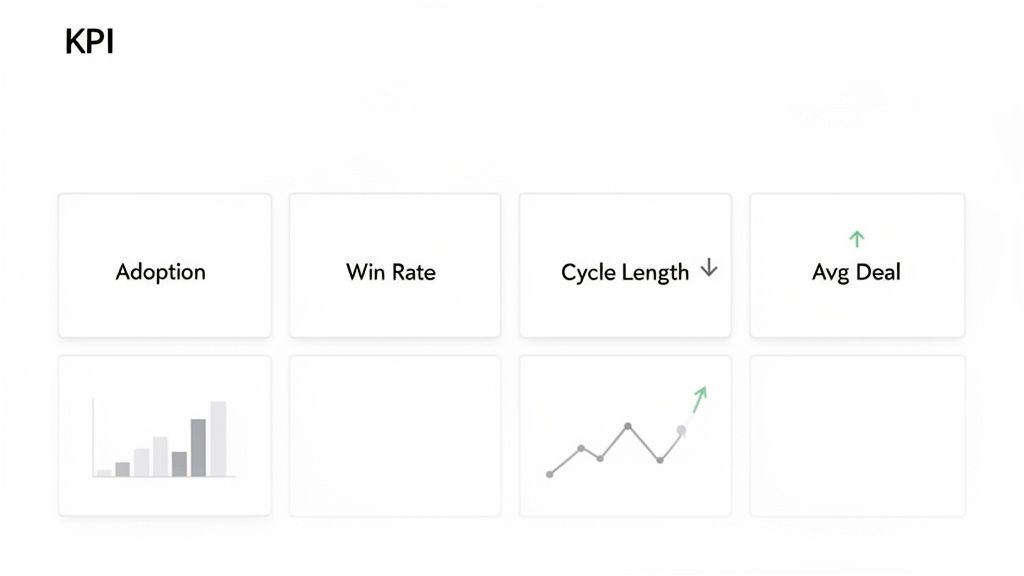
Key Metrics That Prove Business Impact
To get a clear picture, you need to track a handful of critical metrics. These aren't just fluffy numbers; they give you a complete view, from internal usage all the way to a direct influence on closed deals.
Start by tracking these four:
- Content Adoption Rate: This is your ground zero. It answers the simple but vital question, "Are reps actually using the stuff we create?" If adoption is low, it’s the first red flag that your content is missing the mark for the sales team.
- Content Influence on Win Rate: This is where things get interesting. By tagging content pieces to deals in your CRM, you can see which assets pop up most often in successful opportunities. This helps you zero in on your most valuable, deal-closing content.
- Sales Cycle Length: Good content should speed things up. It answers questions proactively and builds trust faster, shrinking the time it takes to close a deal. Compare the sales cycle for deals where content was used versus those where it wasn't. The difference can be staggering.
- Average Deal Size: The right asset at the right time-like a solid ROI calculator or a compelling case study-can give a rep the leverage they need to build a stronger business case and upsell. This leads directly to bigger deals.
Setting Up a Measurement Framework
Tracking these metrics does take a bit of setup, but the payoff is huge. Your CRM and any sales enablement platforms are your best friends here. You can configure them to link content directly to contacts, accounts, and opportunities.
For instance, when a rep fires off a case study to a prospect, that action should get logged in the CRM. Do this consistently, and over time you can run reports to see which assets are the real MVPs in your won deals.
The data from a solid enablement program is seriously compelling. Organizations that get this right often see a 20% jump in sales productivity and a 15% revenue boost. On top of that, they can hit 50% higher win rates. Reps can even reclaim up to 20% more selling time. Great content isn't just a cost center; it's ROI rocket fuel.
Don't forget the qualitative side. Data tells you what is happening, but your sales team can tell you why. Regularly survey your reps to gather their feedback on which content is most effective and what gaps still exist.
Gathering Qualitative Feedback from Sales
Hard numbers are powerful, but they don't paint the whole picture. You need to back up your CRM data with direct feedback from the sales team. A simple quarterly survey can give you invaluable context that the numbers alone can't provide.
Sample Survey Questions for Your Sales Team:
- Which piece of content was your secret weapon for overcoming objections this quarter?
- Can you think of a recent deal where one specific asset made a clear difference?
- What's the biggest content gap you’re running into during your sales calls right now?
This blend of hard data and on-the-ground intel is what empowers you to constantly refine your strategy. You won't just be proving the value of what you've already made; you'll be ensuring that every new piece of content you create is even more impactful than the last.
For a deeper dive on this, check out our full article on measuring content marketing ROI.
Got Questions About Sales Enablement Content? We've Got Answers.
As you start pulling together a sales enablement content program, a few questions always seem to surface. Getting them sorted out early helps you sidestep common pitfalls, get wins faster, and make sure sales and marketing are actually working together, not just in the same building.
Let's dig into the big ones.
Who’s Actually in Charge of Creating This Stuff?
The short answer? It’s a team sport.
Marketing usually handles the heavy lifting of creation-the writing, the design, the storytelling. They’re the pros at taking dense, complex ideas and making them digestible and compelling.
But-and this is a big but-the sales team has to be in the room from the very beginning. They’re the ones on the front lines, hearing the real customer pain points, the common objections, and what the competition is up to. Without their insights, the content is just a shot in the dark. Product marketing is also a key player, making sure every asset is technically sound and positioned perfectly.
Isn't This Just More Marketing Content?
Not quite, though they're definitely related. The real difference boils down to intent and audience.
Your typical marketing content, like a blog post or a social media update, is designed to cast a wide net. It's there to attract and educate a broad audience, building general brand awareness.
Sales enablement content is different. It’s a tool built specifically for a salesperson to use in a live sales conversation. Its job is to solve a very specific problem—answer a tough question, dismantle an objection, or give a prospect the final piece of information they need to move forward. It’s laser-focused, action-oriented, and meant for a one-to-one or one-to-few interaction.
A smart move is to figure out what is content repurposing and turn those broader marketing pieces into sharp, sales-specific tools.
What’s the Absolute First Thing I Should Do to Build a Strategy?
Before you write a single word or design a single graphic, go talk to your sales team. This is the most critical first step. You have to understand their biggest headaches.
Set up some interviews or send out a quick survey. Your goal is to get to the core of what they truly need to close more deals.
Ask them things like: What questions do you get on every single call? Where in the process do deals always seem to stall? What's one resource you wish you had that would make your job 10x easier?
This one step ensures your strategy is built on reality, not just marketing’s best guesses.
How Do I Get the Sales Team to Actually Use the Content?
Ah, the million-dollar question. Adoption is everything. You can have the most brilliant content library in the world, but it’s completely worthless if your reps can’t find it or don’t see the value in using it.
Here’s how you make it happen:
- Make it ridiculously easy to find. Create a single source of truth. Whether it's a dedicated platform or just a super-organized shared drive, there should only be one place to look. No excuses.
- Plug it into their workflow. The ultimate goal is to get the content right inside the tools they already use, like your CRM. This puts the perfect asset at their fingertips exactly when they need it, mid-conversation.
- Train them and celebrate the wins. Don’t just drop a new asset in their lap. Do a quick training session. Even more important, find and share the success stories. When a rep uses a case study to close a huge deal, make sure the whole team hears about it.
A great sales enablement strategy can be a complete game-changer, and a B2B podcast is one of the most effective, high-impact assets you can add to the mix. To see how Fame helps you create a podcast that doesn't just build authority but drives a real, qualified pipeline, visit us today.
Want us to run this for you?
Fame starts and grows B2B podcasts that generate pipeline. Tell us who you are trying to reach and we will send a costed proposal within 48 hours.
Related content
- Read moreFame Team · July 16, 2026
10 Account Based Marketing Tactics For B2B Growth In 2026
Discover 10 actionable account based marketing tactics for B2B tech. Learn to use podcasts, data, and targeted content to close high-value accounts. - Read moreFame Team · July 16, 2026
The 8 Best Brighton Podcast Agency Picks For 2026
Find the best Brighton podcast agency for your B2B brand. Our 2026 guide reviews top 8 agencies for production, growth & ROI. Expert analysis here - Read moreJune 10, 2026
20 Best Podcast Production Agencies For 2026 (And Why Should You Hire One)
Global podcast and vodcast ad revenues are on track to hit $5 billion in 2026 , up 20% year-on-year. - Read moreApril 13, 2026
Leadership In Marketing: The B2B Podcast Playbook
Most companies still confuse leadership in marketing with job titles, org charts, and budget control. That's outdated.