February 8, 202618 min read6 sections
How To Build Sales Pipeline With A B2B Podcast
By Fame Team
Key Takeaways
- A B2B podcast can be a strategic relationship engine, enabling sales teams to build genuine rapport and trust before pitching products or services.
- The key is to start with a direct, guest-driven strategy, inviting ideal clients to be guests on the show and building connections in a non-salesy setting.
- By adding "Podcast" as a lead source option in the sales process, businesses can measure the effectiveness of podcasting as a sales and marketing channel and prove its value in the pipeline.
Let's be real, building a B2B pipeline can be an absolute grind. Cold outreach is exhausting, conversion rates often suck, and actually earning trust in a noisy market is tougher than ever.
Too many sales teams are stuck in a relentless cycle, pushing for demos with prospects who just aren't ready to listen. This is exactly where a B2B podcast flips the entire game on its head.
Rethinking B2B Sales Pipelines with Podcasting
Stop thinking of a podcast as just another piece of content. Start seeing it for what it really is: a strategic relationship engine.
Imagine warming up your ideal clients and building genuine rapport before you even think about a sales pitch. It completely changes the dynamic from "selling to" someone to "collaborating with" them, creating a rock-solid foundation for future business.
This guide is all about the actionable playbook for turning your podcast into your most powerful pipeline-building machine. We'll split it into two distinct phases.
- The First Six Months: This is all about a direct, guest-driven strategy. You invite your ideal clients to be guests on your show. You build a real connection in a non-salesy setting. Down the line, you offer them a unique deal as a thank you for being on the show. It’s quality over quantity, turning a handful of high-value chats into closed deals.
- Six Months and Beyond: Once you've built a following, you shift gears to a more scalable, audience-driven model. By offering valuable lead magnets, such as exclusive reports or checklists, in your show notes, you can start converting engaged listeners into qualified leads for your marketing funnel. You can dive deeper into the broader benefits of podcasting for B2B growth in our detailed article.
The core idea is simple: Stop chasing cold leads and start attracting warm prospects. A podcast allows you to demonstrate expertise, build trust at scale, and create a pipeline filled with people who already know, like, and respect your brand.
To actually prove this is working, you absolutely have to bake it into your sales process.
One simple but critical step? Add "Podcast" as a lead source option when your sales team asks, "How did you find us?" This gives you clean attribution, proving the podcast's value as a legitimate sales and marketing channel. Follow this playbook, and you'll transform your pipeline from a simple list of names into a thriving community of engaged, high-intent prospects.
Building Your Guest-Driven Pipeline in Six Months
When you're first building a sales pipeline with a podcast, forget about downloads. Seriously. Your goal is to forge high-value, one-on-one relationships.
The whole strategy hinges on turning your ideal clients into podcast guests, and then, down the line, into actual customers. It’s a process I’ve seen work time and time again, completely shifting the dynamic from a cold, awkward pitch to a warm, collaborative conversation.
Instead of your typical outreach, start by identifying the key decision-makers and influencers at your dream accounts. Who would make a fantastic interview subject? Look for people with unique insights, great stories, or respected opinions in your industry.
Crafting the Perfect Invitation
The secret sauce here is a compelling, non-salesy invitation. You're not asking for a demo; you're positioning them as an expert and offering them a platform. Your outreach needs to feel like a genuine opportunity for them to share their knowledge with an audience that cares.
Make sure your invitation highlights a few key things:
- Why them specifically: Get personal. Mention a recent article they wrote, a project they led, or a specific point of view they shared that caught your eye.
- The value for them: Explain how the podcast is a platform for them to build their personal brand and showcase their company's expertise.
- A low time commitment: Nobody has time. Emphasize that the process is straightforward and you'll make it as easy as possible for them.
The goal is simple: get a "yes" to a conversation. This one move reframes the entire interaction and opens the door to building real rapport.
From Guest to Qualified Prospect
The real magic happens before, during, and after the recording. Every single touchpoint is a chance to organically uncover their business challenges without ever putting on your sales hat. The pre-interview chat? Perfect for breaking the ice and learning about their role and what’s top-of-mind for them right now.
During the recording itself, your questions should guide them to talk about their industry, their wins, and the hurdles they're facing. This isn't an interrogation; it's a collaborative exploration of their world.
After the show, the follow-up is completely natural. You're not some random salesperson hitting their inbox; you're the host who just gave them a platform to shine.
This method is so powerful because it flips the traditional sales model on its head. You provide massive value first by offering them an audience. The sales conversation then becomes a natural next step, born from a relationship built on mutual respect and shared insights.
This is what that shift looks like, moving from exhausting cold outreach to building a relationship founded on trust.
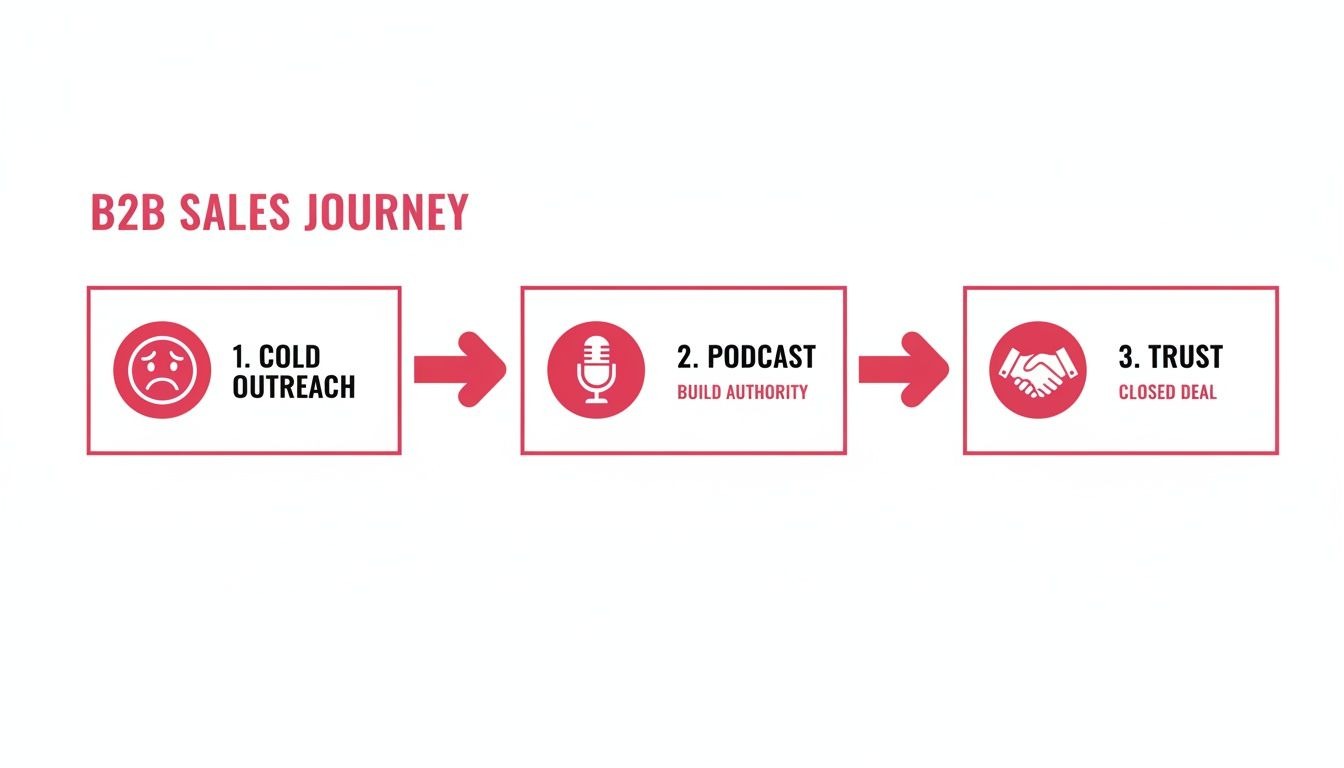
As you can see, the podcast interview acts as the critical bridge, turning a stranger into a trusted connection ready for a real business conversation.
Here’s a quick look at how these stages might play out over the first six months.
Podcast Guest Pipeline Stages (First 6 Months)
This table breaks down the key stages, actions, and goals for converting your podcast guests into happy customers.
| Stage | Key Action | Primary Goal |
|---|---|---|
| Month 1: Outreach and Booking | Identify 20 ideal guests and send personalized invitations | Book 4 to 6 high-value guests for upcoming episodes |
| Month 2 to 3: Recording and Rapport | Conduct interviews focusing on expertise and challenges | Build trust and uncover potential business needs |
| Month 4: Nurturing and Follow-up | Share the live episode and provide value post-interview | Stay top of mind and strengthen the relationship |
| Month 5: Transition to Sales | Identify the right moment to pivot to a business discussion | Introduce your solution in a natural way |
| Month 6: Guest Offer | Present a preferential deal as a thank you for their time | Convert 1 to 2 former guests into new customers |
This isn't a rigid timeline, but it shows how a deliberate, relationship-first approach can fill your pipeline with highly qualified leads.
Transitioning to a Sales Conversation
Once you've built this solid foundation of trust, pivoting to a business discussion feels easy and organic. The final step is to use this unique relationship to your advantage by offering a preferential deal. Just frame it as a special offer exclusively for podcast guests, a small "thank you" for their contribution.
This approach absolutely crushes traditional conversion rates. As one of our clients, Yellowbird, discovered, this strategy can lead to a 20% conversion rate from guest to customer. You can read the full case study here: 20% Conversion Through Podcasting: Yellowbird's Winning Strategy.
The guest-driven podcast strategy helps you bypass the coldest, leakiest parts of the traditional sales funnel. You’re entering the conversation with someone who already knows, likes, and trusts you. If you want to dive deeper into making this work, check out the 4 elements of high-performing podcast guesting funnels. We've seen this method produce consistently higher conversion rates for our clients, all because that critical element of trust is established from day one.
Scaling with an Audience-Driven Funnel
For the first six months, your podcast is all about precision. You're turning high-value guests into customers, a fantastic one-to-one strategy. But now it's time to scale. We're shifting from that direct approach to a one-to-many model. Your podcast is about to become an engine for a steady flow of inbound leads.
By now, you've built a dedicated audience in your niche. If you’ve been smart about your topics, these aren't just random listeners. They're a highly-qualified group of your ideal customers who already see you as an expert. This is where you flip the switch and build a sales pipeline that practically runs itself.
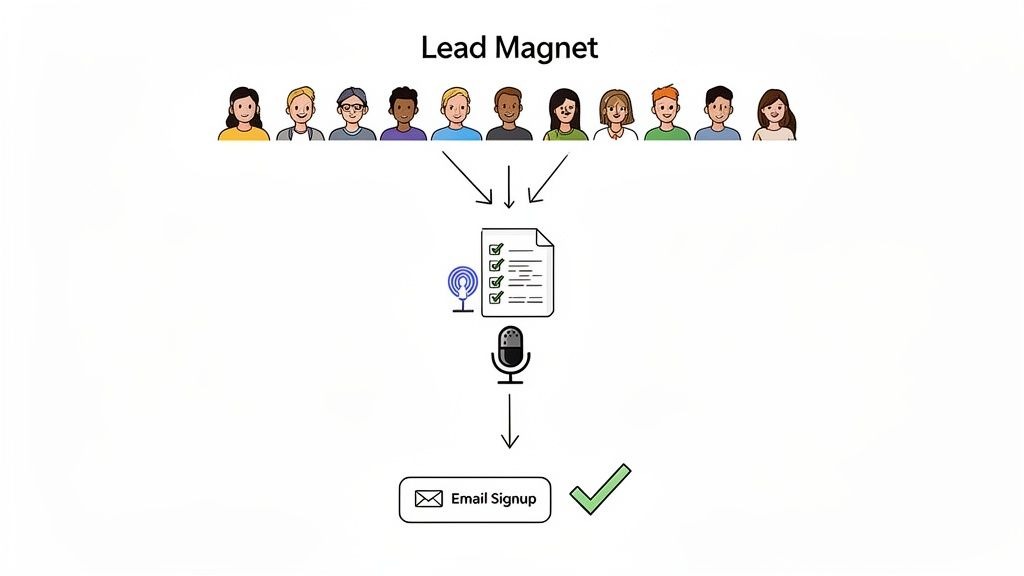
Creating a High-Value Lead Magnet
The bridge between your listeners and your marketing funnel is a lead magnet. I'm not talking about some generic, slapped-together freebie. This needs to be a seriously high-value resource that solves a very specific problem for your audience.
Your listeners are savvy B2B pros. They won't hand over their contact info for just anything. It has to be genuinely useful.
Here are a few formats that consistently work:
- An Exclusive Industry Report: Got unique data or insights? Package it up into a report they can't get anywhere else.
- A Detailed Checklist: Create a step-by-step guide that helps them nail a complex task you've discussed on the show.
- A Special Discount: Offer an exclusive deal only available to podcast listeners to incentivize action.
The goal is to create something so valuable that it feels indispensable for anyone who cares about your podcast's topics. Once they sign up, you move them into your marketing funnel. For more ideas on growing your audience in the first place, check out these proven audience development strategies in our guide.
Promoting Your Lead Magnet on the Podcast
Once your lead magnet is ready, you have to weave it into your episodes. The key is making the call-to-action (CTA) feel like a natural part of the conversation, not a jarring ad.
I've found three prime spots to mention it:
- The Intro: A quick shout-out at the top of the show works well as a "thank you" for listening. Something like, "Before we jump in, make sure to grab our free B2B Prospecting Checklist. The link is in the show notes."
- The Mid-Roll: Drop a slightly longer mention in the middle, tying it directly to something you're discussing. This reinforces its value when engagement is at its peak.
- The Outro: This is your last shot. As you're wrapping up, give a clear, compelling reminder. "If you found today's chat helpful, you're going to love the template we created. Get it now at [yourwebsite.com/resource]."
The best promotion sounds less like an ad and more like a genuine recommendation. Frame it as an extension of the value you're already delivering in the episode. It builds trust and makes a download way more likely.
Crafting Show Notes That Convert
Your podcast’s show notes are more than just a recap; they're a critical conversion tool. This is the first place people will look for your lead magnet link, so the page needs to be designed to get sign-ups.
Make sure your show notes include a prominent, visually distinct section for the lead magnet. Don't just dump a link and call it a day. Write a short, benefit-focused paragraph explaining what it is and why they need it. Use clear, action-oriented text like "Download Your Free Template" or "Get the Exclusive Report."
This simple setup connects your audio content straight into your marketing system. Once someone signs up, they should automatically be dropped into a tailored email nurture sequence. That sequence keeps the value flowing, builds the relationship, and gently guides them down your sales pipeline. This is how your podcast transforms from a content channel into a reliable source of warm, qualified leads.
Integrating Your Podcast with Sales & Marketing Systems
A podcast isn't an island. It's a powerful current that should flow directly into the heart of your business operations.
If you really want to build a sales pipeline with your show, you have to wire it into your existing sales and marketing systems. This is how you turn a content project into a measurable, predictable source of revenue.
It all starts with something simple, yet so often overlooked: attribution.
You can't prove your podcast's value if you can't track where the leads are coming from. This is the non-negotiable first step. Get this right, and everything else follows.
Get Your CRM Ready for Podcast Leads
Your CRM is the central nervous system for your entire sales operation. For your podcast to be taken seriously, it needs a formal place in your data.
It's a small tweak, but it's a game-changer: add "Podcast" as a lead source option in your CRM.
- On your website forms: Make sure "Podcast" is a selectable option in the "How did you hear about us?" field on your contact and demo forms.
- In your sales conversations: Coach your sales team to ask prospects if they've listened to the show. It's a great conversation starter and a crucial data point. They need to log it correctly every single time.
This tiny change gives you clean, undeniable proof of how many direct inquiries your podcast is generating. Suddenly, you can justify the investment and truly understand its influence on the pipeline.
Create Nurture Sequences That Don't Feel Generic
A lead from your podcast isn't a cold lead. Far from it.
These people have already spent hours with you. They've heard your voice, absorbed your point of view, and built a real sense of trust. Hitting them with a generic, one-size-fits-all email sequence is jarring. It completely squanders the rapport you've built.
Instead, build a customized lead nurturing sequence just for them. Acknowledge the source in the very first email.
Here’s a quick example for a welcome email:
"Hey [First Name], thanks for grabbing the [Lead Magnet Name] we talked about on the podcast! Since you're a listener, we know you're serious about [Topic]. Over the next few days, I'll send over a few extra resources that build on what we discussed in the last episode."
This simple acknowledgment validates their decision and seamlessly continues the conversation. These tailored sequences should deliver more value related to the podcast's themes, guiding your most engaged listeners deeper into your world. To see how this fits into a bigger picture, you can discover more about creating a cohesive demand generation strategy in our detailed guide.
Use Lead Scoring to Flag Your Hottest Prospects
Not all leads are created equal, and let’s be honest, podcast leads are often warmer than most. Lead scoring is the system that helps your sales team prioritize who to talk to first by assigning points based on their actions. We need to plug the podcast right into this system.
The rule is simple: assign a higher score to leads who come from your podcast. Why? Because they've shown a level of engagement and interest that goes way beyond a casual website visit.
Think about setting up scoring rules like these:
- Downloaded a podcast lead magnet: +20 points
- Lead Source = "Podcast": +10 points
- Listened to 3+ episodes (if you can track it): +15 points
This setup ensures that when a listener enters your pipeline, they're immediately flagged as a high-priority opportunity. They jump to the top of the queue, and your sales team can engage them while the insights from your show are still fresh in their minds.
This isn't just a "nice-to-have." This is operational discipline. Recent data shows 91% of marketers see lead generation as a top priority, yet a whopping 58% say it's their biggest challenge. Scoring and nurturing your podcast leads properly gives you a serious edge.
When you connect these systems, your podcast stops being a standalone piece of content. It becomes a fully integrated, highly effective pipeline-building machine.
Measuring the ROI of Your Podcast Pipeline
So, how do you actually prove your podcast is making money? It’s time to stop obsessing over download numbers and start tracking the metrics that get your CFO excited. To justify the investment, you have to connect your show directly to sales outcomes.
The trick is to treat your podcast just like any other sales channel. That means digging into its real impact on deal flow, how fast those deals close, and how much they're worth. We need to move from "Yeah, I think the podcast is working," to "I can prove the podcast generated $X in pipeline and $Y in closed-won revenue."
Calculate Your Podcast Pipeline Velocity
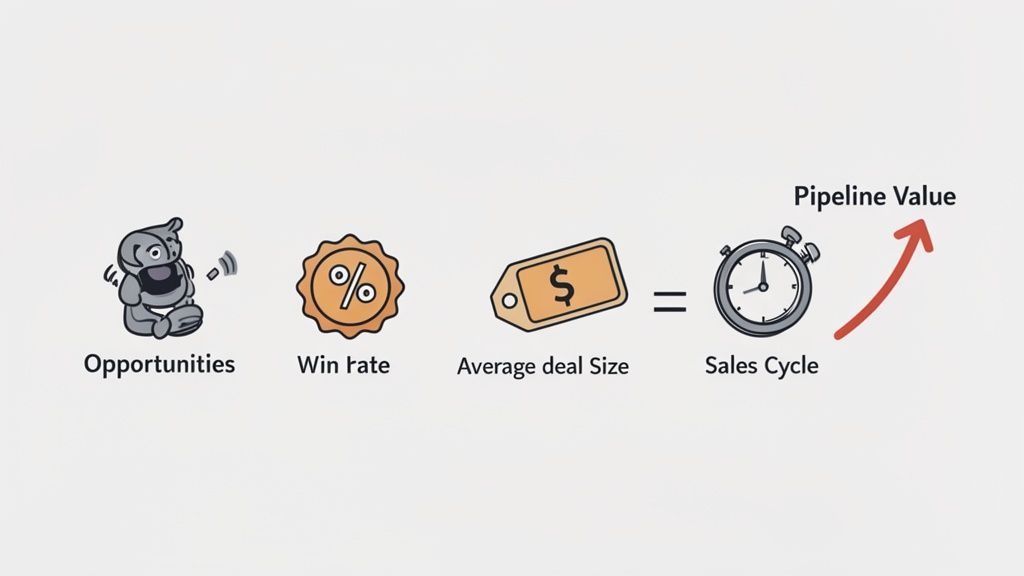
One of the best ways to see how healthy your pipeline is? Look at its sales pipeline velocity. This metric doesn't just tell you how big your pipeline is; it tells you how fast deals are moving through it and turning into actual cash. This is where you can see if podcast-sourced leads are outperforming the rest.
The formula is pretty simple but powerful: (Number of Opportunities × Win Rate × Average Deal Size) ÷ Sales Cycle Length. It reveals how quickly deals are sprinting from one stage to the next. I saw one tech startup use this to find bottlenecks, make a few targeted automations, and chop 15 days off their sales cycle. The impact on revenue was massive.
Apply this formula specifically to the leads you've tagged with "Podcast" as the source. Calculate their velocity, then stack it up against leads from other channels like cold outreach or paid ads. Don't be surprised if you find the trust built through your podcast results in a much shorter sales cycle and higher win rates.
By isolating podcast-sourced leads, you create a direct comparison. If these leads have a higher velocity, you have a clear, data-backed argument that your podcast is not just a content play, it's a powerful sales accelerator.
Track Key Conversion and Cost Metrics
Beyond velocity, a few other numbers will paint the full picture of your podcast's ROI. These help you understand just how efficient and financially sound your audience-driven funnel really is.
Start tracking these meticulously:
- Lead Magnet Conversion Rate: Of all the people listening (or visiting your show notes), what percentage actually signs up for your lead magnet? This tells you how compelling your offer is. If the rate is low, you might need to tweak your call-to-action or the resource itself.
- Cost Per Acquisition (CPA): This one is non-negotiable. Tally up the total cost of producing and promoting your podcast over a set period, then divide it by the number of new customers you landed from it. This gives you a hard number to compare against your other marketing channels.
- Total Pipeline Value: Add up the potential deal size of every single active opportunity that came from your podcast. This is a forward-looking metric that’s gold for forecasting and showing the future revenue your show is teeing up.
These are the metrics that speak the language of the C-suite. When you can walk into a meeting and say, "Our podcast generated $150,000 in new pipeline value last quarter with a CPA of $1,200," you've bridged the gap between content and tangible business results.
For an even deeper look at this, check out our complete guide on measuring B2B podcast ROI and pipeline impact.
A Few Common Questions
Diving into a podcast-driven sales pipeline is smart, but it's natural to have a few questions before you jump in. Let's tackle the big ones so you can get started with confidence.
How Much Time Will This Actually Take Each Week?
This is always the first question, and the answer is probably less than you think. When you're in that initial guest-driven phase, you're really only looking at 2-4 hours per week.
Your time breaks down into a few core chunks:
- Prospecting & Outreach (1-2 hours): This is just identifying the right guests (who are also your ideal clients) and sending them personalized invites.
- Interview Prep & Recording (1 hour): A quick pre-chat to get comfortable, then the recording itself. Keep your episodes tight, 20-30 minutes is the sweet spot.
- Post-Production & Follow-Up (1 hour): You can (and should) outsource the editing. Your main job here is the follow-up, which is just a natural next step in building that relationship.
It's all about consistency, not a massive time commitment. Once you get a simple process locked in, it's a very manageable part of your week.
What Gear Do I Really Need to Start?
You don't need a professional studio. Not even close. While high-quality audio is non-negotiable for credibility, you can get there with a surprisingly simple setup. Forget the fancy mixing boards and soundproof foam for now.
Honestly, your starter kit only needs two things:
- A solid USB microphone: Brands like the Blue Yeti or Audio-Technica AT2020 are industry workhorses for a reason. They plug right into your computer and give you crisp, clear audio for around $100-$150.
- Recording software: There are some amazing free options out there. Audacity is a powerful, open-source editor that many podcasters use for their entire careers. For recording remote interviews, platforms like Riverside.fm or Zencastr make capturing high-quality audio from both you and your guest incredibly simple.
That’s it. A good mic and reliable software are all you need to sound like a pro. Your content and the relationships you're building matter infinitely more than having the most expensive gear.
How Do I Get My Ideal Clients to Actually Say "Yes" to Being a Guest?
Let's face it, top-tier prospects are busy. Your invitation has to cut through the noise, and the secret is making it 100% about them, not you. Your outreach should never, ever feel like a sales pitch in disguise.
You need to frame the invitation as a genuine opportunity for them to showcase their expertise and build their personal brand. Your email has to be hyper-personalized, reference a specific article they wrote, a project they just shipped, or a unique point they made on LinkedIn. This instantly shows you've done your homework.
A simple structure that just plain works:
- Personalized Hook: "I absolutely loved your recent LinkedIn post on [specific topic]..."
- The Offer: "...and it's exactly why I'm reaching out. We host a podcast for [target audience], and I know our listeners would get a ton of value from your insights on [specific area of their expertise]."
- The Value Prop: "It's a great platform to share your expertise with an engaged audience of your peers."
- The Low-Friction Ask: "Would you be open to a quick 20-minute chat?"
This approach respects their time and instantly positions them as the expert, which makes getting a "yes" a whole lot easier. It's the perfect way to kick off a relationship on the right foot.
When Do I Switch From a Guest Funnel to an Audience Funnel?
The move from the one-to-one guest strategy to a one-to-many audience funnel isn't about hitting a specific date on the calendar. It's a milestone you'll reach, usually around the six-month mark.
By then, you should have a solid back catalog of episodes and a small but dedicated niche following. The real trigger to make the shift is seeing consistent listener engagement. Are people giving you feedback? Are they mentioning the show in industry circles? Once you have an audience that knows, likes, and trusts you, that's the moment to introduce a lead magnet and start building your email list.
And here’s the best part: you don't have to kill the guest strategy. Keep inviting high-value prospects onto the show while you build your audience-driven pipeline in parallel. The two strategies complement each other perfectly, creating a powerful, multi-channel engine for filling your pipeline.
Ready to turn your podcast into a predictable pipeline engine? At Fame, we specialize in helping B2B companies launch and scale podcasts that drive real business results. We handle the production, so you can focus on building relationships.
Learn how we can help you build your authority and your pipeline.
Want us to run this for you?
Fame starts and grows B2B podcasts that generate pipeline. Tell us who you are trying to reach and we will send a costed proposal within 48 hours.
Related content
- Read moreFame Team · July 16, 2026
10 Account Based Marketing Tactics For B2B Growth In 2026
Discover 10 actionable account based marketing tactics for B2B tech. Learn to use podcasts, data, and targeted content to close high-value accounts. - Read moreFame Team · July 16, 2026
The 8 Best Brighton Podcast Agency Picks For 2026
Find the best Brighton podcast agency for your B2B brand. Our 2026 guide reviews top 8 agencies for production, growth & ROI. Expert analysis here - Read moreJune 10, 2026
20 Best Podcast Production Agencies For 2026 (And Why Should You Hire One)
Global podcast and vodcast ad revenues are on track to hit $5 billion in 2026 , up 20% year-on-year. - Read moreApril 13, 2026
Leadership In Marketing: The B2B Podcast Playbook
Most companies still confuse leadership in marketing with job titles, org charts, and budget control. That's outdated.