

Your podcast's format is its foundational structure—the blueprint that dictates how you present your content to the listener. It controls everything from the number of hosts to the style of conversation, and it's what ultimately shapes the show's tone, pacing, and overall vibe.
For a B2B brand, picking the right format isn't just a creative choice. It's a strategic one. It directly impacts your ability to build authority and hit your marketing goals.
Why Your Podcast Format Is A Strategic Choice
Think of your podcast's format as its DNA. It determines what the listener experiences, it shapes your content, and it decides whether your show becomes a valuable asset or just more noise in a crowded space. In the B2B world, this decision is the bedrock for establishing authority, generating qualified leads, and hitting specific business objectives.
Let's put it another way: an unstructured show is like a business meeting without an agenda. You might stumble into an interesting conversation, but you're not going to achieve a specific outcome reliably. A well-defined format, on the other hand, gives you a repeatable framework that builds trust and loyalty with your audience.
Aligning Format With Business Goals
The format you choose should be a direct reflection of what you want the podcast to accomplish. Different structures are simply better suited for different goals. For example, a solo show is fantastic for showcasing deep, proprietary expertise. An interview format? That's a powerhouse for networking and borrowing authority from established industry leaders.
Before you land on a style, ask yourself a few critical questions:
- What's our primary objective? Are we trying to build brand awareness, generate leads, or hang on to existing clients?
- Who are we talking to? What kind of content does our target audience actually value, and how do they like to consume it?
- What can we realistically commit? Do we have the in-house expertise for a compelling solo show, or the production chops for a complex narrative series?
Choosing a podcast format isn't about chasing what's popular; it's about what's effective for your brand. The right structure makes content creation sustainable and ensures every single episode aligns with your larger marketing strategy. It turns your podcast into a predictable engine for growth.
This guide isn't about giving you generic definitions. We're going to dive into a strategic framework for picking the right format for you. We'll explore the core concepts behind solo, interview, panel, and narrative styles, helping you figure out which blueprint actually fits your brand’s expertise and resources.
To see the bigger picture of how a podcast can impact your business, you can explore the key benefits of podcasting. Consider this your playbook for turning audio content into a revenue-driving machine.
Exploring the Core B2B Podcast Formats
So, how do you pick the right podcast format for your business? A good starting point is to think about your main goal. We find it helps to group the most effective B2B podcast formats into three strategic pillars: Authority-Building, Collaborative, and Narrative.
Each of these pillars is built to deliver a different marketing outcome. Your format isn't just a creative choice; it’s the bridge connecting your high-level business goals to what your audience actually hears in their earbuds.
This diagram shows it perfectly. Strategy comes first, which dictates your format, and that format shapes the entire listener experience.
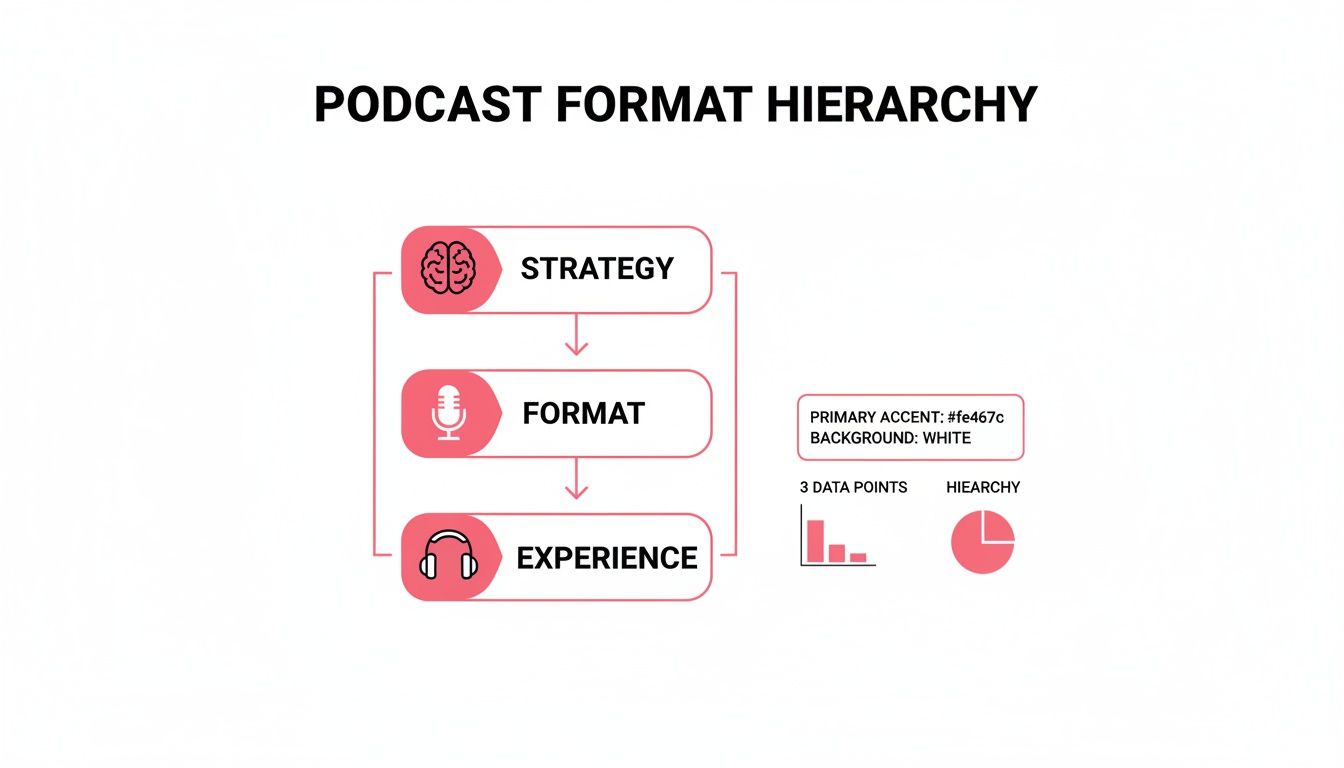
Let's break down what that looks like in practice.
The Authority-Building Pillar
This one’s pretty straightforward. The goal here is to cement you or your brand as the expert in your space. It’s all about owning the conversation and delivering value straight from your own well of knowledge.
The undisputed champion of this pillar is the Solo / Monologue Show.
- What it is: Just one host speaking directly to the listener. You're sharing deep insights, expert opinions, or educational content. Think of it less like a podcast and more like a weekly keynote.
- B2B Pros: You get total control over the brand message, which is fantastic for showcasing proprietary knowledge. It also builds a really strong, direct connection with your audience.
- B2B Cons: The pressure is all on the host. You have to be consistently engaging and ridiculously well-prepared. Get it wrong, and it can become a snooze-fest fast.
A solo show is a beast of a format for subject matter experts looking to build a powerful personal brand. It's the most direct route to being seen as a thought leader, but it takes serious dedication to content planning and scripting to pull off well.
The Collaborative Pillar
Collaborative formats are all about the power of conversation. Instead of just one voice, you're bringing in different perspectives to create something dynamic and engaging. This is often the quickest path to audience growth because you can tap into other people's networks.
The key formats here are:
- The Interview Show: This is probably the most popular B2B podcast format out there, and for good reason. A host interviews a different guest each episode—usually an industry expert, a key customer, or a partner. It’s an unbeatable way to deliver fresh insights while networking with the big players in your industry.
- The Co-Hosted Show: Two or more hosts riffing off each other. They discuss topics, debate opinions, and inject their own energy and expertise. This format is brilliant for showing off your company's culture and the depth of talent on your team. The back-and-forth banter can make even the most complex topics feel more accessible and fun.
- The Roundtable / Panel Show: Imagine a moderated discussion with a group of three or more guests. This is your go-to for exploring complex topics from every conceivable angle. You get a rich, layered conversation that a simple one-on-one interview could never achieve.
These formats are incredibly effective for extending your reach and adding a layer of credibility to your show. To get a better handle on all the options, check out our detailed guide on the different types of podcasts.
The Narrative Pillar
Narrative formats are a different animal entirely. They go beyond simple conversation to tell a captivating story. This usually means higher production values, like sound design, clips from multiple interviews, and a tightly scripted storyline that creates an immersive, almost cinematic experience.
The main formats here are Storytelling and Hybrid shows.
A storytelling show might unpack your company’s origin story over several episodes or investigate an industry trend through a series of deep-dive case studies. A hybrid show could blend formats, maybe starting with a solo monologue before diving into an interview.
These shows can be incredibly powerful, but they also demand the biggest investment in time and resources for scripting, recording, and post-production. They’re best for brands that have a killer story to tell and the budget to do it justice.
Despite all the talk about video, audio isn't going anywhere. By 2025, it's estimated that 584.1 million people worldwide will be podcast listeners, and most of them will be tuning into audio-only content during commutes or workouts. For B2B brands, audio-first formats are efficient, cost-effective, and a direct line to decision-makers when they're actively looking for solutions.
Building Your Episode From Hook to Action
Nailing your podcast format is only half the battle. If you want to really succeed, you need a repeatable, professional episode structure. Think of it as a roadmap for every single recording. It creates the consistency that builds listener trust and keeps your audience locked in from the first second to the final call-to-action.
Without a solid structure, you're just having a conversation. With one, you're creating a strategic asset. Each segment has a job to do, guiding the listener on a journey that delivers real value and, ultimately, helps you hit your business goals.
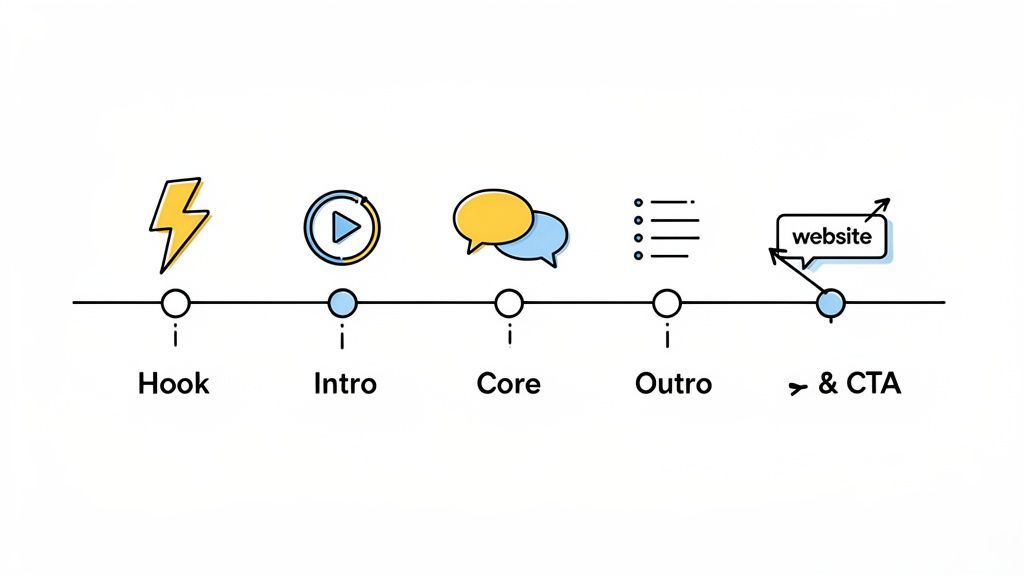
This simple flow is universal. It works across pretty much every format you can think of and is the key to a high-impact episode.
The Anatomy of a Winning B2B Episode
Every great episode, regardless of format, is built from the same core components. These are the essential building blocks for a polished and effective show. Once you master this structure, you'll be producing content that feels professional and effortlessly holds your audience's attention.
Here's the breakdown of the five critical sections:
- The Pre-Intro Hook (0–30 seconds): Think of this as your episode's movie trailer. Grab a killer clip from the main interview—something surprising, compelling, or genuinely thought-provoking. Its only job is to make someone think, "I have to hear the rest of this."
- The Intro (30–90 seconds): Now your theme music kicks in. This is where you introduce the show, yourself as the host, and what this specific episode is all about. Be crystal clear about what the listener is going to learn and why it's worth their time. Remember, don’t pitch your company here; save that for dedicated ad slots or the outro.
- The Core Content (15–40 minutes): This is the meat of your episode—the interview, the solo deep-dive, or the panel discussion. The key here is to give it some shape. I recommend breaking the conversation into two or three distinct sub-topics to keep it focused and easy to digest.
- The Outro (60–120 seconds): Time to wind things down. Start by summarizing the key takeaways from the conversation. Thank your guest (if you have one) and, of course, your audience for tuning in. This creates the perfect runway for your final, most important segment.
- The Call-to-Action (CTA): End every single episode with one clear, specific instruction. Don't ask people to subscribe, leave a review, and download your ebook. Pick one goal—like signing up for your newsletter—and state it directly.
Once you've recorded, a slick post-production workflow often involves using an audio to text converter to create transcripts for your show notes. This is a great way to reinforce your CTA and make your content more accessible.
Plug-and-Play Episode Templates
To make this even more practical, let's see how this structure looks in action for two of the most common B2B podcast formats. Use these as a starting point and tweak them to fit your own voice and style.
Template 1: The B2B Interview Show
- (0:00–0:30) Hook: Play a punchy 20-second quote from your guest that teases the episode's biggest "aha!" moment.
- (0:30–2:00) Intro: Music fades in and out. "Welcome to [Your Podcast Name]. Today, we're talking with [Guest Name], [Guest Title], about [Episode Topic]. By the end of this episode, you'll know exactly how to [Key Takeaway]."
- (2:00–10:00) Segment 1: Get into the guest's background and set the stage by discussing the core problem your audience is up against.
- (10:00–20:00) Segment 2: This is where the magic happens. Dive into your guest's unique solution or framework. This is the "how-to" part of the show.
- (20:00–25:00) Segment 3: Bring it all to life by exploring a real-world case study or a success story related to their solution.
- (25:00–26:30) Outro: "That's a wrap with [Guest Name]. My biggest takeaway was [Your Key Insight]. Thanks for listening."
- (26:30–27:00) CTA: "To put these ideas into action, download our free [Resource Name] at [YourWebsite.com]."
Template 2: The Solo Host Show
- (0:00–0:30) Hook: Lead with a bold statement or a startling statistic. "Did you know that 75% of B2B companies are making this one critical mistake?"
- (0:30–1:30) Intro: Music fades. "Welcome back to [Your Podcast Name]. Today, we're breaking down [Episode Topic]. I'm going to walk you through three simple steps to [Achieve Outcome]."
- (1:30–7:00) Point 1: Explain your first concept or step in detail. Back it up with a clear example.
- (7:00–13:00) Point 2: Introduce the second concept, making sure it builds logically on the first.
- (13:00–18:00) Point 3: Deliver your final point and tie all three concepts together into a cohesive strategy.
- (18:00–19:30) Outro: "So, to recap, the three steps are [Step 1], [Step 2], and [Step 3]. Put these into practice, and you'll be on your way to [Desired Result]."
- (19:30–20:00) CTA: "If you found this valuable, the best way to get more insights is by subscribing to our weekly newsletter. Just visit [YourWebsite.com/newsletter] to sign up."
Your episode structure is the invisible hand that guides your listener. A predictable yet engaging flow makes your show feel professional and easy to consume, which is the secret to building a loyal B2B audience.
For an even deeper dive into this, our guide offers a winning outline for podcast episodes with more detailed examples.
Time to Turn On the Camera: Integrating Video into Your Podcast
Let's be honest, video isn't just a "nice-to-have" anymore. For podcasters, especially in B2B, it's quickly becoming a core part of a smart content strategy. This isn't just about sticking a camera in front of you while you talk; it's a strategic move that opens up entirely new platforms for discovery and forges a much stronger connection with your audience.
In the B2B space, trust is the name of the game. Video accelerates that trust-building process like nothing else. When your audience can see your face and your guest's face, you're no longer just a voice coming through their headphones. You're a real person sharing real expertise, making your advice feel more credible, memorable, and human.
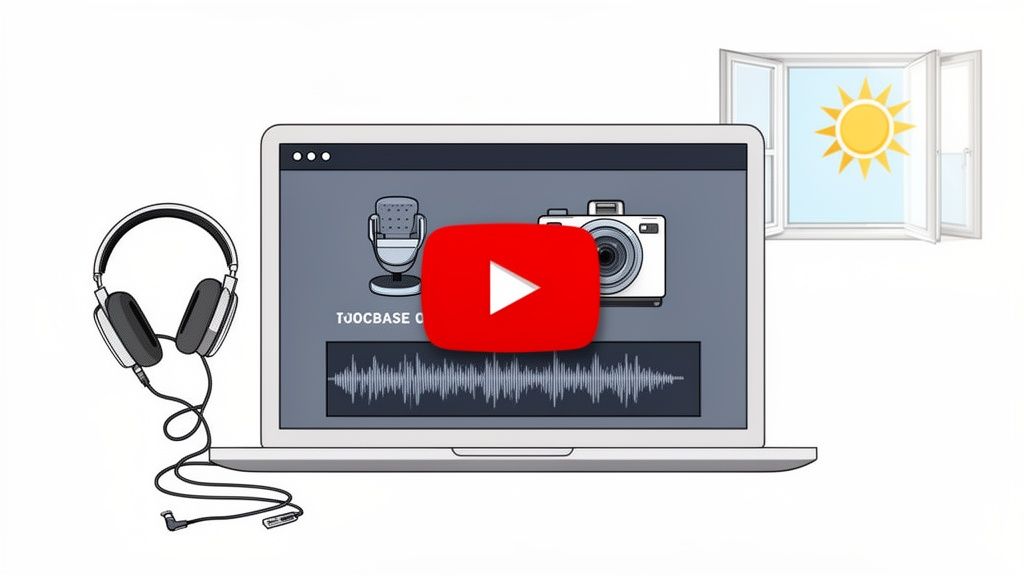
Why Video Is a B2B Game-Changer
While audio-only podcasts have been the standard for years, the ground is definitely shifting. By 2025, it's expected that 41% of US podcast listeners will be actively seeking out "watchable" podcasts. This is a massive change, and it's being driven by one platform in particular: YouTube.
Believe it or not, YouTube has quietly become the single biggest platform for podcast consumption. Right now, 33% of weekly US listeners are heading to YouTube for their favorite shows. For any B2B company looking to establish themselves as a thought leader, that's a trend you simply can't ignore. It’s about meeting your audience where they already are. You can dig into more of this data over at Backlinko.
This doesn't mean you need a production budget worthy of a Hollywood blockbuster. The key is simply to pair your high-quality audio with clear, professional visuals.
Here's the golden rule: Great audio will always be more important than great video. Listeners will forgive a slightly grainy webcam, but they will click away in a second if your audio is crackling and impossible to understand. Nail your sound first, then layer in a solid video strategy.
Best Practices for Remote Video Recordings
One of the best things about modern podcasting is how easy it is to record remotely. You can book high-profile guests from anywhere in the world without the logistical nightmare of travel and studio bookings. The catch? You have very little control over your guest's recording setup.
To avoid any technical hiccups, it’s a great idea to send your guests a simple prep guide before you hit record. Here are a few battle-tested tips you can steal:
- Stick to Wired Headphones: Bluetooth can be fickle, introducing lag or connection drops. Asking guests to use a simple pair of wired headphones with a built-in mic is the most reliable way to get clean audio.
- Embrace Natural Light: The best lighting is usually free! Advise your guests to sit facing a window. Natural light is far more flattering than most lamps and will instantly make their video look ten times better.
- Find a Quiet Spot: This one seems obvious, but it’s crucial. Ask your guest to find a quiet room with minimal background noise. Bonus points if the room has soft furnishings like carpets, curtains, or bookshelves to help soak up any echo.
- Consider a "Guest Kit": If you have the budget, sending your guests a simple USB mic like a Blue Yeti is a fantastic touch. It’s a small investment that shows you’re serious and dramatically elevates the production value of your entire show.
Adding video might feel like a big leap, but with a few simple guidelines, you can create a professional-looking show that expands your reach and deepens your audience connection. If you're ready to get started, check out our guide on the essential equipment for video podcasting.
Adapting Your Format for Global Audiences
If your B2B brand has an international footprint, pushing out a single, one-size-fits-all podcast format is a recipe for stalled growth. What absolutely crushes it with an audience in one country might completely fall flat somewhere else. To really scale your show's impact, you have to adapt your strategy to the different listening habits and platform choices around the world.
This goes way beyond just translating your episodes. It's about genuine localization. The format that feels right at home in North America could need some serious tweaking to connect with listeners in Europe or Asia. This means rethinking everything from how you pick your guests to the fundamental structure of your episodes.
Understanding Regional Listening Habits
First thing's first: you have to accept that people don't listen to podcasts the same way everywhere. How people consume podcasts—and what formats they prefer—can change dramatically from one region to another. For instance, in North America, podcast listenership among internet users is on track to hit 45.20% by 2025.
Western Europe, on the other hand, shows a more reserved adoption rate at 31.90%. Meanwhile, Latin America is right behind at 31.40% but is actually leading the pack in terms of new listener growth. If you're a B2B agency working with multinational clients, these numbers should be a wake-up call about the need to localize your format.
Practical Steps for Global Adaptation
Adapting your podcast for an international audience isn't just about staring at data. It means making real, practical changes to how you produce and plan your content.
Here are a few ways to get started:
- Diversify Your Guests: Make a conscious effort to bring on guests from the regions you're targeting. This does more than just add an authentic local voice; it helps you tap into their professional networks in those markets, giving you a natural boost in reach.
- Be Mindful of Cultural Nuances: The casual, chatty style of a typical North American podcast might come off as way too informal for a business crowd in Germany or Japan. You have to pay close attention to the communication styles, humor, and professional etiquette that are standard in each region.
- Localize Your Distribution: Don't just assume everyone is on Apple Podcasts or Spotify. Do your homework and find out which podcast platforms dominate your key markets. For example, platforms like Gaana in India or Anghami in the Middle East could be your ticket to reaching a whole new audience.
Your goal isn't just to be heard globally, but to be understood and valued locally. Sourcing regional guests and adapting your conversational style are small changes that can make a huge difference in how your brand is perceived in a new market.
To really broaden your podcast's appeal, especially if you have a video component, figuring out how to translate videos and reach a global audience is a smart move. Whether you decide on a single global format or create localized versions of your show, these insights will help your podcast truly connect with a diverse international audience and unlock new markets.
Connecting Your Format to Business Growth
Let's be brutally honest for a second. The real test of your podcast format isn't how creative it feels or how much fun you have making it. The only thing that truly matters is whether it delivers tangible, measurable business results.
Your format choice has to connect directly to your KPIs. This is what turns your show from a fun side project into a strategic growth engine for your business. It's where you stop just tracking downloads and start measuring the impact on metrics that actually move the needle.
Matching Format to Your Primary Business Goal
Think of different podcast formats as tools in a toolbox—each one is designed for a specific job. To make sure you're grabbing the right one, you need to first define the single most important objective for your podcast. Getting crystal clear on this will guide every decision you make, from format to content.
- For Brand Awareness and Authority: Nothing beats the interview format with established industry leaders. When you associate your brand with recognized experts, you're essentially borrowing their credibility and tapping into their audience. It's a shortcut to thought leadership. In the same vein, a well-run panel show can position you as the host of your industry’s most important conversations.
- For Lead Generation: A solo show is a powerhouse for this. It gives you an unfiltered platform to showcase your deep, proprietary expertise. You can methodically educate your audience on a specific problem your product solves, naturally guiding them toward your solution. It's the perfect place to drop clear calls-to-action for demos, consultations, or lead magnets.
- For Client Retention and Upselling: Try a format built around customer success stories or advanced strategy sessions. This delivers incredible value to your existing clients, helping them get even better results with your product. It reinforces why they chose you in the first place and can subtly introduce them to other features or services they might not be using.
Measuring Success Beyond the Download Count
Downloads and listener counts are nice for the ego, but they don't tell you anything about your podcast's business impact. To measure real ROI, you have to track the metrics that tie directly back to revenue and growth. You can get a much deeper look at this by building out a proper business plan for your podcast.
True success isn't just being heard; it's driving action. Your format should be engineered to produce specific outcomes, whether that’s a new lead in your CRM or a stronger relationship with a key client.
Here are the KPIs that actually matter:
- Lead Attribution: It's as simple as adding "Podcast" as an option on your "How did you hear about us?" form fields. This is the most direct way to track how many leads your show is generating.
- Guest-Driven Referrals: When you feature a guest, you're building a relationship. Keep an eye on whether that guest or their company sends new business your way in the following months. This is a huge, often-overlooked benefit of interview shows.
- Website Traffic: Use a unique, easy-to-remember URL in your calls-to-action (e.g., "yourcompany.com/podcast"). This lets you hop into your analytics and see exactly how much traffic the show is driving to your site.
- Industry Mentions: Pay attention to how often other blogs, newsletters, or podcasts reference your show. This is a massive indicator of your growing authority and influence within your niche.
Still Have Questions?
We get it. Choosing a podcast format is a big decision. Here are some of the most common questions we hear from B2B brands trying to figure it all out.
What's the Best Podcast Format if I'm Just Starting Out?
For anyone new to the B2B podcasting game, the interview format is almost always the smartest first move. Why? It lets you borrow the authority—and the audience—of your guests. This takes a ton of pressure off you to come up with all the content yourself. It's also an incredible networking tool.
Now, if you're already a recognized expert and comfortable holding the stage alone, a solo format can work. Just know that it demands serious planning to keep a single voice engaging, week in and week out.
How Long Should My B2B Podcast Be?
The sweet spot for most B2B shows lands somewhere between 25 and 45 minutes. That's just enough time to dive deep and offer real, actionable value, but not so long that it won't fit into a commute or lunch break.
But here’s the real rule: let the content dictate the length. Never, ever add fluff just to hit a time target. Your audience's time is your most valuable asset. Respect it by keeping things tight and to the point.
Can I Change My Format After I've Already Launched?
Yes, and you absolutely should if what you're doing isn't working. It's far better to pivot than to keep pushing a format that isn’t connecting with listeners or hitting your business goals.
A simple way to do this is to frame it as a "Season 2" relaunch. Or, you can just be upfront with your audience and explain the "why" behind the change. Moving from a solo show to interviews to bring in fresh perspectives is a classic, healthy evolution for any growing podcast.
How Important Is a Script, Really?
It completely depends on the format you’ve chosen. There's no one-size-fits-all answer.
- For a solo show: A detailed script, or at the very least a comprehensive bullet-point outline, is your best friend. It’s what keeps you on track and ensures you sound clear and structured.
- For interviews and co-hosted shows: A rigid, word-for-word script can make you sound robotic and kill the natural vibe. Instead, work from a structured outline—think key topics, guiding questions, and planned transition points.
This approach gives you the best of both worlds: you hit all your critical points while still allowing for the kind of natural, back-and-forth conversation that keeps people listening.
Ready to turn your B2B expertise into a strategic asset? At Fame, we specialize in producing authority-building podcasts that drive real business growth. Learn how we can help you launch and scale a show that delivers measurable ROI.
