December 17, 202518 min read7 sections
Unify Branding And Content Marketing To Build Authority
By Fame Team
Key Takeaways
- A strong brand is essential for guiding content marketing efforts, as it provides the personality, promise, and tone that underlies all content creation.
- Content marketing, in turn, brings the brand to life by providing tangible proof of expertise and values, and turning abstract ideas into real-world value for the audience.
- The relationship between brand and content is a feedback loop, where the brand guides content creation and content builds the brand, ultimately weaving together to form a cohesive narrative that resonates with people.
Branding and content marketing aren't just related; they're two sides of the same coin. You simply can't have one without the other. Your brand is your company's personality, your promise to the market. Content is how you let that personality shine through and prove you can actually deliver on your promises. For any B2B company, getting these two to work together isn't just a good idea; it's everything.
Why Your Brand Is The Blueprint For Your Content
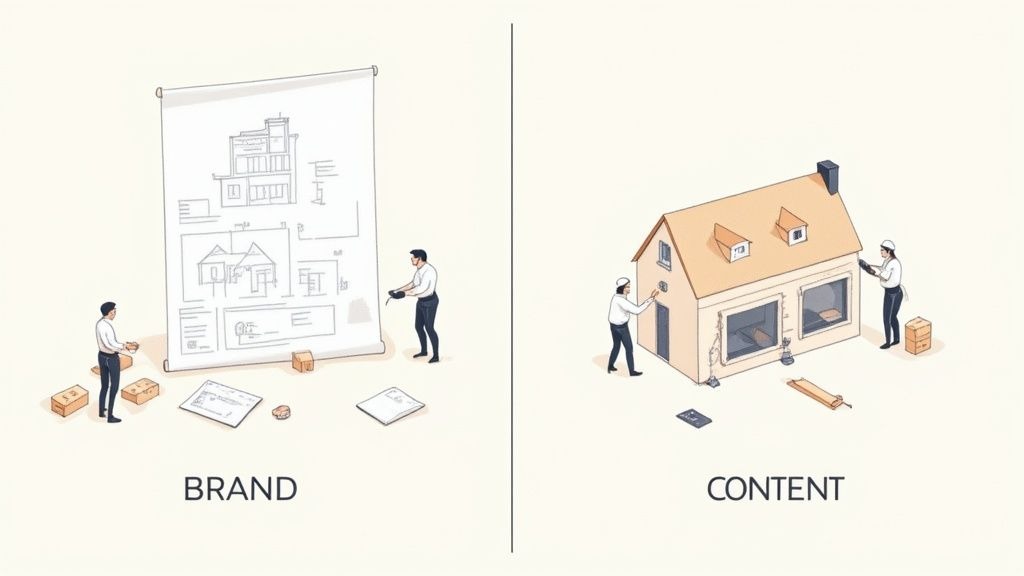
Think of your brand as the architect's blueprint for a house. It lays out the entire structure, the style, and the core purpose of the building before a single brick is ever laid. This blueprint is your DNA, it's your core values, your unique value proposition, who you're talking to, and the voice you use to do it.
Content marketing, then, is the skilled construction crew bringing that blueprint to life. Every blog post, every video, every podcast episode is a room being framed, a window being installed, or a wall being painted. Without that blueprint, the crew would be working blind, building a chaotic structure with no rhyme or reason. It would just be noise.
The Feedback Loop of Brand and Content
This relationship isn't a one-way street; it's a powerful feedback loop. Your brand gives you the "why" that guides every piece of content, making sure it’s all consistent and authentic. In turn, that content actively shows your "why," building real trust and authority with your audience over time.
- Branding guides content: It answers the big questions, like, "What do we really stand for?" and "How should we sound when we talk to people?" This ensures everything you publish feels like it came from the same place.
- Content builds the brand: It offers tangible proof of your expertise and values, turning abstract ideas into real-world value that your audience can actually use.
Without a strong brand, your content will feel directionless and never truly connect. And without consistent content, your brand is just a cool logo with no story behind it. The magic happens when you weave them together. This is the heart of brand storytelling, transforming who you are into narratives that actually resonate with people.
A well-defined brand is your creative compass. It’s the true north for your entire content strategy, ensuring every single thing you create is instantly recognizable and hammers home your unique position in the market.
To see this in action, it helps to look at some effective content marketing strategies. These examples really show how a crystal-clear brand identity informs the kind of compelling content that drives results.
Ultimately, when your brand and content are perfectly aligned, you stop just attracting an audience. You start building a loyal community that genuinely believes in what you're doing.
How To Define Your B2B Brand Narrative
Before you write a single blog post or record a podcast episode, you need to get your story straight. This is your brand narrative, the foundational story that gives every piece of content a purpose. Think of it as the creative compass for your entire branding and content marketing strategy, making sure everything you publish feels authentic and instantly recognizable as you.
A powerful narrative isn't cooked up in a boardroom with a bunch of corporate jargon. It's born from empathy. You have to start by mapping out the real-world struggles of your ideal customer. And I mean really dig in, beyond just surface-level problems. What are their daily frustrations? What are they secretly hoping to achieve? What pressures are they under?
Pinpoint Your Unique Value
Once you're living in your customer's world, it's time to figure out the unique value only you can bring to the table. This isn’t about a laundry list of product features. It’s about clearly stating how you solve their most painful problems in a way no one else can. What’s the unique perspective you have that cuts through the noise?
This unique angle is the beating heart of your brand narrative. It’s the "so what?" that makes your content worth anyone's time in a ridiculously crowded market. Get this right, and your story won't just stand out; it'll hit home.
Develop a Brand Voice Chart
Okay, you've got your story. Now, how does it sound? This is where a brand voice chart comes in. It’s a super practical tool that turns your brand from an abstract idea into a concrete communication style. This simple document is your secret weapon for consistency, no matter who on your team is doing the writing.
Your chart should break down the key personality traits of your brand and give clear dos and don'ts for bringing it to life.
A brand voice chart acts as a practical guide, ensuring every piece of content, from a podcast episode to a social media post, sounds like it came from the same trusted source.
To build one, just define your brand’s personality across a few key dimensions. Here’s a simple template to get you started:
CharacteristicWe AreWe Are NotExampleToneAuthoritative, helpfulCondescending, arrogant"Here’s a proven framework to..." not "It’s obvious that you should..."VocabularyClear, directFull of jargon, complex"Use this tool to get more leads," not "Leverage this solution to optimize conversions."PaceEnergetic, conciseSlow, ramblingUse short sentences and bullet points to get to the point quickly.HumorWitty, clever. Sarcastic, unprofessional. Alight-hearted reference to a shared industry pain point.
Nailing this down is a core part of building a brand that actually works today. For a deeper dive into how all these pieces fit together, check out our guide to a modern B2B brand strategy.
By following these steps, mapping customer pains, defining your unique value, and building a voice chart, you're laying a rock-solid foundation. Your narrative becomes the filter every idea has to pass through, making sure everything you create is coherent, compelling, and consistently on-brand. That's how you turn casual readers into a loyal audience.
Using A Podcast As Your Content And Branding Engine
The single best way to bring your brand and your content marketing together is to start a B2B podcast. In a world full of faceless corporate jargon, a real conversation cuts through the noise. It establishes your voice, builds authority, and serves as a powerful content engine for every other marketing effort.
Your host’s voice literally becomes the voice of your brand. You start building authority and forging genuine relationships with listeners, one episode at a time. This isn’t about just creating another audio file for the sake of it.
It's about seeing the podcast as a powerful content engine, one high-value conversation that can fuel your entire marketing ecosystem with audio, video, written assets, and design. This approach kills the constant need for "more content" while making sure every single thing you publish is perfectly tied to your brand's voice and story.
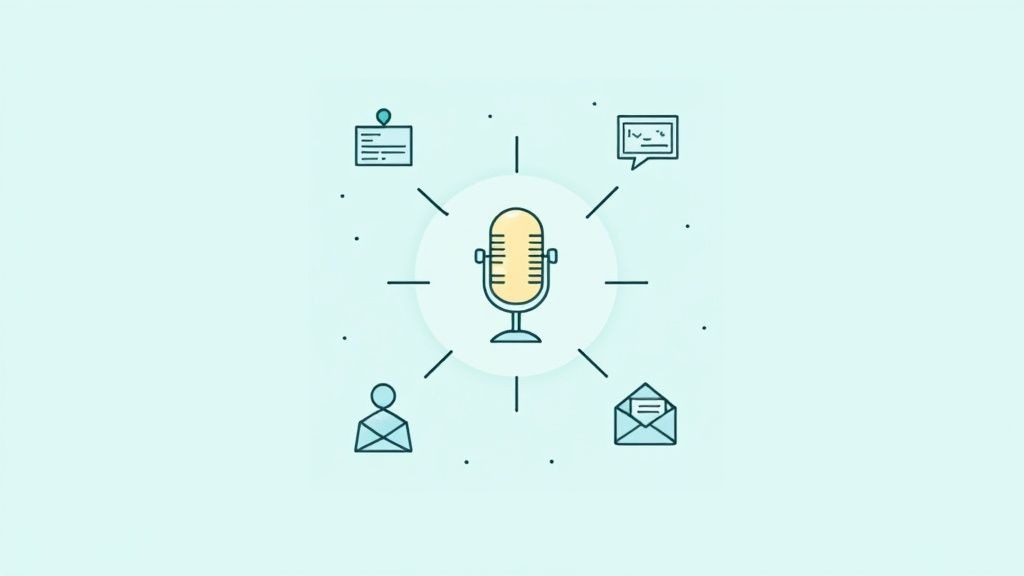
One Conversation Fuels The Entire Flywheel
Just think about what you get from a single one-hour podcast episode. From that one recording, you can spin off a huge library of on-brand content. This is how you build a memorable brand personality at scale without burning out your team.
Here’s how one episode can be chopped up into dozens of assets:
- Short-Form Video: Snag the best 30-60 second clips to create compelling shorts for YouTube, TikTok, and LinkedIn.
- SEO-Optimized Blog Posts: Transcribe the chat and turn it into a deep-dive article targeting the right keywords, complete with show notes and key takeaways.
- Insightful Newsletters: Use the episode's main themes to write a newsletter that actually gives value and pulls people back to the full episode.
- Compelling Quote Graphics: Pull out powerful quotes from your host or guest and turn them into shareable graphics for social media.
This "create once, distribute forever" model is a lifesaver for lean B2B marketing teams. Our guide on podcast content marketing digs into this repurposing strategy in much more detail.
At Fame, we see the podcast as the sun in a content solar system. Every other piece of content, from social snippets to long-form articles, orbits around the central conversations had on the show, ensuring absolute brand consistency.
Why Podcasting Is The Ultimate B2B Branding Tool
A podcast gives your brand something few other formats can: a distinctly human voice. This is absolutely critical in B2B, where trust and relationships are what really drive buying decisions.
You get to build that trust at scale, speaking directly into the ears of your ideal customers while they're commuting, working out, or just winding down.
And don't forget the video. Recording your podcast on video gives you an instant supply of high-quality clips for social media and deeper engagement on platforms like YouTube. Video-first strategies have become central to branding, with multiple surveys showing that around 90% of marketers report video provides a good ROI or has a direct, positive impact on sales.
The Fame Approach To Podcast-Led Growth
Look, building a podcast that actually moves the needle requires more than just hitting "record." You need a real strategy for growth and promotion. As the largest producer of B2B podcasts in the world, we’ve perfected a system that delivers results you can actually measure.
We’re so confident in our ability to grow your show that we offer a unique guarantee: if we don’t hit an average of 10% monthly download growth over the first six months, you get the seventh month of our services for free.
This confidence comes from a battle-tested promotion system and the sheer scale of our operations. With over 100 active shows, we're constantly iterating on what works for guest outreach, production, and promotion.
The results speak for themselves. In fact, 98% of our clients see 10%+ growth every month in their first six months. This translates to an average of 18,957 downloads in the first 6 months and 68,524 downloads in the first 12 months.
By making a B2B podcast the engine of your branding and content marketing, you’re not just creating content. You’re building a sustainable, scalable system for establishing authority and driving real demand.
Building A Sustainable B2B Podcast Production Workflow
So, you’ve decided to make a podcast the main engine for your branding and content marketing. Fantastic. Now for the hard part: building a system to actually make the thing consistently.
Wing it, and you’re signing up for burnout and spotty quality, two things that will actively work against the very brand you’re trying to build. The real goal is to create a repeatable, sustainable workflow that turns great conversations into polished episodes without descending into chaos.
This isn't about dropping a ton of cash on the fanciest gear. It's about having a clear, defined process from start to finish. A solid workflow is the operational backbone of your content strategy, making sure every episode hits your quality bar, goes out on time, and reinforces your professional image.
The Core Stages Of Podcast Production
Every episode, no matter the format, basically moves through the same few stages. When you break the entire process down into these smaller, more manageable steps, it suddenly becomes a lot less intimidating and much easier to handle. Think of it as an assembly line for your content.
Here’s a look at the key stages involved in bringing a single episode to life.
Podcast Production Workflow Stages
This table outlines the essential phases and goals for producing one episode, from the initial idea right through to publishing it for your audience.
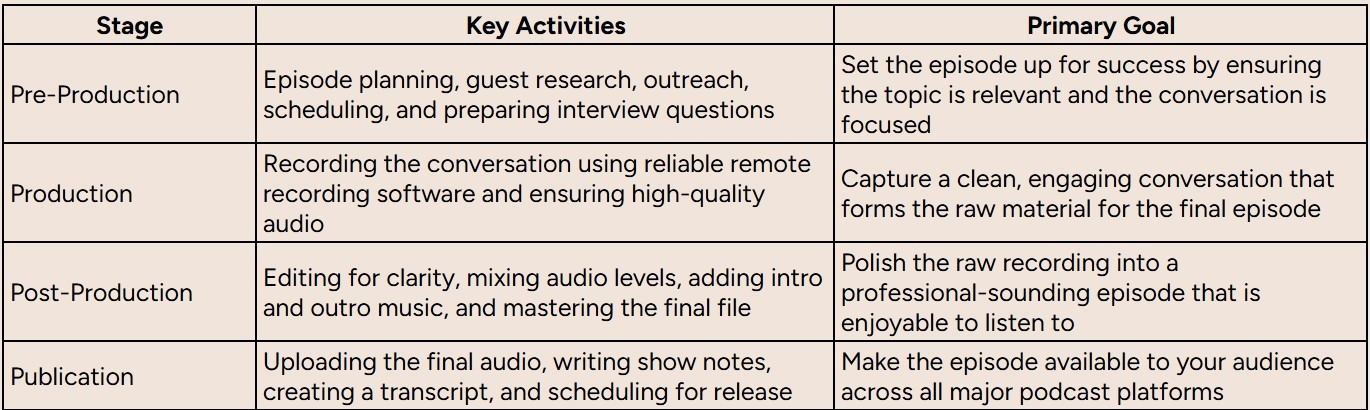
Getting a handle on these distinct phases is the first step toward building a system that actually works for you. If you want to go deeper, our complete guide to the ideal podcast production workflow breaks down each of these steps in much more detail.
Demystifying The Technical Details
This is where a lot of B2B teams get hung up. Which microphone? What software? How do you even edit audio?
While quality absolutely matters, you don't need a pro-level recording studio to get started. A good USB mic and a reliable remote recording platform will get you 90% of the way there. The real secret is to pick your tools and stick with them for consistency.
But let's be honest, managing all these moving parts, scheduling guests, editing audio, writing show notes, and promoting episodes, is a massive time suck. It's the reason so many internal teams start strong and then fizzle out, letting the podcast slide when other priorities inevitably pop up.
The secret to a sustainable podcast isn't just having a workflow; it's having a workflow that doesn't rely entirely on your team's already-stretched bandwidth. Consistency is everything when it comes to building an audience.
This is exactly why so many companies choose to partner with a specialized agency. At Fame, we handle the entire production process, from sourcing and scheduling guests to professional audio engineering and show note creation. We're the largest producer of B2B podcasts in the world, running over 100 shows at any given time. That scale allows us to constantly refine our process, which means we deliver better results, faster.
By handing off the technical and administrative grind, your team is free to focus on what really matters: hosting incredible conversations that build your brand.
An 8-Pillar Framework For Podcast And Brand Promotion
Making a killer podcast is only half the job. If nobody listens, your brand’s voice just echoes into the void.
This is where a real, systematic promotion strategy for both your branding and content marketing becomes absolutely critical. You can't just publish and pray. A great podcast needs an equally great promotional engine behind it to grow an audience and build that all-important brand authority.
At Fame, we’ve spent years building and refining our own 8-pillar promotion framework that turns a podcast into a growth flywheel. This is the exact system that lets us confidently guarantee 10% month-on-month download growth for our clients. And it works, 98% of them hit that target in their first six months.
It’s not just one tactic; it’s a holistic approach where each pillar supports the others, creating compounding returns on your content.
Pillar 1: Video, Audio, And Written SEO
Search engine optimization is your foundation for long-term, organic discovery. Think of your podcast as more than just an audio file. It’s a goldmine of keyword-rich content just waiting for Google and other platforms to find it.
- Actionable Step: Use SEO tools to find relevant keywords your ideal customers are searching for. Incorporate these keywords naturally into podcast titles, descriptions, summaries, and any blog posts you create from the episode.
This simple workflow is how you turn ideas into polished, promotable episodes, again and again.
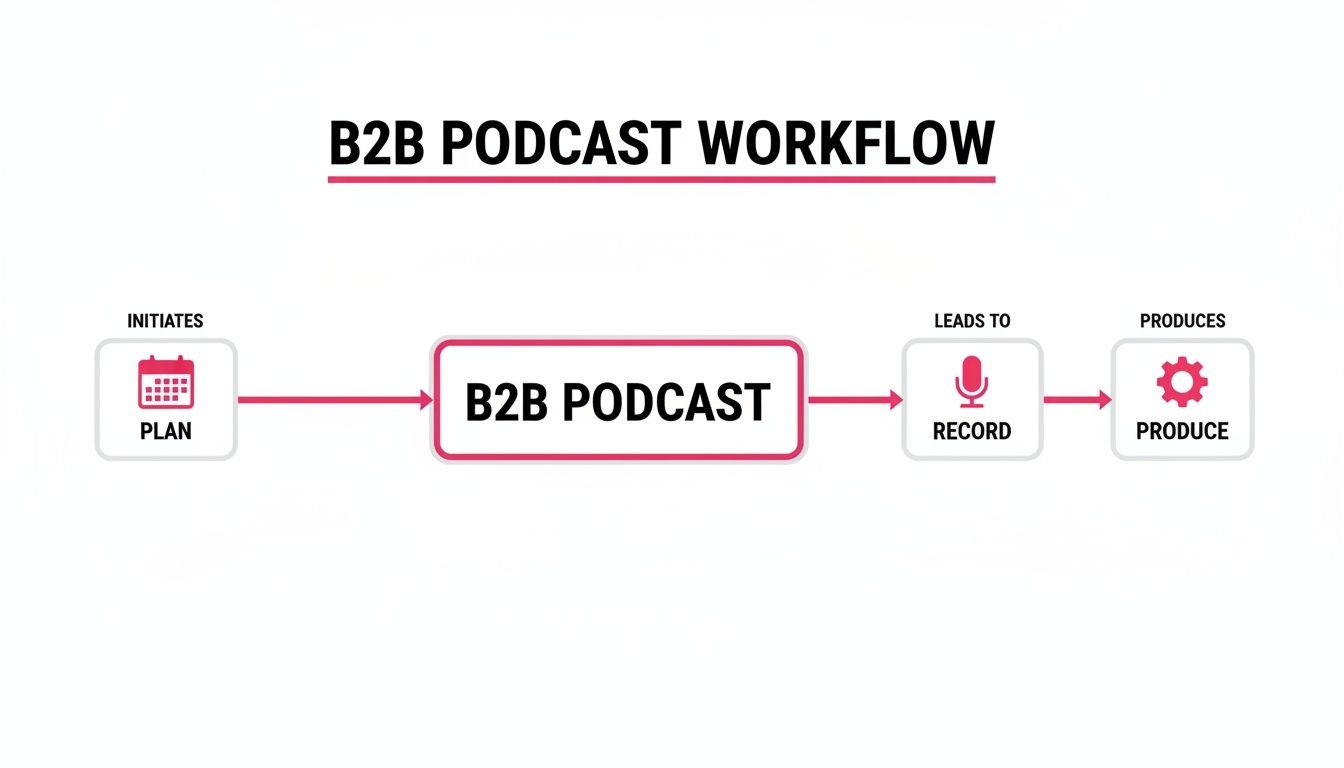
By breaking production into distinct stages, plan, record, and produce, you build a sustainable system that consistently fuels all your promotional efforts.
Pillar 2: Organic Social Media
Your social channels are where you give your podcast a face and a personality. It’s where you can actually talk to your community. A huge part of this is treating YouTube as a primary platform, not just an afterthought.
- Actionable Step: Publish the full video episode on YouTube with an SEO-optimized description, chapters, and captions. Then, select the most valuable 30-60 second clips to create YouTube Shorts and social posts for your most relevant channel (start with one, like LinkedIn, then expand). Create a dedicated LinkedIn page for the podcast to build a focused community.
Pillar 3: Guest Sharing
Your guests are your most powerful promotional weapon. Seriously. They come with a built-in audience that already knows, likes, and trusts them.
- Actionable Step: Make it ridiculously easy for guests to share the episode. Provide them with a promo pack containing easy-to-share links, pre-written social posts, and shareable assets like quote graphics and video snippets highlighting their key insights.
Pillar 4: Partnerships And Communities
If you want to grow your audience, you have to get in front of other people's audiences. It’s that simple. This means you need to be actively looking for collaboration opportunities in your niche.
- Actionable Step: Connect with other podcast hosts, influencers, and blog authors in your space. Propose mutual promotion or arrange for your host to appear as a guest on their shows to tap directly into new listener bases.
Pillar 5: Paid Platforms
Organic is great for building a solid foundation, but paid advertising is how you pour gasoline on the fire. It’s a direct, scalable way to speed up your growth.
- Actionable Step: Allocate a test budget to run targeted ads on platforms where your ideal listeners are active, such as LinkedIn, YouTube, or Reddit. Utilize precise audience targeting to reach your ideal profile and partner with niche influencers for sponsored posts.
The best promotion strategies are multi-channel. When you combine organic SEO, social engagement, and targeted paid ads, you create multiple pathways for new listeners to discover your brand.
Pillar 6: Paid Podcasts
If you’ve got the budget, one of the most direct ways to reach qualified listeners is by advertising on other podcasts in your industry.
- Actionable Step: Identify 3-5 podcasts that your ideal customer profile listens to. Reach out to them to inquire about advertising slots to get your show in front of a highly relevant, engaged audience.
Pillar 7: Cold Email
Don't sleep on the power of a good old-fashioned email. We gather email addresses from website visitors and platforms like Apollo, then segment the list based on interests.
- Actionable Step: Gather emails from subscribers, website visitors, or platforms like Apollo. Create a compelling email campaign with an enticing subject line that highlights a specific episode's value and encourages a download on Apple Podcasts or Spotify.
Pillar 8: Existing Client Assets
Finally, use what you’ve already got. Promote relevant podcast episodes within your existing blog posts and on key pages of your website.
- Actionable Step: Review your top 10 blog posts and find relevant podcast episodes to embed or link to. Integrate your podcast into your B2B social media calendar and email newsletter to ensure your current audience knows about the valuable content you’re creating. You can see a full breakdown of these tactics in our complete podcast marketing strategy.
This integrated approach to branding and content marketing is what delivers real business results. The global content marketing market was valued at about $413.2 billion in 2022 and is projected to hit $2.0 trillion by 2032, which just shows how critical this kind of investment is for growth.
How To Measure Your Integrated Strategy's ROI
So, how do you actually prove this whole podcast-first approach to branding and content marketing is working? You have to look past the easy vanity metrics like download numbers. The real win is connecting your content directly to business results and showing the long-term value of building a brand people trust.
To tell a convincing story with your data, you need to track a mix of leading and lagging indicators. Leading indicators are your early warning system; they show engagement and audience health. Lagging indicators are the ones that tie back to revenue. This balanced view proves that a consistent brand voice pays off in ways a simple spreadsheet can’t always show.
Key Performance Indicators That Matter
Focus your measurement on KPIs that show both brand growth and business impact. This gives you the full picture, from someone just discovering your show to becoming a customer.
- Audience Growth: This is the foundational metric. Are more people listening this month than last? At Fame, we are so confident in our promotion framework that we guarantee 10% monthly download growth for the first six months.
- Listener Retention: Check your episode completion rates. If people are sticking around until the end, you know your content is hitting the mark, and your brand message is connecting.
- Website Traffic: Jump into your analytics and measure referral traffic from show notes, blog posts you’ve repurposed from episodes, and social media clips. This is a direct line from your podcast content to your website.
- Qualified Leads: Track conversions from podcast-specific calls-to-action. This could be a dedicated landing page for a special offer you mentioned or an exclusive download only available to your listeners.
Connecting Content to Business Outcomes
Ultimately, the goal is to show how your investment in content turns into a return. And with many companies spending big, some reports show 58% of companies spend $5,000–$10,000 per month on content, proving ROI is not optional. You can see more on how modern content spending is evolving with insights from Power Digital Marketing.
As you dig into the financial success of your strategy, it's also smart to understand how to measure your paid channels. Getting a handle on achieving ROI in advertising gives you a benchmark for your whole marketing ecosystem. It lets you compare how efficiently your organic podcast efforts are performing against your paid campaigns, giving you the complete financial picture.
True ROI isn't just about the numbers. It’s a blend of quantitative data (leads, traffic) and qualitative feedback (audience comments, brand sentiment). It's that combination that proves your podcast isn't just being heard, it's building a brand people trust and want to do business with.
By tracking these metrics, you can shift the conversation from "How many people listened?" to "How did our content influence the pipeline?" That's the key to securing the budget and executive buy-in you need to keep your podcast, and your entire content strategy, growing.
Got Questions? We've Got Answers
You're probably thinking about how this all fits together. Here are some of the most common questions we get about using a B2B podcast as the engine for your branding and content.
How Long Does This Actually Take To Work?
Look, if you're looking for an overnight success story, podcasting isn't it. While you'll start building brand buzz from the moment you hit publish on episode one, the real, measurable traction, think audience growth and actual leads, starts to show up around the 6 to 9-month mark.
Podcasting is a marathon. The magic is in the consistency. A steady, reliable rhythm of high-quality episodes and promotion is what earns trust and builds an audience that actually cares about what you have to say.
What's The Biggest Mistake People Make With This Stuff?
Easy. Treating branding and content like they're in different departments. It's the most common and expensive mistake we see.
When your brand's 'why' is totally disconnected from your content's 'what,' you get a jumbled mess of messages. It confuses your audience, tanks your credibility, and makes it impossible to build any real authority. A unified strategy isn't just a nice-to-have; it's the whole game.
Can I Really Repurpose Content Without Sounding Like A Broken Record?
Absolutely, and you must. Smart repurposing isn't just copying and pasting chunks of text. It's about taking a single, powerful idea and translating it for different platforms and mindsets.
Think about it this way: a deep-dive, hour-long podcast interview can become a sharp, tactical text post on LinkedIn. It can be a visual, easy-to-digest carousel on Instagram. And it can be a detailed, SEO-rich article on your blog. Same source, completely different experiences.
Each piece of repurposed content should feel native to where it lives, offering unique value on its own.
Do I Need A Hollywood-Level Studio To Start A Podcast?
Definitely not. While a pro setup is nice, it’s not what makes or breaks a show in the beginning. You can get fantastic results with a solid USB microphone and some decent remote recording software.
Honestly, the most important thing is the quality of the conversation and making sure the audio is clear. No one cares about the price tag on your gear if the insights are garbage. Start with delivering real value, and you can always upgrade the tech as your show gains momentum.
Ready to put a B2B podcast at the center of your brand and content strategy? At Fame, we don't just produce shows; we build media assets. We handle everything from production to our 8-pillar promotion system that guarantees 10% month-on-month download growth. See how we do it at Fame.
Want us to run this for you?
Fame starts and grows B2B podcasts that generate pipeline. Tell us who you are trying to reach and we will send a costed proposal within 48 hours.
Related content
- Read moreFame Team · July 16, 2026
10 Account Based Marketing Tactics For B2B Growth In 2026
Discover 10 actionable account based marketing tactics for B2B tech. Learn to use podcasts, data, and targeted content to close high-value accounts. - Read moreFame Team · July 16, 2026
The 8 Best Brighton Podcast Agency Picks For 2026
Find the best Brighton podcast agency for your B2B brand. Our 2026 guide reviews top 8 agencies for production, growth & ROI. Expert analysis here - Read moreJune 10, 2026
20 Best Podcast Production Agencies For 2026 (And Why Should You Hire One)
Global podcast and vodcast ad revenues are on track to hit $5 billion in 2026 , up 20% year-on-year. - Read moreApril 13, 2026
Leadership In Marketing: The B2B Podcast Playbook
Most companies still confuse leadership in marketing with job titles, org charts, and budget control. That's outdated.