
Key Takeaways
- A branded B2B podcast is the most effective way to build authority and establish yourself as a thought leader.
- Podcasting helps create a personal connection with listeners, building trust and loyalty with potential customers and partners.
- Consistently educating your market through a podcast makes you the go-to authority, increasing the chances of being considered when clients are ready to buy.
Marketing thought leaders aren't just experts; they're the influential voices who genuinely shape industry conversations. They get there by consistently sharing unique, valuable insights, and the single most effective way to build that authority today is through a branded B2B podcast.
Why a podcast? Because it’s a powerful content engine, not just another marketing channel. For executives, it's the best way to elevate your position in the market. You educate your potential customers and your peers, establishing yourself as the leading voice in the industry. As a result, your ideal clients will think of you first when they're ready to buy. It’s a great way to build trust and loyalty while creating a sustainable content engine for all your marketing efforts.
Why Podcasting Is Your New Authority-Building Playbook
In a world drowning in generic blog posts and social media updates that disappear in minutes, how do you actually stand out? How do you build a personal brand that lasts? The answer is in the raw, unfiltered power of audio.
For executives serious about becoming recognized thought leaders, a B2B podcast has become the most direct and effective path.
Unlike text, the sheer intimacy of audio forges a real, personal connection with your listeners. Your voice—your actual voice—carries nuance, personality, and conviction that written words just can't replicate. This builds a foundation of trust and loyalty with potential customers and partners long before a sales call ever enters the picture.
The Strategic Value of Expert-Led Content
Let's be honest, today's B2B decision-makers are sharp. They aren't scrolling aimlessly; they're actively seeking out expert content to vet potential partners. Thought leadership isn't a "nice-to-have" anymore—it's a core part of their buying process.
The numbers don't lie. A massive 65% of decision-makers spend at least an hour every week consuming this kind of content. Even more telling, 55% use it specifically to decide which vendors to work with. The 2025 Edelman-LinkedIn report has even more on how executives use this content to make buying decisions.
This means your podcast isn't just another asset. It's a strategic tool that gets in front of your ideal clients at every stage of their journey. By consistently educating your market, you become the go-to authority, making sure you're the first one they think of when they're ready to buy. For a deeper dive, check out our guide on the core principles of marketing thought leadership.
To put this in perspective, let’s compare a podcast-led approach to more traditional methods.
Podcast-Led Authority vs Traditional Content Marketing
It's not that blogs and social media are dead, but a podcast-centric strategy simply builds authority in a way they can't match on their own.
Ultimately, a podcast gives you a direct line to your audience's ears, creating a much stronger, more memorable brand presence.
Turning Your Podcast into a Content Engine
This is where the real magic happens. The biggest advantage of this whole approach is its incredible efficiency. A single podcast episode is the seed that can grow into a dozen other marketing assets. You’re not just making a podcast; you're creating a sustainable content machine.
"A podcast is not just about the audio. It’s the nucleus of your entire thought leadership strategy. One hour of recording can generate weeks of high-value content, from social clips and articles to newsletter highlights and quote graphics."
— Tom Hunt, Founder of Fame
Think about it this way: one conversation becomes…
- Video Clips: Short, punchy clips for LinkedIn and YouTube that grab attention instantly.
- Blog Posts: The transcript gets turned into a detailed, SEO-friendly article that pulls in organic traffic.
- Newsletter Content: Key insights and killer quotes become the perfect material for your next email send.
- Social Media Graphics: Pull-quotes and key takeaways are transformed into eye-catching graphics for all your social channels.
This model flips your thinking from, "a podcast is one more thing to do," to "my podcast is the heart of my entire influence strategy." It's hands-down the most effective way to build authority, educate your market, and create a system that fuels all of your marketing.
Building Your Strategic Foundation Before You Record
A fancy microphone won't make you a thought leader, but a sharp strategy will. Before you even think about hitting "record," you need a rock-solid foundation that defines your podcast's entire purpose and carves out its unique space in the market.
Honestly, this initial work is what separates the shows that fizzle out after ten episodes from the ones that build real, lasting influence.
The very first thing to do is get ruthless about your niche. You can't be a thought leader for everyone. The goal isn’t to cover a huge topic like "marketing" but to own a specific, valuable corner of it. Think "go-to-market for vertical SaaS" or "brand building for deep tech startups."
This kind of focus lets you go deeper than anyone else and attracts a hyper-dedicated audience who will hang on your every word.
Not sure where to start? Run through these questions:
- What specific problem are you uniquely qualified to talk about? Dig into your own experience, your company's core expertise, and the biggest headaches your best clients face.
- What's your angle? What can you say that challenges the status quo? True thought leaders don't just report the news; they offer a distinct, sometimes controversial, point of view.
- Where’s the gap in the conversation? Listen to the other podcasts in your space. What aren't they talking about? That silence is your opportunity.
Crafting Your Show's Unique Position
Once you’ve nailed your niche, it’s time to craft your positioning. This is your show's promise to the listener. It clearly states who the show is for, what problem it solves, and why it's different from the hundred other things they could be listening to.
A strong positioning statement becomes your North Star, guiding every single content decision you make. For instance, instead of a bland "A podcast about B2B marketing," your positioning could be: "Growth Unlocked is the weekly podcast for B2B tech marketers tired of fluffy advice, giving them actionable playbooks for driving real pipeline in crowded markets."
See the difference? Your ideal listener immediately knows, "This is for me." For more inspiration, explore these effective brand positioning strategies.
A podcast without a clear strategy is just a hobby. A podcast aligned with specific business goals becomes a powerful asset for generating leads, building brand equity, and educating your market.
Your show's goals have to tie directly back to your larger business objectives. Are you trying to build a pipeline for a new service? Educate a new market on your category of tech? Or maybe you're building brand authority ahead of a funding round. Define these goals upfront so you can actually measure what matters.
Transforming Your Strategy into a Content Engine
Your podcast should never be a standalone activity; it's the heart of a powerful content engine that can fuel your entire marketing effort. As you map out your strategy, it's worth looking into AI-powered tools like lunabloomai's starter app, which can give you a serious leg up in streamlining your content workflows from day one.
This is how we think about it—a single episode becomes the source for a whole universe of marketing assets that amplify your message.
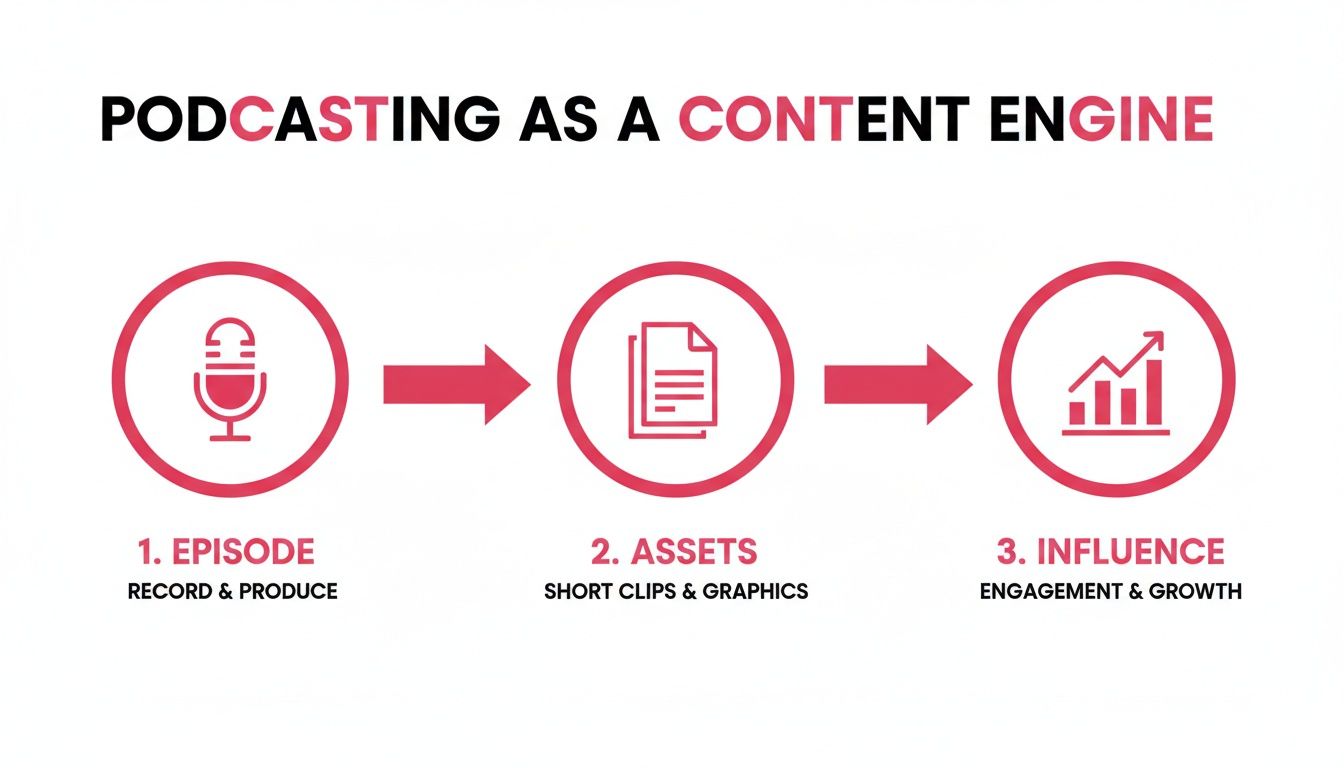
This simple flow shows just how efficient a podcast-led strategy can be, turning one core piece of content into dozens of touchpoints across different channels. By investing in this strategic planning phase now, you ensure every single episode is a deliberate step toward becoming a recognized marketing thought leader.
To get more granular, our guide on planning a podcast provides a detailed framework to structure your thinking. Trust me, this initial investment of time and thought will pay dividends, creating a focused, high-impact show that attracts your ideal clients and elevates your position in the market.
Creating Content That Positions You as an Authority
A great strategy gives you a map, but it's the content itself that builds your reputation as a thought leader. This is where the rubber meets the road—where you shift from planning to actually creating episodes that deliver so much value, your audience can't help but see you as an authority.
The secret isn't just talking about your industry. It's offering a unique, defensible "take" on what's happening.
Developing Your Core Content Pillars
To create consistently valuable content, you need to operate from a set of core content pillars. Think of these as the 3-5 foundational topics that directly reflect your niche expertise and the biggest headaches of your ideal listener. They act as your North Star, ensuring every episode you record is hyper-relevant and reinforces your positioning.
Let's say your niche is "GTM for vertical SaaS." Your pillars might look something like this:
- Ideal Customer Profile (ICP) Deep Dives: Analyzing the specific needs and buying triggers within niche verticals.
- Partnership & Channel Sales Playbooks: Actionable strategies for building an ecosystem to drive growth.
- Category Creation & Narrative Design: How to define and own a new market category.
- Pricing & Packaging for Niche Markets: Strategies for monetizing value in specialized industries.
These pillars are your guardrails. They stop you from drifting into generic topics and keep your show laser-focused, which is exactly what busy executives crave. They want deep expertise, not a grab-bag of random interviews.
Going Beyond Reporting to True Analysis
The single biggest mistake I see aspiring thought leaders make is simply reporting on industry news. True authority comes from interpreting what's happening and telling your audience what it means for them.
This isn't just a stylistic choice; it's a strategic one. Marketing leaders are actively tuning out filler content. In what many CMOs are calling a 'no-BS year,' a full 65% of executives crave 'takes' that challenge their assumptions and interpret trends, not just rehash them. And there's a reason for that—win rates improve by a significant 18% when audiences are exposed to this kind of sharp, actionable storytelling. You can read more about these evolving priorities for marketing leaders at Attentive.com.
Don't just tell your audience that a new technology exists. Tell them how it will upend their current strategy, what three actions they need to take this quarter, and what common pitfall they need to avoid. That's the analysis they can't get anywhere else.
Balancing Solo Episodes with Guest Interviews
A powerful thought leadership podcast strikes a balance between two core formats: solo episodes and guest interviews. Each serves a different, but equally important, purpose in building your authority.
- Solo Episodes: This is your stage. It's your chance to present your core frameworks, share your unfiltered opinions, and go deep on your content pillars. It's a direct line to your brain and the fastest way to build credibility.
- Guest Interviews: These episodes expand your network and bring fresh perspectives to your audience. The key is to treat guests not as celebrities, but as sources of unique insight. Your job as a host is to be a skilled extractor of non-obvious ideas—the stuff your listeners haven't heard on ten other podcasts. For more actionable advice, here's how to prepare for your next podcast guest appearance.
Alternating between these formats shows your audience that you have both deep knowledge of your own and that you're a well-connected industry insider. That combination is a key ingredient for creating robust thought leadership content.
To pull this off, you have to do the prep work. Before any interview, dive into your guest's recent work so you can push past their standard talking points. For your solo shows, outline your key arguments and have specific, real-world examples ready to go. This level of preparation ensures every minute of your show delivers undeniable value, cementing your status as the go-to voice in your field.
Mastering Your Production Workflow Without the Headache
The technical side of podcasting can feel pretty intimidating. Honestly, it stops a lot of would-be thought leaders cold before they even hit record.
But here’s the thing: getting pro-level audio quality is way more accessible than you think. It's less about building a Hollywood-grade studio and more about setting up a simple, repeatable system that just works.
The real focus shouldn't be on the gear, but on a slick process that respects your most valuable asset: your time. A solid workflow gets the tech headaches out of the way so you can focus on what you actually do best—sharing your expertise. Our partners at Castos, who provide world-class podcast hosting, often emphasize that a streamlined workflow is the secret to long-term podcasting success.
Assembling Your B2B Podcasting Toolkit
You don't need to break the bank to sound great. Seriously. The key is to invest in a few essential pieces of kit that deliver clear, crisp audio. Forget the complicated mixing boards and studio arms for now; your initial setup can be dead simple.
Here’s what you actually need to get rolling:
- A Quality USB Microphone: This is your most important purchase. Models like the Blue Yeti or Rode NT-USB+ offer fantastic quality for the price and plug right into your computer. No fuss.
- Decent Headphones: A good pair of over-ear headphones is non-negotiable for monitoring your audio while you record. They kill echo and let you hear exactly what your audience will.
- Remote Recording Software: Since most B2B podcasts feature guests dialing in, you need reliable software for remote interviews. Platforms like Riverside.fm or Zencastr are built for this, recording separate audio tracks for each person to guarantee high quality.
This minimalist setup is all it takes to produce a professional-sounding show. As you grow, you can always explore fancier gear, but these fundamentals are more than enough to get your voice out there. For a complete breakdown, check out our B2B podcast equipment guide.
It's a common myth that you need super expensive equipment to be taken seriously. The truth? Your audience cares a hell of a lot more about the quality of your insights than the brand of your microphone. Clear audio is the goal, not a perfect studio.
Designing a Simple and Repeatable Workflow
Consistency is the engine of authority. A well-defined workflow is how you produce high-quality episodes on a regular schedule without completely burning out. This system covers everything from prepping your guests to the final edits.
Think of it as a checklist that turns a complex process into a series of small, manageable tasks. A solid podcast production workflow is your secret weapon for staying efficient and consistent.
An effective system really just boils down to three key phases:
- Pre-Production: This is all about prep. It means scheduling the guest, sending them a simple doc with talking points, and doing a quick tech check before you hit record. Nailing this phase ensures the recording session is smooth and the conversation just flows.
- Production (Recording): During the recording itself, your main job is to guide a great conversation. Make sure you and your guest are in a quiet space with a stable internet connection. A simple pro-tip: record a few seconds of "room tone" (just silence) at the beginning. It makes the editing process so much easier later on.
- Post-Production: This is where the raw audio gets polished into a final episode. It includes editing out mistakes, adding your intro/outro music, and mastering the audio so the volume levels are consistent.
While you can definitely handle this in-house, many executives choose to partner with a specialized B2B podcast agency. This lets you offload all the technical and admin grunt work, shrinking your time commitment down to just the recording itself. This kind of partnership frees you up to focus entirely on being the thought leader, not the audio engineer.
Amplifying Your Voice with Smart Distribution
Look, recording a brilliant podcast episode is only half the battle. If nobody hears it, your expertise might as well be invisible. A smart, multi-channel distribution strategy is what separates the real marketing thought leaders from those just shouting into the void. It’s how you turn a single recording into a constant, authoritative presence right where your ideal clients are hanging out.
First things first, you need to get the basics right. Optimize for discovery where people actually listen to podcasts. That means getting your show properly submitted and categorized on the big players like Apple Podcasts and Spotify. A descriptive show title, detailed episode notes stuffed with relevant keywords, and compelling cover art are non-negotiable.
But let's be honest, a truly effective strategy goes way beyond just publishing an audio file. It means treating your podcast as the core of a powerful content engine.
Turning One Episode into Dozens of Assets
The most efficient thought leaders don't just create more content; they create smarter content. The secret is systematically repurposing every single podcast episode into an army of assets, each one tailored for a different channel and a different way people consume information. This isn't just about getting more listeners—it’s about hammering home your message across every touchpoint, cementing your authority.
This means breaking down your conversation into its most valuable pieces:
- Short-Form Video Clips: Find the most insightful 30-60 second moments. These are gold for LinkedIn, X (formerly Twitter), and YouTube Shorts. Slap on some captions, and they're instantly consumable in a silent feed.
- Audiograms: Create those slick, waveform-style videos with a killer quote. They're perfect for social platforms where video grabs attention, but your audience might not commit to a full clip.
- In-Depth Blog Posts: Take the episode transcript and use it as the backbone for a detailed, SEO-optimized article. Suddenly, an audio conversation becomes a searchable asset that pulls in organic traffic for years to come.
- Quote Graphics: Design some sharp, visually appealing graphics with powerful quotes from you or your guest. These are ridiculously shareable and great for reinforcing the main takeaways.
- Newsletter Content: Feature the episode's highlights, key insights, and a direct link to listen in your next email. Easy win.
To really broaden your reach beyond the usual podcast platforms, you have to think about smart content repurposing strategies that adapt your audio for other mediums. It's all about meeting your audience where they are, in the format they actually prefer.
Automating Amplification for Maximum Impact
Managing this level of multi-channel promotion can quickly become a full-time job. This is where leaning on specialized services can make all the difference, letting you focus on creating great content while a dedicated team handles the amplification.
The goal is to build a system where your voice is consistently present and adding value across the entire ecosystem your ideal customer inhabits. It's about being everywhere they look, without you having to manually be everywhere at once.
This is exactly why integrating with a B2B social media agency or a B2B email newsletter agency can be so powerful. They can take the assets you've spun out of your podcast and systematically get them in front of the right people, ensuring your message gains traction and builds momentum. This isn't a "nice-to-have"; it's essential for any serious marketing thought leader.
The impact of this approach is real and measurable. High-performing thought leadership formats deliver 1.8x better results than standard digital ads and a nearly 3x uplift in purchase intent. For B2B firms, this data proves that expert-led audio is a superior way to build true 'Information Gain,' which earns AI citations and boosts branded searches by 25-30%.
For a deeper dive, check out our B2B guide to distributing a podcast. It breaks down the specific steps to make sure your message not only reaches your audience but actually resonates.
Your Top Questions About Thought Leadership Podcasting, Answered
Jumping into podcasting, even for seasoned execs, can feel like a huge leap. It's totally normal to have questions about the time, the investment, and what you’ll actually get out of it. Let's dig into the big questions that come up time and again when B2B leaders think about launching a show.
How Do I Actually Measure the ROI of a Podcast?
When you’re trying to pin down the ROI of a thought leadership podcast, download numbers are just the tip of the iceberg. The real gold is in the qualitative signals—the little things that tell you the right people are listening and your message is hitting home.
Forget vanity metrics for a second and think about what genuine influence looks like:
- DMs from Dream Clients: Are ideal customer profiles sliding into your LinkedIn messages saying they love the show? That's a massive leading indicator.
- The "How'd You Hear About Us?" Field: When prospects start writing "your podcast" in that form field, you’ve got a direct line from content to lead. It doesn't get much clearer than that.
- Faster Sales Cycles: Keep an eye on prospects who are listeners. Do they move through your pipeline faster? They should. They’re coming to the table already trusting you and understanding your point of view.
- Content-Assisted Pipeline: Get your sales team in on this. A simple, "By the way, have you checked out our podcast?" can help attribute real influence to deals in the pipeline.
Of course, you’ll also want to watch for a lift in branded search and referral traffic from podcast apps. And while a service like Fame can lock in that foundational download growth, the true ROI for a thought leader shows up in better inbound leads and the kind of brand authority that gets you a seat at tables you weren't invited to before.
Seriously, How Much Time Does This Take?
This is the big one. For busy leaders, the time commitment is a very real—and very valid—concern. The honest answer? It depends entirely on how much of the grunt work you take on yourself.
If you go the DIY route—handling guest outreach, scheduling, prep, recording, editing, sound engineering, and promotion—you’re easily looking at 8-10 hours of work for every single episode. That’s a fast track to burnout for most executives.
But the goal isn't to add "podcast producer" to your resume. The goal is to focus on the one thing only you can do: share your unique expertise.
The most effective thought leaders delegate the mechanics so they can concentrate on the message. Your time is far too valuable to be spent wrestling with audio software; it belongs in the high-value conversations themselves.
When you bring in a dedicated B2B podcast production agency, you can shrink that time commitment down to just 1-2 hours per episode. And that time is spent purely on the part you enjoy—the recording. The agency runs the entire machine in the background, from strategy and guest logistics to post-production and creating all your promotional clips and graphics. It’s how you build a personal brand without getting sucked into the operational vortex.
What Are the Biggest Mistakes I Need to Avoid?
I’ve seen a lot of promising podcasts fizzle out. It's rarely because the host isn't an expert. More often, they just trip over a few common, and totally avoidable, pitfalls. Getting ahead of these is key to building real momentum.
Here are the top five landmines to watch out for:
- No Real Strategy: Just hitting "record" without a clear niche, a defined listener, or a unique angle. This is how you end up with generic content that never finds a loyal audience. If you need a refresher, make sure you know how to craft a winning thought leadership content strategy.
- Publishing "Whenever": Dropping episodes randomly is the fastest way to kill momentum and lose your audience's trust. A predictable schedule is non-negotiable for building a habit with your listeners.
- Bad Audio Quality: Nothing screams "amateur" louder than terrible sound. If you sound like you’re recording in a tin can, people will tune out in seconds, and your credibility takes a massive hit.
- The "Me, Me, Me" Show: A thought leadership podcast isn't a 30-minute sales pitch for your company. Your job is to solve your audience's problems. Focus on delivering insane value, and the business will naturally follow.
- Forgetting to Promote: The "if you build it, they will come" mindset is a death sentence for podcasts. A great show will not market itself. You absolutely must have a solid plan for distribution and amplification from day one.
Steer clear of these classic blunders, and you’ll be on the right track to turning your podcast into a powerful asset that solidifies your status as a true authority in your space.
Ready to build your authority and drive real business results with a B2B podcast? Fame handles the entire production and promotion process so you can focus on sharing your expertise. Book a call to learn how we can turn your insights into influence.
