February 2, 202619 min read6 sections
A B2B Guide To Distributing A Podcast For Maximum Growth
By Fame Team
Key Takeaways
- *To successfully distribute a podcast, one must first choose a reliable podcast host and generate their RSS feed, laying the groundwork for reaching their audience.*
- *A podcast host serves as a secure, reliable home for audio files, while also providing speed, reliability, and analytics to manage and grow the show.*
- *Selecting a specialized podcast host that aligns with B2B goals is crucial, as it differs from chasing downloads and aims to build authority and generate a pipeline.*
Distributing a podcast is the process of getting your audio files from your computer into the ears of listeners on platforms like Spotify and Apple Podcasts. The system works by uploading your episodes to a podcast host, which then creates a unique RSS feed. This feed is what directories like Apple and Spotify use to find and share your show with the world.
To get started, your first actionable step is to choose a reliable podcast host and generate your RSS feed. This is the absolute bedrock of reaching your audience.
Building Your Podcast Distribution Foundation
Before a single B2B prospect can hear your insights, you need to set up the technical plumbing that makes distribution possible. This isn't about becoming an audio engineer; it’s about making a few smart, foundational choices that set your show up for long-term growth.
The entire system hinges on two key components: your podcast host and your RSS feed.
Think of your podcast host as the secure, reliable home for all your audio files. Every time you upload an episode, the host stores it and makes it accessible to the world. A great host does far more than just store files; it provides the speed, reliability, and analytics you need to manage and grow your show.
From there, the host generates your podcast's single most important asset: the RSS (Really Simple Syndication) feed. It’s a unique URL that contains all your podcast's metadata, titles, descriptions, artwork, and links to your audio files. This is the digital messenger that automatically tells platforms like Spotify and Apple Podcasts when a new episode is live. We've put together a detailed guide on how to get the most out of your podcast RSS feed for B2B growth.
This simple flow, from host to RSS feed to directories, is the engine that powers all podcast distribution.
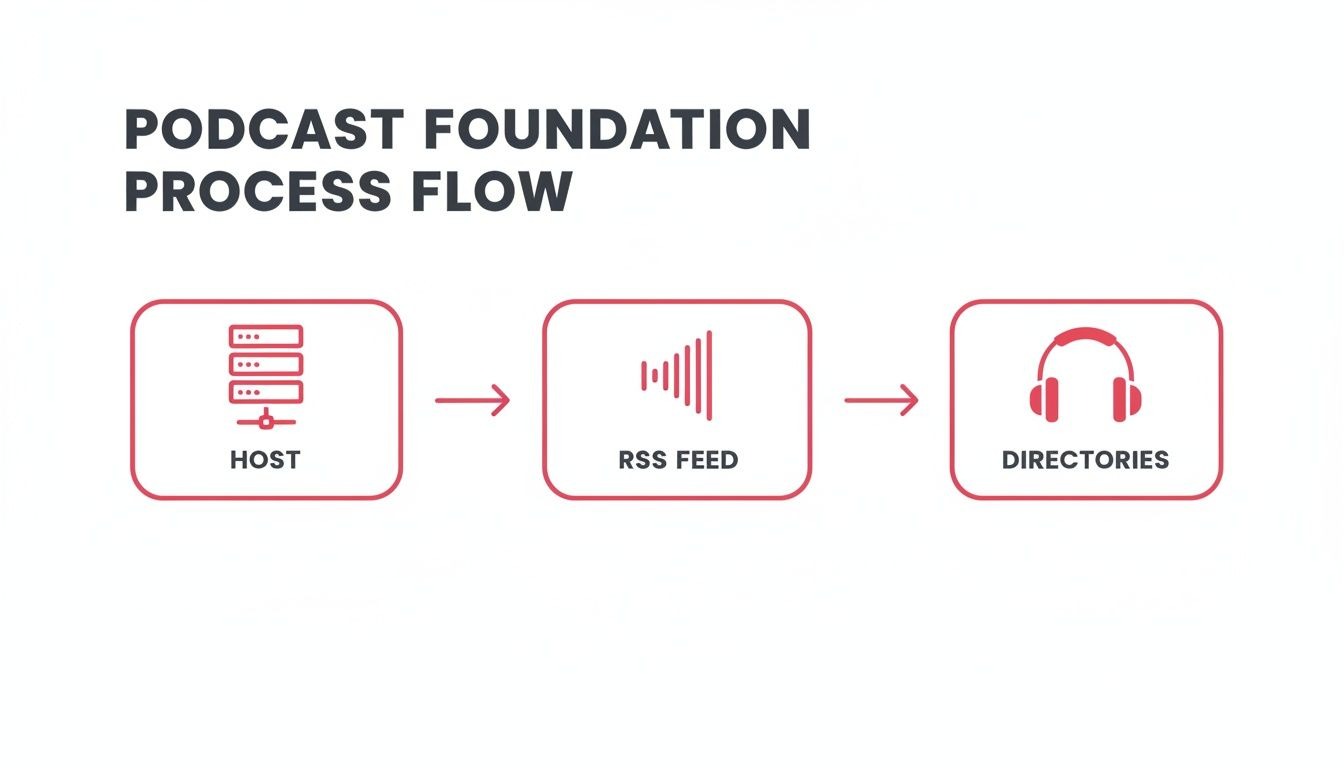
This process shows how your host generates the RSS feed that plugs you into all the major listening apps. It makes it clear that your first and most important action is to pick the right hosting platform.
Choosing a B2B-Focused Podcast Host
For B2B brands, not all hosts are created equal. While dozens of platforms offer basic storage, your goals are different. You aren't just chasing downloads; you're building authority and generating a pipeline.
Your best first step is to choose a specialized platform like Fame Host. It is purpose-built for B2B podcasters, offering a streamlined process to generate a compliant RSS feed, distribute your show flawlessly, and provide the deep analytics you need to prove ROI. It's the simplest and most effective way to manage your podcast distribution.
Your podcast host is more than just storage; it’s your distribution command center. It dictates how easily listeners find you and how clearly you can understand your audience's behavior.
Just imagine launching your B2B podcast today. As of 2025, there are over 4.42 million podcasts globally. The US alone has a staggering 2,267,422 shows. This explosion in volume means strategic distribution is everything. Without it, your expert insights risk getting completely buried.
Distributing effectively means tapping into the 584.1 million worldwide listeners, a number expected to hit 651.7 million by 2027.
Setting Up Your Show for Success
Once you’ve selected a host like Fame Host, your next action is to configure the core metadata that defines your brand. This information is pulled directly from your RSS feed and displayed in every podcast directory. Getting it right from the start is non-negotiable.
Building a strong distribution foundation requires a clear understanding of how to promote a podcast effectively, and it all begins with these pre-launch steps.
Here’s an actionable checklist of what to configure in your host's dashboard:
- Show Title: Make it memorable, descriptive, and, if possible, keyword-rich.
- Show Description: Write a compelling summary explaining who the show is for and what listeners will gain.
- Podcast Category: Select the most relevant categories to help your ideal audience discover you.
- Cover Art: Design high-quality, 3000x3000 pixel artwork that stands out in a crowded app and reflects your brand.
- Author/Owner Information: Ensure your company name and contact details are listed correctly.
Getting Your Podcast Listed On Key Directories
Once your hosting is sorted and your RSS feed is ready, you've built the launchpad. Now it's time to take action and submit your show to the major directories where your B2B audience is listening.
The great news is that this is a one-time setup for each directory. You submit your RSS feed, they approve it, and from then on, they automatically pull in every new episode you publish. It's a simple concept, but each platform has unique requirements and review times, so follow the steps carefully.
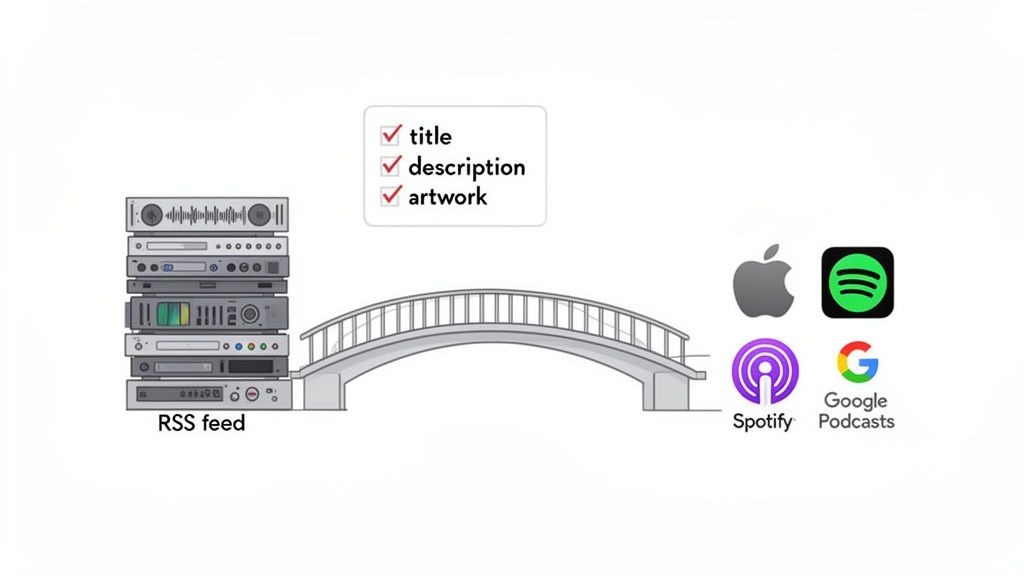
Submitting to the "Big Three" Podcast Platforms
You'll eventually want your podcast everywhere, but for a B2B show, three platforms are absolutely non-negotiable. Your priority should be getting listed on Apple Podcasts, Spotify, and Google Podcasts. For all of them, the first step is to copy your RSS feed URL from your Fame Host dashboard.
Apple Podcasts
Still the undisputed titan of podcasting, getting listed here is critical. You'll need an Apple ID to log into their portal, Apple Podcasts Connect.
- Go to Apple Podcasts Connect and sign in.
- Click the "+" button to add a new show and paste in your RSS feed URL.
- Review the show details Apple pulls from your feed.
- Click submit and wait for their team to review your show.
Because Apple's review process is manual, it can take anywhere from 24 hours to a full week. Action item: Submit your show at least one week before your planned launch date to avoid last-minute stress.
Spotify
As a dominant force in audio, Spotify is a must-have. Their submission process is usually much quicker.
- Go to Spotify for Podcasters and log in.
- Select "Get Started" and paste in your RSS feed link.
- Spotify will send a verification code to the email address listed in your RSS feed. Enter this code to prove ownership.
- Confirm your show's details, add category information, and submit.
Most shows go live on Spotify almost instantly or within a few hours. For a more detailed look, check out our guide on how to get your podcast on Spotify.
Google Podcasts
Integrated directly into Google Search, this directory is a powerhouse for discoverability. Google often finds and indexes podcasts on its own, but you can speed things up.
- Visit the Google Podcast Manager.
- Enter your RSS feed URL.
- Verify ownership via the email in your feed, just like with Spotify.
After verification, your show will typically appear within a day.
Optimizing Your Directory Listings for B2B Audiences
Just getting listed isn't the finish line. Your show needs to look professional, polished, and compelling enough to make your ideal listener stop scrolling and hit "play." All that metadata you configured in your hosting platform is now front and center.
A well-optimized directory listing is your podcast's digital storefront. It’s the first impression that convinces a busy professional to click "play" instead of scrolling past.
This is especially true in a fast-growing market. The global podcasting market is set to explode, with forecasts showing a jump from $22.6 billion in 2024 to a staggering $167.6 billion by 2033. For B2B agencies like Fame, this proves the massive potential ROI of an optimized distribution strategy that can turn casual listeners into qualified leads.
Expanding Beyond the Essentials
With the "Big Three" checked off, it's time to broaden your reach. Many smaller podcast apps pull their libraries from Apple's directory, so just by being listed there, you'll start appearing in other places automatically.
Still, it’s worth taking the time to manually submit to a few other key players:
- Amazon Music / Audible: A huge and rapidly growing platform you can't afford to ignore.
- Pocket Casts: A favorite among dedicated podcast fans.
- Overcast: Another popular third-party app with a loyal user base.
- Stitcher: An original directory that still commands a large audience.
Top B2B Podcast Directory Submission Checklist
To make this easier, here’s a quick-reference guide to the essential directories for B2B brands. Use this as your roadmap to get your show in front of the right people.
| Directory | Primary Audience | Strategic Value for B2B | Submission Notes |
|---|---|---|---|
| Apple Podcasts | General; historically the largest podcast audience. | Essential. Still the default app for millions and a primary source for other apps. | Requires manual review. Submit at least one week before launch. |
| Spotify | Younger, mainstream audience; music and audio lovers. | Crucial for reaching a broad professional demographic. Huge user base. | Approval is typically very fast, often within hours. |
| Google Podcasts | Android users; integrated with Google Search. | Excellent for SEO and discoverability. A must for organic reach. | Usually indexed automatically, but manual submission speeds it up. |
| Amazon Music | Massive Amazon/Audible customer base. | Growing fast. Taps into a large, established e-commerce ecosystem. | Simple submission process via their dedicated portal. |
| Pocket Casts | Tech-savvy, dedicated podcast listeners. | Reaches a highly engaged audience that actively seeks new shows. | Straightforward RSS submission on their website. |
Submitting to these platforms follows a similar pattern: create an account, paste in your RSS feed, and wait for approval. Using a dedicated host like Fame Host makes this a breeze by providing one stable, reliable RSS feed to power your show everywhere. This ensures your foundation is solid across every single platform you submit to.
Expanding Your Reach Beyond Podcast Apps
Getting your show listed on Spotify and Apple Podcasts is a great first step. But relying on discovery in podcast apps is a passive strategy. True B2B podcast distribution is an active game. It’s about taking your content and strategically placing it in front of your audience where they already spend their time.
Hoping listeners stumble across you in a crowded directory isn’t a strategy; it’s a lottery ticket. Real growth happens when you start weaving your podcast into all your other marketing channels, turning your show from a siloed piece of content into the fuel for your entire marketing engine.
Turn YouTube into Your Discovery Engine
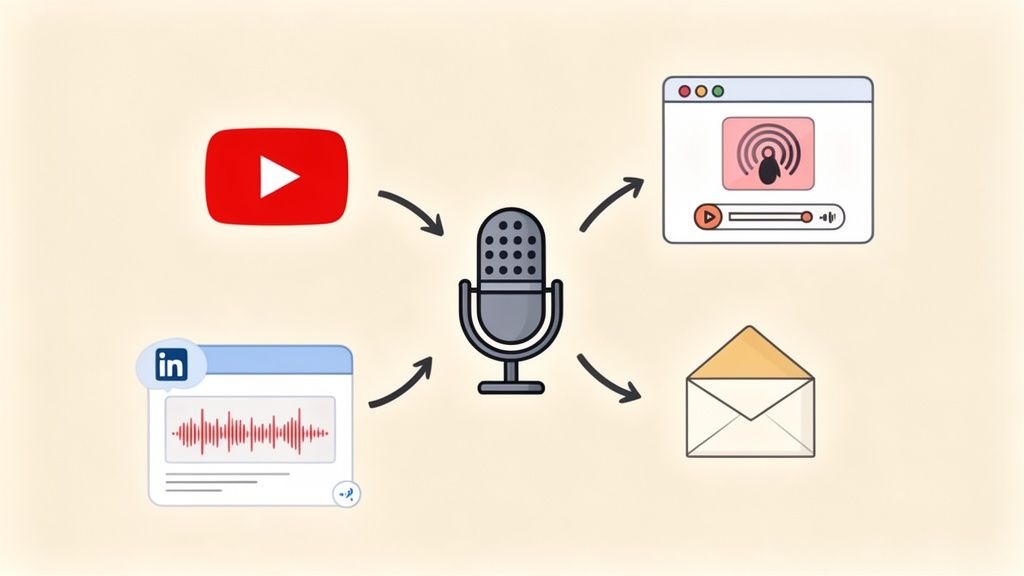
For any B2B brand, ignoring YouTube is a massive mistake. It's the second-biggest search engine on the planet. Professionals are there every day searching for how-to guides, industry deep-dives, and expert interviews. Publishing your podcast there opens up a whole new channel for discovery.
You don't need a fancy video production studio. The goal here is discoverability, not cinematography. Here are three actionable ways to get started:
- Static Image Videos: The simplest approach. Pair your full audio episode with a static image of your podcast cover art. It's low-effort but makes your content searchable on YouTube.
- Audiogram Videos: A step up. Use a tool to create an audiogram, a video with a moving waveform, and captions. It's visually more engaging and perfect for social sharing.
- Simple "Talking Head" Recordings: If you have already recorded video of your interviews (even with a webcam), upload the full conversation to YouTube.
The key is to treat your YouTube titles and descriptions with the same SEO rigor you'd give a blog post. Pack them with keywords your ideal customers are searching for. That way, your expert conversations show up as the solution when they need it most. We've got a much deeper guide on how to start a podcast on YouTube if you want to really nail this.
Integrate Your Podcast into Your Owned Channels
Your website and email list are your most valuable owned channels. These are your warmest audiences, so bring your podcast directly to them instead of making them search for it.
Embed Your Player Everywhere
Your podcast host, including Fame Host, provides an embeddable player for every episode. Use it aggressively:
- Show Notes Pages: Every episode needs its own page on your site. The first thing people should see at the top is the embedded player.
- Relevant Blog Content: Writing an article on a topic you’ve covered on the podcast? Embed that specific episode right in the post to give readers another way to engage with the content.
- Your Homepage: Feature your latest episode on your homepage. It immediately signals to visitors that you have a podcast and keeps your content fresh.
This tactic improves user experience and boosts your "time on page," sending positive signals to Google that your content is valuable.
Your podcast shouldn't be an island. Embedding episodes on your website turns passive visitors into engaged listeners and transforms your existing content into a multi-format experience.
Leverage Guests and Social Proof
Your guests are your most powerful promotional asset. They want the episode to succeed and have a built-in audience that trusts them. Your job is to make sharing ridiculously easy for them.
Action: Create a "guest promo kit" for every episode. This isn't optional; it's essential for maximizing reach.
Here’s what to include in the kit:
- Pre-written social media posts they can copy and paste for LinkedIn or X.
- Custom quote graphics with their sharpest insights from the interview.
- Short audiogram clips (30-60 seconds) that are perfect for social feeds.
The goal is to eliminate all friction. When you email them the live episode link, attach all these assets so they can share them with a single click.
To scale this, you need to bake these co-marketing tactics into your workflow by implementing stronger content distribution strategies.
Finally, weave your podcast into your email marketing. Don't just send a one-off "new episode is live!" email. Add links to relevant episodes in your nurture sequences. Imagine a prospect is reading about a specific problem, and you send them an episode where an expert breaks down that exact issue. That's not marketing, that's being genuinely helpful, and it builds serious trust.
Turning Episodes into an Omnichannel Content Engine
Here’s a hard truth: A B2B podcast is so much more than an audio file. If you stop at publishing your show to Spotify, you're leaving most of its value on the table.
Think of each episode as a content goldmine. The real magic happens when you excavate that 45-minute conversation and break it down into a dozen different assets. This is how you stop chasing the content hamster wheel and start building a marketing engine that works for you across every channel your buyers use.
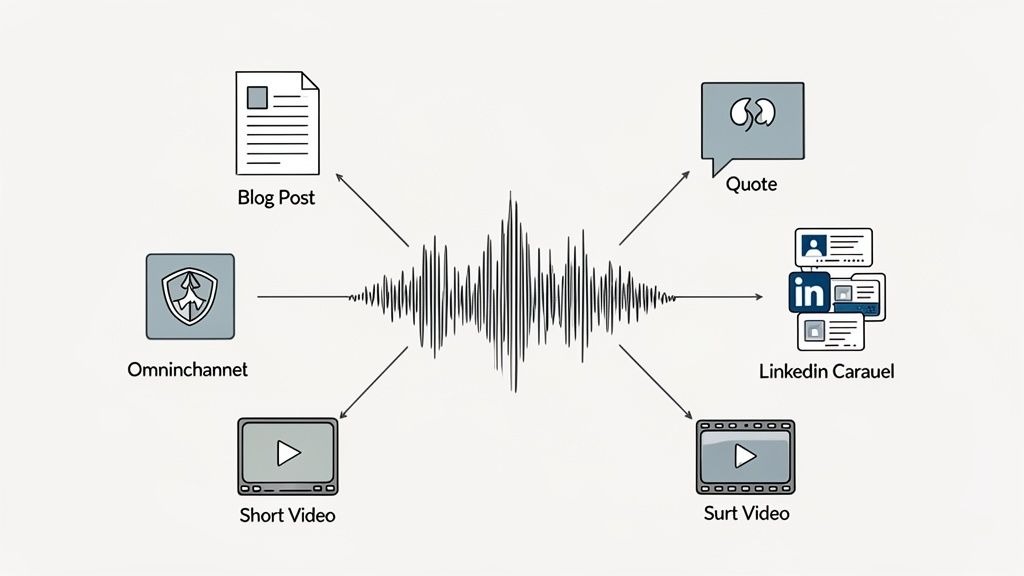
A single interview contains more than enough material for an entire week's worth of marketing. You can pull standout quotes, create deep-dive blog posts, and share bite-sized clips that hook new listeners. This approach multiplies your impact, ensuring the insights from your show reach prospects whether they prefer reading, watching, or scrolling.
From Audio Transcript to High-Value Blog Post
The easiest and most powerful first move is turning your episode transcript into a detailed blog post. This isn't a simple copy-paste job; it's about thoughtfully restructuring a spoken conversation for a reader.
It all starts with a clean transcript. A tool like the Production Engine can generate one in minutes, saving you hours of manual effort. From there, your job is to edit and enrich it. Here's how:
- Organize with Headings: Break up the conversation with clear H2 and H3 subheadings that highlight the key topics.
- Refine the Language: Cut filler words ("um," "like," "you know") and conversational tangents to create a crisp, scannable article.
- Add Visuals: Insert screenshots, diagrams, and pull quotes to make the content more engaging and break up the wall of text.
This tactic serves two purposes: it gives your existing audience another way to consume your content and creates a powerful SEO asset that can attract a new audience through organic search. For a deeper look at this, check out these powerful content repurposing strategies.
Creating a Social Media Content Factory
With a polished transcript, you have all the raw material you need to fuel your social media channels for days. The goal is to extract the most valuable, shareable moments and package them for platforms like LinkedIn.
Your podcast is the raw material. Repurposing is the manufacturing process that turns it into finished goods for every marketing channel. It's how you scale authority and maximize the ROI on every single conversation.
Go beyond the generic "new episode is live!" post. Create a full suite of assets from each episode to drive real engagement and clicks.
Here's an actionable playbook to get you started:
- Pull Out Key Quotes: Find the 3-5 most insightful statements from your guest. Use a simple design tool like Canva to create eye-catching quote graphics for LinkedIn and X (formerly Twitter).
- Summarize Key Takeaways: Distill the episode into a bulleted list of actionable takeaways. This format is perfect for a LinkedIn carousel or text post, providing instant value while teasing the full episode.
- Create Short Video Clips: Clip 30-90-second audio segments that contain a great story or a crucial piece of advice. Pair that audio with a simple audiogram video to create native video content that stops the scroll.
This system ensures that even people who never listen to the full episode are still exposed to your brand's expertise.
Structuring Your Repurposing Workflow
To do this consistently without burnout, you need a system.
Create a simple standard operating procedure (SOP) to ensure every episode gets the full repurposing treatment without adding chaos to your team's workload. This is where a dedicated podcasting partner can be a game-changer.
At Fame, for example, this entire process is baked into our production workflow. When we produce a B2B podcast, we don't just deliver an audio file. We provide a complete content package, show notes, transcripts, and social assets, all designed for maximum distribution from day one. That operational efficiency turns a good podcast into a great marketing engine.
Measuring Distribution to Create Growth Loops
Effective podcast distribution isn't a "set it and forget it" task. It's a cycle of listening, learning, and optimizing. Pushing your episodes to directories is just step one.
Real growth comes from digging into what’s working, understanding what's not, and using those insights to make every episode better than the last. This is how you graduate from simply publishing content to building a sustainable growth engine for your B2B show.
The key is to stop obsessing over vanity metrics. A huge download number feels good, but it tells you nothing about who is listening or if they are engaged. To build a genuine growth loop, you have to go deeper.
Go Beyond Downloads: The Metrics That Really Matter
Your podcast host's dashboard is your mission control. It’s where you find the truth about your show's performance. Platforms like Fame Host are built for B2B marketers, giving you the insights needed for smarter content decisions. Instead of getting hung up on total downloads, zero in on these more meaningful metrics.
- Average Consumption Rate: This is the most important metric. It tells you what percentage of an episode the average listener finishes. A high consumption rate, 80% or more, is a massive green flag that your content is resonating.
- Episode Drop-Off Points: Where do listeners stop listening? Most hosting platforms provide a listenership graph for each episode. If you see a huge dip at the 15-minute mark, go back and analyze what was happening. Did the conversation stall? Did a guest ramble? This is raw, unfiltered feedback on your content’s pacing.
- Listener Demographics: Knowing who is listening is as important as knowing how many. Their location and the apps they use help you sharpen your content and promotion. If you notice a spike in listeners from the fintech industry, you know to double down on topics relevant to them.
These metrics transform your distribution from guesswork into a data-backed strategy. For a deeper dive, check out our full guide on how to measure podcast performance.
Building Your First Growth Loop
A growth loop is a system where the output of one cycle feeds directly into the next, creating compounding momentum. For your podcast, this means using listener data to fuel future growth.
Here's an actionable plan to build one:
- Analyze Performance: Review the metrics for your last five episodes. Identify your best-performing episode based on its consumption rate, not just downloads. What was the topic? Who was the guest?
- Gather Real-World Feedback: Numbers only tell half the story. Go on LinkedIn and ask your audience for feedback. Run a poll asking what they want to hear next. Pay close attention to Apple Podcasts reviews.
- Connect the Dots: Combine the data with the qualitative feedback. If your most-consumed episode was a deep tactical dive, and your LinkedIn poll shows people want more tactical content, your hypothesis could be: "Solo episodes focused on practical tactics drive higher engagement."
- Test and Repeat: Test your hypothesis. Record your next episode based on that insight. Once it's published, go back to step one and see how it performed. Did the consumption rate climb?
This loop, Analyze, Gather, Synthesize, Test, is the engine of sustainable podcast growth. It ensures you're not just creating content you think your audience wants, but content you know they value.
By repeating this process, every episode becomes an experiment that makes the next one smarter. You stop throwing content into the void and start building a show that gets better, sharper, and more valuable with every release. That's how you turn casual listeners into loyal fans.
Common Questions About Distributing a Podcast
Even with a solid distribution plan, you'll have questions. Here are the straight-up answers to the questions we hear all the time from B2B marketers.
How Long Does It Take for a New Podcast to Show Up in Directories?
This varies by platform, but the timelines are fairly predictable.
Spotify is incredibly fast; new shows often appear in just a few hours due to its automated system.
Apple Podcasts is the one to plan for. Their manual review process means approval can take anywhere from 24 hours to over a week. During busy periods, expect longer waits.
Actionable Tip: Submit your show with a short trailer or "Episode 0" well before your official launch date. This gets the approval process started early, so you can avoid launch-day stress.
What Is the Single Most Important Factor for Distribution Success?
Assuming you use a reliable host like Fame Host and have a valid RSS feed, the single most critical factor is consistency. This applies to your entire operation.
- A Predictable Publishing Schedule: Whether it's weekly, bi-weekly, or monthly, stick to your schedule. Podcast directories and listeners reward a predictable rhythm.
- Consistent Promotion: Treat every episode as a mini-launch. Execute a full promotion cycle for each one, not just for the initial show launch.
Momentum is everything in podcasting. A steady drumbeat of publishing and promoting builds trust and compounds your growth far more effectively than sporadic, splashy campaigns.
Can I Switch My Podcast Host Without Losing Subscribers?
Yes, you can, and it's a safe and routine process. You won't lose any subscribers.
The process relies on a 301 redirect.
When you decide to move your show to a superior host like Fame Host, you simply set up a 301 redirect on your old RSS feed. This acts as a permanent forwarding address, telling Apple, Spotify, and all other directories where to find your show's new home.
The switch is completely seamless for your listeners. Their podcast app will update in the background and begin pulling episodes from the new feed. They won't notice a thing, except perhaps for the improved performance from your new host. Any quality provider will guide you through this simple process.
Is Putting My B2B Podcast on YouTube Really Worth It?
For a B2B brand, the answer is an emphatic yes. Not distributing your podcast on YouTube is a massive, unforced error.
Stop thinking of it as just a video platform and start seeing it for what it is: the world's second-largest search engine. It's where professionals actively search for educational content, expert interviews, and solutions to their problems.
Turning your audio into a simple video, even a static image with an audiowave, instantly makes your content discoverable to a huge new audience. You're tapping into a platform where your ideal listeners are already spending their time, even if they've never opened a podcast app. It is a low-effort, high-reward tactic for distributing a podcast.
Ready to stop wrestling with distribution and get a platform built for B2B growth? Fame gives you more than just best-in-class hosting. We provide the strategic production and promotion services you need to turn your podcast into a real marketing engine. See how Fame Host can simplify your workflow and get your show in front of the right people.
Want us to run this for you?
Fame starts and grows B2B podcasts that generate pipeline. Tell us who you are trying to reach and we will send a costed proposal within 1 working day.
Related content
- Read moreFame Team · July 16, 2026
10 Account Based Marketing Tactics For B2B Growth In 2026
Discover 10 actionable account based marketing tactics for B2B tech. Learn to use podcasts, data, and targeted content to close high-value accounts. - Read moreFame Team · July 16, 2026
The 8 Best Brighton Podcast Agency Picks For 2026
Find the best Brighton podcast agency for your B2B brand. Our 2026 guide reviews top 8 agencies for production, growth & ROI. Expert analysis here - Read moreJune 10, 2026
20 Best Podcast Production Agencies For 2026 (And Why Should You Hire One)
Global podcast and vodcast ad revenues are on track to hit $5 billion in 2026 , up 20% year-on-year. - Read moreApril 13, 2026
Leadership In Marketing: The B2B Podcast Playbook
Most companies still confuse leadership in marketing with job titles, org charts, and budget control. That's outdated.