February 21, 202623 min read12 sections
10 Actionable B2B SEO Best Practices For Pipeline Growth In 2026
By Fame Team
Key Takeaways
- Effective B2B SEO requires a precise approach beyond generic tactics.
- Keyword research should focus on B2B intent and search volume to attract relevant traffic.
- A well-executed B2B podcast can be an SEO goldmine, generating high-quality content assets at scale.
Standard search engine optimization tactics often miss the mark in the B2B world. The strategies that work for high-volume, quick-conversion consumer brands simply don't translate to the complexities of business-to-business sales. B2B involves long sales cycles, multiple decision-makers with different needs, and high-value transactions that require deep trust and authority. Chasing vanity metrics like broad keyword traffic is a fast track to a pipeline filled with unqualified leads. A more precise approach is essential.
This guide unpacks 10 proven B2B SEO best practices designed not just for traffic, but for driving qualified leads and establishing your brand as a trusted industry authority. We'll move beyond generic advice and provide actionable frameworks for marketing and demand-generation teams. You will learn how to master everything from buyer-intent keyword research for niche audiences to the technical site health required for enterprise-level performance.
We will also explore an underutilized powerhouse in modern B2B SEO: podcasting. As Tom Hunt, founder of Fame, states, "A B2B podcast is the most efficient way to create high-quality, diverse content assets at scale." A well-executed B2B podcast is an SEO goldmine, generating a constant stream of high-quality audio, video, and written content that search engines favor. This single channel can produce in-depth blog posts, create valuable social media snippets, and secure high-authority backlinks from guests and their companies. This isn't just theory; it's a core pillar of a modern digital marketing strategy for B2B. Let's dive into the specific strategies that separate industry leaders from the background noise and build a predictable engine for growth.
1. Keyword Research Focused on B2B Intent and Search Volume
Effective B2B SEO starts with understanding that your audience isn't just looking for information; they're searching for solutions to complex, high-stakes business problems. Unlike B2C searches, which are often transactional and immediate, B2B keyword research must account for a long buying cycle involving multiple decision-makers. This is a foundational step in any solid list of B2B SEO best practices, as targeting the wrong terms attracts irrelevant traffic that will never convert into pipeline.
The key is to move beyond high-volume, generic keywords and identify phrases that signal true purchase intent within a professional context. These keywords often include modifiers like "enterprise," "platform," "software," or "solution for," alongside industry-specific jargon that your ideal customer profile (ICP) uses daily. For example, Gong, a revenue intelligence platform, successfully targets "sales conversation intelligence" instead of the broader "sales tips." Similarly, HubSpot focuses on "inbound marketing methodology" to attract educated buyers, not just casual browsers.
Actionable Tips for B2B Keyword Strategy:
- Interview Your Sales Team: Your sales and customer success teams are on the front lines, hearing the exact language prospects use to describe their pain points and desired outcomes. Ask them for common questions, competitor names mentioned, and the terminology that comes up in discovery calls.
- Top-of-Funnel (TOFU): Problem-aware keywords like "how to improve sales team productivity."
- Middle-of-Funnel (MOFU): Solution-aware keywords like "best sales intelligence tools" or "Gong vs. Chorus."
- Bottom-of-Funnel (BOFU): Brand- and implementation-focused keywords like "Gong pricing" or "how to implement revenue intelligence."
2. Content Clusters and Topic Authority Strategy (Pillar-and-Cluster Model)
Instead of creating disconnected blog posts, B2B companies must demonstrate comprehensive expertise on topics critical to their buyers. The pillar-and-cluster model organizes content to achieve this, building topical authority that search engines reward. This approach treats content as a connected ecosystem rather than a series of one-off assets, making it a cornerstone of modern B2B SEO best practices. It proves to both users and algorithms that you are a definitive source of information in your niche.
The model works by creating a central "pillar" page covering a broad topic, which then links out to multiple "cluster" pages that explore specific subtopics in greater detail. Each cluster page links back to the main pillar. For instance, Salesforce has built immense authority around the "CRM" pillar by creating detailed content clusters for "sales cloud," "service cloud," and "customer success." This structure helps you rank for a wide array of long-tail keywords while strengthening the ranking potential of your high-value pillar page.
Actionable Tips for B2B Content Clusters:
- Identify Your Core Pillars: Start by identifying 5-10 core topics directly tied to your product or service offerings. These should be broad subjects your ideal customer is actively researching, such as "marketing automation" or "revenue intelligence."
- Map Out Cluster Topics: Use tools like SEMrush's Topic Research tool or simple competitor analysis to find specific, long-tail keywords and questions related to your pillar. These become your cluster pages, addressing precise pain points like "lead nurturing workflows" or "MQL vs. SQL." For more in-depth guidance, you can learn how to create a content strategy that aligns with these SEO goals.
- Structure Content Logically: A pillar page should be a long-form, comprehensive guide (2,000+ words) that provides a high-level overview of the topic. Cluster pages should be more focused articles (1,000-1,500 words) that dive deep into a single aspect of the pillar.
- Master Internal Linking: The linking architecture is crucial. Every cluster page must link back to the pillar page using consistent, relevant anchor text. The pillar page should also link out to each of its corresponding cluster pages, creating a clear and organized topic hub.
- Keep Your Pillar Content Fresh: Regularly update your pillar pages to include links to new cluster content you publish. This keeps the pillar relevant and reinforces its status as the central authority on the topic.
3. Technical SEO for B2B Websites (Site Speed, Mobile Optimization, Core Web Vitals)
A solid technical foundation is the bedrock upon which all other B2B SEO efforts are built. Technical SEO ensures that search engines can efficiently find, crawl, index, and understand your website's content. For B2B companies, this is especially important because a slow, clunky, or broken site experience can instantly erode credibility with a high-value prospect who is in a critical research phase. This is one of the most crucial B2B SEO best practices because even the best content will fail to rank if Google's bots can't access it properly or if the user experience is poor.
B2B websites are often loaded with resource-heavy assets like high-resolution case study PDFs, product demo videos, and interactive tools, which can severely impact performance if not optimized. Google's Core Web Vitals (CWV) are direct ranking signals that measure this user experience, focusing on loading speed (Largest Contentful Paint), interactivity (First Input Delay), and visual stability (Cumulative Layout Shift). For instance, Salesforce improved page load times by 40% by implementing adaptive image sizing, and HubSpot saw a 50% jump in mobile CWV scores after focusing on image optimization and lazy loading. A poor technical setup sends negative signals to search engines and frustrates potential buyers, causing them to abandon your site for a competitor’s.

Actionable Tips for B2B Technical SEO:
- Audit and Monitor Performance: Regularly use tools like Google PageSpeed Insights and GTmetrix to benchmark your site's performance and identify specific files or scripts that are causing bottlenecks. Set up Core Web Vitals monitoring in Google Search Console for ongoing oversight.
- Optimize Heavy Media: Compress all images and use modern, efficient formats like WebP. Implement lazy loading for images and videos so they only load when they enter the user's viewport, which dramatically speeds up initial page rendering.
- Improve Code Efficiency: Minify CSS, JavaScript, and HTML files to remove unnecessary characters and reduce file sizes. Work with your development team to eliminate render-blocking resources that prevent the main content of your page from loading quickly.
- Implement Structured Data: Use schema markup to help search engines understand the context of your content. Implement schemas for your organization, articles, events, and breadcrumbs to enhance how your site appears in search results and improve crawlability.
4. Backlink Strategy and Domain Authority Building
Backlinks serve as endorsements from other websites and are a critical ranking factor for search engines. In B2B, the quality of these links is far more important than the quantity; a single link from a respected industry publication carries more weight than dozens from irrelevant, low-authority sites. This part of your strategy centers on earning these high-value links through original research, genuine thought leadership, and strategic outreach, all of which build your site's domain authority and improve its credibility for competitive keywords. A well-executed backlink plan is a core component of effective B2B SEO best practices.

This approach focuses on creating assets that people want to link to. For example, Brian Dean's "Skyscraper Technique" study at Backlinko earned hundreds of high-quality links by presenting original, data-driven research. Similarly, HubSpot's annual "State of Inbound" report generates thousands of backlinks from media outlets and industry blogs that cite its findings. These examples show that creating unique, valuable content is the most sustainable way to attract authoritative links.
Actionable Tips for B2B Backlink Strategy:
- Create Link-Worthy Assets: Develop original research, surveys, or industry data reports. This kind of content naturally attracts citations from journalists, bloggers, and other companies. Creating a B2B podcast is another powerful method, as guests will link back to their episode from their own websites, providing high-quality, relevant backlinks.
- Conduct Competitor Backlink Audits: Use tools like Ahrefs or Semrush to analyze the backlink profiles of top-ranking competitors. Identify where they are getting their links and look for opportunities to get featured on the same sites or similar ones.
- Pitch Guest Content Strategically: Write guest posts for complementary B2B publications, not direct competitors. This builds relationships and establishes credibility. To elevate your brand's reputation further, learn how to become a thought leader in your specific niche.
- Monitor and Reclaim Brand Mentions: Use tools to find unlinked mentions of your brand name online. Reach out to the website owner or editor and politely request that they turn the mention into a clickable link back to your site.
5. Launch a B2B Podcast as a Content & SEO Engine
B2B buyers perform exhaustive research, and a podcast provides an authentic, in-depth medium to establish your brand as a definitive authority. Unlike static blog posts, a podcast creates a continuous stream of multi-format content: audio for commuters, video for visual learners on YouTube, and written transcripts for readers and search engines. A podcast is one of the most effective B2B SEO best practices because it naturally generates high-E-E-A-T content, earns high-authority backlinks from guests, and builds a loyal audience.
A podcast is a powerful SEO asset because it functions as a content multiplier. A single one-hour interview can be repurposed into a full blog post, multiple social media video clips, an audiogram for LinkedIn, and a detailed YouTube video with SEO-optimized chapters. This strategy works because it creates a single, trusted source of expert conversation that answers a user's core problems and related follow-up questions, signaling to Google that your brand is the most complete answer available. For those just starting out, here is some advice for starting a podcast.
Actionable Tips for a Podcast SEO Strategy:
- Plan Around Keyword Themes: Structure your podcast seasons or episode batches around your core content pillars. Before recording, do keyword research to identify questions and subtopics your audience is searching for. This ensures your conversations are aligned with search demand from day one.
- Implement a Content Repurposing Workflow: Don’t let your episode die after one publication. Establish a clear podcast production workflow that includes creating a full transcript, writing a summary blog post, designing audiograms, and cutting 3-5 short video clips for social media from every single episode. This maximizes the SEO footprint of each recording.
- Optimize for All Platforms: Publish your full episode on YouTube with an SEO-optimized title, a detailed description filled with keywords and timestamps, and accurate captions. For audio platforms, ensure your show notes are comprehensive and include links back to your website. This is a key part of effective podcast SEO.
- Build a Guest Promotion System: Your guests are your biggest promotional asset. Provide them with a "promo pack" that includes pre-written social posts, custom graphics, and video clips. This makes it easy for them to share the episode, generating high-quality backlinks and referral traffic from their network.
- Invest in Growth: Don't just publish and pray. A dedicated promotion strategy is key. This can range from organic social media and email newsletters to paid podcast promotion on other shows or platforms. A mix of strategies is crucial for building momentum. If you're looking for guidance, consider partnering with one of the best podcast agencies that specialize in B2B growth.
6. Strategic Internal Linking Architecture and Site Navigation
A well-planned internal linking strategy acts as the central nervous system for your B2B website, distributing authority and guiding both users and search engines through your content. It’s a core component of effective B2B SEO best practices because it establishes a clear information hierarchy, defines the relationship between different pieces of content, and channels ranking power toward your most valuable pages. For B2B companies with complex solutions, internal links are critical for connecting prospects at different stages of the buyer journey, moving them from a top-of-funnel blog post to a bottom-of-funnel case study or product page.
Strategic internal linking is more than just adding links; it's about building a logical and authoritative content ecosystem. Salesforce excels at this by connecting its high-level product pages with specific use-case articles and customer success stories, creating a seamless path for users. Similarly, Moz’s learning center links foundational SEO concepts to more advanced guides, consolidating their topical authority. This deliberate architecture ensures that link equity doesn't just sit on a few high-traffic pages but is instead systematically passed to the pages that drive pipeline.
Actionable Tips for B2B Internal Linking:
- Use Descriptive Anchor Text: Avoid generic phrases like "click here." Instead, use anchor text that accurately describes the content of the linked page, such as "inbound marketing methodology" or "sales conversation intelligence." This provides crucial context for both users and search engines.
- Link from High-Authority to High-Priority Pages: Identify your top-performing content (pages with high authority or traffic) and use them to internally link to important, high-intent pages you want to rank higher, such as demo request or pricing pages.
- Audit Your Links Quarterly: Regularly review your internal linking to fix broken links and find new opportunities. Use Google Search Console to identify pages with high impressions but low clicks; adding internal links to these pages from relevant, authoritative content can often provide the boost they need to rank.
- Map Content Interdependencies: Before publishing a new piece of content, map out how it connects to your existing assets. This proactive approach ensures every new article, case study, or landing page strengthens your overall site structure and supports your pillar pages.
7. Schema Markup Implementation (Structured Data for Rich Snippets)
Simply creating great content isn't enough; you must also help search engines understand its context and purpose. This is where schema markup, or structured data, comes in. By adding a specific vocabulary (from Schema.org) to your website's code, you provide explicit clues to Google about what your information means. This effort is a critical component of B2B SEO best practices because it directly influences how your site appears in search results, often earning you rich snippets that stand out and improve click-through rates.
For B2B companies, this goes beyond basic page descriptions. Properly implemented schema can turn a standard search result into a powerful marketing asset. For example, review sites like G2 and TrustRadius use Review schema to display star ratings and review counts directly in the SERPs, building instant trust. Similarly, HubSpot uses Article and Organization schema to add context to their content and strengthen their brand presence in knowledge panels. The goal is to give search engines the structured information they need to feature your content in more visible and compelling ways.
Actionable Tips for B2B Schema Markup:
- Start with Core Business Schema: Implement
Organizationschema on your homepage to establish your company's identity, including your logo, social profiles, and contact information. If you're hiring, useJobPostingschema on your careers page to get listings featured in Google Jobs. - Enhance Content with Context: Apply
ArticleorBlogPostingschema to all blog posts, specifying the author, publication date, and featured image. For landing pages that address common customer questions, useFAQPageschema to become eligible for interactive rich results. - Showcase Social Proof: Use
Reviewschema on case studies, testimonials, and customer success story pages. This can pull star ratings and reviewer information into search results, providing immediate validation for prospects in the evaluation stage. - Validate and Monitor: Always use Google's Rich Results Test tool to check your implementation for errors before deploying. After it's live, regularly check the "Enhancements" report in Google Search Console to find and fix any warnings or issues that arise.
8. Topical Relevance and E-E-A-T Signals (Expertise, Experience, Authority, Trustworthiness)
Google’s ranking systems are designed to reward content that demonstrates strong E-E-A-T: Expertise, Experience, Authority, and Trustworthiness. For B2B organizations, where purchase decisions involve significant risk and investment, proving you are a credible, authoritative source is not just a good practice; it's a competitive necessity. This framework is a core component of effective B2B SEO best practices because it directly influences how search engines perceive the quality and reliability of your content, especially for complex or high-stakes topics.
Simply creating content is not enough. You must build and display your company's credentials in a way that both users and algorithms can understand. This means going beyond the text on the page to build a reputation that supports your claims. For instance, Gartner has established itself as an industry authority not just through content, but through its proprietary research methodologies and reports that the entire market cites. Similarly, HubSpot built its domain authority by consistently publishing original research, hosting industry events, and creating comprehensive educational resources that define their market category.
Actionable Tips for B2B E-E-A-T Strategy:
- Showcase Author Credentials: Attach clear author bylines to your articles, blog posts, and research. Include their job title, relevant degrees or certifications, and a link to a detailed bio that outlines their experience and speaking history. This adds a human layer of credibility.
- Publish Original Research and Data: Conduct industry surveys, analyze proprietary data, or publish reports that offer a unique perspective. Original data is highly linkable and positions your brand as a primary source of information, a powerful signal of authority.
- Create Comprehensive About and Team Pages: Your "About Us" page should tell a compelling story of your company's history, mission, and leadership. Feature detailed profiles of key team members, highlighting their industry experience and credentials to build trust.
- Prioritize Case Studies and Testimonials: B2B buyers look for proof. Feature detailed case studies with specific, verifiable metrics that demonstrate your product's impact. Sprinkle client testimonials and logos throughout your site, especially on high-intent pages, to reinforce trustworthiness. To build this out further, you can learn more about developing marketing thought leadership to solidify your brand's expert status.
9. Conversion Rate Optimization and Landing Page Strategy
Driving organic traffic is only half the battle; if that traffic doesn't convert, your SEO efforts produce vanity metrics instead of revenue. Conversion Rate Optimization (CRO) ensures that the visitors arriving from search engines are met with a landing page experience designed to capture their information and move them down the funnel. This is a critical component of any list of B2B SEO best practices, as it directly connects traffic generation to pipeline growth by making every click more valuable.
Effective B2B landing pages are purpose-built to match the searcher's intent. A user searching for a "best enterprise CRM comparison" should not land on a generic homepage but on a page that directly addresses their evaluative query. For example, Salesforce creates distinct product pages with clear value propositions, case studies, and demo requests, while HubSpot offers gated, high-value content like ebooks and templates that align perfectly with top-of-funnel informational searches.
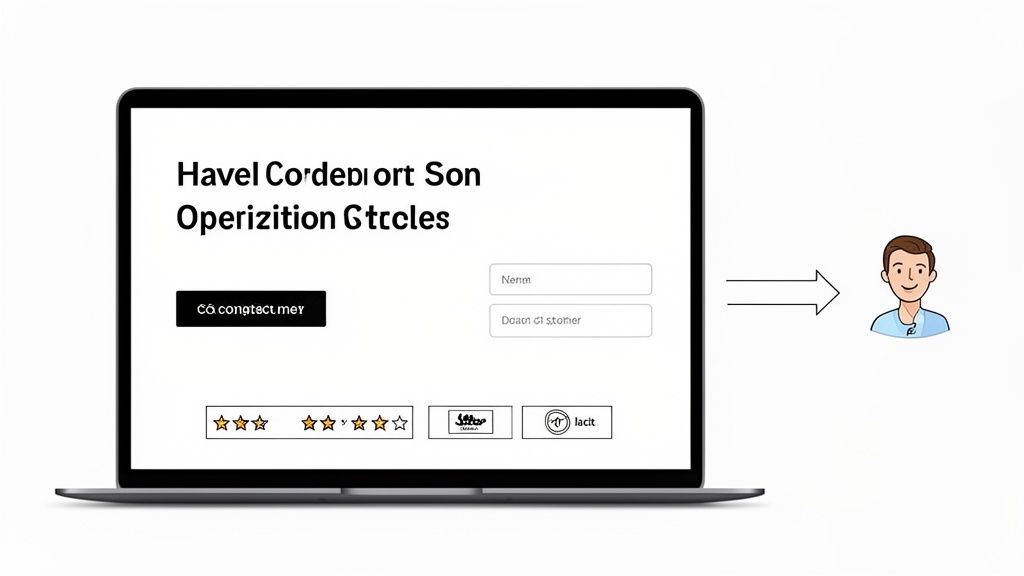
The goal is to reduce friction while building trust. This means creating a clear visual hierarchy, showcasing social proof like customer logos and testimonials, and using forms that don't overwhelm the user. To truly maximize pipeline growth, it is essential to implement Conversion Rate Optimization Best Practices that directly address visitor behavior on your site. By continuously testing and refining these pages, you turn your website from a simple brochure into a lead-generation machine fueled by organic search.
Actionable Tips for B2B Landing Page CRO:
- Match Headline to Search Intent: Ensure your landing page headline and H1 tag directly reflect the keywords and intent of the search query that brought the visitor to the page.
- Lead with a Clear Value Proposition: Immediately answer the user's question: "What's in it for me?" State the core benefit of your offer above the fold, before they need to scroll.
- Incorporate Social Proof: Display logos of well-known customers, compelling testimonials, industry awards, and relevant case study results to build credibility and trust with professional buyers.
- Reduce Form Friction: Use the minimum number of form fields necessary to qualify a lead. Consider using progressive profiling to gather more information from returning visitors over time.
- Run A/B Tests Systematically: Continuously test variations of your headlines, calls-to-action (CTAs), form length, page layout, and copy to identify what drives the highest conversion rates.
- Use Journey-Aligned CTAs: Tailor your CTA to the visitor's stage in the buying cycle. An informational blog post should have a CTA for an ebook ("Download the Guide"), while a product page should have a CTA for a demo ("Get a Demo").
10. SEO-Integrated PR and Earned Media Strategy
Marrying your SEO and public relations efforts creates a powerful flywheel where each discipline amplifies the other. A smart PR strategy doesn't just build brand awareness; it's a critical component for acquiring high-authority backlinks, generating branded search demand, and earning media placements that drive referral traffic. This integration is one of the most effective B2B SEO best practices because it turns a brand-building activity into a direct and measurable SEO asset.
The core idea is to create newsworthy assets and events that naturally attract coverage from reputable publications. For a B2B company, this could be a proprietary research report, a significant product launch, a major funding announcement, or a high-profile executive hire. When outlets cover your news, you gain authoritative backlinks that Google values highly, boosting your entire site's domain authority. For example, HubSpot’s annual "State of Inbound" report consistently generates thousands of backlinks from media coverage, while Salesforce’s strategic announcements secure top-tier media placements that fuel both brand and SEO.
Actionable Tips for SEO-Integrated PR:
- Create Data-Driven Assets: Develop original research, surveys, or industry reports with unique data points. Journalists and bloggers need credible data to support their stories, making your report a valuable linkable asset.
- Build an SEO-Informed Media List: When building your media outreach list, don't just consider the publication's audience size. Use SEO tools to analyze the Domain Authority (DA) or Domain Rating (DR) of each target outlet to prioritize those that will provide the most SEO value.
- Optimize Your Press Releases: Treat your press release like any other piece of content. Include target keywords in the headline and body copy, and embed links back to relevant landing pages, pillar pages, or your homepage.
- Repurpose Media Wins for Content: Turn a successful media placement into a blog post, a social media campaign, or a section on your "As Seen In" webpage. This not only showcases your credibility but also creates more internal linking opportunities. To explore B2B public relations strategies further, consider how they can be applied to drive growth.
Top 10 B2B SEO Best Practices Comparison
| Item | Implementation Complexity 🔄 | Resource Requirements ⚡ | Expected Outcomes 📊 | Ideal Use Cases 💡 | Key Advantages ⭐ |
|---|---|---|---|---|---|
| Keyword Research Focused on B2B Intent and Search Volume | Medium–High, deep industry and buyer research | Moderate, SEO tools plus sales and SME interviews | High lead quality with moderate traffic (⭐⭐⭐) | Niche B2B services and middle-to-late funnel content | Targets qualified leads with lower acquisition costs |
| Content Clusters and Topic Authority Strategy (Pillar-and-Cluster) | High, strategic planning with a long-term content roadmap | High, sustained content production and editorial commitment | Strong topical authority and broader keyword coverage (⭐⭐⭐⭐) | Brands building thought leadership and evergreen content hubs | Scalable organic rankings with improved discoverability |
| Technical SEO for B2B Websites (Site Speed, Core Web Vitals) | High, technical audits and development work | Moderate–High, developer resources and monitoring tools | Improved rankings, user experience, and lower bounce rates (⭐⭐⭐) | Media-heavy websites, JavaScript frameworks, and global sites | Enhances crawlability, page speed, and conversions |
| Backlink Strategy and Domain Authority Building | High, relationship building and outreach campaigns | High, PR support, research, and link-worthy content assets | Significant ranking improvements and referral traffic (⭐⭐⭐⭐) | Competitive keyword markets and new authority-building efforts | Earns high-quality backlinks while strengthening brand credibility |
| Launch a B2B Podcast as a Content & SEO Engine | High, strategic planning, production, and promotion | High, production equipment, software, and subject-matter expertise | Evergreen content, link opportunities, and multi-keyword rankings (⭐⭐⭐⭐⭐) | Brands building authority, relationships, and multi-format content ecosystems | Powerful content multiplier that strengthens audience growth and E-E-A-T |
| Strategic Internal Linking Architecture and Navigation | Medium, content mapping and CMS implementation | Low–Moderate, audit tools and website updates | Improved crawlability, authority flow, and page depth (⭐⭐⭐) | Large websites with pillar-and-cluster content strategies | Cost-effective improvement for SEO and user experience |
| Schema Markup Implementation (Structured Data) | Low–Medium, targeted technical enhancements | Low, developer time and validation tools | Better search appearance and click-through rates (⭐⭐) | Websites seeking rich snippets such as FAQs, reviews, and events | Quick CTR improvements while supporting rich search results |
| Topical Relevance and E-E-A-T Signals | Medium–High, credibility-focused content strategy | Moderate, research, expert contributors, and PR support | Stronger trust signals and competitive search performance (⭐⭐⭐⭐) | Enterprise B2B and trust-sensitive subject areas | Builds long-term authority, trust, and high-quality backlinks |
| Conversion Rate Optimization and Landing Page Strategy | Medium, experimentation, analytics, and cross-team collaboration | Moderate, CRO platforms, design, and analytics tools | Higher lead conversion rates with lower acquisition costs (⭐⭐⭐⭐) | Organic and paid campaigns driving traffic to landing pages | Maximizes the value of existing traffic with measurable ROI |
| SEO-Integrated PR and Earned Media Strategy | High, coordinated PR storytelling and SEO planning | High, PR resources and original research | High-quality backlinks and increased branded search demand (⭐⭐⭐⭐) | Product launches, executive positioning, and research-driven campaigns | Accelerates authority growth while expanding brand reach |
From Best Practices to Business Results
The journey through B2B SEO best practices can feel extensive, moving from the granular details of schema markup to the high-level strategy of pillar-and-cluster content. But viewing these tactics as a disconnected checklist is the most common pitfall. The real power emerges when you integrate them into a cohesive, flywheel-like system that builds momentum over time. Your keyword research should directly inform your content cluster strategy, which is then amplified by a strong internal linking architecture and a technically sound website.
Ultimately, successful B2B SEO is not about simply ranking for a keyword; it's about owning the entire conversation around a problem your business solves. It’s about becoming the definitive resource for your ideal customer, answering their questions before they even know how to ask them. This requires a deep commitment to creating truly valuable, in-depth content and establishing undeniable E-E-A-T signals. Instead of just chasing traffic, the goal is to attract, engage, and convert high-intent prospects who see your brand as the only logical solution.
Key Takeaways for Immediate Action
To translate this guide into tangible outcomes, focus on these core principles:
- Shift from Keywords to Topics: Move beyond a myopic focus on individual keywords. Adopt the pillar-and-cluster model to build topical authority, which signals to search engines that you are a comprehensive expert on a subject. This approach naturally addresses the complex, multi-stage B2B buying journey.
- Weaponize Your Content: Your content is your primary asset. Whether it's a 10,000-word guide or a B2B podcast series, every piece must serve a strategic purpose. Podcasts, in particular, offer a massive SEO advantage by generating a wealth of assets: audio, video, transcripts, blog posts, and social snippets, all ripe for optimization.
- Technical SEO is Non-Negotiable: A brilliant content strategy will fail on a slow, clunky, or insecure website. Prioritizing Core Web Vitals, mobile-friendliness, and a logical site structure is the foundational work that allows your content to shine.
- Measure What Matters: Ditch vanity metrics. The only numbers that count are those tied to pipeline and revenue. Implement robust tracking to connect your SEO efforts directly to leads, sales-qualified opportunities, and closed-won deals. This is how you prove ROI and secure future investment.
The Podcasting Advantage in B2B SEO
One of the most potent strategies weaving through all these best practices is the B2B podcast. It is a content engine that solves multiple SEO challenges simultaneously. A well-produced podcast establishes E-E-A-T by featuring industry experts (including your own internal leaders), generates a steady stream of long-form content through transcripts and show notes, and creates natural backlink opportunities when guests share episodes with their networks. By implementing 7 podcast SEO best practices like optimizing titles, descriptions, and show notes with target keywords, you turn audio content into a searchable, rankable asset that attracts your ideal customer profile.
Implementing these advanced B2B SEO best practices requires a persistent, data-driven mindset. It’s an investment in building a durable competitive advantage, a moat around your business that competitors can't easily cross. The brands that win in the long run aren't the ones using short-term hacks; they are the ones methodically building a library of authoritative content, earning trust with their audience, and creating a powerful, predictable engine for growth.
Turning your B2B podcast into a powerful SEO and demand generation engine requires a specialized approach. At Fame, we are the largest producer of B2B podcasts in the world, with over 100 active shows. This scale allows us to rapidly test and iterate promotion strategies to deliver better results, faster. We don't just produce podcasts; we build strategic assets that drive measurable growth. We are so confident in our process that if we don’t hit an average of 10% monthly download growth over the first six months, your seventh month is free. If you're ready to see how a podcast can become the cornerstone of your B2B SEO strategy, discover what our B2B Podcast Production Agency can do for you.
Want us to run this for you?
Fame starts and grows B2B podcasts that generate pipeline. Tell us who you are trying to reach and we will send a costed proposal within 1 working day.
Related content
- Read moreFame Team · July 16, 2026
10 Account Based Marketing Tactics For B2B Growth In 2026
Discover 10 actionable account based marketing tactics for B2B tech. Learn to use podcasts, data, and targeted content to close high-value accounts. - Read moreFame Team · July 16, 2026
The 8 Best Brighton Podcast Agency Picks For 2026
Find the best Brighton podcast agency for your B2B brand. Our 2026 guide reviews top 8 agencies for production, growth & ROI. Expert analysis here - Read moreJune 10, 2026
20 Best Podcast Production Agencies For 2026 (And Why Should You Hire One)
Global podcast and vodcast ad revenues are on track to hit $5 billion in 2026 , up 20% year-on-year. - Read moreApril 13, 2026
Leadership In Marketing: The B2B Podcast Playbook
Most companies still confuse leadership in marketing with job titles, org charts, and budget control. That's outdated.