March 1, 202625 min read10 sections
8 Actionable Niche Marketing Strategies For B2B Growth In 2026
By Fame Team
Key Takeaways
- Effective niche marketing strategies target a specific, high-value audience by understanding their unique challenges.
- A B2B podcast can be a powerful tool for building brand and thought leadership in a targeted niche.
- A hyper-focused vertical podcast can establish a brand as the definitive authority in a specific industry vertical.
In a crowded B2B market, broad marketing is a recipe for budget drain and minimal return. The real opportunity for growth isn't in casting a wider net, but in becoming the undisputed authority for a specific, high-value audience. This is the core of effective niche marketing strategies. It’s about surgically targeting your Ideal Customer Profile (ICP), deeply understanding their unique challenges, and positioning yourself as their go-to resource. To do this, you must first define that specific audience by applying robust methods like different customer segmentation models to move beyond generic personas.
While many channels exist for this focused approach, one stands out for its ability to build brand, thought leadership, marketing channels, and generate more leads: the B2B podcast. This strategy allows you to target your ideal customers directly by inviting them on as guests to solve their problems in real-time. In doing so, you create invaluable content that naturally attracts other ICPs as listeners, turning both guests and audience members into qualified leads. This creates a powerful flywheel for your B2B customer acquisition strategy.
This listicle breaks down eight actionable niche marketing strategies, with a special focus on how a B2B podcast can become your ultimate tool for dominating a niche. You will learn how to build thought leadership, drive a predictable pipeline, and generate measurable ROI through targeted audio content. Forget competing for everyone; it’s time to win your best customers.
1. The Hyper-Focused Vertical Podcast
General business podcasts are a dime a dozen. This strategy sidesteps the crowded market by going deep, not wide. A hyper-focused vertical podcast dedicates its entire premise to a single, specific industry vertical, such as fintech compliance, medtech device manufacturing, or logistics software for cold chain management.
Instead of discussing broad business trends, you become an insider, speaking the unique language of your Ideal Customer Profile (ICP). This approach makes your content indispensable for professionals in that niche, positioning your brand as the definitive authority. It’s one of the most effective niche marketing strategies because you stop shouting into the void and start whispering directly to your most valuable buyers, ultimately helping you increase market share in your chosen vertical.
When to Use This Strategy
This approach is perfect for B2B companies that serve a well-defined industry segment. It's particularly effective when your ICP faces complex, industry-specific challenges like regulatory hurdles, specialized operational workflows, or unique technological standards. If your sales team constantly hears the same niche-specific questions, that’s a clear signal that a vertical podcast could succeed.
How to Implement It
- Define Your Micro-Niche: Don't just pick "healthcare." Narrow it down to "private practice management for dermatologists" or "patient data security for regional hospitals." The more specific your focus, the less competition you'll have. This is a crucial step in any successful B2B marketing plan.
- Adopt the "Guest-First" Model: The fastest way to build authority and generate leads is by inviting your ICPs to be guests on your show. This isn't just content creation; it's a powerful B2B customer acquisition strategy. You build a genuine relationship with a key prospect, solve their problems on the episode, and showcase your expertise to an audience of their peers.
- Structure Episodes Around Pain Points: Center each episode on a specific, tangible problem your niche faces. Avoid abstract topics. Frame titles as questions or "how-to" guides, such as "How to Navigate HIPAA Compliance with a Lean IT Team" instead of "Thoughts on Healthcare Data."
- Promote Where Your Niche Gathers: Distribute your podcast content in the LinkedIn groups, industry forums, and newsletters your ICP already trusts. Turn episodes into a stream of targeted social content using our B2B social media agency services, or get your message out through targeted email with a B2B email newsletter agency.
"Your podcast becomes a lead-generation engine. You target your ICP, bring them on as a guest, solve their issues in real time, and other ICPs listen. You can win both guests and listeners as clients." - Tom Hunt, Founder of Fame.
Key KPIs to Track
- Guest-to-Pipeline Conversion Rate: What percentage of podcast guests enter your sales pipeline?
- Audience Demographics: Use podcast platform analytics and listener surveys to confirm you are reaching your target vertical.
- "How did you hear about us?" form field: Track how many inbound leads attribute their discovery to the podcast.
- Website Referral Traffic: Monitor traffic from podcast directories like Apple Podcasts or Spotify.
2. Guest-Driven Authority Leverage Strategy
Instead of trying to build authority from scratch, this strategy involves "borrowing" it from established leaders in your niche. You position your podcast as a premier platform for the industry's most respected voices: the founders, investors, and decision-makers whose opinions already command attention. Their prestige instantly elevates your brand and attracts a pre-qualified audience seeking insights from sources they already trust.

This is one of the most powerful niche marketing strategies because it shortcuts the credibility-building process. By featuring high-profile guests like those on shows such as Masters of Scale or The All-In Podcast, you build a platform that is not just heard but sought after. Their existing audiences drive discoverability and signal to the market that your brand is a serious player, which is foundational for effective demand generation marketing.
When to Use This Strategy
This approach is ideal for B2B brands that need to rapidly establish a foothold in a competitive or mature niche. It works exceptionally well when your ICP looks up to a specific set of influencers, analysts, or executives for guidance. If you want to bypass the noise and directly access the social networks of industry titans, this strategy is your most direct route. It's particularly effective for new shows aiming for immediate impact.
How to Implement It
- Aspirational Guests: High-profile leaders you may book in 3-6 months.
- Reachable Guests: Well-known experts you can realistically book in 1-2 months.
- Proven Bookers: Accessible guests you can book consistently to maintain momentum.
- Create a Professional "One-Pager": Pitch potential guests with a concise document highlighting your podcast's mission, audience demographics, and key metrics. Showcase the value you offer them, not just what they offer you.
- Build a "Guest Success" Process: Ensure every guest has a great experience. Provide them with promotional assets (clips, quotes, images), share audience insights, and follow up with feedback. A "past guests" page on your website with photos and episode links builds social proof for future outreach.
- Personalize Your Outreach: Reference a guest's specific work, a recent talk, or a shared perspective in your pitch. Explain exactly why your unique audience would benefit from their specific expertise. This is where an expert podcast guest booking service can make a significant difference.
- Guest Seniority Score: Create an internal scoring system (e.g., C-Suite = 5, VP = 4) to track the seniority of guests you book over time.
- Audience Crossover: Monitor social media mentions and shares from your guest's network to measure audience reach.
- Referral Bookings: Track how many new guests are referred by previous guests.
- Inbound Guest Applications: The number of unsolicited guest pitches you receive is a strong indicator of your show's growing reputation.
- Audit Niche Communities: First, identify 20-30 online spaces where your target audience congregates. Go beyond the obvious and look for paid communities, niche forums, and active Discord servers. Observe the rules and culture before engaging.
- Become a Value-First Member: Don't just show up to drop links. Participate genuinely, answer questions, and build a reputation as a helpful member first. Your podcast then becomes a natural extension of the value you already provide.
- Create Community-Specific Content: Tailor your distribution to the group. Create episode bundles that address common topics discussed in that community. You can even offer exclusive Q&A episodes for members, making them feel like insiders. This is a core part of a good content strategy for B2B.
- Develop Community Champions: Identify 2-3 active, respected members within a key community and build relationships with them. Offer them early access to episodes or other perks. A champion's recommendation carries far more weight than a brand's self-promotion. For a deeper dive into this, explore our comprehensive guide to podcast distribution for maximum growth.
- Community-Sourced Leads: Use your CRM to track how many leads or demo requests originate from specific community discussions.
- Referral Traffic from Communities: Monitor your website analytics for traffic coming directly from links shared in these groups.
- Discussion Engagement: Track the number of comments, upvotes, and shares your podcast episodes receive when posted in a community.
- "How did you hear about us?" Mentions: Add a field to your contact forms to capture how many new contacts credit a specific community.
- Map Content to the Funnel: Align your podcast episode themes with different stages of the buyer's journey. Awareness-stage episodes can be paired with high-level guides, while consideration-stage episodes can offer templates, calculators, or case studies.
- Create Lead Magnet Archetypes: Develop a set of repeatable lead magnet types, such as checklists, templates, ROI calculators, or exclusive case studies. This allows you to quickly create relevant offers for new episodes without starting from scratch. For example, a company like our partner Lately, which provides an AI social media management platform, could offer a "Social Media Content Calendar Template" alongside a relevant podcast episode.
- Place the CTA Mid-Episode: Mention your lead magnet around the 50% mark of the episode. At this point, the listener is highly engaged with the problem you're discussing and is more likely to act on a solution-oriented offer than if you wait until the very end.
- Use Unique Landing Pages: Direct listeners to a specific, simple landing page for each episode's lead magnet. A generic "sign up for our newsletter" page will kill conversion rates. Make the page title and offer directly match what was promised in the podcast.
- Automate Nurture Sequences: Once a listener downloads the magnet, trigger an automated email nurture sequence. This series of 5-7 emails over 21 days should provide more value related to the topic and gently guide the lead toward a sales conversation.
- Episode-to-Download Conversion Rate: The percentage of estimated listeners who download the episode's lead magnet.
- Lead Quality Score: Score leads based on the data they provide and their engagement with your nurture sequence.
- Downstream Sales Conversion: Track how many leads from podcast magnets ultimately become customers.
- A/B Test Results: Monitor the performance of different magnet types (e.g., checklist vs. template) to see which drives the highest quality leads.
- Establish Host Credibility: Your host's background is paramount. Their title, experience, or recognized work must position them as a genuine peer to your ideal guests. This is non-negotiable for the format to work.
- Frame it as a "Peer Conversation": When pitching guests, avoid the word "interview." Instead, frame the opportunity as "Two [Job Titles] discussing [Shared Challenge]." This creates a mutual-value dynamic where both parties contribute and benefit, making guest acquisition much easier.
- Use Conversational Starting Points: Ditch the rigid question list. Prepare 5-7 open-ended prompts to guide the discussion, not dictate it. This allows for a more natural, authentic conversation to unfold. For more guidance, explore these actionable executive interview techniques.
- Repurpose for Social Distribution: A key part of a good B2B social strategy is repurposing long-form content. Turn these peer conversations into quote cards, video clips, and discussion prompts for LinkedIn to maximize reach and engagement.
- Guest Acceptance Rate: A high acceptance rate on your "peer conversation" pitch indicates your positioning is resonating.
- Audience Crossover: Track mentions and shares from your guests' networks to measure audience cross-pollination.
- Inbound Introduction Rate: Monitor how many new guest opportunities come from introductions by former guests.
- Listener Feedback on Authenticity: Pay attention to reviews and comments that mention the "real" or "candid" nature of the conversations.
- Identify Key Certifications: Research the top 3-5 professional certifications or continuing education requirements within your niche. Map out their core exam domains or knowledge areas, as these will become your content pillars.
- Design Content Around Exam Domains: Structure your podcast episodes to directly address specific topics from the certification syllabus. Title episodes clearly, for example, "Mastering Risk Management for the PMP Exam" or "A Deep Dive into Access Control for CISSP."
- Feature Credentialed Experts: Invite guests who are exam authors, high-achieving certificate holders, or trainers from prep organizations. Their insights lend immediate credibility and attract an audience of their peers. This turns your podcast into a powerful relationship-building tool, echoing the "Guest-First" model of B2B customer acquisition.
- Create 'Learning Path' Resources: Group related episodes into study guides or playlists based on certification domains. Promote these resources heavily during key exam registration and study periods. You can distribute these guides through targeted social media and email newsletters, which is a core function of our B2B social media agency and newsletter services.
- Content-to-Certification Correlation: Survey listeners to ask which certification they are studying for and how the podcast is helping.
- "Learning Path" Completion Rate: Track how many listeners progress through a sequence of certification-aligned episodes.
- Website Downloads: Monitor downloads of supplementary resources like study guides, checklists, or glossaries.
- Inbound Lead Source: Use your "How did you hear about us?" form to track how many new leads discovered you while studying for a credential.
- Audit Your Audience's Tool Stack: Map out the other products and services your ICP uses. Survey your audience or interview key customers to identify these "adjacent solutions." These companies are your prime candidates for partnership. For instance, a podcast focused on sales leaders might partner with a company like our partner Sales Assembly, which provides training and development for GTM teams.
- Develop Tiered Sponsorship Packages: Create clear, value-based tiers. For example, a "Presenting Partner" package might include a guest slot, multiple ad reads, and co-branded content, while a "Content Partner" tier could offer mentions and social promotion.
- Proactively Recruit Anchor Partners: Before launching the program, secure 3-4 long-term anchor sponsors. This provides financial stability and social proof, making it easier to attract other partners. Create a sponsor prospectus with audience demographics, engagement metrics, and case studies.
- Mandate Co-Promotion: Your partnership agreement must require sponsors to promote their sponsored episodes to their email lists and social media followers. This is a key mechanism for audience expansion and is a core part of effective content distribution strategies.
- Sponsor ROI: Track leads, demo requests, or other conversions generated for your partners.
- Audience Growth from Partner Channels: Measure new subscribers and listeners who came from partner promotions.
- Partner Retention Rate: What percentage of sponsors renew their agreements?
- Sponsor-Sourced Revenue: Monitor the total revenue generated from your partnership program.
- Define a Winnable Micro-Niche: Go extremely narrow. Don't target "AI in Healthcare"; target "AI for Private Practice Dermatology Billing." Your goal should be to realistically become a top-3 voice in that space within six to twelve months.
- Become Essential to the Community: Before launching anything, immerse yourself in the micro-niche's online world. Identify and participate in their specific Reddit, Slack, and Discord communities to understand their language, pain points, and trusted figures.
- Launch Your Authority Platform (e.g., a Podcast): Create a podcast dedicated to this micro-niche. Invite the community's most respected members and your ideal prospects as guests. This builds your brand and functions as a direct B2B customer acquisition strategy.
- Create an Explicit Expansion Roadmap: Plan your next moves. Identify 3-4 adjacent niches you will expand into over the next 18-24 months. For example, from "dermatology billing," you might move to "radiology billing" and then "cardiology billing."
- Expand with Credibility: Once you've achieved significant brand awareness in your starting niche, use that authority as your introduction to the next one. Frame your expansion as: "The show trusted by experts in dermatology billing is now exploring the challenges in radiology."
- Share of Voice in Micro-Niche: Track brand mentions and keyword rankings within your specific niche community forums and social channels.
- Audience Penetration: Use surveys in relevant communities to measure what percentage of the micro-niche is aware of your brand or podcast.
- Anchor Audience Growth: Monitor the number of influential figures from the niche who engage with, share, or appear on your content.
- Adjacent Niche Crossover: When you expand, track how many of your original audience members remain engaged and what percentage of new listeners come from the new target niche.
- Authority is Built, Not Bought: Strategies like the Guest-Driven Authority Leverage and Peer-to-Peer Interview Format show that credibility comes from association and demonstration. You become a thought leader by sharing a platform with other leaders and facilitating conversations that your niche genuinely cares about.
- Community is Your Moat: A loyal audience is a competitive advantage that can't be easily replicated. The Community-Embedded Podcast Distribution strategy emphasizes that success isn't just about creating content; it’s about becoming part of the fabric of the communities where your ICP already gathers.
- Content is a Multiplier: A single podcast episode is not a single asset. As highlighted in the Intent-Based Lead Magnet strategy and detailed in content repurposing strategies, one great conversation can be repurposed into dozens of assets: audiograms for social media, quotes for your newsletter, blog posts for SEO, and clips for your sales team. This is the essence of an efficient content flywheel.
"Your show's credibility is a direct reflection of your guests' credibility. Securing one industry leader opens the door to the next. It creates a powerful flywheel of authority that is nearly impossible for competitors to replicate."
3. Community-Embedded Podcast Distribution
Submitting your show to podcast directories and hoping for the best is a recipe for obscurity. This strategy flips the script by distributing your content directly within existing, highly-engaged niche communities. Instead of casting a wide net, you bring your podcast to the digital campfires where your ICP already gathers-Slack workspaces, professional forums, LinkedIn groups, and Reddit subreddites.
By positioning your podcast as a community resource rather than a broadcast, you tap into a pre-qualified audience. These listeners are already self-selected by their membership in the group, making them ideal prospects. This is one of the most direct niche marketing strategies because it places your brand's expertise right at the center of your target market's most important conversations. It's a key tactic in a smart B2B social media strategy.
When to Use This Strategy
This approach is ideal for B2B brands whose ICPs are active in tight-knit online professional communities. If your target audience relies on specific Slack channels for industry news, participates in specialized forums, or belongs to active professional associations, this strategy is a perfect fit. It is particularly powerful when you want to build deep credibility and generate word-of-mouth referrals within an insular market.
How to Implement It
"Stop broadcasting and start embedding. Find the single most valuable online community for your ICP, become its most helpful member, and then share your podcast as a resource. You won't get thousands of downloads overnight, but you'll get the right downloads." - Tom Hunt, Founder of Fame.
4. Intent-Based Lead Magnet Podcast Strategy
A podcast generates awareness, but this strategy turns engaged listeners into qualified leads. The intent-based lead magnet approach involves structuring your podcast content to capture listener information at the exact moment they are seeking a solution. Instead of just producing episodes, you create a content ecosystem where each episode offers a relevant, valuable asset like a checklist, template, or guide.
This method transforms your podcast from a passive brand-building tool into an active lead-generation machine. By aligning your content with specific buyer problems and offering a tangible next step, you capture high-intent prospects who are actively looking for help. It’s one of the most effective niche marketing strategies because it meets buyers where they are and provides immediate value, converting passive listeners into active leads within your sales funnel, a key component of the top B2B demand generation strategies.
When to Use This Strategy
This strategy is ideal for B2B companies with a well-defined sales funnel and a library of content assets. If your podcast already discusses specific customer pain points but lacks a direct conversion path, this is your next step. It’s particularly powerful when your product or service solves complex problems that can be broken down and addressed with downloadable resources. It’s a foundational tactic in modern podcasting for small businesses looking for measurable ROI.
How to Implement It
"Don't just create content; create conversion paths. Every podcast episode should answer the listener's question, 'What's next?' A well-placed lead magnet is the bridge between a listener and a lead." - Tom Hunt, Founder of Fame.
5. Peer-to-Peer Interview Format for Niche Credibility
This strategy moves away from the classic host-interviews-expert model. Instead, it positions two peers-for example, two CMOs, two venture investors, or two product leaders-in a collaborative conversation. This format instantly builds credibility by showing your host isn't just an interviewer but an equal participant with genuine domain experience.
Listeners in the niche identify with the dynamic, seeing a reflection of their own professional conversations. This fosters deep trust and makes your content feel like an inside look rather than a lecture. As a result, this is one of the more subtle but potent niche marketing strategies for B2B brands, as it attracts both the host's and the guest's audiences, creating a valuable cross-promotional effect.
When to Use This Strategy
This format is ideal when your host has legitimate peer status within the target niche (e.g., a former CFO hosting a podcast for finance leaders). It works exceptionally well in mature or highly specialized industries where credibility is earned, not claimed. If your goal is to build a community and facilitate high-level networking, this approach is far more effective than a standard interview show.
How to Implement It
"Positioning a podcast as a conversation between two peers changes the entire dynamic. The guest feels more respected, the conversation is more authentic, and the audience gets to be a fly on the wall for a discussion they wish they were a part of." - A B2B Podcast Strategist.
6. Certification and Professional Credential Alignment Strategy
This strategy taps into a pre-existing motivation within your niche: professional development. Instead of creating content and then searching for an audience, you align your content with the knowledge required for industry-specific certifications like the PMP, CISSP, or CPA. Your podcast becomes an essential study tool for professionals who are already committed to learning.
This approach creates a built-in audience of high-intent listeners who are actively seeking the exact information you provide. By designing episodes around exam domains or continuing education requirements, you position your brand as an indispensable resource. It's one of the most direct niche marketing strategies because you are serving a tangible, immediate need within your target audience’s career path.
When to Use This Strategy
This method is ideal for B2B companies serving industries with strong professional bodies and widely recognized certification paths. It works exceptionally well in fields like project management, cybersecurity, finance, and healthcare, where continuous learning is often mandatory. If your ICPs regularly mention studying for exams or earning credits to maintain their credentials, this is a powerful signal to align your content with that journey.
How to Implement It
"By aligning with a certification, you're not just creating content; you're creating a curriculum. Listeners aren't passive; they are active learners who will come back to your brand again and again as a trusted educational partner." - Tom Hunt, Founder of Fame.
7. Sponsor and Partnership Ecosystem Strategy
This strategy moves beyond traditional podcast advertising by creating a curated ecosystem of partners. Instead of just selling ad slots, you strategically recruit non-competing brands whose products or services are already used by or are valuable to your niche audience. This turns sponsorships into deep partnerships that improve content quality and create a powerful, self-sustaining growth loop.
This approach transforms your podcast from a simple content channel into a central hub for your industry. Partners co-create content, refer guests, and promote sponsored episodes to their own audiences, giving you access to new pools of your ICP. It’s one of the most advanced niche marketing strategies because it builds a moat around your brand, making your podcast an indispensable resource for both listeners and partners.
When to Use This Strategy
This model is ideal for established podcasts with a proven, engaged audience in a specific vertical. It works best when your listeners' needs extend beyond your core product, creating opportunities for complementary partnerships. If your audience often asks about tools, services, or solutions adjacent to yours, it's a strong indicator that a partnership ecosystem will provide significant value. Examples include Lenny's Podcast's partnerships with growth tools or the All-In Podcast's founder-led ties to investment platforms.
How to Implement It
"A partnership ecosystem turns your podcast into a true media asset. You're not just selling ads; you're building a network effect where each partner adds value to the listeners and brings in a new segment of the audience, creating exponential growth." - Tom Hunt, Founder of Fame.
8. Micro-Niche Domination and Market Expansion Strategy
This strategy is about conquering a small, specific market segment first before expanding. Instead of fighting for attention in a crowded, broad category, you focus on becoming the definitive resource for an underserved micro-niche. You aim to own that conversation completely.
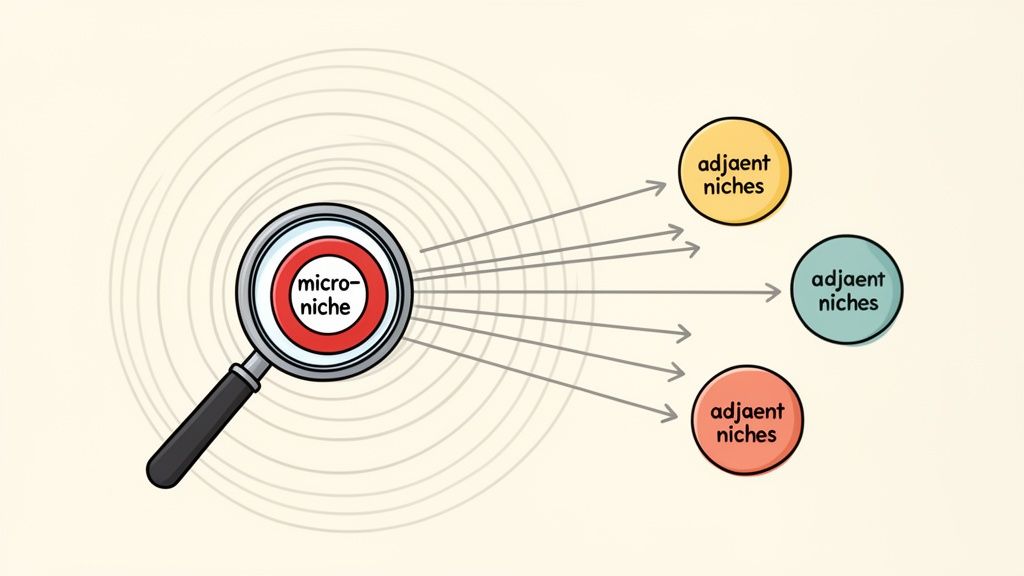
Once you achieve a dominant market position and high brand recognition there, you systematically expand into adjacent micro-niches. This creates a powerful snowball effect. Your credibility in the first niche acts as a launchpad, making it easier to capture the next. It’s one of the most methodical niche marketing strategies because it builds authority step-by-step, like conquering territory on a map. Podcasts like The Changelog and SaaStr used this method, starting narrowly with open-source developers and SaaS metrics, respectively, before expanding across the entire tech ecosystem.
When to Use This Strategy
This approach is ideal for brands entering a large, competitive market with established players. It allows you to gain a secure foothold without needing a massive initial budget. It is also effective when your product or service has applications across multiple verticals but you need to build credibility and case studies in one area first. If you can identify a small but passionate community that is currently underserved, this strategy is primed for success.
How to Implement It
"Start so niche you can't fail to become the #1 authority. When you own a small pond, it’s much easier to start connecting it to larger lakes. Your initial niche audience becomes your army of advocates for the next phase of growth." - Tom Hunt, Founder of Fame.
8-Point Niche Marketing Strategy Comparison
| Strategy | Implementation Complexity 🔄 | Resource Requirements ⚡ | Expected Outcomes 📊 | Ideal Use Cases 💡 | Key Advantages ⭐ |
|---|---|---|---|---|---|
| Vertical-Specific Podcast Content Strategy | Medium–High, requires deep vertical research and tailored content formats | Moderate, industry experts and niche distribution channels | High relevance, faster credibility, and more qualified leads | B2B companies building authority within a single industry or preparing for IPO/exit positioning | Higher engagement, targeted sponsorship opportunities, and lower competitive pressure |
| Guest-Driven Authority Leverage Strategy | High, extensive guest outreach, vetting, and skilled interviewing | High, PR and outreach efforts with coordinated guest promotion | Immediate credibility transfer and expanded audience reach through guest networks | New or growing podcasts looking to accelerate discoverability and establish authority | Rapid credibility building, organic audience growth, and valuable industry relationships |
| Community-Embedded Podcast Distribution | Medium, ongoing community engagement with platform-specific content | Moderate, community managers and tailored content for each audience | Stronger engagement, higher loyalty, and measurable community-driven conversions | Brands serving audiences active in Slack, Discord, LinkedIn, Reddit, or similar communities | Access to highly targeted audiences, better conversion rates, and authentic audience feedback |
| Intent-Based Lead Magnet Podcast Strategy | High, integrates CTAs, landing pages, and marketing automation | High, landing pages, email nurture workflows, lead scoring, and analytics | Direct lead generation with clear podcast-to-pipeline attribution | Demand generation teams and sales-driven organizations focused on measurable pipeline growth | Converts listeners into qualified leads while providing clear ROI measurement |
| Peer-to-Peer Interview Format for Niche Credibility | Medium, requires credible hosts and strong conversational preparation | Low–Moderate, experienced hosts, peer guests, and light production | Authentic audience engagement, easier guest acquisition, and mutual audience growth | Brands with respected practitioners who want to build trust through genuine conversations | Authenticity, natural audience alignment, and straightforward cross-promotion opportunities |
| Certification and Professional Credential Alignment Strategy | High, content must align with certification standards and frequent updates | High, subject matter experts, certification partnerships, and ongoing maintenance | High retention, binge listening, and a highly motivated audience | Professional services, training providers, and certification-driven industries | Evergreen educational content with strong partnership and sponsorship opportunities |
| Sponsor and Partnership Ecosystem Strategy | High, structured partner programs and co-created content initiatives | Moderate–High, partnership management, sales enablement, and co-marketing resources | Sustainable revenue growth, expanded reach, and stronger ecosystem relationships | Established podcasts looking to monetize while strengthening strategic partnerships | Additional revenue streams, broader promotion, and enhanced market credibility |
| Micro-Niche Domination and Market Expansion Strategy | Medium–High, focused niche launch followed by staged expansion | Moderate, community building, niche research, and sustained publishing cadence | Category leadership within a micro-niche and scalable long-term audience growth | Startups and B2B brands aiming to dominate a narrowly defined market before expanding | Minimal competition, rapid authority building, and a clear pathway for market expansion |
Your Next Step: From Niche Strategy to Market Dominance
We've explored eight powerful niche marketing strategies, from building a Vertical-Specific Podcast to executing a Micro-Niche Domination plan. Each approach offers a distinct path to sidestep the noise of mass-market competition and connect directly with the buyers who matter most. The core lesson is clear: going broad and trying to be everything to everyone is a recipe for being nothing to anyone. The most direct path to growth in a crowded B2B market is to go narrow and deep.
The common thread weaving through these strategies is the power of a focused B2B podcast. It’s not just another channel; it’s a strategic platform. A well-executed podcast acts as the engine for your authority, the catalyst for relationship-building, and the primary source for a pipeline of high-intent leads. It is the modern application of the 'Dream 100' concept, allowing you to invite your ideal customers onto your platform, solve their problems in public, and attract other ideal customers who are listening in. This is how you stop chasing leads and start attracting them with powerful demand gen strategies.
Synthesizing Strategy into Action
The value of these niche marketing strategies is unlocked not just by choosing one, but by committing to its execution. Let's distill the key takeaways into an actionable framework for your demand generation team:
Moving from theory to reality requires a systematic approach. The first step is to prioritize. Review the eight strategies and identify the one that most closely aligns with your immediate business goals. Are you trying to establish a foothold in a new vertical? The Vertical-Specific Podcast is your starting point. Do you need to build credibility fast? The Guest-Driven Authority approach is your accelerator.
"A great B2B podcast is not about you. It's about your guest. When you make your guest the hero, you become the guide, and the audience trusts you for it." - Tom Hunt, Founder of Fame
Once you've chosen your strategic focus, the real work begins. This isn't about simply recording audio. It’s about building a system. It requires a meticulous process for guest outreach, professional production that respects your audience's time, and a multi-channel promotion plan designed to drive real B2B outcomes, from brand recall to pipeline contribution.
The ultimate goal of adopting these niche marketing strategies is to achieve market dominance, not by shouting the loudest, but by speaking most clearly to a specific audience. You are building a brand that is synonymous with a particular problem or solution. You are creating a marketing channel that you own, a community that trusts you, and a pipeline that is predictable. This is how you transition from being just another vendor to becoming an indispensable partner.
Ready to stop competing for everyone and start winning the customers that matter? A podcast is the most effective platform for executing these niche marketing strategies, but success requires expertise and a proven process. At Fame, we help B2B brands launch and scale podcasts that drive authority, build relationships, and generate pipeline.
Want us to run this for you?
Fame starts and grows B2B podcasts that generate pipeline. Tell us who you are trying to reach and we will send a costed proposal within 48 hours.
Related content
- Read moreFame Team · July 16, 2026
10 Account Based Marketing Tactics For B2B Growth In 2026
Discover 10 actionable account based marketing tactics for B2B tech. Learn to use podcasts, data, and targeted content to close high-value accounts. - Read moreFame Team · July 16, 2026
The 8 Best Brighton Podcast Agency Picks For 2026
Find the best Brighton podcast agency for your B2B brand. Our 2026 guide reviews top 8 agencies for production, growth & ROI. Expert analysis here - Read moreJune 10, 2026
20 Best Podcast Production Agencies For 2026 (And Why Should You Hire One)
Global podcast and vodcast ad revenues are on track to hit $5 billion in 2026 , up 20% year-on-year. - Read moreApril 13, 2026
Leadership In Marketing: The B2B Podcast Playbook
Most companies still confuse leadership in marketing with job titles, org charts, and budget control. That's outdated.