






Key Takeaways
- Stop chasing vanity metrics and focus on measuring revenue-driven KPIs.
- Launching a B2B podcast can help build brand assets and generate high-intent leads.
- Tracking key metrics is crucial to measuring marketing ROI and improving performance.
If you want to boost your marketing ROI, you have to stop chasing vanity metrics and start measuring what actually drives revenue. It’s about building long-term, defensible brand assets that generate consistent, high-quality pipeline.
The single best way to do this in B2B is by launching a podcast. Why? A podcast allows you to build your brand, establish thought leadership, create owned marketing channels, and generate high-intent leads all at once. It’s a multi-faceted growth engine disguised as a content format. We’ve seen clients like Yellowbird achieve a 3.5x ROI in under 6 months by turning strategic conversations into customers.
This guide will show you how to improve marketing ROI by putting a B2B podcast at the center of your strategy.
Stop Guessing and Start Measuring Marketing ROI
You can't improve what you don't measure. In B2B marketing, I’ve seen too many teams get lost in a sea of data, celebrating high impression counts or click-through rates without ever tying those activities back to actual revenue.
This leaves them scrambling when leadership asks the one question that matters: "What did we get for our investment?"
Answering that question with confidence is your first real step toward a better marketing ROI. It means moving beyond surface-level metrics and building a rock-solid framework for tracking performance against real business goals. This is a crucial first step in building your B2B marketing plan.
From Vanity Metrics to Revenue-Driving KPIs
The secret is to zero in on a handful of metrics that tell the full story of your marketing's financial impact. Sure, a high lead count might feel like a win, but it’s worthless if none of them ever convert. The metrics that truly matter are the ones that draw a straight line from marketing spend to customer value and revenue.
Here’s a quick-reference guide to the core metrics every B2B marketer should have on their dashboard to measure and improve ROI.
Essential B2B Marketing ROI Metrics
.tbl-scroll{contain:inline-size;overflow-x:auto;-webkit-overflow-scrolling:touch}.tbl-scroll table{min-width:600px;width:100%;border-collapse:collapse;margin-bottom:20px}.tbl-scroll th{border:1px solid #ddd;padding:8px;text-align:left;background-color:#f2f2f2;white-space:nowrap}.tbl-scroll td{border:1px solid #ddd;padding:8px;text-align:left}MetricWhat It MeasuresWhy It's Critical for ROICustomer Acquisition Cost (CAC)Total sales and marketing cost to acquire one new customer.Tells you exactly how much you're spending to win each client. A key part of any B2B customer acquisition strategy.Customer Lifetime Value (LTV)Total revenue expected from a single customer over their entire relationship.Shows if you're acquiring and keeping high-value customers.LTV to CAC RatioCompares the lifetime value of a customer to the cost of acquiring them.The ultimate test of profitability. Aim for 3:1 or higher.Marketing-Sourced PipelineThe total value of sales opportunities generated directly by marketing.Proves marketing's direct contribution to the sales funnel.Marketing-Influenced PipelineThe value of opportunities where marketing had a touchpoint, even if not the source.Highlights marketing's role in nurturing leads and closing deals.
Tracking these essentials helps you prove marketing's worth in a language everyone understands.
By consistently tracking these metrics, you shift the conversation from "we got 5,000 clicks" to "we spent $20,000 and generated $80,000 in new revenue." This outcome-based language is far more compelling for stakeholders and justifies your team's budget. For a deeper dive, check out our guide on how to calculate marketing ROI.
Choosing the Right Attribution Model
Once you know what to measure, you need to figure out how to assign credit. An attribution model is just the set of rules you use to decide which marketing touchpoints get credit for a conversion. Without a clear model, it's impossible to know which of your channels are the real MVPs.
Models can be as simple as last-click attribution (giving 100% of the credit to the final interaction) or more complex, like multi-touch models (linear, time-decay, etc.).
For B2B companies with long, winding sales cycles, a multi-touch model is almost always the way to go. It gives you a much more realistic view of the entire customer journey, acknowledging that multiple touchpoints played a role in demand generation marketing.
Building this measurement foundation isn't just a reporting task. It's a strategic move that gives you the power to make smarter decisions, optimize your spend, and finally prove the massive value your marketing efforts bring to the table.
Why B2B Podcasting Delivers Exceptional ROI

While optimizing existing channels is smart, the biggest jumps in marketing ROI come from building long-term, defensible assets for your brand. In a world of fleeting ads and crowded social feeds, a B2B podcast is one of the most powerful growth engines you can build.
Podcasting isn't just another content format. It’s a strategic platform for building real relationships, establishing deep authority, and generating high-intent demand. Think about it: you get to speak directly into your ideal customer's ear for 30-60 minutes at a time. That creates a level of connection and trust that a blog post or social update simply can't match.
We've seen this happen time and again. For example, our client Yellowbird, an EHS software company, launched a podcast that delivered an incredible 3.5x ROI in under six months. You can get the full story of how they turned conversations into conversions in the Yellowbird case study.
Build a Brand That Commands Authority
One of the main reasons podcasting drives such a strong return is its power to build your brand and cement you as a thought leader. Instead of just telling the market you're an expert, you're actively proving it with every single episode. This is central to any modern content strategy for B2B.
This creates what our founder, Tom Hunt, calls "dark social" buzz. These are the conversations happening in Slack channels, DMs, and team meetings that attribution software can’t track, but that directly influence buying decisions. When a prospect hears your team discussing their exact pain points with a respected peer, your brand becomes the obvious solution.
A podcast is a stage for your expertise. Each episode is a public demonstration of your company's knowledge and a signal to the market that you are the go-to authority in your niche.
This authority is an asset that grows over time. As your episode library expands, so does your credibility. This makes it easier to land top-tier guests, grow your audience, and ultimately, close more deals. You can dive deeper into these compounding effects by reading about the benefits of podcasting for B2B brands.
The Podcast as a Content Generation Engine
A podcast isn't a one-and-done piece of content; it's the heart of an entire content ecosystem. A single 30-minute interview can be strategically repurposed into dozens of assets, dramatically increasing the ROI of your initial time investment. Mastering these content repurposing strategies is key.
This approach transforms one long-form recording into a multi-channel marketing campaign that continuously drives engagement and leads.
Here’s how one episode can fuel your entire marketing machine:
- Video Clips for Social Media: Pull short, engaging clips from the interview to share on LinkedIn and other platforms. These are perfect for grabbing attention and driving traffic.
- In-Depth Blog Posts: Turn the episode transcript into a detailed, SEO-optimized article that attracts organic search traffic for months or even years.
- Quote Graphics and Carousels: Transform powerful quotes and key takeaways from your guests into visually appealing graphics for your B2B social media strategy.
- Newsletter Content: Summarize the most valuable insights and send them to your email list, nurturing subscribers and driving them back to your best content.
By atomizing your podcast, you maximize its reach and impact across all your B2B marketing channels. This flywheel effect is the key to improving marketing ROI—you create one high-value asset and let it work for you everywhere. To really scale this, you can even partner with a B2B social media agency or a newsletter agency to handle distribution, freeing up your team to focus on strategy.
Turn Your Podcast Guests Into High-Value Customers
A growing audience is great, but let's talk about a more direct path to boosting your marketing ROI: turning your podcast guests into clients.
This isn't just about recording an episode; it's about engineering high-value relationships from the ground up. This is one of the most powerful demand gen strategies a B2B company can deploy. Imagine a world where your ideal prospects don't just know your brand—they're actively advocating for it before they ever see a sales deck.
This guest-to-client strategy is a core pillar of high-ROI podcasting. Instead of a cold email sequence that gets ignored, you’re kicking off a warm, collaborative conversation. You give them a platform to share their expertise, which builds genuine rapport and gives you incredible insight into their business challenges.
The numbers don't lie. The average guest-to-client conversion rate is a respectable 10% for most B2B podcasts. But the top performers? They're hitting a staggering 48% conversion rate. They do this by strategically inviting guests who fit their ideal customer profile, turning almost half their conversations into real business. You can dig into more of these powerful B2B podcasting statistics on beomniscient.com.
Identify and Invite Your Ideal Customers
First things first: treat your guest list like a target account list. This is a critical mindset shift. Stop asking, "Who would be an interesting guest?" and start asking, "Which leaders from our dream accounts can we feature?"
Create a "Dream 100" list of companies you'd kill to work with. These are the accounts that would seriously move the needle for your business. Once you have this list, your guest prospecting becomes razor-sharp.
Your outreach needs to be a genuine opportunity, not a sales pitch in disguise. Frame it as a chance for them to showcase their expertise to your audience. Your invitation should highlight:
- What's in it for them: Emphasize the chance to build their personal brand and share their insights with a relevant, engaged audience.
- The specific topic: Propose a discussion area where you know they're an expert. This shows you've done your homework.
- How easy it is: Let them know you’ll handle all the logistics. Make it a low-effort, high-reward gig for them.
Conduct Interviews That Build Real Relationships
The interview itself is where the magic happens. Your goal isn't to sell. It's to listen and learn. A great podcast interview builds trust and positions you as a knowledgeable peer, not just another vendor.
During the chat, ask questions that get to the heart of their pain points, strategic priorities, and operational headaches. A simple question like, "What's the biggest obstacle your team is facing with X right now?" can give you priceless intelligence you'd never get on a standard sales call.
The secret to a successful guest interview is making your guest the hero. When you give them a platform to shine, you build a deep level of trust and rapport that naturally opens the door for a business relationship later on.
By the end of the episode, you've got a warm relationship and a deep understanding of their business needs. That's the perfect foundation to build on.
Create a Seamless Transition from Conversation to Conversion
The post-interview follow-up is where you turn a great conversation into a real commercial opportunity. But you have to be thoughtful. This can't feel like a bait-and-switch.
Start by sending a simple thank-you note. Include the link to the live episode and some pre-made promotional assets (like quote graphics or video clips) they can easily share. This makes them look good and helps your content go further.
Then, wait a few weeks. Follow up with an idea or resource that directly addresses a challenge they mentioned during the interview.
For example, if a guest talked about struggling with content scaling, you could send a note like:
"Hey [Name], I was thinking about our chat and that challenge you mentioned with content scaling. I put together a few thoughts on how we've helped other companies in your space tackle this. Happy to share if you're interested."
This approach smoothly transitions the relationship from 'podcast host' to 'trusted advisor,' making the eventual sales conversation a natural next step. This guest-to-client pipeline is a powerful way for any company asking how to improve marketing ROI to create a direct, relationship-driven revenue stream.
For even more strategies on this, you might be interested in our guide on how to win new customers with podcast guesting.
Build a Content Engine to Maximize Your Reach
A great podcast episode isn't the finish line; it's the starting block. If you want to really improve your marketing ROI, you need a smart, systematic way to repurpose and distribute your content. This turns a single piece of audio into a full-fledged marketing campaign that keeps working for you long after you’ve hit stop on the recording.
The idea is simple: take one high-value asset and atomize it. A single 30-minute interview contains enough material to fuel your marketing channels for weeks on end. By breaking it down into smaller, native formats, you make sure your message connects with your audience right where they already hang out.
From One Episode to a Multi-Channel Campaign
Think of your podcast as the sun in your content solar system. Every other piece of content revolves around it, drawing energy and life from that core conversation. A huge part of this is repurposing your audio. To get started, you can easily transform your podcast episodes into blog posts.
This whole process ensures that for every hour you put into recording, you get a massive return in marketing assets.
Here’s what that looks like in practice:
- SEO-Driven Blog Posts: Turn the episode transcript into a detailed, keyword-optimized blog post. This is your hook for capturing organic search traffic and gives your ideas a permanent home on the web.
- LinkedIn Video Clips: Pull short, punchy video clips (1-2 minutes) of your guest dropping a key insight. These are gold for grabbing attention on fast-scrolling social feeds.
- Quote Graphics & Carousels: Find powerful, tweetable quotes and turn them into shareable graphics or carousels. They're highly engaging and super easy for your audience to digest and share.
- B2B Newsletter Fodder: Sum up the episode's top three takeaways and feature them in your next B2B email newsletter. This gives your subscribers immediate value and drives them back to the full episode.
This infographic gives a high-level look at the journey from identifying a potential guest to turning them into a customer.
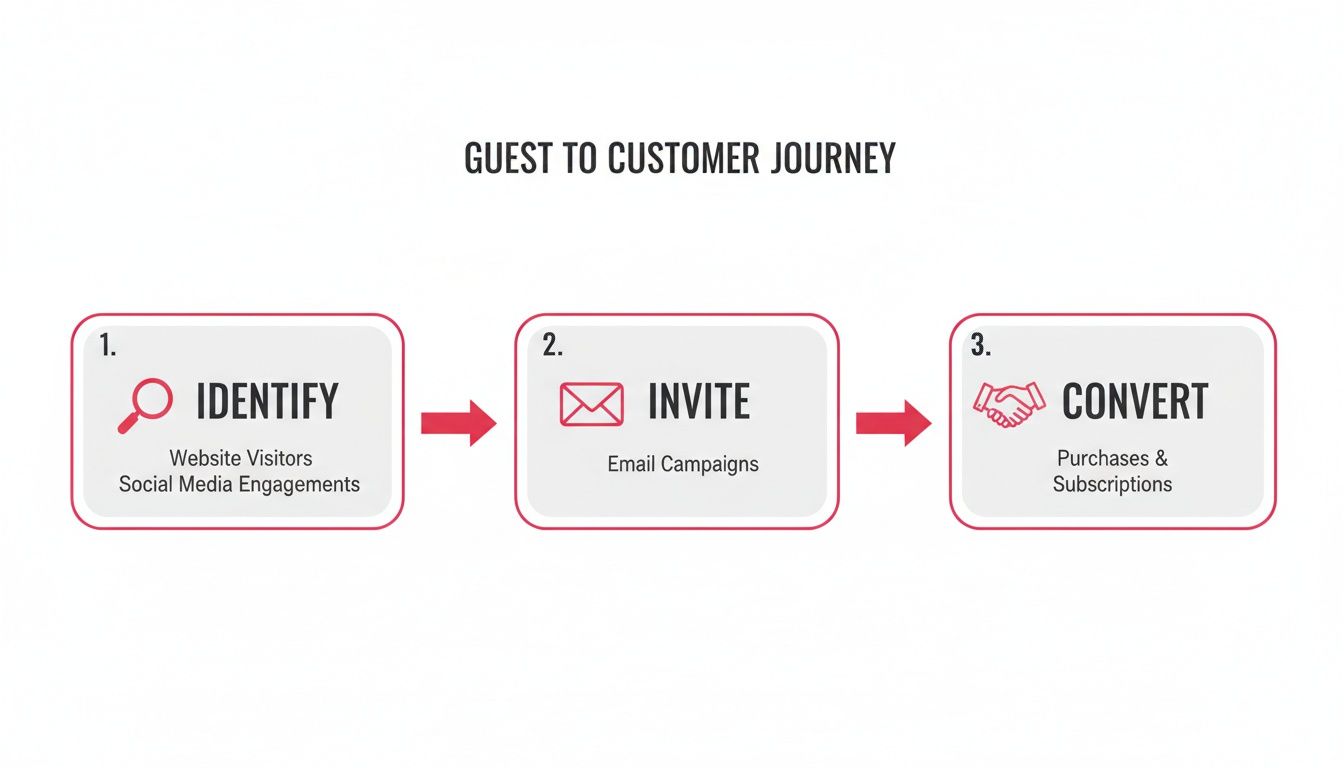
As you can see, a strategic podcasting process isn't just about creating content—it's a direct funnel for business development.
Amplify Your Reach with Strategic Distribution
Creating all these assets is only half the job. The other half is getting them in front of the right people. A rock-solid content distribution strategy is what separates the podcasts that generate real ROI from the ones that just collect digital dust.
A podcast episode that no one hears has an ROI of zero. Smart distribution is what turns your content investment into tangible business results, like brand awareness, lead generation, and sales.
Your distribution plan needs multiple layers. Start with your owned channels—your website, email list, and social media profiles. But to really scale, you have to think bigger. This could mean paid promotion, guest swaps with other podcasts, and collaborative content partnerships. Your B2B social strategy will be critical here.
For B2B brands looking to really put the foot on the gas, this is where a team of specialists can be a game-changer. For example, we've found that leveraging dedicated teams for promotion is highly effective. This frees up your internal team to focus on what they do best: building relationships and closing deals.
If you're looking for more ways to expand your content's footprint, check out our guide on how to scale content marketing. By building this content engine, you create a sustainable system for growth that continuously improves your marketing ROI.
Real-World Insights from a B2B Podcast Expert
Frameworks and theory are great, but the real lessons on boosting marketing ROI come from the trenches. So, to bridge that gap, let's get some practical advice from Tom Hunt, the founder of Fame. He's helped over 100 B2B companies launch and grow high-impact podcasts.
Tom’s philosophy is refreshingly direct: the best marketing ROI doesn’t come from chasing complex attribution models or jumping on the trendiest new channel. It comes from building a brand people genuinely trust and creating content that actually starts conversations.
This means you have to embrace the “dark social” buzz—the word-of-mouth that happens in DMs and private Slack channels, which attribution tools will never fully capture.
The Perfect Attribution Trap
So many marketers get obsessed with tracking every single touchpoint. They're on a quest to build a flawless attribution model. While measurement is obviously important, Tom argues that relying on it too heavily can be a huge mistake. You just end up optimizing for what’s easy to measure, not what’s truly effective.
The hard truth is that your most valuable marketing moments are often invisible to your analytics dashboard.
Think about it. A prospect hears your CEO on a podcast, loves the episode, and shares it with their team. That sparks an internal discussion, and suddenly your brand is the top contender. No attribution model on earth can track that journey, yet it’s the most powerful path to a sale you could ask for.
Your goal shouldn't be perfect attribution; it should be to create so much value that your brand becomes an undeniable part of your industry's conversation. The ROI will follow, even if you can't map every single step.
This is a fundamental mindset shift. Instead of asking, "How can we track this?" start asking, "How can we create an experience so memorable that our ideal customers can't help but talk about us?"
Conversation is Your Highest-ROI Marketing Tool
The most direct way to drive conversations is to start them yourself. At its core, a B2B podcast is a conversation engine. It’s a platform for building relationships at scale—both with your guests and your audience. This is one of the top B2B demand generation strategies available today.
Tom points out two key conversational flywheels a podcast gets spinning:
- Guest Conversations: As we've covered, if you're strategic about inviting leaders from your target accounts, you create a direct, relationship-driven sales pipeline. It’s a conversation that can lead straight to revenue.
- Audience Conversations: Every episode you release arms your listeners with new ideas and talking points. They then take these insights into their own team meetings and professional circles, basically becoming extensions of your marketing team.
This approach flips marketing from a one-way broadcast into a genuine two-way dialogue.
Building a Brand People Actually Like
In a world drowning in polished, corporate-speak content, authenticity is your secret weapon. A podcast is one of the few channels where the real voices and personalities of your team can actually shine through. As Tom says, listeners don't connect with logos; they connect with people.
When your audience hears the genuine passion and expertise from your team, they build a much deeper level of trust than they ever would from reading a perfectly crafted whitepaper. This authenticity is the key ingredient for building a brand that people not only buy from but actively root for.
Here are a few of Tom’s actionable tips for injecting authenticity into your show:
- Don't Over-Script: Have a clear outline, but let the conversation flow. The best insights almost always come from unscripted moments.
- Share Real Stories: Talk about your failures as much as your successes. It makes your brand more human and relatable.
- Let Your Personality Show: If your team is funny, be funny. If they're deeply analytical, lean into that. Don't try to be something you're not.
At the end of the day, improving marketing ROI in B2B isn't about finding some magic bullet. It’s about a sustained commitment to building authority and fostering real connections. By focusing on creating valuable conversations, you build brand equity—a long-term asset that delivers returns far beyond what any single campaign ever could.
Building Your B2B Marketing Tech Stack for Growth
Look, the best strategy in the world is useless without the right tools to bring it to life. Building a B2B marketing tech stack that actually helps you grow is a non-negotiable for improving marketing ROI, but it doesn't have to be a complicated or expensive nightmare.
The real secret? Integration. You need your tools to talk to each other, creating a smooth journey from that very first touchpoint all the way to a closed deal. This is a core part of most modern digital marketing strategies for B2B.
Your stack should cover the basics, from the CRM that tracks your pipeline to the analytics platforms that show you what’s working. For instance, a scheduling tool like Chili Piper, one of our partners, can instantly book meetings for high-intent leads who come in from your podcast. That's a direct line from your content to a sales action, which makes proving ROI incredibly straightforward.
Key Components of a High-ROI Tech Stack
A tech stack that's firing on all cylinders connects your marketing efforts directly to sales outcomes. Instead of a jumbled mess of standalone tools that don't communicate, you should be aiming for a system where data flows seamlessly. This gives you that coveted single source of truth.
Your essential toolkit will probably include:
- Customer Relationship Management (CRM): This is the heart of your stack where all customer data lives. Think Salesforce or HubSpot.
- Marketing Automation: The engine for nurturing leads through email workflows and personalized campaigns.
- Analytics Platform: This is how you track website behavior and campaign performance. Google Analytics is the obvious starting point.
- Content & Podcast Tools: Platforms for hosting, editing, and getting your podcast out there. We've actually put together a list of our favorite podcast tools to help you choose the right fit.
Integrating Your Stack for Maximum Impact
An integrated stack is your best defense against data silos. It gives you a complete picture of the customer journey. When your podcast brings in a lead, your automation platform should snag it, your CRM should track it, and your analytics should attribute it back to the show. As you put the pieces of your B2B marketing tech stack together, figuring out how to apply the principles of Mastering ROI in Marketing Automation is absolutely critical for driving real business growth.
The goal is to create a closed-loop system where you can clearly see how much you spent on a marketing activity and how much revenue it generated. This visibility is the foundation of a high-ROI marketing program.
At the end of the day, your tech stack should empower your strategy, not make it more complicated. Focus on tools that solve specific problems and play well with others. This ensures every dollar you spend is measurable and contributes directly to your bottom line.
Got Questions About Podcast ROI? We've Got Answers
Even with a rock-solid game plan, it's smart to have a few lingering questions before you dive headfirst into creating a B2B podcast. Let's tackle some of the most common ones we hear from marketers trying to figure out how to boost their marketing ROI with a show.
How Long Until We Actually See an ROI?
This is the big one, isn't it? While you get immediate value from building relationships with your guests, the tangible financial ROI usually starts to show up within 6 to 9 months.
But don't just take my word for it. Look at the Yellowbird case study—a focused strategy got them a 3.5x ROI in less than half a year. The real magic happens with consistency. A B2B podcast is a compounding asset; the returns snowball over time as your brand authority grows, your audience expands, and you nurture those high-value relationships.
Will a Podcast Even Work for My Super-Niche Industry?
Absolutely. In fact, the more niche or "boring" your industry, the better your podcast will probably do. It's simple supply and demand—less competition means a hungry, dedicated audience is out there actively searching for the specialized content that only you can provide.
Your goal isn't to get millions of downloads. It's to deliver immense value to a very specific group of people who just happen to be your ideal customers. Do that, and you'll quickly become the go-to authority in your space, turning your podcast into a lead-gen machine.
The more niche your industry, the more a podcast can differentiate your brand. It becomes the primary source of expertise in a field where quality content is scarce, building a highly valuable and loyal audience.
So, What's the Real Cost to Start a B2B Podcast?
The cost can be all over the map. You could go the DIY route for a few hundred bucks or invest in a full-service agency. But when you're crunching the numbers, don't forget to factor in the massive opportunity cost of your team's time. Production, editing, promotion—it all adds up.
This is where partnering with a specialized agency like Fame can be a game-changer. It frees up your team to focus on what they do best: strategy and converting the qualified leads your podcast brings in. This shifts the podcast from a potential time-suck and cost center into a strategic, ROI-driving asset, which is the whole point of figuring out how to improve marketing ROI, right?
Ready to transform your B2B marketing with a podcast that delivers measurable returns? Learn how Fame can build your authority and drive qualified pipeline by testing out our B2B Podcast ROI Calculator.
