January 27, 202620 min read6 sections
Actionable Executive Interview Techniques For B2B Podcasts
By Fame Team
Key Takeaways
- A successful executive interview requires thorough prep work to understand the guest, their company, and industry, going beyond a quick LinkedIn profile scan.
- Effective prep involves laying the groundwork with deep-dive research, such as analyzing company filings, immersing yourself in industry news, and studying previous appearances to find unique angles or topics.
- The ultimate goal is to have a peer-level conversation that provides value to the audience, not to pitch one's own company, by using the prep work to craft data-driven, timely, and relevant questions.
Effective executive interviews don't just happen. They're won or lost long before you hit the record button. It’s all in the prep work.
This isn’t about a quick scan of their LinkedIn profile five minutes before you go live. It’s about doing the deep, strategic work to understand your guest, their company, and the world they operate in. Your goal is to have a peer-level conversation, not a simple Q&A. You get there by respecting their time and giving them a crystal-clear vision of what a successful interview looks like. And remember, the goal is to provide value to the audience, not to pitch your company. Mention your business in the intro or outro, but keep the core content focused on insight and education.
Laying The Groundwork For A Memorable Interview
A truly killer executive interview is a game of preparation, insight, and strategic alignment. The groundwork you lay is what separates a surface-level chat from a deep, memorable discussion that actually delivers value to your audience.
Think of yourself less as an interviewer and more as a strategic partner. You need to get inside the web of their company's market position, their recent wins, and the big challenges keeping them up at night.
Deep-Dive Research Beyond The Bio
Your research has to go way beyond the standard bio. Their official bio tells you the "what." Your job is to uncover the "why" and the "how."
- Actionable Step 1: Analyze Company Filings. For public companies, quarterly earnings calls and annual reports are a goldmine. Download the transcript of the last earnings call. You'll hear the exact metrics, challenges, and priorities the CEO is communicating to investors. Use this to form specific, data-driven questions.
- Actionable Step 2: Immerse Yourself in Industry News. What’s the big conversation in their sector right now? Use tools like Feedly or Google Alerts to track keywords related to their industry. Read recent articles and analyst reports to understand the context so you can ask questions that are sharp, timely, and relevant.
- Actionable Step 3: Study Previous Appearances. Watch or listen to their last 2-3 interviews. Take notes. Which questions got them fired up and gave real, insightful answers? Which ones led to canned, generic responses? Your whole mission is to find a fresh angle that nobody else has touched. As our founder, Tom Hunt, often emphasizes, finding a unique "hook" or topic is key to creating unignorable content.
This whole process is about building a solid foundation for the interview itself.
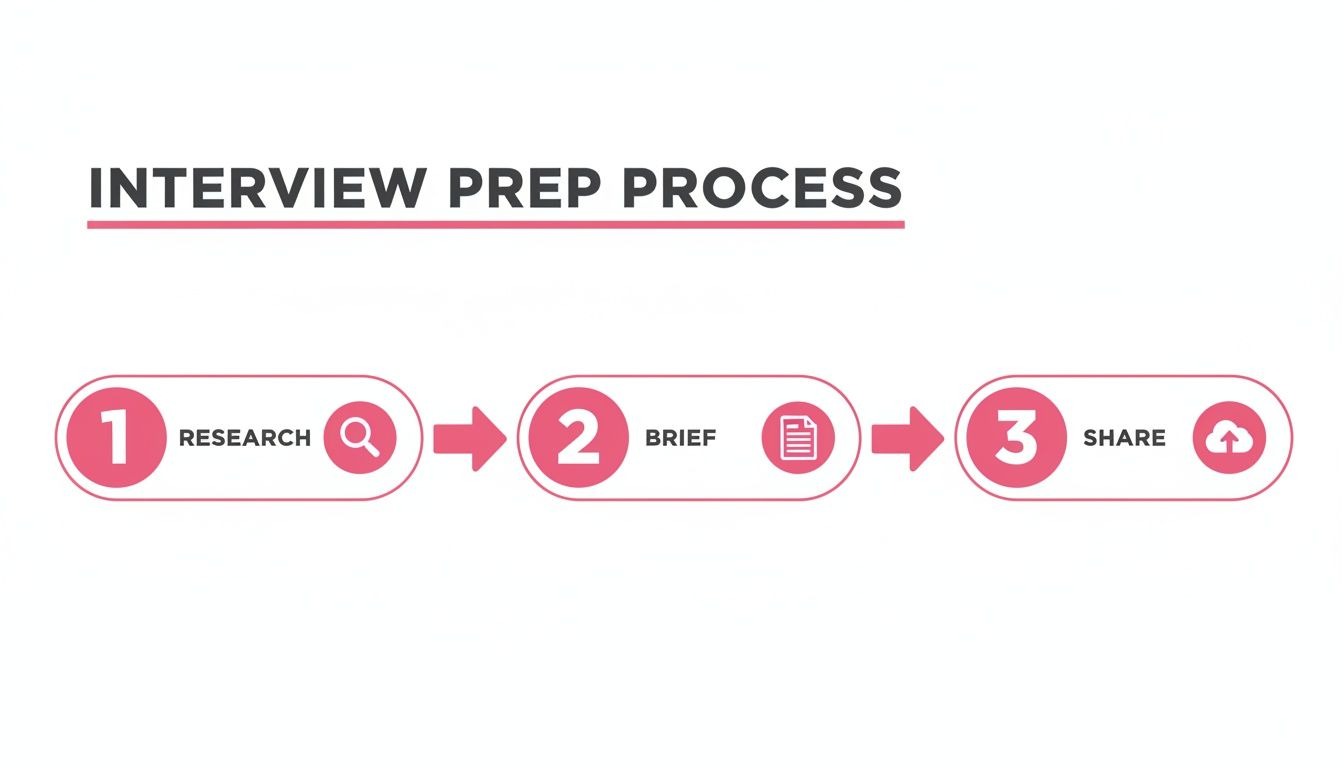
This simple flow, Research, Brief, Share, gets you and your guest perfectly aligned before the mics go hot, which makes every minute of your time together count.
Building And Sharing The Strategic Guest Brief
Once you've done your homework, it’s time to pull it all together into a strategic guest brief. This document is an absolute game-changer. It's not a rigid script. It’s a collaborative roadmap that maps out the conversation’s narrative arc, the key themes, and potential talking points. To keep all this organized, it can be helpful to explore different executive meeting tools that can help structure your findings and build the brief.
Sharing this brief with the executive and their team beforehand is a massive sign of respect. It shows you value their time and expertise. It also helps calm any pre-interview jitters and empowers them to come prepared with specific, data-backed stories and examples.
Think about it like this: in B2B leadership hiring, behavioral interview techniques lead to a 35% higher success rate in cultural fit because candidates are prepped to share quantified stories. An executive who can say "I led an AI pivot that improved cash flow by 18%" builds instant authority. That's the exact principle you want to apply to your podcast.
Your Pre-Interview Strategic Checklist
This checklist breaks down the essential steps to ensure every executive interview is professional, insightful, and runs smoothly from start to finish.
| Preparation Phase | Action Item | Strategic Benefit |
|---|---|---|
| Deep Research | Review last 2 earnings calls, annual reports, and competitor press releases. | Uncover key business priorities, challenges, and metrics for timely questions. |
| Context Analysis | Read 3–5 recent industry analyst reports and top-tier media articles. | Frame the conversation around current trends and market shifts, showing expertise. |
| Angle Development | Analyze 2–3 of the guest's previous interviews (podcasts, keynotes). | Identify overused questions to avoid and discover fresh, unexplored angles. |
| Brief Creation | Synthesize research into a 1-page strategic brief with 3–4 core themes. | Provide a clear, collaborative roadmap that respects the executive's time. |
| Pre-Call Alignment | Share the brief with the guest or their comms team at least 48 hours in advance. | Calm nerves, build trust, and empower the guest to prepare impactful stories. |
| Logistics Lock-in | Confirm all technical details (platform, audio/video checks, recording time) in one email. | Ensure a smooth, professional recording experience with no last-minute hiccups. |
Following these steps methodically transforms a good interview into a great one. It builds a partnership with your guest before you even start recording.
A well-crafted guest brief elevates the conversation from an interview to a strategic dialogue. It tells the executive, "I've done my homework, I value your perspective, and I want to co-create something truly insightful."
By investing heavily in this foundational stage, you set yourself up for a compelling, high-impact episode that your B2B audience will actually care about.
Asking Questions That Spark Strategic Conversations
Generic questions are the fastest way to get generic, PR-approved answers from an executive. To get past the corporate talking points and uncover real C-suite insights, you have to master the art of asking strategic questions.
This isn’t just about what you ask. It’s about how you ask it and in what order.
The real goal is to frame your questions in a way that invites storytelling, gently challenges their assumptions, and reveals the kind of forward-thinking perspective that defines strong leadership. This means getting beyond simple "what" and "how" questions and into the much richer territory of "why" and "what if."
From Standard To Strategic Questions
A simple rephrase can completely change the depth of the response you get. It’s the difference between an answer they’ve given a dozen times and a moment of genuine reflection. This subtle but powerful shift is everything.
Here’s how to reframe common questions to get a much bigger impact:
- Standard: "What are your company's goals for next year?"
- Strategic: "Looking at the next 12-18 months, which market headwind are you most focused on turning into a strategic advantage, and what's the first step?"
- Standard: "How has technology changed your industry?"
- Strategic: "If you were advising a legacy company in your space today, what's the one uncomfortable truth they need to accept about their tech stack to stay relevant in five years?"
- Standard: "What makes a good leader?"
- Strategic: "Think about a time you had to lead your team through intense uncertainty. What was the one principle you refused to compromise on, and why was it so important?"
These strategic versions push the executive to pull from specific experiences and give you a narrative, not just a canned response. For a deeper dive, check out our list of compelling interview questions for a podcast that you can adapt for any executive conversation.
The Power of "Why" and "What If"
Some of the best moments in an interview come from the follow-ups. "Why" and "What if" are your two most powerful tools for digging deeper.
- Actionable Tip: Use "Why" for Motivation. After a guest describes a major move, a simple, "Why was that the right call at that specific moment?" can unlock the entire strategic context.
- Actionable Tip: Use "What If" for Vision. These questions open the door to speculation and big-picture thinking. A question like, "What if your primary assumption about your customer base turns out to be wrong next year?" forces a leader to think beyond their current playbook.
The quality of your interview is directly proportional to the quality of your questions. A great question makes the guest think, and a thinking guest provides unique value to your audience.
Building A Narrative Through Question Sequencing
The order you ask your questions matters just as much as the questions themselves. A well-sequenced interview feels like a natural conversation, not an interrogation. It builds a narrative arc that keeps both the guest and the listener locked in.
Here's a simple structure that works:
- Start with Rapport and Context: Kick things off with questions that establish their expertise and passion. Ask about their journey to the C-suite or a recent company win they're proud of. This warms them up and builds credibility with your audience right away.
- Escalate to Strategic Depth: Now you can smoothly transition into the core themes you outlined in your guest brief. This is where you deploy your carefully crafted "why" and "what if" questions, connecting their personal experience to broader industry trends.
- End with a Forward-Looking Vision: Wrap up by asking them to look to the future. Questions about long-term industry predictions, advice for aspiring leaders, or the legacy they hope to build leave the audience with a powerful, memorable takeaway.
This structured approach ensures you capture both hard data and strategic insights. It also helps you spot trends. For instance, a recent report showed that 68% of executives now prioritize AI-driven personalization in vendor selection, a huge jump from 42% just three years ago. This kind of data highlights how consistent, structured questioning can reveal massive shifts in market priorities.
Guiding the Conversation with Confidence
This is where the magic happens. Your role as host is a delicate dance; you're part interviewer, part facilitator, and part conversation strategist. Once you hit record, all that prep work melts into the background. What matters now is your ability to guide the discussion with a steady hand.
The real goal? To make the executive feel like they're sparring with an intellectual peer, not just ticking off answers from a list. This comes down to confidence, listening with intent, and being able to pivot on a dime.
Master the Art of Active Listening
Active listening isn’t just about waiting for your turn to talk. It's about hearing the words, sure, but it’s also about catching the subtext, the passion, and the unexplored ideas hiding in their answers. It's your single best tool for digging up gold. Forget your next question for a second and just focus on what they're saying right now.
Listen for these cues:
- Energy Shifts: Pay attention to when their voice picks up speed or passion. That's a huge sign you've landed on something they genuinely care about. Lean into it. Ask a follow-up.
- Vague Language: Executives can sometimes slip into corporate-speak. When you hear a broad statement like "we focused on synergy," that's your cue to jump in. Gently ask, "Can you give me a specific example of what that synergy looked like on the ground?"
- "In-Between" Moments: The juiciest follow-ups often spring from a tiny detail or a comment they made in passing. A guest might mention a "challenging quarter" and then quickly move on. That's your chance to circle back. "You mentioned a challenging quarter earlier. What was the single biggest lesson your team learned from that period?"
This isn't just a technique; it shows you're fully present and invested in their story, which builds massive rapport on the spot.
Navigating Common Interview Hurdles
Even the best-planned conversations can hit a bump or two. Knowing how to handle these moments gracefully is what separates the pros from the amateurs.
A classic one is the guest who gives super-short, one-sentence answers. This usually happens when they're either nervous or have been media-trained to death. Your job is to gently coax more out of them.
Don't just move on to the next question. Try an open-ended prompt instead:
"That's a really interesting point. Could you walk me through the thought process that led you to that conclusion?"
See the difference? You're not asking another question; you're inviting them to tell a story. It almost always works.
On the flip side, you'll get guests who love to go on tangents. Their passion is fantastic, but you still owe it to your audience to keep things focused. A smooth way to get back on track is to validate their point and then use it as a bridge. For instance, "I love that insight on company culture, and it actually connects perfectly to what I wanted to ask about talent retention..."
Gently Challenge to Add Depth
If you want to create a truly memorable interview, sometimes you have to gently push back. This isn't about being confrontational. It's about adding layers to the conversation and showing you can hang in a sophisticated discussion. The idea is to explore the 'why' behind their positions.
A slick way to do this is to introduce a counterargument without making it your own.
For example, you could say:
"Some analysts in your industry have argued that focusing too heavily on X could leave companies vulnerable to Y. How do you think about balancing those risks?"
This move introduces a bit of healthy tension and forces a more nuanced, strategic response. It shifts the entire dynamic from a simple Q&A to a genuine exploration of strategy and trade-offs, exactly the kind of high-level chat executives are built for. Honing this ability is a key part of what our guide on executive communication training is all about, because it's about creating a dialogue, not just recording a monologue.
Ensuring Flawless Audio for Remote Interviews
Let's be blunt: even the most mind-blowing conversation with a C-suite executive is worthless if the audio is terrible.
In a world where most interviews are remote, getting the tech right isn’t just a nice-to-have. It’s a baseline requirement for any B2B podcast that wants to be taken seriously. Listeners have zero patience for echo, background noise, or tinny sound; it screams "amateur hour" and instantly devalues everything your guest is saying.
The good news is you don't need a Hollywood-level studio to sound incredible. It just comes down to a few key pieces of gear and a simple, repeatable process for both you and your guest.
The Non-Negotiable Gear for Great Sound
First rule of podcasting: your laptop's built-in microphone is not your friend. To capture broadcast-quality audio, both you and your guest need a dedicated external microphone. The investment is tiny compared to the massive leap in quality it provides.
- For the Host: A high-quality USB mic is your best bet. Something like the Blue Yeti or Rode NT-USB+ is a fantastic starting point. They're plug-and-play, super reliable, and deliver that rich, clear sound that gives you a professional presence.
- For the Guest: Never assume an executive has a pro setup. Your job is to make it dead simple for them. A few days before the recording, send over a simple, non-technical checklist to set them up for success.
A solid guest checklist removes all the technical guesswork and helps them sound their best with minimal effort.
Key Takeaway: The single biggest audio upgrade you can make is ensuring both you and your guest use an external microphone and headphones. This one move eliminates the vast majority of common audio problems like echo and feedback.
Your Simple Guest Audio Checklist
Sending this checklist ahead of time isn't just about good audio; it shows you're a professional who respects the quality of the final product.
- Find a Quiet Space: A small room with soft furnishings is perfect. Think carpets, curtains, or even a bookshelf. These things absorb sound and kill echoes. Avoid big, empty boardrooms at all costs.
- Use an External Mic: If they have one, great. If not, even the mic on a pair of wired earbuds (like the old Apple EarPods) is a huge improvement over the computer's built-in mic.
- Wear Headphones: This is critical. Any kind of headphones will do. This one step prevents your voice from bleeding into their microphone, which is the number one cause of distracting echo.
- Close All Unnecessary Apps: Remind them to shut down Slack, email, and anything else that might send a notification mid-sentence.
- Use a Stable Internet Connection: A wired Ethernet connection is always going to be more reliable than Wi-Fi. It's worth suggesting if they have the option.
Embracing the "Double-Ender" Recording
One of the most crucial executive interview techniques for remote audio is the double-ender recording. It’s a fancy term for a simple concept: you record each person's audio locally on their own computer, completely separate from the main call recording.
Platforms like Riverside.fm or SquadCast are built specifically for this. They capture a pristine, uncompressed audio file directly from each person's mic. This is an absolute lifesaver because it sidesteps any internet glitches, dropouts, or compression artifacts that can completely ruin a recording. Among our partners, we've seen companies like Resound, an AI podcast editor, benefit greatly from high-quality source audio provided by these platforms.
For the most important executive interviews where quality is everything, many B2B podcast agencies like Fame will handle this whole process. We often ship pre-configured recording kits directly to guests. This white-glove service removes all technical stress and guarantees flawless audio, every single time. It lets the executive focus on one thing: delivering incredible insights.
Turning Your Interview Into A Marketing Engine
Here's the thing: the interview recording isn't the final product. It's the raw material. The conversation itself is where you create the value, but amplifying it is where you actually see the ROI. This is the part where you transform a single, long-form audio file into a full-blown, multi-channel marketing campaign that keeps generating demand long after the episode airs.
But before you start slicing and dicing, there's a crucial step you can't skip: the approval process. When you're working with C-suite executives, especially from big companies, you can bet their corporate communications or legal teams will want to review the final edit. Don't see this as a roadblock. It's a standard part of the process that shows you're a pro and builds trust.
Navigating The Corporate Approval Workflow
The secret to a smooth approval process is being fast and clear. Never leave your guest's team guessing. A simple, proactive workflow keeps everyone in the loop and your publishing schedule on track.
- Set expectations early. Mention the review process right from the start, either in your initial outreach or the pre-interview brief. Just a quick line like, "We'll send a private link for your team to approve before we publish," works wonders.
- Give a clear deadline. When you send that review link, be specific. "Please provide any feedback by EOD Friday" creates a bit of urgency and gives them a clear timeframe to work with.
- Make feedback easy. This is a big one. Ask them to provide time-stamped notes for any requested changes. It eliminates all the back-and-forth and lets your production team make precise edits in minutes.
This approach isn't just about being polite; it shows you respect their internal processes and positions you as an organized, professional partner. It's a small detail that makes a huge difference.
Mining The Gold From Your Conversation
Once you get that green light, the real marketing fun begins. It's time to mine the conversation for gold, those killer quotes, surprising stats, and actionable tips that will hit home with your audience. To really squeeze every drop of value from your interviews, you need to implement some powerful content repurposing strategies and turn one episode into dozens of assets.
First things first: get the episode transcribed. This makes it so much easier to scan the entire conversation and pull out the best bits. As you read through, keep an eye out for:
- Pithy, Memorable Quotes: Short, punchy statements that can stand on their own.
- Actionable Advice: Concrete tips or frameworks your audience can use right away.
- Surprising Statistics: Any hard numbers or data points the executive dropped.
- Contrarian Takes: Moments where your guest went against the grain or challenged a common belief.
These golden nuggets are the foundation of your entire promotional campaign.
"The goal of repurposing isn't just to create more content; it's to meet your audience where they are, in the format they prefer. A single 45-minute interview can fuel a month's worth of social media, newsletter, and short-form video content."
Transforming Raw Material Into A Multi-Channel Campaign
With your key takeaways identified, you can build out a comprehensive content waterfall. This ensures you get maximum mileage from every single interview.
Your campaign could look something like this:
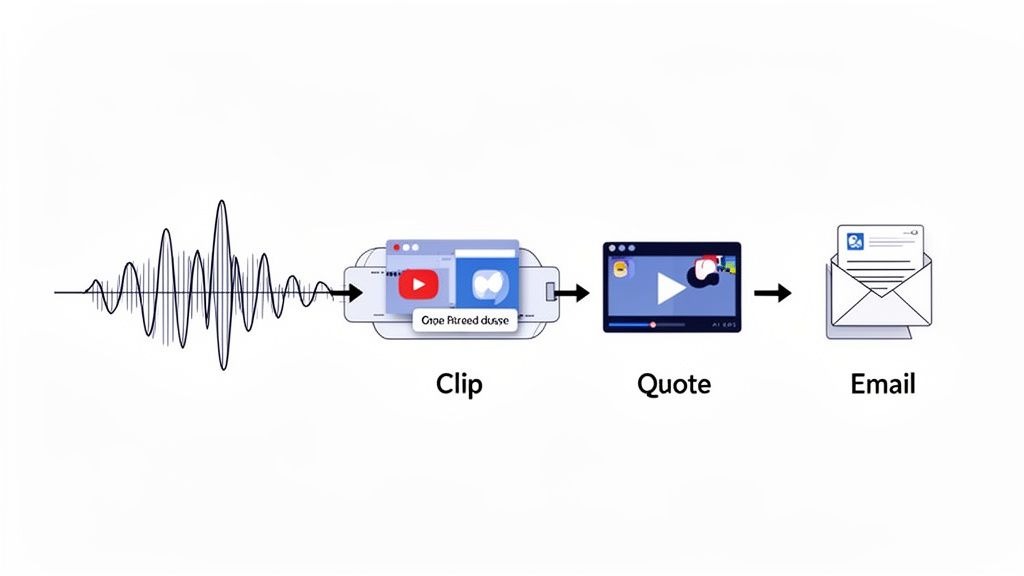
- Short-Form Video Clips: Cut 30-60 second video clips of the best moments. Slap on a branded template and some captions, and you've got perfect content for LinkedIn, TikTok, and YouTube Shorts.
- Audiograms: For platforms where audio reigns supreme, turn those powerful quotes into engaging audiograms with a moving waveform. They’re great for grabbing attention in a crowded feed.
- Quote Graphics: Design some sharp, visually appealing graphics featuring the executive's best one-liners. These are super shareable and perfect for reinforcing key messages on LinkedIn and X.
- Newsletter Summaries: Make the episode the star of your next newsletter. Highlight the top 3-5 takeaways and drive traffic back to the full episode for the deep dive. This is where a dedicated B2B Email & Newsletter service can create massive leverage, ensuring your best content reaches the right inboxes.
When you follow this process, your podcast stops being just a series of episodes and becomes a powerful marketing engine. You can discover more about this in our guide on how to turn your podcast interview into content. This methodical approach ensures every executive conversation continues to deliver value, build your authority, and drive real business results for weeks, even months, to come.
Frequently Asked Questions About Executive Interviews
Even with the tightest prep, there are always a few curveballs when you're interviewing top-tier executives. You’re not alone. Here are some of the most common questions that pop up, with practical advice you can actually use.
How Long Should an Executive Interview Be?
The sweet spot for the actual recording session is between 45 and 60 minutes. Any shorter, and you barely scratch the surface. Any longer, and you're fighting against calendar fatigue from both your guest and your future listeners.
This block of time is perfect because it gives you enough room to build real rapport, go deep on a few critical topics, and still have a buffer for those unexpected, valuable tangents. Once you get it into post-production, a 45-minute recording usually trims down to a crisp 30-35 minutes of polished content, ideal for a B2B audience listening on their commute or between meetings.
A quick pro-tip: Always confirm the final, edited episode length with the guest's team beforehand. It’s a small detail that shows you respect their time and helps manage everyone's expectations.
What Is the Best Way to Handle an Overly Promotional Guest?
Ah, the classic. You've asked a strategic question, and you get a five-minute sales pitch in return. It happens. The trick is to steer them back on course gently but firmly, without making things awkward.
I swear by what I call the "validate and pivot" method. First, you acknowledge their point so they feel heard. Then, you use that point as a launchpad to a much more interesting, strategic question.
Let's say they drop a line like, "Our new platform is the only solution that does X."
Instead of moving on, you jump in with:
- "That's a powerful capability. Stepping back a bit, what broader industry problem were you seeing that made a feature like X so necessary in the first place?"
See what that does? It respects their comment but immediately elevates the conversation from product features to market strategy. It subtly coaches them on what your audience really wants to hear: the why behind the what. Remember, listeners, tune in for valuable insights, not a commercial.
What Should I Do If the Executive Gives a Factually Incorrect Answer?
Tread very, very carefully here. Directly correcting a C-suite guest in the middle of a recording is the fastest way to kill the mood and destroy any rapport you've built. The goal isn't to be right; it's to get the best content.
Your approach should feel more like a curious collaborator than a fact-checker.
Instead of saying, "Actually, that's not correct," frame it as a point of clarification from your own research.
- "That's an interesting perspective. My research pointed to [mention a conflicting data point or trend]. Could you help me understand how you see those two ideas connecting?"
This gives them an out. They can clarify their point, correct themselves without losing face, or provide a new context you might have missed. You maintain a peer-to-peer dynamic instead of turning the interview into a debate.
How Far in Advance Should I Book an Executive Guest?
For anyone in the C-suite, you need to be thinking at least 6-8 weeks out. Seriously. Their calendars are often planned a full quarter, and getting on their schedule requires navigating through very protective EAs.
This lead time isn't just about finding a slot. It's strategic.
- Flexibility: It gives you a much better chance of securing a time without having to bend over backward.
- Preparation: This is your window to do the deep-dive research needed to craft a truly exceptional guest brief.
- Logistics: It provides plenty of time for tech checks, shipping out a quality microphone, and getting aligned with their comms or PR team.
Booking this far in advance sends a clear message: your podcast is a professional operation, and you view their time as a valuable event, not just another meeting.
At Fame, we turn these executive conversations into a marketing engine that actually drives demand. Our podcast production service is completely end-to-end, handling everything from booking high-profile guests and strategic prep to flawless recording and promoting the content across multiple channels.
Discover how Fame can help you build authority and drive pipeline with a B2B podcast.
Want us to run this for you?
Fame starts and grows B2B podcasts that generate pipeline. Tell us who you are trying to reach and we will send a costed proposal within 48 hours.
Related content
- Read moreFame Team · July 16, 2026
10 Account Based Marketing Tactics For B2B Growth In 2026
Discover 10 actionable account based marketing tactics for B2B tech. Learn to use podcasts, data, and targeted content to close high-value accounts. - Read moreFame Team · July 16, 2026
The 8 Best Brighton Podcast Agency Picks For 2026
Find the best Brighton podcast agency for your B2B brand. Our 2026 guide reviews top 8 agencies for production, growth & ROI. Expert analysis here - Read moreJune 10, 2026
20 Best Podcast Production Agencies For 2026 (And Why Should You Hire One)
Global podcast and vodcast ad revenues are on track to hit $5 billion in 2026 , up 20% year-on-year. - Read moreApril 13, 2026
Leadership In Marketing: The B2B Podcast Playbook
Most companies still confuse leadership in marketing with job titles, org charts, and budget control. That's outdated.