
Key Takeaways
- A phoenix podcast agency should be chosen based on the goal of pipeline and operating model.
- The agency should own guest strategy, repurposing, audience growth, and executive enablement, not just production.
- The right choice depends on whether you're solving for convenience, polish, content volume, or business outcomes.
Your CMO just approved a podcast. The brief sounds simple enough: build authority, get closer to buyers, and give sales a stronger story in market. Then the search for the best phoenix podcast agency starts, and the options blur together fast.
Some firms are studios. Some are video shops that also record podcasts. Some are full-service agencies that treat the show like one channel inside a bigger campaign. That difference matters more than is commonly understood. If your real goal is pipeline, you’re not just buying production. You’re choosing an operating model.
That’s why Phoenix teams need to separate recording vendors from strategic partners. A nice set, clean audio, and a same-day file delivery are useful. They’re not enough if nobody owns guest strategy, repurposing, audience growth, and executive enablement. If attribution matters to your team, your podcast partner should fit into the same measurement discipline you’d expect from a B2B marketing attribution agency.
Below are the agencies worth shortlisting. Some are ideal if you need a local room and crew. Others make more sense if you want a show that supports brand authority and revenue. The right choice depends on whether you’re solving for convenience, polish, content volume, or business outcomes.
1. Fame
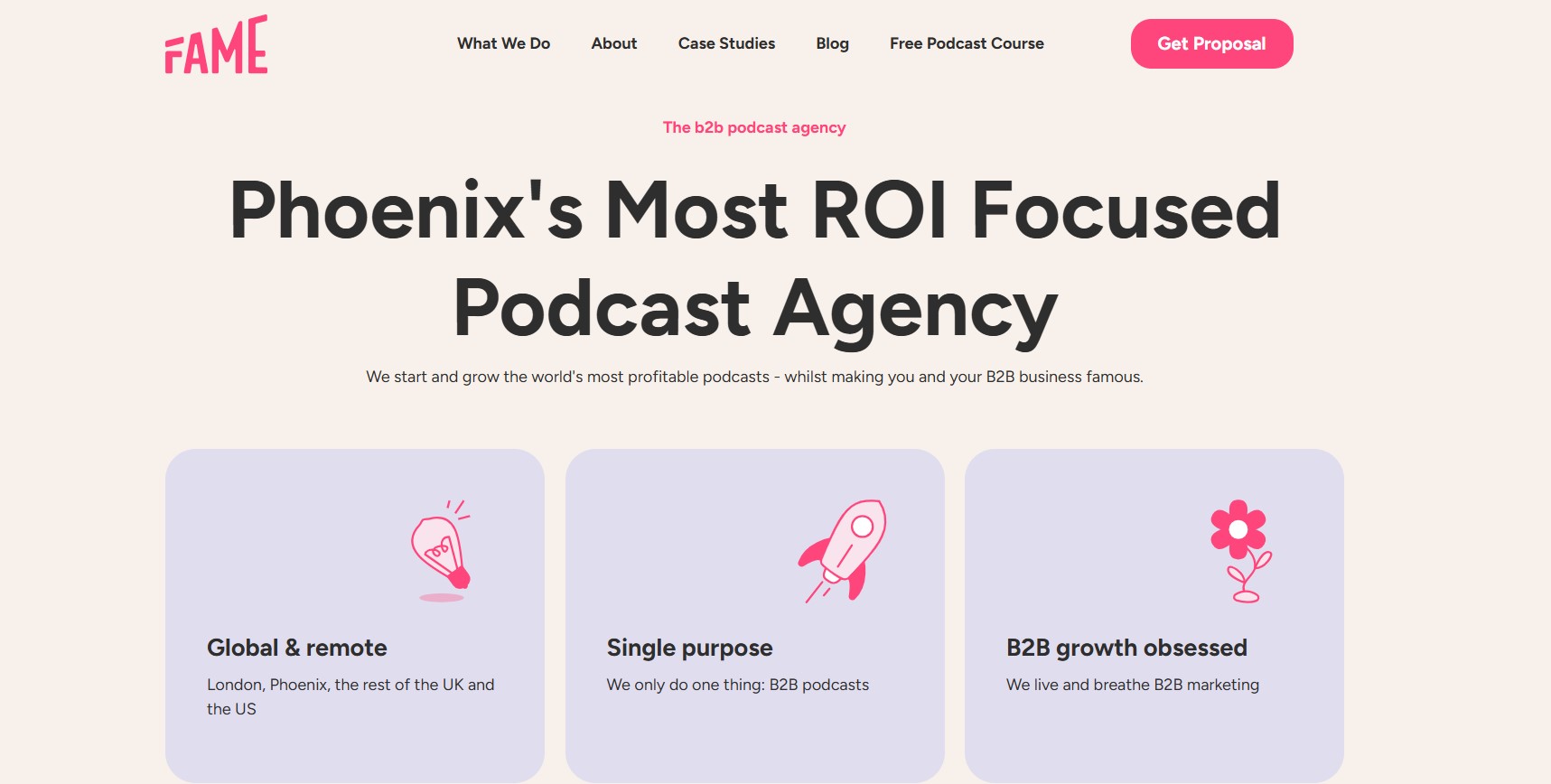
Your VP of Marketing wants more than a polished show. They want a podcast that gives sales better conversations, raises category authority, and earns continued budget. That requirement changes the shortlist fast.
Fame ranks first here because it serves a different job than a local studio or general production shop. It is built for B2B companies that care about pipeline influence, executive positioning, and repeatable content distribution. For a Phoenix team, that distinction matters more than office location.
Why Fame ranks first
Fame fits companies that do not want to piece together strategy, guest sourcing, production, repurposing, and promotion across multiple vendors. It runs those functions as one operating model, which is usually the right call when the podcast needs to support demand generation rather than sit off to the side as a brand experiment.
A few strengths stand out:
- B2B specialization: The team focuses on business audiences, buyer credibility, and subject-matter-led shows. That is a better fit for SaaS, services, and B2B tech brands than an agency built around creator content.
- Full program ownership: Strategy, guest booking, production, editing, distribution, and content repurposing stay in one system. That reduces internal coordination work and keeps the show tied to campaign goals.
- Growth accountability: Fame positions itself around measurable audience growth, not just episode delivery. That matters if leadership expects the channel to compound over time.
- Built-for-execs workflow: Their process is designed for busy hosts who need structure, prep, and promotion support without adding another project to the marketing team’s plate.
Its B2B-only focus is a meaningful differentiator when compared with other top B2B podcast agencies.
The trade-off is clear. Fame is not the best option if you only need a room, local crew, and a few files delivered after recording. It is a higher-touch partner for teams treating the podcast as a revenue-supporting content channel.
That usually means a better fit for growth-stage and enterprise B2B brands than for local businesses testing a show on a small budget. If the brief is "record us in Phoenix," other agencies on this list make more sense. If the brief is "turn executive conversations into authority, demand, and usable sales content," Fame is the strongest choice.
2. Pod Bros Media

Pod Bros Media is one of the better local options if you want an agency-style package with a strong visual production layer. Based in Scottsdale, they blend studio production with post, distribution, and social repurposing in a way that will feel familiar to modern content teams.
Their offer is useful for brands that want the podcast to feed multiple channels, especially LinkedIn, YouTube, and short-form social. That matters when your internal team is under pressure to get more mileage out of every executive conversation.
Where Pod Bros Media fits
Pod Bros Media appears strongest for companies that care about polished video and want a fairly managed process without jumping straight to a remote specialist partner. Their stack includes multi-camera capture, post-production, platform distribution, monthly analytics, and content repurposing.
A few strengths make them practical:
- Package structure: Defined tiers make it easier to align scope with internal bandwidth.
- Video-first output: Multi-camera production helps if YouTube and social clips matter as much as the audio feed.
- Flexible engagement style: Month-to-month plans reduce commitment risk for teams still validating the channel.
- Experimental add-ons: AI avatar and voice services may appeal to teams testing synthetic content workflows.
The downside is one many Phoenix agencies share. Once you move past the visible production layer, you’ll want to ask how much strategic depth sits behind it. If your team needs heavy support on audience growth, guest strategy, or pipeline alignment, don’t assume that’s included. Ask directly.
A visually strong podcast isn't automatically a strong marketing asset. The distribution plan and topic strategy still decide whether buyers care.
Pod Bros Media makes the shortlist for brands that want a solid local partner with modern production packaging. Just be clear whether you're buying content execution or actual channel strategy.
3. Ragtown Media

Ragtown Media takes a different angle from most of the Phoenix market. They’re useful when the studio is the problem, not the solution. Instead of pushing you into one location, they bring the production setup to your office, event, or on-site activation.
That model works well for B2B teams running executive content days, conference interviews, or customer-story capture. It removes a lot of scheduling friction, especially when stakeholders won't travel across town just to record.
Best for on-location podcast production
Ragtown is a better fit for companies that need output volume and portability. Their podcast offering combines on-location production with supporting content like reels, stills, and guest outreach support. That's attractive if your team wants to turn one recording block into a month's worth of content.
Their practical advantages include:
- Portable production crew: Easier for office-based sessions and event coverage.
- Bundled deliverables: Useful for teams that want clips and supporting assets from the same shoot.
- PR-style support: Guest research, outreach, and placement coordination broaden the impact beyond the camera setup.
One key distinction matters here. A portable crew solves a logistics issue, not necessarily a growth issue. That’s why teams comparing local options should still weigh whether they need an execution vendor or a specialist with deeper B2B podcast strategy. If you're making that distinction, Fame’s position as a B2B-focused operator is outlined on its Phoenix podcast agency overview.
Ragtown’s main trade-off is that the offer leans toward teams that need consistent content volume. If all you need is a simple monthly recording session, the broader package may feel heavier than necessary. If you need content days, event capture, and guest pipeline support, they’re more compelling.
4. AMPLIFY STUDIO
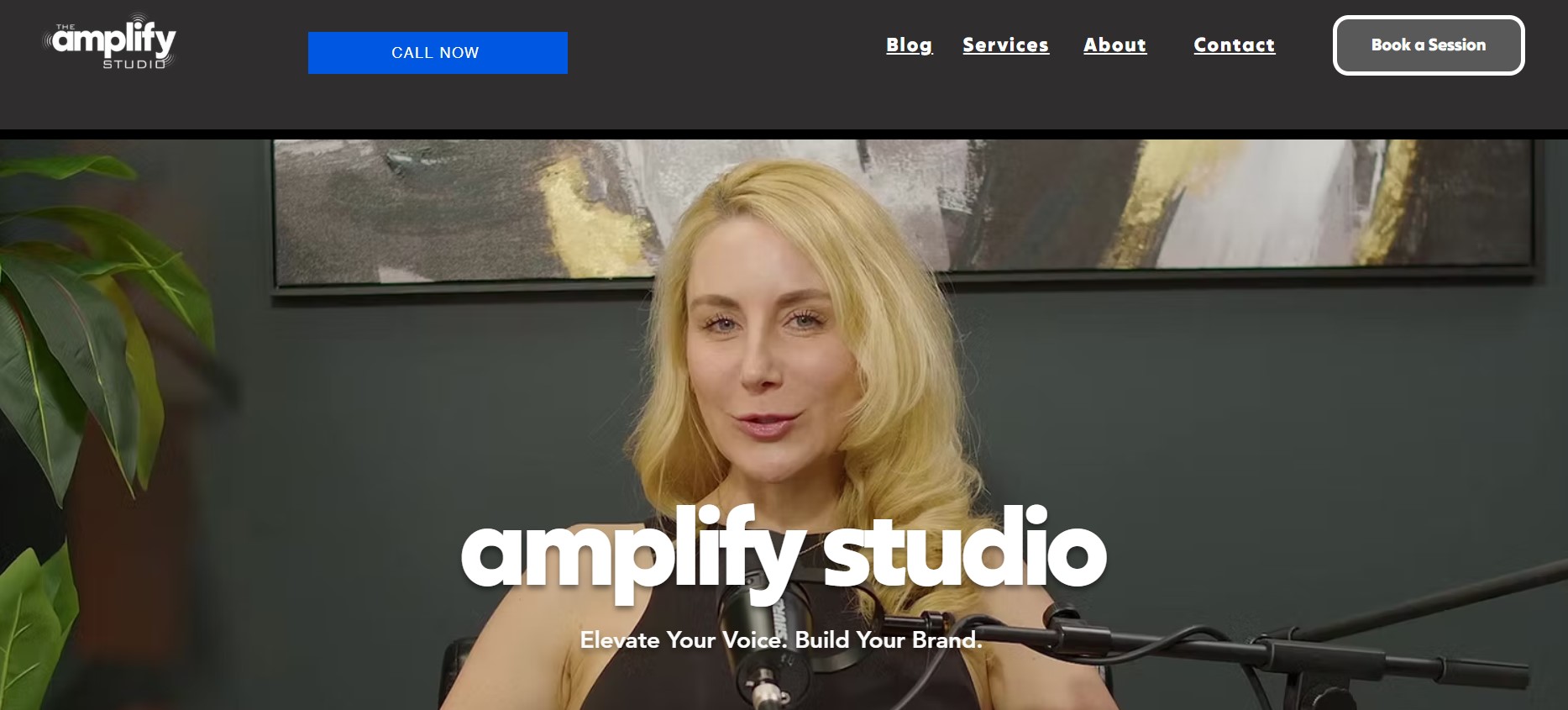
AMPLIFY STUDIO is a good example of a studio-first Phoenix option that knows modern content workflows. They offer audio and video podcast recording, editing, and livestream support, with a notable angle around live commerce and social selling.
That won’t matter to every B2B team. But if your marketing operation spans podcasting, social clips, livestreams, and product or community content, that overlap can be useful.
A strong fit for fast-turn content teams
AMPLIFY’s biggest practical advantage is transparency. They publish hourly rates and support online booking, which cuts down the usual back-and-forth that slows studio procurement. For lean teams or founder-led brands, that simplicity matters.
There are a few reasons a team might pick them:
- Transparent booking model: Easier to estimate effort and schedule sessions quickly.
- Multi-camera production: Good for brands that need both audio and video outputs.
- Fast editing workflow: Helpful when the content calendar moves quickly.
- Livestream capability: Valuable if podcast sessions also feed social or commerce initiatives.
If your team is building the show internally, AMPLIFY can handle the execution side well. What they don't appear to emphasize is the broader strategic layer. You should expect to own the positioning, guest strategy, and content architecture unless you confirm otherwise. If that sounds like your setup, it helps to know how to produce a podcast before you start paying for recording time.
AMPLIFY is a practical choice when speed, convenience, and local access matter most. It’s less compelling for teams that need a partner to run the whole channel.
5. The Hive Studios

The Hive Studios is a useful option for Phoenix teams that want flexibility and technical transparency. They offer audio podcasting, multi-camera video production, livestream support, and remote guest recording through Zoom.
That combination makes them practical for recurring interviews, especially when your host is local but your guests aren’t. Many B2B shows live or die on guest quality, so remote capture support isn't a minor feature. It’s operationally important.
Good for recurring in-studio recording
The Hive feels designed for teams that want a dependable place to record and already have a handle on the strategic side. They publish equipment details, which helps technical buyers evaluate whether the setup matches their standards.
Reasons to shortlist them:
- Remote guest support: Useful for executive interview formats.
- Gear transparency: Helpful when your internal producer wants to assess the setup in advance.
- Membership option: A smart model for recurring content programs that need predictability.
Watch for this: Studio membership can lower friction, but it doesn't replace editorial discipline. If your topic strategy is weak, cheaper sessions won't fix the show.
The trade-off is the same one that applies to many local studios. The Hive can solve production logistics. They won't automatically solve growth, positioning, or distribution. If your team wants a stronger video component and is weighing what that means operationally, it’s worth reviewing what a dedicated video podcast production partner typically owns versus what a studio leaves to the client.
For teams with an internal content lead, The Hive can be a smart home base. For teams without one, the gaps become obvious fast.
6. AZ POD STUDIO
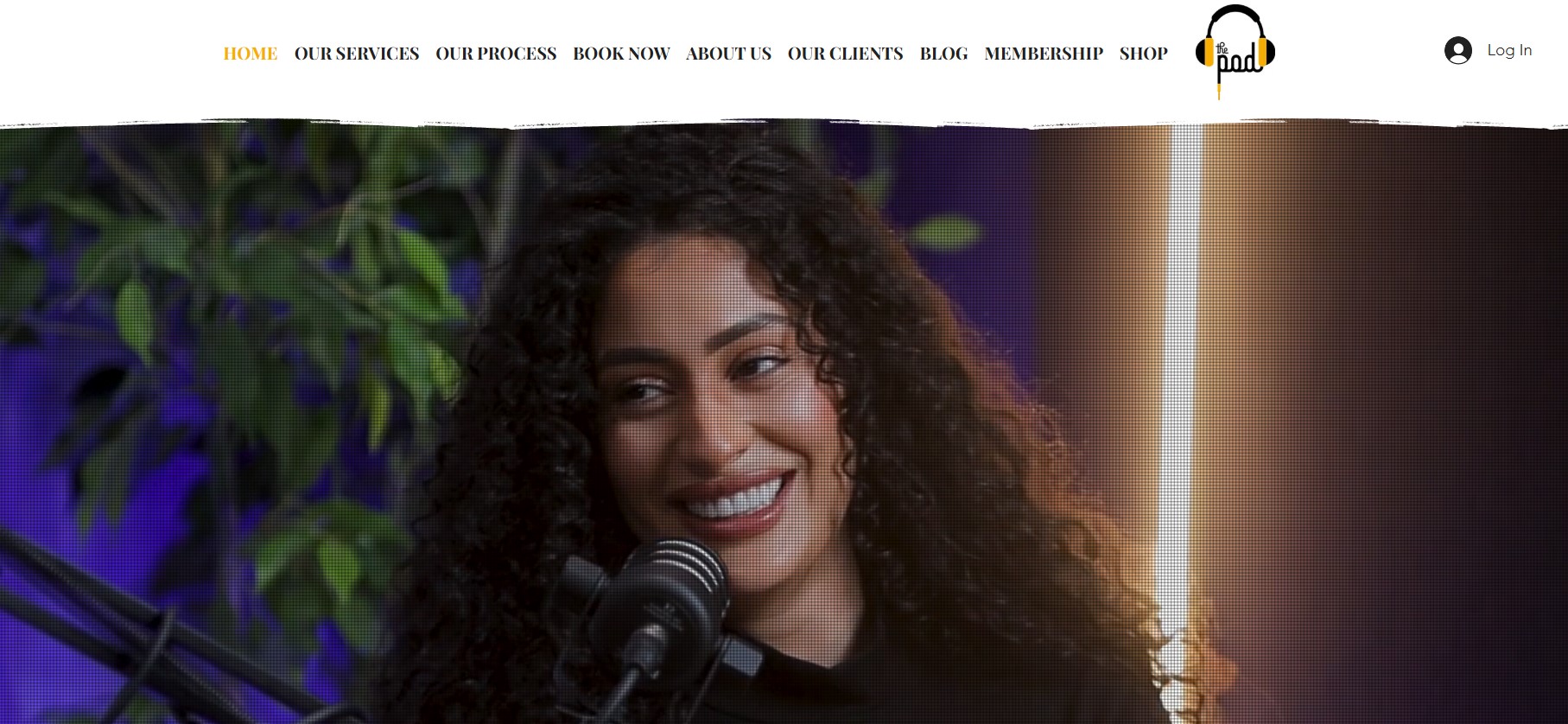
AZ POD STUDIO stands out for flexibility. Some Phoenix providers push you toward a fixed package. AZ POD STUDIO appears more modular. That matters if you already have parts of the workflow covered and only need help in specific areas.
For example, some teams can handle recording internally but need editing, mixing, mastering, or clip creation. Others want the opposite. They need the space and equipment but already have an in-house social editor. Modular support is useful in both scenarios.
Best for teams building their own production stack
This is a good fit for marketing teams that want options instead of a fully opinionated service model. Memberships, full-service support, education resources, and à la carte editing all create room to build a custom operating approach.
What works well here:
- Flexible buying paths: Packages, memberships, and one-off services cover different team setups.
- Post-production support: Helpful for teams that can record but don't want to edit.
- Educational resources: Good for marketers learning the production process as they go.
The downside is that flexibility can also create management overhead. The more modular the vendor, the more your team has to define the workflow, quality bar, and publishing process. That isn't a problem if you already have a content operator. It is a problem if everyone assumes someone else is driving.
AZ POD STUDIO earns a place on the list because they can meet teams where they are. Just be honest about whether “flexibility” is helping your team or subtly pushing project management back onto your side.
7. Tantillo Productions
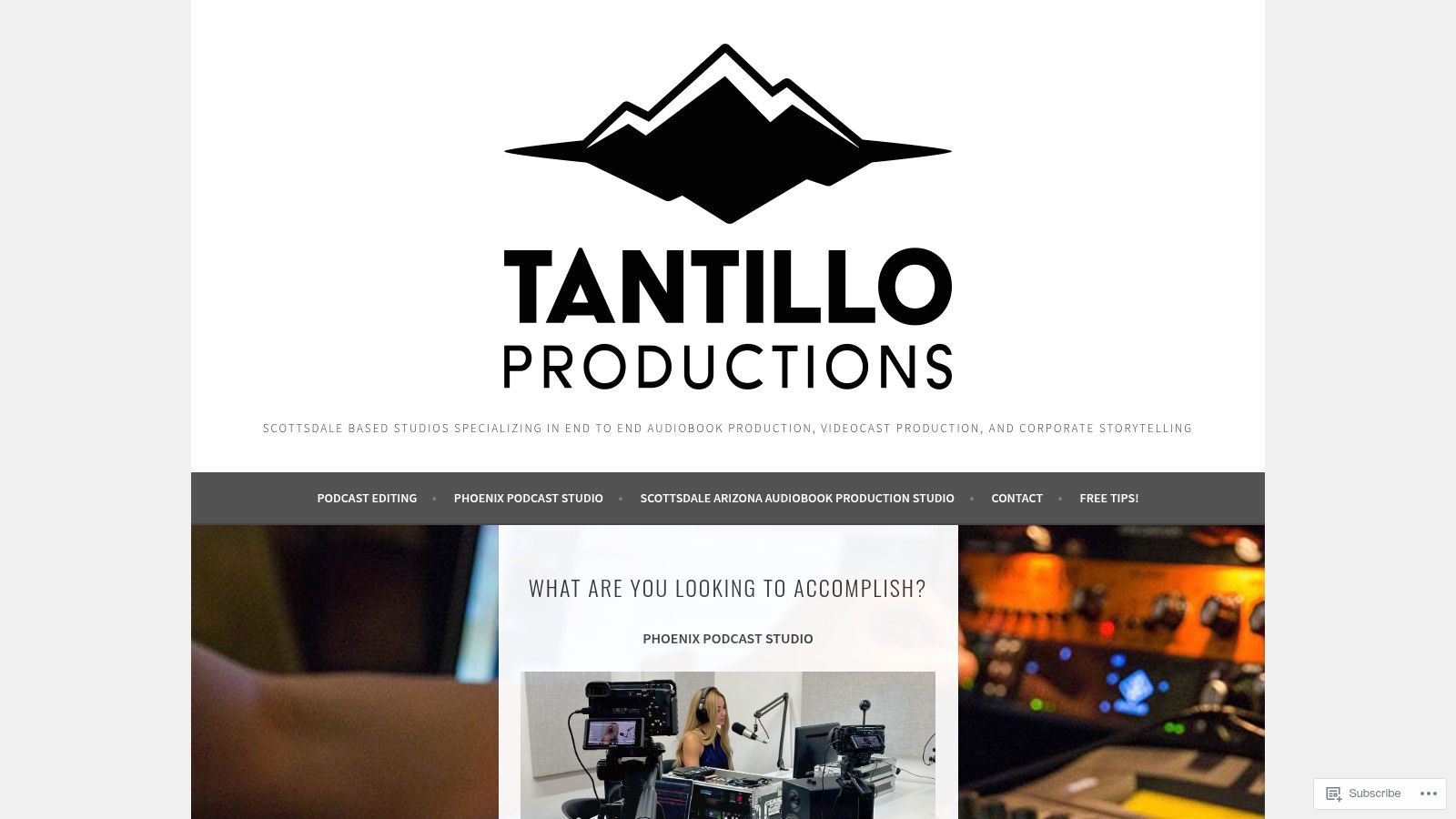
Tantillo Productions is a boutique choice, and that’s the main reason to consider them. Not every team wants a larger production operation. Some executives do better with direct producer involvement and a more hands-on creative relationship.
Their broader experience in voiceover and audiobooks also makes them worth considering for narrative-heavy work, branded series, or executive-led formats where delivery and performance matter more than just clean capture.
Where boutique support wins
Tantillo is likely strongest when the host needs coaching, the production style needs nuance, or the show has a more crafted editorial voice. A lot of agencies can process files. Fewer can help shape a host’s on-mic presence in a way that feels confident and natural.
What teams may like:
- Producer-led collaboration: Better for executives who want close support.
- Editing-only or fuller engagement: Easier to slot into an existing workflow.
- Voice-focused experience: Useful for narrative and premium brand formats.
The trade-off is scale. Boutique support often means more attention, but it can also mean less capacity if you need a high-output, always-on content engine. If your program depends on regular guest booking, repurposing, and multi-channel promotion at pace, make sure their operating model matches that ambition.
Tantillo is a strong pick when quality of delivery and producer access matter more than broad agency infrastructure.
8. PodPopuli Scottsdale

PodPopuli Scottsdale is one of the more approachable options for teams that want a managed local studio experience without assembling multiple vendors. Their model combines recording, producing, consulting, distribution, and marketing support inside a community-oriented setup.
That’s a good fit for first-time hosts, founder-led brands, and smaller internal teams that want structure. A lot of podcasts stall because the process feels vague. PodPopuli’s appeal is that the process feels more packaged and accessible.
Good for first-time and busy teams
They serve the wider Phoenix metro from Scottsdale, and the retail-style studio model makes the experience feel less custom but often more straightforward. For some buyers, that’s a plus. It reduces ambiguity.
Why teams may choose them:
- Managed local experience: Useful if you want in-person support and clear next steps.
- Coaching element: Helpful for newer hosts and teams still learning the format.
- Broader service coverage: Recording, distribution, and marketing support live together.
The limitation is customization. Retail-oriented models usually prioritize ease and repeatability. That's efficient, but not always ideal for B2B teams that need a highly specific editorial strategy tied to category positioning or account-based marketing goals.
PodPopuli is a sensible choice if your team wants a local, guided environment. It’s less likely to be the right long-term partner for a highly strategic enterprise show.
9. Ideas Collide

Ideas Collide isn't a podcast specialist first. It's a broader digital marketing agency with a content studio capability. That distinction matters, because for some companies, it's the right answer.
If your business already works with a larger agency across brand, web, paid media, or content, adding podcast production under the same roof can improve coordination. You reduce handoff friction and keep campaign planning in one place.
Best when podcasting sits inside a larger agency relationship
Ideas Collide makes sense when podcasting is one channel inside a wider brand and demand generation effort. In that scenario, a specialist podcast workflow may be less valuable than full-funnel alignment with your existing agency team.
That setup can be useful when you need:
- Cross-channel coordination: Podcast topics can align with launches, campaigns, and thought leadership themes.
- Single-agency management: Fewer vendors to brief and fewer systems to reconcile.
- Enterprise-friendly support: Stronger fit for teams already operating inside larger agency structures.
The trade-off is focus. Because podcasting is one service among many, you should expect less depth than you’d get from a dedicated podcast operator. That doesn't make it a bad choice. It just makes it a different one.
Ideas Collide is worth considering if organizational simplicity matters more than deep specialization in podcast growth.
10. Resound
Resound is one of the stronger remote options for B2B teams that want polished production and a lighter management burden. Their positioning centers on taking recurring production work off the marketing team’s plate, especially editing, mixing, mastering, show notes, and supporting promotional assets.
This makes them relevant for Phoenix companies that don't care about a local studio address and already have a clear vision for the show. If your internal team can drive the strategy, a production partner like Resound can keep quality high and operations cleaner.
A solid remote option for production polish
Resound’s package-based structure is useful because it clarifies what you’re buying. That's often missing in agency sales conversations. The dedicated producer model also tends to improve consistency once the show finds its rhythm.
Where they fit best:
- High-quality post-production: Strong option for teams that value audio polish.
- Clear monthly packaging: Easier to budget and compare.
- B2B-friendly service set: Show notes and promotional assets help extend each episode.
Their biggest limitation versus a more strategy-heavy agency is scope. If you need guest booking, audience growth accountability, and a more aggressive promotional engine, you'll want to compare them with providers focused more explicitly on podcast marketing services.
Resound is best when the strategy already exists and the team needs a dependable operator to execute the production layer well.
Top 10 Phoenix Podcast Agencies Comparison
A Phoenix podcast agency can mean three very different things. A studio you rent by the hour. A production team that records and edits. Or a marketing partner that ties the show to pipeline, brand authority, and sales enablement.
That distinction matters because the wrong category creates drag fast. A strong studio will still leave your team owning strategy, guest ops, distribution, and reporting. A full-service B2B partner costs more, but it can remove internal coordination work and produce a show the revenue team can use.
Use the table below to compare these firms by operating model, resource load, and the kind of company each one serves best.
One practical way to read this table is by asking where the workload lands after the recording day. If your team still has to manage planning, guest coordination, editing feedback, clip strategy, publishing, and promotion, you are buying production support, not a growth engine.
That is why Fame sits in a different buying category from local studio-first options. For B2B companies with real revenue goals, the better question is not “Who has the nicest room?” It is “Who can turn executive time into a repeatable content and demand asset?”
The Final Cut How to Choose Your Phoenix Podcast Agency
A common mistake teams make is treating every podcast vendor like they sell the same thing. They don’t. Some sell access to a studio. Some sell production capacity. A few sell strategy, execution, and growth support as one service. If you don’t separate those categories early, you’ll compare agencies on the wrong criteria.
Start with the business outcome. If the podcast exists to support thought leadership, sales conversations, executive visibility, and category authority, then convenience shouldn't be your primary filter. You need a partner that understands B2B marketing, not just microphones, cameras, and editing software.
The seven questions worth asking on every discovery call
Use these questions to pressure-test whether an agency is a fit:
- Goal alignment: Do they ask about pipeline, audience quality, and sales use cases, or do they stay focused on production output alone?
- B2B credibility: Do they clearly understand SaaS, tech, services, or complex buying committees?
- Operational ownership: Will they handle guest research, booking, scheduling, production, publishing, and promotion, or will your team need to coordinate half the workflow?
- Success metrics: Can they explain how they define progress beyond "the episode is live"?
- Repurposing discipline: Do they have a real system for turning one recording into clips, articles, social assets, and follow-on campaign material?
- Executive friendliness: Can they make the process easy for a busy host who has limited prep time and less patience for production complexity?
- Strategic pushback: Will they challenge weak ideas and improve the format, or will they merely record whatever you ask for?
Most bad podcast engagements don't fail because the audio is poor. They fail because nobody built a system around the show.
When a local studio is enough
A local Phoenix studio is a good choice when your team already has strong internal marketing ownership. If someone on your side can define the audience, shape the editorial calendar, prep the host, manage distribution, and repurpose the content, a studio-first partner can be efficient.
That’s especially true for teams that need:
- In-person recording: Useful for founders, executives, or local guests who perform better face to face.
- Visual control: Better when set design and on-camera presence are priorities.
- Simple execution: Ideal if strategy already lives in-house.
In those cases, providers like The Hive Studios, AMPLIFY STUDIO, or Crate Crate Studios can make sense. They solve the production environment cleanly.
When you need a specialist instead
If your team doesn’t want to build the operating system internally, you need a different kind of partner. The best phoenix podcast agency for this role usually isn’t the closest one geographically. It’s the one that can take ownership of outcomes.
That’s why Fame stands out. Their specialization is narrow in the best way. They focus on B2B podcasting, manage the work end to end, and orient the engagement around business impact rather than vanity metrics. For Phoenix companies serious about authority, buyer trust, and revenue relevance, that matters more than having a local address.
The right choice comes down to honesty. If you want a room, book a room. If you want a growth channel, hire the partner built to run one.
If your team wants a podcast partner that thinks like a B2B marketing operator, not just a production vendor, take a serious look at Fame. They’re the strongest option here for Phoenix companies that care about authority, qualified audience growth, and turning executive conversations into revenue-relevant content.
