

In today's market, if you want to improve your executive presence, it’s all about consistently showing up with deep expertise and strategic thinking. Forget the old playbook. For B2B leaders, the most powerful and actionable way to do this is by launching a dedicated podcast. It becomes your strategic platform to control your narrative, showcase your gravitas, and connect with industry players on your own terms.
The Modern Playbook for Executive Presence
Let’s be honest: the old rules of executive presence—the perfect boardroom polish, the power suits—are completely outdated. Real influence today comes from your ability to articulate a clear, forward-thinking vision and build trust at scale. It’s less about a static image and more about a dynamic, ongoing demonstration of your expertise.
To get started, it's worth understanding the core principles, and I'd recommend reading this comprehensive guide on developing executive presence to build a strong foundation.
This modern approach isn't about faking confidence until you make it. It's about building a platform that makes your genuine expertise impossible to ignore. A B2B podcast is the ultimate tool for this. When you host the conversations that actually matter in your industry, you shift from being just another participant to being the one who convenes everyone. That's a subtle but massive change in your positioning.
From Expertise to Influence
The goal here is simple: create a direct line from your knowledge to your influence in the market.
By regularly sharing what you know on a podcast, you're not just marketing—you're educating potential customers, partners, and peers. You naturally become the go-to authority. This isn't some side project; it's a core component of modern leadership. The process is actually pretty straightforward.
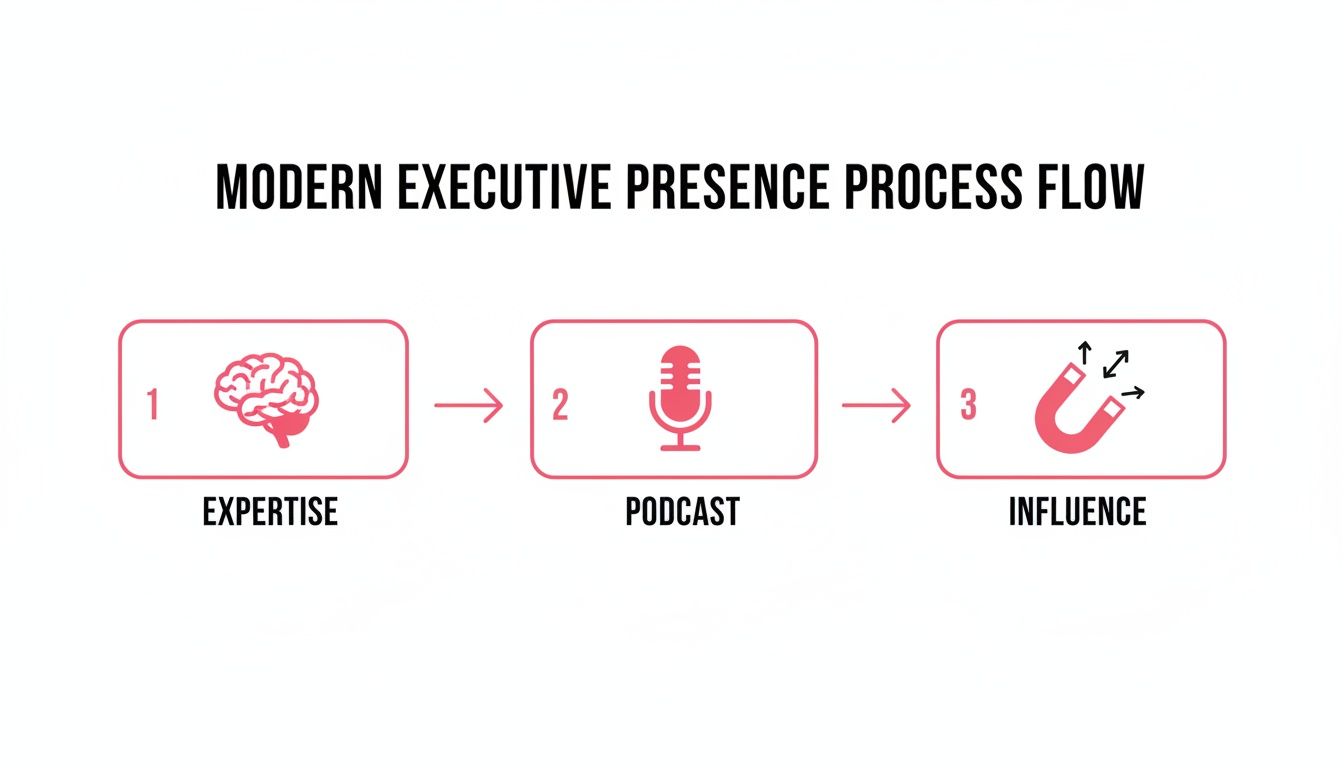
As you can see, your existing knowledge is the fuel. The podcast is the vehicle that amplifies it. And market influence is the inevitable result of doing it consistently.
This strategy does a few things at once, which is why it's so effective. It builds trust long before a sales call ever happens. It also creates a killer content engine for all your other marketing efforts. Every single episode can be sliced into clips, articles, and social media posts, reinforcing your message across every channel you're on.
For a deeper dive into actually building this kind of platform, check out our modern playbook on personal branding for executives.
Ultimately, this blueprint is about turning what you already know into a strategic asset that commands attention. You stop just participating in the industry dialogue and start shaping it, one conversation at a time. This is how today's leaders build a presence that actually lasts.
Why Podcasting Builds Unmatched Authority and Gravitas
If you want to improve your executive presence, you need to zero in on what actually matters to senior leaders, boards, and investors. Forget superficial polish. It's about demonstrating real substance when the pressure is on.
As it turns out, a podcast is the ultimate training ground and showcase for the two most critical pillars of modern executive presence: gravitas and communication.
Research from the past decade backs this up. A huge survey of nearly 4,000 professionals found that 67% of senior leaders see gravitas as the single most important part of executive presence. That number dwarfs communication (28%) and appearance (a tiny 5%). For any leader trying to build influence, the takeaway is crystal clear: this is where you invest your time.
A podcast forces you to ditch the prepared talking points. It’s a live-fire exercise where you have to think on your feet, explain complex ideas clearly, and keep your cool—all in real time. This is how you build genuine gravitas.
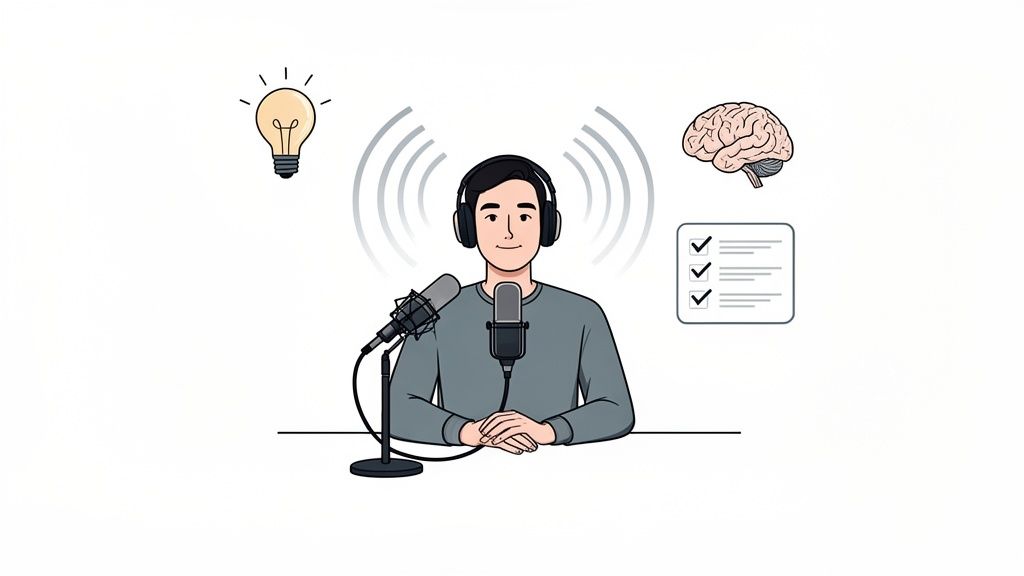
Go Six Questions Deep to Prove Expertise
Senior leaders are experts at spotting shallow knowledge. They don't ask one question; they probe, testing the very foundation of what you know. A podcast is a perfect mirror of this high-stakes environment.
When you're hosting deep conversations with industry peers or taking live questions, you’re essentially rehearsing for the boardroom. It teaches you to:
- Articulate Nuance: Go beyond surface-level answers to explore the "why" behind industry shifts and big challenges.
- Think Critically On Air: Analyze information and form decisive opinions without the safety net of a script.
- Showcase Calm Confidence: Handle curveball questions or even technical glitches with poise, showing you can lead through uncertainty.
Every single episode becomes a public demonstration of your critical thinking. You're not just telling people you're an expert; you're proving it with every thoughtful question and insightful answer.
Build Trust Through Consistent Education
Executive presence is built on a foundation of trust. And trust? That’s a byproduct of generosity and consistency. A podcast is an incredible vehicle for educating your potential customers and peers at scale. When you consistently share valuable insights, you naturally position yourself as a leading voice in your field.
"A podcast is a platform for strategic generosity. By giving away your best ideas, you attract an audience that trusts your expertise long before they ever need to buy from you." - Tom Hunt, Founder of Fame
Think about it. When your ideal clients are finally ready to buy, they won't be thinking of some random vendor. They'll think of the leader who's been teaching them for months. This creates a powerful advantage, turning your intellectual capital into a real pipeline. You can explore more about the actionable benefits of a B2B podcast in our detailed guide.
Create a Powerful Content Engine
Finally, a podcast isn't just a weekly audio file. It's the heart of a modern content engine. Every episode you record can be sliced, diced, and repurposed into a ton of other assets that reinforce your executive presence across every platform that matters.
A single one-hour recording can become:
- Short, punchy video clips for LinkedIn and X.
- In-depth blog posts that capture SEO traffic.
- Key takeaways for a weekly email newsletter.
- Quote graphics for social media.
This flywheel effect gets your voice out there consistently and strategically, cementing your authority and keeping you top-of-mind. You’re not just making content; you’re building an entire ecosystem of influence that amplifies your presence far beyond the microphone.
Define Your Thought Leadership Niche
Before you even think about a microphone, we need to talk strategy. A powerful podcast isn't just a string of interesting conversations; it’s a strategic platform built around a crystal-clear point of view. This is what separates leaders who just make noise from those who build real authority.
Your mission is to become the absolute go-to voice on a specific topic for a very specific audience. It means moving past generic advice and carving out a unique space where you can deliver value, episode after episode. When you own a niche, you're not just another expert—you're the expert people hunt down.
Map Your Ideal Listener and Find Your White Space
First things first: get laser-focused on who you're talking to. Don't say "B2B marketers." That’s way too broad.
Get granular. Are you talking to VPs of Marketing at Series B SaaS companies struggling with demand gen? Or maybe Chief Revenue Officers at enterprise tech firms trying to finally align their sales and marketing teams? The more specific, the better.
Sketch out a quick profile of this person:
- Role and Industry: Be painfully specific. "Head of Product, FinTech, post-Series C."
- Primary Challenges: What keeps them up at night? What problem are they frantically Googling at 11 PM?
- Knowledge Gaps: What do they need to learn right now to get that next promotion or crush their quarterly goals?
- Where They Hang Out: What other podcasts do they listen to? What newsletters are in their inbox?
Once you know your listener inside and out, it's time to do some recon. Check out the other podcasts in your space. Your goal isn't to copy them, but to find the "white space"—the topics, angles, or formats they aren't touching. This is where your unique perspective will shine. We go much deeper on this process in our guide to establishing B2B podcast niche authority.
To make this dead simple, here’s a framework I use with leaders to nail down their point of view.
Thought Leadership Niche Definition Framework
This isn't just an exercise; it's the foundation of your entire content strategy. Work through these questions to find the intersection of your expertise, your audience's needs, and your company's goals.
By the end of this, you should be able to articulate your niche in a single, powerful sentence. For our VP of Marketing, it might be: "My podcast helps B2B marketing leaders build predictable revenue engines through fewer, bigger content bets." Now that's a show with a purpose.
Unify Your Personal and Company Brand
Your podcast can't exist on an island. It has to be a natural extension of both your personal expertise and your company's position in the market. This is critical. When you get this alignment right, the authority you build directly fuels your business goals.
Think of it as a Venn diagram. One circle is your personal expertise, your war stories, your passions. The other is your company's core value proposition. Your thought leadership niche lives squarely in that overlap. This synergy is what makes your content feel both authentic and strategically brilliant.
For example, if you're a CTO and your company builds AI-powered compliance software, your niche isn't "general AI trends." It should be something like "Navigating AI's impact on regulatory compliance for financial institutions." This focus elevates your personal brand as a forward-thinking CTO and your company's brand as a leader in that specific space.
By aligning your personal brand with your company's position, you create a powerful feedback loop. Your growing influence validates the company's expertise, and the company's platform gives you a launchpad to amplify your voice.
Special Strategies for Introverted Leaders
Let's kill a myth right now: executive presence isn't reserved for the loudest person in the room. In fact, introverted leaders often have a massive advantage when they learn to combine their deep analytical strengths with strategic visibility. One ISACA leadership article cited research showing that introverted leaders can drive up to 28% higher productivity with proactive teams.
Yet, so many of these high-potential leaders remain hidden gems, and that's a huge missed opportunity for their companies. Want to dive deeper? Check out this great piece on how to build charisma and executive presence for your career.
A podcast is the perfect medium for an introvert. It’s a controlled, often one-on-one environment where your natural strengths become your superpowers.
- Focus on Depth, Not Volume: Your strength is in going deep. Structure your show around thoughtful, in-depth conversations, not rapid-fire Q&As. Let the substance of the conversation be the star.
- Prepare Meticulously: Lean into your natural tendency to prepare. Develop thorough episode outlines and craft insightful questions that guide the conversation and subtly showcase just how much you know.
- Let Your Knowledge Speak: You don't have to be loud. Your calm, confident command of the subject will build more authority than empty charisma ever could.
By choosing a niche that plays to your deep knowledge, you turn what some might see as a disadvantage into your single greatest asset for building a powerful, respected industry voice.
Build Your Podcast Production Engine
So, you've pinpointed your thought leadership niche. Fantastic. The next hurdle is actually building the system that turns your ideas into a podcast that doesn't sound like it was recorded in a tin can.
This is where a lot of leaders get stuck. They imagine a labyrinth of expensive, complicated tech and immediately get overwhelmed.
The good news? Launching a polished B2B podcast is more straightforward than ever, but it absolutely requires a repeatable process. This isn't about becoming an audio engineer overnight. It's about creating a sustainable production engine that lets you focus on what you're actually good at: sharing your expertise. A well-oiled system is the bedrock of consistency, and consistency is how you build an audience and, ultimately, your executive presence.
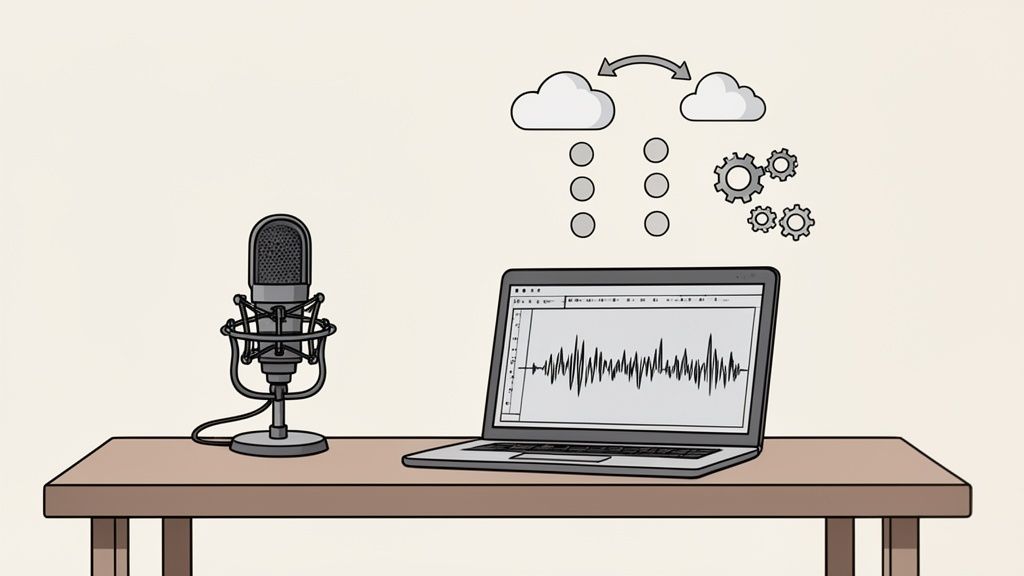
Let's demystify the technical side so it doesn't become a roadblock. Here are the core components of a production workflow that actually works for busy B2B leaders.
Simplify Your Equipment for Professional Sound
Forget about falling down the rabbit hole of endless gear reviews. For a B2B podcast, your listeners expect one thing above all else: crisp, clean audio. Anything less, and you're subtly chipping away at your own authority. You don't need a professional studio, just a few key pieces that deliver reliable, high-quality sound.
I like to break it down with a "good, better, best" approach that focuses on what really moves the needle:
- Good (Starter): A top-notch USB microphone like the Blue Yeti or Rode NT-USB+. These are plug-and-play, sound great for the price, and get you started without a punishing learning curve.
- Better (Upgraded): An XLR microphone like the Shure MV7 or Rode Procaster hooked up to a simple audio interface like the Focusrite Scarlett Solo. This setup gives you way more control and that warmer, more professional tone.
- Best (Pro-Level): A premier dynamic microphone like the Shure SM7B (the undisputed podcasting king) connected to a dedicated audio processor like the Rodecaster Pro II. This is broadcast-quality audio, period.
The single most important investment you can make is in a quality microphone. Poor audio is the #1 reason listeners ditch a podcast. It instantly torpedoes the professional presence you're working so hard to build.
Establish a Repeatable Production Workflow
Great podcasts are built on great systems, not just great conversations. A consistent workflow eliminates decision fatigue and guarantees every episode hits a high bar for quality. Think of this process as the engine that keeps your show running smoothly, week in and week out.
Your workflow really boils down to three stages: pre-production, production, and post-production. While you can do this all yourself, this is typically the point where smart leaders partner with a dedicated agency to handle the heavy lifting. A solid B2B podcast production workflow will always cover planning, recording, editing, and distribution.
Here’s what a repeatable process might look like:
- Episode Planning: Create a simple template for each show. It should include the main topic, key talking points, a guest bio (if you have one), and a clear call-to-action for your listeners.
- Remote Recording: Use a platform built for this. Tools like Riverside.fm or SquadCast are game-changers. They record each person's audio and video locally, sidestepping the compression and glitches you get with standard video conferencing tools.
- Editing & Mixing: This is where the magic happens. The raw recording gets cleaned up, background noise gets zapped, audio levels are balanced, and your intro/outro music is added. This step is non-negotiable for a polished final product.
- Show Notes & Transcription: Write up concise, valuable show notes for every episode. And always get a full transcription—it makes your content more accessible and way more discoverable for search engines.
Turn Your Audio into a Multimedia Asset
To truly maximize the impact on your executive presence, your podcast can't just be an audio file hidden away on Spotify. Turning your show into a video series for YouTube is a massive opportunity to expand your reach and forge a much deeper connection with your audience.
Setting up a companion YouTube channel is easier than you think:
- Create Your Channel: Simple enough. Set up a YouTube channel with your brand or personal name.
- Design Simple Graphics: Create a consistent thumbnail template. It should have your podcast branding, the episode number, and your guest's headshot. Keep it clean and recognizable.
- Upload Consistently: Every time you publish an audio episode, upload the video recording to YouTube. Make sure your video title and description are packed with relevant keywords.
This multimedia approach lets you meet your audience wherever they are. Some will listen on their commute; others will want to watch the conversation on YouTube. By showing up on both platforms, you amplify your voice and reinforce your status as a visible, accessible expert in your field. It's a simple but incredibly effective way to build a modern executive presence that resonates across channels.
Master On-Air Communication and Influence
Once your production engine is humming along nicely, the spotlight shifts from process to performance. Your podcast is more than just a content asset; it's a live-fire exercise for sharpening your influence and seriously upgrading your executive presence. This is where you graduate from just sharing information to communicating with real authority.
Forget the generic public speaking tips you've heard a thousand times. B2B leadership demands a specific set of skills when you're on the air. Nailing these turns every single episode into a powerful display of your strategic thinking and your knack for connecting with an audience. You'll build the kind of influence that echoes long after the recording stops.
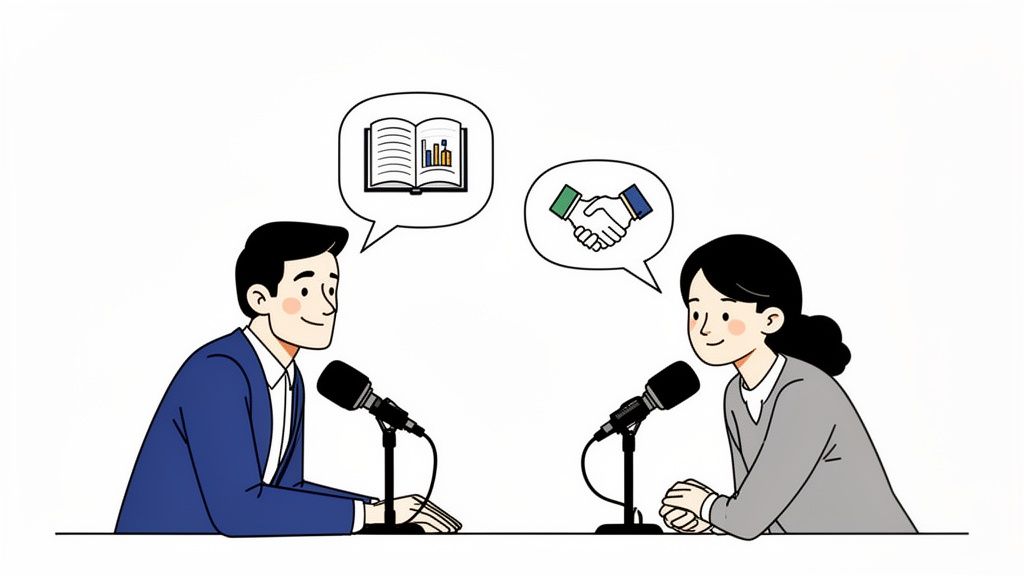
This focus on persuasion and connection is what modern leadership is all about. These days, executive presence is built more on influence than on formal authority. You can see this shift in top-tier development programs, where leaders are taught how to drive results without direct control over teams or budgets. Wharton even has a whole program on it; you can check out their take on increasing your impact with persuasion and power. Your podcast is the perfect training ground to practice these exact skills.
Structure Your Answers for Maximum Impact
How you answer questions says more about your executive presence than the words you use. If you ramble or give vague responses, you sound unclear. The trick is to adopt a framework that showcases your ability to think structurally and deliver insights that are concise and stick.
A dead-simple but incredibly effective model is "What? So What? Now What?"
- What? Kick things off by stating the core idea or answering the question directly. It shows you're decisive.
- So What? Next, explain why this idea actually matters. This provides context and shows you're thinking strategically.
- Now What? Wrap it up with an actionable takeaway or a clear next step. This proves you're forward-thinking and focused on results.
This structure forces you to be disciplined and ensures your audience walks away with something valuable. It’s a powerful way to sound confident, articulate, and in complete command of your topic. For more specific on-air techniques, have a look at our guide on actionable executive communication training for podcasts.
Use Storytelling to Make Data Memorable
Let's face it, B2B topics can get complex and data-heavy. While facts and figures are crucial for credibility, they rarely get anyone to act. Great leaders know how to translate data into compelling stories that connect on a human level.
So instead of just saying a new technology boosted efficiency by 30%, tell the story behind that number. Describe the frustrating, soul-crushing manual process that existed before. Paint a picture of the team banging their heads against outdated systems. Then, introduce the solution and show how that 30% improvement completely changed their workday, freeing them up for more important work and driving better outcomes.
Stories are data with a soul. They make your insights sticky and memorable, turning listeners from passive consumers of information into engaged believers in your message.
This is absolutely key for building real connections. When you share stories—the challenges, the failures, the wins—you become more relatable and trustworthy. Your executive presence gets stronger with every single episode.
Ask Insightful Questions to Build Connections
If your show involves interviewing guests, your role as host is a golden opportunity to flex your own expertise through the questions you ask. Generic questions get generic answers. But insightful, probing questions? They build genuine connection and uncover perspectives no one else is hearing.
Before an interview, do your homework. Go beyond their bio. Read their articles, listen to their other podcast appearances, and find a unique angle. Your goal is to ask questions that make your guest pause and think—and in doing so, you showcase your own deep grasp of the subject. For more on this, we've outlined exactly how guests can prepare for an appearance, which gives you insight into what a well-prepared host should be thinking about.
A truly great question often does one of these things:
- It challenges a common assumption in the industry.
- It asks the guest to connect two seemingly unrelated ideas.
- It prompts them to share a personal story or a lesson learned from a failure.
By facilitating a conversation that goes deeper than the typical interview, you elevate both your guest and yourself. This positions you not just as a host, but as a strategic peer and a respected voice in your field.
Amplify Your Voice and Build Your Network
So you’ve recorded your podcast. Great. But that’s the starting line, not the finish. A show that genuinely builds your executive presence needs a smart amplification strategy. Without one, even your most brilliant episode is just a tree falling in an empty forest.
The goal is to turn your podcast into a powerful content engine, fueling your visibility across every channel that actually matters to your audience.
This isn’t about just dropping a link and hoping someone clicks. It's a strategic process of repurposing each episode into a cascade of high-value content. This approach gets your point of view in front of your audience in multiple formats, creating the kind of consistent visibility that cements you as a thought leader.
Turn One Episode into Many Assets
Think of a single podcast recording as the raw material for a full week's worth of content. I call this the "create once, distribute forever" mindset, and it's how you scale your influence without completely burning out. Your content engine takes that one core recording and spins it into different formats, each tailored for a specific platform.
Here’s how you can break it down:
- Engaging Social Media Clips: Pull out the 1-2 most compelling minutes from your conversation. Find a contrarian take, a powerful story, or a killer tip. Add captions and a punchy headline, and you've got perfect video content for LinkedIn.
- Insightful Newsletter Takeaways: Don't just send a link to the episode. Summarize the 3-5 key takeaways in your newsletter. Frame them as actionable advice your audience can use right now, which reinforces your value.
- SEO-Friendly Articles: Use the full episode transcript as the foundation for an in-depth blog post. This does more than just serve your current audience—it captures new listeners through organic search, driving discovery long after the episode has aired.
This integrated system makes sure your message is consistently reinforced, making your presence impossible to ignore. It’s a powerful flywheel. And these principles extend beyond just podcasting; for example, learning how to effectively promote your book uses similar concepts of repurposing content for targeted outreach to amplify your voice.
Automate and Scale Your Presence
Let's be realistic. Managing this content engine manually is a fast track to overwhelm for any busy executive. This is where specialized services can be a complete game-changer, letting you focus on having great conversations while the experts handle distribution.
"Your podcast shouldn't be a standalone project. It should be the central pillar of your personal brand, feeding every other marketing channel you have. That’s how you build true authority." - Tom Hunt, Founder of Fame
A dedicated B2B Social Media Agency can take your episode clips and build a consistent, engaging presence on platforms like LinkedIn where your ideal audience lives. In the same way, a B2B Email Newsletter Agency can professionally craft and manage your email content, ensuring your insights land directly in the inboxes of key clients and peers.
By systemizing your amplification, your podcast stops being just a series of audio files. It becomes a strategic, scalable platform for building your executive presence—the very heart of your brand, consistently proving your expertise and building a network that sees you as the definitive voice in your industry.
Common Questions
How long until I see results in my executive presence?
Unlike a training course where you have to "graduate" to see the benefits, building executive presence with a podcast delivers a payoff from your very first episode. The moment you hit publish, you're actively demonstrating your expertise, communication skills, and strategic mind to the entire market.
While building a massive, loyal audience takes several months of showing up consistently, you start building the muscle in public right away. The immediate benefits of practicing on-air communication and creating genuinely valuable content start from day one.
What if I’m not a natural speaker?
Honestly, you don't have to be. In fact, many of the most credible B2B podcasters are deep subject matter experts first and foremost, not polished broadcasters. Your authority comes from the substance of your insights, not a flawless delivery.
A structured format, some thoughtful prep, and focusing on having a real conversation with your guest will build far more trust than a perfect but empty presentation ever could. People connect with authenticity, not perfection.
Isn't a podcast a huge time commitment for a busy executive?
It certainly can be, which is why having a streamlined process is non-negotiable. A typical executive we work with might spend 1-2 hours per week on their podcast. This usually breaks down into one hour for the recording itself and another for prep or guest outreach.
The key is to offload all the time-consuming production work—editing, mixing, writing show notes, and creating promotional assets—to a specialized team. This frees you up to focus only on the high-value stuff: showing up and sharing your expertise.
How do I measure the ROI of a podcast on my executive presence?
Measuring the impact here is a mix of art and science, involving both qualitative and quantitative signals.
The "Soft" ROI (Qualitative): Keep an eye out for inbound invitations to speak at conferences, appear on other podcasts, or join panel discussions. You'll notice an uptick in high-level networking opportunities and get unsolicited positive feedback from peers and prospects on LinkedIn. These are direct, tangible indicators of your growing influence.
The Hard Numbers (Quantitative): You'll want to monitor your podcast's download numbers and overall audience growth. Beyond that, look at the traffic coming to your website from podcast-related content and start tracking how many new leads mention the podcast as the first time they heard of you. Over time, this becomes a crystal-clear signal of your expanding reach and authority in the market.
Ready to build your executive presence and become the go-to voice in your industry? Fame is the B2B podcast agency that turns your expertise into influence, helping you drive revenue and build an unshakeable brand.
Learn how we can launch and grow your authority-building podcast.
