January 5, 202623 min read12 sections
10 Actionable Benefits Of A Podcast For B2B Growth In 2026
By Fame Team
Key Takeaways
- A B2B podcast is a strategic platform to establish your company as the definitive voice in your industry and build trust with your ideal customers.
- Consistently educating your peers and potential customers through a podcast helps you shift from being a vendor to an indispensable resource, leading to increased brand awareness and trust.
- A well-executed podcast can be a predictable engine for brand elevation, qualified lead generation, and measurable revenue growth, transforming your marketing from a cost center into a strategic asset.
In today's crowded B2B marketplace, standing out is no longer about shouting the loudest; it's about earning the trust of your ideal customers. While blogs and whitepapers have their place, they often struggle to build the deep, authentic connection required for high-stakes enterprise decisions. This is where a B2B podcast changes the game. It’s not just another content format; it's a strategic platform to establish your company as the definitive voice in your industry, directly addressing the complex challenges your audience faces.
By consistently educating your peers and potential customers, you build unparalleled trust and authority. This shift from vendor to indispensable resource is critical. When your ideal clients are finally in the market for a solution, your brand will be the first one they think of, not because of an ad, but because you've been providing value all along. A well-executed podcast fights above its weight class, allowing even smaller businesses to engage with industry giants and shape the conversation.
This guide moves beyond theory to deliver a comprehensive breakdown of the tangible benefits of a podcast. We will explore eleven specific advantages, each supported by actionable implementation tips, real-world examples, and key metrics to track. You will learn precisely how this powerful medium can become a predictable engine for brand elevation, qualified lead generation, and measurable revenue growth, transforming your marketing from a cost center into a strategic asset.
1. Establishes Thought Leadership and Authority
One of the most powerful benefits of a podcast is its ability to build and broadcast authority. By consistently sharing specialized insights, research, and expert perspectives, a B2B podcast positions your company and its executives as the definitive go-to source in a specific market niche. This isn't just about brand awareness; it’s about shaping the industry conversation and earning the trust of your target audience long before they ever consider a purchase.

This credibility becomes a critical asset for high-stakes business goals. For companies preparing for an IPO, acquisition, or significant funding round, the market's perception of your brand directly impacts valuation. A podcast serves as a public record of your expertise, demonstrating deep market understanding to investors and partners. For example, Reid Hoffman’s Masters of Scale became synonymous with elite founder insights, elevating both his and LinkedIn's authority.
How to Implement This Strategy:
- Define a Hyper-Specific Niche: Avoid broad topics like "marketing." Instead, focus on a specific area like "pipeline acceleration for Series B SaaS companies." This precision attracts a highly relevant audience and makes your authority more defensible. If you need more guidance on this, you can learn how to become a thought leader in your industry.
- Leverage Guest Expertise: Invite recognized industry leaders onto your show. This co-signs your authority by association and introduces your brand to their established audience.
- Systemize Content Repurposing: Don't let your insights live only in audio. Turn key podcast segments into LinkedIn posts, data-driven whitepapers, and conference speaking topics to amplify your message across multiple channels. This turns your podcast into a true content engine for all your marketing efforts.
Key Metrics to Track:
- Media Mentions & Speaking Invitations: Track how often your podcast, host, or insights are cited by other publications or lead to speaking opportunities.
- Social Engagement on Clips: Monitor likes, shares, and comments on short video or audio clips shared from your episodes, paying attention to the quality of the discussion.
2. Generates Qualified Leads and Sales Pipeline
Beyond building brand awareness, one of the most direct benefits of a podcast is its power to generate a predictable flow of qualified leads. A podcast attracts your ideal customer profile (ICP) during their active research and consideration phases, creating a unique opportunity to convert engaged listeners into tangible pipeline. By strategically embedding calls-to-action (CTAs) and offering high-value content, your audio platform transforms from a brand asset into a powerful demand generation engine.
This process turns passive consumption into active engagement. Listeners who resonate with your expertise are more inclined to take the next step, whether that's downloading a resource, requesting a demo, or subscribing to a newsletter. A powerful tactic is to invite ideal clients on as guests. This creates a natural, high-value reason to connect, and you can offer them preferential deals or pilot programs post-interview to sign them as clients.
How to Implement This Strategy:
- Create Episode-Specific Resources: Instead of a generic CTA, offer a gated resource directly related to the episode’s topic, such as a checklist, template, or research report. Host this on a dedicated landing page to track conversions accurately.
- Use Memorable URLs and Codes: During the episode, mention a simple, memorable URL (e.g.,
yourcompany.com/podcast) or a unique offer code for listeners. This simplifies attribution and makes it easy for your audience to take action. After 6-12 months of consistent publishing, you can even use these codes to offer your own services to loyal subscribers. - Align with Your Sales Team: Integrate your podcast leads directly into your CRM and create a follow-up cadence. Ensure your sales team knows the context of the lead, referencing the specific podcast episode they converted on to create a highly personalized outreach. For a more structured approach, you can learn more about how to start a B2B podcast.
Key Metrics to Track:
- Conversion Rate on Landing Pages: Monitor the percentage of visitors who complete a form on your podcast-specific landing pages.
- Lead-to-Opportunity Rate: Track how many leads generated from the podcast progress to a qualified sales opportunity, proving its impact on revenue.
3. Builds Deep Audience Connection and Brand Loyalty
One of the most valuable benefits of a podcast is its unparalleled ability to create an intimate, long-term relationship with your audience. The nature of audio consumption, where listeners actively invite your voice into their daily routines like commutes or workouts, fosters a powerful parasocial connection. This isn't passive scrolling; it's dedicated time spent with your brand, building trust and familiarity that text or video often struggle to replicate.

This sustained engagement translates directly into brand loyalty and higher customer lifetime value. Listeners who feel connected to a host's genuine personality and consistent insights become brand advocates. You can deepen these relationships by inviting existing clients onto the show to share their success stories. This not only provides powerful social proof but also strengthens your partnership, often leading to more business together.
How to Implement This Strategy:
- Maintain Host Consistency: Ensure your host's personality and tone are authentic and consistent across all episodes. This reliability is the foundation of the listener-host relationship. Effective brand storytelling is key to building this authentic connection.
- Create Audience Interaction Loops: Actively solicit and feature listener feedback. Dedicate segments to Q&A sessions or share listener stories to make your audience feel seen and heard, transforming one-way communication into a two-way dialogue.
- Build a Community Hub: Extend the connection beyond the audio. Create an exclusive Slack channel, a dedicated newsletter, or even branded merchandise for your most engaged listeners to foster a sense of belonging and deeper community.
Key Metrics to Track:
- Listener Feedback Volume: Monitor the number of emails, social media comments, and direct messages you receive from your audience per episode.
- Audience Retention Rate: Analyze your podcast analytics to see what percentage of listeners return for subsequent episodes, indicating strong engagement and loyalty.
4. Improves SEO and Organic Discoverability
A podcast acts as a powerful engine for search engine optimization, extending your brand's reach far beyond audio platforms. This is one of the most overlooked benefits of a podcast for B2B marketers. Each episode creates a new set of digital assets that search engines can index, including transcripts rich with target keywords, show notes pages, and dedicated blog posts. This multi-asset strategy significantly increases your surface area for organic discovery.
This process turns audience conversations into searchable, long-form content that answers the specific questions your ideal customers are typing into Google. Instead of just hoping to rank for broad commercial terms, your podcast content can capture long-tail keyword traffic related to niche industry problems. For instance, shows like HubSpot's INBOUND generate consistent organic traffic by converting episode discussions into keyword-optimized transcripts and articles that rank for specific marketing queries.
How to Implement This Strategy:
- Publish Keyword-Rich Transcripts: Always publish a full, accurate transcript for every episode. This allows search engines to crawl the entire conversation, capturing every mention of relevant terms, guest names, and industry-specific language.
- Create Comprehensive Show Notes: Develop detailed show notes that act as a mini-blog post. Include a summary, key takeaways, guest bios, and links to all mentioned resources, optimized with your target keywords.
- Repurpose Audio into SEO-Focused Content: Use the episode's core topic to create a standalone blog post or pillar page. This allows you to expand on the conversation in a format specifically designed for search, including structured data and internal links. For more guidance, you can explore how to start a podcast on YouTube to maximize video SEO.
Key Metrics to Track:
- Organic Traffic to Podcast Pages: Monitor the number of unique visitors arriving at your episode show notes, transcripts, and related blog posts from search engines.
- Keyword Rankings for Episode Topics: Track your search engine ranking positions for the primary and secondary keywords targeted in each episode's content.
5. Creates Shareable, Multi-Format Content
One of the most significant benefits of a podcast is its unparalleled efficiency as a content engine. A single, hour-long episode isn't just one asset; it's a goldmine of raw material that can be systematically repurposed into dozens of smaller, highly shareable pieces of content. This content multiplication strategy extends the reach of your core message far beyond your listener base, engaging audiences across different platforms and with varying consumption habits, thereby maximizing your marketing ROI.
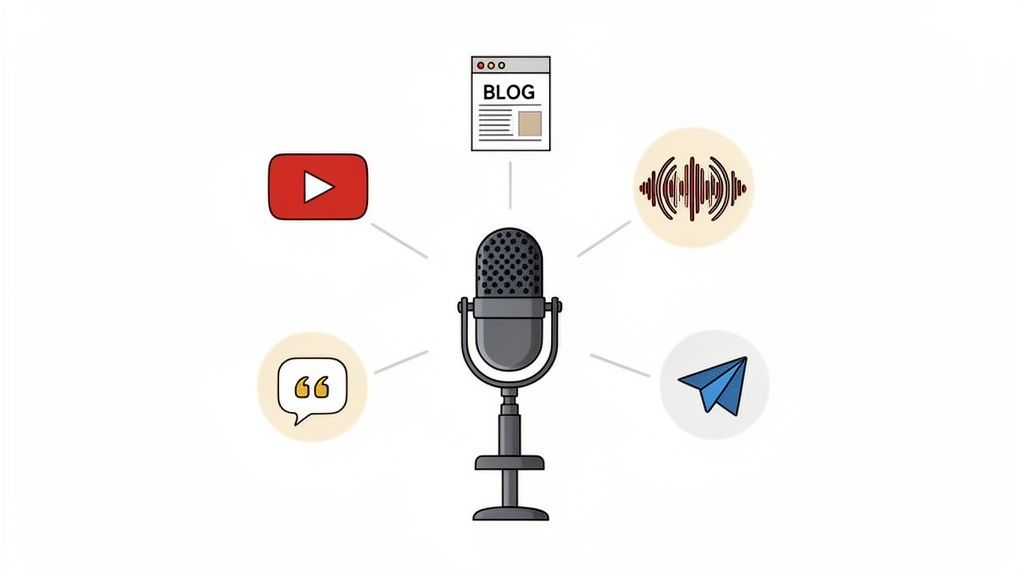
This approach turns your podcast from a standalone channel into the central hub of a comprehensive content ecosystem. For example, a powerful guest quote can become a visually striking graphic for LinkedIn. A deep-dive segment can be expanded into a detailed blog post or newsletter. The most engaging conversational moments can be clipped into viral-ready videos for YouTube Shorts and TikTok, as seen with shows like My First Million. This atomization ensures every valuable insight reaches its maximum potential audience.
How to Implement This Strategy:
- Build a Repurposing Workflow: Don't treat content repurposing as an afterthought. Create a standardized process using tools like Descript to quickly identify and extract key quotes, stories, and data points during the editing phase. For a deeper dive, you can explore detailed content repurposing strategies on fame.so.
- Optimize for Platform Nuance: Tailor each repurposed asset to its destination. A vertical video clip with captions works best for Instagram Reels, while a text-based post with a key insight is ideal for LinkedIn. Leverage a B2B social media agency to maximize the impact of these assets across platforms.
- Systemize Graphic and Video Creation: Develop a suite of branded templates for different content types, such as quote cards, audiograms, and video clips. This speeds up production and ensures brand consistency across all channels.
Key Metrics to Track:
- Asset Performance by Channel: Monitor which formats (e.g., video clips, quote graphics, blog posts) generate the most engagement on each specific platform.
- Website Referral Traffic: Use UTM parameters to track how much traffic your repurposed content drives back to your main website or podcast landing pages.
6. Enhances Executive Visibility and Personal Branding
Beyond building corporate authority, a key benefit of a podcast is its unparalleled ability to amplify an executive’s personal brand. By providing a platform for founders and leaders to share their unique perspectives, a B2B podcast transforms them from company representatives into influential industry voices. This personal brand becomes a powerful company asset, attracting media opportunities, high-profile speaking engagements, and crucial investor interest.
This dynamic is especially critical for founder-led companies or businesses preparing for a significant financial event like an IPO or acquisition. In these scenarios, the market’s confidence in the leadership team is directly tied to the company’s valuation. For example, Daniel Ek’s visibility through podcasting helped strengthen investor relationships and build market confidence during Spotify’s IPO process, demonstrating how a leader’s personal authority can directly translate into tangible business value.
How to Implement This Strategy:
- Align Personal and Corporate Brands: Ensure the executive's messaging on the podcast is consistent with the company’s core values and strategic goals. The personal brand should complement, not compete with, the corporate brand.
- Focus on Authentic Expertise: The most compelling personal brands are built on genuine expertise, not just self-promotion. Encourage leaders to share candid stories, unique insights, and even lessons from failures to build a relatable and trustworthy persona.
- Leverage Appearances for PR: Use podcast episodes as a portfolio to pitch the executive for media interviews, guest articles, and conference keynotes. Create a “speaking topics” list derived from the most successful podcast episodes.
Key Metrics to Track:
- Inbound Media & Speaking Requests: Monitor the volume and quality of inbound requests for interviews, quotes, and speaking roles that reference the executive's podcast presence.
- LinkedIn Audience Growth & Engagement: Track the growth of the executive’s personal LinkedIn following and the engagement rates (likes, comments, shares) on posts related to their podcast content.
7. Builds Networking and Partnership Opportunities
A B2B podcast is one of the most effective and genuine business development tools available. Far more than just a content platform, it functions as a powerful catalyst for strategic relationships by creating a natural reason to connect with industry leaders, potential integration partners, and even ideal clients. Each guest interview is a high-value, structured conversation that lays the groundwork for future collaboration.
This benefit transforms your marketing efforts into a relationship-building engine. Instead of cold outreach, you offer a platform for experts to share their insights, creating immediate goodwill and rapport. Even a smaller business can attract guests from massive players if they are discussing the most relevant industry issues. This allows you to "fight above your weight class," building relationships that would otherwise be inaccessible.
How to Implement This Strategy:
- Create a Strategic Guest Wishlist: Don't just invite popular figures. Build a target list of guests from companies you see as potential partners, customers, or key influencers. Align your guest outreach with specific business development goals.
- Prepare Deeply for Every Interview: Show respect for your guest's time by conducting thorough research. Go beyond their LinkedIn profile to understand their unique perspective. This level of preparation demonstrates your commitment and builds a strong foundation for a professional relationship. Learn how to prepare for a podcast guest appearance to make every interaction count.
- Systemize Your Post-Episode Follow-Up: The relationship doesn't end when the recording stops. Follow up with a personalized thank you and suggest a specific next step for collaboration, whether it's a joint webinar, a content swap, or a formal partnership discussion.
Key Metrics to Track:
- Partnerships Sourced from Guests: Track the number of formal partnerships, integrations, or co-marketing campaigns that originated from a podcast guest relationship.
- Pipeline Influence: Use CRM tracking to monitor how many opportunities or closed-won deals involved a contact who appeared as a guest on your show.
8. Provides Direct Market Research and Customer Insight
Beyond marketing, one of the most strategic benefits of a podcast is its function as a direct, real-time market research tool. Hosting conversations with industry experts, ideal customer profiles, and listeners provides an unfiltered channel to gather intelligence about your audience's core challenges, emerging needs, and competitive landscape. This qualitative data is invaluable for shaping a truly customer-centric strategy.
This continuous feedback loop allows you to stay ahead of market shifts and validate assumptions without expensive, time-consuming surveys. The insights from a single guest interview can reveal critical pain points that directly inform your product roadmap, refine your marketing messaging, and identify new service opportunities. For instance, the Product Hunt Radio podcast gathers direct feedback from its community of makers and users, influencing platform features and priorities.
How to Implement This Strategy:
- Systemize Insight Capture: Don't let valuable information disappear after an interview. Create a centralized repository (like a Notion database or spreadsheet) to document recurring themes, pain points, and suggestions from both guests and listeners.
- Integrate Listener Feedback Loops: Actively solicit audience input. Use calls-to-action in your episodes to encourage listeners to submit questions for Q&A segments, vote on future topics via polls, or share their experiences through a dedicated email or voicemail line.
- Share Intelligence Internally: Create a formal process for sharing key findings with your product, sales, and marketing teams. A bi-weekly insights summary or a dedicated Slack channel can ensure this valuable research translates into tangible business action.
Key Metrics to Track:
- Volume of Listener Submissions: Monitor the number of questions, comments, and topic suggestions received per episode as an indicator of audience engagement and investment.
- Product/Marketing Initiatives Influenced: Keep a qualitative log of specific product features, marketing campaigns, or content pieces that were directly inspired by podcast insights.
9. Supports Measurable Revenue Growth and ROI Tracking
Unlike many traditional brand-building activities that are difficult to quantify, a B2B podcast can be engineered to generate measurable business outcomes. With the right strategy and attribution model, you can directly connect your audio content to pipeline growth, closed deals, and customer lifetime value. This transforms the podcast from a "brand expense" into a predictable, revenue-driving engine.
The ability to prove financial impact is crucial for securing executive buy-in and justifying continued investment in your show. As you build an engaged audience over 6-12 months, your show also becomes attractive to sponsors, opening a direct monetization channel. This can help offset production costs and even turn the podcast into a profit center.
How to Implement This Strategy:
- Create Gated Resources and Offers: Develop high-value content like whitepapers, templates, or exclusive webinars that relate to a specific episode. Mention this resource in the episode with a dedicated, trackable landing page to capture listener information.
- Integrate with Your CRM: Connect your podcast hosting analytics and landing page forms directly to your CRM (like Salesforce or HubSpot). This allows you to tag leads as "podcast-sourced" and track their entire journey from listener to closed-won customer.
- Use Unique Codes and URLs: Implement unique, memorable promo codes or vanity URLs for special offers mentioned only on the podcast. This provides a simple yet effective way to attribute direct conversions and revenue. A fundamental aspect of proving your podcast's business impact is knowing how to calculate marketing ROI.
Key Metrics to Track:
- Listener-to-Lead Conversion Rate: Measure the percentage of estimated listeners who convert on an episode-specific landing page or offer.
- Podcast-Sourced Pipeline Value: Track the total monetary value of sales opportunities in your pipeline that originated from the podcast.
- Customer Acquisition Cost (CAC) vs. Other Channels: Compare the cost to acquire a customer through your podcast against channels like paid search or social media advertising.
10. Accelerates Growth Through Owned Audience Development
Unlike paid channels where influence disappears the moment you stop spending, a podcast builds an owned audience that becomes a permanent company asset. This is one of the most sustainable benefits of a podcast, creating a direct line of communication to your most engaged prospects and customers. Over time, this subscriber base compounds in value, creating a flywheel that drives predictable growth, nurtures leads, and reinforces brand loyalty long-term.
This owned channel de-risks your marketing strategy by reducing dependence on third-party platforms and volatile ad costs. A dedicated listener base is an insulated ecosystem where you can launch products, gather feedback, and drive pipeline activity on your own terms. For example, The Tim Ferriss Show cultivated an audience of millions, creating a platform that generates immense value far beyond its initial production investment. Similarly, the HubSpot Podcast Network leverages its owned audience to generate consistent, high-quality demand for its software suite.
How to Implement This Strategy:
- Prioritize Email Capture: Make converting listeners to email subscribers your primary goal. Use clear calls-to-action in your episodes to direct listeners to exclusive resources, show notes, or a newsletter signup page. A B2B email newsletter agency can help you craft a compelling newsletter that keeps your audience engaged.
- Create Gated, High-Value Content: Offer exclusive content like bonus episodes, detailed templates, or in-depth reports that are only accessible to email subscribers. This provides a compelling reason for listeners to transition from a rented platform to an owned one.
- Build Direct Engagement Channels: Establish a dedicated community on a platform like Slack, Discord, or a private forum. This creates a space for direct interaction, deepens relationships, and provides invaluable qualitative feedback from your ideal customer profile.
Key Metrics to Track:
- Email Conversion Rate: Track the percentage of listeners who visit your website from the podcast and subscribe to your email list.
- Owned Audience Growth Rate: Monitor the month-over-month growth of your email list and community membership, ensuring it's scaling alongside your download numbers.
11. Lets You Test the Waters Through Podcast Guesting
Running your own show is a real commitment - strategy, guest booking, production, promotion. If you want proof the format works for your business before you take that on, guesting on other people's podcasts gets you most of the same benefits with none of the production overhead. You borrow an established host's audience and credibility instead of building your own from zero, and every appearance sends targeted traffic and a high-authority backlink back to your site via the show notes.
How to Implement This Strategy:
- Get Booked on Relevant Shows: Target podcasts your ideal customers already listen to, not just the biggest shows in your category. Fame Connect books B2B executives onto podcasts that reach their exact ideal customer profile, so this doesn't have to be a manual outreach slog.
- Treat Every Appearance Like an Asset: Repurpose the clip, quote and show notes link the same way you would an episode of your own show - see our guide to B2B podcast promotion for the repurposing playbook.
Key Metrics to Track:
- Referral Traffic and Backlinks: Track visits and links back to your site from each show's notes page.
- Booking-to-Pipeline Rate: Track how many guest appearances lead to a real sales conversation, the same way you'd track guest conversion on your own show.
Top 10 Podcast Benefits Comparison
| Item | Implementation Complexity | Resource Needs & Speed | Expected Outcomes | Ideal Use Cases | Key Advantages / Quick Tips |
|---|---|---|---|---|---|
| Establishes Thought Leadership and Authority | High. Requires sustained editorial effort, research, and expert guests. | High resources. Slow ROI (6 to 12+ months). | Strong credibility, media mentions, and long-term authority. | Executive visibility, pre-IPO or acquisition positioning, enterprise trust-building. | Differentiates in crowded markets. Tip: Pick a narrow niche, feature recognized guests, and repurpose episodes. |
| Generates Qualified Leads and Sales Pipeline | Medium to High. Requires CTA strategy, landing pages, and CRM integration. | Medium resources. Scales in 3 to 6 months with coordinated marketing. | Measurable qualified leads and pipeline. Lower CPL compared to paid ads. | Demand generation, SaaS signups, sales enablement programs. | Produces warm, attributable leads. Tip: Use episode-specific landing pages, gated offers, and unique UTMs or promo codes. |
| Builds Deep Audience Connection and Brand Loyalty | Medium. Requires consistent hosting, storytelling, and community management. | Medium resources. Gradual build tied to host time and engagement channels. | Higher engagement, repeat customers, increased CLV, and referrals. | Retention-focused brands, community-driven growth, advocacy programs. | Creates intimate host-listener bonds. Tip: Maintain a consistent host voice and run Q&A sessions or live events. |
| Improves SEO and Organic Discoverability | Medium. Requires transcripts, show notes, and SEO optimization. | Low to Medium resources for content operations. SEO gains in about 3 to 6 months. | Increased organic visibility and long-tail search traffic over time. | Inbound marketing, content-driven lead capture, long-tail keyword targeting. | Expands indexed content footprint. Tip: Publish accurate transcripts, optimize titles and descriptions, and use schema markup. |
| Creates Shareable, Multi-Format Content | Medium to High. Requires repurposing workflows for clips, graphics, and blogs. | Medium resources upfront for editing and design tools. Distribution becomes fast once systems exist. | Broader reach, higher social engagement, and backlinks. | Social growth, content scaling, multi-channel campaigns. | Multiplies one asset into many. Tip: Extract clips and quotes, use templates, and secure guest permissions. |
| Enhances Executive Visibility and Personal Branding | Medium. Requires executive time, messaging discipline, and PR support. | Medium resources. Moderate speed for visible results with amplification. | More speaking opportunities, media mentions, investor interest, and talent attraction. | Founder-led companies, fundraising, executive positioning. | Personal brand becomes a company asset. Tip: Align personal and company messaging and track mentions. |
| Builds Networking and Partnership Opportunities | Medium. Requires guest outreach and relationship nurturing. | Low to Medium resources such as business development time. Outcomes depend on timing. | New partnerships, joint promotions, and integration opportunities. | Business development, ecosystem building, integration strategies. | Enables authentic business development conversations. Tip: Curate strategic guest lists and follow up to explore collaborations. |
| Provides Direct Market Research and Customer Insight | Low to Medium. Requires feedback channels and analysis processes. | Low resources compared to formal research. Insights are continuous. | Qualitative market intelligence to inform product and messaging. | Product-market fit validation, roadmap decisions, competitive intelligence. | Low-cost real customer insight. Tip: Collect listener surveys, document recurring themes, and share insights with product teams. |
| Supports Measurable Revenue Growth and ROI Tracking | Medium to High. Requires attribution frameworks and CRM linkage. | Medium resources for analytics and tracking. Revenue impact may take months. | Quantifiable pipeline attribution and ROI to justify spend. | Performance-driven marketing, budget-conscious demand generation. | Enables data-driven budgeting. Tip: Implement UTMs, promo codes, episode landing pages, and CRM integration. |
| Accelerates Growth Through Owned Audience Development | Medium. Requires consistent production and audience migration systems. | Medium resources such as email tools and community platforms. Growth compounds over time. | Long-term owned audience value and reduced reliance on ads. | Long-term growth strategies, subscription or SaaS models, retention-focused brands. | Creates a permanent marketing asset. Tip: Prioritize email capture and build direct engagement channels like communities and newsletters. |
Proof It Works
These benefits aren't theoretical - they show up in results from real B2B shows. YellowBird used podcasting as part of its account-based approach and saw 20% of guests convert into customers, documented in the YellowBird case study. It's one of many results across the full set of Fame case studies, worth a look if you want to see these benefits attached to a specific show, guest list and outcome rather than a general claim.
From Insight to Impact: Putting Your Podcast to Work
We’ve journeyed through the multifaceted landscape of B2B podcasting, moving far beyond the simple act of recording audio. You’ve seen how this powerful medium is not just another marketing channel, but a strategic asset capable of transforming your entire go-to-market motion. The core theme is clear: a podcast is a central pillar for building authority, fostering deep relationships, and generating a measurable return on investment.
The discussion has illuminated eleven critical benefits of a podcast, from establishing unshakeable thought leadership and accelerating your sales pipeline to creating a versatile content engine that fuels your entire marketing ecosystem. We've explored how each episode becomes an opportunity- not just to broadcast a message, but to engage directly with prospects, partners, and customers in a meaningful, human way. The intimacy of audio builds trust and loyalty in a way that static content simply cannot match. It allows your brand’s personality, expertise, and voice to resonate directly with your ideal audience, turning passive listeners into active advocates.
From Understanding to Action: Your Strategic Next Steps
Grasping the benefits is the first step; implementation is what drives results. The true power of a podcast is unlocked when it’s integrated into your broader business strategy. It’s a tool for account-based marketing when you invite target accounts as guests. It’s a customer retention tool when you feature success stories and deepen relationships with existing clients. And it’s a powerful networking asset that allows you to connect with industry titans, punching far above your weight class.
To translate these insights into tangible outcomes, consider these actionable next steps:
- Define Your "Why": Before anything else, solidify your primary objective. Is it lead generation? Brand authority? Investor relations? Your core goal will dictate your content strategy, guest selection, and success metrics. A podcast aimed at pipeline acceleration will look very different from one focused on establishing a new market category.
- Start Small with Guesting: If launching a full-scale production seems daunting, dip your toes in the water first. Appearing as a guest on established podcasts in your niche is a brilliant way to reap many of the rewards- like audience building and authority- without the upfront investment. This approach allows you to refine your message and build your confidence on the mic. Services like Fame Connect can be invaluable here, helping you secure placements on shows that reach your ideal customer profile.
- Commit to a Pilot Season: Don’t overcommit to an indefinite run from day one. Frame your launch as a "pilot season" of 8-12 episodes. This creates a manageable project scope, allowing you to test formats, gather feedback, and analyze initial data before scaling your efforts. It’s a lower-risk way to prove the concept internally.
- Build a Repurposing Workflow: From the very first episode, plan how you will atomize the content. A single 45-minute interview can be transformed into a blog post, multiple social media video clips, a newsletter feature, quote graphics, and an audiogram. This strategy maximizes the reach and ROI of every conversation. For those ready to move from understanding the benefits to launching their own show, explore Fame's guide to getting guests on your B2B podcast.
The journey from a podcast concept to a revenue-driving asset is a marathon, not a sprint. Consistency, quality, and strategic promotion are the pillars of success. By embracing this medium, you are not just creating content; you are building an owned media platform, a community, and a direct line to the people who matter most to your business. The time to press record is now.
Ready to build your authority and turn conversations into customers but need an expert partner to handle the heavy lifting? Fame specializes in launching and growing B2B podcasts that drive real business results, from strategy and production to promotion. Let us help you build your strategic content engine.
Want us to run this for you?
Fame starts and grows B2B podcasts that generate pipeline. Tell us who you are trying to reach and we will send a costed proposal within 48 hours.
Related content
- Read moreFame Team · February 3, 2025
How To Start A B2B Podcast In 2025
Ready to act on the benefits above? Here's the step-by-step process for launching your B2B podcast. - Read moreFame Team · August 8, 2025
The ROI Double-Helix: Why Your B2B Podcast Needs Both Guest And Listener Conversion Models
A deeper look at how B2B podcasts convert through both guest relationships and listener growth. - Read moreJune 14, 2026
10 Account Based Marketing Tactics For B2B Growth In 2026
Your SDR finally gets a reply from a dream account. Then the thread stalls the moment the conversation sounds like a meeting request. - Read moreJune 10, 2026
20 Best Podcast Production Agencies For 2026 (And Why Should You Hire One)
Global podcast and vodcast ad revenues are on track to hit $5 billion in 2026 , up 20% year-on-year.