
Key Takeaways
- Organic traffic attracts visitors already looking for your business through helpful content.
- It's a long-term strategy that builds trust, authority, and a self-sustaining asset.
- Organic traffic is a compounding asset that delivers a high return on initial investment.
Let's be honest, "increasing organic website traffic" sounds like a dry marketing task. But what it really means is attracting visitors who are already looking for you—without paying for every single click. It’s about creating genuinely helpful content that answers the exact questions your ideal customers are typing into Google.
This isn't a short-term sugar rush like paid ads. It's a long-game strategy that builds something real and lasting: trust, authority, and a website that becomes a self-sustaining asset for your business.
Why Organic Traffic Is Your Most Valuable Asset
Before we get into the tactical playbook, we need to get one thing straight: organic traffic isn't just another line item in your marketing mix. For B2B, it's the absolute bedrock of sustainable growth. It's the engine that builds market authority and keeps your sales pipeline full of high-quality leads.
Paid ads are great for immediate visibility, but they're like a rented faucet—the second you turn off the budget, the traffic dries up completely. Organic traffic is different. It’s a compounding asset.

The pillar page you publish today can keep attracting high-intent prospects for months, even years, delivering an incredible return on that initial time investment. Think of it as building a library of expertise that works for you 24/7. It’s the core principle behind what we call owned media.
Organic vs. Paid Channels: A Quick Comparison
When you're deciding where to put your marketing budget, it's crucial to understand the fundamental differences between organic and paid channels. Here’s a quick breakdown to illustrate why organic often wins in the long run for B2B.
While paid ads have their place for short-term campaigns, organic search is where you build a truly resilient and cost-effective growth engine.
The Unmatched Value of High-Intent Visitors
Let's talk about the type of person who finds you through a search engine. They're worlds apart from someone you reach with a cold email or a display ad. They weren't interrupted during their day; they actively went looking for an answer, a solution, a better way to do their job.
That built-in intent is a game-changer. It's precisely why leads from organic search convert at a jaw-droppingly higher rate.
The numbers don't lie. Organic search leads are 8.5x more likely to convert than those from outbound marketing, with a 14.6% close rate. In the B2B world, organic traffic is the engine behind nearly 45% of all revenue. It's not a channel you can afford to ignore.
If you're on a demand-gen team, this is the one thing to remember: building a strong organic presence isn't a "nice-to-have." It's a strategic imperative that delivers better leads at a fraction of the long-term cost of paid acquisition.
Building a Lasting Competitive Advantage
At the end of the day, a powerful organic footprint is a durable moat around your business. It cements your brand as a trusted authority, making your website the default destination for anyone in your industry looking for answers.
Every high-quality article, guide, or podcast you publish reinforces that position, making it that much harder for competitors to gain ground.
This long-term focus shifts your entire marketing mindset. You stop chasing fleeting vanity metrics and start building a reliable, predictable engine that consistently delivers your ideal customers right to your digital doorstep. For a deeper dive into modern approaches, this A Modern Playbook for Increasing Organic Search Traffic is a great resource.
Build Your Foundation With Keyword Research And Topical Authority
Sustainable organic traffic doesn't come from throwing content at the wall and seeing what sticks. It all starts with a deep, almost obsessive, understanding of what your ideal customers are actually typing into Google.
This is the first major hurdle where I see B2B marketing go off the rails. They get distracted by the vanity metrics of high-volume, generic keywords instead of zeroing in on the specific, high-intent phrases that signal someone is actively looking for a solution like theirs.
To really move the needle, you have to get inside your customer's head. What problems are keeping them up at night? What questions are they asking right before they're ready to pull out the company credit card? Nailing this is step one.
Uncover High-Intent, Low-Competition Keywords
The goal isn't just to find any keywords; it's to find the right ones. We're hunting for phrases that show a user is past the "just browsing" stage and is seriously considering their options. These are often longer, more descriptive phrases—what we call "long-tail keywords."
So, instead of a broad term like "marketing software," you'd be much better off targeting queries like:
- Problem-focused queries: "how to reduce B2B customer churn rate"
- Comparison keywords: "best b2b podcast production agency for tech companies"
- Question-based searches: "what do you need for a podcast"
Sure, the search volume for these is lower. But the intent? It's through the roof. The traffic you get from these kinds of searches is infinitely more likely to turn into qualified leads. A great starting point is to use SEO tools to see what your competitors are ranking for—you'll often find valuable gaps they've missed.
Build Topical Authority With Content Clusters
Search engines reward expertise. Period. The single most effective way to signal that you're an expert is to build topical authority. This means creating a deep and comprehensive web of content around a single core topic, essentially telling Google, "Hey, when it comes to this subject, we're the ones to trust."
The best way to structure this is with a topic cluster model. It works like this:
- Pillar Page: Think of this as your magnum opus on a broad topic, like "The Ultimate Guide to B2B Podcast Production." It's a massive, in-depth resource.
- Cluster Content: These are shorter, more focused articles that dive into specific subtopics related to your pillar. For example, "How to Plan a Podcast Episode," "Podcast SEO Best Practices," or "How to Promote a Podcast."
- Internal Linking: This is the glue that holds it all together. Every cluster article links back up to the main pillar page, and the pillar page links out to all its supporting cluster articles.
This creates an interconnected web that search engines love. It clearly shows them your site's structure and signals that you're an authority. A solid content plan is non-negotiable here; if you need a refresher, check out our guide on how to create a content strategy.
Map Keywords to the Buyer's Journey
Every keyword has a story. It tells you where someone is in their buying process. By mapping your keywords to the buyer's journey, you ensure every piece of content you create has a specific job to do, guiding prospects smoothly from "What is this?" to "Shut up and take my money."
Here’s a simple way to think about it:
When you align your content this way, you're not just throwing information at people; you're building a journey that nurtures them at every single step.
As you lay this groundwork, it's also becoming critical to understand how AI is changing the search game. For a look ahead, this guide on LLM SEO and AI Search Ranking is a fantastic read. This kind of strategic mapping is what separates the campaigns that just drive clicks from the ones that build a healthy, predictable sales pipeline.
The Ultimate Content Engine: How B2B Podcasting Drives Organic Traffic
Let's be honest: conventional content marketing can feel like a grind. The constant pressure to churn out blog posts and social updates is a recipe for burnout.
But what if you could generate a whole suite of high-value, SEO-rich assets from just a single hour of work? That’s not a hypothetical—it’s the reality of B2B podcasting. It completely changes the game.
A B2B podcast is so much more than an audio file. It’s a powerful content engine that works around the clock to drive organic traffic. It’s the secret to creating expert-level content at scale, turning a weekly conversation into a sustainable source of high-intent visitors without exhausting your team.
From One Episode to a Dozen SEO Assets
Think about what you can get from a single 45-minute podcast episode. You're not just creating one piece of content; you're building an entire content ecosystem. This is the core of its power—repurposing a single recording into multiple formats that appeal to different audiences and, crucially, different search engine algorithms.
Here’s what that looks like in practice:
- A Full, Keyword-Rich Blog Post: The episode transcript is your foundation for a killer long-form article. With a bit of editing, that natural conversation becomes a highly structured, SEO-optimized post targeting your core keywords.
- High-Quality Website Video: Record video alongside your audio, and you’ve got another powerful asset. Embedding this on your episode page spikes your dwell time—a huge signal to Google that your content is valuable.
- Multiple Social Media Snippets: Pull out the most insightful moments, surprising stats, or actionable tips. Clip them into short-form videos perfect for YouTube Shorts, TikTok, and LinkedIn.
- Quote Graphics and Audiograms: Turn powerful quotes from your guest into shareable images or short audio clips with animated captions. These are perfect for grabbing attention on noisy social feeds.
This multi-asset approach maximizes the SEO footprint of every single episode. The key is having a repeatable podcast production workflow to scale it effectively.
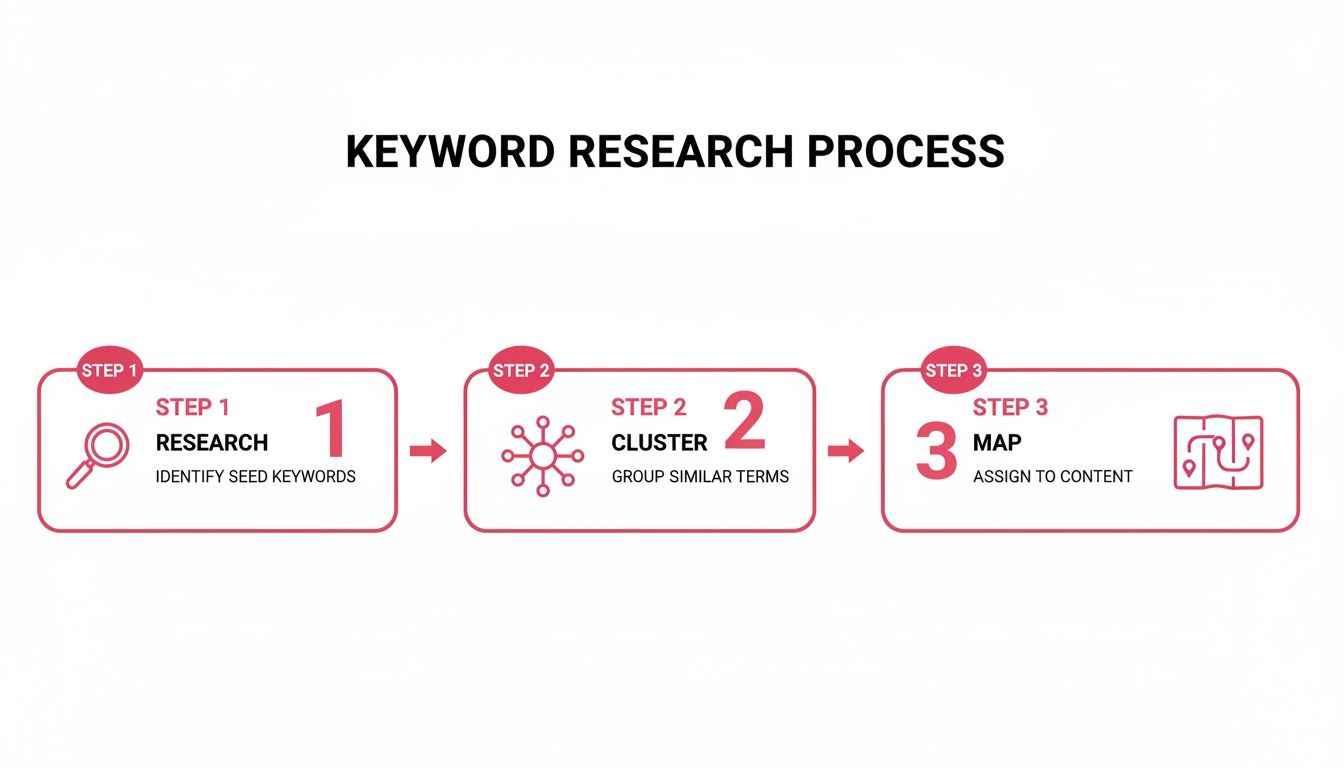
This workflow ensures every asset you create from your podcast is strategically aligned with what your audience is actually searching for.
Instantly Boost E-E-A-T and Generate Backlinks
Google's ranking algorithm is obsessed with content that demonstrates Experience, Expertise, Authoritativeness, and Trustworthiness (E-E-A-T). Trying to manufacture this from scratch is a slow, painful process.
Podcasting is the ultimate shortcut.
When you feature industry experts, respected leaders, and even influential customers as guests, you instantly borrow their authority. Their insights and experience are baked right into your content, sending powerful E-E-A-T signals to search engines.
This is one of the most underutilized strategies for building topical authority. You’re not just writing about experts; you’re co-creating content with them. That makes your material far more credible and valuable in the eyes of Google and your audience.
On top of that, this process naturally generates one of the most coveted SEO assets: high-authority backlinks.
When you feature a guest, they have a vested interest in sharing the episode. They’ll post it on LinkedIn, link to it from their company blog, and share it in their newsletter. More often than not, each share comes with a backlink pointing right to your website.
These aren't just any links; they're contextually relevant and come from trusted sources—the exact type of link that search engines reward with higher rankings. It’s a natural, white-hat link-building strategy that’s baked right into your content process.
The Fame Approach to Podcast-Driven Growth
At Fame, we’ve seen this engine drive incredible results for B2B brands. As the largest producer of B2B podcasts in the world, we manage over 100 shows at any given time. This scale allows us to rapidly test and refine promotion strategies to see what truly moves the needle.
We operate on a simple but powerful guarantee: 10% month-on-month download growth.
This isn't just a vanity metric. This growth is a direct result of a finely tuned system that leverages each episode for maximum SEO impact.
In fact, 98% of our clients have seen this level of growth in their first six months. The average client achieves 18,957 downloads in the first six months and 68,524 downloads in the first year. We’re so confident in this model that if we don’t hit an average of 10% monthly growth over the first six months, the seventh month of service is on us.
The data backs this up. Did you know organic search still powers a whopping 53% of all website traffic? To capture that traffic, you need a steady stream of high-quality, long-form content. Podcast-driven blog posts, which average over 1,400 words, are the perfect vehicle for targeting high-intent B2B queries.
Ultimately, a B2B podcast is the most efficient way to consistently publish authoritative content that both your audience and search engines will love. It transforms your content strategy from a constant sprint into a sustainable, compounding engine for growth.
You can dig deeper into this idea by reading about podcasting as a growth engine.
Amplify Your Content With Strategic Distribution
Look, putting out a brilliant podcast or blog post is only half the job. If you hit ‘publish’ and then just sit back, waiting for the traffic to magically appear, you're leaving a massive amount of potential on the table.
To really move the needle on organic traffic, you need a powerful, multi-channel distribution plan. It’s about making sure the content you worked so hard on actually finds its way to the right people. This isn’t about just mindlessly blasting links on social media. It’s a methodical process for turning every single piece of content into a magnet for your ideal customer, pulling them back to your site from all corners of the internet.
At Fame, we’ve boiled this down to a set of core promotional pillars that just flat-out work.
Squeeze Every Drop of SEO From Your Content
First things first: every single piece of content you create—even the small clips—is a new chance to rank. You have to think beyond just optimizing the main blog post.
- Pillar 1: Video/Audio/Written SEO: We use tools to find relevant keywords and incorporate them into everything: podcast titles, descriptions, summaries, and the repurposed blog posts. Every asset is treated as an SEO opportunity.
- Pillar 2: Organic Social: A full episode is published to YouTube with an SEO-optimised description, chapters, and captions. We then select the most valuable sections to turn into snippets for YouTube Shorts and other key social channels like LinkedIn. We even create a dedicated LinkedIn page for the podcast itself to build a focused community.
Turn Your Guests into Your Best Promoters
Don't forget, your podcast guests are your single biggest promotional asset. They come with a built-in audience that already knows, likes, and trusts them.
- Pillar 3: Guest Sharing: Your job is to make it ridiculously easy for guests to share. We provide them with easy-to-share content, such as pre-written posts, episode highlights, and quote graphics. We also develop content related to the episode that guests can feature on their own websites, including backlinks that direct traffic back to your podcast for increased visibility.
By taking all the work off their plate, you dramatically increase the chances they’ll share the episode far and wide. This amplifies your reach and helps you build high-authority backlinks at the same time.
Expand Your Reach Through Partnerships and Promotion
To scale growth, you need to get your content in front of new audiences.
- Pillar 4: Partnerships/Communities: We connect with other podcast hosts, influencers, and blog authors who have audiences that could be interested in the show. This includes arranging for the host to feature on other shows and engaging with writers to secure listings in "top podcast" articles.
- Pillar 5 & 6: Paid Promotion: When budget allows, we run targeted ads on platforms like LinkedIn and YouTube, and even run ads on other relevant podcasts to tap directly into an engaged listener base.
- Pillar 7 & 8: Email and Existing Assets: We leverage cold email outreach and existing client assets, like their blog and social accounts, to promote episodes. This includes integrating podcast episodes into relevant website sections and cross-linking within blog posts to direct readers to related episodes.
This systematic approach is how you turn one piece of content into a traffic-generating machine. It’s a huge reason why 98% of our clients see 10%+ growth every single month in their first 6 months with us, with the average client hitting 18,957 downloads in that timeframe.
You can get an even deeper look at this playbook in our full guide to content distribution strategies.
Secure Your Rankings With Technical SEO And Link Building
So you’ve created some incredible content. That's a huge win, but if your website's technical foundation is shaky, even the best articles and podcasts will struggle to make an impact. If you want to increase your organic website traffic, you need to make it dead simple for search engines to crawl, understand, and trust your site.
This is where technical SEO and a smart link-building strategy come into play.
Think of it like building a house. Your content is the beautiful interior design, but technical SEO is the solid foundation, plumbing, and electrical wiring. Without it, the whole structure is unstable.
Nail the Technical SEO Essentials
The good news? You don't need to be a developer to get the basics right. Just focusing on a few key areas can make a massive difference in how search engines view and rank your pages.
- Prioritize Site Speed: Page speed is a critical ranking factor. Period. Slow sites frustrate users, which leads to high bounce rates—a clear negative signal to Google. Compress your images, use a good hosting provider, and keep your code clean to make sure everything stays snappy.
- Embrace Mobile-First Optimization: Google now primarily uses the mobile version of your site for indexing and ranking. This isn't a "nice-to-have" anymore. Your website must be flawless on smartphones and tablets. Every element should be easy to read, tap, and navigate on a small screen.
- Build a Clean Internal Linking Structure: Internal links—the ones pointing from one page on your site to another—are your way of telling search engines what your site is about and which pages are most important. A strong internal linking strategy, like the topic cluster model we talked about earlier, spreads authority throughout your site and keeps users engaged longer.
Build High-Quality Backlinks Naturally Through Podcasting
Once your technical house is in order, the next job is building authority. In the world of SEO, backlinks (links from other websites to yours) are one of the most powerful signals of trust. The more high-quality, relevant sites that link to you, the more credible you appear to search engines.
But let's be honest, old-school link-building tactics are tedious and can even be risky. This is where podcasting flips the script and becomes a natural, white-hat link-building machine. It’s a strategy that builds authoritative links simply as a byproduct of creating great content.
"A common misconception is that more content equals more traffic. The truth is that most content gets zero traffic. The key is creating link-worthy, expert-driven assets and then building a system to get them shared." - Tom Hunt, Founder of Fame
How Podcasting Generates SEO Gold
Every single podcast episode you produce creates multiple opportunities to earn the kind of backlinks that genuinely move the needle on your rankings.
- Guest Appearances on Other Shows: When your host appears as a guest on another podcast, they almost always get a link back to your company's website in the show notes. This is a double win: you place your brand in front of a new, relevant audience and you secure a valuable backlink.
- Guest Sharing from Your Own Show: When you feature an industry expert on your podcast, they have a built-in incentive to share the episode with their network. They’ll link to it from their blog, share it on LinkedIn, and mention it in their newsletter—all driving traffic and sending authority signals right back to your domain.
This process transforms link-building from a chore into a natural outcome of your content strategy. You’re no longer just chasing links; you're creating valuable content that people genuinely want to share.
And this is absolutely critical. Ranking #1 in Google isn't just for show—it commands a 27.6% average click-through rate, with the top three spots capturing 54.4% of all clicks. Yet, a staggering 90.63% of pages get no organic traffic at all. The difference often comes down to producing deep, authoritative content backed by a strong link profile—a perfect match for an end-to-end podcast process. Dive into more revealing SEO statistics to see how these elements guide winning strategies.
Measure What Matters To Iterate For Growth
You can't improve what you don't measure. Driving organic traffic isn't a "set it and forget it" task; it's a constant cycle of doing, analyzing, and tweaking. If you want sustainable growth, you have to look past the vanity metrics like total traffic and zero in on the KPIs that actually mean something for the business.
A data-driven approach is your secret weapon. It shows you exactly what's hitting the mark and where to double down. Instead of guessing, you start making smart decisions based on real performance, turning your organic strategy into a predictable growth engine.
Track Actionable Growth Metrics
The whole point is to track numbers that tell a story and guide your next move. Focus on KPIs that tie directly back to business goals and give you a clear read on the health of your organic efforts.
Here are the key performance indicators you should be watching:
- Keyword Ranking Improvements: Are you climbing the SERPs for your target, high-intent keywords? Tracking this shows whether your content is actually resonating with search engines and users.
- Click-Through Rates (CTR) from Search: A high CTR means your headlines and meta descriptions are doing their job—they're compelling enough to win the click over your competitors.
- Organic Lead Conversion Rates: This is the big one. Is the traffic you're attracting turning into qualified leads and, ultimately, customers? This metric is the ultimate proof that your strategy is working.
- Backlink Profile Growth: Are you earning new, high-quality links from reputable sites? This is a direct measure of your website's growing authority and trustworthiness.
Accountability Drives Results
At Fame, this data-driven philosophy is baked into everything we do. We hold ourselves accountable with transparent reporting and clear goals, focusing on 10% month-on-month download growth for our clients' podcasts. This isn't some arbitrary number; it’s a direct reflection of a content and distribution strategy that’s successfully boosting organic visibility.
We are so confident in our ability to deliver growth that if we don’t hit an average of 10% monthly download growth over the first six months, you get the seventh month of services for free. You can discover more about our growth guarantee at Fame.
This kind of commitment forces us to constantly dig into the performance data, learn what it's telling us, and iterate our approach to make sure we're always moving the needle. When you track the right numbers, you create a powerful feedback loop that fuels continuous improvement and lasting organic growth.
For a deeper dive on this, check out our guide on measuring content marketing ROI.
Got Questions? We've Got Answers
If you're digging into the world of B2B SEO, you've probably got a few questions rattling around. It's a complex game, after all. Let's tackle some of the most common ones I hear.
How Long Until I Actually See Organic SEO Results?
I get this one a lot. Everyone wants to know when the magic happens.
While you might catch a few quick wins here and there, real, meaningful organic traffic growth is a long game. You should budget at least 4-6 months of consistent, quality work before you start seeing significant, measurable results.
Why so long? It gives search engines enough time to crawl, index, and figure out where your new content fits. More importantly, it gives you time to build your topical authority and let your backlink profile mature. The secret to speeding this up is relentless consistency. A weekly podcast, for example, creates a dependable rhythm of fresh content that Google loves.
Is Podcasting Really a Good Use of Time for SEO?
Absolutely. For B2B, it's one of the most efficient content engines you can build. Seriously.
Think about it. Each single episode hands you a goldmine of SEO assets:
- A full transcript you can turn into a long-form, keyword-rich blog post.
- Dozens of high-quality video clips for social media, your blog, and YouTube.
- Natural backlink opportunities every time a guest shares the episode with their network.
This isn't just one piece of content; it's a whole campaign. You're creating assets in multiple formats, and that sends a chorus of positive signals to search engines. It's a uniquely powerful way to drive organic growth.
Should I Focus on Creating New Content or Updating Old Stuff?
The classic debate. The answer is: you need a healthy mix of both.
Publishing new content is non-negotiable. It's how you target new keywords and broaden your footprint, building that all-important topical authority.
But don't sleep on your archives. Updating older content—what we call a "content refresh"—is an incredibly effective way to boost your existing rankings for a fraction of the effort. A pro move is to take insights from a new podcast episode and use them to add depth and freshness to an older, related blog post. This creates a killer feedback loop, signals ongoing relevance to Google, and gives your readers even more value.
Ready to turn your B2B podcast into a powerful organic traffic engine? Fame provides end-to-end production and guarantees 10% monthly download growth. See how we do it.
