January 6, 202618 min read6 sections
A Modern Playbook On Personal Branding For Executives
By Fame Team
Key Takeaways
- A strong executive personal brand is now a critical business asset, directly linked to revenue, talent acquisition, and market position.
- Executives who establish a personal brand through credible content, such as B2B podcasts, can build trust and expert authority, driving customer loyalty and business growth.
- In the digital age, an executive's online presence, including their digital footprint, has become their new resume, and by 2026, 70% of employers expect to consider a personal CV more valuable than a traditional CV.
Personal branding for an executive used to be a "nice-to-have." Something you worked on in your spare time, maybe a vanity project. Not anymore. Today, it’s a critical business asset with a direct line to revenue, talent acquisition, and your company's market position.
Trust has shifted. People no longer put their faith in faceless corporations; they trust credible, visible individuals. An executive's voice, their story, and their expertise are now the most powerful tools for building real customer loyalty.
And what's the most effective, actionable way to build that brand and cement that authority? Launching a B2B podcast. It's the ultimate platform to educate your ideal customers, be seen as the leading voice in your industry, and create a powerful content engine for all your marketing efforts. When you do this consistently, your ideal clients will think of you first when they're in the market.
Why Executive Personal Branding Is a Business Imperative
Let's kill the old-school idea that an executive's personal brand is somehow separate from the company's success. In the crowded, noisy B2B world we live in, the two are fundamentally intertwined.
Potential clients, future partners, and top-tier talent want to know who is behind the logo. They're looking for authenticity and expertise, not just another polished corporate press release.

A strong executive brand cuts through the noise. It gives you a direct line to your ideal customers, letting you educate them, build trust, and stay top of mind. When they're finally ready to buy, they’ll think of the person who has consistently delivered value and insight, you.
The data backs this up. Individuals often increase engagement on brand channels by as much as 800% when they share the same content. We dive deeper into the mechanics of brand trust in our article covering.
Moving Beyond the Resume
An executive's digital footprint has become their new resume. Projections show that by 2026, 70% of employers will consider a personal CV more important than a traditional CV, completely reshaping how top opportunities are secured. Shift is all about digital-first impressions. Recruiters, investors, and potential partners are scouring online activity for consistency, credibility, and thought leadership. If you're not actively shaping your online presence, you're becoming invisible in a fiercely competitive market.
A powerful personal brand is also deeply connected to a leader's ability to command a room and inspire action. It's about more than just posting online; it involves the nuances of developing executive presence and translating that into tangible business outcomes.
"Your personal brand is a promise to your clients… a promise of quality, consistency, competency, and reliability." – Jason Hartman.
This is the kind of promise that builds deep, lasting relationships that corporate advertising alone simply can't buy. It elevates an executive from a mere company rep to a trusted advisor and a respected voice in their industry.
The Strategic Advantage of a Personal Brand
When you get right down to it, investing in an executive's personal brand is a strategic business decision with a measurable ROI. This isn't about vanity metrics like LinkedIn followers. It's about building a sustainable competitive advantage.
Here's what that looks like in practice:
- Attracting Top-Tier Talent: The best people want to work with, and for leaders they recognize and respect, people with a clear vision and a strong public reputation.
- Securing Strategic Partnerships: A respected personal brand opens doors. It gets you into conversations and unlocks collaborations that would otherwise be out of reach.
- Driving Revenue Growth: When you establish yourself as the go-to expert, you build a powerful inbound lead engine full of people who are already sold on your value.
The rest of this playbook will walk you through, step-by-step, how to build that brand. We'll focus on using a B2B podcast as the ultimate platform to achieve these goals.
Defining Your Authentic Executive Brand Narrative
Before you even think about hitting record or drafting that first LinkedIn post, we need to talk foundations. This is the stuff that executives who make a real impact are made of, not those who just add to the noise.
Let's be clear: an effective executive brand isn't just about "being yourself" online. It's a deliberate, strategic process of defining exactly what you stand for, who you're trying to reach, and the unique story you have to tell.
Without this groundwork, your content will feel random and disconnected. You'll end up sounding like every other leader out there, spouting generic corporate-speak that nobody remembers. We can't have that.
Uncover Your Core Point of View
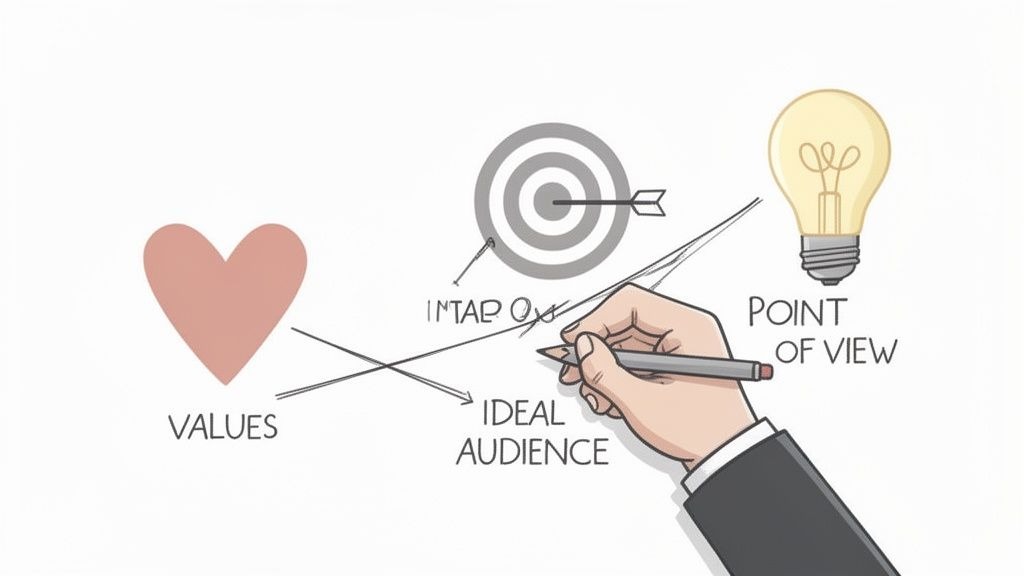
Every memorable executive brand is built around a strong Point of View (POV). This is your unique take on the industry, the belief, the contrarian insight, the hard-won wisdom that sets you apart. Think of it as the intellectual and emotional core of everything you'll say and do.
Finding it requires some real honesty. Ask yourself:
- What's a widely accepted "best practice" in my field that I think is fundamentally wrong?
- What major shift do I see on the horizon that almost no one is preparing for?
- What's a problem my ideal audience has that they can't yet put into words? It's not just about what you know; it's about how you see the world. It’s the lens you use to dissect problems and build solutions. Nailing this down gives your brand a sharp, unforgettable edge.
Map Your Brand Narrative
With your POV as the North Star, you can start building out the rest of your brand story. This isn't some fluffy, theoretical exercise. It's about making a few key decisions that will guide every piece of content you create from now on. Make this tangible: I’ve put together a simple framework. Just work through these questions to get the core pillars of your brand down on paper.
Executive Brand Narrative Framework
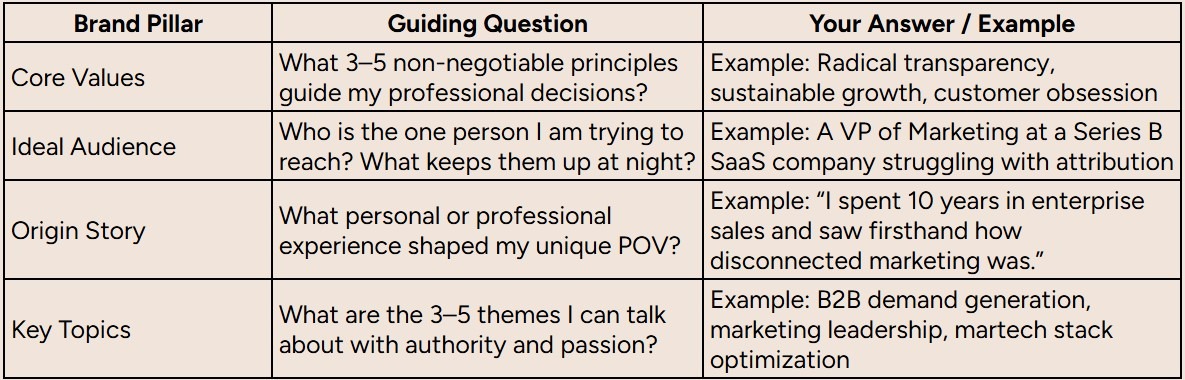
See how that forces you to move from vague ideas to concrete statements? This worksheet becomes the bedrock of your brand's identity. If you want to go deeper on this, we've got a great guide that explains the power of what is brand storytelling and how it creates genuine connections.
Articulate Your Brand Positioning
Last but not least, you need to figure out where you fit in. Brand positioning is about carving out a specific, unoccupied space in your audience's minds.
Start by doing some light competitive recon. Identify 5-10 other influential executives in your niche. Look at their content, listen to their tone, and pinpoint the specific angle they own.
Your goal is not to copy them but to find the gaps. Where is the conversation lacking? What perspective is missing? Who is being ignored?
This is where you find your opening. Maybe everyone is stuck on high-level strategy, but nobody is giving tactical, in-the-weeds advice. Or maybe the dominant voices are all hyper-technical, leaving a massive opportunity for someone to bring a more human, accessible perspective to the table.
Claiming that open space is how you become known for something. It's how, when your ideal audience faces a particular challenge, you're the first and only person who comes to mind. This is the final, crucial step before you start creating.
The B2B Podcast as Your Content Engine
Once your narrative is nailed down, it’s time to execute. You could fire up a blog or post on LinkedIn, sure. But one strategy stands head and shoulders above the rest for building an executive personal brand: launching a B2B podcast.
Forget thinking of it as just an audio show. A podcast is the single most effective content engine you can build.
This isn’t about becoming a radio host. It’s about creating a powerful, scalable platform that positions you as an industry connector, a thought leader, and the absolute go-to expert in your niche. A single, high-quality conversation can be systematically sliced and diced into dozens of marketing assets, fueling your entire content strategy for weeks.
Why Podcasting Is the Ultimate Executive Branding Tool
Launching a podcast immediately elevates your status in the market. You stop chasing conversations and start hosting them. That simple shift gives you a powerful platform to educate potential customers, connect with peers, and build trust on a scale that’s just not possible with other formats.
The strategic upside is huge. You aren't just making content; you're building a library of your expertise that works for you 24/7. This evergreen content keeps generating value, pulling in listeners, and building your authority long after you’ve hit the record button.
Here’s why it’s a perfect fit for executives:
- It Builds Genuine Relationships: Every guest you invite is a networking goldmine. You get an hour of dedicated, one-on-one time with high-profile industry leaders, potential partners, or even your ideal future clients.
- It Establishes Unmatched Authority: When you host a show where you interview other experts, you’re instantly seen as a peer and a central figure in your industry’s most important conversations.
- It creates a Content Flywheel: One 45-minute episode can be turned into LinkedIn video clips, audiograms, quote graphics, newsletter content, and in-depth blog posts. It’s the very definition of working smarter, not harder.
The impact of this approach skyrockets when the executive's brand is seen as an extension of the company's. This isn't a vanity project; it's a powerful commercial strategy. Employee advocacy, led from the top down, is rocket fuel for growth; content shared by staff earns 8 times the engagement of brand posts. It's clear that executives profoundly shape public perception, directly influencing both reputation and revenue.
Turning Conversations into a Marketing Machine
Think of your podcast as the top of your content funnel. Each episode is a rich source of raw material ready to be strategically broken down and distributed across every single channel where your ideal audience hangs out.
The process transforms one recording session into a multi-week promotional campaign. A dedicated agency can handle all the heavy lifting, turning your conversation into a full suite of polished assets.
For example, a chat with an industry leader can easily become:
- 2-3 Short Video Clips: Perfect for LinkedIn, highlighting the most insightful moments.
- A Compelling Newsletter: A summary of key takeaways sent directly to your audience.
- Multiple Quote Graphics: Visually engaging, easily shareable snippets for social media.
- A Detailed Blog Post: A full-length article that dives deeper into the episode's topic, fully optimized for search engines.
This is where specialized services become invaluable. A focused B2B Social Media Agency can leverage these assets to ensure they reach the right people. At the same time, a dedicated B2B Email Newsletter Agency can nurture your subscriber list with high-value content pulled directly from your podcast.
The goal is to make every single episode work as hard as possible. You invest one hour in a conversation to steadily create a constant stream of high-quality, relevant content that builds your brand and engages you in return.
The Long-Term Value of a Content Library
Over time, your podcast becomes much more than a marketing tool; it becomes a valuable company asset. You're building an entire library of your unique perspective, industry insights, and conversations with the brightest minds in your field.
This library serves multiple strategic purposes:
- Sales Enablement: Your sales team can share specific episodes with prospects to answer questions, handle objections, and build instant credibility.
- Onboarding and Training: New hires can binge past episodes to get up to speed on your company's viewpoint and the state of the industry.
- Lead Nurturing: Podcast content can be repurposed for automated email sequences to educate leads and guide them through the buyer's journey.
By consistently showing up and delivering value, you create a powerful magnetic force around your personal brand. Your ideal clients, partners, and future employees will naturally gravitate toward you because you've proven you're the one leading the conversation. The cumulative effect is profound, which we explore in our deep dive on the 10 actionable benefits of a podcast for B2B growth.
Your Practical B2B Podcast Launch Plan
Theory is great, but let's be honest, execution is what actually builds a brand. We're moving from the why to the how. This is your hands-on playbook for getting a B2B podcast off the ground and turning your brand narrative into a real, tangible asset.
Launching a podcast can feel like a massive undertaking, but it really comes down to a set of manageable decisions and steps. We're going to simplify the whole thing, from the first brainstorm to your first published episode.
Planning Your Podcast Format and Identity
Before you even think about a microphone, you need a clear plan. The first two dominoes to fall are your show's format and its name. Get these right, and everything else follows much more easily.
For executives, there are three formats that just plain work:
- Interview-Based: This is the most popular format in B2B for a reason. You host conversations with other industry experts, clients, or partners. It immediately positions you as a connector and lets you learn right alongside your audience.
- Solo Insights: This format puts you in the spotlight as the sole expert, sharing your unique Point of View on specific topics. It's an incredibly powerful way to build direct authority, but it demands a steady stream of well-structured ideas.
- Panel/Roundtable: Think of this as a lively dinner party conversation. You host a discussion with multiple guests, which can lead to some really dynamic and unexpected insights. Just know it requires more coordination and a skilled moderator to keep the conversation on track.
Once you’ve landed on a format, it’s time to pick a name. You want something memorable and relevant that’s actually available. It should hint at your niche and the value you bring without being so generic that it gets lost in the noise.
Demystifying Podcast Equipment and Tech
This is where a lot of executives get stuck. The technical side of podcasting can seem daunting, but it doesn't have to be complicated or expensive. You absolutely do not need a professional recording studio to produce fantastic audio.
To get that clean, professional sound, you really only need a few key pieces of gear:
- A Quality USB Microphone: Please, forget your laptop’s built-in mic. A dedicated microphone is non-negotiable. Models like the Blue Yeti or Rode NT-USB+ are excellent starting points that plug right into your computer. Simple.
- Headphones: Wearing headphones while you record is critical. It prevents echo and lets you monitor your own audio quality in real time. Any standard over-ear headphones will do the trick.
- Recording Software: You need a platform to capture the conversation. For remote interviews, tools like Riverside.fm or SquadCast are the industry standard because they record each person's audio locally. This gives you the best possible quality, no matter how glitchy someone's internet is.
That's it. With those three things, you can record a broadcast-quality podcast from your office. The main thing is to prioritize sound quality from day one, as it directly reflects on your professionalism.
Simplifying the Production Workflow
Recording the conversation is just the beginning. The real magic happens in the post-production workflow, which turns that raw audio into a polished episode ready for your audience.
This flow chart shows how a single podcast recording becomes the engine for a whole host of marketing assets.
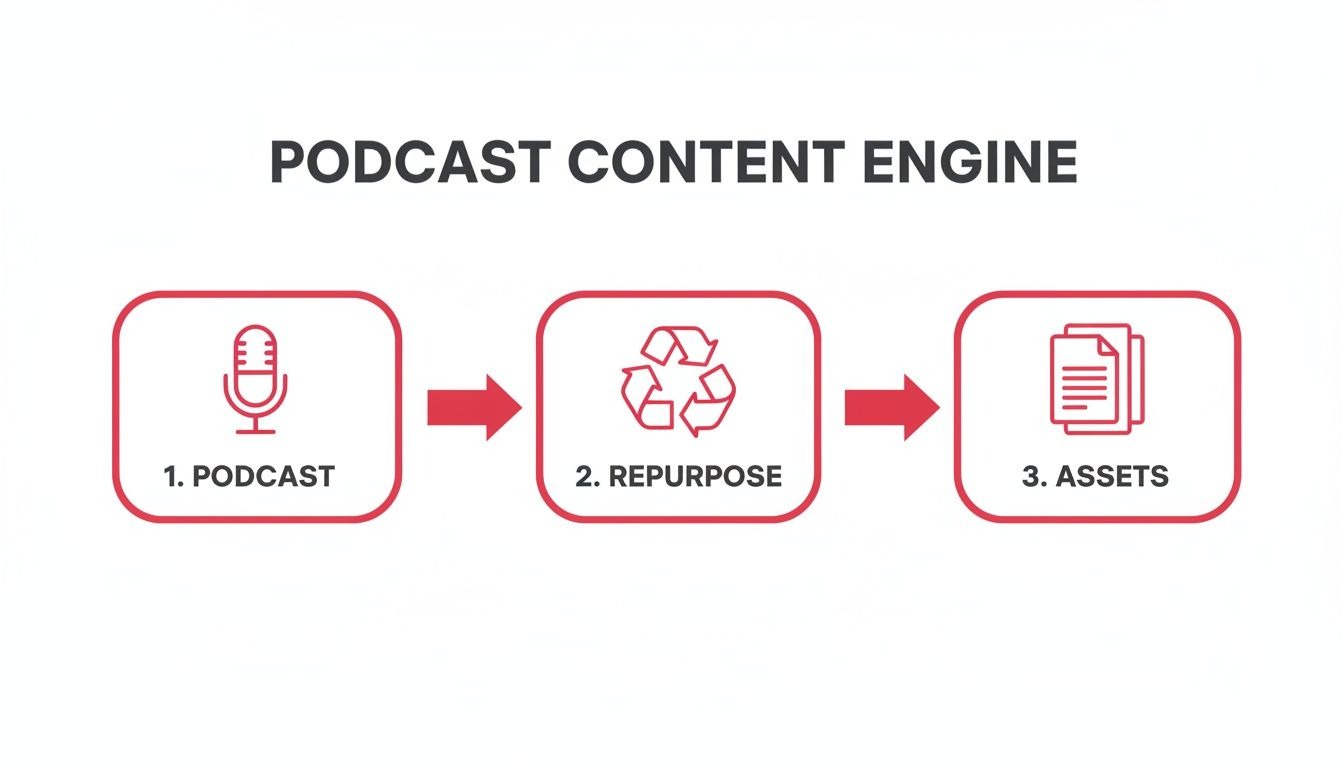
As you can see, the podcast's value extends way beyond the audio file. It’s the strategic starting point for a ton of content you can share everywhere.
"Your time as an executive is your most valuable asset. The goal of a podcast workflow shouldn't be to turn you into an audio engineer; it should be to capture your expertise with minimal friction." – Tom Hunt, Founder of Fame
This is exactly where a dedicated agency can be a game-changer. A partner like Fame can handle the entire production workflow for you, from guest outreach and scheduling to the remote recording session, audio editing, and creating show notes.
This approach frees you up to focus on the one thing only you can do: having great conversations. For anyone who wants to tackle the process themselves, our detailed guide on how to start a business podcast provides a complete checklist.
By outsourcing the technical and administrative heavy lifting, podcasting becomes a highly sustainable and leveraged part of your brand-building strategy. Your commitment can be as little as one hour a week for recording, while your agency turns that single hour into a full suite of content that builds your personal brand around the clock.
Amplifying Your Voice and Promoting Your Content
Recording a great podcast episode is a huge win for any executive's personal brand, but honestly, that's just the starting line. A brilliant conversation has zero impact if it never reaches the right ears. The next, equally critical phase is building a powerful promotion ecosystem to make sure your message lands.
This means getting way more strategic than just uploading to Apple Podcasts and Spotify and hoping for the best. A modern distribution playbook treats every single episode like its own mini-campaign, systematically spinning your main conversation into a whole suite of assets designed for different platforms and audiences.
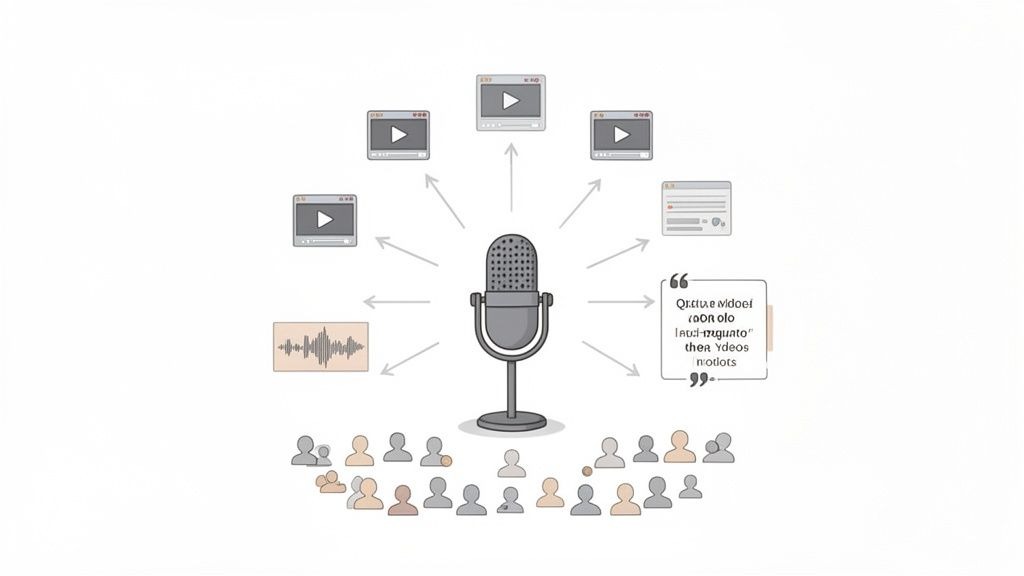
The goal here is to make every episode work harder for you. By turning one long-form conversation into multiple pieces of micro-content, you amplify your reach exponentially. You're creating a bunch of different doors for new people to walk through and discover your brand.
Creating a Content Repurposing Flywheel
Think of your podcast episode as the raw material. From this one recording, you can carve out a ton of promotional content perfectly suited for platforms like LinkedIn, where your ideal clients and peers are already hanging out.
This isn't just about dropping a link to the full episode and calling it a day. It’s about surgically extracting the most compelling moments and reframing them for maximum impact in a social feed.
Your repurposing checklist for each episode should look something like this:
- Short Video Clips (2-3 per episode): Find the "aha" moments, the surprising stats, or the contrarian takes. Slap on some captions and a punchy headline, and you've got shareable gold for social.
- Audiograms: Pair a powerful audio snippet with a static image or a cool waveform animation. These are perfect for snagging attention and teasing the episode's value.
- Quote Graphics: Turn the most memorable lines from you or your guest into clean, visually appealing graphics. These are super shareable and help hammer home your key messages.
- In-Depth Articles: Use the episode transcript as the backbone for a detailed blog post. This is a great way to capture some SEO value and give your audience a text-based option to consume the content.
This multi-asset approach creates a promotion flywheel where every piece of content drives awareness and traffic back to your core brand. For even more tactical ideas, our guide on how to promote your podcast dives deeper into building momentum.
Empowering Guests to Become Brand Advocates
Your podcast guests are your single most powerful promotional asset. They have a vested interest in the episode's success and an entirely new network for you to tap into. But just asking them to "share the episode" is lazy and ineffective.
You have to make it absurdly easy for them to become your champion.
The key is to remove all friction. Give your guests a "promo pack" that includes pre-written social copy, all the video clips and graphics you've made, and direct links. When you do all the heavy lifting, you dramatically increase the chances they'll share it far and wide.
This simple strategy effectively doubles your promotional reach with almost no extra effort. It also helps to ensure your guests are well-prepared for the conversation, which is why we created a guide on how to prepare for a podcast guest appearance that you can share with them beforehand to guarantee a high-value discussion.
The Strategic Value of Content Distribution
In a tough B2B world, especially in SaaS where customer acquisition costs have shot up by 60% in just three years, this kind of efficient brand-building isn't just a nice-to-have; it's a strategic must. We've seen an executive validate new product ideas by posting just two or three times, sparking conversations with 150 sellers and 150 buyers for incredibly fast, high-quality feedback. This isn't marketing fluff; it's a direct engine for growth. By creating and distributing content effectively, you're not just building a brand; you're building a smarter, more scalable way to grow your business.
Got Questions About Executive Podcasting?
Look, kicking off a podcast isn't a small decision. When executives and their teams are thinking about it, the same practical questions always pop up. They want to know what the real commitment looks like, and frankly, how to justify the investment. Let’s get into the nitty-gritty.
How Much Time Does This Really Take an Executive?
This is always the first question, and the biggest hesitation. Time.
The good news? With a solid system in place, an executive's direct involvement can be shockingly minimal, often just one to two hours a week. That’s it. This typically covers the recording itself and a quick pre-interview chat to get warmed up.
A dedicated B2B podcast agency is the key here. They handle all the heavy lifting that would otherwise eat up your team's time:
- Sourcing and scheduling the right guests.
- Deep-dive research and creating prep docs.
- All the tech and logistics for remote recording.
- Professional audio editing and writing show notes.
- Turning the episode into a suite of promotional assets.
This small time investment gets turned into a massive output of content and high-level networking. It's easily one of the most leveraged activities for personal branding for executives.
How Do We Actually Measure the ROI?
The ROI of a B2B podcast isn't just one number on a spreadsheet; it's a mix of hard data and the kind of value you can't always quantify.
On the quantitative side, you can absolutely track things like downloads, traffic to your site from the show notes, and even inbound meeting requests where someone says, "I heard you on the podcast."
But the qualitative value is often where the real magic happens:
- The incredible, high-caliber relationships you build with your guests.
- A noticeable uptick in inbound partnership opportunities.
- Sales cycles that move faster because leads come to the table already knowing, liking, and trusting you.
We actually guarantee a minimum of 10% monthly download growth, so you have a clear performance metric right from the start.
“Your personal brand is a promise to your clients… a promise of quality, consistency, competency, and reliability.”
This promise isn't built overnight. It's built through consistently delivering high-value content, and a podcast is simply the most effective way to do it.
What if I’m Not a Natural on the Mic?
This is a totally normal fear. But let’s be clear: the goal isn’t to sound like a polished radio host. The goal is to be an authentic expert sharing what you know.
Most of the great podcast hosts you hear weren't born that way; they just got good at having interesting conversations through practice. When you work with a production partner, you get media training, detailed outlines, and professional editing to smooth out any stumbles.
The interview format is the perfect place to start. At its core, it's just a focused conversation, and your passion for the subject will naturally shine through.
Ready to turn your executive expertise into a powerful content engine? At Fame, we specialize in producing B2B podcasts that build authority and drive real business growth.
Want us to run this for you?
Fame starts and grows B2B podcasts that generate pipeline. Tell us who you are trying to reach and we will send a costed proposal within 48 hours.
Related content
- Read moreFame Team · July 16, 2026
10 Account Based Marketing Tactics For B2B Growth In 2026
Discover 10 actionable account based marketing tactics for B2B tech. Learn to use podcasts, data, and targeted content to close high-value accounts. - Read moreFame Team · July 16, 2026
The 8 Best Brighton Podcast Agency Picks For 2026
Find the best Brighton podcast agency for your B2B brand. Our 2026 guide reviews top 8 agencies for production, growth & ROI. Expert analysis here - Read moreJune 10, 2026
20 Best Podcast Production Agencies For 2026 (And Why Should You Hire One)
Global podcast and vodcast ad revenues are on track to hit $5 billion in 2026 , up 20% year-on-year. - Read moreApril 13, 2026
Leadership In Marketing: The B2B Podcast Playbook
Most companies still confuse leadership in marketing with job titles, org charts, and budget control. That's outdated.