December 7, 202513 min read6 sections
Mastering The Mic: Actionable Executive Communication Training For Podcasts
By Fame Team
Key Takeaways
- Executive communication training for podcasts focuses on storytelling, vocal control, and conversational agility to create a genuine connection with listeners.
- Podcasts offer a unique opportunity for thought leadership and building brand trust through authentic, conversational appearances that traditional marketing can't replicate.
- Effective podcast training can drive measurable business growth by placing the executive's voice directly in front of a highly targeted audience, leading to new leads and opportunities.
What is executive communication training for podcasts? It's a specialized program designed to transform leaders into confident, compelling speakers in the unique, conversational world of audio. This isn't your standard media training. Instead of focusing on rigid talking points, this training hones the skills of storytelling, vocal control, and conversational agility to create a genuine connection with listeners, whether the executive is a guest or hosting their own show.
The goal is simple: equip executives with actionable techniques to navigate podcast interviews with authority and authenticity, turning every appearance into a strategic asset for the brand.
Why Podcast Training Is a Non-Negotiable Leadership Skill

Podcasts are the new stage for thought leadership. The format is intimate, conversational, and values authenticity above all else. Listeners tune in for a real conversation, not a polished corporate monologue. This shift presents a massive opportunity for executives who know how to leverage the medium. A powerful podcast appearance allows a leader to connect directly with customers, partners, and top-tier talent on a personal level, building brand trust in a way that traditional marketing can't.
However, many executives are unprepared for this format. Old-school media training often encourages guarded, overly formal responses that sound robotic and out of place on a podcast. This is where specialized executive communication training for podcasts provides a critical advantage.
Actionable Benefits of Podcast-Specific Training
Effective podcast training develops the specific skills needed to excel in a conversational setting. It's not about memorizing a script; it's about mastering the art of the interview to make a lasting impact.
Here’s what your executive will learn to do:
- Build Authentic Brand Trust: By sharing genuine stories and insights, executives forge a human connection that advertising can't replicate.
- Attract A-List Talent: When leaders passionately articulate their company's vision on relevant podcasts, they become a magnet for top candidates who share their values.
- Drive Measurable Business Growth: Engaging podcast appearances place the executive's voice directly in the ears of a highly targeted audience, often leading to new leads and opportunities.
The demand for these skills is reflected in the booming executive coaching market, projected to hit USD 161.10 billion by 2030, according to Mordor Intelligence's market analysis. Investing in this training is no longer a luxury; it's a core business strategy.
A great podcast interview isn't a performance; it's a guided conversation. The goal is to make the listener feel like they're sitting at the table with you, learning something valuable from an expert they trust.
Ultimately, this training is a direct investment in an executive's ability to influence. By mastering the audio medium, leaders can solidify their position as an industry authority. Understanding how to become a thought leader is central to this process. Turning expert insights into compelling audio creates a powerful asset that shapes market perception and drives tangible business results.
Action Plan: Crafting Your Core Message for Any Podcast
Before an executive steps up to the mic, they need a clear, repeatable message. A memorable podcast appearance is not an accident; it's a strategic conversation built on a solid foundation of key talking points. Without this structure, even the most brilliant leader can sound unfocused and miss opportunities to connect with the audience.
The first actionable step in any executive communication training is to distill complex ideas into three or four core "messaging pillars." These pillars act as a compass during the interview, ensuring the conversation consistently returns to the critical insights you want the audience to remember.
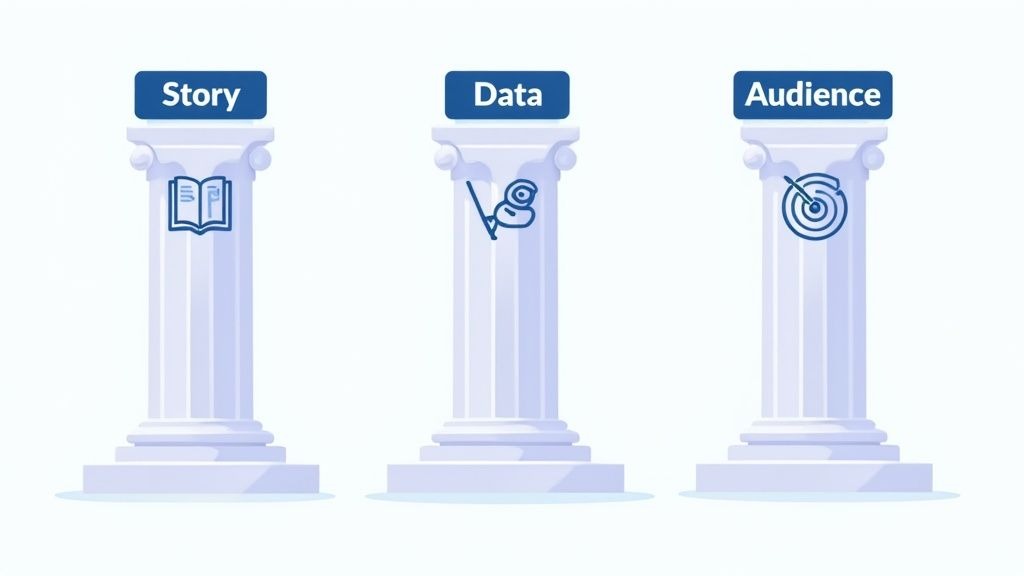
Step 1: Define Your Three Messaging Pillars
Think of these pillars as flexible containers for your stories, data, and expertise, not a rigid script. They are the core themes that will guide the conversation. Each pillar should be distinct yet interconnected, telling a cohesive story about your brand, vision, or industry perspective.
To build them, answer these questions with your executive:
- What is the single most important idea the audience must remember? This becomes your primary pillar.
- What is our unique perspective or solution that sets us apart? This is where you establish your authority.
- What problem does this specific audience faces can be solved? This makes your message immediately relevant and valuable.
Actionable Example: The CEO of a B2B SaaS company preparing for a tech podcast could define their pillars as:
- The Problem: Manual data entry is the silent killer of productivity, costing mid-market companies millions in hidden operational drag.
- Our Solution: True automation isn't just a tool; it's a core business strategy that unlocks growth by freeing up your best talent.
- The Future: AI-driven insights will soon predict operational needs before they arise, turning reactive businesses into proactive ones.
This simple, repeatable framework can be adapted for any podcast, ensuring a consistent and powerful message every time.
I see this mistake all the time: executives try to cover way too much ground. A killer podcast appearance leaves the listener with a couple of powerful, sticky ideas, not a dozen they’ll forget by lunchtime. Go for depth, not breadth.
Step 2: Tailor the Message to the Podcast's Audience
With your pillars defined, the next step is to customize them for the specific show. A generic, one-size-fits-all message will fall flat.
Actionable Homework:
- Listen to 2-3 recent episodes. Get a feel for the host's style, the typical questions, and the audience's level of expertise.
- Analyze the audience. Are they founders, technical experts, or general business leaders?
- Adapt your language. Frame your pillars using the vocabulary, examples, and data points that will resonate most with that audience.
This research transforms a standard pitch into a valuable conversation. It shows respect for the host and their listeners, which is the foundation of a memorable appearance. For a deeper look at structuring your points, our guide on how to make a podcast script provides a practical framework for turning these pillars into a compelling narrative.
Developing a Confident Voice and On-Air Presence

In the audio-first world of podcasting, an executive's voice is their personal brand. Listeners decide within seconds if a speaker sounds credible and engaging. Top-tier executive communication training moves beyond messaging to focus intensely on how things are said, transforming a competent speaker into a compelling one.
This focus on delivery is critical, as evidenced by the corporate leadership development market's projected growth from USD 89.5 billion in 2025 to USD 238.5 billion by 2035. This highlights a clear demand for leaders who can communicate with strategic impact.
Actionable Drills for Vocal Energy and Pacing
Vocal energy is the audible enthusiasm and confidence in a speaker's voice. A flat, monotone delivery is the fastest way to lose an audience. The goal is to use varied pitch, volume, and pace to keep the conversation dynamic.
Actionable Exercises for Your Executive:
- The Smile Trick: Practice speaking key messages while smiling. It physically changes the tone of the voice, making it sound more approachable and engaging.
- Pacing with a Metronome: Use a metronome app set to a slow, deliberate pace (around 120-140 words per minute). Practice answering questions to this rhythm to combat nervous, rapid speech. Slowing down adds weight and authority.
- Mark Up Your Notes: Use highlighters or notes to mark where to pause, what words to emphasize, and where to inject more energy.
The most common vocal mistake I see executives make is forgetting to breathe. Taking conscious, deep breaths before answering a question not only calms nerves but also gives one's voice a richer, more controlled quality.
Actionable Techniques to Eliminate Filler Words
Filler words like "um," "ah," "so," and "like" are instant credibility killers. They signal nervousness and a lack of preparation. Removing them requires conscious practice.
Actionable Elimination Strategy:
- Embrace the Power of the Pause: Instead of using a filler word while thinking, train the executive to simply pause. A moment of silence sounds thoughtful and confident, not uncertain.
- Record and Review: Use a phone to record answers to common interview questions. Listen back only for filler words. Tally them up to create awareness of the habit.
- Practice the "One-Breath Answer": Challenge the executive to answer a question completely in one deep breath, without fillers. This forces concise, direct communication.
Overcoming the initial anxiety of being on a mic is often the first step. Check out our guide: 8 tips to overcome mic fright.
Steering the Conversation as a Guest or Host
A great podcast is a dynamic conversation, not a static presentation. Whether an executive is the guest or the host, their ability to steer the dialogue is what separates a mediocre episode from a memorable one. This is a core competency taught in high-level executive communication training.
As a guest, the key skill is gracefully guiding the conversation back to core messages. As a host, the job is to create an environment where the guest can share their most valuable insights. Both roles require preparation, active listening, and a clear objective.
As a Guest: Master the Art of Bridging
Bridging is the technique of smoothly connecting a host's question, no matter how unexpected, back to one of your key messaging pillars. This isn't about dodging the question; it's about answering it respectfully and then using it as a launchpad to deliver your intended message.
Actionable Bridging Phrases to Practice:
- "That's an excellent point, and it connects to a larger issue, which is..."
- "I'm glad you brought that up. What's really interesting about that is..."
- "Yes, and what's also important to remember is..."
- "That speaks to the core of what we believe, which is..."
Scenario: The host asks, "Your competitor just launched a new feature. How will you respond?"
- Weak Answer: "We're looking into it and will be releasing our own version soon." (Reactive, technical)
- Bridged Answer: "That's an interesting development, and it really highlights the pace of innovation in our industry. For us, innovation isn't about a feature-for-feature race; it's about solving the deeper customer problem. That speaks to the core of what we believe, which is that true automation frees up your best talent to solve bigger challenges." (Strategic, returns to a message pillar)
The best podcast guests don't just answer questions; they use questions to tell their story. Bridging allows you to maintain control of your narrative with poise, turning any inquiry into an opportunity to reinforce your expertise.
As a Host: Ask Questions That Unlock Stories
When an executive hosts a podcast, their primary role is that of a facilitator. The goal is not to demonstrate their own knowledge, but to unlock the expertise of their guest. This starts with asking powerful, open-ended questions that cannot be answered with a simple "yes" or "no."
Instead of This (Closed)ACTIONABLE: Try This (Open-Ended)"Was it difficult to launch your company?""Walk me through the single biggest challenge you faced in the early days of launching your company.""Do you think AI is important?""From your perspective, what’s one surprising way AI will change our industry in the next five years?""Did you have a good time at that event?""What was the most insightful conversation you had after your talk at that conference?"
Great hosting is built on active listening. This means listening not just for words, but for underlying themes, emotions, and unspoken points. The best follow-up questions come from truly hearing what the guest is saying and asking for more detail. For a complete playbook, see our guide on how to conduct a podcast interview.
Building a Practice Routine That Delivers Results
Confidence on a podcast is not a personality trait; it is a skill built through consistent, deliberate practice. Knowing the theory is useless without turning concepts into instincts through repetition. A structured training loop of practice, recording, and feedback is essential.
This focus on practical skill-building is why the corporate leadership training market is projected to grow by USD 31.40 billion by 2029, with North America accounting for roughly 39% of that growth, as detailed in corporate leadership training market trends on Technavio. Organizations are investing heavily in these actionable skills.
Actionable Step 1: Conduct Realistic Mock Interviews
Mock interviews are the single most effective way to prepare an executive. They are a safe environment to test messages, practice vocal techniques, and master conversational bridging without the pressure of a live audience.
How to Run an Effective Mock Interview:
- Simulate the Real Environment: Use the exact microphone, software (Zoom, Riverside), and setup that will be used for the actual podcast.
- Assign a "Host": Have a colleague play the role of the host, armed with a list of likely questions, a few challenging curveballs, and one off-topic question to test bridging skills.
- Record Everything: Record both audio and video. It is impossible to self-assess accurately in the moment. The recording provides objective data for feedback.
Record every single mock interview. Audio and video, if you can. It's flat-out impossible to accurately self-assess in the moment. The playback is where the real learning happens, shining a light on unconscious habits and missed opportunities.
Actionable Step 2: Use a Simple Evaluation Rubric for Feedback
After each session, review the recording together using a simple, focused rubric. This provides specific, actionable feedback instead of vague comments like "it was good."
Sample Evaluation Rubric:
- Message Clarity (Score 1-5): Did they successfully land their 3 core message pillars? Were the key points memorable?
- Vocal Performance (Score 1-5): Was the pace varied and engaging? How many filler words were used? Did they sound confident and energetic?
- Conversational Agility (Score 1-5): How well did they listen and respond? Did they effectively use bridging to steer the conversation? Did it feel natural?
This flowchart shows the mechanics of what you are evaluating: a process of research, listening, and bridging.
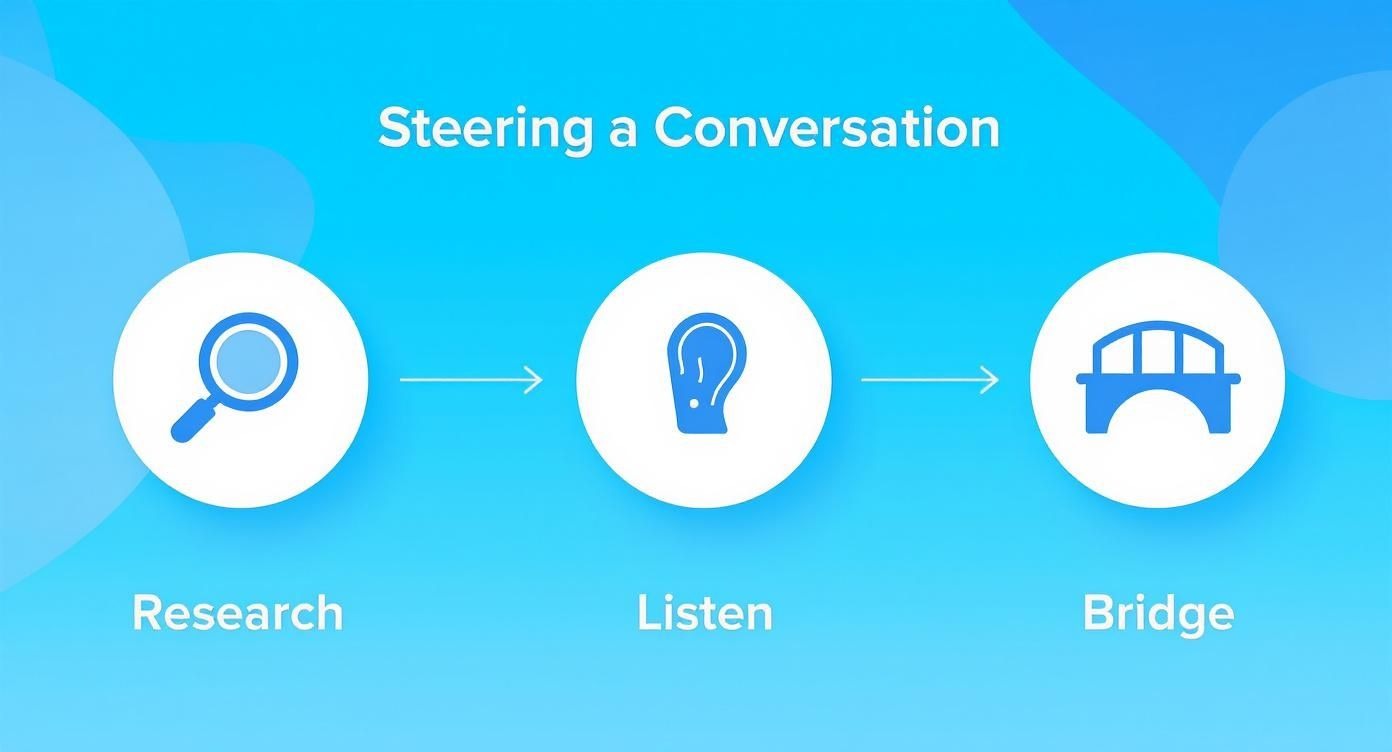
This feedback loop allows for specific notes like, "You did a great job bridging from that tough question, but let's work on reducing the 'ums' by pausing for a full second before you answer."
This disciplined practice is why guests who prepare see better results, transforming a stressful performance into a natural, authoritative conversation.
Answering Your Executive Podcasting Questions
Even with a solid plan, it’s natural to have a few questions before you kick things off. Let's tackle some of the most common ones I hear from companies getting their leaders ready for the mic.
How Long Does This Kind of Training Usually Take?
The timeline really depends on where the executive is starting from. Are they a seasoned public speaker who just needs to adapt to a new medium, or are they completely new to this?
Generally, a solid foundational program can be knocked out in 4-6 sessions spread over a single month. That’s usually enough time to nail down their core message, work through some vocal coaching, and run several mock interviews to build confidence.
Of course, if they're gearing up for a huge, high-stakes appearance or even launching their own show, you’ll want to think about ongoing coaching. A quick session before a big interview can make all the difference.
What's the Biggest Mistake Execs Make on Podcasts?
Easy. They treat it like a press conference or a formal presentation. It's a classic mistake. They slip into corporate-speak, deliver rambling, pre-scripted answers, and completely drain the energy from the conversation. That kills the authentic vibe that makes podcasts so effective in the first place.
The real challenge is getting them to shift their mindset from being a 'presenter' to being a 'storyteller.' It's about connecting with listeners, not just broadcasting information. Authentic language, personal stories, and sharp, memorable points are what create that genuine connection.
Is Virtual Podcast Training as Good as In-Person?
Honestly? For podcasting, it's often better. Think about it: over 90% of podcasts are recorded these days remotely. Virtual training perfectly mimics the real-world environment.
This setup gives a coach a huge advantage in providing real-time feedback on the little things that matter in a remote recording:
- Mic Technique: How close should they be? Are they popping their "P"s? A coach hears exactly what the audience will hear.
- On-Camera Presence: With video podcasts becoming the norm, getting feedback on lighting, framing, and body language is non-negotiable.
- Audio Quality: The coach can instantly spot issues with background noise, echo, or vocal energy that might not be obvious in the room.
Virtual training isn't a compromise; it’s a practical, efficient way to prepare for how podcasting actually works today.
How Can I Actually Measure the ROI of This?
Measuring the return on this kind of training is a mix of art and science. You need to look at both the hard numbers and the softer, but equally important, qualitative wins.
On the quantitative side, you can directly track things like:
- Spikes in inbound leads after an episode airs.
- An increase in speaking invitations.
- Social media mentions and engagement that reference a specific podcast appearance.
Qualitatively, the biggest indicator is the executive’s own confidence level. You’ll see it. You'll also get feedback from hosts who rave about what a great guest you were. Ultimately, you're building brand authority, a powerful asset that pays dividends long-term.
Ready to turn your executives into the kind of guests podcast hosts can't wait to book?
Fame specializes in B2B podcast production that builds authority and drives real growth. We manage the entire process, from strategy and production to promotion, so your message connects with the right people. Learn more about how we can elevate your brand's voice at Fame.
Want us to run this for you?
Fame starts and grows B2B podcasts that generate pipeline. Tell us who you are trying to reach and we will send a costed proposal within 48 hours.
Related content
- Read moreFame Team · July 16, 2026
10 Account Based Marketing Tactics For B2B Growth In 2026
Discover 10 actionable account based marketing tactics for B2B tech. Learn to use podcasts, data, and targeted content to close high-value accounts. - Read moreFame Team · July 16, 2026
The 8 Best Brighton Podcast Agency Picks For 2026
Find the best Brighton podcast agency for your B2B brand. Our 2026 guide reviews top 8 agencies for production, growth & ROI. Expert analysis here - Read moreJune 10, 2026
20 Best Podcast Production Agencies For 2026 (And Why Should You Hire One)
Global podcast and vodcast ad revenues are on track to hit $5 billion in 2026 , up 20% year-on-year. - Read moreApril 13, 2026
Leadership In Marketing: The B2B Podcast Playbook
Most companies still confuse leadership in marketing with job titles, org charts, and budget control. That's outdated.