August 17, 202615 min read7 sections
The B2B Podcast Guide Your Competitors Hope You Skip
By Fame Team
Key Takeaways
- A B2B podcast builds relationships, authority, and content when you treat it as a long-term channel.
- The right format depends on your audience, business goals, resources, and the conversations you want to create.
- Consistent production matters more than chasing novelty, especially once the initial excitement around your podcast fades.
- Promotion, guest selection, and repurposing determine how far each episode reaches beyond your existing audience.
Most B2B podcasts die the same way. Someone gets excited and records a handful of episodes under a new name. Then it just stops. Not because podcasting doesn't work, but because it got treated as something to say they had done rather than a real channel. The companies that keep at it build brand authority and a pipeline you can't buy.
This isn't a neutral explainer. It is how we at Fame see B2B podcasting after building hundreds of shows. You will get why it works and how to pick a format that fits your goals. From there, it turns practical, all the way to squeezing a month of content out of one episode. It ends on the mistakes that sink most shows.
What Makes A B2B Podcast Different From Every Other Channel
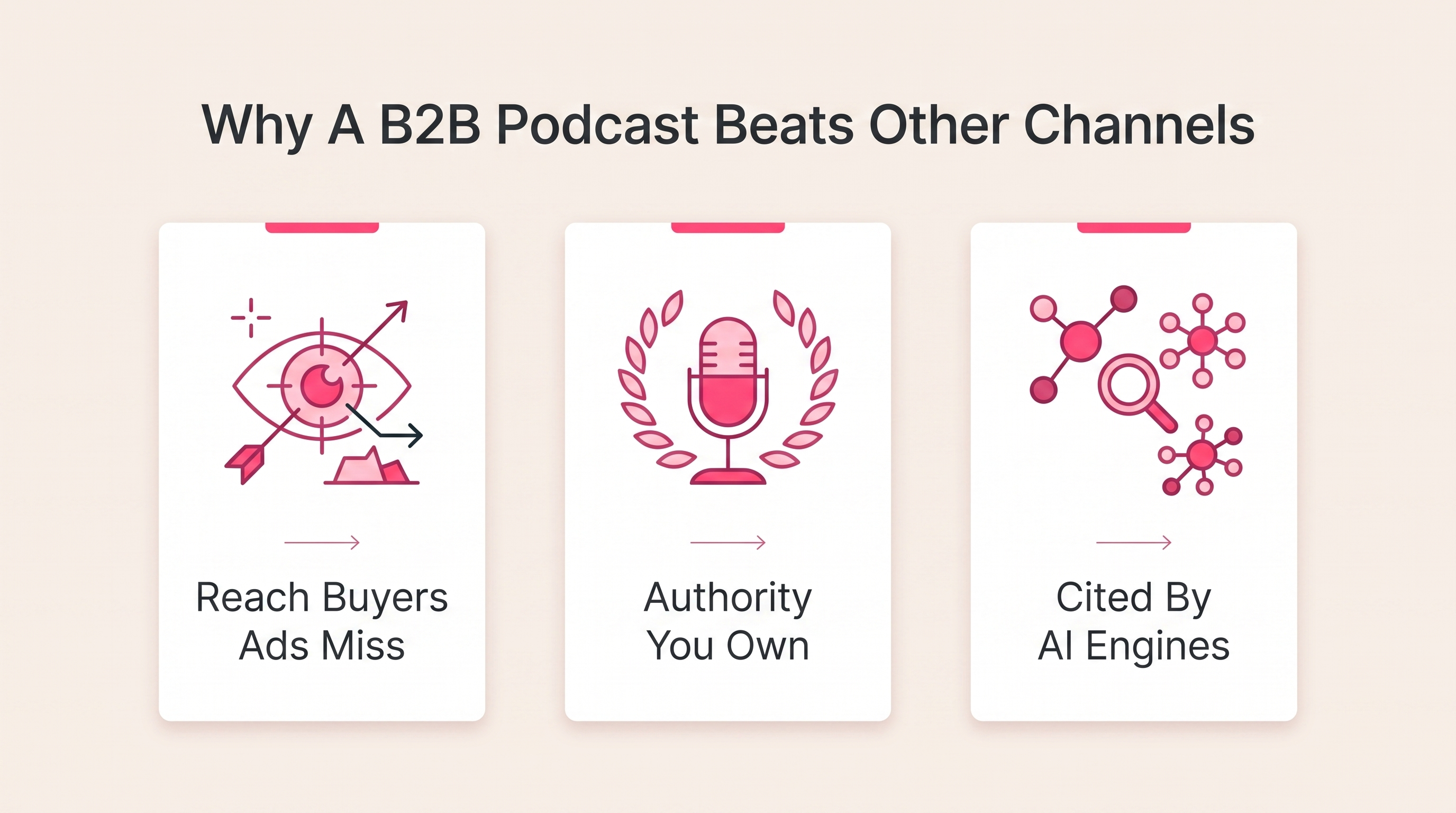
Every channel you are already using is getting crowded and pricier by the month. A B2B podcast works differently, and once you see why, the whole thing starts to make a lot more sense.
1. You Get In Front Of Buyers Your Ads Can't
Cold ads and cold emails show up in front of people who never asked to hear from you. A podcast invite changes that. Ask a senior leader onto your show, and they usually say yes, then turn up prepared to talk for a full hour.
You basically can't buy that kind of access, especially to the specific accounts you are chasing with account-based outreach. And this is no niche habit. Edison Research found 40% of Americans aged 12 and up now listen to podcasts every week.
2. You Build Authority That Actually Sticks
Publish consistently for a year and something changes. You stop being just another vendor and become a name buyers already know before they get on a sales call. That head start compounds. The trust a competitor spent years building can't be cloned in a quarter, and every episode you put out widens the gap a little more.
3. You Become A Voice AI Engines Actually Quote
This is the part that has changed most in 2026. Your buyers ask AI before they ask Google now, and AI doesn't parrot ads. It points people to voices, the experts, and shows that keep saying smart things about a topic.
A B2B podcast happens to produce exactly what those models feed on. Real people talking in depth, transcribed and posted week after week. Do it long enough and you are the answer the AI gives when someone asks.
3 B2B Podcast Formats Worth Considering for Your Business
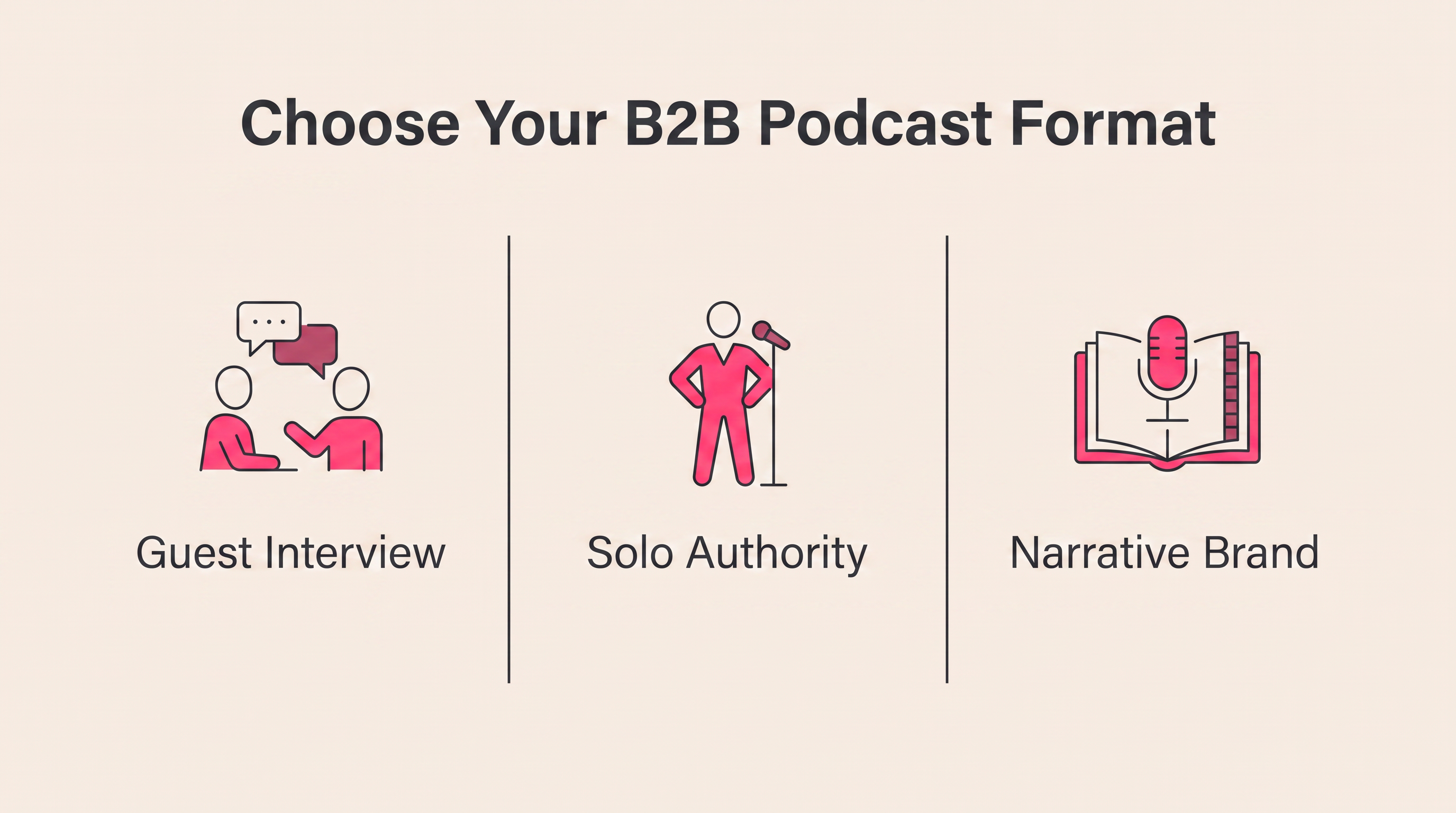
Copying whatever B2B podcast you admire is how a lot of them lose their way. What is right for you comes down to what you are actually chasing.
| Format | Best For | Effort | What You Get |
|---|---|---|---|
| Guest Interview | Relationships and pipeline | Medium | Direct access to target accounts |
| Solo Or Co-Hosted | Category authority | Medium to high | A recognized point of view |
| Narrative Or Branded | Brand and emotion | High | Standout recognition and recall |
1. The Guest Interview Show
This is the one we suggest most often, and for good reason. You invite the exact people you want a relationship with, and the conversation does the selling for you without you ever pitching.
The downside is you are only as reliable as your guest calendar. Reschedules and no-shows turn into your production schedule, so this format only holds up if you stay on top of booking.
2. The Solo Or Co-Hosted Authority Show
Hosting beats interviewing when you want to be known for a specific take. There is no guest to hide behind, so you are forced to actually say something. It is the fastest way to turn a founder or executive into recognized leadership in your space.
The demand is real, though. It rides entirely on one or two people staying worth listening to, week in and week out, with no interview to carry a slow day.
3. The Narrative Or Branded Show
A produced, story-led show is the toughest to pull off and the strongest for brand. Picture a documentary-style series with scripting and a proper edit. It is how bigger companies build the kind of recognition a plain interview never will, and it is about as close to branded content as audio gets.
It is also a real budget line. Most teams only take it on once a simpler show has already proven people will listen.
How To Launch A B2B Podcast That Doesn't Stall Out: 5 Proven Strategies
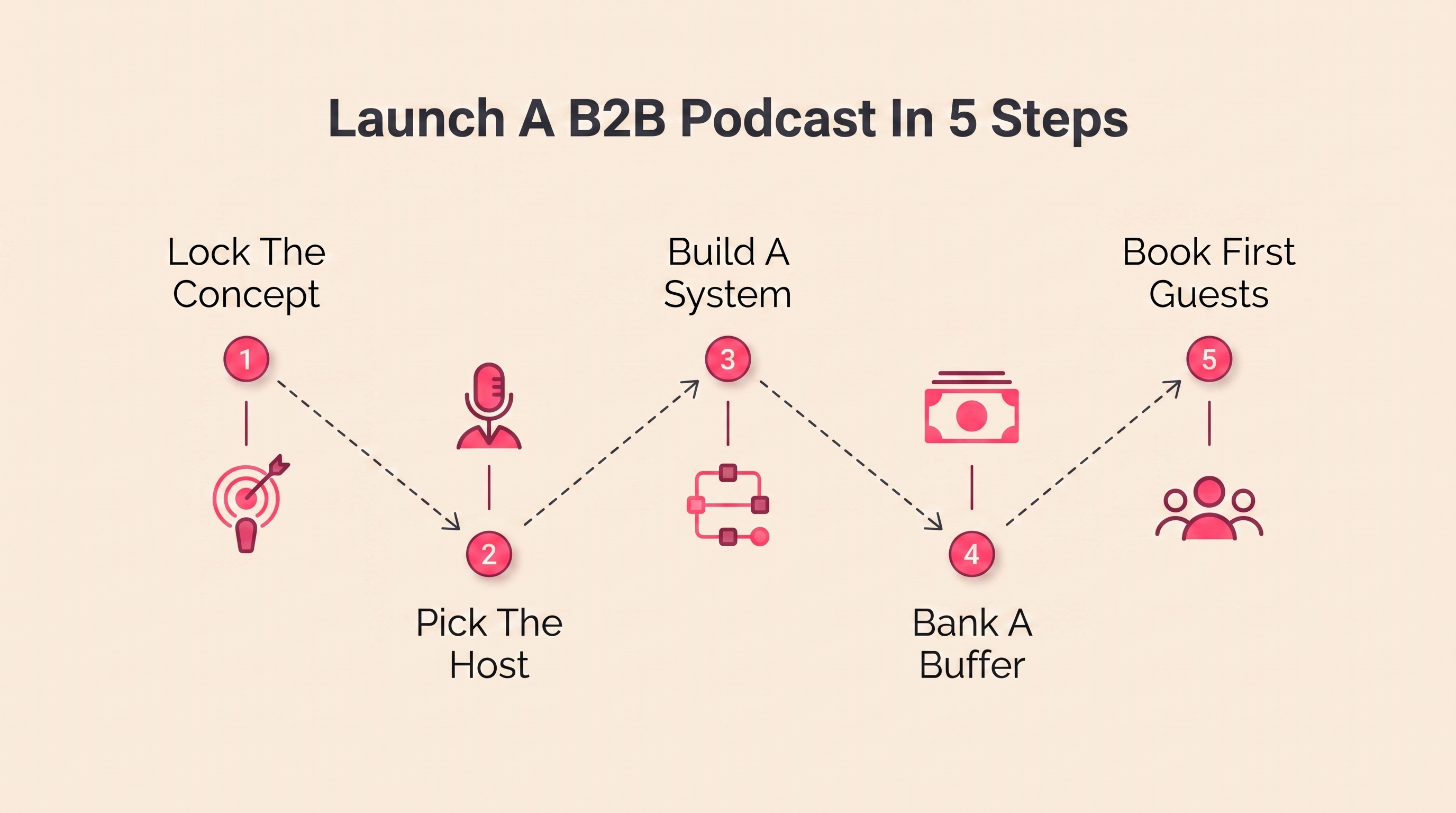
Most shows collapse in the first two months, once the novelty wears off and real life gets in the way. These 5 steps are what keep a B2B podcast alive past episode eight. And there is more room than you would think. Content Marketing Institute found only 27% of B2B marketers use podcasts, so just surviving your first quarter already puts you ahead of most.
1. Lock Your Show Concept Before Anything Else
A loose concept is the number one reason shows stall and quit. If your premise could describe 10 other podcasts, nobody has a reason to pick yours, and you will run dry on episode ideas fast. A sharp one makes the show easy to pitch and easy for the right people to stumble onto.
- Write a one-sentence promise naming your exact listener and what they walk away with.
- Pick a narrow angle no other show in your category has claimed yet.
- Draft 20 episode titles up front to prove the idea has legs.
- Run the concept past 5 ideal listeners and tweak it from their reactions.
2. Pick A Host Your Guests Will Say Yes To
The host basically decides whether the whole thing works, and getting it wrong is painful to undo. Someone who can't carry a conversation makes brilliant guests sound dull, and a host your guests don't rate won't get the yes in the first place. This one choice caps how good your audience and your bookings can ever get.
- Pick someone genuinely curious who can riff well beyond a scripted question list.
- Lean toward an internal expert with real credibility over a slick outsider.
- Confirm they can commit weekly for at least the first six months.
- Have your shortlist each record a quick mock interview before you commit.
This gets genuinely hard for one kind of company: the two-sided marketplace, the sort that has to serve buyers and sellers at the same time. A guest who is gold for one side can be a total miss for the other.
Book a supply-side expert and your demand-side listeners lose interest, and flip it, and the same thing happens. Choosing a host or guest lineup that works for both halves of your audience is a genuine struggle, not a footnote.
Take a marketplace like BusinessForSale, where one side is owners trying to sell a company and the other is buyers hunting for one. A host who has a seasoned business broker will thrill sellers with talk of valuations and exit prep.
Meanwhile, the buyers, who mostly care about due diligence and financing, slowly check out. Swing the host's bias the other way, and it is the sellers reaching for the skip button. Either way, half your audience feels like the show isn't really for them.
The cleanest fix is to stop forcing one host to serve everyone. Run themed seasons or alternating episodes, one aimed at sellers and the next at buyers, so each side gets material built for them.
Or find a host who is right at the intersection - someone who has walked both sides through a deal and can talk to either without losing the other. When neither works, a rotating guest chair beats one voice trying to please two very different rooms.
3. Build A Production Framework You Can Repeat
Excitement gets your first three episodes made. A system gets you the next 50. With no fixed process, every episode turns into a pile of one-off decisions, and that is what burns people out before the show ever finds its feet.
- Batch several episodes in one recording block to protect your weekly calendar.
- Write down every step from booking to publishing in one shared checklist.
- Build one episode template that every recording follows from intro to outro.
- Set hard weekly deadlines so editing never bleeds into the next episode.
This is usually where teams realize how much work editing and scheduling really is, and it is the part we handle most for the shows we run. The production side of Fame OS uses AI to draft the assets you repeat every week, like show notes and clips, then runs a human editor over all of it as a real quality check before anything ships.
The point isn't to cut people out. It is to keep your team on the one thing only they can do, the actual conversation, and take the rest off their hands. Every episode moves through the same tracked stages, so nothing gets lost between the recording and the published feed.
4. Bank A Buffer Of Episodes Before Launch
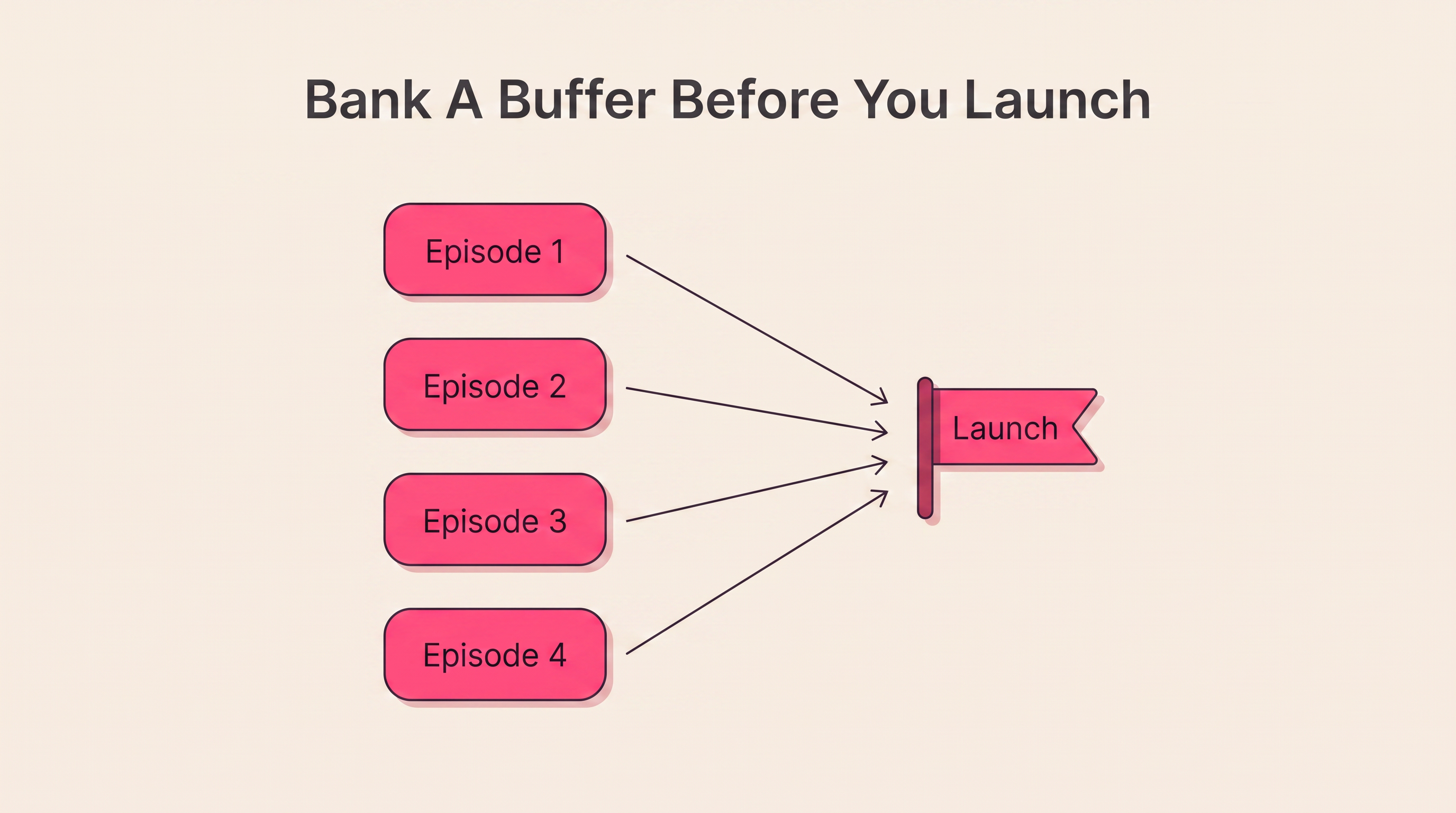
Launching with one finished episode in the bank is how shows end up skipping weeks by month two. Things happen, and guests bail. With no cushion, your schedule caves the first time something goes wrong. A buffer is what lets you ride out a bad week without listeners ever noticing.
- Record at least 4 to 6 full episodes before you publish the first.
- Always keep two finished episodes in reserve once the show is live.
- Book guest recordings a solid 4 weeks ahead of their publish dates.
- Top the buffer back up the moment you dip below your minimum.
5. Book Your First Guests With A Real Pitch
Your first guests set the bar for everyone after them. Get a few great ones early, and the next pitch writes itself, because credibility pulls in more credibility. Weak or random picks make the show look small, and every future ask harder. The pitch itself is usually what decides whether a strong prospect says yes or ignores you.
- Open the pitch with what the guest gets, not what you want.
- Go after guests whose own audience overlaps the buyers you want reaching.
- Send a short note that references their recent work, never a template.
- Make saying yes effortless by handling all the scheduling and prep yourself.
It is also the piece teams most often hand to us at Fame, since the guest booking inside Fame OS scores and chases the right people for you every week rather than leaving it to whenever someone has time.
How To Turn One Episode Into A Month Of Content
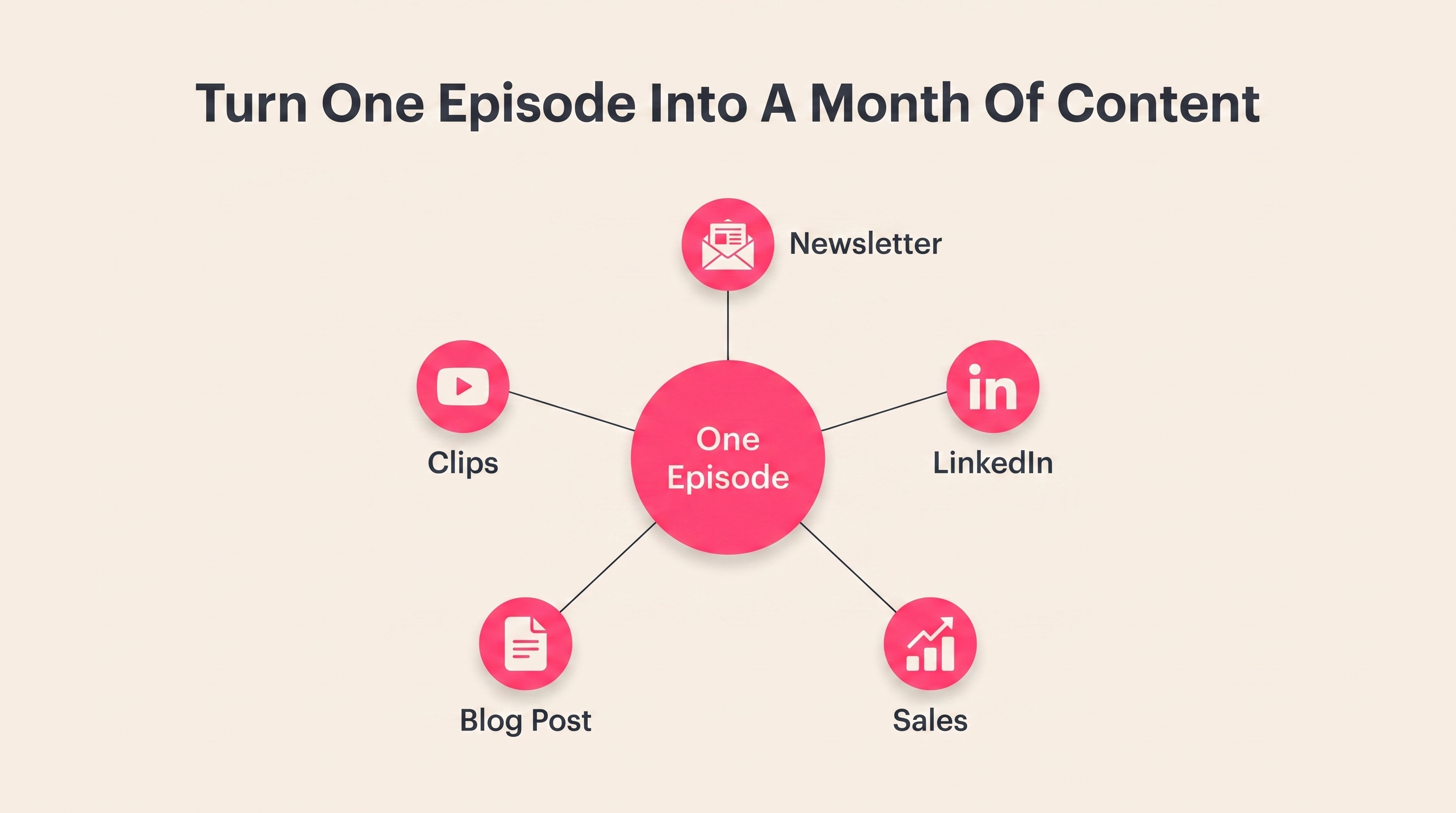
Recording the episode is maybe a third of the job. The teams who actually win treat one conversation as raw material for weeks of content everywhere they own an audience.
1. Slice Each Episode Into Clips, Notes, And Posts
A single hour-long episode is hiding a dozen smaller pieces inside it, and plenty of them will beat the full episode on social. The transcript on its own can become a blog post and a solid week of short posts.
Doing all of that by hand is genuinely tedious, though. You listen back for the best moments, then write notes and cut clips. Next week you start all over again. It is the kind of work that tends to slip, and then a perfectly good episode goes quiet the day after it drops.
That is the job a tool like Podsqueeze can do. You hand it the episode audio, and it drafts the written pieces for you. It will even create a newsletter draft and cut the short clips you would otherwise spend an afternoon trimming by hand.
None of it is meant to be final, and it shouldn't be. But starting from a rough draft instead of a blank screen is the whole difference between repurposing every episode and just meaning to.
Video is not optional anymore either. Edison Research found 33% of weekly podcast listeners now use YouTube, so a video cut of each episode is worth doing.
2. Amplify Your Best Moments With Paid Reach
Organic reach only takes a clip so far, and in a crowded B2B category it barely budges. When you are one of a hundred firms saying roughly the same thing, even a genuinely great 30 seconds can go completely unseen.
That is the point where teams start putting real money behind their best clips, especially short-form video, where one clip breaking out can reach buyers no organic post ever would. Paid promotion stops being optional once you have something good that nobody has seen.
But the problem shows up quickly once you scale spend. Regular self-serve ad accounts on platforms like TikTok get throttled or shut down with barely any warning. And a frozen account mid-campaign wastes your budget and your momentum. Brand-new advertisers also hit small daily caps and slow reviews right when a clip is taking off.
A TikTok agency ad account service can be helpful here. It doesn't run your ads for you. What it hands you is an agency ad account, the higher-trust kind with bigger spend limits and far fewer sudden restrictions, so you can scale a campaign without your own account getting limited or banned mid-flight.
3. Hand Episodes To Your Sales Team
Marketing almost always forgets the best distribution channel it has, which is the sales team. A relevant episode dropped into a live deal is way more effective than a case study because it is a trusted outsider making your point for you.
This is the side of podcasting we push hardest with the companies we work with, because it is where a show stops being content and starts touching revenue. On the promotion side, Fame OS pushes each episode out across YouTube and the other feeds your buyers actually use, instead of letting it sit on a single channel.
But the part that changes the conversation internally is attribution. We track which guests and episodes tie back to real pipeline and report it every month, in the language a CFO cares about rather than download charts.
That is how a show survives a budget review - by showing the deals it helped close. When a podcast is producing clips your reps forward and pipeline your finance team can see, nobody asks whether it is worth keeping.
4 Mistakes That Kill B2B Podcasts Early + How to Fix Them
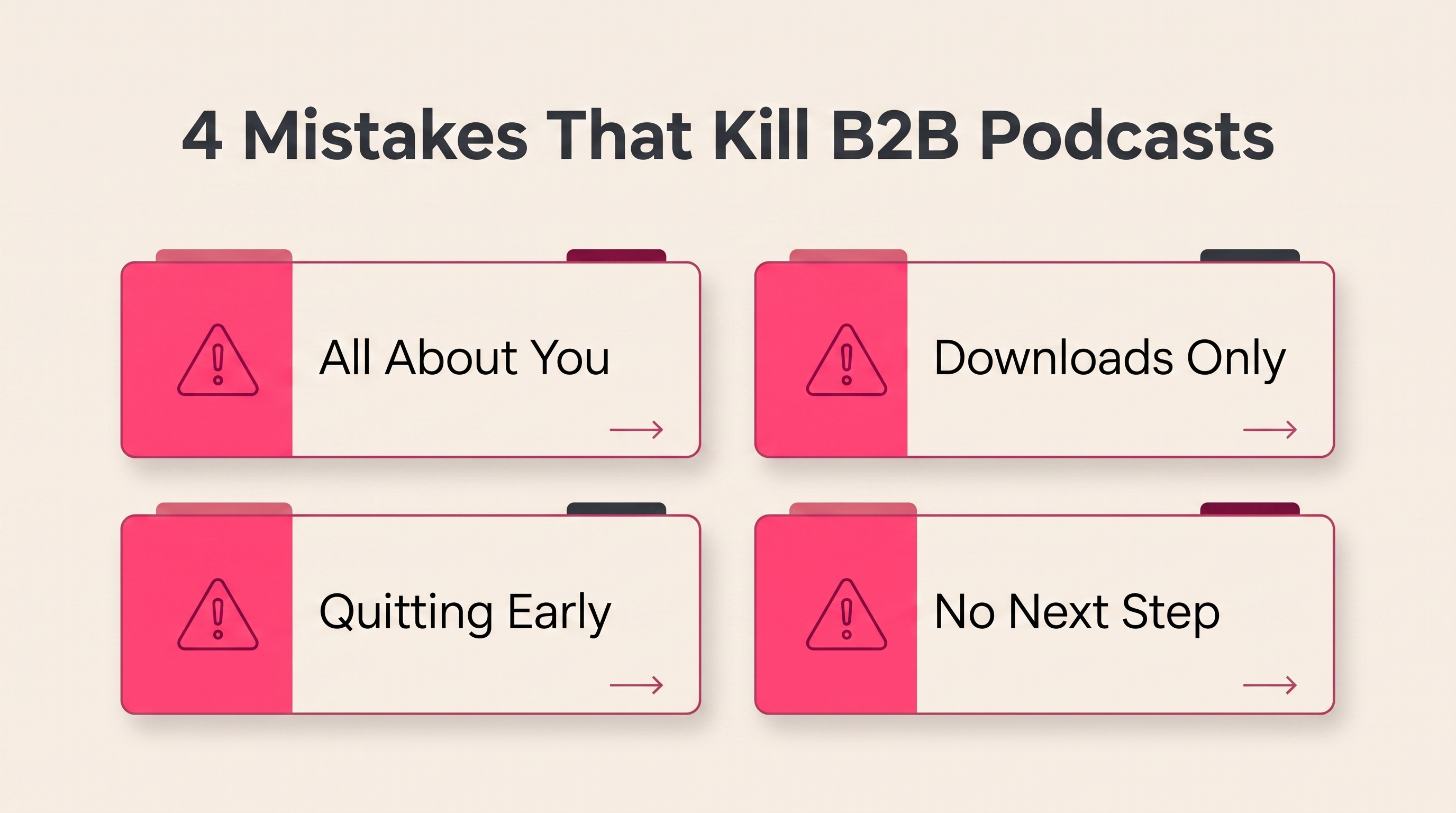
Knowing what to do only gets you halfway. You also have to dodge the traps that kill most shows. These four are the ones we watch end promising B2B podcasts before they ever pay off.
1. Making The Show All About You
The quickest way to lose a B2B audience is to turn every episode into a soft ad for your product. People can smell it in seconds, and they are gone. A show that only ever talks up your own company gives nobody a reason to keep listening because it is serving you, not them.
How to Fix: Build each episode around a real problem your buyer is dealing with, and let your expertise come through in how you talk about it rather than a pitch. Bring up your product only when it genuinely answers something that came up in the conversation.
2. Judging The Show By Downloads Alone
Downloads look like the obvious scoreboard, so teams fixate on them and panic when the number is small. But a show pulling 200 downloads from exactly the right accounts can beat one pulling 10,000 randoms. Chasing the raw number pushes you toward broad, shallow episodes and away from the buyers who actually matter.
How to Fix: Watch the numbers that tie to revenue and map guests and listeners to a real pipeline the way any serious content-marketing program tracks ROI. A simple guest-to-opportunity view will usually tell you far more than a download count.
3. Quitting Before It Has Time To Compound
Podcasts pay off on a delay, and that delay is what beats impatient teams. Your first 10 episodes will almost always be like talking into an empty room. People see that silence as failure and quit right before it starts working, usually somewhere between month 3 and month 6.
How to Fix: Commit to a set number of episodes before you launch, then only judge it at the end of that run. Twenty is a fair floor. Treat the early ones as what they are, the price of building a library that keeps paying you back long after.
4. Giving Listeners Nowhere To Go Next
A great episode that just ends with a goodbye wastes all the attention it earned. That attention is worth protecting: 86% of people spend at least six hours online each day, so your podcast is competing with a huge amount of other content for whatever attention you manage to earn.
Someone finishes 40 genuinely engaged minutes, ready to do something, and you point them at nothing. Without an obvious next step, that goodwill evaporates the second the episode ends, and the show never turns into a pipeline.
How to Fix: Close every episode with one specific, low-friction next step that matches where the listener is, whether that is a resource or a quick way to reach your team. Keep it to a single ask because two competing ones tend to cancel each other out.
Conclusion
If you take one thing from this, make it this. A B2B podcast is a relationship and authority machine that happens to generate content. The teams who understand that stop staring at download graphs and start counting conversations with the people they want as customers. That shift matters more than any tactic here.
At Fame, we have built 300-plus B2B shows and put it all on one platform called Fame OS, which handles everything from booking guests to reporting the pipeline they drive to your CFO. It is why we can promise 10% growth a month, or month seven free. If you want a show that drives pipeline instead of stalling early, let's talk.
Frequently Asked Questions
How much does it cost to produce a B2B podcast?
A lean in-house B2B podcast can run a few hundred dollars a month for hosting and basic editing. A professionally produced show with booking and full production handled for you usually runs from around $2,000 to $8,000 a month. The exact figure depends on episode volume and how much you outsource.
How long should a B2B podcast episode be?
Most solid B2B podcasts run between 25 and 45 minutes. That is enough room for a real conversation with some depth, yet short enough to finish on a commute or a workout. Interview shows tend to run longer, while solo episodes work better when tight. Being consistent with length matters far more than any exact number.
How often should you publish a B2B podcast?
Weekly is the standard for B2B, and it is what trains people to expect you. If weekly isn't realistic, a steady every-other-week schedule beats an ambitious weekly one you give up on. What actually hurts a show is being unpredictable, so pick the fastest cadence you can hold for at least 6 months.
How is a B2B podcast different from a B2C podcast?
A B2C podcast usually goes after scale and entertainment for the biggest audience it can get. A B2B podcast aims for the right few hundred listeners instead of the most. Success comes down to pipeline and relationships rather than raw downloads, which changes everything from who you book to how you promote each episode.
Want us to run this for you?
Fame starts and grows B2B podcasts that generate pipeline. Tell us who you are trying to reach and we will send a costed proposal within 48 hours.
Related content
- Read moreJune 14, 2026
10 Account Based Marketing Tactics For B2B Growth In 2026
Your SDR finally gets a reply from a dream account. Then the thread stalls the moment the conversation sounds like a meeting request. - Read moreJune 10, 2026
20 Best Podcast Production Agencies For 2026 (And Why Should You Hire One)
Global podcast and vodcast ad revenues are on track to hit $5 billion in 2026 , up 20% year-on-year. - Read moreMay 25, 2026
Best Nashville Podcast Production Company: 9 Agencies Ranked (2026)
Your team is ready to launch a podcast. The budget is there, the subject matter experts are there, and leadership wants a show that builds authority with buyers. - Read moreMay 23, 2026
Best Atlanta Podcast Production Company: 9 Agencies Ranked (2026)
Finding the best Atlanta podcast agency usually starts the same way. A marketing leader knows podcasting could help the brand stand out, the executive team likes the…