April 10, 202616 min read8 sections
What is Branded Content Marketing? 2026 Guide
By Fame Team
Key Takeaways
- Branded content marketing is content a buyer would consume even if it didn't feel like an ad.
- It attracts rather than interrupts, providing value through useful, interesting, or well-produced formats.
- Effective branded content gives buyers a clearer point of view, a sharper decision lens, or a reason to trust the brand.
Many B2B teams do not have a content problem. They have a differentiation problem.
They publish blog posts. They run paid campaigns. They promote webinars. Then the results flatten because every asset says roughly the same thing in a slightly different format. Buyers see a sea of competent content and remember none of it.
That is why more teams are asking what is branded content marketing, not as a definition exercise, but as a way out of commodity marketing. They want something that earns attention instead of renting it.
The shift is already visible in budget decisions. The global content marketing industry is projected to reach approximately $1.95 trillion by 2032, and for 2025, 61% of marketers plan to increase video investment, 52% will boost thought leadership content, and 40% will increase spending on AI for content optimization according to Reboot Online’s content marketing statistics summary. The money is moving toward formats and systems that create durable audience relationships.
What Is Branded Content Marketing Really
Branded content marketing is content a buyer would choose to consume even if it did not feel like an ad.
That is the practical definition. Not the academic one.
It is the difference between publishing “5 reasons to buy our platform” and producing a sharp interview, essay, video, or podcast that helps your market make sense of a real shift in their industry. The brand is still present. The message is still strategic. But the value comes first.
It is attraction, not interruption
Traditional advertising interrupts. Branded content attracts.
The audience gives you time because the format is useful, interesting, or well-produced. In B2B, that matters more than many teams admit. Your buyer is not waiting around to consume another product page rewritten as a blog post.
They will spend time with content that gives them one of three things:
- A clearer point of view: Help them understand what is changing in their market.
- A sharper decision lens: Make a complex topic easier to evaluate.
- A reason to trust your brand: Show judgment, not just information.
That last point is where a lot of teams miss the mark. They create content with information, but no distinct voice. Branded content works because it carries a recognizable worldview. If you need a useful primer on narrative-led positioning, what is brand storytelling is a good companion read.
What it looks like in practice
In B2B, branded content often shows up as:
- A podcast series featuring strong operators, buyers, or category experts
- A video interview show built around the problems your market is wrestling with
- An editorial-style article series that explores industry shifts without sounding like sales enablement
- A newsletter with a clear voice, recurring themes, and opinionated curation
Key takeaway: Branded content is not “soft” content. It is strategic content designed to make your brand memorable before a buyer fills out a form.
The brands that win with it stop asking, “What should we post this week?” and start asking, “What kind of media property our buyers would return to?”
Branded Content vs Content Marketing vs Native Ads
These terms get blurred together all the time. They overlap, but they are not interchangeable.
A useful way to separate them is by intent. What job is the content supposed to do?
The quick comparison
| Approach | Primary Goal | Brand's Role | Audience Value |
|---|---|---|---|
| Branded Content | Build affinity, trust, and recognition through story or perspective | Publisher | A compelling experience or meaningful point of view |
| Content Marketing | Educate buyers and move them toward commercial intent | Expert | Useful guidance that helps solve a problem |
| Native Advertising | Earn engagement through paid placement that matches the surrounding platform format | Sponsor | A smoother ad experience than standard display |
Where people get confused
Branded content often feels editorial. It can be a podcast, documentary-style video, or interview series. It does not lead with the product. It leads with an idea the audience cares about.
Content marketing is broader and usually more utility-driven. Think SEO articles, case studies, webinars, comparison pages, email courses, and whitepapers. It helps buyers learn, evaluate, and move closer to purchase.
Native advertising is different again. It is primarily a distribution method. You pay to place content inside a format that matches the platform experience, such as sponsored articles or promoted in-feed content.
If your team needs a broader strategic framework around educational and demand-focused programs, this B2B content marketing strategy guide is a useful reference.
What works best for each
Use branded content when:
- You need market distinction: Your category is crowded and feature messaging sounds interchangeable.
- You want long-term recall: You are trying to become known for a perspective, not just a product.
- You sell trust: The buyer needs confidence in your judgment before they care about your offer.
Use content marketing when:
- Buyers need education: They are researching the problem and comparing approaches.
- Your sales cycle is complex: Different stakeholders need different assets.
- Search intent matters: You want to capture demand already forming in-market.
Use native ads when:
- You need distribution advantage: You already have strong content and want to put it in front of the right audience.
- Your internal channels are limited: You need reach outside your own list and social following.
Practical rule: Native ads can distribute branded content. They are not the same thing.
The trade-off often ignored
Branded content is slower to produce well. It demands editorial judgment, not just production volume. But when it lands, it gives you something ordinary content often cannot: a reason for buyers to remember your brand before they need to buy.
Content marketing converts existing demand. Branded content helps shape future demand.
The strongest B2B programs use both. They build useful bottom-of-funnel assets and a memorable top-of-market voice at the same time.
Why B2B Marketers Should Bet on Branded Content
B2B buying rarely happens in one sitting. There are multiple stakeholders, internal risk checks, long consideration windows, and plenty of vendors saying similar things.
That environment rewards brands buyers already trust.
It supports the business outcomes teams care about
Content is not just for awareness anymore. According to the Content Marketing Institute’s content marketing statistics, 87% of B2B marketers report that content marketing created brand awareness in the last 12 months, 74% generated demand or leads, 62% nurtured subscribers and leads, and 49% generated direct sales. The same source reports that companies with a documented strategy see 60% higher ROI than those without one.
Those numbers matter because they undercut the usual objection. Branded content is often dismissed as hard to justify. In reality, the issue is usually poor strategy, weak distribution, or content that never developed a clear point of view.
It fits the way B2B trust gets built
Trust in B2B does not come from one claim on a landing page.
It builds when buyers repeatedly encounter a brand that sounds informed, consistent, and useful. Branded content helps because it lets your team do more than answer tactical questions. It lets you demonstrate taste, judgment, and depth.
That is valuable in categories where:
- The product is complex
- The sale is expensive
- The buyer is career-risk sensitive
- The market is crowded with similar feature sets
A buyer may not remember your latest gated PDF. They will remember the company that consistently publishes sharp conversations with people they respect.
It creates a brand moat that paid media cannot buy
Paid ads can amplify attention. They cannot manufacture authority.
Branded content creates defensibility because the asset is not just the content itself. The asset is the association your market forms between your brand and a specific conversation. Over time, that compounds.
One company becomes known for practical operator insight. Another becomes known for category education. Another becomes known for hosting the smartest voices in the space.
That kind of positioning is hard for competitors to copy quickly. If they try, they usually produce a weaker imitation because they are copying a format instead of building a real editorial identity.
Tip: If your market cannot easily explain what your brand stands for intellectually, you do not have a content volume problem. You have a positioning problem.
For teams considering audio as the flagship expression of that identity, the benefits of a podcast are especially relevant because podcasts let trust build over repeated, high-attention sessions instead of brief clicks.
The B2B Podcast The Ultimate Branded Content Engine
Many content formats do one job.
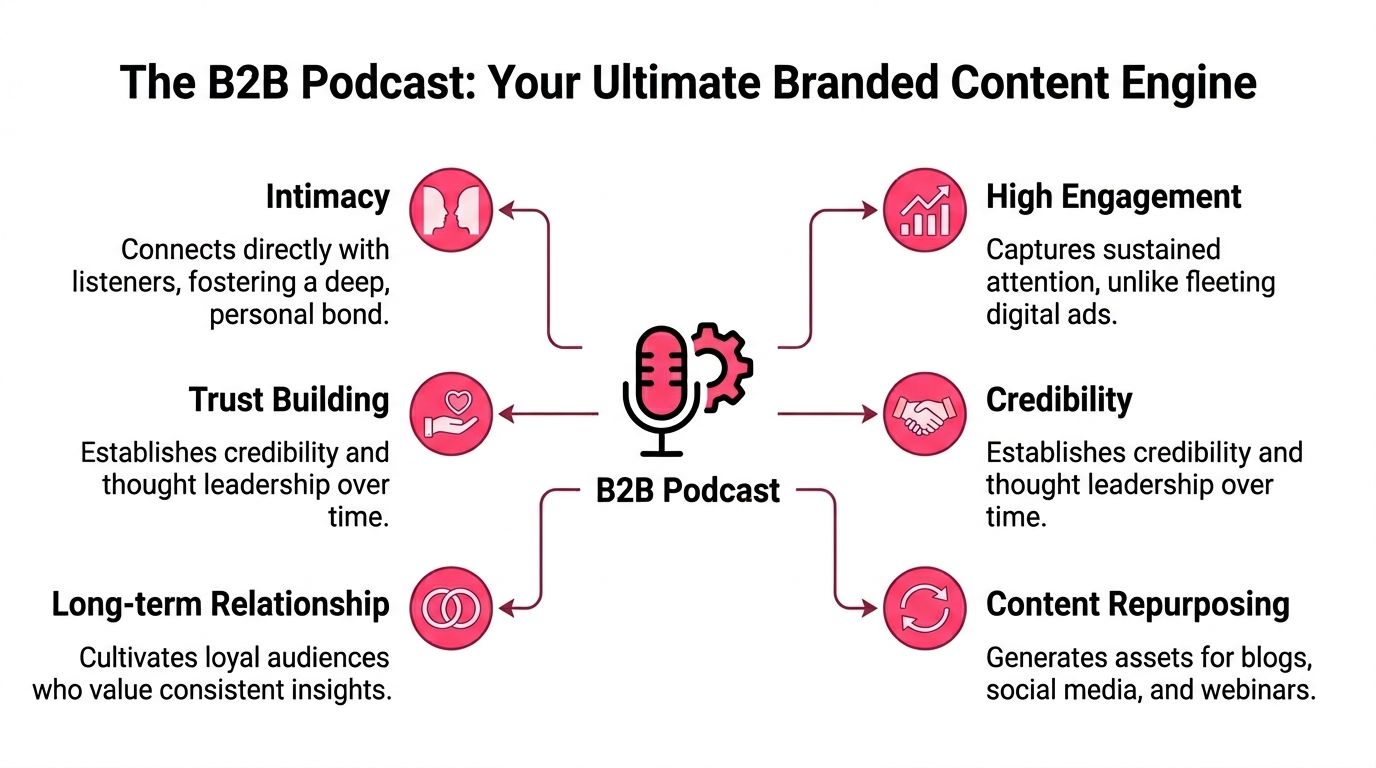
A B2B podcast can do several jobs at once. It builds authority, creates a recurring audience touchpoint, generates source material for the rest of your marketing, and gives your brand a format where expertise sounds human.
That is why the podcast is the strongest execution of branded content for many B2B teams.
Why podcasts fit B2B better than many realize
Audio creates a different relationship than text ads or social posts. A buyer hears your host, your guests, your pacing, your curiosity, and your judgment. That intimacy matters.
It also maps well to how B2B buyers learn. According to LinkGraph’s overview of branded content vs content marketing, 34% of B2B buyers start their vendor research with podcasts. The same source notes that agencies like Fame have guaranteed 10%+ monthly download growth for over 100 B2B clients.
That points to a gap in the market. A lot of B2B brands talk about thought leadership. Fewer build a channel that can deliver it in a recurring, high-trust format.
One episode can power your entire content system
This is the operational advantage that makes podcasts hard to beat.
A single recording session can become:
- A flagship episode for Apple Podcasts, Spotify, and YouTube
- Short video clips for LinkedIn and other social channels
- A transcript that becomes a searchable SEO asset
- A blog post built from the strongest argument or framework in the conversation
- Quote cards and artwork for social promotion
- Newsletter copy that pulls out the key lesson
- Sales enablement snippets that reps can share with prospects
- Internal positioning material that sharpens how the company talks about the market
Many teams produce these assets separately. That creates waste. A podcast gives you a content source instead of a content treadmill.
A more detailed operating model for this sits in this B2B branded podcast framework.
Distribution still decides whether it works
A podcast is not magic just because you publish it. The best shows win because they are built for distribution from day one.
That means:
- Choosing guests your buyers already care about
- Cutting clips around strong, specific ideas
- Writing titles that reflect buyer pain or curiosity
- Repackaging each episode into multiple formats
- Creating repeatable promotion workflows after every release
If you want a practical outside resource on promotion mechanics, this guide on how to grow your podcast audience is useful because it focuses on audience-building actions, not just production.
A good branded podcast also needs momentum. This short breakdown explains why consistency and distribution matter as much as recording quality.
What does not work
A podcast underperforms when teams treat it like a vanity side project.
Common failure modes look like this:
- No editorial thesis: Every episode is a random interview.
- AI-generated content without human review: Using AI to speed up content creation can save time, but teams should review and refine AI-assisted content before publishing. An AI detector can be used as an additional quality-control step when reviewing AI-generated copy.
- Weak host prep: Guests carry the conversation, but no unique angle emerges.
- No repurposing plan: The episode goes live and then dies on the feed.
- Bad guest fit: The guest is famous, but irrelevant to your buyer.
- Too much product talk: The show becomes a disguised demo.
Key takeaway: The best B2B podcast is not “a podcast.” It is a repeatable media asset that feeds every other content channel you run.
How to Build Your B2B Branded Content Strategy
A branded content strategy fails when it starts with formats. “We should post more video” is not a strategy. “We should launch a show that helps CFOs understand AI procurement risk” is much closer.
The work starts with editorial clarity.
Define the show your brand has the right to make
Every strong branded content program has a center of gravity.
That center is not your product category. It is the conversation your brand can credibly own.
Ask:
- What does our market need help understanding right now?
- Where do we have a strong point of view?
- What could we publish repeatedly without sounding forced?
- Which audience would care even if they are not ready to buy yet?
For B2B teams, the answer is often a niche intersection. Not “marketing.” More like “how enterprise demand gen leaders build pipeline quality without bloating spend.”
That specificity gives you a lane.
Build around audience interest, not company org charts
A common mistake is targeting job titles too narrowly.
Your buyer is not interested in content because they are a “VP of Revenue Operations.” They are interested because they need advantage, clarity, proof, and better decisions. Good branded content meets those motivations.
Try a simple audience lens:
| Audience lens | Useful question |
|---|---|
| Professional pressure | What makes this person look smart or reduce risk internally? |
| Market curiosity | What trend or shift are they trying to understand? |
| Identity | What kind of operator do they want to be seen as? |
| Practical need | What problem do they need to solve this quarter? |
This is one reason podcasts work so well. A conversation can hold complexity, nuance, disagreement, and first-hand experience better than a generic article can.
Pick one flagship format
Do not start with seven channels. Start with one flagship format and one repurposing system.
For many B2B brands, the flagship should be a podcast because it creates both depth and raw material. But the format only works if you commit to a cadence and a structure.
A practical starting model looks like this:
- Flagship show: One recurring podcast or video podcast with a clear audience and editorial thesis.
- Episode workflow: Recording, editing, packaging, approvals, publishing.
- Repurposing map: Clip, transcript, article, newsletter, social posts, sales snippets.
- Distribution owners: One person handles guest coordination, one handles publishing, one handles post-production distribution.
- Feedback loop: Review which themes, guests, and formats create the strongest audience response and pipeline signals.
Plan distribution before production
A lot of content teams still produce first and figure out promotion later. That reverses the order.
Before your first episode or branded series goes live, decide:
- Where the core audience already spends time
- Which formats fit each channel
- Who inside the company will help amplify
- How sales can reuse content in active deals
- What success looks like beyond surface engagement
Tip: If no one owns distribution, your branded content program is a publishing exercise, not a growth system.
A good strategy is boring in the right places. Clear thesis. Defined audience. Repeatable production. Consistent promotion. Then you give the creative work room to breathe inside a stable system.
Measuring Branded Content ROI Beyond Vanity Metrics
The wrong way to measure branded content is to ask whether one episode or one article directly closed revenue by itself.
The right way is to measure it across three layers: brand, audience, and demand.
Layer one measures brand traction
Start with signals that show whether your market is noticing and remembering you.
Useful indicators include:
- Branded search lift
- Direct traffic trends
- Share of voice in conversations your buyers care about
- Invitations to speak, guest, or contribute
- Qualitative feedback from prospects and customers
These are not vanity metrics if they reflect market recognition. They become vanity metrics when teams stop there.
Layer two measures audience growth and engagement
This layer tells you whether the content is earning sustained attention.
For a branded podcast, look at:
- Download growth over time
- Repeat listener behavior
- Episode completion trends
- Subscriber growth
- Engagement with clips, transcripts, and newsletter extensions
These metrics matter because they show whether your content has become habit-forming, not just visible.
Layer three measures demand influence
Leadership usually wants clarity here, and rightly so.
Track commercial signals such as:
- Self-reported attribution in forms and sales calls
- Pipeline influenced by content touchpoints
- Closed-won deals where the show, newsletter, or branded series appeared in the journey
- Guest-to-opportunity relationships
- Sales team usage of content in active opportunities
Native branded content can also connect to lead generation more directly. According to Copydash’s guide to branded content marketing, branded content in native formats achieves a 650% higher click-through rate compared to traditional display ads, and top-performing B2B campaigns have reduced cost per lead to as low as $254 on Google by gating high-value content.
That matters for measurement because it shows a path from attention to action. Branded content is not separate from performance. It often improves performance when used to warm the audience before an ask.
A practical reporting model
A monthly branded content report should include all three layers, not just channel analytics.
| Reporting layer | What to include |
|---|---|
| Brand | Recognition signals, branded search, qualitative market response |
| Audience | Subscribers, downloads, completion, content engagement |
| Demand | Influenced opportunities, attribution notes, sales usage, pipeline touchpoints |
If you want a useful outside perspective on evaluation frameworks, Mastering Content Marketing ROI is worth reviewing alongside your internal dashboard design.
For a deeper internal benchmark on how to connect content efforts to revenue conversations, measuring content marketing ROI is the right next read.
Key takeaway: Vanity metrics ask, “Did people react?” Real ROI measurement asks, “Did this build market attention, audience habit, and revenue influence?”
Stop Making Content Start Building a Media Brand
Publishing more assets is not the goal.
Building a media property your market trusts is the goal.
That shift changes how you plan, produce, and judge content. You stop chasing random volume. You start building recurring formats, recognizable themes, and a point of view buyers associate with your company.
Branded content is the mechanism. A B2B podcast is often the best vehicle because it gives you depth, consistency, and a source asset that can feed everything else you publish.
The payoff is not one viral clip or one high-performing post. It is cumulative authority. It is hearing prospects reference your show unprompted. It is watching sales conversations start warmer because the buyer already knows how your team thinks.
That is what strong branded content does. It creates familiarity before the sales motion begins and credibility before the product pitch lands.
If your team has been stuck on the content treadmill, the answer is not more output. It is a better content asset.
Your Branded Content Marketing Questions Answered
Is branded content only for big brands with big budgets
No. It is more about focus than scale.
A smaller B2B company with a tight editorial angle can outperform a larger company producing generic content. The trade-off is that branded content requires consistency and judgment. If budget is limited, start with one flagship format and a disciplined repurposing process instead of spreading effort across too many channels.
Should we build this in-house or use a specialist partner
That depends on whether you already have the required skills.
A serious branded podcast program needs editorial strategy, guest research, host prep, production, design, distribution, writing, and performance tracking. Some teams can assemble that in-house. Many cannot do it well without pulling people off their core roles.
The biggest mistake is assuming a podcast is only an audio production problem. It is really a content system and distribution problem.
How long before branded content produces business results
Some signals appear early. You can usually tell fairly quickly whether the content has resonance by looking at audience response, internal sales adoption, and whether guests and buyers engage with it.
The harder business outcomes take longer because trust compounds over repeated exposure. That is normal. Branded content works best when teams treat it like a strategic media asset, not a short campaign.
What should we publish first
Start with a format you can sustain.
For many B2B companies, that means a podcast or video podcast with a clear audience, a repeatable theme, and a repurposing workflow built in from day one. It gives you one strong source asset instead of forcing your team to invent fresh content for every channel every week.
What ruins branded content fastest
Two things. Bland positioning and poor distribution.
If your content sounds like everyone else, the market will ignore it. If you publish good content and fail to distribute it properly, the market will never see it.
If you want to turn branded content into a real pipeline and authority engine, Fame helps B2B companies build podcasts that do more than sound good. They create shows designed to grow audience, feed your broader content system, and support measurable business outcomes.
Want us to run this for you?
Fame starts and grows B2B podcasts that generate pipeline. Tell us who you are trying to reach and we will send a costed proposal within 1 working day.
Related content
- Read moreFame Team · July 16, 2026
10 Account Based Marketing Tactics For B2B Growth In 2026
Discover 10 actionable account based marketing tactics for B2B tech. Learn to use podcasts, data, and targeted content to close high-value accounts. - Read moreFame Team · July 16, 2026
The 8 Best Brighton Podcast Agency Picks For 2026
Find the best Brighton podcast agency for your B2B brand. Our 2026 guide reviews top 8 agencies for production, growth & ROI. Expert analysis here - Read moreJune 10, 2026
20 Best Podcast Production Agencies For 2026 (And Why Should You Hire One)
Global podcast and vodcast ad revenues are on track to hit $5 billion in 2026 , up 20% year-on-year. - Read moreApril 13, 2026
Leadership In Marketing: The B2B Podcast Playbook
Most companies still confuse leadership in marketing with job titles, org charts, and budget control. That's outdated.