April 11, 202618 min read7 sections
Your Content Marketing Podcast: A B2B Guide to ROI
By Fame Team
Key Takeaways
- A well-structured podcast can create multiple assets from one conversation.
- A podcast can build authority and trust with buyers faster than isolated blog posts.
- Treating a podcast as the center of a content marketing system can solve the bottleneck of generating credible insights.
Most companies treat a content marketing podcast like a single deliverable. Record the episode, publish it, post a link on LinkedIn, move on.
That’s the wrong model.
Podcasting became a $40 billion industry in 2025 with 584.1 million listeners worldwide, yet only about 10% of the 4.5 million+ podcasts remain active, according to Teleprompter’s podcast statistics roundup. The gap isn’t talent. It’s operating model. Many teams produce an audio file. The few that win build a content engine.
For B2B brands, especially in crowded categories, a podcast does something ordinary blog-led programs struggle to do. It creates recurring conversations with buyers, customers, partners, and category experts. Then it turns those conversations into every other asset your team needs: clips, transcripts, email content, social posts, blog articles, sales enablement snippets, and executive thought leadership.
A good content marketing podcast is not a side channel. It’s the raw material for your whole editorial system.
The B2B Podcast Is Your Content Marketing Holy Grail
The most impactful content asset in B2B isn’t a blog post. It isn’t a webinar either. It’s a podcast built for repurposing.
A single strong episode can feed your distribution for weeks. The audio becomes a transcript. The transcript becomes a search-focused article. The sharpest moments become short video clips. A guest quote becomes a LinkedIn post. A contrarian point becomes a carousel. The recap becomes newsletter copy. Your sales team pulls talking points from the same conversation for outbound and follow-up.
That’s why we treat a content marketing podcast as the center of the system, not an extra channel bolted onto it.
One conversation creates many assets
Most B2B teams have the same bottleneck. They don’t lack ideas. They lack repeatable ways to generate credible, senior-level insight without draining internal experts every week.
Podcasting solves that if the show is structured properly.
Instead of asking your founder, product lead, or commercial team to create ten disconnected assets, you schedule one focused conversation. Then you build derivative content around it. That’s far more realistic for busy subject matter experts.
The format builds authority faster than isolated posts
There’s also a trust advantage. A polished article can demonstrate expertise, but a live conversation reveals how your team thinks. Buyers hear nuance, judgment, and pattern recognition. They hear how your host asks questions, how your guests frame trade-offs, and how your brand approaches the market.
Practical rule: If your show can’t produce strong written, social, and sales-adjacent assets after recording, the problem usually isn’t distribution. It’s the episode design.
This matters even more in B2B niches where expertise is hard to fake. A serious buyer can tell the difference between surface-level “marketing content” and a real conversation between operators.
If you want the broader strategic case for audio, this breakdown of the benefits of a podcast is worth reviewing. The short version is simple. Podcasts earn attention, create reusable IP, and compound authority when most brands are still chasing one-off posts.
Define Your North Star Before Hitting Record
The fastest way to waste a year on a content marketing podcast is to start with topics.
Start with the business outcome instead.
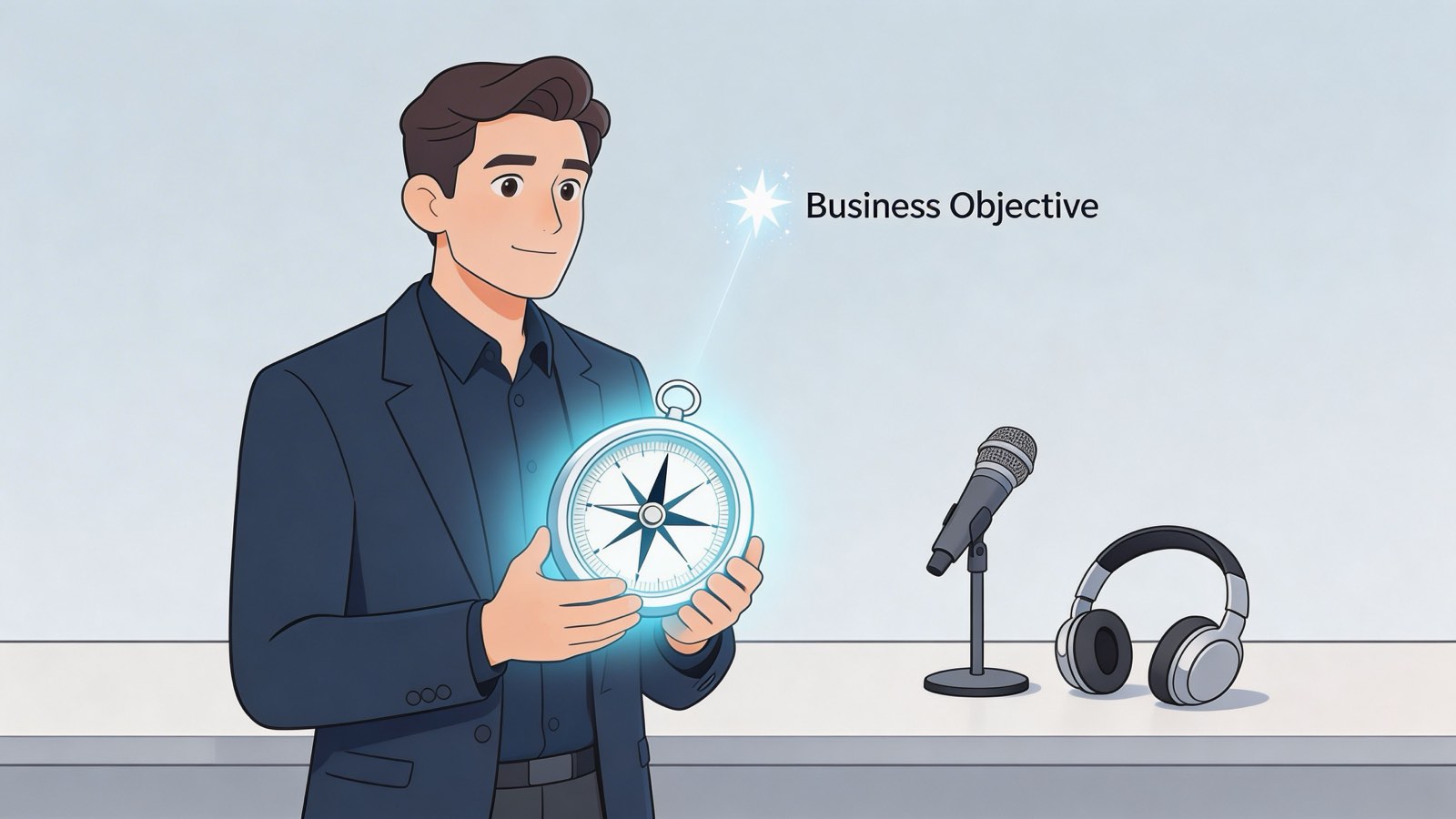
A B2B show needs a job. Not a vague ambition like “build awareness.” A real job. Generate category authority before an IPO. Open doors with named accounts. Build trust with a niche professional audience. Support enterprise sales by surrounding buyers with repeated expert touchpoints.
Without that clarity, teams drift into broad episodes, random guests, and fuzzy measurement.
Pick one commercial job first
A podcast can influence several outcomes, but it shouldn’t launch with several equal priorities.
Ask these questions before you name the show:
- Authority play: Do you need senior buyers, investors, or industry peers to see your company as a category leader?
- Pipeline play: Do you want the show to create warm entry points with target accounts through guesting and follow-up?
- Customer expansion play: Will current customers use the show to deepen product understanding and strategic alignment?
- Recruiting play: Does the show need to signal market credibility to future hires and advisors?
Choose the primary job first. Everything else is secondary.
If your main goal is authority in a narrow niche, the show should sound different than a pipeline-first show. Authority-first shows can go deeper and more thematic. Pipeline-first shows need tighter ICP alignment, more deliberate guest selection, and stronger paths into owned channels.
Define the audience with painful specificity
Many branded podcasts lack specificity here. They target “marketing leaders” or “decision-makers.” That’s not an audience. That’s a placeholder.
Good B2B podcast strategy starts with a narrow listener profile:
| Question | Weak answer | Strong answer |
|---|---|---|
| Who is it for | B2B leaders | VP Marketing at mid-market SaaS firms |
| What are they trying to solve | Growth | Proving pipeline impact with a lean team |
| What do they already know | Marketing basics | Strong demand gen, weaker category creation |
| Why would they subscribe | Useful content | Practical ideas from operators facing the same constraints |
Use the same rigor you’d use for paid acquisition or outbound targeting. If needed, tighten your audience definition before launch with a structured ICP exercise like this guide on how to identify target audience.
Niche beats broad in B2B
One of the biggest missed opportunities in podcasting is niche B2B strategy. Coverage usually centers on broad branded shows, while underserved use cases get ignored. That matters because there’s a real opening for companies in specialized markets. As noted in this Spotify-linked reference on underserved B2B podcast opportunities, only 20-30% of tech firms use audio for funding milestones, despite 40% higher engagement rates versus video for this niche use case.
That should get your attention if you’re marketing a complex product, a specialized service, or a company preparing for an IPO or exit.
Broad shows attract loose attention. Narrow shows attract the right rooms.
A podcast aimed at “everyone in our market” usually reaches no one with urgency.
Write the show premise in one sentence
If your team can’t summarize the show clearly, your audience won’t understand why it exists.
A useful premise usually has four parts:
- Audience
- Problem space
- Point of view
- Why now
For example:
“We interview revenue leaders at B2B software companies on how they build trust and pipeline in markets where buyers are skeptical and cycles are long.”
That works because it tells the listener whether the show is relevant in seconds.
Sanity-check the premise before launch
Run your show idea through this quick filter:
- Would your ideal buyer subscribe even if they never bought from you?
- Can your host speak credibly on the topic for a year?
- Does the premise create natural guest demand?
- Can one episode turn into multiple useful assets for sales and marketing?
- Will the show still matter if platform algorithms change?
If the answer to two or more is no, rework the concept before recording.
Crafting a Show That Commands Attention
A B2B podcast doesn’t need to sound flashy. It needs to sound intentional.
Listeners forgive modest production faster than they forgive rambling conversations, generic questions, or guests who were booked because they’re famous instead of relevant.
The strongest shows usually make three disciplined choices. They pick a format that fits the team. They design an episode structure that respects listener time. They book guests who sharpen the audience fit instead of diluting it.
Choose the format your team can sustain
Different formats do different jobs.
Solo episodes
Best when your company already has a strong internal voice and clear point of view.
Solo episodes work well for category education, strategic commentary, and highly opinionated takes. They’re efficient to produce and excellent for message control. They’re also unforgiving. If the host lacks clarity, pacing, or conviction, the weakness is obvious.
Use solo when:
- Your host has earned authority
- You need message precision
- You want fast production cycles
Expert interviews
This is the default B2B format for a reason. It creates network effects, lets you borrow expertise, and gives you a natural content collaboration loop with guests.
But most interview shows are forgettable because the host asks the same questions every other podcast asks.
Skip “tell us about your journey.” Ask for decisions, mistakes, disagreements, and operating details.
Roundtables or co-hosted commentary
This format is underrated for companies with strong internal chemistry.
A host plus a recurring co-host can create more rhythm than guest interviews, especially if the show covers industry changes, buyer objections, or tactical breakdowns. It also reduces guest sourcing pressure.
The trade-off is obvious. You need two people who can think out loud without sounding rehearsed.
Design the episode around retention
The opening minute matters more than the branding package.
Listeners decide quickly whether an episode will reward their attention. Long intros, self-congratulatory host banter, and generic setup kill momentum. We’ve seen this repeatedly. Tight shows get to the tension fast.
A better structure looks like this:
| Segment | What it should do | Common mistake |
|---|---|---|
| Opening | State the problem or promise quickly | Long music and brand intro |
| Context | Explain why the guest matters | Reading a full bio |
| Core discussion | Stay on one sharp theme at a time | Jumping between topics |
| Midpoint CTA | Direct listeners to a relevant next step | Saving all CTAs for the end |
| Closing | Summarize one clear takeaway | Ending abruptly with no synthesis |
Don’t chase celebrity guests
Big names are often the wrong guests.
They’re overbooked, media-trained, and usually less motivated to promote the episode. The better guest is the person your buyers already respect inside the niche. Someone with actual operating experience, a known point of view, and overlap with your target audience.
A few filters help:
- Audience overlap: Do their followers resemble your buyers?
- Topical fit: Can they speak to a problem your ICP is actively trying to solve?
- Distribution value: Are they likely to share the episode credibly?
- Conversation depth: Will they go beyond polished talking points?
The best guest is rarely the biggest name. It’s the person your ideal buyer would forward to a colleague.
Prep guests like a producer, not a publicist
Guest quality improves dramatically when the prep is strong.
Don’t send a vague note saying “we’d love to chat about marketing.” Send a tight brief. Explain the audience, the angle, the likely questions, the preferred examples, and where you want specificity.
Good prep includes:
- A one-page show brief
- Topic framing and what to avoid
- Recording logistics
- A request for examples and stories
- A post-recording promotion plan
This is also where branded podcasts separate from hobby shows. The team’s job isn’t just to schedule guests. It’s to engineer strong conversations.
Build recurring segments people remember
Most B2B shows underestimate habit.
Listeners come back faster when they recognize a repeatable segment. That could be a closing question, a rapid-fire teardown, a “what most companies get wrong” section, or a short debrief where the host turns the conversation into a practical takeaway.
Recurring segments give the show identity. They also make repurposing easier because your team knows where the strongest clips tend to happen.
Building Your B2B Podcast Production Machine
The easiest way to kill a podcast is to make every episode a custom project.
Good shows run on systems. Not because systems are glamorous, but because consistency is what separates active shows from abandoned ones.
Build a workflow before you build a backlog
Production should feel boring in the right way. Everyone knows what happens before recording, during recording, after recording, and before publishing.
A clean workflow usually includes:
- Topic and guest approval
- Research and question development
- Pre-interview briefing
- Recording
- Editing and quality control
- Show notes, titles, and platform packaging
- Asset repurposing
- Distribution and reporting
If your team is improvising any of those every week, bottlenecks will pile up.
For a more detailed operating model, this breakdown of a podcast production workflow is a useful reference.
Separate strategic work from execution work
Many internal teams face challenges here.
Senior marketers should own audience fit, editorial direction, guest quality, and performance review. They should not spend their best hours trimming filler words, resizing thumbnails, chasing transcripts, or manually scheduling all derivative assets.
Delegate the repeatable work.
For lean teams, one practical option is to Hire LatAm Virtual Assistants to handle recurring production support like guest coordination, publishing logistics, transcript cleanup, asset organization, and content scheduling. That kind of support is often the difference between a podcast that launches and one that lasts.
Record for repurposing, not just for audio
A content marketing podcast should be recorded with downstream usage in mind.
That changes how you run sessions. You want clean remote setups, separate speaker tracks when possible, a host who asks complete questions, and moments that can stand alone as clips. If you’re capturing video, framing and lighting matter because those assets won’t stay on YouTube alone. They’ll end up on LinkedIn, in email, and on your site.
A few rules help:
- Use a stable remote recording platform
- Ask guests to wear headphones
- Capture video even if audio is the priority
- Keep host interruptions low
- Mark standout moments during the session
Video and AI are operational advantages
This isn’t optional anymore for many teams. Video expands reach, and lighter production tooling makes the whole system easier to sustain.
According to Siege Media’s content marketing podcast analysis, 53% of new U.S. weekly listeners prefer video podcasts. The same source notes that AI integration is linked to a 20% reduction in production costs and a 15% adoption rate among producers for content generation.
The practical takeaway isn’t “replace your team with AI.” It’s simpler. Use AI where it removes friction.
Use it for transcript first drafts, clip identification, show note drafting, and content ideation. Keep human review on all strategic output. Especially in B2B, where nuance matters, AI should speed the workflow, not define the message.
Production quality matters. Production reliability matters more.
The Content Multiplier Your Podcast Unleashed
One strong episode should never stay one episode.
That’s where many teams leave value on the table. They publish the full conversation, maybe cut one clip, then move on to the next recording. The result is a lot of effort for very little surface area.
A better approach is aggressive repurposing.
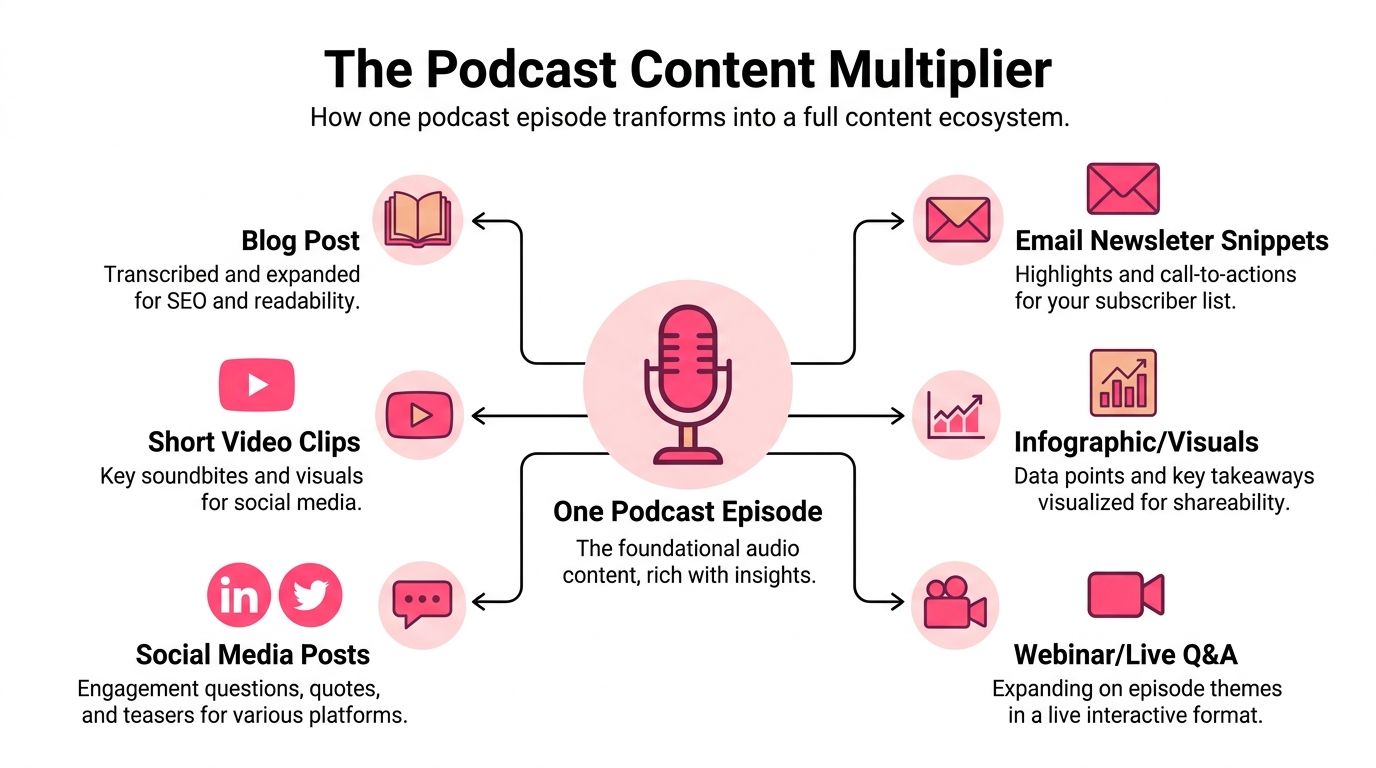
Turn one episode into an asset stack
Here’s what one good B2B conversation can produce without stretching the source material:
- Full episode page with embedded audio or video, summary, and transcript
- SEO blog article built from the transcript, edited for clarity and structure
- Executive LinkedIn post from one strong argument or quote
- Short video clips for social and email
- Quote graphics for branded distribution
- Carousel post breaking down a framework from the episode
- Newsletter edition with key takeaways and a listen CTA
- Sales follow-up asset shared after relevant prospect conversations
- Internal enablement snippet for customer success or recruiting
- Website resource hub addition grouped by topic or buyer problem
- Guest co-marketing post adapted for the guest’s audience
- Talking points for webinars or live events
- Topic seeds for future episodes
That’s why the podcast works as a multiplier. You’re not creating twelve disconnected things. You’re extracting them from one well-run conversation.
Repurposing works when the source is strong
A bad episode doesn’t become good because you sliced it into more formats.
The conversation has to contain tension, specificity, and useful disagreement. If the guest speaks in generic abstractions, every derivative asset will sound generic too.
That’s why repurposing starts before recording:
- pick one theme per episode
- brief guests on the depth you need
- ask for examples
- challenge vague claims
- summarize key points live so clips are easier to isolate
Use guest networks on purpose
The guest should be part of the distribution plan, not just the content plan.
A simple guest content pack helps a lot. Include episode links, a few ready-made social assets, suggested copy, short clips, and a transcript excerpt they can reuse. Remove friction and promotion becomes much more likely. Promotion isn’t just about reach.
According to Content Marketing Institute’s guide to podcasting success and pitfalls, effective podcast promotion includes using guest networks with guest content packs and aggressive repurposing. The same source notes that 47% of B2B buyers view 3-5 pieces of content before sales engagement, which is exactly why a single conversation should become multiple buyer touchpoints.
Connect the show to your website journey
A podcast shouldn’t live in a content silo.
The best teams route listeners toward a clear next step. That might be another article, a newsletter signup, a relevant case study, a category page, or a demo request. But the route has to be intentional.
Use UTM tracking on links from social posts, email, guest shares, and episode pages. If someone discovers your brand through the podcast, then returns later through another channel, your reporting should still show the podcast’s influence.
If you need a playbook for asset atomization, this guide to content repurposing strategies is a solid next read.
A practical weekly content rhythm
A single episode can power a weekly system like this:
| Day | Asset | Purpose |
|---|---|---|
| Publish day | Full episode and transcript | Core content hub |
| Next day | Short clip with sharp hook | Social reach |
| Midweek | Blog article from transcript | Search and site depth |
| Midweek later | Newsletter recap | Audience nurture |
| Later in week | Carousel or quote post | Additional social touchpoint |
| Ongoing | Sales team shares relevant clip | Pipeline support |
If your podcast team publishes an episode and asks, “How should we promote this?” after the fact, the process is backwards.
Promotion starts in pre-production. Repurposing starts in the interview outline. Distribution starts when you choose the guest.
Measuring What Matters Podcast ROI in B2B
Much podcast reporting is too shallow for B2B.
Downloads matter, but they don’t matter in isolation. If a show gets listens but never influences pipeline, never gets mentioned on calls, and never drives any owned audience growth, the dashboard might look busy while the business impact stays thin.
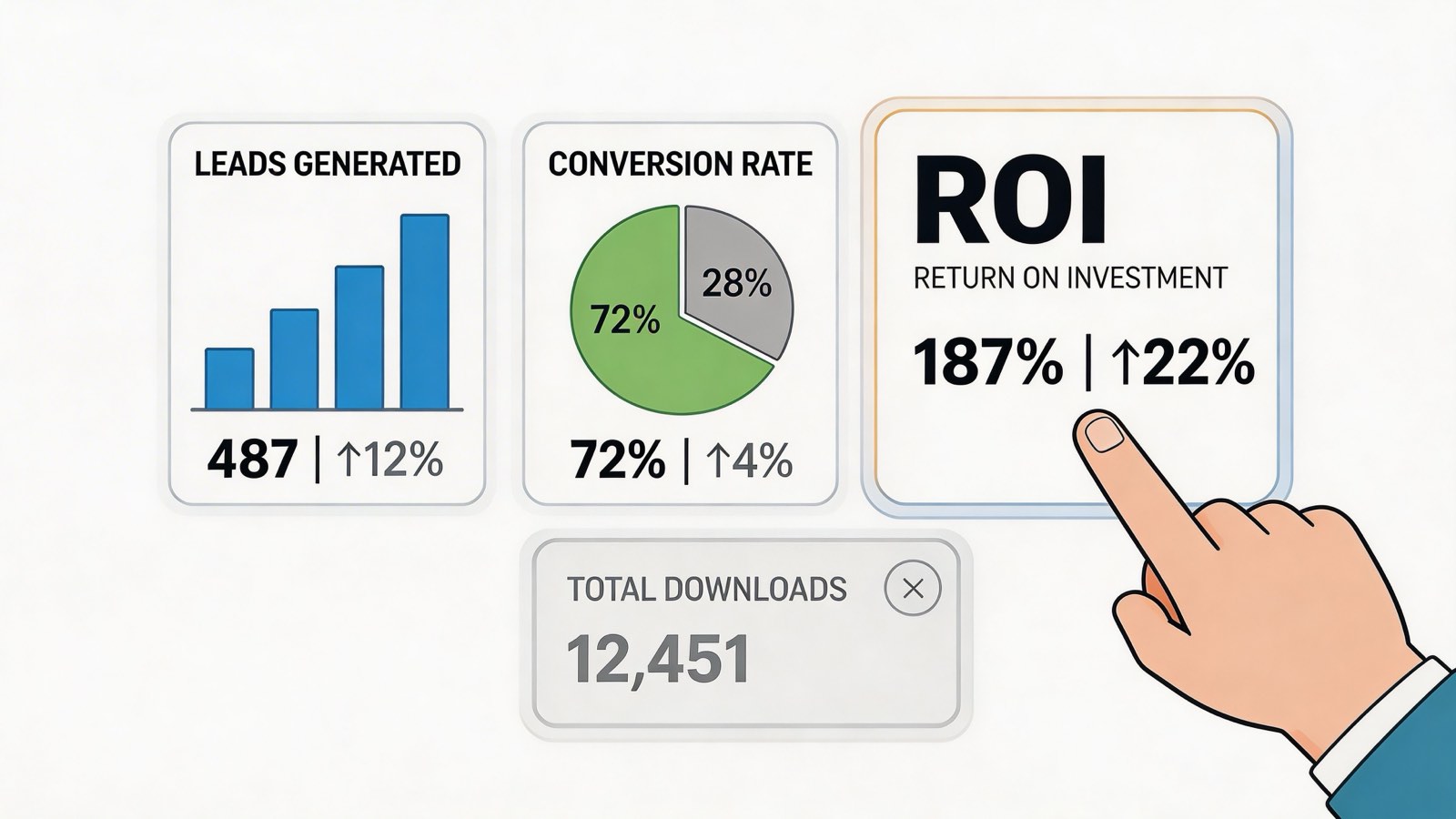
Start with engagement, not vanity
The first question isn’t “How many people clicked play?”
It’s “Did the right people keep listening?”
For B2B podcasts, the quality signal sits in retention and completion. According to Fame’s podcast success metrics framework, a strong benchmark is a completion rate of 60%+, with episodes under 30 minutes achieving 50%+ consumption rates. The same framework notes that high-performing shows hit 40-50%+ completion in the first 90 days and should aim for at least 10% monthly download growth.
That tells you far more than a vanity total ever will.
Track four layers of ROI
A serious podcast KPI model usually has four layers.
Consumption metrics
These tell you whether the content itself is working.
- Completion rate
- Average consumption
- Drop-off points
- Episode-level download trends
- Performance by format or guest type
If episodes keep losing listeners early, look at your intro, topic framing, and pacing before blaming distribution.
Audience growth metrics
These tell you whether the show is building momentum.
Watch:
- Subscriber growth
- Monthly download growth
- Returning listener patterns
- Channel-level growth from Apple, Spotify, YouTube, and your site
Growth without retention is weak. Retention without growth often means the content is good but promotion is underpowered.
Owned-channel impact
Here, the content engine starts proving its value beyond audio.
Track:
- Newsletter signups from episode pages
- Traffic to related site pages
- Time on page for transcript-led articles
- Engagement with repurposed social posts
- Content-assisted journeys across your website
Pipeline influence
This is the metric category leadership teams care about.
Measure:
- UTM-tagged visits from episode promotion
- Demo or contact form submissions influenced by podcast pathways
- “How did you hear about us?” responses
- Sales call mentions
- Named-account engagement after guest episodes
Build an episode scorecard
Every episode should be reviewed like a campaign, not archived like a file.
A simple scorecard can include:
| Metric area | What to review |
|---|---|
| Audience fit | Did the topic align with the ICP? |
| Retention | Where did listeners drop off? |
| Repurposing yield | How many usable assets did the episode create? |
| Distribution | Did the guest promote it? Which channels drove traffic? |
| Commercial signal | Any replies, meetings, mentions, or influenced conversions? |
This creates feedback loops. You’ll quickly learn which themes hold attention, which guest profiles distribute best, and which formats create the most downstream value.
What not to overvalue
Some metrics look impressive and still tell you almost nothing.
Be careful with:
- Raw total downloads with no context
- Follower counts disconnected from buyer fit
- One viral clip that doesn’t drive any owned engagement
- Guest prestige without audience overlap
- Top-of-funnel traffic that never reaches a meaningful next step
A podcast can be successful long before it becomes famous. In B2B, useful is usually more valuable than widely seen.
If you want a more detailed framework for scorecards and attribution, review this guide on how to measure podcast performance.
Your Launch and Scale Checklist
Launching a content marketing podcast gets easier when the work is broken into phases. Keep it practical. Keep it repeatable. Keep shipping.
Pre-launch setup
- Lock the commercial goal: Choose one primary business outcome for the show.
- Define the ICP tightly: Name the buyer, the pain point, and the reason they’d subscribe.
- Write the show premise: One sentence is enough if it’s sharp.
- Choose the format: Pick the structure your team can sustain.
- Name the host: Authority and consistency matter more than internal politics.
- Create visual branding: Cover art, templates, thumbnails, and social assets should be ready before launch.
- Build the workflow: Decide who owns prep, recording, editing, publishing, repurposing, and reporting.
- Prepare the tech stack: Recording platform, editing setup, hosting platform, transcription, scheduling, and analytics.
- Record multiple episodes first: Don’t launch with one episode and hope you catch up later.
- Draft guest outreach and prep templates: Remove as much repeat work as possible.
Launch week rollout
- Publish with substance: Your episode page should include more than an embed.
- Release supporting assets immediately: Clip, post copy, email copy, and internal share notes should already be done.
- Send guest content packs fast: Make promotion easy while the conversation is still fresh.
- Activate your owned channels: Website, newsletter, social, founder profiles, and sales team should all know what to share.
- Use trackable links: Attribution should start on day one.
- Listen for qualitative feedback: Replies, comments, and direct mentions often reveal fit before dashboards do.
Ongoing optimization
- Review performance monthly: Look at retention, growth, channel performance, and influenced actions.
- Double down on what holds attention: Formats and topics earn the right to repeat.
- Cut what drags: Weak intros, vague guests, and bloated edits don’t improve with time.
- Keep the repurposing machine active: The value sits in repeated exposure, not the upload alone.
- Refresh your guest list often: Protect the overlap with your target audience.
- Treat the show like a media property: Editorial discipline beats bursts of enthusiasm.
One last thing matters more than many teams expect. Consistency.
Podcasting reached a $40 billion industry in 2025 with 584.1 million listeners worldwide, and there are over 4.5 million podcasts globally, but only about 10% remain active, according to Teleprompter’s podcast statistics roundup. That’s a significant competitive advantage. Not launch energy. Staying active long enough to compound.
If you want a B2B podcast that drives authority, feeds your entire content engine, and ties back to real pipeline outcomes, Fame can help. We produce strategic podcasts for B2B brands that want more than downloads. We build shows designed to create impact across content, distribution, and revenue.
Want us to run this for you?
Fame starts and grows B2B podcasts that generate pipeline. Tell us who you are trying to reach and we will send a costed proposal within 1 working day.
Related content
- Read moreFame Team · July 16, 2026
10 Account Based Marketing Tactics For B2B Growth In 2026
Discover 10 actionable account based marketing tactics for B2B tech. Learn to use podcasts, data, and targeted content to close high-value accounts. - Read moreFame Team · July 16, 2026
The 8 Best Brighton Podcast Agency Picks For 2026
Find the best Brighton podcast agency for your B2B brand. Our 2026 guide reviews top 8 agencies for production, growth & ROI. Expert analysis here - Read moreJune 10, 2026
20 Best Podcast Production Agencies For 2026 (And Why Should You Hire One)
Global podcast and vodcast ad revenues are on track to hit $5 billion in 2026 , up 20% year-on-year. - Read moreApril 13, 2026
Leadership In Marketing: The B2B Podcast Playbook
Most companies still confuse leadership in marketing with job titles, org charts, and budget control. That's outdated.