April 12, 202621 min read7 sections
How to Build Brand Authority: A B2B Playbook
By Fame Team
Key Takeaways
- A strong B2B company can lose deals due to a lack of authority.
- Building authority through a repeatable media system, such as a branded podcast, can educate the market and feature respected voices.
- A well-positioned podcast can establish a brand's point of view, create repurposable content, and help prospects understand a company's expertise.
A strong B2B company can lose deals for a simple reason. Buyers trust the vendor they’ve heard from more often.
I’ve seen this pattern again and again with technical firms that have a better product, a sharper team, and a weaker market position. Their competitor isn’t winning on substance. They’re winning on authority.
Introduction The Authority Gap Holding Your B2B Brand Back
In B2B, authority isn’t a vague brand metric. It’s the reason prospects answer your outbound, accept your pricing logic, shortlist you faster, and repeat your talking points back in sales calls.
The companies that build authority well do one thing differently. They don’t publish random content. They create a repeatable media system that educates the market, features respected voices, and turns internal expertise into a public asset.
For most B2B teams, the cleanest way to do that is a branded podcast.
Not because audio is magical. It isn’t. A neglected podcast with weak positioning and no distribution does nothing.
A strong B2B podcast works because it solves several authority problems at once:
- It gives your brand a recurring point of view
- It puts your team in conversation with credible operators
- It creates a steady stream of repurposable content
- It helps prospects spend time with your expertise before they ever book a demo
That last point matters more than many teams realize. Brand authority shortens the distance between “I’ve never heard of you” and “you seem like the obvious choice.”
Buyers rarely say, “We chose the company with the best podcast.”
They say, “Your team seems to really understand this space.”
That’s the outcome you want.
The practical question isn’t whether content matters. It’s how to build brand authority in a way that compounds. The playbook that works is to treat your podcast as the center of your content engine, not as another marketing side project.
That means clear positioning, disciplined episode design, smart guest strategy, strong distribution, and ROI tracking tied to pipeline. When teams do that well, the podcast stops being a show. It becomes the place your category conversation happens.
Foundation First Defining Your Authority Niche
A B2B podcast fails long before launch if the brand cannot answer one basic question: what should the market trust you to explain better than anyone else?
Vague positioning kills authority. A show "for business leaders" or "about innovation" forces buyers to do the work of figuring out why they should care. Serious buyers will not do that. They will move toward the company with a clearer point of view.

Start with the narrowest useful promise
The strongest authority niches are tight enough to be memorable and broad enough to support a full editorial calendar. In practice, that means defining three things with precision:
| Factor | What to define | Bad example | Better example |
|---|---|---|---|
| Audience | The exact buyer or influencer | B2B companies | RevOps leaders at mid-market SaaS firms |
| Problem | The expensive pain they need solved | Growth | Pipeline quality, attribution confusion, long sales cycles |
| Point of view | Your interpretation of the market | We share insights | Most RevOps content ignores the handoff failures that kill revenue |
That is the foundation. If you get this wrong, every later decision gets harder. Guest selection drifts. Topics get generic. Repurposed clips feel disconnected. The podcast turns into content output instead of category leadership.
I usually pressure-test a niche with one simple prompt: can the sales team explain the show in one sentence that makes the right buyer say, "that's for me"? If they cannot, the niche is still too loose.
Mine the questions buyers already ask
The best authority strategy rarely comes from a blank-page branding session. It comes from buyer conversations your company already has every week.
Start with sales call recordings, onboarding calls, renewal reviews, customer interviews, and lost-deal notes. Look for patterns in four areas:
Repeated objections
If prospects keep asking whether implementation will be painful, you have a pillar.Category misconceptions
If buyers compare vendors using the wrong criteria, your show should reset how the market evaluates the problem.Advanced strategic questions
These usually reveal where authority gets built. Beginner FAQs attract attention. Sharp answers to high-stakes questions build trust.Customer language
Use the phrases buyers say without prompting. Internal jargon weakens authority because it sounds like company talk, not market understanding.
A simple workshop works well here. Pull in sales, customer success, and marketing. Ask each team for the ten questions buyers ask before purchase, the five reasons deals stall, and the three reasons best-fit customers choose you. You do not need perfect alignment on day one. You need recurring themes.
Build authority around 3 to 4 pillars
Once the patterns are clear, turn them into 3 to 4 editorial pillars. That is enough focus to make your show recognizable and enough range to keep it useful over time.
For a B2B podcast, these pillars are not just topic buckets. They shape the whole media engine around the show. They guide which guests you invite, what stories your host pulls out, what clips get turned into LinkedIn posts, what newsletter essays you publish, and what sales enablement content your team can reuse later.
A cybersecurity company, for example, might build around:
- Risk interpretation
- Board communication
- Operational response
- Vendor evaluation
That structure gives the show a job. It helps the audience know what they will get, and it helps the internal team say no to off-strategy ideas.
Here is the trade-off. A narrow niche limits surface-level reach in the beginning. It also increases relevance with the exact audience that buys, refers, and shapes category opinion. For B2B brands, that is usually the better bet.
Practical rule: If an episode cannot be tied to a revenue-relevant buyer pain point, it does not belong on the branded show.
Check your current market perception
Authority is not only about what you publish. It is also about whether the market already sees you as credible on that topic.
Before setting your editorial direction, ask customers, lost prospects, partners, and trusted peers a few direct questions:
- What do you think we do best?
- What kind of company do we seem to be?
- What topics would you trust us to speak on?
- Where do we still feel generic?
This information is critical because authority is not only about publishing more. It is about reducing the gap between the position you want and the perception buyers already hold.
As noted by The Brand Education, brand authority depends on a consistent brand presence, voice, and visual identity across channels. That matters more when your podcast is the center of the system. If the show teaches one point of view, the website frames another, and the sales deck tells a third story, the market reads that as confusion.
A better approach is to align brand strategy and editorial strategy from the start. That is the logic behind unifying branding and content marketing. Your podcast should not invent your authority niche. It should express it clearly, reinforce it across every format, and give the rest of your content engine a single center of gravity.
The Authority Engine Designing Your B2B Podcast
One SaaS client came to us after publishing a year of episodes that looked respectable on paper. Good guests. Clean branding. Regular releases. The problem was simple. Buyers listened, nodded, and still had no clearer reason to trust the company more than the next vendor in the category.
The show had activity, but no authority architecture.
A B2B podcast earns authority when it is built as the center of your media system. Each episode should sharpen your market point of view, give sales and marketing reusable proof, and create source material for everything else you publish. If the podcast is just another channel, it becomes a weekly production task. If it is the content engine, it becomes the place your market learns how you think.
Choose a format that proves expertise
Format is a positioning decision, not a creative one. The structure you choose determines whose expertise gets airtime, how often your point of view shows up, and whether the show builds trust for the brand or only for the guest roster.
Here are the trade-offs.
| Format | Works well when | Risk |
|---|---|---|
| Interview show | You want access to respected operators and a wider network | The host fades into the background and the brand never develops a clear voice |
| Solo show | Your team can teach with clarity and hold attention without guests | Weak delivery makes the show feel self-focused |
| Panel or roundtable | Buyers need multiple perspectives on a complex buying decision | Scheduling and moderation get harder fast |
| Hybrid | You want outside credibility and in-house expertise working together | It requires tighter editorial control |
For B2B brands, hybrid usually wins.
Guest episodes expand reach and bring external credibility into your orbit. Expert-led episodes let your team explain the hard parts buyers struggle with before a deal moves forward. That combination is how a podcast starts acting like a media property instead of a guest parade. Teams working through those decisions can use this B2B branded podcast framework to define the audience, format, and show role before launch.
Build episodes around buying friction
Editorial calendars often drift because teams start with topic ideas instead of commercial tension. A stronger planning question is: what does a buyer need to believe, understand, or compare before they can buy with confidence?
That shift changes the whole show.
Episodes stop sounding like general industry commentary. They start addressing the issues that stall pipeline, create internal disagreement, or lower win rates. In practice, the best authority shows usually return to a small set of recurring themes tied to revenue:
- Decision criteria buyers misread
- Status quo risks that are easy to underestimate
- Implementation mistakes that create expensive delays
- Comparison frameworks for evaluating options
- Internal alignment problems across stakeholders
- What strong outcomes require after the purchase
This is also where many teams make a bad content choice. They publish the polished company announcement and treat it like thought leadership. Buyers rarely remember those pieces. They do remember useful analysis, sharp explanations, and informed points of view. Press releases still have a place, especially for launches and milestones, but they do a different job. If your team needs the distinction, this guide explains what a press release is and why it should not be confused with authority content.
Design each episode to produce assets
A strong branded podcast episode does more than fill 30 minutes. It should produce clips for social, quotes for newsletters, themes for sales follow-up, and written content that extends the original conversation.
That only happens when the episode is planned with outputs in mind.
A simple structure works well for many teams:
One clear topic
Keep the conversation narrow enough to teach something useful.One defined buyer problem
The right listener should recognize their own situation quickly.One strong point of view
Episodes without a position are hard to remember and harder to repurpose.One asset plan
Decide before recording what will become clips, posts, quotes, or articles.One conversion path
Give listeners a next step that fits the episode. Another episode, a newsletter, a guide, or a conversation.
This is the operating difference between a content engine and a dead archive.
Production quality signals company quality
Buyers may never say, “we ruled them out because the host rambled and the audio was rough.” They still form that impression.
In B2B, production quality affects perceived competence. Sloppy editing, weak guest prep, and inconsistent release timing create the same doubt as a messy sales process. Clean production does not require a studio obsession. It requires a reliable system.
The basics are straightforward:
Recording setup
Use a stable remote recording workflow and microphones that do not distract from the conversation. Practical references like Fame’s guides to how to start a B2B podcast, planning a podcast, and B2B podcast equipment can help teams set this up.Editorial prep
Good hosts need sharper prompts, better research, and a clear angle for the conversation.Post-production
Editing should improve pacing, remove repetition, and keep the listener with you.Publishing rhythm
Weekly is not mandatory. Predictability is.
I have seen lean internal teams outperform larger content departments because they treated production like an operating discipline. They recorded in batches, prepared guests properly, and knew exactly how each episode would be distributed before the first question was asked.
What works and what wastes the budget
Patterns show up fast once you have worked on enough shows.
What works
- A narrowly defined audience
- Episodes built from real buying questions
- Hosts with an informed perspective
- Guests selected for buyer relevance
- Strong pre-interviews and tighter edits
- Distribution planned before recording
What wastes the budget
- Broad category conversations with no angle
- Executive vanity shows
- Guests chosen for status instead of fit
- Release schedules no one can maintain
- No clip strategy, no transcript use, no follow-up promotion
The fastest way to waste a podcast budget is to publish conversations that sound smart but leave the buyer no closer to a decision.
Built properly, the podcast becomes the source material for your authority strategy. It trains the market to recognize your thinking, gives your team repeatable proof points, and feeds the rest of your content system with ideas that started in a real conversation, not an empty calendar.
Amplify Authority With Guests and Partnerships
Authority grows faster when other credible people are part of the story. That’s why guest strategy matters so much.
A branded podcast does two jobs at once. It lets you invite respected operators into your orbit, and it gives your own experts a reason to appear in other people’s ecosystems.

Borrow credibility by showing up on other shows
Getting booked on relevant podcasts is one of the cleanest shortcuts to trust. It works because the endorsement is implied.
The host invited you. Their audience gives you attention. Your expertise lands in a context that already has trust.
That’s very different from publishing another self-authored post on your own site.
For teams building a deliberate outreach motion, this guide on how to get booked on podcasts is useful because it forces you to think about fit, angle, and host value instead of generic outreach.
A few practical rules make guesting work better:
- Pitch a point of view, not your company
- Target shows your buyers already follow
- Tailor your angle to the host’s audience
- Use stories, frameworks, and hard-earned lessons
- Prepare for the interview like it’s a sales call without the pitch
If your spokesperson is appearing as a guest, send them this preparation guide for your next podcast guest appearance. Good guests don’t improvise authority. They prepare examples, phrasing, and useful answers in advance.
Invite guests who sharpen your market position
Many hosts invite guests because they’re recognizable. That’s not enough.
Invite guests who help you own a market conversation. The right guest should do at least one of these things:
| Guest type | Why they matter |
|---|---|
| Category operators | They add practical credibility |
| Analysts or advisors | They help frame the market |
| Customers with strong insight | They make the problem real |
| Adjacent experts | They widen the audience without diluting relevance |
| Internal specialists | They show your company has depth, not just a charismatic founder |
That last one is underrated.
According to Search Engine Land’s article on building authority from zero visibility, prioritizing verifiable employee signals can produce 35% higher credibility than founder-only content, and highlighting team experts in podcasts and community forums can lead to a 2.5x authority lift when done consistently.
That’s an important correction for founder-led brands. If every piece of thought leadership comes from one person, buyers may trust the personality but not the institution.
Use partnerships to create distribution, not just logos
Partnerships only matter when they create access, context, or validation.
A few examples:
Audience research partners
If you want to test whether your messaging is credible to your target audience, Wynter, which runs B2B message testing and is featured on Fame’s partner program, can help validate positioning before you build an entire season around it.PR and media partners
Once an episode or research finding is worth amplifying, PR can help package it for wider pickup. If your team needs a simple primer on what a press release is, PBJ Stories has a practical explanation that helps non-PR teams understand when a release is useful and when it isn’t.
Here’s a good mental model for guest and partner strategy.
Don’t ask, “Who would look impressive on our show?”
Ask, “Whose presence would make our market position more believable?”
That question produces better decisions.
A quick example helps. If you serve CFOs at SaaS companies, inviting generic startup celebrities adds less authority than featuring a finance leader, a revenue systems expert, and an operator who has worked through the exact forecasting challenge your buyers care about.
Later in the cycle, that depth matters more than surface reach.
A good interview also creates more than one asset. This conversation on strategic guesting is worth watching before your team starts outreach:
When guest strategy is done well, your brand stops looking like a publisher trying to get attention. It starts looking like a credible convener in the category.
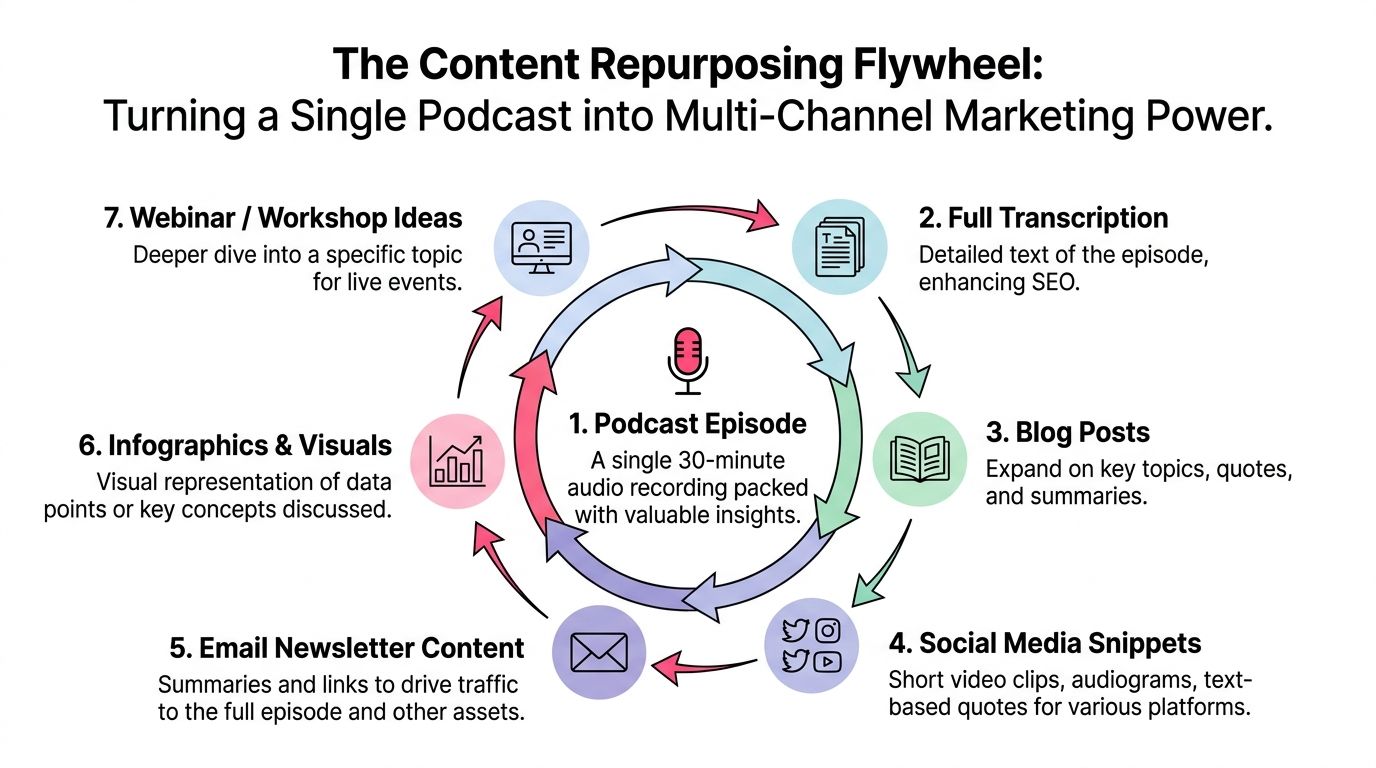
The Flywheel Effect Your Content Repurposing Framework
If you record an episode and publish only the full audio, you’re leaving most of the value on the table.
The podcast isn’t the whole output. It’s the raw material.
One episode should feed multiple channels
A good B2B episode can become a month of useful content if you repurpose it with discipline.
Use the conversation as the source file for:
- A transcript-based article that captures the strongest ideas in searchable form
- Short video clips for LinkedIn and other social channels
- Quote graphics built from memorable lines or frameworks
- Newsletter commentary that adds context and sends people to the full episode
- Sales enablement snippets that reps can share in follow-ups
- Internal knowledge assets for onboarding and positioning alignment
Here's where many teams finally get an advantage. Instead of inventing fresh content formats every week, they extract value from one strong conversation and distribute it through every relevant channel.
Original research gives the flywheel more force
Repurposing works best when the underlying episode contains something worth repeating.
That’s why original research is such a strong authority asset. As noted by Indeed’s overview of brand authority, publishing original research and unique data can triple engagement rates compared to generic content, and brands that use that material can see a 25% to 40% increase in backlinks and social shares.
For a podcast-led strategy, that means you don’t just discuss opinions. You discuss proprietary insight.
That could come from:
| Input source | Podcast angle |
|---|---|
| Customer survey results | What the market is getting wrong |
| Internal benchmark data | What high performers do differently |
| Pipeline or win-loss patterns | What buyers care about |
| Operator interviews | Common failure points and practical fixes |
The point is simple. When your episode contains original material, every repurposed asset becomes more valuable.
Generic insights create generic clips. Unique insights create assets people save, share, and cite.
Build the repurposing workflow before launch
Repurposing breaks when it relies on ad hoc effort. Build a production lane for it.
A clean workflow looks like this:
Record with extraction in mind
Ask for crisp opinions, examples, and frameworks.Create the transcript fast
This becomes the source document for everything else.Mark clip-worthy moments
Don’t wait until weeks later when the context is lost.Turn one idea into several formats
A single insight can become a clip, a quote post, a newsletter note, and a blog section.Distribute natively
Don’t paste the same asset everywhere. Adapt it.
Specialist execution can help here. A content repurposing strategy keeps your team from producing random derivatives that feel disconnected from the original message.
For scale, some brands also use a dedicated B2B social media agency to handle platform-specific publishing and a B2B email newsletter agency to turn episode insights into consistent email distribution.
If you want to see this flywheel logic in practice, Tom Hunt’s LinkedIn profile is a useful reference. The pattern is visible. Long-form ideas get broken into tighter pieces, then redistributed in formats that fit the channel.
What teams get wrong
The mistake isn’t underestimating repurposing. It’s treating it like resizing assets.
Real repurposing means reinterpretation.
A good LinkedIn post shouldn’t read like a transcript fragment. A good newsletter shouldn’t be a list of timestamps. A good blog post should sharpen the argument, not merely summarize the conversation.
When that discipline is in place, the podcast becomes a flywheel. One recorded conversation feeds search, social, email, sales, and future episode planning.
That’s how to build brand authority without building a bloated content operation.
From Downloads to Deals Measuring Authority ROI
The hard part isn’t launching a podcast. The hard part is proving it’s doing useful work.
Downloads matter, but only as an early signal. If your reporting stops there, you’ll struggle to justify continued investment.
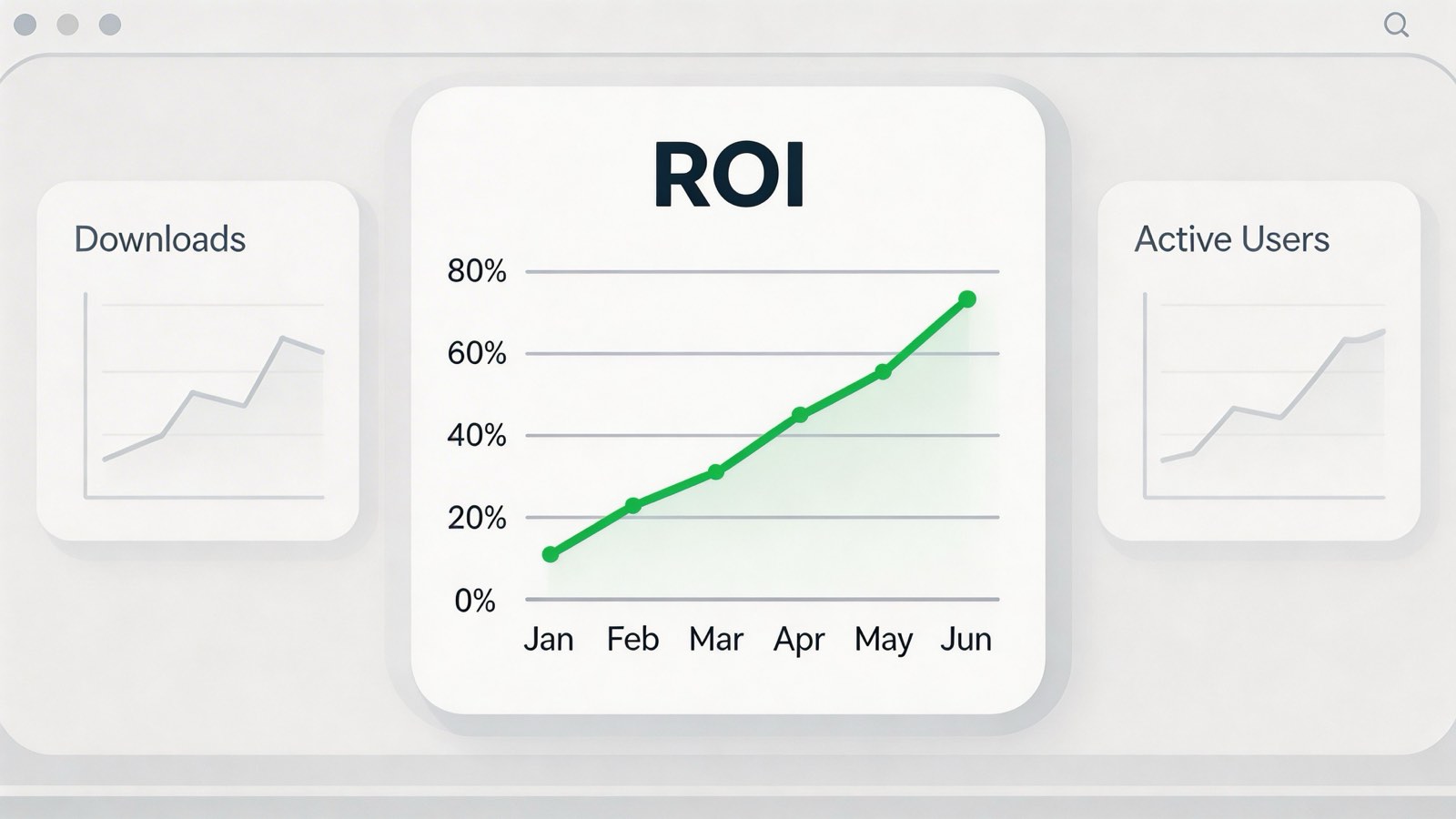
Track authority through a layered dashboard
A practical KPI dashboard for authority should include four layers.
| Layer | What to watch | Why it matters |
|---|---|---|
| Audience growth | Downloads, subscriber trend, episode reach | Indicates whether distribution is gaining traction |
| Engagement quality | Consumption quality, replies, mentions, direct feedback | Shows whether the right people care |
| Lead indicators | Podcast page visits, traffic to linked resources, inbound mentions | Connects attention to intent |
| Business impact | Pipeline influence, sales conversations, “how did you hear about us?” responses | Shows whether authority is affecting revenue |
Qualitative signals matter more than many dashboards admit.
When prospects mention a guest episode on a sales call, when a partner invites your executive to speak, when a recruiter says your company seems visible in the category, those are authority signals. Record them.
Search behavior is one of the clearest downstream indicators
One of the most useful reasons to track authority seriously is that it often shows up in search before it shows up neatly in last-click attribution.
Moz’s analysis of brand authority in search results makes the point clearly. A number one organic result with no SERP features gets about 45% click-through rate, but when that top result earns a feature like sitelinks, the CTR rises to 80%, while the number two result drops to 5% (Moz).
That matters because authority doesn’t only help you rank. It helps you capture attention once you appear.
For B2B teams, that means your podcast and repurposed content can influence branded search, search behavior, and click preference over time. Prospects may not remember the episode title. They do remember your company name when they’re ready to evaluate vendors.
Keep vanity metrics in their place
A show can have respectable downloads and still do little for pipeline. It can also have a smaller audience and produce outsized commercial value because the listeners are precisely the right buyers.
Use a quick distinction:
Vanity signal
“This episode performed well.”Useful signal
“This episode was mentioned by prospects, repurposed by sales, and drove traffic to a high-intent page.”
That’s why marketing teams need attribution notes and narrative context, not just charts.
If you’re building a stronger measurement culture, this guide on measuring content marketing ROI is a useful reference because it pushes reporting closer to business outcomes.
A broader resource that also helps frame the discussion is Truelist’s piece on how to improve marketing ROI, especially for teams trying to connect channel activity to financial efficiency rather than isolated campaign stats.
Use a monthly review that answers three questions
Keep the review simple.
- Are more of the right people finding us?
- Are they engaging with our ideas in meaningful ways?
- Is that trust showing up in pipeline, partnerships, or sales velocity?
If the answer is yes, keep going and sharpen distribution.
If the answer is unclear, the fix usually isn’t “stop podcasting.” It’s one of these:
- The niche is too broad
- The guests are misaligned
- The episodes don’t address buying questions
- Distribution is weak
- Measurement isn’t connected to CRM reality
Measurement lens: Authority ROI isn’t just about what happened on the audio platform. It’s about whether the market starts treating your brand like a serious option.
That’s the standard worth reporting to the C-suite.
Conclusion Your 90 Day Authority Building Roadmap
Many teams don’t need more theory. They need a workable next quarter.
A strong authority program starts small, but it doesn’t start casually. Treat the podcast like an editorial product tied to revenue, not a side project for “brand.”
Days 1 to 30 lock the foundation
Use the first month to make strategic decisions that remove drift later.
- Define the authority niche by audience, problem, and point of view
- Choose 3 to 4 content pillars from sales objections and buyer pain
- Identify the host or hosts who can represent the brand credibly
- Build a guest list with a mix of market voices, customers, and internal experts
- Set the production process for recording, editing, approvals, and publishing
By the end of this phase, you should know exactly who the show is for and why it deserves to exist.
Days 31 to 60 launch the engine
The second month is about creating enough momentum that the show feels real, not tentative.
Record a batch of episodes. Prepare launch assets. Decide how each episode will be repurposed across blog, social, email, and sales channels.
This phase emphasizes discipline most. Keep the format tight. Keep the audience specific. Don’t widen the positioning because you want broader reach.
A narrower show with a stronger point of view builds authority faster than a broad one that tries to please everyone.
Days 61 to 90 tighten the loop
The third month is for signal reading.
Review what topics generated useful conversations. Look at which guests drove the right audience attention. Track whether prospects mention the show, whether sales uses the assets, and whether inbound quality improves.
Then adjust.
You may need sharper episode titles, stronger pre-interviews, better social distribution, or more internal expert participation. That’s normal. What matters is that the system is running and the market is starting to connect your brand with a clear idea set.
If you want to know how to build brand authority in a way that compounds, this is the model that works. Define a sharp niche. Build a podcast around buyer problems. Use guests to expand trust. Repurpose every episode aggressively. Measure authority through business signals, not vanity metrics.
Do that for a quarter and you won’t have “started a podcast.” You’ll have started building the media layer your category already listens to.
If you want help turning that roadmap into a working B2B podcast system, Fame helps companies design, produce, and promote branded podcasts built for authority, qualified pipeline, and long-term market positioning.
Want us to run this for you?
Fame starts and grows B2B podcasts that generate pipeline. Tell us who you are trying to reach and we will send a costed proposal within 1 working day.
Related content
- Read moreFame Team · July 16, 2026
10 Account Based Marketing Tactics For B2B Growth In 2026
Discover 10 actionable account based marketing tactics for B2B tech. Learn to use podcasts, data, and targeted content to close high-value accounts. - Read moreFame Team · July 16, 2026
The 8 Best Brighton Podcast Agency Picks For 2026
Find the best Brighton podcast agency for your B2B brand. Our 2026 guide reviews top 8 agencies for production, growth & ROI. Expert analysis here - Read moreJune 10, 2026
20 Best Podcast Production Agencies For 2026 (And Why Should You Hire One)
Global podcast and vodcast ad revenues are on track to hit $5 billion in 2026 , up 20% year-on-year. - Read moreApril 13, 2026
Leadership In Marketing: The B2B Podcast Playbook
Most companies still confuse leadership in marketing with job titles, org charts, and budget control. That's outdated.