September 19, 202516 min read22 sections
How to Write a Podcast Script That Engages Listeners
By Fame Team
Key Takeaways
- Define the episode's core purpose before writing the script.
- Identify the target audience to create content that resonates with them.
- Align the episode's format with its goal and audience for a solid foundation.
Before you even think about writing dialogue, you need a game plan. So many podcasts fail because they skip the prep work, but a great script always starts by nailing down your episode's core purpose.
What are you actually trying to achieve here? Are you teaching a specific skill, dropping some industry-shaking insights, or just telling a really compelling story? That one decision will shape everything that comes next.
Build a Solid Foundation for Your Script
Look, you can't build a great house on a shaky foundation. The same goes for your podcast script. Getting the fundamentals right before you write makes the whole process smoother and the final product a thousand times better.
It all starts with a simple question: Why does this episode exist?

Once you have that answer, you need to get crystal clear on who you're talking to. Don't just settle for a vague "B2B professional." Seriously, picture them. What’s their job title? What keeps them up at night? What problems are they frantically Googling for answers to? Knowing this is crucial. If you need help, there are great guides on how to determine your online audience that can get you started. This clarity is what stops you from creating generic content that connects with no one.
Finally, you have to match your format to your goal and your audience. A deep-dive solo episode demands a totally different structure than a lively guest interview or a back-and-forth co-hosted chat.
When you align these three things—goal, audience, and format—you create a powerful blueprint. Suddenly, writing the script feels less like a chore and more like a conversation that’s just waiting to happen. To make this even easier, we've put together a comprehensive collection of podcast script templates to help you organize these crucial first steps.
To help you nail this down, think through these core elements before you start scripting. This checklist covers the absolute essentials for a solid episode foundation.
Podcast Script Foundation Checklist
Getting these four pieces locked in will make the actual writing process infinitely easier and more effective.
Define Your Episode Format and Length
Your format and episode length aren't just creative choices; they're strategic ones. And the data backs this up.
Recent studies show that over 53% of aspiring podcasters are aiming for episodes between 20 and 40 minutes long. This isn’t a random number—it’s the sweet spot that aligns perfectly with established listener habits. Hitting this target is a reliable way to meet audience expectations right out of the gate.
The most popular formats also have their own scripting needs:
- Solo Shows (43%): These absolutely require a detailed script. Without one, it's easy to lose momentum, ramble, or get lost. A script is your roadmap.
- Interview-Style (29%): A good interview isn't just a casual chat. It benefits hugely from a script that guides the conversation with well-researched, thoughtful questions.
- Co-hosted Shows (23%): Ever listened to a co-hosted show where one person dominates? A script prevents that. It helps manage the flow and ensures both hosts contribute balanced, valuable insights.
By tailoring your script to your format and intended length, you're setting yourself up to produce a polished, professional episode that keeps people listening from start to finish.
Structure Your Episode from Hook to Outro
The line between a podcast episode that gets skipped and one that gets shared is almost always its structure. You have to think of your script as a road map for your listener. Without a clear path from beginning to end, everyone's going to get lost.
It all starts with a killer hook in the first 30-60 seconds. This is absolutely not the time for a slow, meandering introduction. You need to grab your listener's attention right away. Hit them with a surprising statistic, a bold question, or a relatable problem that makes them need to hear what comes next.
Once you have their attention, the intro sets the stage. Briefly introduce who you are, your guest (if you have one), and nail down the episode's value proposition. What is the listener going to learn or gain by sticking around?
Building the Body of Your Episode
The body is where you deliver on the promise you made in your intro. But please, don't just info-dump. The key is to break your main ideas into distinct, digestible segments that flow logically from one to the next.
Think of each segment as a mini-chapter in your story. Use simple, conversational transitions to connect your points so it feels like a natural conversation, not a checklist. Phrases like, "That brings up an interesting point about..." or "Now that we've covered X, let's dive into Y," work wonders. This methodical approach makes your content so much easier for people to follow and remember.
If you really want to get this right, our guide on creating a winning outline for podcast episodes breaks down a framework you can use for any topic.
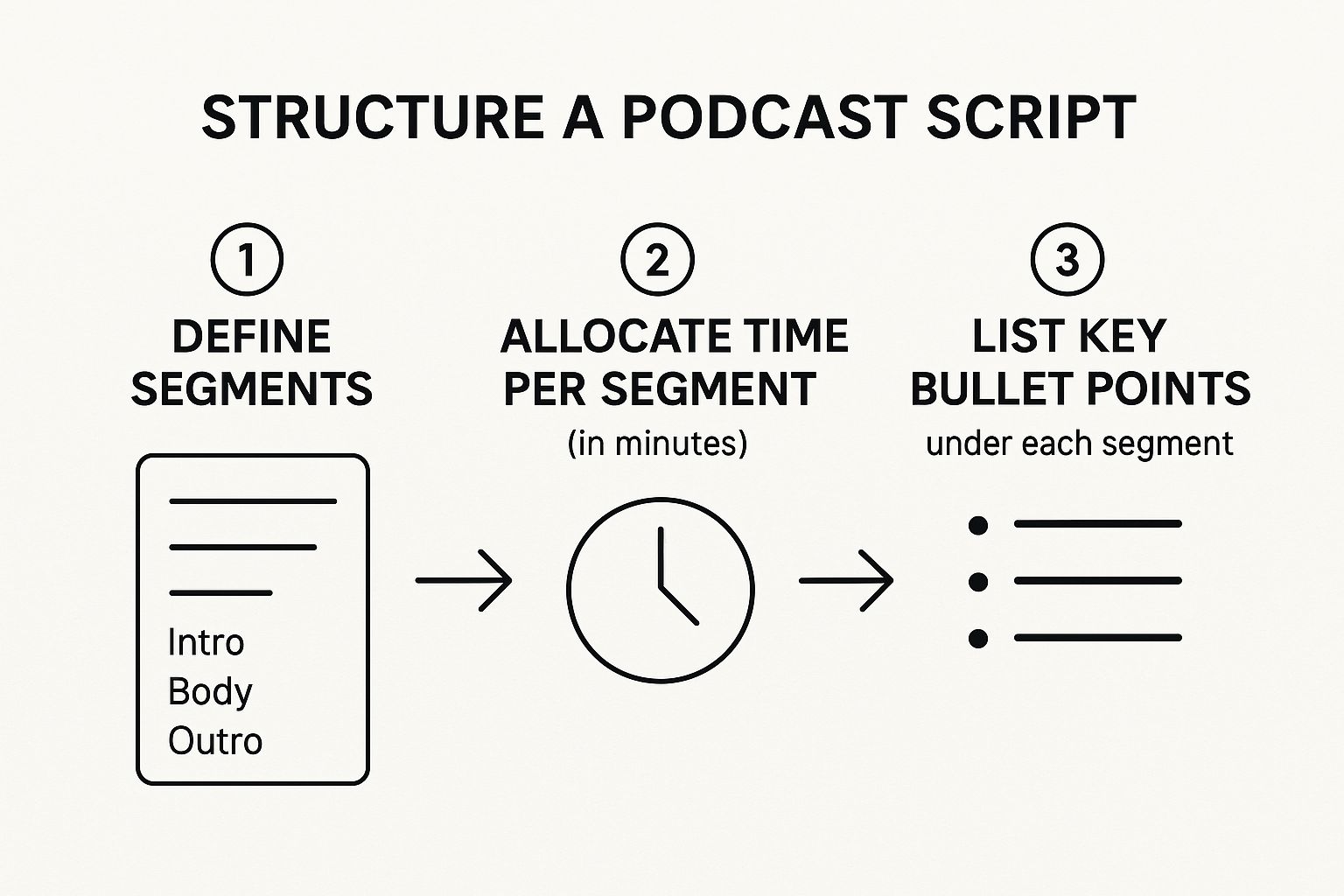
This just shows how effective structuring is a top-down process. You start with the big-picture segments and then fill in the details and timing.
Crafting a Memorable Outro
Finally, a strong outro is just as intentional as your hook. A great outro doesn't just trail off; it wraps everything up neatly and tells the listener exactly what to do next.
A solid outro should accomplish three things:
- Summarize Key Takeaways: Quickly recap the one or two most important points from the episode. What's the one thing they absolutely must remember?
- Provide a Clear Call-to-Action (CTA): What is the single most important action you want them to take? Ask them to subscribe, leave a review, or visit your website for a specific resource. Don't overwhelm them with options.
- Tease the Next Episode: Give them a juicy reason to tune in again next time.
This complete framework—hook, intro, body, and outro—is what transforms a collection of ideas into a cohesive and memorable listening experience. It’s what keeps your audience engaged and, most importantly, coming back for more.
Craft Dialogue That Sounds Natural, Not Rehearsed
The single biggest mistake I see in podcast scripting is writing for the eye instead of the ear.
It's an easy trap to fall into. We've spent our entire lives writing essays and emails, so we naturally lean toward academic language and complex sentences. Stuff that looks impressive on a page.
But when you speak it out loud? It sounds stiff, formal, and totally unnatural. Your goal is to build a connection with your listener, and that starts with sounding like a real human being having a conversation.
This means you need to embrace contractions. Use "you're" and "it's" instead of the stuffy "you are" and "it is." Keep your sentences short and punchy.
Here’s the simplest way to check your work: read every single line out loud. If a phrase feels clunky or awkward to say, trust me, it will sound ten times worse coming through someone's headphones.
Finding Your Scripting Style
Look, not everyone jives with the same type of script. The right approach really depends on your personal style and the episode format. You've basically got two main paths you can go down:
- Word-for-Word Script: This gives you maximum control. It’s perfect for solo episodes where you're delivering dense, specific information and can't afford to miss a beat. The only risk? You can easily sound robotic if you don't practice the delivery until it feels natural.
- Detailed Bullet-Point Outline: This method provides a solid structure but leaves plenty of room for spontaneity. It's my go-to for interviews and co-hosted shows where that conversational back-and-forth is everything. A killer outline is the secret to learning how to conduct a podcast interview that feels both organic and focused.
The key isn't to pick one style and marry it forever. You should absolutely experiment. I've found a hybrid approach often works best—maybe you script your intro and outro word-for-word but use bullet points for the main body of the episode.
This idea of creating authentic connections is something we live and breathe. It's right there in the philosophy of our founder, Tom Hunt, who believes that building real human relationships is the foundation of modern B2B growth.

This focus on building real relationships is the core of effective B2B podcasting. Your script needs to reflect that by being approachable and genuine, not corporate and rehearsed.
Ultimately, you're trying to build a structure that supports your conversation without killing the authentic spark that actually builds a loyal audience.
Master Advanced Scripting for B2B Podcasts
Scripting for a B2B audience is a different ball game. You're not just whipping up some content; you're building a business case and wrapping it in a story that actually holds someone's attention.
Your listeners are sharp professionals. Their time is their most valuable asset. Your script has to deliver real substance without sounding like a college lecture. The end goal? Turn your podcast from just another content piece into a strategic asset that builds authority and brings in real business.
Weave Data and Stories Together
This is where the magic happens in advanced B2B scripting: seamlessly weaving your proof points right into the narrative.
Don't just drop a statistic and move on. Use it to set the stage for a story. Instead of rattling off a list of product features, walk your audience through a case study where a relatable customer solves a problem that your listeners are dealing with right now.
This simple shift turns abstract ideas into tangible solutions. You’re showing, not just telling, which makes complex business challenges feel personal and your solutions feel essential. It’s a crucial technique for developing specialized B2B podcast content that actually connects.
Here’s how to put it into practice:
- Data Points: Use stats to give your claims some weight. Something like, "We know 75% of B2B buyers use podcasts for research, which is exactly why we're digging into..."
- Expert Quotes: Pull in quotes from respected industry leaders. It's an easy way to borrow credibility and back up your perspective.
- Case Studies: Dedicate a whole segment to a quick, punchy customer success story.
This blend of hard data and human stories is what will keep a sharp, professional audience leaning in.
Strategically Place Your Calls to Action
In B2B podcasting, the call-to-action (CTA) can't be an afterthought you tack on at the end. It has to feel like the natural next step after all the value you just delivered.
Your CTAs should tie directly to your business goals, moving listeners from just listening to actively doing something.
Forget the generic "visit our website." Make it specific. Make it contextual. If you just spent 15 minutes breaking down a marketing framework, your CTA should be an invitation to download a template or whitepaper on that exact framework.
A well-placed CTA bridges the gap between the episode's educational content and your company's sales funnel. The goal is to make the next step feel like a logical continuation of the learning experience, not a sales pitch.
When you nail this, your podcast becomes a seriously powerful tool for bringing in qualified leads.
Look, the podcasting world is crowded. There are an estimated 4.52 million podcasts out there, but the telling number is that only about 500,000 are actively putting out new content. Shows burn out. They fail to keep listeners engaged and just… fade away.
A killer B2B script, packed with great stories and smart CTAs, is your best defense. It's how you stand out from the noise and keep your audience coming back.
Refine Your Script and Prepare for Recording
Let’s be honest: your first draft is never the final product. It’s just the raw material. The real magic happens when you start refining that script, polishing your ideas until they shine, and setting yourself up for a killer recording session.
Think of it as a multi-stage editing process. First up, you need to be absolutely ruthless with your content. Read through your script with just one question in mind: does this sentence, this paragraph, this whole section actually serve the episode's main goal? If it doesn’t add real value or push the conversation forward, it has to go. Cut it. Your listeners' time is precious, so make every single word count.
The All-Important Aloud Read
Next comes the non-negotiable step: you must read the entire script out loud. What looks perfect on the page can sound incredibly clunky and unnatural when spoken. I can't stress this enough.
Reading your script aloud is the fastest way to catch:
- Awkward Phrasing: You'll immediately spot sentences that make you stumble or just feel off.
- Run-On Sentences: Long, winding sentences are a nightmare for listeners to follow. This is your chance to break them up into something more digestible.
- Unnatural Dialogue: Does it sound like a real human talking, or did you accidentally write a corporate memo? Adjust the language to sound more conversational and authentic.
This is the moment your script starts to transform from mere text into a real performance.
Preparing for Guests and Production
If you're bringing a guest on, sending them a clear, concise outline beforehand is critical. It sets expectations, helps them prepare their best insights, and avoids any awkward surprises live on the mic. It’s a best practice we see time and again from top-tier B2B podcast production agencies—they know that a little pre-interview alignment leads to a much smoother, more valuable conversation.
This collaborative spirit is really a core value for the best in the business, including our partners like Flowjin, who help turn long-form content into engaging short-form video, demonstrating the power of smart content partnerships.
This just goes to show how top agencies build their entire model around collaboration to create high-quality B2B content, reinforcing just how important guest prep really is.
Finally, start adding production cues directly into your script. These are just simple notes for your future self or your audio editor.
Mark spots for [INTRO MUSIC], [SOUND EFFECT], or [TRANSITION STING]. This simple habit makes the handoff from script to recording seamless, saves a ton of time in post-production, and ultimately results in a far more polished final episode.
Turn Your Script into a Marketing Engine
Your podcast script’s job isn’t over once you hit stop on the recording. In fact, its most important work might just be starting. That document is a goldmine of marketing content waiting to be excavated, fueling your entire promotional strategy long after the episode airs.
Thinking about a promotion strategy from the scripting stage ensures your content is built to travel. This is where comprehensive podcast marketing services for B2B startups become invaluable, as they help integrate promotion into the very fabric of content creation. By planning for repurposing from the start, you can systematically turn a single recording into a multi-channel campaign, ensuring your corporate podcast reaches its full potential.
What are the benefits of investing in B2B podcast promotion?
Investing in B2B podcast promotion is crucial for cutting through the noise. The primary benefits include:
- Increased Brand Authority: Consistent, high-quality content positions your brand as a thought leader.
- Lead Generation: Strategic CTAs and targeted promotion attract qualified leads who are actively interested in your expertise.
- Audience Growth: Promotion expands your reach beyond your existing network, capturing new listeners who fit your ideal customer profile.
- Content ROI: It maximizes the return on your content creation efforts by ensuring the podcast is actually seen and heard by the right people.
What are effective B2B podcast promotion strategies?
Effective B2B podcast promotion strategies are multi-faceted. They include:
- Content Repurposing: Turning episode scripts into blog posts, audiograms, and quote graphics for social media. This is a core function of our B2B social media agency services.
- Email Marketing: Sharing new episodes and key takeaways with your subscriber base through a dedicated newsletter, a service we also specialize in with our B2B email newsletter agency.
- Guest Collaboration: Leveraging your guest's audience by making it easy for them to share the episode.
- Paid Amplification: Using targeted ads on platforms like LinkedIn to reach specific job titles and industries.
- Community Engagement: Sharing your episode in relevant online communities and forums where your target audience gathers.
For a lot of these tactics, the first move is simple: transcription. When you convert your podcast audio to text, you create a searchable document that makes finding these little content nuggets a breeze.
When you get this process dialed in, you can systematically turn episode highlights into a steady stream of engaging posts that drive real audience growth. This is exactly how podcast marketing services help in audience growth and boost your company's visibility—by turning a single recording into a multi-channel campaign. Smart content repurposing strategies are the key to unlocking this potential and truly maximizing your podcast's ROI.
Your Top Podcast Scripting Questions, Answered
Even the most seasoned podcasters run into questions when the time comes to actually write the script. Let's tackle some of the most common ones we see from B2B creators.
How Long Should a Podcast Script Be?
There’s no magic number here. But if you need a starting point, a good rule of thumb is 150-160 words per minute of talk time.
So, for a standard 20-minute B2B episode, you're looking at a script that’s roughly 3,000 to 3,200 words long.
Keep in mind, this can shift quite a bit depending on your natural speaking pace and the show's format. The real goal is to have a script that fits your target episode length without you having to either rush through it or stretch out segments to fill time.
Should I Script Word-for-Word or Just Use Bullet Points?
This really comes down to your personal style and, more importantly, the format of the specific episode you're creating.
- Word-for-Word: This is your best bet for solo episodes, especially when you need to deliver dense, technical information with precision. It gives you maximum control over the narrative, but it takes some real practice to deliver it without sounding like you're just reading off a page.
- Bullet Points: Absolutely ideal for interviews and co-hosted shows. This approach acts as a guide, keeping the conversation on track while leaving plenty of room for those spontaneous, authentic moments that make for a great listen.
Honestly, most podcasters we work with land on a hybrid model. They'll fully script the intro and outro to nail the branding and calls to action, then use a detailed bullet-point outline for the main discussion.
What packages do B2B podcast promotion services typically offer?
B2B podcast promotion services typically offer packages that bundle various tactics to maximize reach and impact. Common offerings include:
- Basic Package: Often includes audio editing, show notes creation, and basic social media asset generation (e.g., audiograms, quote cards).
- Growth Package: Builds on the basic offering with more extensive content repurposing, such as creating blog posts from episodes, LinkedIn article distribution, and email newsletter content.
- Full-Service/Authority Package: This is the most comprehensive option, encompassing all of the above plus strategic guest outreach, paid ad management, PR and media placement, and detailed performance analytics to guide strategy. These packages are designed to turn a podcast into a primary engine for brand authority and lead generation.
What’s the Best Way to Write for a Co-Host or Guest?
When you bring someone else onto the mic, your script transforms from a personal document into a shared roadmap. Collaboration is everything.
If you have a co-host, the key is to clearly assign different sections or talking points. This creates a natural back-and-forth, ensures a balanced conversation, and, crucially, stops you from accidentally talking over each other.
For a guest, the rules change completely. Never, ever hand them a full script.
Instead, send them a clean, concise outline with the main topics and key questions a few days before you record. This gives them just enough structure to prepare their best insights without making them sound rehearsed. The result is a far more dynamic and valuable conversation for everyone, especially your audience.
At Fame, we turn these scripting principles into a repeatable system for creating authority-building B2B podcasts. See how our agency can help you craft compelling episodes that drive real business results at https://www.fame.so.
Want us to run this for you?
Fame starts and grows B2B podcasts that generate pipeline. Tell us who you are trying to reach and we will send a costed proposal within 48 hours.
Related content
- Read moreFame Team · July 16, 2026
10 Account Based Marketing Tactics For B2B Growth In 2026
Discover 10 actionable account based marketing tactics for B2B tech. Learn to use podcasts, data, and targeted content to close high-value accounts. - Read moreFame Team · July 16, 2026
The 8 Best Brighton Podcast Agency Picks For 2026
Find the best Brighton podcast agency for your B2B brand. Our 2026 guide reviews top 8 agencies for production, growth & ROI. Expert analysis here - Read moreJune 10, 2026
20 Best Podcast Production Agencies For 2026 (And Why Should You Hire One)
Global podcast and vodcast ad revenues are on track to hit $5 billion in 2026 , up 20% year-on-year. - Read moreApril 13, 2026
Leadership In Marketing: The B2B Podcast Playbook
Most companies still confuse leadership in marketing with job titles, org charts, and budget control. That's outdated.