January 14, 202622 min read10 sections
Boost Your Brand With B2B Public Relations Strategies That Drive Growth
By Fame Team
Key Takeaways
- A great B2B product is not enough to secure market leadership without a strong narrative and authority.
- To build a strong narrative, businesses need to adopt multi-faceted strategies that include PR, content marketing, and analyst relations.
- Launching a branded podcast is an effective way to control the narrative, build trust, and position a company as the leading voice in its industry.
In the crowded B2B marketplace, a great product isn't enough to secure market leadership. Success demands a powerful, controlled narrative and unwavering authority. Conventional public relations tactics, centered around press releases and sporadic media mentions, fall short of this goal. To capture the attention of sophisticated buyers and influence high-stakes decisions, modern marketing and demand-generation teams need a multi-faceted approach. The right strategy builds deep credibility, shapes market perception, and directly contributes to the sales pipeline.
This guide moves beyond generic advice to deliver ten actionable B2B public relations strategies you can implement immediately. We will explore how to integrate PR with content marketing, leverage analyst relations for third-party validation, and build influential partnerships. Each strategy is designed to transform your PR function from a simple media-mention generator into a strategic engine for brand authority and sustainable growth.
We will place a special focus on one of the most effective modern tools for narrative control: the B2B podcast. Creating a branded podcast allows you to become the primary source of education in your industry, positioning your company as the definitive thought leader. When your ideal clients are ready to buy, they will inevitably think of the trusted voice that guided them. This approach not only builds immense trust and loyalty but also creates a powerful content engine that fuels all your other marketing efforts. Let's dive into the strategies that will redefine your brand's influence.
1. Launch a Branded Podcast to Own Your Narrative
One of the most powerful b2b public relations strategies available today is launching a branded podcast. This approach allows you to control the narrative in your market, directly educate your potential customers and peers, and establish your brand as the leading voice in the industry. By consistently delivering value, you build deep trust and loyalty, ensuring your ideal clients think of you first when they're in the market. A podcast also becomes a central content engine, generating material that can fuel all your marketing efforts.

A branded podcast serves as a powerful platform for showcasing your company's proprietary insights and positioning your executives as definitive thought leaders. When potential customers are evaluating solutions, your brand becomes their primary source of trusted information. This model has been successfully used by companies like HubSpot with The Growth Show and Salesforce to bolster executive visibility. By consistently delivering value, you create a loyal following and a sustainable source of content that can be repurposed across all marketing channels.
How to Implement This Strategy
- Define Your Niche and Angle: Center your podcast's theme around a specific pain point or area of expertise unique to your brand. Your goal is to own a specific conversation in your industry.
- Plan Your First 10 Episodes: Before recording, outline the topics and potential guests for your first batch of episodes. This ensures a strong, consistent start and helps you refine your show's format.
- Invest in Quality Production: Poor audio quality can undermine your credibility. Get the right equipment needed for a podcast and establish a clear podcast production workflow to ensure every episode sounds professional.
- Promote and Repurpose Relentlessly: Your podcast is a content goldmine. Turn each episode into blog posts, social media video clips (using a service like Fame's B2B Social Media Agency), and LinkedIn articles to fuel your broader marketing efforts. Promote it to your list with a dedicated B2B Email Newsletter Agency service.
Expert Insight: "A B2B podcast is the best way to elevate your position in the market and control the narrative about your brand and industry. You educate your potential customers and your peers, be seen as the leading voice in the industry, then your ideal clients will think of you when they're in the market. It's a great way to build trust and loyalty and to create a content engine for your marketing efforts." - Tom Hunt, Founder of Fame
This strategy is particularly effective for B2B tech and service companies seeking to establish market authority and create a measurable pipeline from their content. Agencies like Fame specialize in managing the entire B2B podcast production workflow, from initial concept to promotion, helping brands build and grow their audience.
2. Strategic Guest Placement and Expert Positioning
Another highly effective b2b public relations strategy is securing placements for your executives on established third-party platforms. This approach focuses on positioning your key leaders as guests on high-authority industry podcasts, analyst briefings, and influential live events. By borrowing the credibility of trusted external channels, you can rapidly amplify your brand's reach, validate its expertise, and connect with engaged, high-intent audiences in a context they already trust.
Strategic guesting allows your brand to insert its unique perspective into ongoing industry conversations without the overhead of building an audience from scratch. When Okta executives appear on leading security podcasts or Stripe founders discuss the future of finance on entrepreneurship platforms, they tap into pre-existing communities. This third-party validation is often more powerful than owned media, as it acts as an implicit endorsement from a trusted source, accelerating trust with potential buyers.
How to Implement This Strategy
- Develop Core Narratives: Define 2-3 compelling story angles for your executives that align with key business milestones. These narratives should be concise, insightful, and offer genuine value to a new audience.
- Build a Targeted Media List: Curate a list of 30-50 high-impact podcasts and platforms that your ideal customers follow. Vet each opportunity based on listener profile, audience size, and engagement metrics to ensure alignment.
- Craft a Winning Pitch: Your pitch should be personalized and value-driven. Clearly state what unique insights your executive will bring to their audience and suggest 2-3 specific topics they can cover.
- Prepare Your Executive: Don't just show up. Ensure your speaker is thoroughly prepared by reviewing the host's previous episodes and understanding their audience. Provide them with a brief outlining key talking points and goals. Learn more about how to prepare for your next podcast guest appearance.
- Amplify Every Appearance: After a guest spot goes live, promote it across all channels. Share clips on LinkedIn, send a dedicated email to your newsletter subscribers, and embed the audio or video in relevant blog posts to maximize its impact. For more tips, you can learn about establishing thought leadership with podcast appearances on fame.so.
Expert Insight: "Being a guest on a relevant, respected podcast allows you to borrow trust and access an audience that would take years to build on your own. It's the ultimate PR shortcut for establishing authority and driving qualified inbound interest."
This strategy is ideal for B2B scale-ups and established enterprises aiming to increase executive visibility and influence buying decisions. By systematically placing leaders on the right platforms, you can directly link PR efforts to brand awareness and pipeline generation.
3. Audience Segmentation and Niche Market Targeting
One of the most effective b2b public relations strategies is moving away from a one-size-fits-all approach and adopting a data-driven model of audience segmentation. This involves identifying and targeting specific buyer personas, industries, and decision-making groups with highly tailored messaging and content. This precision ensures your PR efforts resonate deeply, maximize relevance, and drive higher conversion potential by speaking directly to the unique challenges of each niche market.

This strategy replaces broad, generic outreach with surgical precision, allowing brands to build authority within high-value verticals. For example, Slack's messaging is carefully differentiated for IT, sales, and HR teams, while Okta tailors its security-focused content for financial services versus healthcare verticals. By addressing specific pain points and use cases, these companies ensure their public-facing narrative aligns perfectly with the conversations their sales teams are having, accelerating the buyer's journey.
How to Implement This Strategy
- Validate Buyer Personas: Interview your top 20 customers to understand their true decision-making criteria, media consumption habits, and the specific language they use to describe their problems.
- Map Media Consumption: Identify the exact podcasts, newsletters, and industry publications each segment trusts. A CIO in fintech consumes different content than a marketing VP in SaaS.
- Create Segment-Specific Pitches: Develop guest pitch narratives that address the unique pain points and success metrics for each target buyer. Generic pitches get ignored; hyper-relevant ones get booked.
- Develop a Sales Feedback Loop: Work closely with sales teams to validate that PR-generated messaging and content resonate in actual deal conversations and address common objections.
Expert Insight: "Blanket PR campaigns are a waste of resources. The real ROI comes from deeply understanding a specific audience segment and tailoring every piece of communication to their world. When a prospect feels like you're speaking directly to them, trust is built instantly."
This approach is essential for B2B companies practicing account-based marketing (ABM) or targeting specific high-growth industries. It ensures PR investments directly support pipeline goals by focusing influence where it matters most, making every message count.
4. Integrated Content Marketing and PR Synergy
One of the most effective b2b public relations strategies is to stop treating PR and content marketing as separate functions. An integrated approach creates a unified brand narrative where every asset, from a media placement to a podcast episode, reinforces core business messages. This synergy transforms disjointed marketing activities into a powerful, cohesive ecosystem that nurtures buyers and builds market authority.
When PR and content work in tandem, your earned media placements don't just generate backlinks; they drive traffic to high-value content hubs. This model has been perfected by B2B leaders like HubSpot and Drift, where a podcast topic becomes a blog series, which then fuels social media campaigns and newsletter content. By creating this flywheel, brands maximize the ROI of every single content piece, ensuring a consistent and authoritative presence across all channels where their ideal customers are active.
How to Implement This Strategy
- Create a Master Content Calendar: Plan your content six months in advance, aligning podcast episodes, blog posts, and PR pitches with key business milestones, product launches, or industry events.
- Establish a Repurposing Workflow: Institute a system where one core asset, like a podcast episode or industry report, is systematically deconstructed into at least five derivative assets (blog posts, social clips, LinkedIn articles, email sequences).
- Use Guests as Source Material: Leverage the unique insights from your podcast guests as primary source material for SEO-optimized blog posts, data-driven reports, and social media thought leadership.
- Track the Full Journey: Implement analytics to track the customer journey from initial content discovery, whether a podcast or a blog, all the way through to a demo request or conversion event to measure true ROI.
Expert Insight: "Your PR and content strategies shouldn't operate in silos. Every piece of content you create should be a potential PR asset, and every media mention should drive audiences back to your content ecosystem. This integrated flywheel is how you build sustainable brand authority and measurable demand."
This unified strategy is essential for any B2B company looking to dominate its niche. Instead of one-off wins, you build a compounding content engine where each part amplifies the others. This ensures your message is not only heard but is also consistently reinforced across every touchpoint.
5. Analyst Relations and Third-Party Validation
Among the most influential b2b public relations strategies is a targeted focus on analyst relations and third-party validation. This involves building strategic relationships with key industry analyst firms like Gartner, Forrester, and IDC to secure favorable mentions in their reports, which heavily influence enterprise buying decisions. This validation acts as a powerful, unbiased endorsement that builds immense credibility and can significantly shorten sales cycles by providing prospects with the confidence to choose your solution.
Securing a leadership position in a Gartner Magic Quadrant or Forrester Wave report provides instant market authority. Okta, for example, cemented its dominance in the Identity and Access Management (IAM) space through consistent high placement in these reports, making it a default choice for many enterprise buyers. Similarly, Datadog's rapid ascent was bolstered by early and positive recognition from analysts. This strategy is critical for B2B tech companies competing in crowded markets, as it provides a clear differentiator that marketing and sales teams can leverage across all communications.
How to Implement This Strategy
- Identify Key Analysts: Focus your resources by identifying the top 2-3 most influential analyst firms and specific analysts covering your category.
- Create a Briefing Calendar: Develop a 12-month calendar of analyst briefing opportunities, aligning your outreach with major product launches and key report publication schedules.
- Arm Executives with Data: Prepare your leadership and product experts for analyst conversations with clear, data-backed positioning narratives that align with the analysts' evaluation criteria.
- Amplify Every Mention: Promote any positive analyst report mentions, awards, or validations through press releases, social media, website badges, and dedicated sales enablement materials.
Expert Insight: "Third-party validation from respected industry analysts is a game-changer in B2B. It's not just about PR; it's about influencing the entire buyer's journey. When a trusted firm like Forrester validates your solution, it removes a huge layer of friction and doubt for potential customers."
This approach is especially vital for enterprise software and platform companies where purchase decisions involve high stakes and multiple stakeholders. By systematically engaging with the analyst community, you can shape your market's perception and establish an enduring competitive advantage.
6. Influencer and Key Opinion Leader (KOL) Partnerships
One of the most authentic b2b public relations strategies is to partner with trusted, independent voices in your industry. This approach involves collaborating with recognized experts, academics, and Key Opinion Leaders (KOLs) who have already earned the respect and attention of your target audience. By aligning your brand with these credible figures, you can amplify your message, gain third-party validation, and build trust far more effectively than through direct advertising alone.
This strategy moves beyond transactional influencer marketing to build genuine, value-driven relationships. Instead of just paying for posts, B2B brands can co-create valuable content, establish advisory roles, or feature KOLs in keynotes and webinars. For example, GitLab successfully leverages this model by building strong relationships with DevOps community leaders, while Datadog partners with cloud infrastructure experts to reinforce its market authority. These partnerships provide a powerful endorsement that resonates deeply with sophisticated B2B buyers.
How to Implement This Strategy
- Identify Aligned Experts: Pinpoint 5-10 recognized experts whose focus and audience genuinely align with your brand's vision. Look for authenticity and engagement over sheer follower count.
- Start with Small Collaborations: Begin the relationship with lower-commitment activities like a guest appearance on your podcast or a joint LinkedIn Live session before proposing larger partnerships.
- Co-Create High-Value Content: Work with KOLs to develop in-depth whitepapers, research reports, or webinar series. This ensures the content serves both your audience and theirs, creating a win-win scenario.
- Provide Genuine Value: Offer partners early access to products, opportunities to provide feedback that shapes your roadmap, and insights they can use. True partnership value extends far beyond monetary compensation.
Expert Insight: "Authentic B2B partnerships are built on mutual respect and shared value. When you align with a Key Opinion Leader, you're not just renting their audience; you're borrowing their credibility. Focus on creating something meaningful together, and the brand amplification will follow naturally."
This strategy is ideal for B2B companies in specialized or technical fields where trust and expertise are paramount. By building a network of credible advocates, you create a defensible moat of authority that directly impacts brand perception and pipeline. For those looking to dive deeper, you can learn more about how to leverage influencer marketing for B2B brands.
7. Events, Speaking Engagements, and Conference Strategy
One of the most effective b2b public relations strategies involves positioning company executives as sought-after speakers at industry events, trade shows, and virtual conferences. This approach transforms thought leadership from a concept into a tangible, high-impact activity. By securing spots on prominent stages, brands can directly access their target buyers, generate valuable media coverage, and build undeniable authority in their market.
A strategic speaking program allows you to bypass traditional marketing channels and speak directly to a captive audience of potential customers, partners, and journalists. It establishes a powerful feedback loop where your experts share insights, gain credibility, and bring back market intelligence. Companies like Stripe have masterfully used keynotes at fintech conferences to introduce new products and shape industry narratives, while Okta’s presence at security events reinforces its position as an enterprise leader.
How to Implement This Strategy
- Create a Target Event Calendar: Identify 8-12 key industry events per year where your ideal customer profile congregates. Prioritize events based on audience quality over size.
- Develop Core Speaking Topics: Craft 3-4 compelling, non-promotional talk tracks that address major industry challenges. These topics should highlight your company's unique expertise, not just its product features.
- Invest in Executive Coaching: Ensure your designated speakers are polished, engaging, and capable of delivering a presentation that reporters will want to cover. A powerful delivery is as important as powerful content.
- Maximize Media Opportunities: Schedule pre-event briefings with attending journalists to preview the talk and coordinate post-event interviews to follow up on key themes. This extends the PR value far beyond the live session.
Expert Insight: "Securing a speaking slot at a key industry conference is a PR grand slam. It provides a platform to share your unique perspective, a room full of your target buyers, and a clear signal to the media that your brand is a definitive voice worth listening to."
This strategy is ideal for B2B companies looking to accelerate brand awareness, build executive credibility, and create high-value content. Recorded sessions can be repurposed into a wealth of marketing assets, including LinkedIn video clips, blog posts, and even podcast episodes, ensuring the impact of each speaking engagement continues long after the event concludes.
8. Media Relations and Press Coverage Strategy
A foundational pillar of b2b public relations strategies is a dedicated media relations program focused on building authentic relationships with journalists, editors, and key media outlets. The goal is to secure high-value earned media coverage that provides powerful third-party credibility and expands your audience reach far beyond owned channels. This strategy validates your market position and builds trust with prospects, partners, and investors.
Unlike paid advertising, earned media acts as an unbiased endorsement of your company's expertise and innovation. When a respected publication covers your product launch or features your CEO's insights, it signals to the market that your brand is a noteworthy player. This approach has been critical to the growth of companies like Stripe and Notion, which consistently secured coverage in top-tier tech and business press during their scaling phases, cementing their status as industry leaders.
How to Implement This Strategy
- Build a Curated Media List: Develop and maintain a targeted list of 50-100 journalists who actively cover your industry. Track their beats, recent articles, and contact information to ensure relevance.
- Develop Newsworthy Narratives: Instead of constant product pitches, focus on creating 3-4 genuinely compelling stories per quarter. These can be built around funding announcements, proprietary market research, significant product launches, or major customer milestones.
- Personalize Every Pitch: Tailor each outreach email to the specific journalist. Reference their past work and clearly explain why your story is a perfect fit for their audience, demonstrating that you’ve done your homework.
- Amplify Every Win: Maximize the impact of each media placement by sharing it across your social media channels, including it in your email newsletter, and equipping your sales team with the article to use in their outreach.
Expert Insight: "Media relations is about playing the long game. It's not about one-off press releases; it's about becoming a trusted source for reporters covering your space. When you consistently provide value and unique insights, you become their first call when a relevant story breaks."
This strategy is essential for B2B companies aiming to build brand credibility, influence buyer perception, and gain a competitive edge. While media relations requires persistence, the ROI from a single well-placed article in a top-tier publication can often surpass that of a much larger paid campaign. Building these media relationships is just as crucial as securing guest spots on relevant shows, as both contribute to a well-rounded PR presence. You can get booked on podcasts to further amplify your message.
9. Community Building and User-Generated Content Strategy
Among the most authentic b2b public relations strategies is the development of a thriving brand community. This approach shifts the focus from brand-centric monologues to customer-centric dialogues, transforming your company into a hub where users, advocates, and industry practitioners can connect, learn, and create. By fostering a sense of belonging, you empower your most passionate users to generate content, share insights, and become a credible, peer-to-peer extension of your PR efforts.
A strong community generates a powerful flywheel of user-generated content (UGC), social proof, and organic advocacy that traditional PR cannot replicate. Instead of the brand telling the market how great its product is, the community shows it through shared templates, tutorials, and success stories. This model has been masterfully executed by companies like Notion, whose enthusiasts create and share productivity hacks, and Figma, whose design community collaborates and showcases its work, amplifying the brand's value proposition with every interaction. To foster long-term relationships and advocacy, leveraging robust enterprise loyalty software can be a critical strategy.
How to Implement This Strategy
- Define a Clear Purpose: Build your community around a shared interest or goal that genuinely serves your customers, not just product promotion. Focus on education, collaboration, or professional development.
- Invest in Platforms and Moderation: Choose the right platform (e.g., Slack, Circle, or a dedicated forum) and invest in community management to ensure a safe, engaging, and valuable space.
- Spotlight Community Members: Actively feature user stories, celebrate customer successes, and give your most active members a platform through webinars, guest content, or advisory boards.
- Facilitate Contributions: Create structured opportunities for users to contribute, such as template libraries, open-source projects, or community-led events, making them co-creators of brand value.
Expert Insight: "Community isn't just a support channel; it's a strategic PR asset. When your customers become your best advocates, their authentic voices build trust and credibility far more effectively than any corporate press release ever could. Empower them, and they will build your brand for you."
This strategy is highly effective for B2B SaaS and product-led growth companies that rely on user adoption and network effects. By building a space for users to succeed together, brands can cultivate a loyal following that drives both retention and new customer acquisition. For an inside look at this approach, you can learn more about building community with a technical audience.
10. Data-Driven Research and Industry Insights Publishing
One of the most authoritative b2b public relations strategies is to become the source of the story by conducting and publishing original research. This approach involves gathering proprietary data, analyzing industry trends, and creating comprehensive reports that offer novel insights. By generating newsworthy, quotable findings, your brand can secure high-quality media coverage, fuel executive thought leadership, and generate invaluable inbound links.

Instead of commenting on existing narratives, you create them. This positions your company as a definitive expert and an indispensable resource for journalists, analysts, and potential customers. Market leaders like HubSpot with their annual State of Marketing report and Slack with its research on workplace productivity have mastered this strategy. They consistently produce data that the entire industry references, building a powerful moat of credibility that is difficult for competitors to replicate. For those looking to deepen their understanding of how data and AI can inform industry insights and research, an AI company's blog can offer valuable perspectives like these Data-Driven Insights for PR from an AI Blog.
How to Implement This Strategy
- Identify a Knowledge Gap: Select a research topic that addresses a genuine, pressing challenge for your target audience. Avoid self-serving narratives and focus on delivering true value.
- Ensure Methodological Rigor: Your data's credibility is paramount. Use a statistically significant sample size and be transparent about your methodology to ensure journalists feel confident citing your findings.
- Develop a Pre-Launch Media Plan: Don't wait until the report is published. Build a targeted media list, offer embargoed access to key journalists, and pre-schedule executive interviews to maximize launch-day impact.
- Atomize the Content: A single report should fuel months of content. Repurpose the key findings into a webinar series, multiple blog posts, social media infographics, and podcast episodes to extend the campaign's lifespan. You can learn more about creating thought leadership from data and how to extend its reach.
Expert Insight: "Proprietary data is the ultimate PR asset. When you own the data, you own the story. Journalists are always looking for fresh statistics to anchor their articles, and a well-executed research report makes your brand their go-to source, generating high-authority backlinks and media mentions."
This strategy is ideal for established B2B brands seeking to cement their market leadership or for ambitious scale-ups aiming to disrupt an industry by introducing a new, data-backed perspective. It provides a defensible foundation for your entire content and communications program.
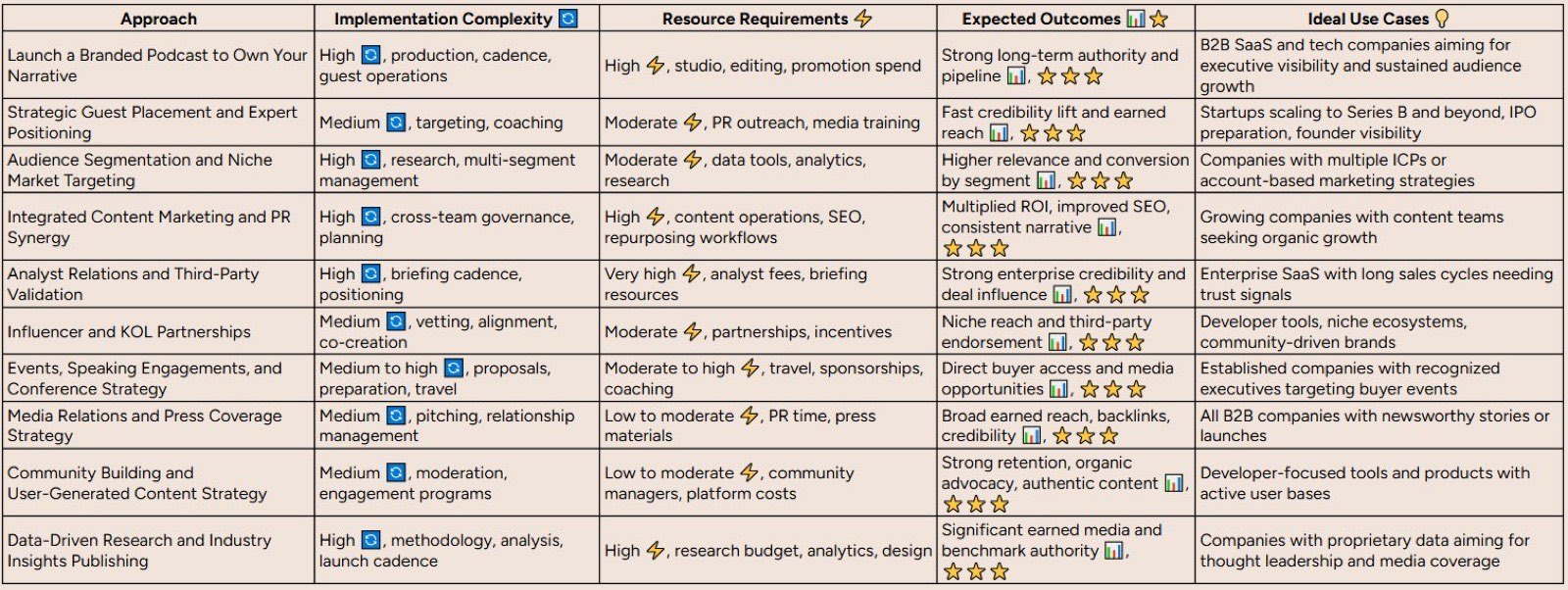
B2B PR Strategies: 10-Point Comparison
Putting Your B2B PR Strategy into Action
The landscape of B2B marketing has shifted. Standing out requires more than just a solid product or service; it demands a powerful, resonant voice that cuts through the noise. As we've explored, the most effective b2b public relations strategies are no longer about isolated press releases or sporadic media mentions. They are about building an integrated, multi-channel engine that establishes authority, builds trust, and directly contributes to your demand generation pipeline.
From leveraging data-driven research to dominate industry conversations, to building robust analyst relations that provide third-party validation, each strategy detailed in this article serves a distinct purpose. They are not mutually exclusive tactics but interconnected components of a holistic brand-building machine. The synergy between them is where the real magic happens: a guest appearance on an influential podcast can be amplified through your content marketing, which in turn can be supported by data from your proprietary industry report, ultimately catching the eye of key media figures and analysts.
From Strategy to Execution: Your Next Steps
The journey from understanding these strategies to implementing them successfully can seem daunting. The key is to move from a theoretical appreciation to a practical, phased approach. Here’s a simple framework to get started:
- Audit and Align: Begin by auditing your current PR and marketing efforts. Where are the gaps? Which of the strategies outlined here aligns most directly with your immediate business goals, whether that's lead generation, market positioning for an IPO, or establishing a new category?
- Select a Cornerstone Strategy: Instead of trying to do everything at once, choose one or two cornerstone strategies to master first. For many B2B firms, this is where an audio-first approach, like a branded podcast, offers an unparalleled advantage. It allows you to control the narrative, build an intimate connection with your audience, and create a powerful content engine that fuels all other marketing activities.
- Build Your Content Engine: A podcast, as highlighted, isn't just an audio file; it's a source of immense content potential. Each episode can be repurposed into blog posts, social media clips, quote graphics, and newsletter highlights. This integrated approach ensures your core messages reach your audience across multiple touchpoints, reinforcing your authority and maximizing ROI.
- Measure, Iterate, and Scale: Implement the right KPIs from the outset. Track metrics that tie directly to business outcomes like pipeline influence, share of voice, and inbound demo requests. Use this data to refine your approach and, once you have a proven model, strategically scale your efforts by integrating other tactics like KOL partnerships and strategic event placements.
The Power of Owning Your Narrative
Ultimately, a modern B2B public relations strategy is about ownership. It's about owning your industry's narrative instead of waiting for others to define it for you. It’s about owning the platform where your ideal customers come to learn and engage. And it's about owning the data and insights that position your brand as an indispensable resource.
The strategies we've covered provide the blueprint. By committing to a consistent, integrated, and audience-centric approach, you transform public relations from a cost center into a strategic growth driver. You stop chasing fleeting attention and start building enduring authority, creating a brand that doesn't just participate in the market but leads it.
Ready to build a B2B PR strategy that drives real business results? At Fame, we specialize in helping B2B companies launch and grow industry-leading podcasts that build authority, generate demand, and become the content engine for their entire marketing function. Book a call with our team to learn how we can help you own your narrative.
Want us to run this for you?
Fame starts and grows B2B podcasts that generate pipeline. Tell us who you are trying to reach and we will send a costed proposal within 1 working day.
Related content
- Read moreFame Team · July 16, 2026
10 Account Based Marketing Tactics For B2B Growth In 2026
Discover 10 actionable account based marketing tactics for B2B tech. Learn to use podcasts, data, and targeted content to close high-value accounts. - Read moreFame Team · July 16, 2026
The 8 Best Brighton Podcast Agency Picks For 2026
Find the best Brighton podcast agency for your B2B brand. Our 2026 guide reviews top 8 agencies for production, growth & ROI. Expert analysis here - Read moreJune 10, 2026
20 Best Podcast Production Agencies For 2026 (And Why Should You Hire One)
Global podcast and vodcast ad revenues are on track to hit $5 billion in 2026 , up 20% year-on-year. - Read moreApril 13, 2026
Leadership In Marketing: The B2B Podcast Playbook
Most companies still confuse leadership in marketing with job titles, org charts, and budget control. That's outdated.