February 12, 202622 min read7 sections
Actionable B2B Social Media Strategies That Convert Leads
By Fame Team
Key Takeaways
- A solid B2B social media strategy is not just a to-do list but a detailed game plan that connects social media actions to business objectives.
- A successful B2B social media strategy stops broadcasting and starts creating valuable content that resonates with a specific professional audience, ultimately attracting high-value leads.
- Defining clear, business-aligned goals and an ideal customer profile is crucial for building a strong social media foundation that connects to tangible business results.
A solid B2B social media strategy isn't just a to-do list for posting content. It’s your game plan. It’s the detailed blueprint that connects what you do on social media to what you want to achieve as a business.
Think of it as turning your social channels from a megaphone into a magnet, one that attracts high-value leads, builds unshakeable brand authority, and nurtures the customer relationships that actually move the needle. A truly effective B2B social media strategy stops broadcasting and starts creating valuable content that clicks with a very specific professional audience.
Building Your B2B Social Media Foundation
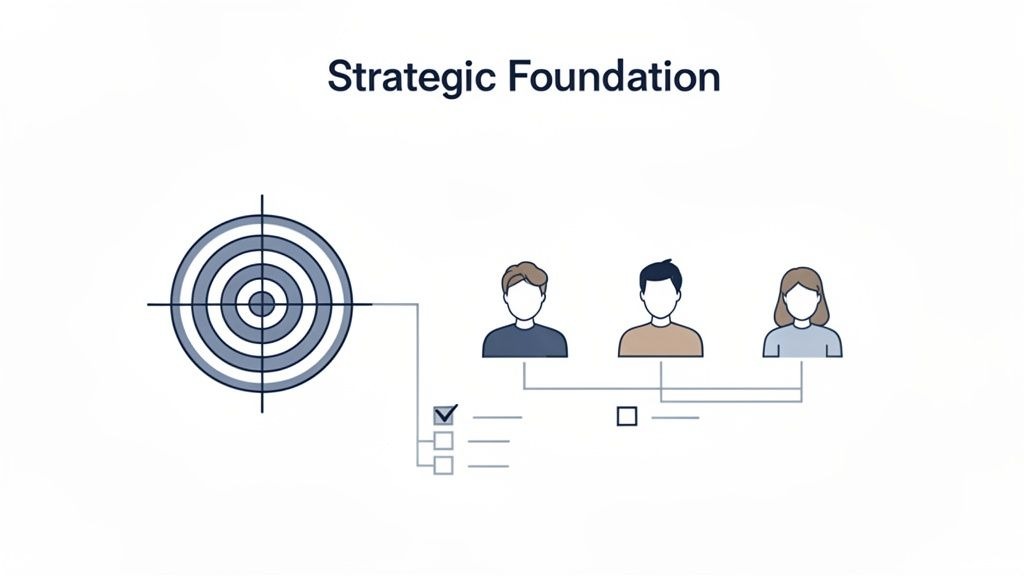
Before you even think about which platforms to use or what to post, you have to pour the concrete. This foundational work isn't the sexy part of social media, but skipping it is like trying to build a skyscraper on sand. It’s a recipe for disaster.
This first phase is all about defining what victory actually looks like for your business. It means setting clear, business-aligned goals that go way beyond fuzzy metrics like "getting more followers." You need to connect every social media action back to a tangible business result.
What does that look like in practice?
- Generate Qualified Leads: Don't just attract anyone; your goal is to bring in potential customers who perfectly fit your ideal profile and are actively looking for the solutions you provide.
- Establish Thought Leadership: The goal is to position your brand and its key people as the undeniable experts in your niche. When people in your industry have a question, your name should be the first one that comes to mind.
- Increase Brand Awareness: Make sure your target audience knows who you are and, more importantly, what problems you solve for them.
- Drive Website Traffic: Social media should act as a funnel, directing the right people from their feeds to high-value pages on your website, like your product pages, podcast episodes, or resource hubs.
Define Your Ideal Customer
Once you know what you want to achieve, you have to get laser-focused on who you're talking to. This is where you move beyond generic demographics and build out a detailed Ideal Customer Profile (ICP). An ICP is much more than a list of job titles; it’s a living document that captures the firmographic and behavioral DNA of your perfect customer.
To really bring this to life, create buyer personas. Give them names, job titles, daily challenges, and career goals. What keeps them up at night? What are they secretly Googling for solutions? Getting this granular ensures your content speaks directly to their world, not just their industry. Our guide on building a modern B2B brand strategy digs deeper into this process.
A killer way to do this is using the 'Jobs to Be Done' framework. It shifts your thinking from what your product does to why a customer "hires" it to solve a specific problem in their work life.
This groundwork is absolutely crucial. To build a powerful B2B social media presence, you need to master proven and actionable social media marketing best practices that actually drive results.
Let's quickly recap what goes into a strong strategic foundation with a simple table.
Key Foundational Elements of a B2B Social Strategy
| Component | Objective | Actionable Tip |
|---|---|---|
| Business Goals | Align social media efforts with revenue-driving outcomes. | Instead of "more followers," aim for a 10% increase in marketing qualified leads (MQLs) from social channels this quarter. |
| ICP & Personas | Deeply understand the audience to create resonant content. | Interview five of your best customers to uncover their real pain points, daily workflows, and where they hang out online. |
| Brand Voice | Ensure consistent and recognizable communication. | Create a simple one-page guide with "we sound like this, not like this" examples for your team. |
| Competitor Analysis | Identify opportunities and differentiate your brand. | Analyze what your top three competitors are doing well on social and what they are ignoring. |
Getting these pieces right from the start is what separates the brands that succeed on social from those that just make noise.
The Power of a Solid Strategy
This foundational work isn't just busywork; it's the engine that drives every single decision you'll make later on. A smart strategy turns social media from a content-posting machine into a predictable engine for business growth.
The proof is in the numbers. B2B brands are generating a staggering 80% of their leads from platforms like LinkedIn. When you see stats like LinkedIn's lead-gen ads hitting a 6.1% conversion rate, you realize just how much opportunity is on the table. This foundational work is what sets you up to actually capture it.
Choosing the Right Platforms for Your Audience
Trying to be everywhere on social media is a classic B2B mistake. It’s a surefire way to spread your team, budget, and creative energy way too thin. The result? Mediocre performance everywhere instead of knockout results somewhere.
The key isn't to be omnipresent; it's to be present where it matters. A winning B2B social strategy is all about depth over breadth. You pick a few core platforms where your ideal customers actually hang out, and then you show up consistently, deliver real value, and become part of the conversation.
Find Your B2B Powerhouses
For most B2B companies, the action starts on the professional networks, the places where business decisions are actually being discussed and made. While consumer platforms can have their place, your main focus should be on the channels built for professional networking and sharing expertise.
- LinkedIn: Let's be honest, this is the undisputed champ for B2B. It’s so much more than a job board; it's a dynamic hub for industry news, expert takes, and professional growth. Your C-suite targets, decision-makers, and technical buyers are all scrolling their LinkedIn feeds.
- X (formerly Twitter): X is all about real-time conversation and breaking news. It’s the perfect spot to engage with industry journalists, jump into live event discussions, and share quick, timely insights that put your brand at the forefront of what's happening right now.
- Niche Communities: Don't sleep on the smaller ponds. I’m talking about industry-specific Slack channels, Reddit communities (subreddits), or specialized forums. These are often highly concentrated pools of your ideal customers, giving you a direct line to their biggest questions and pain points.
As our founder, Tom Hunt, always says, building a strong personal brand for key executives on a platform like LinkedIn can amplify a company's reach exponentially. It adds a human touch that a company page just can't replicate.
Apply the Channel-Purpose Fit Model
Once you’ve got a shortlist of potential platforms, the next move is to give each one a specific job. Think of it as a "channel-purpose fit." This approach makes sure every post, every comment, and every campaign is intentional and ties back to your main goals. Stop just blasting the same content everywhere and start tailoring it.
For instance, your playbook might look something like this:
- LinkedIn: Use it for your heavy-hitting thought leadership articles, sharing clips from your company podcast, and running highly targeted lead gen campaigns. The goal here is building authority and capturing high-intent leads. This is the core of most digital marketing strategies for B2B.
- X: Perfect for sharing breaking industry news, doing quick Q&As, and promoting your latest blog posts to drive clicks. The goal is driving real-time conversation and website traffic.
- YouTube: This is your home for in-depth webinar recordings, customer story videos, and product tutorials. The goal is educating prospects and showcasing product value.
This simple, methodical approach stops you from wasting time and money. You move from just being active to being effective. Getting this right is foundational, and it all comes down to understanding the nuances of choosing your content distribution platform.
Optimize Your Profiles for Discovery
Finally, treat your company profiles like landing pages, not digital business cards. They should be resource hubs that instantly tell a visitor what you're all about and why they should care.
Make sure every single profile has:
- A clear, concise bio explaining who you help and how. No fluff.
- A high-quality logo and a branded banner image that looks professional.
- A direct link back to a relevant, high-value page on your website.
- Pinned posts that spotlight your best stuff, like a cornerstone guide or a can't-miss episode of your podcast.
By picking the right channels and dialing in your profiles, you build a powerful and efficient foundation for everything that comes next.
Developing a Content Strategy That Actually Converts
Let's be honest. A B2B social media strategy without a rock-solid content plan is just noise. Posting random company updates isn't going to move the needle. You need content that educates, pulls people in, and subtly guides them toward seeing you as the solution.
Think of it as the fuel for your entire social engine. The goal isn't just to create one-off posts; it's to build a predictable system that delivers value, day in and day out. This means creating a smart mix of big, splashy campaigns and the steady drumbeat of helpful content that builds real trust over time.
This boils down to a simple, repeatable process: research what your audience needs, select the right formats, and optimize everything for the platform you're on.
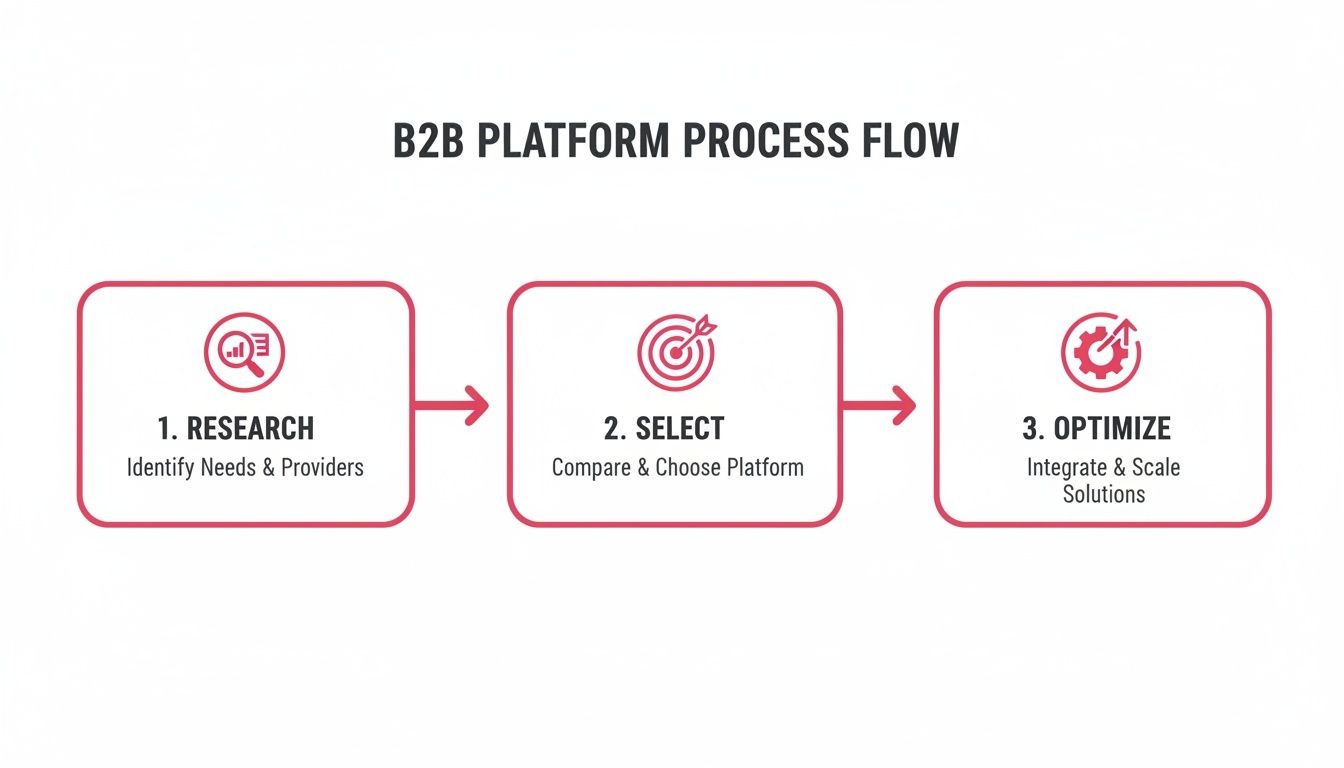
This loop makes it clear that success isn't just about making stuff. It’s about being strategic with where you put it and constantly tweaking your approach based on what the data tells you. A great content strategy for B2B is a living document.
Adopting the Hero, Hub, Help Model for B2B
A brilliant way to structure all this is the Hero, Hub, Help model. I like to think of it as a content pyramid designed to attract prospects at the top of the funnel and nurture them all the way down.
- Hero Content: These are your blockbusters. The big, ambitious projects you launch maybe once or twice a quarter. We're talking a comprehensive industry report, a virtual summit, or a polished B2B podcast series. These are designed to grab massive attention and plant your flag as a serious player.
- Hub Content: This is your regularly scheduled programming. It’s the consistent, value-packed content that keeps your audience subscribed and engaged. Think weekly podcast episodes, deep-dive blog posts, or a monthly webinar. This is the stuff that builds your core tribe.
- Help Content: This is your always-on, problem-solving content. It directly answers the questions your audience is Googling. Think quick tutorial videos, tactical tips on LinkedIn, or detailed FAQ posts. It’s practical, useful, and positions you as the go-to expert.
This framework gives you a balanced diet of content, ensuring you're both capturing wide-net attention and serving the specific needs of your niche audience. For a deeper dive, check out our full guide on how to create a content strategy that truly works.
The Power of Content Repurposing
Here's the secret weapon for a sustainable B2B content strategy: stop trying to create more content. Start getting more mileage out of the content you already have. This is where content repurposing becomes a game-changer.
Instead of a "one-and-done" mindset, you treat every piece of Hero or Hub content as the raw material for dozens of smaller "Help" assets. This is the core of smart content distribution strategies.
At Fame, we don't see a B2B podcast as a single asset. We see it as the sun in a massive content solar system. A single 45-minute episode can power your entire social media calendar for weeks.
For instance, one great interview with an industry leader can be sliced, diced, and remixed into an incredible amount of social media gold. This maximizes the ROI on your initial time and effort.
From One Podcast to Dozens of Assets
Let's get practical. Here's how one podcast episode can fuel a whole campaign:
- Short-Form Video Clips: Pull out the 3-5 juiciest moments from the conversation. Edit these into punchy 30-60 second vertical video clips with captions. These are perfect for LinkedIn, X, and YouTube Shorts.
- Audiograms: Grab a powerful audio quote and turn it into an audiogram, which is a static image with an animated waveform. They're fantastic for sharing killer soundbites on platforms where people scroll with the sound off.
- Quote Graphics: Design visually striking graphics featuring the most memorable lines from your guest. These are incredibly shareable and work on almost any platform.
- LinkedIn Article or Blog Post: Get the episode transcribed. Use that transcript as the backbone for a detailed article summarizing all the key insights. This captures SEO value and gives your audience a deep-dive resource.
- Carousel Posts: Bundle 3-5 related tips or stats from the episode into a multi-slide carousel for LinkedIn. This format is gold for engagement because it encourages people to swipe through.
When you adopt this repurposing mindset, you're not just a content creator; you're building a content engine. It's a system that pumps out high-quality material without burning out your team, building your authority, and driving effective lead generation across every channel.
Integrating Paid Social to Amplify Your Reach
Relying on organic reach alone for your B2B social media is a bit like whispering in a crowded stadium. To really cut through the noise, you need a smart way to blend the genuine feel of your organic posts with the laser-focused power of paid ads.
This isn't an either/or situation. It’s about building a system where organic and paid work hand-in-hand. Your organic posts are the perfect testing ground. They give you raw, real-world data on what your audience actually cares about. When a post starts getting traction on its own, that's your cue to pour some gasoline on the fire with a paid boost.
Using Organic Content as a Proving Ground
Before you even think about opening your wallet for ads, let your organic content do the heavy lifting. Watch your engagement metrics like a hawk. Which posts are sparking thoughtful comments? Which ones are getting shared by people you respect in your industry?
These are your winners. These are your prime candidates for paid amplification. When you boost content that's already proven its worth, you're not just guessing; you're making a calculated move that dramatically lowers your risk and boosts your chances of a great return.
This simple feedback loop is at the heart of most modern B2B social media strategies:
- Post Organically: Share a solid mix of content, videos, articles, and quotes from your team on a consistent schedule.
- Analyze Performance: Give it 24-48 hours. Then, pinpoint the posts with the best engagement and most relevant comments.
- Amplify the Winners: Take a modest budget and push those proven posts to a much larger, highly specific audience.
This way, you're only ever spending money on content that has already demonstrated it can grab attention and start a real conversation.
Hyper-Targeting to Reach Your Ideal Buyers
The real magic of paid social, especially on a platform like LinkedIn, is its insane targeting capability. You can go way beyond simple demographics and get your message in front of the exact professionals who have the power to make purchasing decisions.
Just think about how granular you can get:
- Job Title: Go straight to the "Chief Technology Officers" or "VPs of Marketing."
- Company Size: Zero in on businesses with 50-200 employees.
- Industry: Limit your audience to "SaaS" or "Financial Services."
- Skills & Interests: Find people who list "Demand Generation" or "Cybersecurity" on their profiles.
This kind of precision is a B2B game-changer. You can use it to push high-value content, webinar sign-ups, ebook downloads, and demo requests directly to the people who are looking for it. When you combine this with a strong organic game, you can seriously speed up your pipeline. Our guide on effective demand gen strategies dives deeper into how these pieces all connect.
The investment in this space is absolutely exploding. B2B social media advertising is projected to hit a massive $317.33 billion globally in 2026. This is largely fueled by platforms like LinkedIn, which boasts impressive conversion rates of 6.1% for its lead-gen ads, making its higher cost-per-click well worth it.
The Personal Brand Flywheel Effect
There's a powerful, and often missed, piece to this puzzle: the personal brands of your company's leaders. As our founder, Tom Hunt, always says, an executive with an active, authentic LinkedIn presence gives you a massive unfair advantage.
When a founder or C-level leader shares their own insights, they build a level of trust that a corporate brand page just can't replicate. This creates what you might call a "flywheel effect."
Their organic posts get great traction, which then gives the company valuable data for its paid strategy. Then, when the company puts ad spend behind content featuring that leader, it performs even better because it’s coming from a recognizable, trusted face. This synergy between personal brand, organic content, and paid ads creates a powerful, self-reinforcing engine for growth.
Measuring Social Media ROI That Matters
"If you can't measure it, you can't improve it."
It’s a classic for a reason. In B2B social media, it’s the golden rule. Far too many teams get completely sidetracked tracking vanity metrics, likes, shares, follower counts, that look pretty on a report but tell you next to nothing about actual business impact.
To really prove your social media strategy is working, you have to draw a straight line from your revenue efforts. That means shifting your focus from the surface-level stuff to the KPIs that your execs and sales team actually care about.
Moving Beyond Vanity Metrics
The first step is a change in mindset. A high follower count feels good, sure, but it doesn't pay the bills. Instead, we need to get laser-focused on the numbers that show how social media is influencing the sales pipeline.
Here’s what should be on your dashboard:
- Lead Quality: Are the leads coming from social actually any good? Tracking your MQL-to-SQL conversion rate from social channels is non-negotiable.
- Pipeline Influence: How many deals currently in your pipeline had a social media touchpoint? This proves your content is doing its job, nurturing prospects.
- Conversion Rates: What percentage of website visitors from social channels are actually doing something meaningful, like downloading a resource or booking a demo?
- Customer Acquisition Cost (CAC): The big one. How much are you spending on social to land a new customer? This is the ultimate bottom-line metric.
Zeroing in on these KPIs changes the entire conversation. You'll go from "How many likes did we get?" to "How did social media contribute to Q3 revenue?"
B2B Social Media Metrics That Matter
It's easy to get lost in a sea of data. The key is separating the signal from the noise. This table breaks down what to focus on versus what to simply monitor.
| Metric Category | Vanity Metric (Avoid Over-relying) | Actionable Metric (Focus On) |
|---|---|---|
| Audience Growth | Total Followers | Follower Growth Rate from ICP Accounts |
| Engagement | Likes & Reactions | Comments from Target Personas, Share-to-Lead Ratio |
| Content Performance | Impressions & Reach | Click-Through Rate (CTR) to High-Value Content |
| Lead Generation | Total Clicks | Marketing Qualified Leads (MQLs) from Social Sources |
| Sales Impact | N/A | Pipeline Influence, Social-Sourced Revenue, CAC |
Focusing on the "Actionable Metric" column is how you connect your daily social media activities to tangible business outcomes.
The Framework for Actionable Tracking
Getting this data doesn't require a suite of expensive, complicated software. It’s about being methodical with the tools you probably already use. Your secret weapon is the one-two punch of UTM parameters and your CRM.
UTM parameters are just small snippets of code tacked onto the end of a URL. They act like little GPS trackers, telling your analytics tools exactly where a click came from.
For example, a link to a blog post you share on LinkedIn might have UTMs specifying the source (LinkedIn), the medium (social), and the campaign name (Q3_Podcast_Launch). This gives you perfect attribution.
When a prospect clicks that link and eventually fills out a form on your site, those UTM details get captured right inside their contact record in your CRM. Just like that, you can run reports to see how many leads, opportunities, and closed-won deals came from a specific LinkedIn post or X campaign.
This direct line from a social post to a signed contract is how you prove ROI. If you really want to go deep on this, check out our full guide on how to calculate marketing ROI for a more granular breakdown.
Conducting Regular Performance Reviews
With this data pipeline flowing into your CRM, the guesswork is over. Now you can make decisions based on what’s actually working. Set up a recurring monthly or quarterly performance review to dig into the numbers.
During these reviews, you should be asking the tough questions:
- Which content formats, video clips, text posts, and carousels are driving the highest-quality leads?
- Which channels are giving us the lowest Customer Acquisition Cost?
- Are our paid campaigns outperforming organic for specific goals, like demo requests?
The answers give you a clear roadmap. You can double down on the content that resonates, A/B test your ad creative to improve conversions, and allocate your budget where it will have the biggest impact. This data-driven loop is what turns a good social media presence into a great one.
Your 90-Day B2B Social Media Action Plan
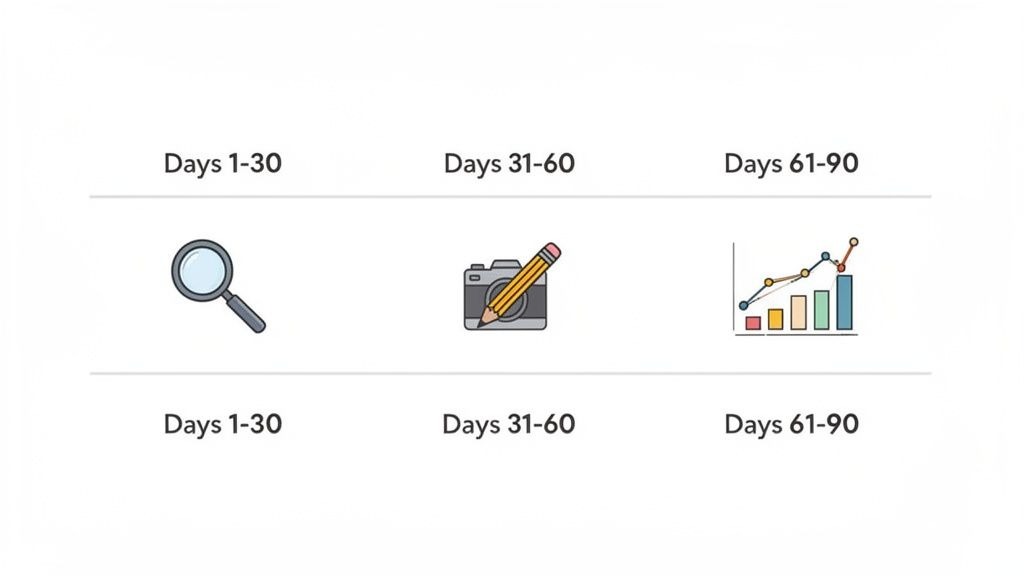
Look, a great strategy is just a nice document without execution. This 90-day plan is your roadmap to turn all the ideas we've talked about into actual, tangible work. It breaks the first three months down into clear, manageable chunks, moving you from laying the groundwork to full-blown optimization.
Think of it as a series of sprints, not a marathon. The goal is to build momentum fast, score some early wins, and lock in the habits that will drive your B2B social media for the long haul. Each phase has a distinct mission, making sure you build your program on solid rock, not sand.
Phase 1: Days 1-30 – Laying the Foundation
Your first month is all about getting your house in order. Before you even think about creating a single post, you need to know exactly who you're talking to, where they hang out online, and what winning actually looks like. This is your strategic deep dive.
The mission here is to move from gut feelings and assumptions to data-backed decisions. This period is more about listening than talking, and trust me, the work you put in here will pay off for months and years to come.
Your Action Checklist:
- Finalize Goals & KPIs: Lock in the specific, measurable business outcomes you'll be tracking. No vanity metrics allowed.
- Deep-Dive Audience Research: Get on the phone with customers. Dig through your CRM data. Build buyer personas so rich you feel like you know them personally.
- Competitor Audit: Pick your top three competitors and analyze what they're doing on their main channels. Pinpoint their strengths, weaknesses, and the content gaps you can drive a truck through.
- Optimize Social Profiles: Update your company's LinkedIn, X (Twitter), and other key profiles. Make sure the branding is consistent, the value prop is crystal clear, and you're linking to your best stuff.
- Set Up Analytics: Get your UTM tracking, CRM integrations, and social media analytics tools dialed in. If you can't measure it, you can't improve it.
By day 30, you should have a razor-sharp picture of your audience, your competition, and the metrics that matter. This isn't just prep work; it's the most critical piece of the entire puzzle.
Phase 2: Days 31-60 – Content Creation and Execution
Alright, time to start the engine. With a solid foundation in place, month two is all about creating and shipping your first wave of content. The key here is to find a consistent rhythm and start testing different formats to see what resonates.
This is where you start building your content machine. If you're launching a B2B podcast, this is the month you'd record your first batch of episodes and start spinning them into a whole library of social assets using your content repurposing strategies.
Your Action Checklist:
- Develop Content Themes: Based on your phase one research, map out three to five core content pillars that hit your audience's biggest pain points right between the eyes.
- Create Your First Content Batch: Produce a healthy mix of content, think video clips, articles, carousel posts, all tied back to your core themes.
- Launch a Consistent Cadence: Start posting on your chosen platforms at a pace you can actually maintain (e.g., 3-5 times per week on LinkedIn). Consistency beats intensity.
- Start Your First Paid Campaign: Find your best-performing organic post and put a little budget behind it. Amplify it to a tightly targeted audience of your ideal customers.
- Engage Actively: Carve out time every single day to respond to comments, answer questions, and jump into relevant industry conversations. Be a part of the community.
Phase 3: Days 61-90 – Analyze, Optimize, and Scale
With 60 days of real-world data under your belt, the final phase is all about learning and refining. This is where you get ruthless, separating what's working from what isn't and pouring gasoline on your winners.
Optimization is the name of the game. You'll measure your performance against the KPIs you set back in Phase 1 and make smart, data-driven tweaks to your content, your targeting, and your budget.
Your Action Checklist:
- Conduct a Full Performance Review: Dig into the numbers. Which content formats, themes, and channels drove the best results against your actual business goals?
- Refine Your Content Strategy: Double down on what worked. If short-form video clips are bringing in high-quality leads, your new job is to make more video clips. It’s that simple.
- Optimize Paid Campaigns: A/B test your ad creative, copy, and audience targeting to systematically lower your customer acquisition cost.
- Scale Your Budget: Take the money you're spending on so-so campaigns and reallocate it to your top performers.
- Plan the Next 90 Days: Use everything you've learned to build an even smarter, more effective plan for the next quarter. The cycle begins again.
Got Questions? We've Got Answers
Diving into the world of B2B social media can feel like you're trying to solve a puzzle with a million pieces. Let's clear up some of the most common questions marketers grapple with when they're putting their strategy together.
"How Often Should I Actually Be Posting?"
Look, there's no single magic number here. But the one rule that always holds is that consistency beats frequency.
It's a classic mistake: posting like a machine gun for a week straight, only to go completely dark for the next two. You're far better off finding a sustainable rhythm you can stick with for the long haul.
For a powerhouse like LinkedIn, a good place to start is 3-5 high-quality posts per week. The real goal isn't to hit a quota; it's to stay on your audience's radar and deliver genuine value with every single thing you share.
"Which Social Platform Is the Best for B2B?"
While the honest answer is "it depends on your audience," it's impossible to ignore the 800-pound gorilla in the room: LinkedIn is the undisputed heavyweight champion for B2B. Its professional vibe, ridiculously powerful targeting, and the simple fact that people are there to do business make it the most fertile ground for building authority and finding great leads.
But don't get tunnel vision. Other channels can play a huge role. X (formerly Twitter) is fantastic for tapping into real-time industry chatter and news. YouTube is your go-to for deeper content like webinar recordings and detailed tutorials. The trick is to focus your firepower where your ideal customers are already hanging out.
"Can a Small B2B Team Really Pull This Off?"
Absolutely. You just have to play smarter, not harder. For smaller teams, the secret is ruthless focus. Instead of trying to be everywhere and spreading yourself thin across five different platforms, your mission is to completely dominate one or two.
The single most powerful weapon for a small team is a killer content repurposing strategy. Think about it: one great podcast episode or a webinar can be sliced and diced into dozens of smaller social posts. This lets you maintain a steady, high-quality presence without burning your team out on constant content creation.
Lean on scheduling tools to stay organized and focus on the activities that move the needle. You could even get strategic with your resources, for example, bringing in an agency like Surge, which provides expert PPC management, frees up your internal team to nail the organic content and community building. It's all about a smart division of labor.
Ready to turn your B2B podcast into the engine of your social media strategy? Fame specializes in producing authority-building podcasts and turning each episode into a full suite of content assets to fuel your growth. We can even handle the ongoing promotion with our B2B social media services and B2B email newsletter management.
Want us to run this for you?
Fame starts and grows B2B podcasts that generate pipeline. Tell us who you are trying to reach and we will send a costed proposal within 1 working day.
Related content
- Read moreFame Team · July 16, 2026
10 Account Based Marketing Tactics For B2B Growth In 2026
Discover 10 actionable account based marketing tactics for B2B tech. Learn to use podcasts, data, and targeted content to close high-value accounts. - Read moreFame Team · July 16, 2026
The 8 Best Brighton Podcast Agency Picks For 2026
Find the best Brighton podcast agency for your B2B brand. Our 2026 guide reviews top 8 agencies for production, growth & ROI. Expert analysis here - Read moreJune 10, 2026
20 Best Podcast Production Agencies For 2026 (And Why Should You Hire One)
Global podcast and vodcast ad revenues are on track to hit $5 billion in 2026 , up 20% year-on-year. - Read moreApril 13, 2026
Leadership In Marketing: The B2B Podcast Playbook
Most companies still confuse leadership in marketing with job titles, org charts, and budget control. That's outdated.