February 5, 202619 min read7 sections
Choosing Your Content Distribution Platform
By Fame Team
Key Takeaways
- A content distribution platform automates and scales the reach of your content across multiple channels, saving time and effort.
- For B2B marketers, such platforms are crucial for building authority and showing measurable impact by strategically amplifying content across various channels.
- The demand for content distribution platforms is growing rapidly, with the market expected to reach USD 1.72 billion by 2030 at a CAGR of 17.5%.
A content distribution platform is your central command center for getting your content in front of the right people. Think of it as the engine that automates and scales up your content's reach. Instead of manually pushing your latest podcast episode, blog post, or video to each channel one by one, a platform streamlines the entire job.
This is a big deal for B2B marketers who are on the hook to build authority and show real, measurable impact from their work.
Why Your B2B Brand Needs A Distribution Engine
Let’s be honest: creating amazing content is only half the battle. Without a solid distribution strategy, even the most brilliant podcast or deeply researched whitepaper is just shouting into the void. It’s the classic content creation hamster wheel; you’re always producing, but never quite sure if anyone’s listening.
This is the exact problem a content distribution platform solves.
Think about promoting a local concert. You could spend days walking around town, handing out flyers to every single person. It’s slow, tedious, and you’ll miss a lot of people. Or, you could use a radio station's broadcast tower to send your message across the entire city instantly.
A content distribution platform is your digital broadcast tower. It takes your core piece of content and pushes it out across all your channels at once.
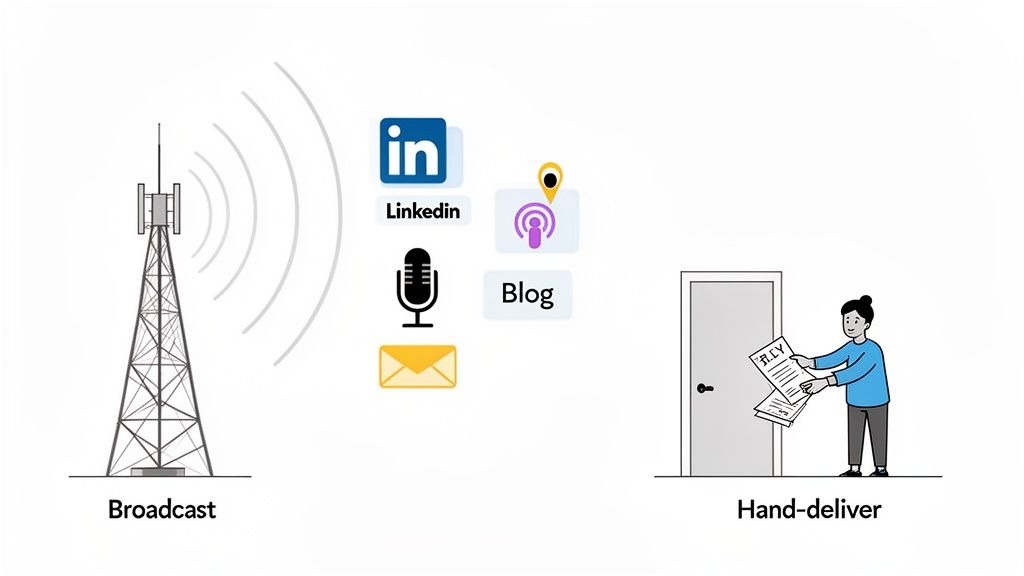
From Manual Effort To Strategic Amplification
For B2B marketers, particularly those creating podcasts, this shift from manual to automated is a game-changer. Your goal isn't just to publish an episode. It's to make sure that the episode reaches decision-makers on LinkedIn, gets heard on Spotify and Apple Podcasts, and sparks conversations in niche industry forums.
A platform handles all that for you. It frees up your team to think about strategy and the big picture instead of getting bogged down in repetitive tasks.
It's no surprise the market for these tools is exploding. The global content distribution platform market shot up from USD 0.55 billion in 2023 and is on track to hit USD 1.72 billion by 2030, growing at a blistering 17.5% annually. The demand is real because the need is urgent.
To see just how much of a difference a platform makes, let's compare the old way with the new way.
Manual Distribution vs Platform Automation
| Aspect | Manual Distribution | Using a Content Distribution Platform |
|---|---|---|
| Time and Effort | Extremely high. Hours spent on repetitive logins, uploads, and posts. | Minimal. Publish once, distribute everywhere saves significant time. |
| Reach and Scale | Limited by team capacity. Often inconsistent and misses key channels. | Expansive. Reaches a wider audience across multiple channels simultaneously. |
| Consistency | Prone to human error and scheduling gaps. Brand presence can feel sporadic. | Automated scheduling ensures a consistent, always-on presence. |
| Analytics | Fragmented data from each platform. Difficult to get a holistic view. | Centralized dashboard provides a unified performance view. |
| Strategic Focus | Team is stuck in execution with little time for strategy. | Frees up time to analyze performance and improve content strategy. |
The takeaway is clear: manual distribution keeps you in the weeds, while a platform gives you the strategic high ground.
The Strategic Value Beyond Automation
A content distribution platform is more than just a time-saving tool; it’s a strategic investment in your brand’s authority. It gives you the infrastructure to consistently show up where your audience is, reinforcing your expertise and building trust over time.
By centralizing distribution, you gain a unified view of your content's performance, enabling you to connect your marketing efforts directly to business outcomes like lead generation and pipeline growth.
To really get the concept, look at how other industries do it. The music world has long used digital music distribution services to get songs onto all the major streaming platforms. It’s the same principle.
Ultimately, this kind of technology isn't a "nice-to-have" anymore. For modern B2B marketers who need to prove their content's impact on the bottom line, it's non-negotiable. Learn more about developing effective content distribution strategies in our guide.
Essential Features For B2B Marketing Success
When you're picking a content distribution platform, it's easy to get lost in a generic list of features. But for B2B marketers, the right features are the ones that lead to real business results, qualified leads, industry authority, and a clear ROI. Let’s be honest, not all platforms are built the same, and the ones that matter are those that actually power your strategy.
Think of it like this: a high-performance engine is worthless without the right transmission and wheels. Your brilliant content is the engine. To get it to the right audience, you need a platform with specific, powerful features.
Let's break down the non-negotiables that turn a simple tool into a B2B marketing machine.
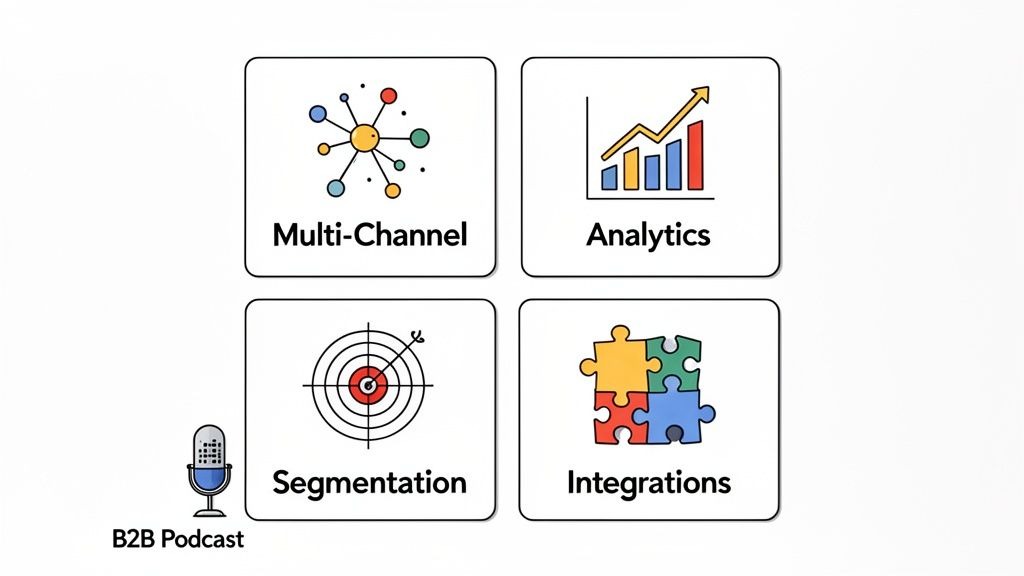
Multi-Channel Publishing
Your B2B audience doesn’t hang out in one place. Decision-makers might find you on LinkedIn, listen to your podcast on Spotify during their commute, and read your blog at their desk. Multi-channel publishing is the feature that makes sure you show up consistently across all these spots.
For podcasters, this is the most critical feature. A purpose-built platform like Fame Host automates the entire process, generating a compliant RSS feed and pushing your episodes to all major directories like Spotify, Apple Podcasts, and YouTube with one click. This means your audio is strategically placed where your ideal customers are already listening, getting you maximum reach with minimal effort.
A great content distribution platform doesn't just blast content everywhere; it places it with surgical precision. It knows that reaching a VP of Sales requires a totally different approach than reaching a software developer.
Advanced Analytics
"So, what was the ROI on that last podcast season?"
If that question makes you break into a cold sweat, you need better analytics. Good analytics are your secret weapon for proving your content's value and justifying bigger budgets down the road.
You need a platform that gives you more than just download numbers. Look for clear, actionable data.
- Audience Demographics: Who are your listeners? What are their job titles? What industries are they in?
- Engagement Rates: Where do listeners drop off? This tells you exactly what content hits the mark and what doesn't.
- Attribution Data: Can you connect a podcast listen to a website visit or a demo request? This is the holy grail.
This is the kind of insight that shifts your reporting from vanity metrics to real business impact. It's how you walk into a meeting and confidently show leadership that your content is driving the pipeline. A solid reporting framework is a massive part of learning how to create a content strategy that actually works.
Audience Segmentation and Integration
Finally, the best platforms help you personalize your outreach and plug right into your existing tech stack. Audience segmentation lets you tailor messages to different groups of listeners, making your content hit that much harder because it feels more relevant.
Integration capabilities are just as critical. Your distribution platform shouldn't be an island. It needs to talk to your CRM, your email marketing tools, and your social media schedulers. When everything is connected, data flows freely, and you can build sophisticated campaigns around your content to close the marketing loop.
How To Choose The Right Platform For Your B2B Podcast
Picking the right content distribution platform for your B2B podcast can feel like a make-or-break decision. Let's be honest, the market is flooded with generic tools. They all promise the world but rarely get the specific needs of audio content, especially for a business audience.
For a B2B brand, your podcast isn't just a collection of audio files; it's a strategic asset you're using to build authority and generate demand. Your distribution platform has to treat it that way. The trick is to look past the flashy dashboards and start asking the questions that actually matter. Does this platform really get podcasting, or is it just another feature tacked on to a bigger product? A purpose-built solution will handle the technical grunt work so you can focus on what you do best: creating amazing content.
Start With A Self-Assessment
Before you even think about booking a demo, take a step back and figure out what you actually need. A generic, all-in-one platform might be fine for a hobbyist, but a serious B2B show demands a whole lot more. You need a tool that's built for strategic growth, not just for hosting files.
Use this checklist to get your thoughts in order:
- RSS Feed Generation: Can the platform create and manage a rock-solid, optimized RSS feed? This is the absolute backbone of your podcast's distribution. Any hiccup here and your show might as well be invisible.
- One-Click Directory Submission: How painful is it to get your show listed on the big players like Spotify, Apple Podcasts, and Google Podcasts? A smooth, streamlined process will save you hours of headaches.
- Content Repurposing Tools: Does the platform help you squeeze every last drop of value out of an episode? Look for features that help you create clips, transcripts, or show notes to feed your other marketing channels.
- B2B-Relevant Analytics: Are you getting metrics that actually matter to a business, like listener demographics and engagement trends, or just vanity numbers like raw downloads?
Asking these questions will pretty quickly separate the pretenders from the specialized tools built for podcasters who mean business.
For B2B podcasters, the best content distribution platform is a growth partner, not just a file storage service. It should make distribution dead simple while giving you the insights you need to prove ROI.
Now, let's talk about why digging deep and evaluating your options is so critical for B2B podcasters. Here’s a checklist to guide you through comparing different solutions.
Platform Selection Checklist For B2B Podcasters
Use this table to methodically assess any platform you're considering. It forces you to think beyond the surface-level features and focus on what will truly drive your podcast's success.
| Evaluation Criterion | Key Questions to Ask | Why It Matters for Podcasting |
|---|---|---|
| Core Podcasting Features |
Does it handle RSS feed creation flawlessly? Can I easily submit to all major directories? Is audio quality preserved? |
This is the non-negotiable foundation. Your show must be accessible everywhere your audience is. |
| Distribution and Syndication |
Does it offer one-click submission? Does it integrate with social media or email tools? Can it push content to other platforms? |
Your podcast should not live in isolation. The platform should distribute content across all marketing channels. |
| Content Repurposing |
Are there tools for audiograms, video clips, or transcripts? Does it generate show notes or blog content? |
Each episode is a content asset. Repurposing maximizes reach and return on effort. |
| B2B Analytics and Measurement |
Can I see listener demographics and drop-off rates? Does it integrate with CRM or marketing tools? |
Downloads alone are not enough. You need insight into audience quality and business impact. |
| Ease of Use and Workflow |
Is the interface intuitive? Does it automate publishing and promotion? How technical is setup? |
The platform should reduce workload and friction, not add complexity. |
| Support and Expertise |
Is support knowledgeable about podcasting? Do they provide strategic guidance? Is there a knowledge base or community? |
Reliable support is critical when issues arise, especially from people who understand podcast workflows. |
| Scalability and Pricing |
Does pricing scale with growth? Are there hidden fees? Can it support multiple shows or users? |
Choose a platform that grows with your needs to avoid costly migrations later. |
By running each potential platform through this gauntlet, you'll have a much clearer picture of which one is truly built to help your B2B podcast thrive, not just survive.
Why A Specialized Platform Is Non-Negotiable
This is exactly where a purpose-built platform like Fame Host comes into its own. It was designed from the ground up for B2B podcasters, which means it solves the exact challenges we just outlined. Instead of fighting with a generic tool that sees your podcast as an afterthought, you get a system that automates the most critical and often most annoying distribution tasks. For example, it generates a perfect podcast RSS feed and uses one-click submission to get your show listed on all the major directories like Spotify without the usual technical nightmare.
The market is already voting with its feet. Projections show that cloud-based software will capture 61.5% of the content distribution market revenue in 2025 as more businesses look for scalable and efficient systems. Companies are ditching rigid, one-size-fits-all tools and moving toward flexible platforms that know how to handle specific content types, like podcasts, across every channel.
A specialized platform understands that for a B2B podcast, success isn't just about getting listens. It's about reaching the right listeners and turning them into leads, customers, and advocates for your brand. Choosing the right tool is the first, and maybe most important, step in building a show that actually moves the needle. For a deeper dive, check out our guide on podcast platforms to compare your options.
Implementing Your Content Distribution Strategy
So, you've picked the right content distribution platform. Now for the fun part: putting it to work.
An effective strategy isn't about just hitting "publish" and crossing your fingers. It's a deliberate process, one designed to squeeze every last drop of value out of your hard-earned content. Get this right, and your platform stops being just a tool and becomes a strategic growth engine.
This whole process kicks off by defining what success actually looks like for you. Are you trying to generate more qualified leads? Is the goal to establish your CEO as a thought leader? Or are you simply looking to grow your audience? Your goals will shape every single step that follows, from the content you prioritize to the channels you hammer.
A Five-Step Implementation Plan
To get your strategy off the ground, you need a structured approach. This isn't about adding bureaucracy; it's about building on a solid foundation so you can get measurable results. A clear path keeps you organized and makes your distribution efforts sustainable for the long haul.
Here’s a practical, five-step guide to get you started:
- Audit Your Existing Content: Before you even think about creating something new, go digging in your archives. Look for those hidden gems. That old webinar or blog post could be an absolute goldmine for social media clips, quote cards, or even a brand-new podcast episode.
- Map Content to Channels: Different formats just work better on different platforms. It's a simple truth. A deep-dive technical demo might be perfect for YouTube, but short, punchy video clips from a podcast are tailor-made for LinkedIn. You have to match the asset to where your audience is and how they consume content there.
- Configure and Integrate Your Platform: This is a crucial technical step, so don't skip it. Connect your content distribution platform to your CRM, marketing automation tools, and social schedulers. This is the secret sauce for tracking attribution and creating a workflow that doesn't make you want to pull your hair out.
- Build a Sustainable Publishing Calendar: Consistency is everything. Seriously. Create a realistic schedule that your team can actually stick to. A well-planned calendar prevents those last-minute scrambles and ensures a steady, reliable stream of content hits all your channels.
- Set Up Performance Tracking: You can't improve what you don't measure. Define your key performance indicators (KPIs) right from the start. Whether it's download growth, lead conversions, or website traffic from a specific piece of content, get your tracking in place.
The B2B Podcast Example in Action
Let's make this real. Imagine you just recorded a killer new B2B podcast episode using a platform like Fame Host. Instead of just publishing the audio and calling it a day, you treat that episode as your core asset. From there, your platform helps you explore dozens of different content repurposing strategies to blow up its reach.
Suddenly, that single one-hour recording becomes a dozen strategic assets:
- The full episode gets pushed out to Spotify, Apple Podcasts, and all the other major directories with Fame Host's one-click submission.
- The complete transcript is published as a blog post, fully optimized for SEO to start pulling in search traffic.
- Three key insights are snipped into short, engaging video clips for LinkedIn, each with a clear call-to-action.
- Five of the most powerful quotes are turned into slick, shareable graphics for Twitter and Instagram.
- A quick summary of the episode goes out in your weekly email newsletter, driving your most engaged subscribers back to the full audio.
This entire process, from choosing the right tool to executing the strategy, follows a clear, methodical path.
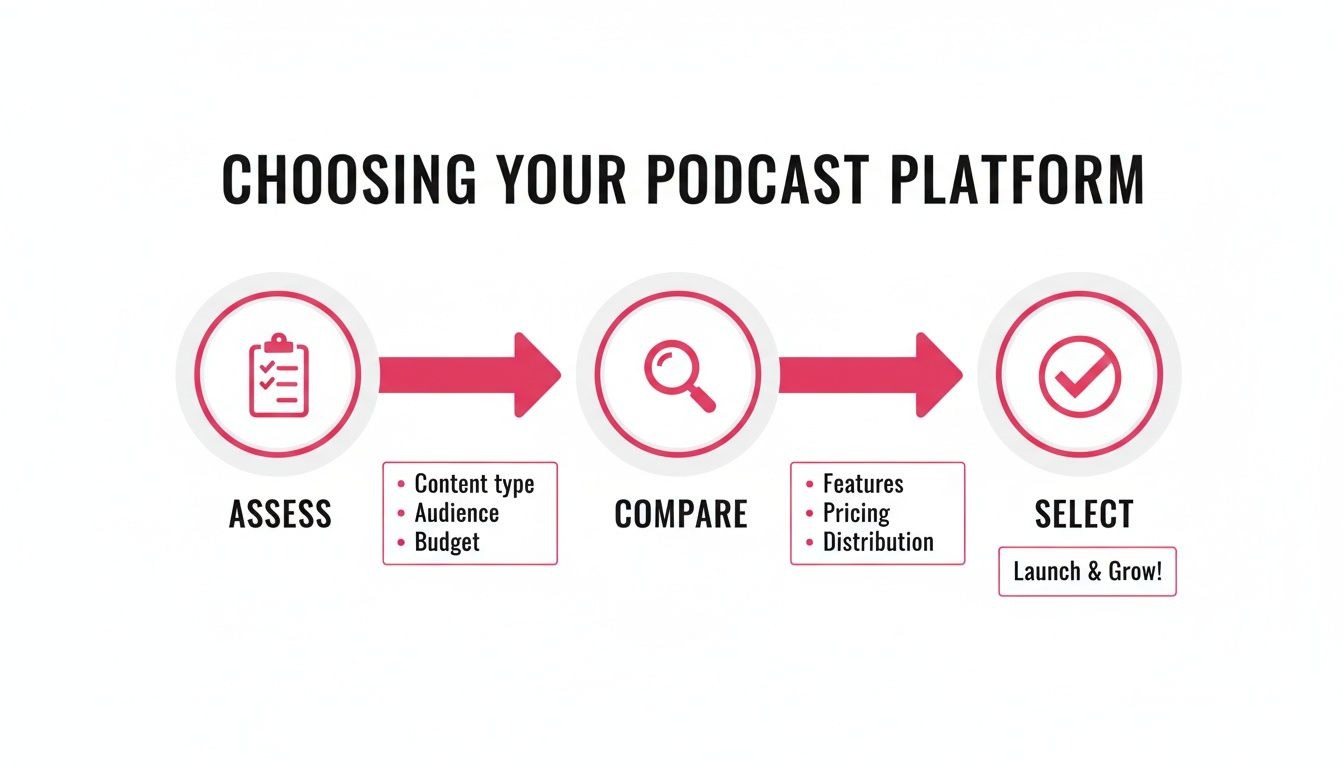
As you can see, a systematic process of assessing your needs, comparing your options, and selecting the right tool is what leads to a truly effective strategy. When you follow these steps, you turn one piece of pillar content into a multi-channel campaign that drives consistent engagement and proves the value of all your hard work.
Measuring The ROI Of Your Content Distribution
So you've invested in a content distribution platform. Great move. But how do you actually prove it's paying off?
Answering this question means looking past the usual vanity metrics, likes, shares, and basic view counts and focusing on the numbers that make leadership sit up and take notice. This is where your platform's analytics suite goes from a feature to your secret weapon for telling a compelling data story.
A real strategy connects your content directly to business goals, showing a tangible return. It's about understanding the big picture of a strong ROI on marketing investment. A dedicated platform makes this possible by giving you clear ways to track specific objectives, whether that's growing your podcast audience or generating qualified leads. It proves its own worth.
Key Metrics That Truly Matter
If you want to build a rock-solid case for your content efforts, you need to track the metrics that tie directly to revenue and growth. Let's move beyond simple download numbers and get into the data that shows real business impact.
- Lead Attribution: Which specific pieces of content are actually bringing in qualified leads? Your platform should make it dead simple to connect a podcast episode or an article to a demo request.
- Pipeline Influence: How is your content helping move prospects through the sales funnel? You should be able to track how many opportunities you engaged with your content before signing on the dotted line.
- Audience Growth: It’s not about how many, it’s about who. Are you attracting listeners and readers that fit your ideal customer profile? Monitor the growth in key segments, not just the overall number.
- Channel-Specific Engagement: Dig deep into how your content is performing on critical B2B channels like LinkedIn. What's actually resonating? Analyze the comments, shares, and click-throughs to find out.
Building Your ROI Dashboard
Honestly, a simple, visual dashboard is the best way to show your content's success. You don't need a crazy-complex business intelligence tool to get started. A straightforward spreadsheet or a native dashboard in your platform can tell a powerful story, as long as you focus on the right KPIs.
Your goal here is to create a clear, at-a-glance view that answers one fundamental question for your leadership team: "Is our investment in content distribution driving measurable business results?"
For B2B podcasters using a specialized platform, this gets a whole lot easier. Instead of just saying "we got more downloads," you can show a 25% month-over-month increase in listeners from your target industry. You can draw a direct line between a specific guest episode and a spike in website traffic.
That's the kind of detail that turns your podcast from just another marketing task into a proven revenue driver. If you're looking for more ways to connect your efforts to bottom-line results, check out our guide on measuring content marketing ROI.
The Future Is An Integrated Content Engine
The best B2B marketing teams I see aren't thinking in terms of channels or campaigns anymore. They're building integrated content engines.
This mindset shift is huge. Instead of viewing a content distribution platform as the last step in a long process, they see it as the central hub of a system, a powerful, interconnected machine that multiplies the value of everything they create.
This is where the real magic happens. It’s a seamless workflow that can take a single piece of pillar content, like a podcast episode, and spin it out into a full-blown, multi-channel assault. The future isn't about just distributing content; it's about intelligently creating and amplifying it from one single source of truth.
How An Integrated System Works
Imagine your core content flowing effortlessly from creation straight through to amplification. That’s the superpower a modern, integrated stack gives you. It’s a one-two punch that turns distribution from a painful chore into a strategic growth driver.
- The Foundational Layer: It all has to start with a specialized hosting solution. For podcasters, a platform like Fame Host is a perfect example. It handles all the messy technical stuff, generating a flawless RSS feed, ensuring one-click distribution to giants like Spotify and Apple Podcasts. This is your rock-solid base.
- The Amplification Engine: With the foundation locked in, an intelligent repurposing tool comes into play. This is where something like the Production Engine steps in to act as the amplification engine. It takes that core podcast episode and smartly carves it up into dozens of ready-to-use assets. We’re talking social media video clips, slick quote cards, full transcripts for SEO, and even first drafts for blog posts.
An integrated approach like this means a modern B2B marketing team can turn one hour of recording into an entire month's worth of strategic, multi-channel content. It’s the ultimate force multiplier.
This synergy is what defines the next generation of content strategy. It's not enough to just have a distribution tool anymore. You need a connected ecosystem that makes your content work harder and smarter, turning every single podcast episode into a sustained campaign that builds real authority and drives measurable growth.
Frequently Asked Questions
Jumping into the world of content distribution can definitely bring up a few questions. Let's tackle some of the most common ones I hear from marketers so you can move forward with confidence.
CMS vs Content Distribution Platform
It's easy to get these two mixed up, but they play fundamentally different roles in your marketing stack.
Think of your Content Management System (CMS) as your digital library or your warehouse. It's where you create, edit, and store all your assets, your blog posts, your website pages, and your podcast audio files. It’s home base.
A content distribution platform, on the other hand, is the global shipping network. It takes what's in your warehouse and actively pushes it out to the world, social media, email newsletters, and crucial podcast directories. One is for storage; the other is for action.
Budgeting for a Distribution Platform
This is the "how long is a piece of string?" question. Costs can range from free plans with basic features all the way up to enterprise solutions that run thousands of dollars a month.
Your budget really needs to line up with your specific goals. For a B2B podcaster, a specialized tool like Fame Host delivers huge value by taking care of all the technical headaches of audio distribution. It automates the creation of your podcast RSS feed and ensures your show lands on Spotify, Apple Podcasts, and everywhere else that matters, without you having to manually upload a thing. This kind of targeted approach often delivers a way better ROI than a generic, pricey platform that does a little bit of everything but nothing particularly well.
The right platform isn't just an expense; it's an investment in your own efficiency and reach. Focus on the value it brings to your specific content strategy, not just the price.
Using Platforms for All Content Types
Absolutely. While this guide has a heavy focus on B2B podcasting, the core principles are the same for your videos, articles, case studies, and whitepapers.
The best platforms are built to be a central hub for all your content formats. This allows you to manage and push out everything from a single place, making sure your brand's message stays consistent no matter where your audience finds you.
Ready to ditch the manual uploads and start distributing your content with a real strategy? With Fame, you’re not just getting hosting; you're getting a complete content engine designed for B2B growth.
See how Fame Host can put your podcast distribution on autopilot at Fame Host.
Want us to run this for you?
Fame starts and grows B2B podcasts that generate pipeline. Tell us who you are trying to reach and we will send a costed proposal within 1 working day.
Related content
- Read moreFame Team · July 16, 2026
10 Account Based Marketing Tactics For B2B Growth In 2026
Discover 10 actionable account based marketing tactics for B2B tech. Learn to use podcasts, data, and targeted content to close high-value accounts. - Read moreFame Team · July 16, 2026
The 8 Best Brighton Podcast Agency Picks For 2026
Find the best Brighton podcast agency for your B2B brand. Our 2026 guide reviews top 8 agencies for production, growth & ROI. Expert analysis here - Read moreJune 10, 2026
20 Best Podcast Production Agencies For 2026 (And Why Should You Hire One)
Global podcast and vodcast ad revenues are on track to hit $5 billion in 2026 , up 20% year-on-year. - Read moreApril 13, 2026
Leadership In Marketing: The B2B Podcast Playbook
Most companies still confuse leadership in marketing with job titles, org charts, and budget control. That's outdated.