February 13, 202619 min read7 sections
How To Find A Video Production Company That Drives Real Business Results
By Fame Team
Key Takeaways
- A top-tier video production company acts as a true partner, translating business objectives into compelling narratives that resonate with a specific audience.
- They manage a team of creative specialists, covering everything from scripting and storyboarding to final color correction and sound mixing, to bring a project to life.
- By handling all the technical and creative aspects, a video production company allows businesses to focus on the big picture, ensuring a cohesive and effective final asset.
A video production company is the creative and logistical engine that turns your business goals into a powerful visual story. Think of them as a general contractor for your video strategy. You have the vision, generating more leads, building brand authority, or launching a product, and they provide the expert crew, professional equipment, and strategic know-how to build the final asset. They manage the entire complex process, from a rough idea to a polished video that delivers measurable results for your business.
What a Video Production Company Actually Does
It's a common misconception that a production company's job is just to show up with a high-end camera and press record. The reality is far more strategic. A top-tier video production company acts as a true partner, specializing in translating abstract business objectives into compelling narratives that resonate with a specific audience.
Their primary role is to assemble and manage a team of creative specialists, such as directors, writers, cinematographers, sound engineers, and editors, and ensure every component works together seamlessly. This involves a significant project management effort, covering everything from initial scripting and storyboarding to the final color correction and sound mixing. Essentially, they handle all the moving parts so you can focus on the big picture.
The General Contractor Analogy
Hiring a video production company is almost exactly like hiring a general contractor to build a house. It’s a perfect analogy.
- You (The Homeowner): You know what you want. A three-bedroom house, open-concept kitchen, and big backyard. You have the vision and the budget, but you definitely don't know how to pour a concrete foundation or wire an electrical panel.
- The Production Company (The Contractor): They take that vision and manage all the specialized crews, the plumbers, electricians, and roofers, to bring it to life. They’re obsessed with quality control, handle all the logistical headaches, and deliver a finished home.
In the same way, your video partner manages all the technical and creative talent needed to produce a professional video, ensuring the final asset is cohesive and hits your goals.
To give you a better sense of who you're actually hiring, here’s a breakdown of the key players on a typical production team.
Key Roles Inside a Video Production Team
This table breaks down the essential roles and their responsibilities to help you understand the expertise you are hiring.
| Role | Primary Responsibility | Impact on Your Project |
|---|---|---|
| Producer | The project manager. Oversees budget, schedule, and logistics from start to finish. | The single point of contact ensuring your project stays on time, on budget, and true to the original vision. |
| Director | The creative visionary. Guides the artistic and dramatic aspects of the video. | Sets the tone, style, and emotional impact of the final video, ensuring the story connects with your audience. |
| Writer/Scriptwriter | Crafts the narrative, dialogue, and overall message. | Translates your business objectives into a compelling script that drives the story forward and delivers your key points. |
| Cinematographer/DP | In charge of the camera and lighting crews; responsible for the visual look and feel. | Makes your video look professional and cinematic, using visuals to enhance the story and evoke the right mood. |
| Sound Engineer | Records and mixes all audio elements, including dialogue, music, and sound effects. | Ensures your video sounds crisp and clear. Bad audio can ruin a great video, so this role is critical. |
| Editor | Assembles the raw footage, adding graphics, music, and effects to create the final cut. | Paces the story, selects the best takes, and pieces everything together into a cohesive and engaging final product. |
Understanding these roles helps you appreciate the depth of expertise a professional company brings to the table. It's not just one person with a camera; it's a coordinated team of specialists.
The Three Stages of Professional Video Production
Ever wonder how a simple idea becomes a polished video? The whole process can feel a bit like a black box, but it's actually pretty straightforward. Every professional video production company follows a structured workflow broken down into three core stages.
Think of it like building a house: you need a detailed blueprint before you ever think about pouring the foundation. And the framing has to be perfect before you can start painting the walls. It’s the same logic.
This visual breaks down that journey, showing how you get from your initial vision to the final, ready-to-use video asset.
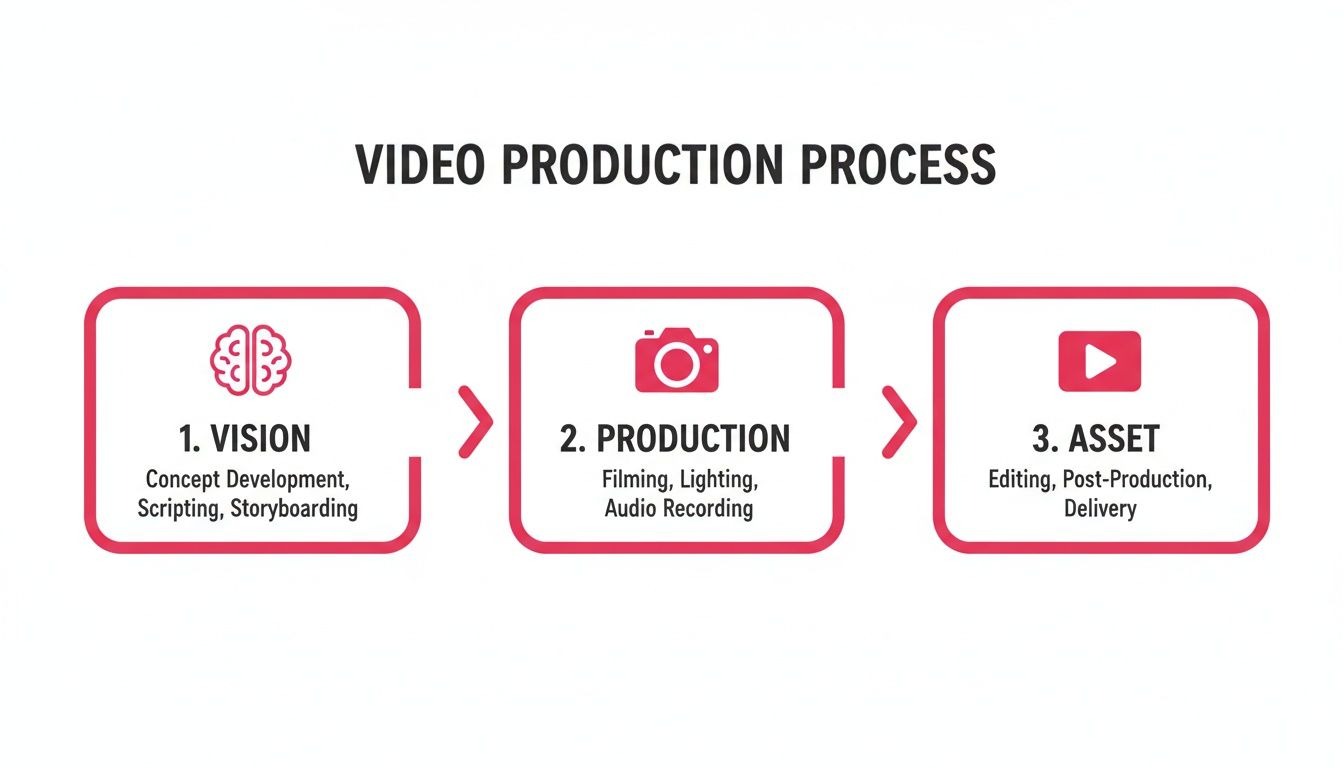
Each step builds directly on the last, creating a predictable path from concept to completion. Let’s break it down.
Stage 1: Pre-Production
This is where the magic really begins. Pre-production is all about planning, and it's easily the most critical phase for keeping a project on track and on budget. It’s where your abstract vision gets translated into a concrete, actionable plan that the entire team can follow.
Honestly, pre-production is 90% of the work. A well-planned shoot is an efficient shoot. Nearly every story I've heard about budget overruns or creative disappointments started with someone trying to rush this stage.
During pre-production, your video partner is busy handling all the critical groundwork:
- Scriptwriting: Nailing down the narrative and dialogue. This is where we make sure your message is sharp, clear, and actually connects with your audience.
- Storyboarding: Sketching out the video shot-by-shot. This simple step aligns everyone on the visual style long before a single frame is recorded.
- Location Scouting: Finding and securing the perfect backdrops that fit the story and tone you’re going for.
- Casting: If your video needs actors or on-screen talent, this is the time to find the right people and get them on board.
As the client, your job here is to give clear, decisive feedback. The more buttoned-up everything is in pre-production, the smoother the next two stages will be.
Stage 2: Production
With the blueprint locked in, it’s time to build. The production stage is the "lights, camera, action" part of the process, where all the raw footage and audio are captured.
The director is guiding the talent, the cinematographer is lining up the shots, and the sound engineer is making sure every word comes through crystal clear. This is where the plan becomes reality.
Your role on shoot days is usually to be an observer or a subject matter expert, especially if your team is being featured. The production company runs the show, making sure everything moves along according to the pre-production plan. This phase could be as short as a single day for a simple interview or stretch over several days for more complex projects.
Stage 3: Post-Production
And finally, post-production. This is where all the raw ingredients, the footage, audio clips, and graphics, are brought into the editing suite to be assembled into a polished story. It's a meticulous process that involves way more than just cutting scenes together.
Key activities in post-production include:
- Editing: Weaving the best takes together to create a narrative that flows and keeps viewers engaged.
- Color Grading: Adjusting colors to create a specific mood and ensure a consistent, professional look from start to finish.
- Sound Design and Mixing: Adding music, sound effects, and cleaning up dialogue to create an immersive audio experience that complements the visuals.
- Visual Effects (VFX) and Graphics: Adding in animated logos, text overlays, or any other digital enhancements that bring the story to life.
The demand for high-quality post-production isn't just a hunch; the market is booming. The video post-production services market in the United States is on track to hit $6.8 billion in 2026. This shows just how vital editing, effects, and sound design have become for creating content that actually grabs and holds attention.
During this final stage, you'll review different versions of the video, which we call "cuts", and provide feedback until it’s perfect. It’s this collaborative back-and-forth that turns raw footage into a powerful asset for your business.
For a deeper dive into the nuts and bolts of the entire workflow, check out our comprehensive guide on the video production process.
What Kind of Videos Can a Production Company Create?
A professional video production company doesn't just point a camera and shoot. They build strategic assets. The right video for you depends entirely on what you're trying to accomplish. Are you looking to build your brand from the ground up? Shorten that long sales cycle? Make new employee onboarding less of a drag?
The answer to those questions dictates the kind of video you need. Think of a production company's services not as a simple menu, but as a toolkit. Each video type is a specialized tool, engineered for a very specific job.
Let's break down some of the most powerful video formats for B2B and where they fit into your strategy.
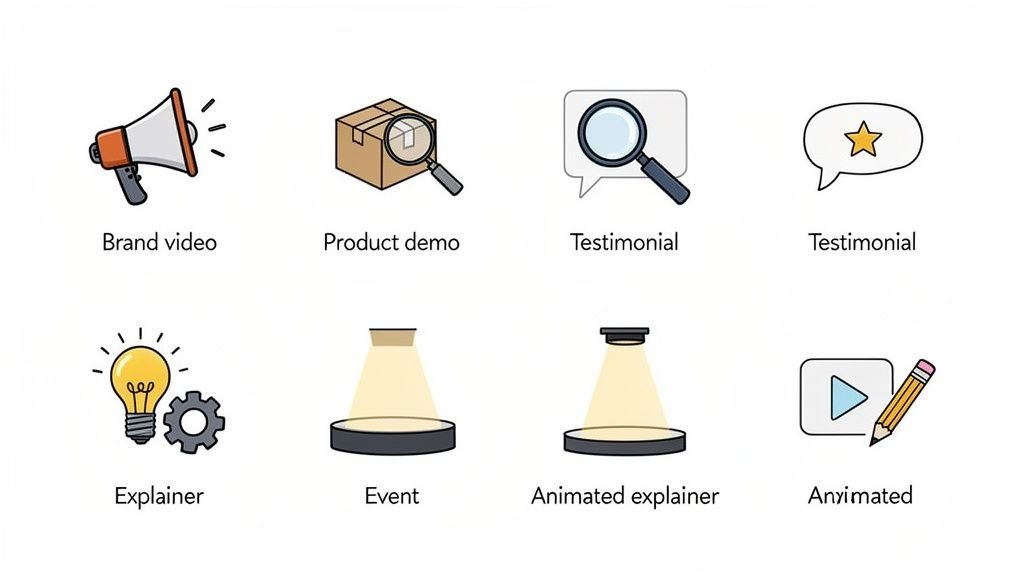
Videos for Brand Building and Awareness
These videos are your top-of-funnel workhorses. They’re designed to introduce your brand, tell your story, and forge a genuine connection with your audience. It's less about the hard sell and more about selling your mission.
- Brand Videos: This is your anthem. It’s the video that screams who you are, what you stand for, and why anyone should care. A powerful brand video is perfect for your homepage or to kick off a big presentation. It builds instant credibility.
- Event Videos: You just spent a fortune on a conference or trade show. Don't let that energy die when the lights go out. Event videos capture the key moments, extend the life of your event for those who couldn't make it, and become killer promo material for next year.
Videos for Lead Generation and Sales Enablement
Moving further down the funnel, these videos are all about education. They’re built to show prospects how you solve their problems and nudge them closer to making a decision—no fluff here, just practical, clear-cut value.
- Product Demo Videos: Stop telling people what your product does and just show them. A great demo walks a potential customer through the key features and answers their questions before they even think to ask. Your sales team will thank you.
- Explainer Videos: Got a complex service or a technical product? Explainer videos are your best friend. They break down complicated ideas into simple, digestible narratives, often using animation, that make people go, "Ah, I get it now!" They’re conversion machines on landing pages.
"When you're deciding who to work with... what's the first thing you do? Chances are, you look for reviews. You want to see what other people experienced... That's the same mindset your clients bring when they're considering your business."
That single thought perfectly captures the power of our next category: social proof.
Videos for Building Trust and Authority
Nothing builds trust faster than hearing it straight from a happy customer. These videos are all about authentic social proof that validates your claims and gives prospects the final push they need to choose you.
- Customer Testimonial Videos: Let your biggest fans do the selling for you. Authentic, unscripted testimonials are incredibly persuasive because they offer an unbiased, third-party perspective on your value. They make trust tangible.
- Case Study Videos: This is a testimonial on steroids. A case study video dives deep into a client's specific problem, the solution you provided, and, most importantly, the measurable results they saw. It’s the ultimate bottom-of-funnel asset for prospects weighing their options.
Of course, this is just scratching the surface. A huge area of specialization is video production for training, which focuses on creating engaging educational content for internal teams. The applications are nearly endless, which is the beauty of the craft. To go a bit deeper, check out our guide on the different facets of professional videography.
Ultimately, the best video production company won't just sell you a video; they'll help you pick the right tool for the job.
How to Find and Choose the Right Video Production Company
Finding the right creative partner can feel like searching for a needle in a haystack. But with a clear, actionable plan, you can turn an overwhelming task into an empowering one.
Choosing a video production company isn't about hiring just another vendor; it's about onboarding a strategic partner who becomes an extension of your marketing team. The goal is to find a group that not only possesses the technical skills but also deeply understands your B2B objectives.
This partnership is more critical than ever, as the demand for high-quality video explodes. The global video production market was valued at $53.46 billion in 2024 and is projected to reach $90.97 billion by 2035. This growth is fueled by the relentless need for engaging content across social media, corporate communications, and digital marketing. You can explore the data in the full market research on video production growth.
That massive market means you have plenty of options. Here’s a step-by-step approach to cut through the noise and find the perfect fit.
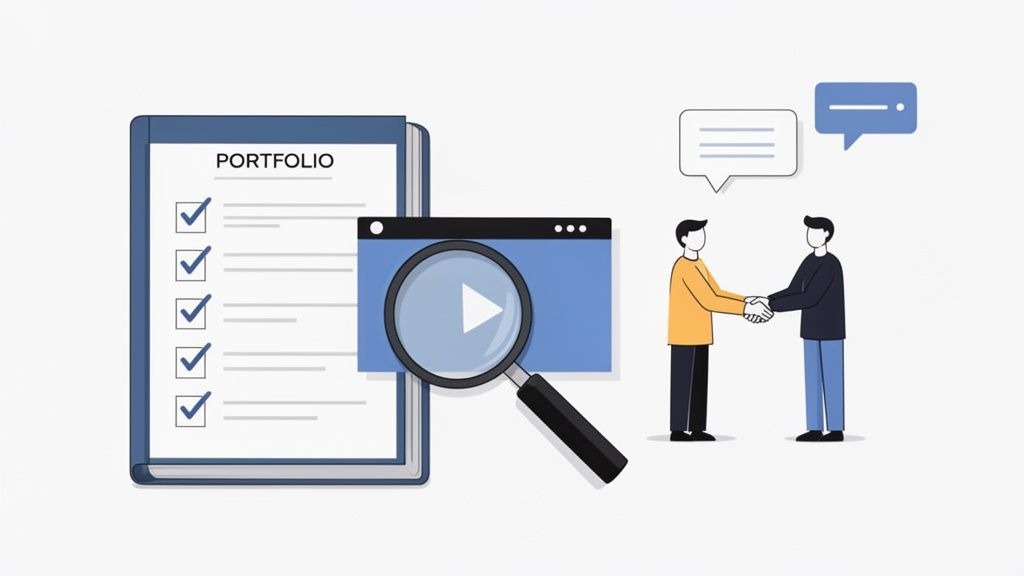
Step 1: Where to Look for Potential Partners
A simple Google search is a good starting point, but the best candidates are often found through more focused channels. Here are the most effective places to build your shortlist:
- Professional Networks: Use LinkedIn to find recommendations from trusted connections. Search for companies specializing in B2B video and review their work, client lists, and industry reputation.
- Creative Portfolio Platforms: Websites such as Vimeo and Behance serve as digital galleries for creative professionals. They are ideal for discovering companies with a strong visual style and seeing their capabilities firsthand.
- Industry Referrals: Ask other marketing leaders in your network who they recommend. A positive referral from a respected peer is one of the most reliable signals of quality and a great way to find proven partners.
Step 2: How to Analyze a Company’s Portfolio
A portfolio is more than a highlight reel; it’s a window into a company's strategic thinking, style, and expertise. Don’t just watch the videos; analyze them with a critical eye.
A great portfolio doesn't just show what a company can do; it shows how they think. Look for the 'why' behind each project. Does the video clearly nail a business goal, or is it just a montage of pretty shots?
As you review their work, ask these actionable questions:
- Is there a stylistic match? Does their visual and storytelling style align with your brand's identity? If you're a serious B2B tech company, a portfolio filled with flashy consumer ads may not be the right fit.
- Do they have relevant experience? Have they worked with companies in your industry or with similar business challenges? A partner who already speaks your language will get up to speed much faster.
- Are the results clear? Do their case studies mention tangible business outcomes, like increased lead generation or improved conversion rates? This demonstrates a focus on ROI, not just creative awards.
Seeing a company's past work is non-negotiable. For instance, you can explore a B2B-focused portfolio to understand how strategic video should be presented.
Step 3: Vetting Communication and Process
The best creative outcomes are born from seamless communication. During your initial conversations, pay close attention to how a potential partner interacts with you. A great partner will listen more than they talk, asking insightful questions to understand the core of your business challenges.
Here’s a quick checklist for assessing their process:
- Project Management: Ask them to walk you through their typical workflow. Is there a clear, structured process for pre-production, the shoot, and post-production? You're looking for order and predictability.
- Client Collaboration: How do they handle feedback and revisions? A transparent, collaborative revision process is crucial. It ensures you get the video you want, not just the video they deliver.
- Technical Capabilities: What equipment and software do they use? You don't need to be a technical expert, but their answer will reveal if they are invested in professional-grade tools capable of delivering a high-quality final product.
By following these actionable steps, you can move beyond a gut feeling and make a confident, informed decision that sets your project up for success.
Top Video Production Companies to Consider
Now that you have a framework for what to look for, it's time to build your shortlist. The B2B video production landscape is vast, but a few companies consistently rise to the top because they understand that a great B2B video isn't just about aesthetics, it's about moving an audience to act.
Here are some premier partners known for transforming complex business objectives into compelling visual stories.
1. Fame Crew
Fame Crew is a video production company that is relentlessly focused on creating videos that deliver tangible business results. Their entire process begins with one question: "What business goal is this video meant to achieve?" This strategy-first approach ensures that every project, whether it's a major brand film or a targeted product demo, is engineered to generate demand and accelerate growth.
What sets Fame Crew apart is its deep B2B expertise. They excel at taking dense, technical subjects and transforming them into clear, engaging narratives that connect with sophisticated buyers. They operate not just as a vendor but as a true extension of your marketing team, providing strategic guidance from the initial concept to the final distribution plan.
Key Takeaway: Fame Crew is the ideal partner for B2B companies that view video as a strategic investment in their sales pipeline, not just a creative expense. They are masters at crafting content that builds authority and drives measurable ROI.
If you're looking for a team that obsesses over results and understands the nuances of B2B marketing, explore Fame Crew’s video production services.
2. Sandwich Video
Sandwich Video is legendary in the tech startup scene for its distinctive, quirky, and highly effective explainer videos. They have a unique talent for making new and complex technology feel human, approachable, and easy to understand.
3. Sparkhouse
With a strong focus on authentic, emotional storytelling, Sparkhouse creates powerful brand films and testimonials. They are exceptionally skilled at capturing the human element of a business, making them a great choice for brands aiming to build a deep, emotional connection with their audience.
4. Lemonlight
Lemonlight has developed a scalable production model that makes high-quality video accessible to businesses of all sizes. Their streamlined process and extensive network of creators make them a reliable partner for companies needing a consistent volume of content for social media and digital ad campaigns without a massive budget.
5. VeracityColab
Specializing in high-end animated explainer videos and brand narratives, VeracityColab is known for its polished animation and sharp, strategic scripts. They are a go-to partner for B2B technology and SaaS companies that need to break down complex value propositions into visually captivating stories.
Measuring the ROI of Your Video Investment
Putting serious budget behind a professional video production company is a big move. And like any smart business decision, the only thing that really matters is the bottom line. It's tempting to get excited about view counts, but those are just vanity metrics. Real success is measured by the tangible impact video has on your pipeline and revenue.
To actually prove the value of what you're spending, you have to connect the dots between video performance and your business goals. That means digging into the key performance indicators (KPIs) that tell a clear story about how your content is changing audience behavior and pushing them to convert.
Key Metrics That Actually Matter
Forget about trying to go viral. For B2B, it’s all about engaging the right people, not just the most people. Start tracking these metrics to see what’s really moving the needle.
- Audience Retention Rate: You could argue this is the single most important metric. It shows you the exact moment viewers lose interest and click away. A high retention rate is a clear signal that your content is resonating and your message is hitting home.
- Click-Through Rate (CTR): If your video has a call-to-action (CTA), like a link to book a demo or download a whitepaper, the CTR tells you how many people are actually taking that next step. It’s a direct measure of how well your video inspires action.
- Conversion Rate: This is where the rubber meets the road. How many viewers filled out that lead form on your landing page after watching? This is the KPI that ties your video directly to lead generation.
Connecting Video to Your Sales Pipeline
The ultimate goal here is to see how your video content is shortening the sales cycle or bringing in better leads. By plugging your video analytics into the tools you already live in, like your CRM or Google Analytics, you can start painting a complete picture of your return on investment.
You can set up specific goals in Google Analytics to track viewers who arrive from a video and eventually convert. Your CRM can do the heavy lifting too, attributing new leads back to the specific video campaigns that brought them in, showing you which assets are actually worth the investment. For a deeper dive, check out our guide on how to calculate marketing ROI.
The data backs this up, big time. Video marketing stats for 2025 show that 89% of businesses are now using video as a key part of their marketing toolkit. With video on track to make up 82% of all consumer internet traffic, it’s no longer a "nice-to-have." It’s completely central to any content strategy that works.
When you focus on concrete KPIs like conversion rates and lead quality, you stop treating video as a creative expense and start seeing it for what it is: a measurable growth engine. This data-driven approach gives you all the proof you need to justify the investment and build a rock-solid case for your next project.
Got Questions? We've Got Answers.
Diving into the world of professional video can feel a bit overwhelming. Let's clear up some of the most common questions businesses have before they partner with a video production company.
What Exactly Is a Video Production Company?
A video production company is a business that manages the entire process of creating a video, from the initial concept to the final product. They handle all three stages of production: pre-production (planning, scripting, storyboarding), production (filming), and post-production (editing, sound design, visual effects). Their role is to translate a client's business goals into a compelling visual narrative that achieves specific, measurable outcomes.
What Services Do They Typically Offer?
A full-service video production company offers a wide range of services to cover the entire production lifecycle. This includes:
- Strategy and Concept Development: Helping you define your goals and develop a creative concept.
- Scriptwriting and Storyboarding: Crafting the narrative and visualizing the shots.
- Casting and Location Scouting: Finding talent and the perfect filming locations.
- Filming and Cinematography: Capturing high-quality video and audio footage.
- Editing and Post-Production: Assembling the footage, adding graphics, color grading, and mixing sound.
- Animation and Motion Graphics: Creating animated explainer videos or visual effects.
Companies like Fame Crew are a prime example of a video production company that provides end-to-end strategic services.
How Do I Find the Right Video Production Company?
Finding the right partner involves three key steps:
- Research: Look for companies on professional networks like LinkedIn or creative platforms like Vimeo and Behance. Ask for referrals from trusted peers in your industry.
- Review Portfolios: Analyze their past work. Look for experience in your industry, a style that aligns with your brand, and case studies that demonstrate real business results.
- Interview Candidates: Talk to your top choices. Assess their communication style, project management process, and whether they truly understand your business goals.
Which are Some Top Video Production Companies?
While the best fit depends on your specific needs, several companies are highly regarded in the industry. Here is a list to get you started:
- Fame Crew: Specializes in outcome-focused B2B videos designed to build authority and accelerate pipeline growth.
- Sandwich Video: Renowned for its quirky and effective explainer videos for tech startups.
- Sparkhouse: Experts in authentic, emotional storytelling through brand films and testimonials.
- Lemonlight: Offers scalable video production for businesses needing a high volume of content for digital marketing.
- VeracityColab: A top choice for high-end animated explainer videos that simplify complex ideas.
Choosing the right partner is a critical business decision. It's an investment in a powerful asset that can support your growth goals for years to come.
Ready to transform your B2B marketing with video that actually drives measurable results? Fame is a specialized video production company dedicated to helping businesses build authority and accelerate pipeline growth. Learn more about our video production services and see how we can turn your vision into a powerful strategic asset.
Want us to run this for you?
Fame starts and grows B2B podcasts that generate pipeline. Tell us who you are trying to reach and we will send a costed proposal within 48 hours.
Related content
- Read moreFame Team · July 16, 2026
10 Account Based Marketing Tactics For B2B Growth In 2026
Discover 10 actionable account based marketing tactics for B2B tech. Learn to use podcasts, data, and targeted content to close high-value accounts. - Read moreFame Team · July 16, 2026
The 8 Best Brighton Podcast Agency Picks For 2026
Find the best Brighton podcast agency for your B2B brand. Our 2026 guide reviews top 8 agencies for production, growth & ROI. Expert analysis here - Read moreJune 10, 2026
20 Best Podcast Production Agencies For 2026 (And Why Should You Hire One)
Global podcast and vodcast ad revenues are on track to hit $5 billion in 2026 , up 20% year-on-year. - Read moreApril 13, 2026
Leadership In Marketing: The B2B Podcast Playbook
Most companies still confuse leadership in marketing with job titles, org charts, and budget control. That's outdated.