

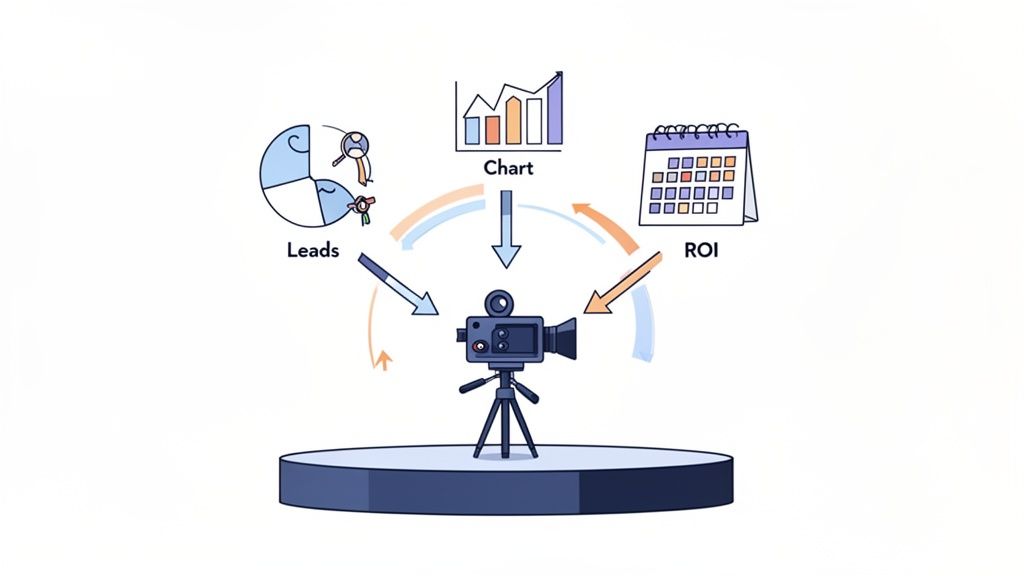
Let's be honest—you just dropped a small fortune on your conference presence. The booths are packed, the lanyards are in the trash, and the buzz is already gone. Professional conference videography is how you stop that from happening. It’s about turning that one-time hit to the budget into a strategic asset that pays you back all year.
From Event Expense to Strategic Growth Engine
Most B2B marketing teams get this wrong. They treat conference video as a simple to-do list: film the keynotes, grab some B-roll of people smiling, and maybe snag an interview or two.
This approach is exactly why most event footage ends up on a hard drive gathering digital dust. There was never a plan for it beyond a generic "event recap" video that nobody watches. The value is just left on the table.
The mindset shift is everything. You have to stop documenting the event and start seeing it as a content goldmine. Every session, every off-the-cuff conversation, and every expert on that stage is a potential marketing asset. This is what separates brands who get real ROI from their events from those who just get an expensive folder of unused video files.
Actionable Tip: Unlock Year-Long Marketing Value
When you get strategic, that footage can fuel your entire marketing engine for months. Here’s what the sharpest B2B brands are doing:
- Demand Generation: Slicing up keynote presentations into clips that generate leads for a webinar.
- Sales Enablement: Editing powerful customer testimonials that your sales team can actually use in their outreach.
- Social Proof: Turning attendee reactions and quick interviews into authentic, trust-building social content.
- Thought Leadership: Repurposing an expert panel discussion into a deep-dive YouTube series or a podcast.
This is where professional execution is non-negotiable. A crew that gets B2B marketing, like Fame Crew, doesn't just point a camera. They work with you to pinpoint the exact moments and messages that tie back to your business goals, making sure every second of footage is captured with a purpose. For a deeper look at maximizing your event's reach, our ultimate guide to conference video production has even more strategies.
The real ROI of conference videography isn't in the raw footage; it's in the pipeline of marketing assets you create from it. A single 45-minute presentation can be strategically repurposed into dozens of pieces of content that attract, engage, and convert your target audience for a full year.
To really make this switch, you need a holistic view of event visuals. You can learn more about Mastering Corporate Event Video Production to see how a video strategy should align with your bigger business goals. That’s what turns a line item on your event budget into a genuine growth engine.
Strategic Planning Before You Press Record
Showing up to a conference with a camera crew and no plan is a recipe for disaster. It’s the fastest way to burn thousands of dollars and walk away with hours of footage that has zero marketing value.
Success in conference videography happens long before you press record. It’s all about pre-production and treating your event presence like a full-blown content production. You need to stop thinking "let's film everything" and start thinking "what specific video assets will fuel our marketing for the next 6 to 12 months?"
This is the difference between collecting random clips and manufacturing strategic assets.
Actionable Tip: Define Your Content Menu Before the Event
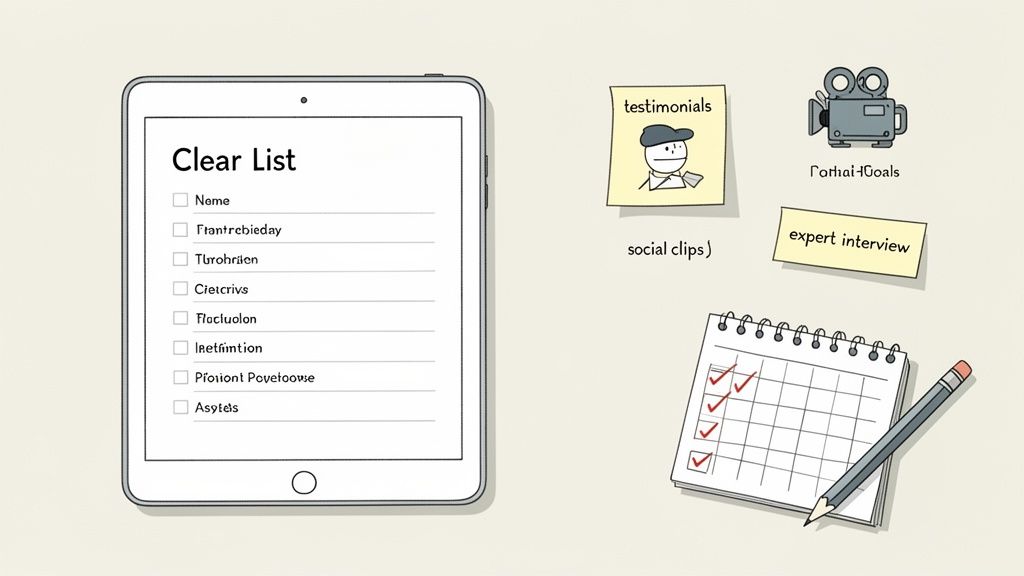
First things first, you need a "content menu." This is your wish list of every single video asset you want to walk away with, all tied back to specific marketing goals. This menu gives your video crew a crystal-clear mission.
A solid B2B content menu might look something like this:
- For Sales Enablement: Three polished customer testimonial videos to drop into sales cadences.
- For Social Media: Ten high-energy, short-form clips for LinkedIn and TikTok to boost brand awareness.
- For Thought Leadership: Five deep-dive interviews with industry experts for your YouTube channel.
See the difference? You're not just "capturing content"; you're producing assets for specific channels and objectives.
Actionable Tip: Build a Comprehensive Shot List
Once the menu is set, it's time to build the shot list. This is your crew’s bible for the entire event. A professional shot list is obsessively detailed, covering far more than just "film the main stage."
Your shot list should be broken down into categories:
- Primary Content: Multi-camera coverage of your keynotes and breakout sessions.
- Secondary Content: Scheduled interviews with your execs, key partners, and happy customers.
- Audience Reactions: Candid "vox pop" interviews with attendees. Ask them what they’ve learned and what they think of the event.
- Atmospheric B-roll: Get dynamic shots of your booth in action, people networking, event signage, and the overall buzz on the floor.
Your shot list is the single most important document in pre-production. It's the bridge between your marketing goals and the on-the-ground execution. A detailed list ensures your crew captures not just what's happening, but captures it in a way that aligns with your post-event editing needs.
This level of planning means when you hit post-production, you have all the ingredients you need. No gaps, no "I wish we had a shot of..." moments. It's a critical step that many overlook, but you can explore more pre-production essentials in our ultimate guide to conference video production.
Actionable Tip: Choose the Right Videography Partner
Picking a crew is about more than just good cameras. Technical skills are table stakes. You need a partner who gets B2B marketing and understands that their job is to help you hit your business goals.
When you're vetting potential videographers, ask these questions to see if they think like a marketer:
- How do you help clients build a shot list that maps to marketing KPIs?
- Show me some examples of how you've repurposed conference footage for other B2B clients.
- What’s your process for getting great sound for testimonials on a loud, chaotic event floor?
A true partner, like the team at Fame Crew, acts as an extension of your marketing department. They bring a strategic eye to the entire conference videography process, ensuring your investment pays off long after everyone has gone home.
Getting It Done: Mastering On-Site Capture and Execution
The conference floor is controlled chaos. It's loud, crowded, and completely unpredictable—and you need to walk away with broadcast-quality video. This is where all your planning slams into reality.
Success on the day isn't just about having cameras. It's about orchestrating a small army to capture the right content, at the right quality, without blowing up the event itself. It's about knowing what a pro setup actually looks like and how to manage all the moving pieces.
The Anatomy of a Professional On-Site Crew
There's no one-size-fits-all crew. What you need depends entirely on your shot list. The goal is to match the team to the content you planned to capture.
You'll typically be working with two kinds of teams on the ground:
- Multi-Camera Stage Crews: This is your bread and butter for keynotes, panels, and anything happening on the main stage. A standard setup involves 2-3 cameras to get you a wide shot of the stage, a medium on the speaker, and a tight shot for close-ups. This is how you get those dynamic, professional-looking edits. Critically, this crew will also plug directly into the main soundboard to get that crystal-clear audio.
- Run-and-Gun Teams: These are your nimble operators. Often just a single videographer and a sound tech, they’re tasked with capturing the energy of the event. Think roaming the floor for "vox pop" interviews with attendees, getting B-roll of your booth in action, or pulling a speaker aside for a quick testimonial.
A truly experienced crew leader knows how to make these two teams work in concert. While the stage crew is locked in on the planned sessions, the run-and-gun team is out hunting for those unscripted moments that make event content feel real.
Your On-Site Marketing Playbook
As the marketing manager, your job isn't to touch a camera. You’re the producer. You’re the central command for the entire video operation, making sure the crew has what they need to just do their job.
Here’s your actionable checklist for event day:
- Connect with the Venue AV Team: First thing. Introduce your video crew lead to the in-house AV team. They need to get on the same page about audio feeds, where to plug in for power, and camera placement. A good relationship here is the difference between smooth sailing and a technical nightmare.
- Run the Interview Schedule: Executives and speakers are on a tight clock. You need to manage their time like a hawk. Block out 15-minute slots, have a quiet spot pre-scouted, and run that schedule with military precision.
- Get Your Releases Signed: Anyone featured on camera (like for a testimonial) absolutely must sign a release form. Use a tablet with a digital app to make it quick and painless. For general crowd shots, just make sure you have prominent signs up that clearly state filming is in progress.
The single most valuable thing you can have on event day is a crew that can think on its feet. When a speaker is late, the lighting in a room is awful, or the audio feed is buzzing, a pro team doesn't panic. They problem-solve. They have backups for their backups and the know-how to fix problems you didn't even see coming.
This adaptability is what separates the pros from the amateurs. It's a core tenet of crews like Fame Crew, who know that event environments are anything but predictable. For a deeper dive into the on-the-ground roles, our complete event video production guide breaks it down even further.
Don’t forget that modern conferences have changed the game. At massive events like NVIDIA's GTC, videographers had to capture content for over 25,000 people in the room while also streaming to a virtual audience of more than 300,000. This has pushed crews to use remote production tech and AI tools just to manage the scale and cost. Having a crew that gets these new hybrid dynamics is a massive advantage.
The Art of Content Repurposing for Maximum ROI
Let's be blunt: the most expensive mistake you can make with conference videography is thinking the job is done when the cameras are packed away. A hard drive full of gorgeous, unedited footage isn't an asset. It's a liability gathering dust.
The real money, the actual ROI, shows up in post-production. This is where you transform that single event investment into a content machine that fuels your marketing for the next year.
This is all about content atomization. It’s a fancy term for a simple, powerful idea: strategically breaking down your big video assets into a whole menu of smaller, purpose-built content for every channel you care about. With a smart plan, you squeeze value out of every single second of footage.
Actionable Tip: From Keynote to Content Engine
Think about a standard 45-minute keynote. In the old days, you’d upload the whole thing to YouTube, get a few dozen views, and watch it sink into the algorithm's abyss. That's a tragic waste of potential.
Using a content atomization model, that same 45-minute session becomes a goldmine. You can create an entire content calendar from just one talk.
Here’s an actionable playbook for breaking it down:
- One Full-Length Anchor Video: The complete, professionally edited 45-minute session. Perfect for your YouTube channel or as a gated lead-gen asset.
- One 10-Minute "Deep Dive": Pull the single most valuable 10-minute segment. This is killer for embedding in a blog post that unpacks the topic.
- Five 60-Second Social Clips: Identify the best soundbites, surprising stats, or punchy, actionable tips. These become your high-engagement clips for LinkedIn, Instagram, and TikTok.
- One Audio-Only Podcast Episode: Just strip the audio, add a quick intro/outro, and boom—you've got a new episode for your company podcast.
- A Dozen Quote Graphics: Pull the most powerful, tweetable lines. Your designer turns these into branded graphics for X (formerly Twitter), LinkedIn, and Instagram.
Suddenly, one presentation has created an entire ecosystem of content. You’re hitting five different channels, with assets perfectly tailored to how people consume content on each platform. For a deeper look, check out our guide on smart content repurposing strategies.
To see this in action, take a look at the table below. It's a simple menu showing how one video becomes an arsenal of marketing assets.
The Conference Video Repurposing Menu
Use this menu to see how a single keynote session can be transformed into a wide variety of marketing assets for different channels and goals.
This isn't an exhaustive list, but it shows how quickly you can multiply the impact of your initial investment. The key is to stop thinking "one video" and start thinking "one content ecosystem."
Accelerating Repurposing with AI Tools
This kind of repurposing used to take a painful amount of manual labor. An editor would have to scrub through hours of footage just to find the gems. Thankfully, modern AI tools have changed the game.
Instead of burning hours on tedious tasks, AI-powered platforms can give you a massive head start. For example, they can:
- Transcribe Everything in Minutes: Get a searchable, time-stamped transcript of every single session. No more manual transcription.
- Identify Viral-Worthy Moments: AI can analyze the transcript to flag sections with high energy, audience reactions, or powerful statements that are perfect for short-form clips.
- Generate Summaries and Chapters: Automatically create summaries for blog posts or YouTube descriptions and even identify logical chapter breaks for longer videos.
These tools don’t replace skilled human editors who understand narrative and storytelling. What they do is get all the grunt work out of the way, freeing up your team to focus their creative energy on polishing the final assets. They work faster and more strategically.
If you really want to unlock the full ROI from your conference video, implementing smart content repurposing strategies is non-negotiable.
The image below breaks down the on-site process—it’s a simple flow, but getting these three pieces right is everything.
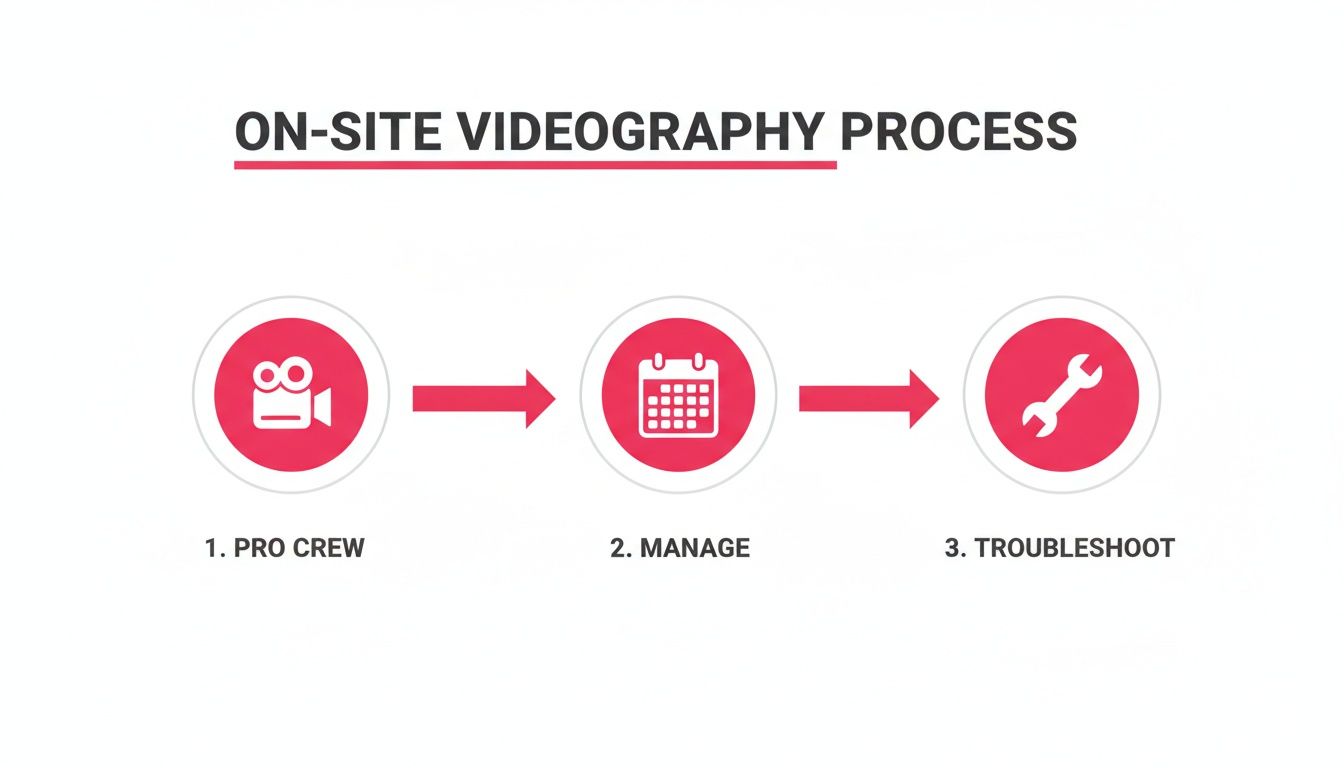
It really comes down to having a great crew, solid management on the ground, and the experience to troubleshoot before small problems become big ones.
For B2B events, a winning formula we see constantly is creating anchor videos around 8-30 minutes long that can then be spun out into 10-20 short clips. This approach is only getting more critical. Looking ahead to 2026, 53% of marketers plan to dedicate at least a third of their budget to video. The wave is coming.
Repurposing isn't about making your content smaller; it's about making your message bigger. By adapting a single idea for multiple platforms, you meet your audience where they are and surround them with your brand's expertise in a non-repetitive way.
Smart Distribution and Measuring What Matters
Great. You’ve captured some incredible video at your conference. But here’s the hard truth: amazing content is useless without an audience.
Getting that footage in front of the right B2B decision-makers is where the real work begins. If your plan is to just dump everything onto your corporate YouTube channel and call it a day, you’re leaving a massive amount of value on the table. You’ll never see a real return on your conference videography investment that way.
It’s time to get a bit more sophisticated with your distribution plays. Think of each video asset as a specific tool, built for a specific job and a specific person. This is how you make your content work for you long after the event wraps up.
Sophisticated Distribution for B2B Audiences
Your distribution strategy needs to be just as thought-out as your on-site capture plan. Ditch the "spray and pray" mindset. Instead, you want to strategically place your content exactly where it will have the biggest impact on a buyer’s journey.
Here are a few powerful plays to get you started:
- Email Nurture Sequences: Drop short, high-impact clips into your email flows. A 90-second snippet from a keynote that breaks down a complex idea can reignite a cold lead or boost click-through rates way more effectively than a wall of text ever could.
- Sales Team Enablement: Build a library of killer testimonial clips for your sales reps. Imagine a prospect brings up a specific objection, and your salesperson can immediately fire back with a video of a happy customer talking about how they overcame that exact issue. That's authentic, on-demand social proof.
- Targeted Paid Social: Take your short-form clips and run hyper-targeted ad campaigns on platforms like LinkedIn. You can zero in on the exact job titles, industries, and company sizes you need to reach, ensuring your content hits the right eyeballs.
These moves transform your video from just "content" into an active, lead-generating part of your sales and marketing machine.
You don't need your videos to go "viral." You need them to go viral with the 500 people who can actually buy your product. In B2B, smart, targeted distribution crushes mass viewership every single time.
And don't forget about emerging channels. We're starting to see some interesting plays on Connected TV (CTV). Placing short-form ads or sponsored content on platforms like YouTube TV lets you reach execs in their "lean-back" home environment, cutting through the noise of the typical workday.
Measuring the ROI of Conference Videography
Sooner or later, your CMO is going to walk over to your desk and ask, "What was the ROI on all that video stuff?" To have a good answer, you need a clear way to measure success with metrics that actually mean something to the business. "Views" are a starting point, but they don't tell the story.
You need to focus on metrics that draw a straight line from your video efforts to business results.
Actionable Metrics to Track:
- Lead Attribution from Video CTAs: Use a platform like Wistia or Vidyard that lets you embed forms or CTAs directly inside your videos. This is gold. It allows you to see exactly how many leads a specific video generated.
- Pipeline Influence: This one is a little trickier, but it’s a game-changer. Get your sales team to log every time they use a video asset in their outreach. Then, correlate that activity with deal progression and close rates. Did deals that watched three testimonial videos close 20% faster? That’s pipeline influence.
- Brand Lift and Engagement: Go beyond simple views. Look at audience retention (how long are people actually watching?), click-through rates on video links in emails, and the sentiment of comments on your social clips. These numbers tell you if your content is actually resonating and building authority.
This data-driven approach changes the conversation from, "we got some nice videos," to, "our conference video strategy generated 45 qualified leads and influenced $250,000 in new pipeline last quarter."
The market is betting big on this. By 2026, corporate video spending is projected to blow past $30 billion. More importantly, 88% of video marketers are already seeing a direct connection to sales. And with global livestream sales approaching $500 billion, the content you capture at conferences is perfectly positioned to drive real business. If you want to dig deeper, you can explore more detailed corporate video insights and see how distribution is adapting.
Why Partnering with a Pro Crew Is Non-Negotiable
Let’s be blunt: strategic conference videography is a complex, high-stakes game. This isn't a task you hand off to an intern with a smartphone or your already-swamped internal marketing team.
The risk of technical glitches, missed moments, and a completely wasted investment is just too high. We've seen it happen. Trying to wrangle this in-house almost always ends in subpar audio, shaky footage, and a final product that screams amateur—the exact opposite of the brand authority you're trying to build.
A professional crew is your insurance policy against the chaos of a live event. They anticipate problems you don't see coming—from poor lighting and buzzing audio feeds to last-minute schedule changes—and solve them on the fly, ensuring flawless execution.
Beyond Just Cameras and Mics
A true B2B video partner isn’t just a vendor who shows up with gear. They should be a strategic extension of your team, plugged in from day one.
They’ll help you build a smarter shot list, consult on your content strategy, and handle the tangled web of on-site logistics. This kind of partnership guarantees that every decision, from pre-production planning to post-production content strategy, is laser-focused on your marketing goals and ROI.
If you want more guidance on vetting partners, we've put together some advice on how to find a video production company that drives real business results.
If you’re serious about turning your next conference into a real asset for growth, it’s time to bring in the experts. A professional partner like Fame Crew doesn’t just capture footage; we help you build a content engine that delivers measurable returns. Let's talk about what that could look like for your next event.
Answering Your Toughest Questions
Let's cut to the chase. Here are the straight answers to the questions B2B marketers always ask about getting real value from conference video.
So, What’s This Going to Cost Me?
I get it, this is always the first question. The real answer? It depends entirely on what you want to achieve.
A simple, one-day shoot with a single camera might start in the low thousands. But if you're talking about a multi-day conference with several crews, live streaming, and a mountain of post-production work, you're looking at a range of $20,000 to $50,000+.
The right way to think about this isn't cost, but investment. Before you even ask for a quote, you need to define your goals. The cost is just a number until you frame it against the ROI of having a full year's worth of marketing assets ready to go.
How Early Do I Need to Book a Video Crew?
For any major conference, you need to be having these conversations 3-6 months out. No exceptions.
The best crews—the ones who think like marketers, not just camera operators—are booked solid. Locking them in early isn't just about availability; it's about giving them the time they need for deep strategic planning, sorting out logistics, and getting the right people on your team.
Trying to book last-minute is a recipe for disaster. You'll get whoever is left, and you'll completely miss out on the pre-production strategy that separates great content from just "footage."
What's the Single Biggest Mistake I Can Make?
The biggest and most common mistake is having no post-event content strategy. I've seen countless companies spend a fortune on capturing beautiful footage, only for it to die a slow death on a hard drive.
This is non-negotiable. Before you hit record on a single camera, you need a documented plan. You must know exactly how every clip will be edited, repurposed, distributed, and measured against your marketing goals. Without that, you're just recording, not creating assets.
Can't We Just Use Our In-House Team to Save Money?
While it might seem like a smart way to cut costs, going the in-house route for a high-stakes event almost always leads to disappointing results.
Your internal team might be great, but they probably lack the specialized gear (especially for audio in a chaotic hall), the experience of shooting in a live event environment, and a deep focus on B2B content strategy.
A professional crew is more than a camera operator. They are your strategic partner on the ground. They handle logistics, solve the inevitable on-the-fly problems, and ensure every shot is captured with your ROI goals in mind.
Turning your next conference into a pipeline-generating machine is a big job, but the payoff is massive. It demands more than just recording sessions; it requires a partner who lives and breathes B2B marketing.
Fame Crew was built for this. We help you move beyond simple event coverage to create a library of high-impact assets that drive real growth. See how we can help you at your next conference.
