March 14, 202618 min read6 sections
How To Reduce Customer Acquisition Cost: Practical Strategies For 2026 Growth
By Fame Team
Key Takeaways
- B2B customer acquisition costs are increasing due to market saturation and changing buyer journeys.
- Building brand authority and investing in long-term assets like SEO and content can lower costs.
- Companies that adapt their acquisition methods can cut costs by up to 50% and build a more resilient customer acquisition engine.
Feeling like you’re spending more and more to land each new B2B customer? You’re not imagining it. The days of predictable returns from the same old marketing playbooks are over. Acquiring customers today is just flat-out more expensive and complicated than it used to be, thanks to a perfect storm of market shifts.
The old go-to channels for quick wins, like digital ads, are now incredibly saturated. Everyone's fighting for the same sliver of attention, which naturally drives up costs and gives you less bang for your buck. On top of that, B2B buyer journeys have become a tangled web, involving more people, longer research phases, and a much bigger need for trust before anyone even thinks about buying.
Why Your B2B Customer Acquisition Costs Are Skyrocketing
The core of the problem is a strategic shift. We've moved from an era of paid acquisition to one where building brand authority is what actually attracts customers. The most effective ways to lower CAC now involve optimizing the channels you already have for peak efficiency, investing in long-term assets like SEO and content, and building a brand so strong that high-intent leads just come to you, no expensive ad spend required.
The Sobering Statistics Behind Rising CAC
The numbers don't lie. Over an eight-year span, general customer acquisition costs have shot up by a staggering 222%. And for B2B SaaS companies, it’s even worse. Average acquisition costs have hit $1,200 per customer; a 70% leap from the previous benchmark of $702. If you want to go deeper on these numbers, you can explore the full research on rising CAC trends.
These stats make it painfully clear that just throwing money at paid ads is a losing game. But there’s a silver lining here for teams willing to adapt. Companies that have smartly woven new acquisition methods into their strategy have successfully cut these costs by up to 50%.
Key Takeaway: The issue isn't just that ads are more expensive. The real problem is that the entire model of "buying" customers is breaking down. The solution is to stop renting attention and start building a brand that earns it through strategic thought leadership.
Charting a Path to Lower CAC
To really tackle these rising costs, you need a strategy that hits both short-term efficiency and long-term brand building. This guide is your roadmap, breaking down the tactics you need to build a more cost-effective and resilient customer acquisition engine.
Before we dive in, let's get a high-level view of the core strategies we'll be covering. Think of this as the framework for transforming your entire approach to acquiring customers.
Core Strategies for B2B CAC Reduction
| Strategy | Primary Goal | Key Channels |
|---|---|---|
| Accurate CAC Measurement | Gain visibility into true acquisition costs to identify inefficiencies and optimization opportunities. | CRM platforms, financial software, and marketing analytics tools |
| Channel Optimization | Improve the performance and return on investment of existing marketing and sales channels. | Paid advertising, SEO, email marketing, and conversion rate optimization (CRO) |
| Building Authority (Podcasting) | Establish industry leadership to attract high-intent inbound leads organically. | B2B podcasts, webinars, and thought leadership content |
| Strategic Guesting | Leverage existing audiences to generate cost-effective brand awareness and qualified leads. | Niche industry podcasts, partner webinars, and guest appearances |
| Customer Retention & LTV | Increase customer lifetime value to improve profitability and support sustainable growth. | Customer success programs, loyalty initiatives, and upsell campaigns |
Each of these pieces works together. The goal isn't just to spend less, but to fundamentally increase the value and loyalty of the customers you bring in. Let's get into the specifics.
Measure Your True CAC to Find Hidden Costs
Before you can even think about cutting your customer acquisition cost, you have to know what it actually is. Too many B2B teams are flying blind, relying on a simple ‘blended’ CAC that averages everything out. This number doesn't just hide the truth; it actively masks the massive inefficiencies draining your budget.
If you want to make smart decisions that actually save money, you need to dig deeper. It's time to calculate your true, fully-loaded CAC. A basic formula just scratching the surface won't cut it—it misses all the overhead that quietly inflates your real acquisition spend.
Uncovering Your Fully-Loaded CAC
Your true CAC goes way beyond what you’re spending on ads. It needs to account for every single dollar associated with landing a new customer. Tallying this all up is the only way to get a realistic picture of your investment.
So, what gets included?
- Marketing & Sales Salaries: This is the full compensation for everyone touching the acquisition process. Think marketers, SDRs, and anyone in between.
- Software & Tool Subscriptions: Add up the monthly and annual fees for your CRM, marketing automation, analytics platforms, and any other tech that supports your go-to-market efforts.
- Creative & Production Costs: The money spent creating content, designing ads, and producing any materials for your campaigns. It all counts.
- Overhead Allocation: A portion of general business expenses, like office space or utilities, that supports your sales and marketing teams.
This isn't just a marketing metric anymore; it's a core business KPI. If you need a hand organizing all these inputs, a good customer acquisition cost calculator can be a lifesaver.
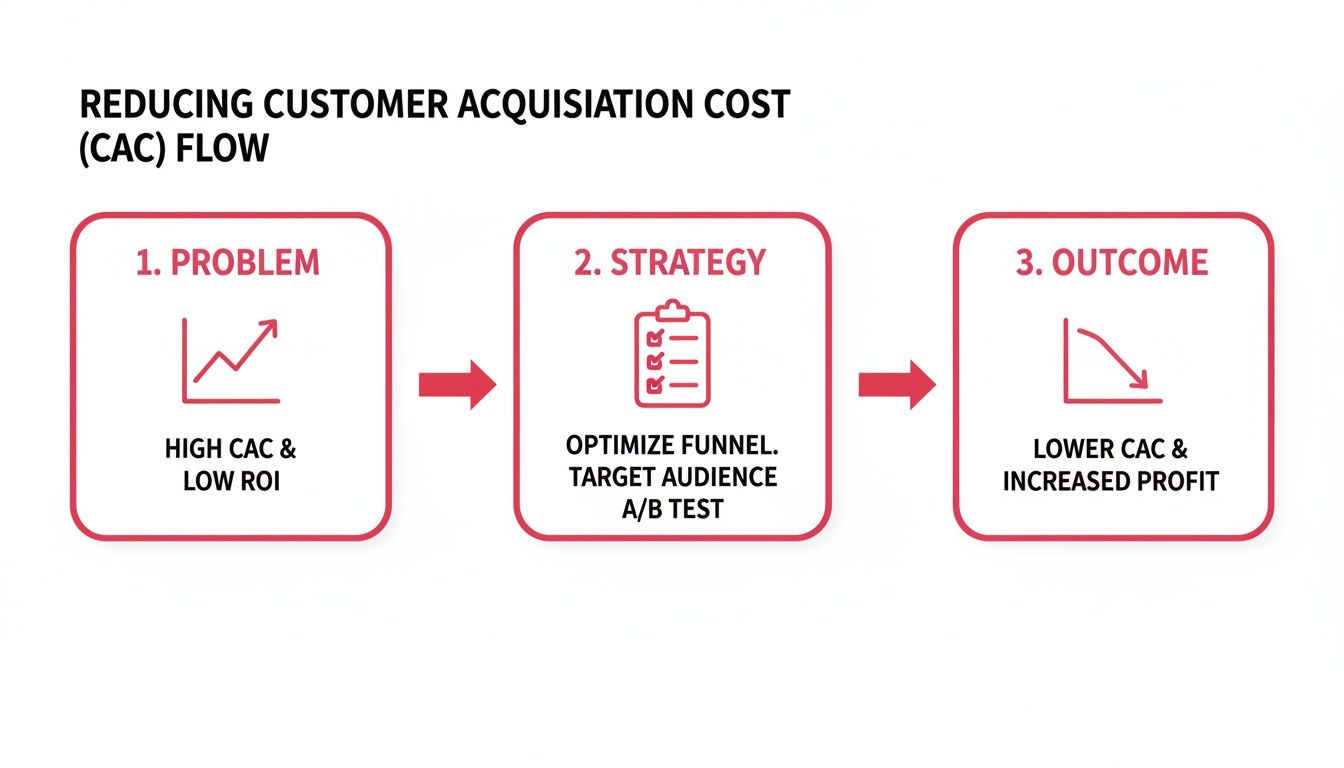
This whole process is about creating a clear path from diagnosis to solution. You identify where the costs are bleeding, implement targeted fixes, and get to a much healthier, more efficient CAC.
Go Granular with Channel-Specific CAC
Okay, you've got your fully-loaded CAC. But a blended number only tells you the average. The real magic happens when you calculate a channel-specific CAC.
This is where you figure out the exact cost to acquire a customer from each individual channel; paid search, social media, SEO, events, you name it. Suddenly, you can see which channels are profitable and which are just budget black holes.
This is where true optimization begins. Imagine you discover your LinkedIn ads have a CAC of $500, but your organic search traffic brings in customers for just $50. That’s a game-changer. You know exactly where to shift your budget for a massive efficiency boost.
We're just scratching the surface here. For a much deeper look at the mechanics, check out our full guide on how to calculate marketing ROI.
Benchmarking with Key Efficiency Metrics
So, you have an accurate CAC. But is it any good? The only way to know for sure is to compare it to the value that customer brings to your business. This is where a couple of critical metrics come into play: the LTV:CAC ratio and your payback period.
The LTV:CAC ratio compares a customer's Lifetime Value to the cost of acquiring them. A healthy B2B company should be aiming for a ratio of at least 3:1. This means for every $1 you spend on acquisition, you’re generating $3 in value over time.
Your payback period is simply the amount of time it takes to earn back the money you spent acquiring a customer. For most SaaS and B2B service companies, a payback period under 12 months is a fantastic signal of a healthy, sustainable growth model.
The efficiency gap between the best and worst companies is staggering. Data shows the worst-performing SaaS companies spend $2.82 to acquire just $1 of new annual revenue. The top performers? They spend only $1.00.
With the median cost to acquire $1 of revenue now sitting at $2.00, understanding where you stand is non-negotiable. By tracking these numbers, you stop guessing and start making strategic moves that genuinely drive down your costs.
Squeeze More Juice From Your Acquisition Channels
Alright, you've got your CAC numbers dialed in. Now for the fun part: taking action. You know where the money is going, so the mission is to make every single dollar pull more weight.
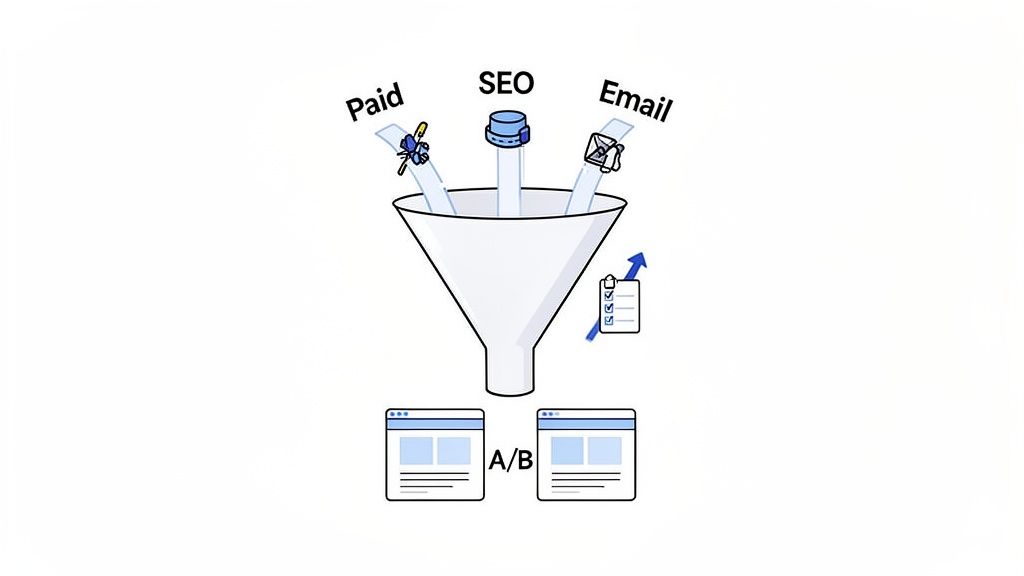
The most direct path to lowering your CAC is by optimizing the channels you're already using. It's about plugging leaks and doubling down on what's proven to work.
This isn't some wild goose chase for the "next big thing." It's about taking a magnifying glass to your current efforts, from paid ads to organic search, and fine-tuning them for peak performance. This is where you translate that raw data into real cost savings and a much healthier ROI.
Get Hyper-Specific With Your Audience Targeting
One of the quickest ways to incinerate your budget? Showing ads to the wrong people. Vague targeting is a classic culprit behind a bloated CAC. The fix is to become relentlessly specific about who you're trying to reach.
For paid platforms like LinkedIn or Google Ads, this means you have to go deeper than broad firmographics. Take your ideal customer profile (ICP) and use it to build audiences that are so specific, they almost feel too small.
- Drill Down on Job Titles: Instead of just "Marketing," zero in on "Head of Demand Generation" or "VP of Marketing" at Series B tech companies.
- Layer on Company DNA: Combine those job titles with company size, specific industries, or even the tech stack they use (e.g., they use HubSpot, you integrate with HubSpot).
- Use Exclusion Lists Aggressively: Actively block industries, company sizes, and job functions that are a terrible fit. This simple step is like turning off a leaky faucet—it stops the wasted spend instantly.
Every irrelevant impression you avoid and every unqualified click you prevent is money straight back into your pocket. This directly pushes your channel-specific CAC down.
Become Obsessed With Conversion Rate Optimization
Getting traffic to your website is only half the job. If your landing pages can't convince those visitors to become leads, you’re just pouring expensive water into a leaky bucket.
This is where Conversion Rate Optimization (CRO) becomes your secret weapon.
CRO is simply the process of methodically tweaking your website to get more visitors to take the action you want them to take. Start with your highest-impact pages; the ones with the most traffic and the highest intent, like your demo request or pricing pages.
A/B testing is the soul of CRO. Never, ever trust your gut. Test one thing at a time; the headline, the call-to-action button color, the number of form fields; and let the cold, hard data tell you what wins. Even a tiny lift in conversion rate, say from 1% to 2%, effectively slashes your cost-per-lead in half.
This constant cycle of testing and iterating turns your website from a static brochure into a dynamic, lead-generating machine.
Build Assets With Long-Term, Low-Cost Channels
Paid channels are great for turning on the faucet quickly, but they require constant cash to keep the water flowing. To build a sustainable advantage and truly reduce customer acquisition cost for the long haul, you have to invest in channels that build compounding value.
I'm talking about content marketing and SEO.
Unlike a LinkedIn ad that vanishes the second you stop paying, a high-value blog post can rank on Google for years, pulling in a steady stream of high-intent organic traffic—for free. Every single lead you get from a piece of content you published six months ago has a marginal CAC of pretty much $0.
This isn't just marketing; you're building a genuine asset for your business. Deciding on the best B2B marketing channels for your company means striking a balance between these short-term paid wins and long-term, asset-building investments.
Build Authority and Slash CAC with a B2B Podcast
Fine-tuning your existing channels is smart, but it's really just a game of efficiency. If you want to fundamentally change your acquisition model and drive down costs for good, you have to stop "hunting" for customers and start "attracting" them. It’s about building a brand so strong that your best-fit clients come looking for you when they have a problem.
And in the B2B world, the single best tool for that mission is a podcast. As our founder, Tom Hunt, puts it, a podcast is the fastest way to build authority in your niche.
It’s way more than just another content format. It's a content engine and a relationship-builder all in one. By consistently educating your market and becoming a leading voice in your space, you build incredible trust and loyalty. That directly translates to a healthier bottom line.
Become the Go-To Voice in Your Niche
A great B2B podcast completely changes your standing in the market. It’s your stage to tackle the big issues, share your expertise, and steer the conversation in your industry. When you show up every week with real value, you become the first name people think of when they’re finally ready to buy.
This process of building authority hits your CAC from a few different angles:
- It Warms Up Your Market: You’re educating potential customers long before they even think about talking to sales. They show up already bought into your way of thinking.
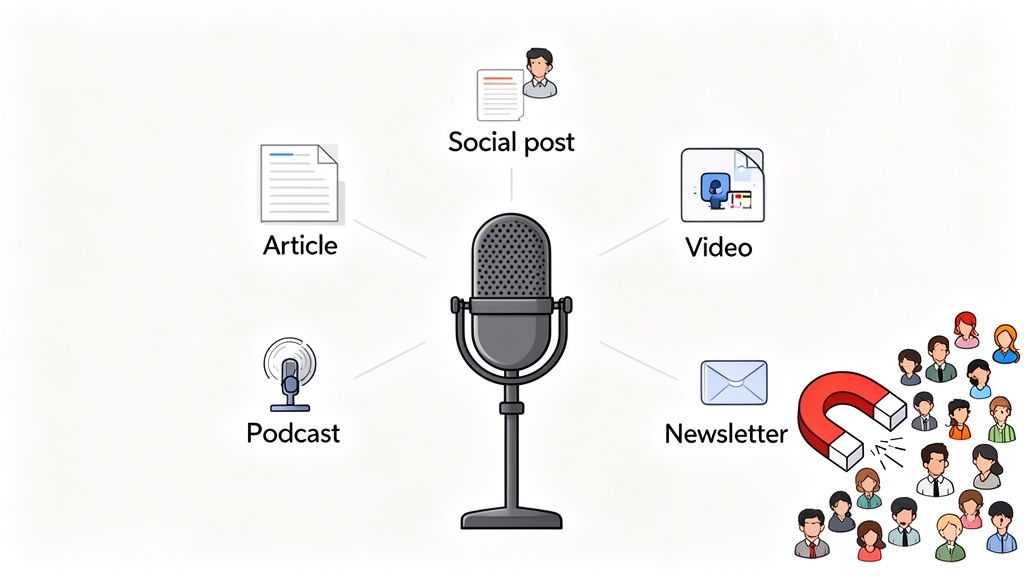
- It Drives Inbound Leads: As your show’s reputation grows, you become a magnet for high-intent leads who are a perfect match for what you do. No more chasing.
- It Builds Real Trust: Hearing your voice week after week creates a personal bond that a paid ad could never dream of. That trust shortens sales cycles and smooths out the whole acquisition process.
A podcast flips the script from outbound interruption to inbound attraction. You stop chasing prospects and instead create a platform that draws them to you, dramatically lowering the effort and cost required to win new business. Exploring the actionable benefits of podcasting for your business can reveal just how deep this impact goes.
Turn One Episode into a Dozen Content Assets
A single podcast episode is a content goldmine. Forget the struggle of creating fresh material for every channel. One hour of recorded audio can be sliced, diced, and repurposed into a ton of different assets. This is a massive efficiency boost for your marketing team and multiplies the reach of your core message.
Here’s a quick look at how one episode can power your entire content calendar:
- Full-Length Video: Post the recording on YouTube for your visual audience. Learn how to start a podcast on YouTube.
- Short-Form Video Clips: Chop up 3-5 engaging clips for TikTok, Instagram Reels, and LinkedIn that highlight the best moments.
- Audiograms: Pair a powerful audio snippet with an animated waveform and share it across social media.
- Blog Post: Get the episode transcribed and turn it into a detailed, SEO-friendly article.
- Newsletter Content: Feature the episode’s main takeaways in your next email send, which can be managed by a B2B email newsletter agency.
- Social Media Posts: Pull out killer quotes, stats, and ideas to fuel a week’s worth of posts for LinkedIn and Twitter with the help of a B2B social media agency.
This “create once, distribute forever” model means you get way more bang for your buck from every minute you invest, stretching your content budget and lowering the overall cost of engagement.
It's a Business Development Super-Tool
A podcast is also one of the slickest business development tools out there. It gives you a non-salesy excuse to connect with high-value people, including the exact prospects you want to turn into clients.
Think about it: you can invite a dream client onto your show as an expert guest. This isn't a sales pitch; it's a genuine conversation where you build a real relationship. You give them a platform to share their expertise, and in return, you get an hour of their undivided attention to learn their pain points and show off your own knowledge. After building that kind of rapport, offering them a special deal to become a client feels like a natural next step.
This strategy works wonders for deepening relationships with your existing clients, too. Bring them on the show, celebrate their success, and strengthen your partnership. It often leads to referrals and more business—a powerful way to boost LTV while using their story to attract new customers. Even smaller companies can "fight above their weight class" and land guests from huge industry names if the podcast is good.
After about six months, a respected podcast can even become a revenue-generating asset. Once you have a loyal audience, you become attractive to sponsors. Better yet, you have a direct line to your most engaged followers, letting you pitch your own services with "listener-only" deals, creating a hyper-efficient and profitable acquisition channel.
Want Low-Cost Leads? Get Yourself on Some Podcasts
Launching your own show is a massive power play for the long game, but let's be real; maybe you're not ready for that level of production commitment right now. And that's completely fine.
There’s another way to get in on the audio action immediately: podcast guesting.
Showing up as an expert guest on podcasts that are already established in your space is the perfect way in. It’s a low-cost, high-impact move that lets you borrow the credibility of hosts your audience already trusts. You can even get the benefits of having a podcast without launching one.
This strategy is all about getting your expertise in front of people who are already primed to care about what you do. It’s a direct line to brand awareness and driving qualified traffic back to your site, often for a tiny fraction of what you'd spend on paid ads.
Find the Right Stage for Your Message
The whole game with podcast guesting is finding the right shows. You aren't just spraying and praying. You're looking for podcasts where the audience is a dead ringer for your ideal customer profile (ICP).
Sure, getting on a huge, general-interest podcast might feel like a major win, but a smaller, niche show packed with your target buyers will almost always deliver a better return.
Start by figuring out what your best customers are already listening to.
- Just ask them: A simple question like, "What podcasts do you listen to for industry insights?" can hand you a golden list.
- Dig into podcast directories: Fire up Apple Podcasts and Spotify. Search for keywords tied to your industry, your services, and the problems you solve for people.
- Spy on your competitors: See what shows your competitors or other leaders in your space have been on. Their guest appearance history is basically a public roadmap to relevant podcasts.
Once you’ve got a list, vet each show. Look at the audience fit, check out their engagement (reviews, social media chatter), and make sure the quality is there. A well-produced show with a lively community is exactly the platform you want.
Show Up Ready to Deliver the Goods
Getting booked is just the first hurdle. To actually make the appearance count, you need to show up and provide massive value. This is not a 30-minute sales pitch. It's your chance to teach, share something genuinely new, and build trust. Knowing how to prepare for your next podcast guest appearance is non-negotiable.
Your goal is to be such a fantastic guest that people are scrambling to look you up afterward. Have a couple of killer stories or frameworks ready to go that clearly show off your expertise. And critically, have a simple, clear call-to-action for the end. Point them to a specific resource on your website that you mentioned during the conversation.
Being a guest on a podcast is one of the fastest ways to build authority. You're not just creating content; you're associating your personal brand with a trusted source in your industry. That borrowed credibility is an incredibly efficient way to warm up cold audiences. Explore the top 5 benefits of appearing on podcasts to see the full potential.
Scale Your Outreach for Maximum Impact
Let's be honest: manually finding shows, pitching hosts one by one, and coordinating schedules is a massive time sink. It’s a great way to get started, but it quickly becomes a bottleneck when you try to do it at scale.
This is where you need to get smart if you want to reduce customer acquisition cost consistently.
For businesses that want to make podcast guesting a real, repeatable part of their marketing engine, a service like Fame Connect can be a total game-changer. We handle all the outreach and booking, getting you guest spots on high-value podcasts in your niche.
This frees you up to do the one thing you can't outsource: preparing for the conversation and sharing what you know. By offloading the logistics, you can turn podcast guesting into a predictable, scalable channel for generating leads.
Common Questions About Reducing Customer Acquisition Cost
As you start putting these strategies into practice, you're going to have questions. It’s inevitable. Knocking down your customer acquisition cost isn't a one-and-done task; it’s a constant cycle of measuring, tweaking, and making smart bets.
Let's tackle some of the most common hurdles B2B marketing teams run into.
What Is a Good LTV to CAC Ratio for a B2B Company?
For most B2B companies, a healthy LTV:CAC ratio is at least 3:1. Plain and simple. This means for every dollar you sink into acquiring a new customer, you should be getting at least three dollars back over their lifetime.
But this isn't a hard-and-fast rule. A ratio below 3:1 is a red flag. It often means you're paying too much for growth and your model might be unsustainable. On the flip side, the best-in-class companies often hit ratios of 5:1 or even higher.
Just as important is your payback period. You should aim to get your CAC back in under 12 months. This keeps cash flow healthy and gives you the fuel you need to keep growing.
How Long Until a B2B Podcast Actually Reduces CAC?
Look, a B2B podcast is a long game. It's not an overnight fix for your acquisition numbers. You’ll probably see some early wins like better brand buzz and solid networking opportunities within the first 3-6 months of publishing consistently. For a full breakdown, you can check out our advice on how to start a B2B podcast.
But the real, measurable drop in your blended CAC? That usually becomes clear after 6-12 months. This is the point where you’ve built real authority. Your back catalog starts pulling in organic listeners, and the show becomes a trustworthy source of high-intent inbound leads who are already bought into your expertise. That's when your acquisition costs really start to fall.
Should I Focus on Lowering CAC or Increasing LTV?
This is the classic chicken-or-egg question for marketers, and the honest answer is: you have to do both. They're two sides of the same business efficiency coin.
Most teams start by chipping away at CAC because you get faster feedback. You can tweak ad campaigns or optimize a landing page and see the results pretty quickly. It feels more direct, more controllable.
However, the most sustainable way to reduce customer acquisition cost over the long haul is by obsessing over Customer Lifetime Value (LTV).
Think about it. Strategies that pump up LTV; like nailing your onboarding, providing amazing customer success, and building a real community, turn customers into fans. These loyal advocates drive super low-cost referrals and high-margin repeat business, which naturally drags your blended CAC down over time. Honing your demand gen strategy means getting good at both sides of this equation.
Ultimately, focusing only on cutting acquisition costs can lead to shortsighted decisions. The companies that build truly resilient businesses strike a balance: they get the right customers efficiently and invest in keeping them happy for a long, long time.
Ready to build authority and attract customers instead of chasing them? At Fame, we help B2B companies launch and grow podcasts that become powerful lead-generation engines. Learn more at Fame.
Want us to run this for you?
Fame starts and grows B2B podcasts that generate pipeline. Tell us who you are trying to reach and we will send a costed proposal within 48 hours.
Related content
- Read moreFame Team · July 16, 2026
10 Account Based Marketing Tactics For B2B Growth In 2026
Discover 10 actionable account based marketing tactics for B2B tech. Learn to use podcasts, data, and targeted content to close high-value accounts. - Read moreFame Team · July 16, 2026
The 8 Best Brighton Podcast Agency Picks For 2026
Find the best Brighton podcast agency for your B2B brand. Our 2026 guide reviews top 8 agencies for production, growth & ROI. Expert analysis here - Read moreJune 10, 2026
20 Best Podcast Production Agencies For 2026 (And Why Should You Hire One)
Global podcast and vodcast ad revenues are on track to hit $5 billion in 2026 , up 20% year-on-year. - Read moreApril 13, 2026
Leadership In Marketing: The B2B Podcast Playbook
Most companies still confuse leadership in marketing with job titles, org charts, and budget control. That's outdated.