February 17, 202623 min read6 sections
The Ultimate Event Video Production Guide
By Fame Team
Key Takeaways
- Event video production can turn a single live event into a long-term content engine for B2B marketing.
- Smart event video production can multiply ROI by transforming a single investment into a year-long content calendar.
- Effective event video production requires a strategic mindset, capturing content for repurposing into various marketing assets.
Event video production isn't just about hitting record on a keynote. It's about turning a single live event—be it a conference, trade show, or product launch—into a long-term content engine that fuels your B2B marketing for months. This guide provides an actionable framework for mastering every stage of the process, from strategic planning to distribution that drives real business results.
When you're ready to put this into practice, start by sourcing event videography crews that understand how to capture content for marketing, not just for the archives.
Why Event Video Production is Your Secret Marketing Weapon
Think back to the last big corporate event you attended. Remember the energy? The expert panels, insightful keynotes, and the buzz on the networking floor. Now, what happened to all that value after the last person headed home? For most companies, it just… evaporates.
This is where smart event video production completely changes the game.
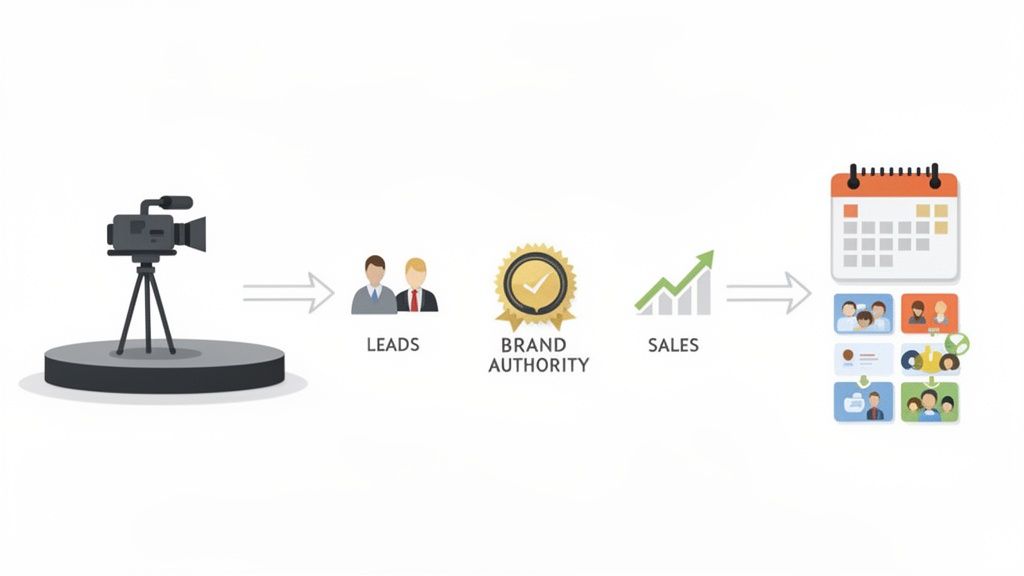
Instead of a one-off moment, your event becomes a goldmine of reusable assets. That 45-minute panel isn't just a recording anymore. It’s a future podcast episode, ten high-impact social media clips, three killer quotes for your sales deck, and a gated webinar to pull in new leads. Suddenly, you're multiplying your ROI, transforming a single investment into a year-long content calendar. When you get this right, you're not just documenting an event; you're manufacturing a library of marketing assets.
From One-Time Cost to Long-Term Investment
To really make this work, you have to shift your mindset. You're not just creating a simple recap video anymore. You're building a strategic content-capturing machine.
Here’s a real-world example of what that shift looks like:
- The Event: A B2B tech firm hosts its annual user conference, packed with breakout sessions on industry trends.
- The Old Way: They hire one videographer to create a 3-minute sizzle reel for next year’s promo. After that, the footage collects dust on a hard drive.
- The Strategic Way: They bring in a multi-camera crew to capture keynotes and panel discussions, making sure to get crystal-clear audio for easy repurposing.
This isn't just about capturing moments; it's about manufacturing marketing opportunities. When you plan for content repurposing from the very beginning, every minute of footage serves a real business goal, whether that's nurturing leads or building your brand.
The market is already moving in this direction. The global event videography services market is on track to hit $2,780 million in 2025 and keep climbing. That's not just because events are back in full swing; it's because 82% of organizers now create on-demand video from their events, with over half gating it to generate leads.
Digging into the broader world of SaaS Video Marketing makes it clear just how critical this kind of content has become. Once you adopt this powerhouse mentality, you stop seeing event video as an expense and start treating it as a core investment in your company’s growth.
Mastering Pre-Production and Strategic Planning
Let's be honest: success in event video production is decided long before you even think about hitting the record button. The real magic happens in pre-production. This is where you lay the strategic groundwork that separates a forgettable event recap from a marketing asset that actually drives business.
It’s about shifting from a reactive mindset-just filming whatever happens-to proactive storytelling. You’re not just a fly on the wall; you're shaping the narrative from the get-go.
Nail Down Your Primary Objective
Before you dream about fancy camera angles or drone shots, you need to answer one dead-simple question: What is the primary goal of this video? Your answer will dictate every single decision that follows, from the shots you plan to the final editing style.
Don't settle for a vague goal like "promoting the event." That's not a strategy. Dig deeper and get specific. Is your objective to:
- Generate Leads? Then you might gate a high-value keynote recording to capture MQLs.
- Boost Brand Awareness? A high-energy sizzle reel, cut perfectly for social media shares, is your play.
- Arm Your Sales Team? Go capture authentic customer testimonials on the event floor they can use in their outreach.
- Build Thought Leadership? Film a panel discussion with flawless audio, specifically to repurpose it into a podcast series.
Pick one. Just one. Forcing yourself to choose a single, primary objective brings incredible clarity. It stops you from creating a Frankenstein's monster of a video that tries to do everything but accomplishes nothing.
Build a Production Brief Your Crew Will Actually Love
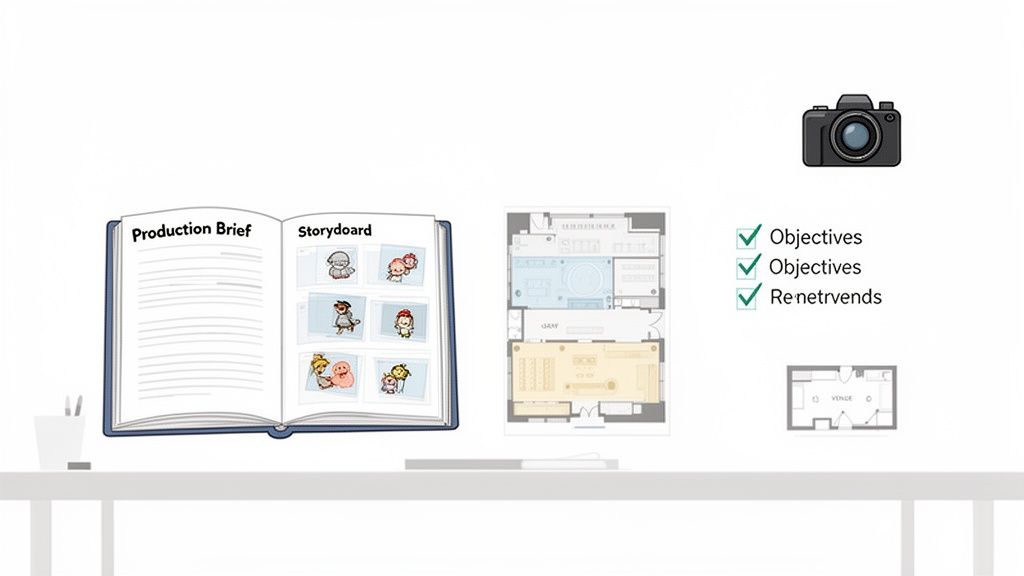
The production brief is the single most important document you’ll create. It's the blueprint, the Rosetta Stone that translates your vision into reality for the crew on the ground. A truly great brief goes way beyond logistics; it communicates the vibe and energy you’re trying to bottle up.
Think of it less as a dry checklist and more as a creative guide. Make sure it includes:
- Key Faces: Who are the must-interview people? List everyone from your CEO to a key customer, along with their titles and a quick note on why their voice matters.
- Visual Vibe: What’s the mood? Is it "polished and corporate" or "dynamic and energetic"? Use descriptive words that paint a clear picture for the camera operators.
- The Story Arc: What’s the story here? A simple "beginning, middle, end" structure is surprisingly powerful. Maybe it’s the pre-event buzz, the high-energy moments during the keynote, and the key takeaways people left with.
- B-Roll Wishlist: Be specific about the non-interview shots you need to tell the story. Think attendees networking, hands-on product demos, or epic wide shots of a packed auditorium.
A well-crafted production brief isn't just a list of instructions; it's an alignment tool. It gets everyone-from the marketing director down to the person holding the boom mic-on the exact same page, pulling in the same direction. That shared clarity is what turns good footage into great marketing.
The broader film and video industry, which includes event video, is absolutely massive and growing, projected to hit $383.23 billion by 2030, mostly driven by corporate demand. And with the average event pro juggling 25 events per year, a dialed-in pre-production process isn't just nice to have-it's the only way to capitalize on this and ensure your videos deliver a real return.
Before we move on, here's a quick checklist to keep your pre-production on track. Think of it as your safety net to make sure nothing critical falls through the cracks.
Essential Event Video Pre-Production Checklist
| Task Category | Key Action Items | Why It Matters |
|---|---|---|
| Strategy & Objectives |
• Define a single primary goal (e.g., lead generation or brand awareness). • Identify the target audience. • Establish clear KPIs for success. |
Without a clear objective, your event video lacks focus and is unlikely to deliver measurable business results. |
| Creative Brief |
• Write a detailed production brief. • Create a shot list of must-have moments. • Prepare interview questions for speakers and attendees. |
A detailed brief keeps marketing teams and production crews aligned on the creative vision and execution plan. |
| Logistics & Coordination |
• Conduct a venue walkthrough with the production lead. • Create a detailed run sheet with timings and locations. • Confirm power sources, internet access, and crew credentials. |
Planning logistics in advance prevents delays, minimizes production risks, and keeps the event running smoothly. |
| Talent & Legal |
• Schedule and confirm interviews ahead of time. • Secure signed media release forms from on-camera participants. • Brief speakers on the filming process and expectations. |
Managing permissions and preparing participants helps ensure a legally compliant and efficient production. |
This isn't exhaustive, but running through these items will put you leagues ahead of teams that just show up and hope for the best.
Plan Your Logistics Like a Producer
Once your creative vision is locked in, it’s time to put on your producer hat and get into the nitty-gritty details that can make or break a shoot. Thinking like a producer means solving problems before they even happen.
A physical site visit is non-negotiable. Walk the venue with your lead videographer and look for potential trouble spots.
- Lighting: Are there huge windows that will create nasty backlighting? Is the stage lighting dynamic or just flat and boring? Knowing this helps the crew pack the right gear.
- Audio: Listen for background noise. Is the HVAC system super loud? Is there bleed-through from the exhibition hall next door? Plan to get a clean audio feed from the soundboard and use lavalier mics on all your key speakers. No exceptions.
- Power & Access: Simple things can derail a shoot. Where are the outlets? Does the crew have the right badges to get backstage? Sorting this out early prevents massive headaches on the day.
Finally, get all the admin out of the way early. Have speakers and interviewees sign media release forms weeks in advance. Nailing these logistics frees up your team to focus on one thing when the event kicks off: capturing incredible content. For a more exhaustive look at the entire process, check out our complete guide on video production.
Executing a Flawless On-Site Production
This is it. The moment all that meticulous planning comes to life. Forget the spreadsheets and run sheets for a second—the day of the event isn’t about sticking to a rigid script. It’s about managing the flow, empowering your crew, and improvising when you need to.
This is where the real work happens. A flawless on-site execution is what turns a solid plan into exceptional footage. Your job is to move with purpose, capture everything on your shot list, but stay nimble enough to grab those unexpected moments of magic that always happen at a live event.
Directing Your Crew for Cinematic Results
Your video crew is your single most valuable asset on the ground. You've briefed them, sure, but how you direct them throughout the day is what separates decent footage from something truly cinematic. This isn’t about micromanaging every single shot. It's about clearly communicating the feeling you're after and then trusting their expertise to capture it.
Kick off the day with a quick huddle, even if you’ve had a dozen calls leading up to this. Run through the schedule one last time and point out the absolute "can't-miss" moments. Is the vibe polished and corporate, or are you going for something more raw and energetic? Make sure everyone is on the same page.
Once the cameras are rolling, you become the conductor. Here’s how to manage the orchestra:
- Multi-Camera Magic for Keynotes: For any keynote or panel discussion, a multi-camera setup isn't a luxury; it's a necessity. The standard is a wide shot to establish the stage and at least two tighter shots on the speakers. Your job is to direct the operators to vary their framing. While one holds a stable medium shot, the other can hunt for close-ups to capture a speaker's emotion or a specific detail on a slide. This simple technique gives your editor a ton of options to create a dynamic, broadcast-quality video.
- The Roaming B-Roll Camera: This is your secret weapon. Assign at least one camera operator to be your "storyteller." Their mission? To roam freely and capture the candid moments that breathe life into your event: attendees laughing during a coffee break, intense conversations in the hallway, hands-on demos at a sponsor booth. Give them a shot list for inspiration, but empower them to follow their instincts.
The difference between good and great event video often lies in the B-roll. These unscripted, authentic moments are what provide the emotional texture and visual interest that make your final video compelling and relatable.
Capturing Audio That’s Ready for Repurposing
Killer visuals might grab someone's attention, but it's the audio that holds it. Nothing screams "amateur" faster than bad audio, and it immediately kills any hope of repurposing your content for a podcast or audiogram.
Your #1 priority is getting a clean feed directly from the venue’s soundboard. This will give you the crispest possible audio from every presenter's microphone.
But never, ever rely on that feed alone. Always have backups.
- Lavalier Mics: Make sure every key speaker, panelist, and interviewee is fitted with their own lavalier (lapel) mic that records to a separate, dedicated device. This isolates their voice from room noise and saves you if the main sound system has a technical meltdown.
- Ambient Sound: Have one of your cameras capture the natural room sound—the applause, the collective laughter, the general buzz of the crowd. Mixing this in subtly during post-production is the key to making the final video feel immersive and alive, not sterile and disconnected.
This multi-track approach is the foundation of professional event video production. It gives your post-production team the ultimate flexibility to create a clean, balanced audio mix that works for any format.
Conducting Interviews That Capture Authentic Insights
Those on-the-fly interviews with speakers, sponsors, and attendees can become some of your most valuable content assets. The trick is to make them feel like a natural conversation, not a stilted interrogation.
Keep the setup simple: a camera operator, someone monitoring sound, and you asking the questions.
To get the best soundbites, ditch the generic questions. No more, "So, are you enjoying the event?" Instead, ask open-ended questions that make people think:
- "What's the one key takeaway from today's sessions that you're excited to implement back at the office?"
- "Describe the energy you're feeling on the event floor right now."
- "What conversation have you had today that sparked a completely new idea for you?"
Listen—really listen—to their answers and ask follow-up questions. That's how you turn a simple Q&A into a genuine conversation that yields authentic, powerful clips. You can find out more about what it takes to find the perfect team for this by exploring our guide to sourcing event videography crews.
Adapting to the Inevitable Curveballs
Let's be real: no live event ever goes exactly to plan. A speaker will run late. The stage lighting will be weird. A fire alarm will go off (it happens). Your ability to stay calm and adapt is what will save the shoot.
When something goes wrong, huddle with your crew lead. Is there a quick technical fix? Can you shuffle the shot list? If a scheduled interview spot is suddenly too dark, can you move to that brighter area by the window? If you lose the soundboard feed, are the lav mics still recording?
Being flexible and having backups for your backups is the hallmark of a seasoned producer. Your job on-site is to clear roadblocks so your crew can focus on what they do best: capturing incredible content. Communicate clearly, trust your team, and always keep the end goal in sight.
Turning Raw Footage into Marketing Assets
The lights dim, the last attendee grabs their swag bag, and your crew starts packing up gigs of footage. For most, the event is over. For you, it's just getting started.
The real return on your event video production investment happens now, in post-production. This is where you transform hours of raw video into a stockpile of marketing assets that will fuel your campaigns for the next month, or even the next quarter.
This isn't about making one slick recap video. It's about building a content factory. Every soundbite, every audience reaction, every speaker slide is a potential standalone piece of content waiting to be born.
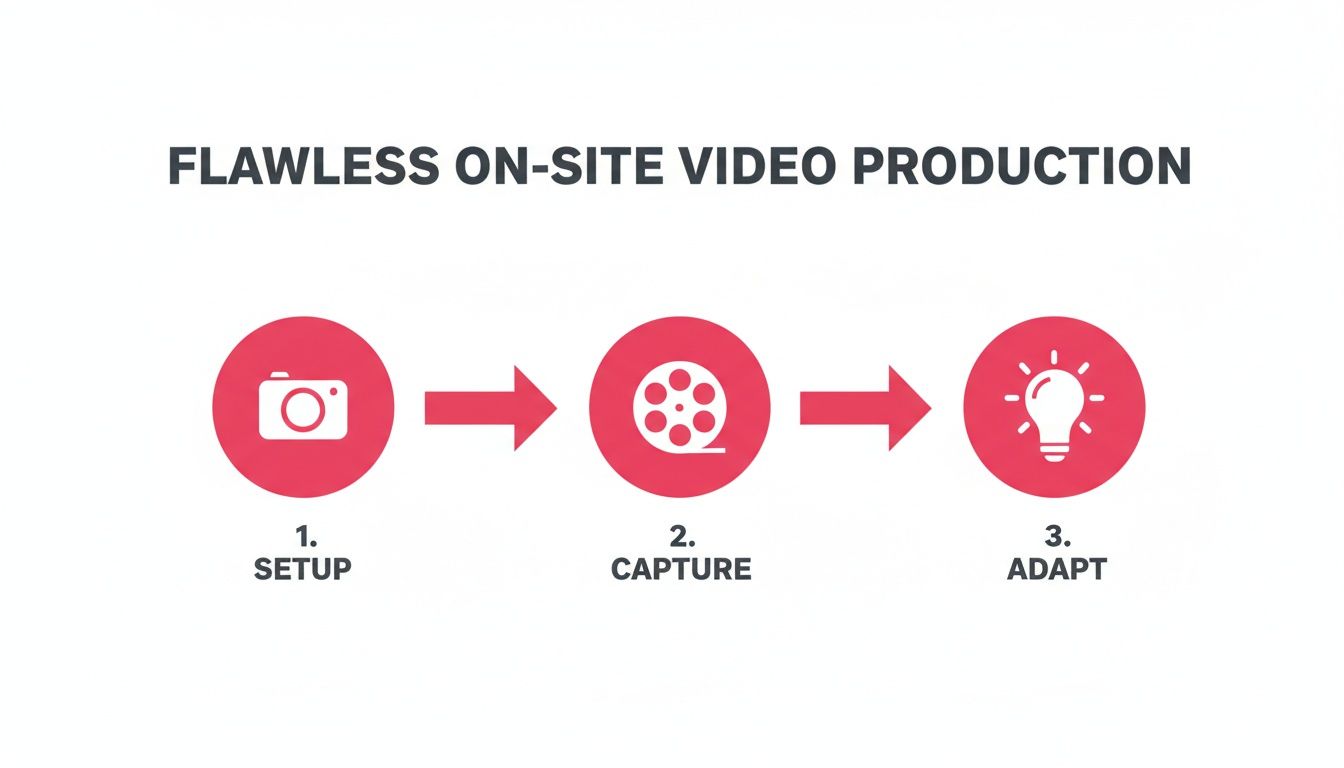
As you can see, a successful shoot is all about the workflow-nailing the setup, capturing everything you need, and adapting on the fly. That foundation of high-quality, well-organized footage is what makes an ambitious post-production strategy possible.
A Post-Production Workflow That Actually Works
Before anyone even thinks about opening an editing program, you need a system. Just dumping all the footage into a Dropbox folder and telling an editor to "make it look cool" is a one-way ticket to a messy, expensive disaster.
First things first: log the footage. This is the unglamorous but absolutely critical step of watching everything and tagging clips with descriptive keywords. Think speaker names, specific topics they covered, and shot types ("wide shot of crowd," "keynote B-roll," "testimonial interview").
It feels tedious, but investing a few hours here will save your team dozens of hours later. No more scrubbing through two hours of a keynote to find that one perfect 30-second soundbite.
Post-production isn’t just a technical step; it’s a strategic one. Every decision-from the first cut to the final color grade-determines whether your videos generate leads, build authority, or just add to the noise.
With your footage logged, the next move is creating "selects reels" or "stringouts." These are rough edits that pull together all the best moments: the most powerful clips from the keynote, the most insightful quotes from interviews, the most energetic crowd shots. These reels are the raw clay you'll sculpt all your final assets from.
Start with Your "Hero" Asset: The Sizzle Reel
Every event needs a flagship video, and that's usually the sizzle reel. This is your hero asset-a punchy, 60-90 second video that bottles the energy and excitement of the entire event. Its main job? To spark some serious FOMO and get people signing up for your next one.
A great sizzle reel isn't just a montage of cool shots set to music. It needs a story.
- The Hook: Kick things off with a killer quote or a visually arresting shot that stops the scroll.
- The Energy: Use quick cuts, driving music, and shots of a packed, smiling audience to build momentum.
- The Value: Weave in lightning-fast soundbites from speakers that hint at the game-changing insights they shared.
- The Vibe: Show people connecting-laughing, shaking hands, networking. This is what makes live events irreplaceable.
- The Ask: End with a clean, branded graphic telling people exactly what to do next. "See You in 2025!" or "Early Bird Tickets Available Now."
Don't cheap out on the music. A professionally licensed track that matches your brand's energy can make or break the entire video. It’s a small cost that delivers a massive impact.
Slice It Up: Turning One Video into 20
The sizzle reel is your anchor, but the real ROI comes from atomizing your footage. If the hero asset is the whole pizza, now you're slicing it up into micro-content for every platform and every goal.
From a single day's event, you should be aiming to create at least 15-20 distinct pieces of content. This isn't about spamming people; it's about meeting them where they are with content tailored for that specific channel.
- Social Media Clips: Cut 15-30 second vertical clips from keynotes for LinkedIn, Instagram Reels, and TikTok. Slap on big, bold captions-most people watch with the sound off.
- Audiograms: Remember that pristine audio you captured for the podcast? Pull the best 60-second insights and create audiograms (a static image with an animated waveform). They're perfect for sharing podcast-style snippets.
- Quote Graphics: Screen grab a speaker's most powerful one-liner. Design a sharp, branded graphic with their headshot and the quote. Easy, shareable, and effective.
- Sales Enablement Snippets: Those quick testimonials you grabbed from happy customers on the floor? Edit them into 1-minute clips. Give them to your sales team to drop into their outreach emails for instant social proof.
This process of breaking down big content into smaller, targeted pieces is what gives your event an incredibly long shelf life. We dig even deeper into this mindset in our guide on content repurposing strategies.
To make this crystal clear, here’s how one piece of original footage can be systematically repurposed.
Event Video Repurposing Matrix
| Original Footage | Repurposed Asset Type | Primary Distribution Channel | Marketing Goal |
|---|---|---|---|
| Full Keynote Session (45 min) | Full-Length YouTube Video | YouTube, Website Resource Hub | Thought leadership and SEO |
| Keynote Session (45 min) | Audio-Only Podcast Episode | Apple Podcasts, Spotify | Audience engagement and brand building |
| Keynote Session (45 min) | 2–3 Short Video Clips (30–90 sec) | LinkedIn, X (Twitter), Instagram Reels | Driving traffic and social engagement |
| On-Floor Customer Interview (5 min) | 60-Second Testimonial Video | Sales outreach emails, Website | Sales enablement and conversion |
| Speaker Interview (15 min) | 60-Second Audiogram | LinkedIn, Instagram | Social engagement and lead nurturing |
| Speaker Interview (15 min) | Branded Quote Graphic | X (Twitter), Instagram, LinkedIn | Brand awareness and shareability |
By planning this out, you ensure that every minute of footage captured works as hard as possible for your brand, turning a single event into a long-term content engine.
Distributing Your Content and Measuring Success
Let's be blunt: creating incredible video is pointless if the right people never see it. The final, and arguably most critical, piece of your event video production puzzle is getting those polished assets in front of your ideal audience and proving they actually worked.
Finishing the edits is only half the battle. Now comes the real test—a distribution plan that's just as strategic as your on-site production. Every clip needs a purpose, a channel, and a way to measure its impact.
Crafting a Multi-Channel Distribution Plan
Your content deserves a better fate than a single, lonely post on the company LinkedIn page. To really squeeze every drop of value out of your investment, you need a coordinated, multi-channel attack that meets your audience where they already hang out.
Think of it less like a cannonball and more like a series of targeted drone strikes. Each channel has its own vibe, audience, and format.
- Your Website: This is your home turf. Build a dedicated "Resources" or "Events" hub to host the full-length keynotes and panel discussions. These are absolute gold for SEO and perfect for gating to capture high-intent leads.
- Email Marketing: Slice and dice your email list. Send the main sizzle reel to a broad audience to build hype for next year's event. Then, send a technical deep-dive session only to a specific segment of product users or prospects in a certain industry.
- LinkedIn: This is your B2B playground. Share short, punchy clips from speakers with bold, insightful captions. Make sure to tag the speakers and their companies—it's the fastest way to exponentially expand your reach. Use the video to start conversations, not just to broadcast.
- YouTube: Treat YouTube like the search engine it is, not a video dumping ground. This is the perfect home for your full-length sessions, customer testimonials, and behind-the-scenes content that people will actively search for.
Once your videos are ready to go, it's not enough to just upload them. A great starting point is to learn how to optimize videos for YouTube and rank higher, making sure your content gets discovered long after the event is over.
Driving Engagement with Paid and Organic Tactics
Relying purely on organic reach is like waiting for rain in a desert. It might happen, but you can't build a business on it. To get real traction and speed up your results, you need to blend your organic efforts with a smart, targeted paid promotion plan.
With 91% of companies now using video marketing, smart distribution is what separates the winners from the noise. Many are turning event videos into on-demand assets, a tactic used by 82% of organizers. These assets can be promoted through channels like social media, where mobile video ad spend is projected to hit $60.94 billion in the U.S. in 2025, and connected TV, which is surging to $33.35 billion. This gives you incredibly powerful, targeted channels to get your event content in front of the right people and drive qualified pipeline.
Your goal isn't just to get views; it's to get the right views. A targeted paid campaign on LinkedIn, aimed at specific job titles in your key accounts, is far more valuable than thousands of irrelevant views from a generic boost.
Carve out a small budget to promote your best-performing clips on LinkedIn. Target your ideal customer profile by industry, company size, and job function. This is how you guarantee your best content lands in front of decision-makers who can actually sign a check.
Measuring What Truly Matters
Vanity metrics like views and likes feel good, but they don't pay the bills. To prove the business value of your event videos, you have to track KPIs that tie directly back to marketing and sales goals.
It's time to move past surface-level numbers and track metrics that demonstrate real business impact. This is how you justify your budget year after year and prove the ROI of all this hard work.
Focus on building a measurement framework around these key areas:
- Lead Generation: How many new, qualified leads did your gated keynote video actually generate? Track form fills and what visitors do after they watch a video on your site.
- Sales Pipeline Influence: Use your CRM to see how many contacts in active sales cycles engaged with your event videos. This shows how your content is helping nurture deals and move them across the finish line.
- Audience Engagement: Look beyond simple view counts. What’s the average watch time on your YouTube videos? A high watch time on a 30-minute panel discussion is a massive signal of genuine interest and content-market fit.
- Cost Per Lead (CPL): If you're running paid campaigns, what's your CPL from video ads? Compare this against your other marketing channels to see where your video content is performing most efficiently.
By focusing on these business-critical KPIs, you can paint a clear, undeniable picture of how your video strategy contributes to the bottom line. For an even deeper dive, check out our guide on measuring content marketing ROI to build out a dashboard that will make your CFO smile.
Event Video Production FAQs
Here are some quick-fire answers to the questions that always come up when planning, shooting, and budgeting for event video.
How Much Does Event Video Production Cost?
This is the big "how long is a piece of string" question. Costs can swing wildly depending on what you're trying to achieve.
A single shooter for a half-day event might start in the low thousands. But if you're talking about a multi-day conference with a full crew, several 4K cameras, and a mountain of post-production work, you could be looking at anywhere from $15,000 to over $50,000.
What drives that price tag up? A few key things:
- Crew Size: How many videographers, audio techs, and directors do you need on the ground?
- The Gear: Are we talking standard cameras, or do you need cinema-grade cameras, professional audio rigs, and complex lighting?
- The Deliverables: The final product list matters. A simple sizzle reel is one thing; adding full session recordings and dozens of social clips is another.
Always, always get a detailed quote that itemizes pre-production, on-site filming, and post-production. It’s the only way to really understand where your money is going.
How Long Does It Take to Get the Final Videos?
The timeline is completely tied to the complexity of the project. If you just need a simple highlight reel or a single session recording, you might see a final cut in one to two weeks.
For bigger events with a whole suite of videos, the post-production runway is usually more like four to six weeks. It's so important to have this conversation with your production partner before the event. If you absolutely need a snappy social teaser ready to go within 48 hours, that needs to be ironed out from day one.
My two cents: Get the content delivery schedule baked right into your contract. Pin down specific deadlines for first drafts and final versions. This keeps everyone on the same page and ensures your marketing team isn't left waiting.
Highlight Reel vs. Sizzle Reel: What's the Difference?
People throw these terms around interchangeably all the time, but they're really built for two different jobs.
A highlight reel is basically a chronological summary. It’s documentary-style, showing off key moments, big-name speakers, and attendee reactions to give people a taste of what happened. It’s telling the story of, "Here's what you missed."
A sizzle reel, on the other hand, is pure marketing adrenaline. It’s a high-energy, fast-cut montage of the best shots from the event, all set to upbeat music. Its job is to create a feeling of excitement and FOMO for the next event. It screams, "You won't want to miss our next one."
Can I Repurpose Event Footage for a Podcast?
You absolutely can, and you absolutely should! It's one of the most efficient content plays you can make.
The trick is to capture high-quality, isolated audio from your main speakers during their sessions. That clean audio track can be lifted and edited directly into a full-blown podcast episode.
Make sure you tell your video crew this is the plan during pre-production. That way, they’ll bring the right microphones and recording gear to capture broadcast-quality audio that’s completely separate from the main video feed. Nailing this comes down to your crew, which is why we put together a guide on finding the right B2B video production agency for growth.
Ready to capture your next event with a crew that gets B2B marketing? Fame Crew connects you with vetted, world-class video professionals who know how to turn live events into content that actually performs. Find your perfect event video crew at www.fame.so/crew.
Want us to run this for you?
Fame starts and grows B2B podcasts that generate pipeline. Tell us who you are trying to reach and we will send a costed proposal within 1 working day.
Related content
- Read moreFame Team · July 16, 2026
10 Account Based Marketing Tactics For B2B Growth In 2026
Discover 10 actionable account based marketing tactics for B2B tech. Learn to use podcasts, data, and targeted content to close high-value accounts. - Read moreFame Team · July 16, 2026
The 8 Best Brighton Podcast Agency Picks For 2026
Find the best Brighton podcast agency for your B2B brand. Our 2026 guide reviews top 8 agencies for production, growth & ROI. Expert analysis here - Read moreJune 10, 2026
20 Best Podcast Production Agencies For 2026 (And Why Should You Hire One)
Global podcast and vodcast ad revenues are on track to hit $5 billion in 2026 , up 20% year-on-year. - Read moreApril 13, 2026
Leadership In Marketing: The B2B Podcast Playbook
Most companies still confuse leadership in marketing with job titles, org charts, and budget control. That's outdated.