February 15, 202620 min read5 sections
A Guide To Business Video Production Services For B2B Growth
By Fame Team
Key Takeaways
- Strategic video production is a game-changer in B2B marketing.
- A well-crafted video can build authority and drive pipeline more effectively than traditional marketing materials.
- Integrating video with other B2B strategies creates a powerful flywheel effect that squeezes value out of content.
Let's be honest, cutting through the noise in B2B marketing is a grind.
Your audience, whether they're CTOs, procurement officers, or marketing VPs, is drowning in a sea of whitepapers, case studies, and those endless email sequences. It's tough out there.
This is exactly where strategic video production flips the script. It's not just another line item on your marketing budget; it's a game-changer.
The top B2B brands I've seen don't treat video like some creative luxury. They see it for what it is: a core engine for building authority and driving a real pipeline.
Think of it this way. A well-crafted video can break down your complex SaaS platform in 90 seconds, something a 10-page PDF will always struggle with. It puts a human face on your brand and builds trust in a way that plain text just can't.
The Flywheel Effect of Integrated Video
Here’s the thing: video doesn't live on an island. It’s at its most powerful when it’s integrated with your other B2B strategies, like podcasting or account-based marketing (ABM). This creates a seriously powerful flywheel effect.
For instance, you can take one solid thought-leadership podcast episode and slice it up into:
- Short, punchy video clips for LinkedIn to grab attention mid-scroll.
- A longer, deep-dive video interview for YouTube to build up your authority.
- Hyper-targeted video snippets for an ABM campaign to engage your key accounts.
This multi-channel approach squeezes every drop of value out of a single recording session. Suddenly, one piece of content becomes a dozen assets fueling different parts of your marketing funnel. It's just smart marketing.
The market data backs this up. The corporate video production services market is exploding, valued at USD 7.73 billion in 2025, it's projected to hit USD 8.29 billion in 2026 and surge to USD 12.73 billion by 2032. This isn't just a trend; it's a fundamental shift in how businesses communicate.
With over 85% of companies already using video as a top marketing tool, the demand is only getting hotter.
By reframing video production as a measurable, outcome-driven investment, you shift the conversation from "How much does this cost?" to "What business objective will this achieve?"
Moving Beyond Vanity Metrics
The real magic of business video production lies in delivering tangible results. We're not just chasing views and likes here. We're talking about influencing deals and shortening sales cycles.
A compelling customer testimonial video can be that final piece of social proof a prospect needs to sign on the dotted line. A clear product demo can take a massive load off your sales team, freeing them up to focus on closing instead of explaining.
Ultimately, investing in video is investing in a more efficient and effective path to revenue. To get deeper into the strategic side of things, check out our guide on corporate videography.
Finding and Vetting the Right Video Production Partner
Choosing who to trust with your company's story is a massive decision. Pick the right business video production services, and they become a true extension of your team, they get your goals, speak your language, and build content that actually moves the needle on your KPIs.
Pick the wrong one? You get a flashy video that looks pretty but does absolutely nothing for your pipeline. It’s a huge waste of time and budget.
The secret is looking past the sizzle reel. A slick-looking video is just table stakes these days. The real win is finding a partner who understands B2B strategy and can create a video that generates real business.
And the market for these services is blowing up for a reason. Video production is on track to grow from USD 28.0 billion in 2024 to nearly USD 45.0 billion by 2035. That explosion is almost entirely driven by B2B companies in tech, healthcare, and finance who need to turn complex ideas into compelling stories.
Beyond the Portfolio: What to Actually Ask Potential Partners
Every production company will show you its greatest hits on a discovery call. Your job is to dig deeper and figure out if they have any strategic brains behind the creative brawn. Generic questions are a waste of time.
Here’s what you should be asking:
- "Walk me through a B2B project you did for a company like ours. What were their business goals, and how did you measure success?" This question immediately shifts the conversation from creative flair to tangible results.
- "What does your feedback and revision process look like?" If they give you a vague answer, run. You're looking for a structured, collaborative process. Anything less is a recipe for scope creep and chaos.
- "Our main goal is to [generate MQLs/shorten the sales cycle/etc.]. How would your video strategy directly help us do that?" This ties their work directly to your marketing funnel. Make it their problem to solve.
A true video partner talks about pipeline, not just pixels. Their first questions should be about your business objectives, target audience, and desired outcomes, not about cameras and lighting.
15+ Business Video Production Services for B2B Companies
To give you a head start, here is a curated list of services known for their B2B expertise. This isn't just a random directory; these are partners who understand the nuances of corporate storytelling and integrated marketing. Start your search here to find the right fit.
- Fame Crew: Specializes in integrated B2B video and podcast production, ideal for tech and service-based businesses focused on thought leadership and pipeline generation.
- Sandwich: Known for high-concept tech explainers and brand stories, perfect for startups launching a new product or category.
- Sparkhouse: Focuses on creative brand storytelling and commercials, suited for companies wanting to build an emotional connection with their audience.
- VeracityColab: Excels at animated explainer videos and product demos, a top choice for SaaS and software companies needing to simplify complex concepts.
- Lemonlight: Offers scalable video production for brands of all sizes, making it a good fit for businesses needing a high volume of quality video content.
- Indigo Productions: Provides full-service corporate, commercial, and entertainment video, catering to enterprises that need a wide range of high-end video services.
- Epipheo: Creates explainer videos that drive business results, designed for marketers focused on conversion and clarity.
- Kasra Design: Specializes in custom 2D and 3D animated videos, a great option for brands looking for a unique visual style.
- Yum Yum Videos: Produces engaging animated explainer videos, targeting companies with educational and corporate training goals.
- Shoot You: A global video and animation production house, built for multinational corporations with global campaign needs.
- Demo Duck: Crafts handmade explainer and testimonial videos, ideal for businesses that want authentic, story-driven content.
- BodeTree: Focuses on data-driven video content for financial services, specifically for fintech and financial institutions.
- Thinkmojo: Creates video for tech companies from launch to scale, catering to high-growth technology brands.
- Casual Films: Specializes in corporate video communication and recruitment films, a go-to for HR and internal communications teams.
- Vidico: Produces high-performing video for tech startups and enterprises, perfect for companies focused on ROI-driven video ads and content.
- BX Films: Known for cinematic brand films and corporate videos, ideal for luxury brands and companies seeking a premium feel.
This list is a great starting point, but always do your own due diligence to find the perfect fit for your specific needs and company culture.
Final Checks Before You Sign Anything
Once you've narrowed it down to your top two or three contenders, it's time to make sure everything is crystal clear before you commit.
A detailed Statement of Work (SOW) is absolutely non-negotiable.
It needs to spell out deliverables, timelines, the number of revision rounds, and, this is a big one, who owns the final assets and the raw footage. If anything in the SOW seems fuzzy, push for clarification.
This vetting process might feel like a lot of work upfront, but it pays off massively. Choosing the right partner means you’re not just buying a one-off video; you're investing in a strategic asset that will build your brand and drive measurable growth for years.
Building Your Strategic Video Blueprint
Jumping into production without a clear strategy is like trying to build a house without a blueprint. It’s expensive, chaotic, and you definitely won’t like the final result.
The best video projects are won long before the cameras start rolling. It all begins with defining precisely what you want to achieve and who you need to reach.
Your first job is to get ruthlessly clear on your goals. "Creating a cool brand video" isn't a goal; it's a wish. A real goal sounds more like this: "We need to increase qualified demo requests from VPs of Engineering by 15% this quarter." That’s specific. It’s measurable. And it becomes your North Star, guiding every single decision you make, from the script right through to distribution.
Mapping Video Content to Your Marketing Funnel
With a solid goal in place, you can now align your video concept with a specific stage of the B2B buyer's journey. This is non-negotiable. Different videos do different jobs, and using the right tool is everything. A top-of-funnel video won't close a deal, and a bottom-of-funnel video won't bring in new prospects.
Here’s a practical way to think about mapping video types to your funnel:
- Top of Funnel (Awareness): Your only goal here is to grab attention and introduce your brand to a new audience. The content has to be educational and engaging, not salesy. Think short, impactful clips, maybe some thought leadership, an explainer on industry trends, or a compelling brand story that positions you as a go-to resource.
- Middle of Funnel (Consideration): Prospects at this stage know they have a problem, and they're actively hunting for a solution. Your videos need to show them how you solve that problem. This is the perfect spot for detailed product demos, webinar recordings, or case study videos that put your solution in the spotlight and build serious credibility.
- Bottom of Funnel (Decision): By now, your audience is weighing you against competitors. They need that last little push of confidence to sign on the dotted line. This is where highly-targeted videos like client testimonials, implementation walkthroughs, or even personalized video messages from your sales team can provide the social proof needed to seal the deal.
Real-World Success Stories
Let's look at this in action. I once worked with a SaaS company that was struggling to get trial users to convert. Their generic homepage video just wasn't doing the job. So, we developed a series of short, targeted demo videos, each one zeroing in on a specific high-value feature. By embedding these right into their onboarding emails, they lifted trial-to-paid conversions by 25% in a single quarter.
Another great example comes from a consulting firm. They created a series of in-depth client case study videos. But they didn't just rattle off results; they had the client's team on camera, speaking authentically about their challenges and the transformation they experienced. This series was directly credited with influencing three new enterprise deals because it gave prospects the confidence and social proof they were looking for.
The most effective business video production services don't just create videos; they build strategic assets that align directly with marketing funnel stages and business objectives. The conversation should always start with "Why?" before moving to "What?"
Tying Budget to Tangible KPIs
When you approach video this way, it completely changes the conversation around budget.
Instead of being seen as a creative expense, video becomes an investment tied to clear marketing KPIs. When you pitch a video budget, you’re not just asking for money; you’re proposing a concrete plan to move the needle on metrics like lead generation, sales cycle velocity, or even brand recall. For a deeper dive into maximizing the value of your content, exploring proven content repurposing strategies can help you get more mileage out of every video you create.
The discussion quickly shifts from "Can we afford this?" to "What's the potential ROI here?" You can build a rock-solid business case by projecting how the video will influence key performance indicators, making it an easy "yes" for any data-driven leadership team.
How to Run a Smooth Production Process
Once you’ve nailed down your blueprint, you’ve moved past the "why" and can finally dig into the "how." This is where a tight process separates the successful video projects from the ones that spiral into chaos. A smooth production isn’t about luck; it's about clear communication and structured workflows that bring your vision to life without any drama.
The absolute cornerstone of this whole thing is the creative brief. Don't treat this like a formality. It’s the single source of truth for the entire project. A vague brief is a recipe for endless revisions and a final video that just misses the mark. A great one leaves zero room for guessing and gets everyone on the same page from day one.
To write a killer brief, you have to go deeper than just the basics. Sure, you'll list your target audience and core message, but push yourself. What’s the single most important feeling you want viewers to have after watching? Confidence? Urgency? Reassurance? Pinpointing that emotion gives your production partner a real creative direction to run with.
Demystifying the Production Workflow
Getting a handle on the main phases of production helps you manage expectations and give feedback at the right times. The whole journey really breaks down into three core stages, each with its own crucial milestones. Think of it like building a house: you lay the foundation before you put up the walls and start painting.
Here’s a simple look at a typical business video production services workflow:
- Pre-Production (The Blueprint Phase): This is where 70% of the project's success is locked in. It covers everything from scriptwriting and storyboarding to scouting locations and casting talent. Your input here is critical. When you sign off on a script or storyboard, you're greenlighting the project's direction before a single frame is even shot.
- Production (The Filming Phase): This is where the crew gets to work, bringing the script to life. Whether it’s filming interviews on-site, capturing B-roll, or animating graphics, this is usually the shortest but most intense part of the process.
- Post-Production (The Assembly Phase): Now, all the raw ingredients come together. Editors assemble the footage, sound designers mix the audio, colorists grade the look, and motion graphics are dropped in. This stage almost always involves a few rounds of review to get the final cut just right.
Before any of this kicks off, though, those foundational strategic steps have to be solid. This visual lays it out perfectly.
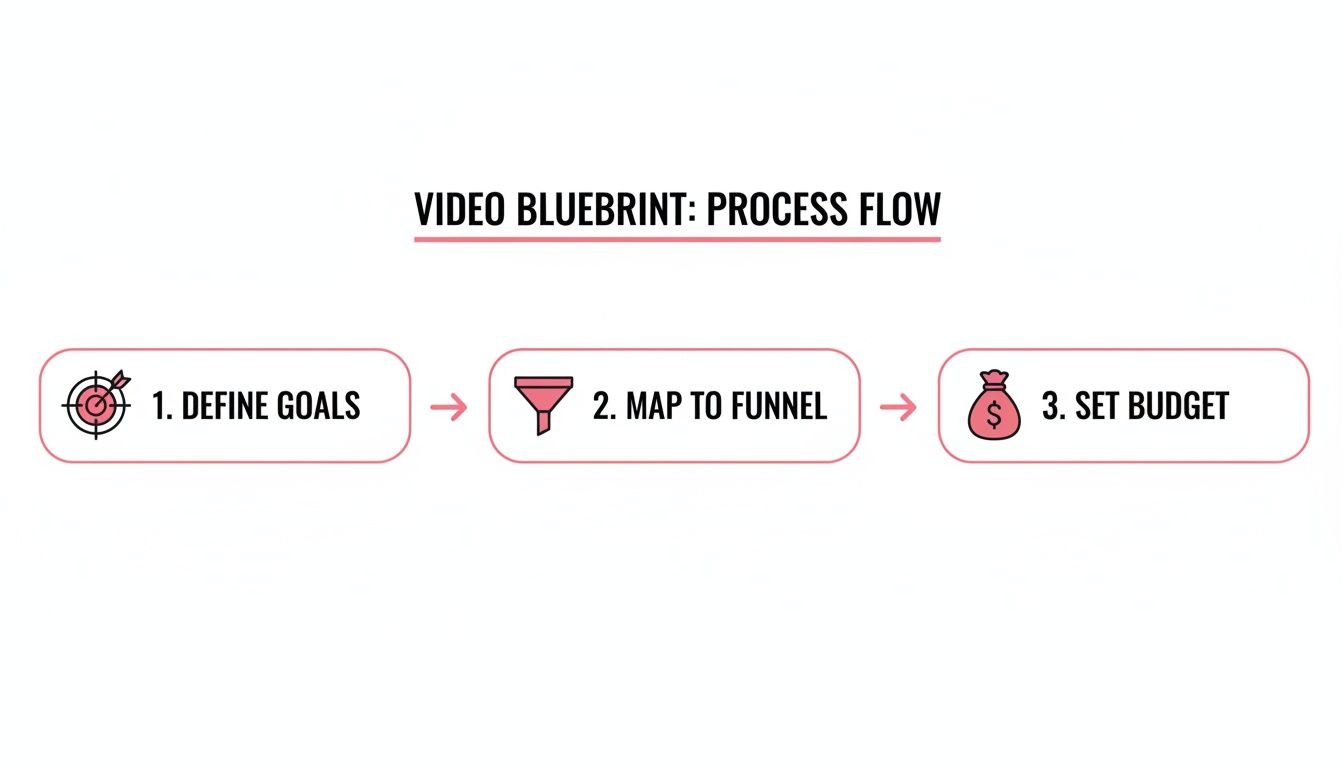
As you can see, a successful project is built on a clear strategy: define your goals, map them to the marketing funnel, and set a budget that makes sense.
Giving Effective Feedback and Dodging Scope Creep
How you give feedback can either speed things up or grind the entire project to a halt. Vague notes like "make it pop more" are genuinely unhelpful and just frustrate everyone. Instead, get specific and tie your comments directly back to the goals you laid out in the creative brief.
Pro Tip: When you're reviewing a draft, use timecodes. Don't just say, "I don't like the music in the middle." Say, "At 1:15, the music feels too upbeat for the serious point being made. Can we try something with a more thoughtful tone?"
The other classic project killer is scope creep, that slow, painful drip of new requests that weren't part of the original plan. Your best defense here is a rock-solid Statement of Work (SOW). Before you sign anything, make sure the SOW clearly spells out:
- The exact number and length of the final videos.
- A specific number of revision rounds for each stage (e.g., two for the script, two for the final edit).
- Who owns what, from the final video to the raw footage.
This clarity protects both you and your production partner. If you're really looking to tighten up your process, it's worth exploring the key workflow automation benefits that can cut down on manual tasks. The same logic applies whether you’re managing a sales pipeline or a video shoot, especially for recurring projects like an event videography series, where efficiency is everything.
The rise of AI is also making this whole process more accessible. The global AI video generator market is expected to jump from $534.4 million in 2024 to $2,562.9 million by 2032. With 50% of small businesses already using these tools, it's becoming easier for B2B teams of any size to create professional content without a Hollywood budget. In fact, nearly 57% of online ads now feature AI-generated videos, showing just how mainstream this technology has become.
Maximizing Your ROI with Smart Distribution
Let's be blunt: a brilliant video that nobody sees has an ROI of exactly zero.
After all the blood, sweat, and tears of strategy, planning, and production, this is where your investment actually pays off. Smart distribution isn't just about blasting your video everywhere you can think of. It’s about strategically placing and adapting your content to meet your audience where they are, in the format they expect.
It means ditching the one-size-fits-all mentality for good. A deep-dive webinar that crushes it on your website will absolutely bomb as a quick hit on a social media feed. Context is king, and the platform always dictates the play.
Adapt Your Content for Every Channel
The real secret to distribution is tailoring your core video for different platforms. Think of your main video, say, a customer testimonial or a product demo, as your source material. From there, you're not just sharing it; you're creating a whole suite of micro-assets designed for specific channels.
Take that five-minute customer case study you just produced. It can become:
- A 60-second, subtitled clip for LinkedIn: Pull out the single most powerful quote, slap on some bold text overlays, and you've got a scroll-stopper. Most people on LinkedIn watch with the sound off, so you need to deliver the message instantly.
- The full-length version for your website: This is where it lives in its full glory. Host it on a dedicated landing page surrounded by more context, a clear call-to-action, and, most importantly, a lead capture form.
- A 15-second vertical snippet for Instagram Stories: Grab a surprising statistic or an engaging question from the video. The goal here isn't to tell the whole story; it's to spark curiosity and drive people back to the main event.
This approach ensures you're not just on multiple channels; you're actively engaging with people in a way that feels completely native to each one.
The goal of distribution isn't to get the most views. It's to get the right views from the right people on the right platform. Every piece of content should have a specific job, whether that's building awareness, snagging a lead, or helping to close a deal.
Use Video SEO to Get Found
Your videos shouldn't just be a flash in the pan on social media. Hosting them on your site and on platforms like YouTube turns them into long-term assets that can pull in organic traffic for months, even years. But for that to happen, you have to think like a search engine.
Video SEO is just about making it dead simple for algorithms and people to find and understand your content. A few simple tweaks can make a massive difference:
- Write descriptive titles and descriptions: Use your target keywords, but make it sound human. Instead of "Client Testimonial," go with something like "How [Client Name] Increased MQLs by 40% with Our Platform."
- Create a full transcript: Search engines can't watch a video, but they can crawl text like nobody's business. Adding a transcript makes every single word you say searchable.
- Use a compelling thumbnail: Your thumbnail is your video's first impression. It needs to be professional, clear, and intriguing enough to earn that click over all the noise.
By optimizing your videos for search, you build an evergreen engine that keeps working for you long after the initial promotion dies down. A solid plan here is a game-changer; for more on this, check out our deep dive on content distribution strategies.
Track the Metrics That Actually Matter
At the end of the day, to prove your video program is worth the investment, you have to track the numbers your C-suite actually cares about. Views and likes are nice vanity metrics, but they don't pay the bills. The real goal is connecting your video efforts directly to the pipeline and revenue.
Once your videos are out in the wild, it's absolutely critical to understand how to measure content marketing ROI so you can prove what's working and justify doing more of it.
Start using tools like UTM tracking to tag every single link you share. This isn't optional. It allows you to look at your analytics and see exactly where your traffic and leads are coming from. When you integrate that data with your CRM, you can finally start answering the big-money questions:
- Which videos are influencing the most deals in the pipeline?
- What’s the average audience retention rate for our product demos? Are people dropping off?
- How many MQLs did that last webinar actually generate?
This is how you shift the conversation from, "Hey, people liked our video," to, "This video campaign generated $50,000 in new pipeline." Now that's how you demonstrate real ROI and get the budget for your next big project approved without a fight.
Answering Your Burning B2B Video Production Questions
Alright, let's get down to brass tacks. You know you need video, but the logistics can feel like a whole new world. To help you get your bearings and move forward with confidence, I'm tackling the most common questions B2B marketers have when they're about to dive into professional video production.
These are the nitty-gritty details that often get overlooked but are absolutely critical for keeping your project on track and on budget.
"So, How Much Is This Going to Cost Me?"
This is always the first question, and for good reason. The honest answer? It depends. A simple talking-head video with one camera might run you a few thousand dollars. A full-blown brand film with actors, multiple locations, and custom animation? That can easily rocket into six-figure territory.
But for the kind of high-quality marketing video most B2B teams need, think a polished customer story or a slick product demo, you're typically looking at a budget in the $5,000 to $25,000 range.
Here's a pro tip: stop thinking about "cost" and start thinking about "investment." Figure out your goal first. Do you want to increase demo requests by 20%? Then frame your request for quotes around that outcome, not just the creative deliverables. You'll get much more strategic proposals that way.
What’s a Realistic Timeline for a Video Project?
Good video takes time. Rushing it is the fastest way to get a video you hate. From the first kickoff call to getting the final files, a standard B2B video project usually takes about 6 to 8 weeks.
Here’s a rough breakdown of how that time is spent:
- Pre-Production (2-3 weeks): This is all the homework. We're talking concept development, scriptwriting, storyboarding, location scouting, and scheduling. This is where the strategy is baked in.
- Production (1-2 weeks): This is the shoot day (or days). It's the shortest phase but the most intense. It’s when the crew, gear, and talent all come together to capture the magic.
- Post-Production (3-4 weeks): This is where it all comes to life. Editors assemble the footage, sound designers mix the audio, and motion graphics artists add the polish. This phase includes a few rounds of your feedback to get it just right.
Heads up: if your project involves complex animation or coordinating with teams across different time zones, you'll want to pad that timeline a bit. Always build in a buffer.
Who Actually Owns the Final Video and All the Raw Footage?
This is a big one, and you need to get it in writing before a single dollar is spent. There’s no universal rule here, so you must clarify this in your Statement of Work (SOW) to avoid nasty surprises later.
Generally, here’s how it shakes out:
- The Final Video: You, the client, almost always own the final, delivered video. The contract should clearly state where you can use it, your website, social media, trade show booths, etc.
- The Raw Footage: The production company usually retains ownership of the raw, unedited footage. Think of it as their work-in-progress files. If you think you'll want those raw files for other projects down the line, you'll need to negotiate a "buyout," which typically comes with an extra fee.
Don't just assume you own everything. It's a common mistake that can be very expensive to fix after the fact.
How Do I Prove This Video Was Worth the Money?
Measuring the ROI of your video isn't about chasing vanity metrics like views and likes. Those are nice, but they don't pay the bills. You need to tie your video's performance directly to business goals.
Start by looking at engagement metrics in your hosting platform, like view duration and click-through rate (CTR). Are people actually watching? Are they clicking the call to action?
For lead generation, the best approach is to place your video on a dedicated landing page with a form. That way, you can track exactly how many leads that specific video generated.
But the real power move? Use UTM parameters on every link associated with the video. This lets you pipe performance data directly into your CRM. You’ll be able to see which leads, opportunities, and new customers watched that video, proving its direct impact on revenue.
Ready to create video content that actually builds authority and drives your pipeline? Fame specializes in integrated B2B video and podcast production that delivers real marketing outcomes. Learn more about our business video production services and see how we can help you tell your story.
Want us to run this for you?
Fame starts and grows B2B podcasts that generate pipeline. Tell us who you are trying to reach and we will send a costed proposal within 48 hours.
Related content
- Read moreFame Team · July 16, 2026
10 Account Based Marketing Tactics For B2B Growth In 2026
Discover 10 actionable account based marketing tactics for B2B tech. Learn to use podcasts, data, and targeted content to close high-value accounts. - Read moreFame Team · July 16, 2026
The 8 Best Brighton Podcast Agency Picks For 2026
Find the best Brighton podcast agency for your B2B brand. Our 2026 guide reviews top 8 agencies for production, growth & ROI. Expert analysis here - Read moreJune 10, 2026
20 Best Podcast Production Agencies For 2026 (And Why Should You Hire One)
Global podcast and vodcast ad revenues are on track to hit $5 billion in 2026 , up 20% year-on-year. - Read moreApril 13, 2026
Leadership In Marketing: The B2B Podcast Playbook
Most companies still confuse leadership in marketing with job titles, org charts, and budget control. That's outdated.