March 8, 2026
10 Actionable Demand Generation Best Practices For B2B Growth In 2026
By Fame Team
Key Takeaways
- Creating authentic demand is key to growth in the B2B market.
- Building authority and trust through valuable content is crucial.
- Positioning executives as industry authorities helps attract sophisticated buyers.
In today's crowded B2B market, simply generating 'leads' is a recipe for stagnation. True growth stems from creating authentic demand, inspiring your ideal customers to seek you out before they ever speak with a sales representative. This requires a fundamental shift from short-term tactics to long-term strategies that build authority, trust, and a dedicated audience. Old-school lead generation focuses on volume; modern demand generation focuses on value and influence.
This guide moves beyond generic advice to deliver 10 proven demand generation best practices that forward-thinking B2B teams are using to build predictable, high-quality pipelines. We'll show you how to stop chasing prospects and start attracting them by becoming a trusted voice in your industry. To unlock growth and drive pipeline, exploring various approaches is key. For example, you can delve into these 10 Actionable Demand Generation Strategies for B2B Teams to see different frameworks in action.
Inside this article, you will find concrete playbooks for:
- Establishing thought leadership through expert content.
- Integrating Account-Based Marketing (ABM) with high-impact channels.
- Building powerful owned media assets, including branded podcasts.
- Measuring performance with a clear focus on ROI and pipeline contribution.
Each point is designed to be actionable, providing specific implementation steps you can use to elevate your market presence, differentiate your brand, and drive measurable results. Forget chasing MQLs and start building a demand engine that fuels sustainable growth.
1. Position Executives as Industry Authorities Through Expert Content
One of the most effective demand generation best practices involves a fundamental shift in mindset: stop selling and start teaching. By positioning your company’s executives and subject matter experts (SMEs) as genuine industry authorities, you build a foundation of credibility that attracts sophisticated buyers seeking strategic partners, not just transactional vendors. This strategy moves the conversation away from product features and toward your company's unique market perspective and vision.
This approach is about creating content so valuable that it becomes a prerequisite for any serious buyer in your category. It builds a protective moat of trust and authority that competitors find difficult to replicate.

Why It Works
High-value B2B buyers are not looking for another sales pitch; they are looking for solutions to complex problems. When your leadership provides genuine insights, proprietary methodologies, and forward-looking market analysis, you capture the attention of an ideal audience. A well-produced B2B podcast serves as the perfect stage for your executives to lead the industry conversation.
As our founder, Tom Hunt, often notes, building a personal brand for your executives is a direct and powerful investment in your company's brand equity and long-term demand engine.
Example in Action: Reid Hoffman’s "Masters of Scale" podcast cemented his status as a leading voice in venture capital and entrepreneurship. Similarly, Salesforce executives frequently appear on podcasts to shape conversations around the future of enterprise technology, influencing buying decisions long before a sales rep gets involved.
How to Implement This Strategy
- Identify Your Expert and Their Point of View (POV): Start with one media-savvy executive who has a unique, and ideally contrarian, perspective on your industry. Document this core POV to ensure all content is consistent and builds a coherent narrative.
- Choose the Right Platform: A podcast is an ideal format for this strategy. It allows for in-depth, nuanced conversations that establish authority. If you need a comprehensive guide, explore our detailed breakdown of how to start a B2B podcast.
- Create and Repurpose Content: Record episodes where your executive shares their framework or interviews other complementary experts to expand reach. Then, atomize that core content into blog posts, social media snippets, and newsletter features to maximize its impact across all your channels. You can even start a podcast on YouTube to leverage video SEO.
2. Strategic Guest Booking and Influencer Partnerships
One of the most powerful demand generation best practices is to turn your podcast into a networking engine. By systematically inviting relevant industry influencers, complementary vendors, and even customers as guests, you borrow their credibility and gain direct access to their established audiences. This strategy shifts your content from a monologue to a collaborative industry conversation.
This approach transforms your show into a valuable platform for others, creating a virtuous cycle where guest promotion drives new listeners, who in turn attract even higher-profile guests. It’s a smart way to expand your reach into adjacent markets and build relationships that fuel your business development pipeline.
Why It Works
Your ideal buyers already follow and trust key voices in your industry. Featuring these individuals on your show is the ultimate endorsement, placing your brand directly in front of a pre-qualified, high-intent audience. When a respected expert shares an episode they appeared on, their followers listen with a degree of trust that is impossible to achieve with traditional advertising.
This "borrowed influence" is a core tenet of effective B2B media. It creates authentic demand by associating your brand with the authorities your target accounts already admire.
Example in Action: HubSpot's 'The Growth Show' frequently features SaaS leaders and marketing experts, tapping into their networks to reinforce its position as a central voice in the growth conversation. Similarly, Drift's early podcasts gained massive traction by featuring sales and marketing pioneers who were leading the charge on conversational marketing, effectively co-opting their influence to build a category.
How to Implement This Strategy
- Build a Strategic Guest Pipeline: Don't book guests ad-hoc. Map your ideal customer profiles and buyer segments, then identify the influencers and experts they follow. Build a 12-month guest pipeline that aligns with your content themes and business goals.
- Make Sharing Easy and Inevitable: Provide guests with easy-to-share content, such as episode highlights, audiograms, or quote cards. This provides them with high-quality content and a strong incentive to share the episode with their network.
- Position Your Show as Their Platform: Frame the invitation as an opportunity for the guest to share their thought leadership, not just as a favor to you. This respects their expertise and makes them an enthusiastic partner in the episode's success. For a deeper dive, explore our guide on how to leverage influencer marketing for your podcast.
3. Account-Based Marketing (ABM) Podcast Campaigns
Instead of casting a wide net, this advanced demand generation best practice applies a sniper’s precision. ABM podcasting treats audio content not as a broadcast medium, but as a highly targeted tool to engage specific, high-value accounts. This involves creating episodes, or even entire series, designed to address the unique pain points and strategic interests of a select group of companies on your target list.
This strategy merges the authority-building power of podcasting with the focused ROI of account-based marketing, creating a powerful one-two punch that speaks directly to decision-makers.

Why It Works
Decision-makers at enterprise accounts are inundated with generic marketing. A podcast episode that directly discusses a challenge specific to their industry or even their company's known initiatives will cut through the noise. It demonstrates a deep understanding of their business and positions your brand as a strategic partner before a sales conversation ever begins. It’s an effective way to surround a buying committee with valuable insights.
This method transforms your podcast from a general brand asset into a specific sales enablement tool, directly influencing pipeline progression for your most important accounts.
Example in Action: ABM pioneers like 6sense, Terminus, and Demandbase use this playbook effectively. They create vertical-specific podcast content for industries like financial services or healthcare, then use paid promotion to ensure directors and VPs at target accounts like Fortune 500 banks see and hear the content. This warms up the account for sales outreach.
How to Implement This Strategy
- Select Your Target Account Cohort: Start small to prove the concept. Identify a group of 20-30 high-value target accounts with shared characteristics, such as industry, business challenges, or technology stacks.
- Align Content with Account Pains: Work with your sales and customer success teams to identify the most pressing pain points for this cohort. Build your podcast episode themes around solving these specific problems. You can explore a variety of account-based marketing examples to inspire your approach.
- Execute Precision Distribution: Use LinkedIn advertising to target employees at your selected accounts by job title, seniority, and function. Promote short, engaging video clips from the podcast that lead back to the full episode, and track engagement metrics as signals of account interest. The sales team should then use these clips and insights in their outreach.
4. Owned Media Channel Monetization and Lead Capture
A powerful demand generation best practice is to stop viewing your podcast as just a brand-building tool and start treating it as a direct revenue and lead-generating asset. This means building a proprietary media channel with a business model baked in from day one, integrating clear lead capture mechanisms and potential revenue streams like sponsorships to turn content into a measurable demand engine.
By designing your podcast this way, you create a direct path from listener engagement to business outcomes. It transforms your content from a cost center into a profit center that both builds your brand and fills your pipeline.
Why It Works
Many companies struggle to connect their content marketing efforts, especially podcasts, to tangible business results. A monetization and lead capture strategy solves this by building conversion opportunities directly into the listener experience. This approach captures high-intent individuals who are already engaged with your expertise and makes your owned media channels directly accountable for growth.
This method shifts the podcast from a long-term, indirect brand play to a central component of your demand generation best practices, with clear metrics tying listenership to pipeline and revenue.
Example in Action: Lenny Rachitsky’s podcast serves as a prime example, generating significant sponsorship revenue while simultaneously building a massive personal brand and funneling listeners into his paid newsletter. Similarly, the "Huberman Lab" podcast has effectively monetized its academic audience through endorsements for supplements, demonstrating how a dedicated following can be converted into direct revenue.
How to Implement This Strategy
- Integrate Non-Disruptive Lead Capture: Instead of jarring mid-roll ads, place your calls-to-action at natural conclusion points. Offer genuinely valuable gated resources like proprietary research, frameworks, or templates mentioned in the episode. The goal is to make the lead capture feel like a valuable extension of the content.
- Build Your Email List as the Primary Asset: Use the podcast as a powerful engine to grow your email list, which is the most critical asset in your owned media portfolio. An engaged email list, managed through a B2B email newsletter agency service, gives you a direct, reliable communication channel to nurture leads and promote future content, independent of third-party algorithms.
- Track the Entire Funnel: Implement tracking to measure listener-to-lead and lead-to-customer conversion rates. Use unique URLs or promo codes mentioned in the podcast to attribute sign-ups and sales directly to your audio content, proving its ROI.
5. Sales Enablement and Revenue Acceleration Through Podcast Content
Effective demand generation best practices extend beyond attracting net-new audiences; they also involve accelerating existing prospects through the sales funnel. This is where a strategically designed podcast becomes a powerful sales enablement asset. By creating episodes that directly address common prospect objections, showcase customer success stories, and demonstrate ROI, you arm your sales team with content that educates and persuades on their behalf.
This approach transforms your podcast from a top-of-funnel brand play into a critical mid-funnel tool that builds rapport and credibility before a sales rep even joins a call, effectively shortening the sales cycle.
Why It Works
Buyers are more informed and skeptical than ever, often conducting extensive research independently. A podcast featuring real customer stories or expert discussions that tackle specific pain points acts as valuable social proof and a problem-solving resource. When a sales representative shares a relevant episode, they are not pushing a product; they are offering a solution, which reframes the entire sales conversation.
This content helps prospects self-educate and self-qualify, ensuring that by the time they speak with sales, they are already convinced of your company's value and expertise.
Example in Action: HubSpot and Intercom excel at this by featuring customer success narratives on their podcasts. These stories provide authentic, relatable proof points that sales teams can share with prospects facing similar challenges. Salesforce also uses its podcasts to feature executives and customers discussing enterprise-level problems, supporting complex sales cycles by building a strong business case for their platform.
How to Implement This Strategy
- Align with Sales Leadership: Involve the sales team in content planning from day one. Ask them for the top five questions and objections they hear most frequently from prospects. Use their direct feedback to create episode topics that provide immediate value in active sales cycles.
- Create Content for Each Funnel Stage: Develop a library of short, shareable clips and full episodes tailored to different stages of the buyer’s journey. An early-stage clip might address a common industry pain point, while a late-stage clip could feature a customer detailing their impressive ROI.
- Equip Your Sales Team: Provide sales reps with email templates and social media copy to make sharing podcast content frictionless. To truly arm your sales team with revenue-accelerating content, consider tools that boost their efficiency, such as exploring strategies on how marketers can write faster emails using voice typing. Integrate podcast engagement data into your CRM to track which episodes drive the most pipeline and inform your forecasting. For a deeper dive, review these actionable sales enablement best practices.
6. Distribution and Amplification Optimization Across Channels
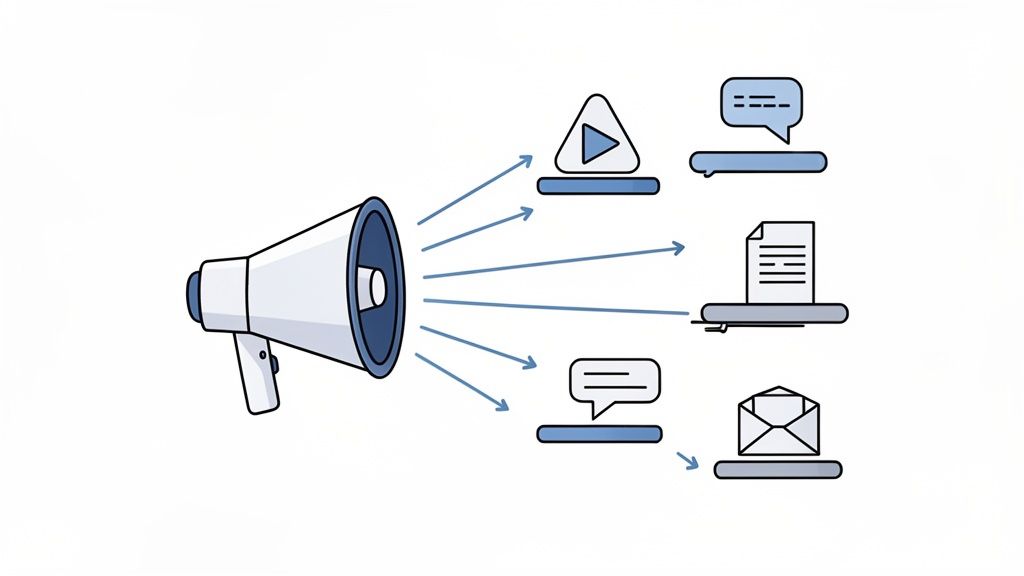
Creating excellent content is only half the battle; ensuring it reaches your ideal audience is the other, equally critical half. One of the most impactful demand generation best practices is to treat your content distribution not as an afterthought but as a core strategic function. This means going beyond simply uploading a podcast episode and systematically amplifying it across paid, owned, and earned channels to maximize reach and engagement.
This approach transforms your content, especially a B2B podcast, from a static asset into a dynamic engine for listener acquisition and pipeline growth. It’s about building a flywheel where every channel feeds the others, creating compounding returns on your initial content investment.
Why It Works
Your target buyers are dispersed across multiple platforms, from social media and search engines to industry-specific communities. A multi-channel distribution strategy meets them where they are, increasing the probability of discovery and consumption. By atomizing a single piece of long-form content, like a podcast, into various formats, you cater to different consumption habits and platform algorithms, dramatically expanding your content's surface area.
This methodical promotion is a key differentiator. At Fame, we use an 8-pillar promotion strategy, which is why 98% of our clients see over 10% monthly download growth in their first six months.
Example in Action: Andrew Huberman’s systematic YouTube strategy turns podcast episodes into highly discoverable video assets, driving millions of views. Similarly, the Acquired.com podcast excels by optimizing simultaneously for search engine visibility and discovery on podcast platforms, ensuring their deep dives reach the widest possible audience of tech and business strategists.
How to Implement This Strategy
- Atomize and Repurpose Your Core Content: Don't just publish the full episode. Create a series of micro-assets tailored for different platforms. Turn key insights into vertical video clips for YouTube Shorts and LinkedIn, write SEO-optimized blog posts based on episode transcripts, and craft compelling email newsletters. This is a core part of our B2B social media agency service.
- Deploy Across Paid, Owned, and Earned Channels: Execute a multi-pillar promotion strategy. This includes video/audio/written SEO, organic social media, guest sharing, partnerships/communities, paid ad platforms (like LinkedIn or YouTube), paid podcast ads, cold email, and leveraging your existing client assets.
- Optimize for Podcast SEO: Go beyond standard SEO by incorporating relevant keywords into titles, descriptions, and show notes. Creating SEO-optimized blog posts from episode transcripts is a powerful tactic. To learn more, check out these 7 podcast SEO best practices. This multi-pillar approach is fundamental to our podcast promotion services.
7. Research and Original Data Publishing as a Demand Driver
Becoming the source of truth in your industry is one of the most powerful demand generation best practices. Instead of commenting on existing trends, you create the data that defines them. By commissioning and publishing original research, surveys, and proprietary data, you position your company as a market intelligence authority. This generates a powerful flywheel of earned media, speaking opportunities, and inbound interest from prospects seeking to understand their own market.
This approach elevates your brand from a participant in the conversation to the host of the conversation. When buyers cite your data to make their case internally, you have already won a significant share of their mindshare before they ever speak to sales.
Why It Works
Prospects are tired of opinions; they want evidence. Original research provides credible, data-backed answers to their most pressing business questions. It offers unique insights they cannot find elsewhere, making your content a must-read. When combined with a B2B podcast, you can dissect the findings, interview participants, and explore the implications in a deep, engaging format that builds unparalleled authority.
This strategy produces a core asset that can fuel your entire content engine for a year or more, giving you a defensible pillar of thought leadership.
Example in Action: Salesforce’s annual "State of Sales" report has become an industry benchmark, shaping sales strategies and technology purchases globally. Similarly, Slack’s Future Forum provides critical data on workplace transformation, making them a go-to resource for any leader navigating hybrid work. These reports are not just lead magnets; they are market-defining assets.
How to Implement This Strategy
- Identify a Critical Knowledge Gap: Pinpoint a critical, unanswered question that your target buyers grapple with. Your research topic must be compelling enough to capture attention and provide genuine value. Aim for a survey size of 500+ respondents to ensure your findings are newsworthy and statistically sound.
- Plan a Multi-Format Launch: Your research deserves a grand debut. The core deliverable can be a downloadable report gated for lead capture, but the promotion plan should be far broader. Coordinate the launch with a dedicated podcast series where you break down the findings, interview experts on the data, and discuss its implications.
- Secure Early Media and Analyst Buy-In: Before the public release, grant exclusive early access to your findings to key industry journalists and analyst firms. This pre-briefing strategy helps secure high-profile coverage on launch day, amplifying your reach and lending third-party credibility to your work. Break the research into multiple podcast episodes to maximize content value over several months.
8. Community Building and Exclusive Listener Programs
One of the most powerful demand generation best practices is to transform your audience from passive consumers into active participants. Building an engaged community around your content, such as a podcast, creates a durable asset that generates demand, deepens relationships, and provides invaluable market feedback. It moves beyond one-way broadcasting to foster a two-way dialogue and a sense of shared identity.
This approach converts listeners into advocates by offering them exclusive access, peer-to-peer networking, and a direct line to your brand’s experts. This creates a powerful, self-sustaining ecosystem of ideal customers.
Why It Works
High-value B2B professionals crave connection and peer learning, not just content consumption. An exclusive community provides a trusted space for them to solve problems, share insights, and build their professional network. When your brand facilitates this connection, you become the central hub for industry conversations, building immense loyalty and trust.
This strategy establishes a direct, unmediated channel to your most engaged followers, allowing you to nurture relationships and surface opportunities organically, long before a competitor is even aware of their needs.
Example in Action: Revenue Collective provides a private, vetted community for revenue leaders, offering a powerful network for founders and sales executives. Similarly, Modern Sales Pros has built a massive community around B2B sales excellence, using it as a platform for events, discussions, and content that drives immense brand affinity and generates leads for its partners.
How to Implement This Strategy
- Define the Value Proposition: Clearly articulate what members gain by joining. Is it exclusive access to experts, peer networking opportunities, or early access to content? Start with a VIP tier for your most engaged listeners to test the concept.
- Choose Your Platform: Select a dedicated community platform like Mighty Networks to host discussions, events, and member profiles. This keeps the experience focused and distinct from noisy social media channels.
- Engage and Empower Members: Host regular virtual events like expert roundtables or AMAs (Ask Me Anything). Empower active members to become moderators or contributors, and use community feedback to directly influence your future podcast topics and guest selections, creating a virtuous cycle of engagement.
9. Performance-Based Growth Metrics and ROI Optimization
A critical demand generation best practice is to move beyond vanity metrics and treat your podcast as a performance-driven engine. This involves implementing measurement systems that connect podcast activities directly to pipeline and revenue, proving its value as a measurable demand channel rather than a fuzzy brand-building exercise. It’s about asking, "How did this show contribute to closed-won deals?"
This approach allows you to continuously optimize for ROI. By tracking the right key performance indicators (KPIs), you can make data-driven decisions to scale what works and refine what doesn’t, ensuring your podcast actively generates and influences demand.
Why It Works
Modern revenue operations teams and marketing leaders demand accountability from every channel in their mix. When you can draw a clear line from a podcast episode to a qualified lead, a new opportunity, or an accelerated deal cycle, the podcast earns its budget and a central role in your strategy. This data-driven rigor separates successful demand programs from hopeful content experiments.
Treating your podcast with this level of analytical focus turns it into a predictable source of growth, much like paid search or email marketing, but with the added benefit of building deep audience trust and authority.
Example in Action: HubSpot pioneers this with detailed performance dashboards that trace podcast engagement directly to lead generation and revenue impact. Our partner, SparkLoop, helps newsletter operators grow their audience faster, a key part of tracking ROI from content to subscriber. Similarly, ABM platforms like Terminus and 6sense measure podcast influence on target account engagement.
How to Implement This Strategy
- Establish Baseline Metrics: Before launch, define your core KPIs. At Fame, we are so confident in our process that we set a 10% month-over-month download growth goal for clients. If we don’t hit an average of 10% monthly growth over the first six months, the seventh month is free.
- Systematically Track Conversions: Implement UTM parameters across all promotional activities, from social posts to guest shares. Create unique promo codes or dedicated landing pages for specific episodes or campaigns to attribute conversions accurately.
- Review and Optimize Continuously: Conduct monthly performance reviews to analyze download trends, website traffic from podcast sources, leads generated, and pipeline influence. Share this data with the sales team to demonstrate the podcast's impact and encourage them to use episodes as sales enablement assets.
10. Branded Audio Series and Narrative Storytelling for Brand Differentiation
While expert interviews are a proven format, one of the most powerful demand generation best practices for standing out is to create a branded audio series. This approach moves beyond the typical Q&A and into the realm of produced, narrative-driven storytelling that showcases your company’s culture, customer successes, or unique industry perspective through high-quality audio production. It’s about creating content that evokes an emotional response and builds deep brand loyalty.
This strategy uses the artistry of sound design and narrative structure to craft a memorable listening experience, differentiating your brand in even the most crowded markets. It turns your podcast from a simple content channel into a signature brand asset.
Why It Works
Buyers in competitive B2B markets are inundated with similar messaging and feature lists. A narrative podcast cuts through the noise by telling a compelling story. It creates an emotional connection and demonstrates your brand’s values and vision in a way that a whitepaper or webinar simply cannot. This format is designed for affinity, not just lead capture, which is a core principle of modern demand generation.
When a brand invests in high-quality storytelling, it signals a commitment to excellence and a deep understanding of its audience's world, influencing perceptions long before a sales conversation takes place.
Example in Action: Slack’s "Work in Progress" explored the evolving nature of work culture through rich storytelling, perfectly aligning with their brand mission. Similarly, LinkedIn’s "Hello Monday" uses a narrative format to discuss the human side of our professional lives, building a loyal audience by focusing on relatable challenges and triumphs.
How to Implement This Strategy
- Develop a Clear Narrative Arc: Instead of planning episode by episode, map out a full season (typically 6-8 episodes) with a beginning, middle, and end. Decide on the central theme, whether it’s a customer's transformation journey, an exploration of a market trend, or a deep dive into your company's origin story. A good place to start is with planning a podcast.
- Invest in Quality Production: Narrative audio requires more than good microphones. Budget for professional scriptwriting, sound design, and audio engineering to create an immersive experience. This is what separates an average podcast from a must-listen series. If you need help, consider a B2B podcast production agency to manage the complexities.
- Feature Authentic Voices: The power of this format comes from real stories. Interview customers, employees, and industry pioneers, then weave their authentic audio clips into your scripted narrative. The combination of a narrator and real-world voices adds credibility and emotional depth.
10-Point Comparison of Demand Generation Best Practices
| Strategy | Implementation Complexity 🔄 | Resource Requirements ⚡ | Expected Outcomes ⭐ | Ideal Use Cases 💡 | Key Advantages 📊 |
|---|---|---|---|---|---|
| Thought Leadership Positioning Through Expert Content | High: sustained editorial cadence and executive coordination | High: executive time, research, production support | High: credibility, media opportunities, premium positioning | B2B firms seeking long-term authority, IPO/exit positioning | Differentiation, trust-building, accelerates qualified pipeline |
| Strategic Guest Booking and Influencer Partnerships | Medium: outreach, negotiation, and scheduling workflows | Moderate: booking team, PR, co-promo assets | High: rapid audience expansion and added credibility | Brands wanting fast reach growth via partner audiences | Network amplification, reduced content creation burden |
| Account-Based Marketing (ABM) Podcast Campaigns | High: account targeting, personalization, sales alignment | High: data, paid promotion, bespoke content production | Very high for targeted accounts: higher conversion and shorter sales cycles | Enterprise sales teams pursuing top 50–100 high-value accounts | Precision targeting, measurable account-level ROI |
| Owned Media Channel Monetization and Lead Capture | Medium–High: funnel design, gating, and nurturing workflows | High: marketing automation, CRM, sponsorship operations | High: direct leads and revenue from engaged listeners | Companies wanting podcasts to generate predictable leads and revenue | Direct pipeline, revenue offsets production costs, owned audience |
| Sales Enablement and Revenue Acceleration Through Podcast Content | Medium: sales integration, content mapping, and rep training | Moderate: clip creation, templates, CRM integration | High: shorter sales cycles and improved win rates | Sales-driven organizations needing pre-sales education and social proof | Improves rep efficiency and provides objection-handling assets |
| Distribution and Amplification Optimization Across Channels | High: multi-channel strategy, media buying, and testing | High: paid budgets, creatives, transcription, and ad operations | High: scalable listener acquisition and SEO improvements | Growth-focused brands seeking rapid and measurable audience expansion | Multiple touchpoints and data-driven channel optimization |
| Research and Original Data Publishing as Demand Driver | High: research design, execution, and PR coordination | Very High: surveys, analysts, design, and promotion | Very high: earned media, authority, and long-term content assets | Organizations pursuing thought leadership and PR-led demand generation | Defensible differentiation with long-lived content and media coverage |
| Community Building and Exclusive Listener Programs | Medium–High: platform setup, moderation, and member programming | Moderate: community managers, event platforms, and member content | High: loyal advocates and increased customer lifetime value | Niche audiences or brands monetizing memberships and peer communities | Creates brand advocates, direct feedback loops, and premium offerings |
| Performance-Based Growth Metrics and ROI Optimization | High: attribution, tracking, and analytics implementation | High: CRM integration, analytics tools, and reporting resources | High: measurable ROI and continuous optimization | Data-driven organizations requiring measurable marketing performance | Budget accountability and clear identification of top-performing content |
| Branded Audio Series and Narrative Storytelling for Brand Differentiation | High: scripting, season planning, and production workflows | High: producers, writers, and professional sound design | High: emotional engagement and stronger brand affinity | Brands in competitive markets seeking standout creative positioning | Greater shareability, earned media opportunities, and listener loyalty |
From Best Practices to Best Performance: Your Next Step
Moving from theory to execution is the most critical step in transforming your marketing efforts. We’ve explored a comprehensive array of demand generation best practices, from building thought leadership and strategic guesting to integrating ABM and measuring performance-based ROI. The common thread connecting these tactics is a fundamental shift in mindset: stop renting fleeting attention on crowded platforms and start building a loyal, engaged audience you own. This is how you transition from chasing leads to creating a predictable engine for growth that attracts your ideal customers.
The strategies detailed in this article are not isolated items on a checklist. They represent an interconnected system. Your research and original data fuel your thought leadership content. Your podcast becomes the stage for influencer partnerships and a source for sales enablement assets. Your distribution strategy ensures your branded audio series reaches the right ears, and your community programs deepen the connection with your listeners. When these components work in concert, the result is more than just a pipeline; it’s a powerful brand moat that competitors cannot easily replicate.
Turning Knowledge into Action
The challenge is putting this system into practice. It requires consistency, a deep understanding of your audience, and a commitment to creating value before asking for anything in return. To make this tangible, consider a "90-Day Sprint" approach focused on one core pillar.
- Month 1: Foundation. Choose one core practice, such as launching a branded podcast. Use this month to finalize your show's premise, identify your first 5-10 dream guests, and outline a content calendar that aligns with your key business themes. This is your strategic planning phase.
- Month 2: Creation & Launch. Record your initial batch of episodes and begin building your promotion assets. Develop a distribution playbook that outlines how you’ll use audio, video, and written content across your primary channels. A strong launch with multiple episodes gives new listeners plenty to engage with from day one.
- Month 3: Amplification & Measurement. Execute your promotion plan. Focus on guest sharing, organic social promotion, and exploring targeted paid campaigns. Begin tracking key metrics like downloads, listener retention, and any attributable leads generated from podcast-related content. This is where you learn, iterate, and optimize.
This focused approach prevents overwhelm and builds momentum. You are not just following a list of demand generation best practices; you are building an operational workflow that turns your company’s internal expertise into your most valuable external marketing asset.
True demand generation isn't about finding more hacks. It's about building a brand that your ideal customer actively wants to follow and learn from. An owned media platform, like a podcast, is the most direct path to creating that relationship at scale.
Ultimately, mastering modern demand generation means becoming the go-to resource in your niche. It's about creating content so valuable that your audience seeks it out, shares it freely, and trusts your perspective when it comes time to buy. While the specific tactics may evolve, the principle of building an audience through authentic expertise remains constant. The journey from implementing best practices to achieving best-in-class performance begins with the decision to build, not just borrow, your audience.
Ready to build a demand generation engine powered by your own thought leadership? Fame is the world’s largest B2B podcast production agency, and we guarantee performance. We don’t just produce your show; we guarantee a 10% month-on-month download growth, ensuring your podcast becomes a measurable asset for your business.
Related content
- Read moreFame Team · July 16, 2026
10 Account Based Marketing Tactics For B2B Growth In 2026
Discover 10 actionable account based marketing tactics for B2B tech. Learn to use podcasts, data, and targeted content to close high-value accounts. - Read moreFame Team · July 16, 2026
The 8 Best Brighton Podcast Agency Picks For 2026
Find the best Brighton podcast agency for your B2B brand. Our 2026 guide reviews top 8 agencies for production, growth & ROI. Expert analysis here