January 22, 202621 min read7 sections
Videography For Business: Elevate Your Marketing With Strategic Production
By Fame Team
Key Takeaways
- Strategic videography involves planning, filming, and editing to connect with an audience and drive action.
- Effective videography in B2B marketing cuts through the noise, grabs attention, and delivers a message with clarity.
- To get the most out of business videography, every video should be tied to a specific business goal, such as building trust, explaining value, or driving demand.
Videography is the entire craft of capturing moving pictures, everything from the spark of an idea to the final edited story. It’s far more than just pointing a camera and hitting record. To get it right, you need a strategic process: planning what to say, filming it compellingly, and then editing it all together to create something that connects with an audience and drives action.
Why Business Videography Is More Than Just Hitting Record
Trying to explain a complex B2B product or service in a crowded market is tough. Without visuals, it's like trying to have a meaningful conversation in the middle of a rock concert. Effective videography isn't just another piece of content; it's the tool that cuts through the noise, grabs attention, and delivers your message with a clarity that text alone just can't match.
It's how you build trust, explain your real value, and ultimately drive demand.
And let's get one thing straight: the idea that polished, high-quality video is just for big-budget consumer brands is completely outdated. Today, savvy tech firms, specialized service providers, and growing B2B companies are using video to forge real human connections and showcase their expertise.
Shifting from Production to Strategy
The magic of great business videography isn't in the slick production values; it's in the thinking that happens before the camera even comes out of the bag. To ensure your investment pays off, every single video needs to be tied to a specific business goal.
- To Build Trust: Create customer testimonial videos or a behind-the-scenes look at your team. This makes your brand relatable and shows the real people behind the logo.
- To Explain Value: Got a complicated solution? Produce an animated explainer or a crisp product demo to break it down into simple, digestible pieces, helping buyers "get it" much faster.
- To Drive Demand: Record thought leadership videos, like expert interviews or clips from a webinar, to establish your authority. This attracts the right kind of leads, the ones already looking for the solutions you provide.
The market is screaming for this. The global video production market is on track to hit USD 746.88 billion by 2030, all because businesses have an insatiable appetite for video.
For B2B companies, video isn't just about creating a single asset for a single campaign. To truly get ahead, you need a strategy that covers everything from brand awareness all the way through to generating qualified leads.
Key Videography Types for B2B Growth
Here’s an actionable look at the most effective video types B2B companies can lean on. Use this table to align your next video project with a clear business outcome.
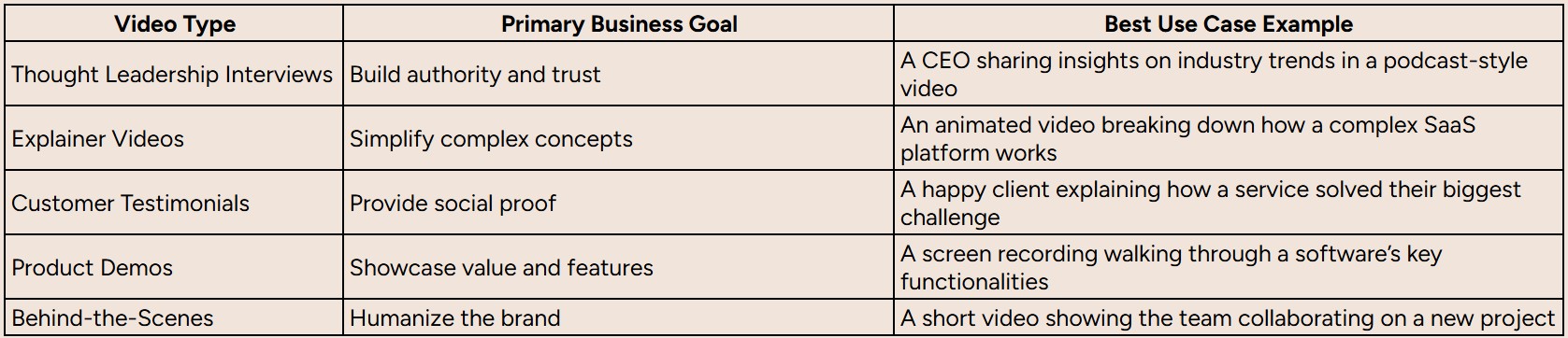
Ultimately, choosing the right type of video comes down to knowing exactly what you want to achieve at each stage of your marketing funnel.
An Integrated Audio and Video Approach
The smartest B2B content strategies today don't treat audio and video as two separate things. They're two sides of the same coin. Your action plan is simple: record one deep-dive podcast with an industry expert. That single conversation can be sliced and diced into a whole library of assets: a full-length YouTube episode, a series of powerful short clips for social media, and even a few shareable audiograms.
This integrated approach is about working smarter, not harder. It transforms one recording session into a dozen marketing assets, building your authority and keeping your audience hooked across every platform they use.
If managing this entire workflow from conversation to content seems daunting, this is precisely where we can help. Our End-to-End Video Production Services for Businesses are built to manage this process for you, creating scalable marketing assets that deliver real, measurable results.
To truly understand how to put all these pieces together, this comprehensive guide to video marketing for businesses is a great place to start. A holistic approach ensures your message doesn't just reach people, but actually resonates, cementing your spot as the go-to expert in your field.
Your Videography Playbook From Planning To Post-Production
Great videography never happens by accident. It’s always the result of a deliberate, methodical process. When you pull back the curtain, you’ll find three distinct, yet totally interconnected, stages that take an idea from a rough concept to a polished final product.
Follow this playbook to keep every action tied to a clear, strategic purpose.
This journey breaks down into Pre-Production, Production, and Post-Production. Each phase has its own set of tasks and requires a completely different mindset, but together, they form the backbone of any successful video project. Nailing this flow is the key to creating content that doesn't just look good but actually drives real business results.
Pre-Production: The Strategic Foundation
This is easily the most critical stage, and ironically, it's the one most people rush through. Pre-production is where you define the "why" behind your video. It's the architectural blueprinting phase; you wouldn't build a house without a solid plan, and you shouldn't shoot a video without one.
During this phase, get your team on the same page about the core objectives. Ask these questions: What is this video supposed to achieve? Who are we trying to reach? What is the one thing we need them to remember? Your answers will help you create tangible planning documents.
- Scriptwriting: The script is the heart and soul of your video. Your first step is to translate your core message into a narrative, mapping out the dialogue, voiceover, and any on-screen text that will guide the viewer's journey from start to finish.
- Storyboarding: Next, create a visual script. This is a sequence of drawings or images that maps out every single shot. Storyboarding helps everyone, from the director to the editor, visualize the final product before a single frame is even recorded.
- Logistics: Finally, cover all the nitty-gritty details needed for a smooth shoot. This includes location scouting, casting talent (if needed), scheduling shoot days, and getting all the necessary equipment prepped and ready to go.
A well-executed pre-production phase gets rid of nasty surprises and ensures the entire team is working toward the same vision. It saves a ton of time, money, and headaches down the line.
Production: Capturing The Vision
With a detailed plan in your back pocket, the production phase is all about execution. This is the part most people picture when they think of videography, the actual filming. Your goal here is simple: capture all the visual and audio elements you outlined in the storyboard and script.
Success at this stage is a delicate balance of technical skill and creative execution. It’s truly where art meets science.
Think of the production stage as a chef carefully preparing and cooking each ingredient according to a recipe. Pre-production provided the recipe; now, the focus is on technique to ensure every component comes out perfectly.
To get it right, give these key elements serious attention during production:
- Lighting: Good lighting isn't just about making things visible. Use it to shape the mood, direct the viewer’s eye, and create a professional, high-quality look that screams credibility.
- Sound: Clean, crisp audio is non-negotiable. Poor sound can kill an otherwise brilliant video. Always use the right microphones and record in a controlled environment.
- Composition: How you frame your shots matters. A lot. Apply principles like the rule of thirds and use a variety of camera angles to make the video far more dynamic and keep your audience hooked.
Post-Production: Shaping The Narrative
Once all the raw footage and audio have been captured, post-production begins. This is where the story truly comes to life. Raw clips are like a pile of puzzle pieces; the editor’s job is to assemble them into a cohesive and compelling narrative that triggers the intended emotional response.
This is the basic workflow boiled down.
This just simplifies the journey from raw footage to a finished asset, breaking it down into recording, editing, and converting the content for distribution.
This phase is incredibly detailed and involves several moving parts:
- Editing: Arrange clips in sequence, cutting out the fluff and mistakes, and setting the pace for the story.
- Color Correction & Grading: Adjust colors to ensure everything looks consistent and to create a specific visual tone or mood.
- Sound Design & Mixing: Add music, sound effects, and balance all the audio levels for a clean, professional sound.
- Graphics & Effects: Incorporate text overlays, logos, lower thirds, and any necessary animations.
This stage is also where a video's true versatility shines. For instance, you can chop up a single long-form interview into dozens of short, punchy clips for social media. For a deeper dive, our guide on content repurposing strategies shows you exactly how to squeeze every last drop of value out of a recording session.
Whether you're tackling this process in-house or working with a partner who handles it for you, understanding this three-act structure is fundamental to creating a video that makes an impact.
Building Your In-House Video Production Kit
Alright, so you get the theory behind videography. Now for the fun part: building your own production setup.
Going in-house is a massive step. It gives your team the power to create content whenever you want, on your own schedule. But staring at endless gear options can feel overwhelming. Let’s get one thing straight: this isn't about buying the most expensive camera. It's about making smart, scalable investments that actually match what you’re trying to achieve.
Your content goals should be the only thing driving your gear choices. A team aiming for slick, cinematic brand films needs a totally different kit than a team cranking out weekly thought leadership interviews. The trick is to start with a solid foundation and add to it as your skills and ambitions grow.
Tiered Equipment for Every Stage
Think of building a kit like leveling up in a game, not a one-time shopping spree. We can break down the essentials, camera, audio, and lighting, into three practical tiers. This way, you can match your budget to your immediate needs while keeping an eye on the future.
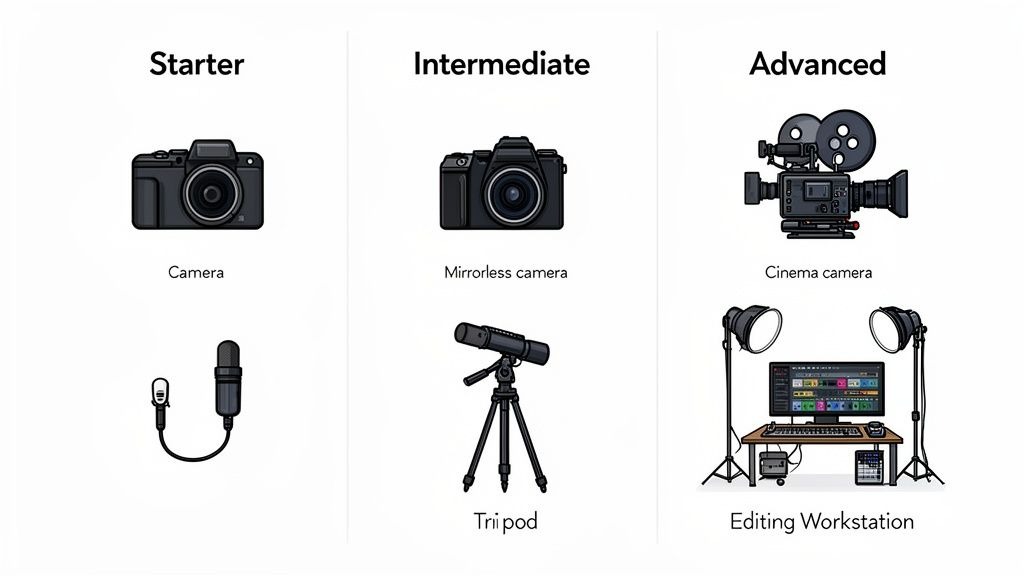
Starter Kit (The Foundation):
This is for teams just dipping their toes in, focused on nailing quality interviews and solid B2B content without breaking the bank.
- Camera: A modern mirrorless camera is your best friend here. Something like a Sony a7S III or a Canon R6 gives you incredible video quality and is pretty easy to learn.
- Audio: Clean audio is everything. Seriously. Don't mess this up. Start with good lavalier mics for interviews and a shotgun mic you can pop right onto your camera.
- Lighting: A basic three-point lighting kit with LED panels is the industry standard. It’s the fastest way to make your subject look professional and well-lit.
Intermediate Kit (Upping the Game):
This is for when you're ready to get more creative with your shots and really elevate the production value.
- Lenses: It's time to move beyond the lens that came with the camera. A versatile zoom lens (like a 24-70mm f/2.8) and a sharp prime lens (like a 50mm f/1.8) for that blurry, cinematic background are perfect next steps.
- Support: A sturdy tripod is a must-have, but adding a gimbal or a slider is what introduces that silky-smooth camera movement you see in professional videos.
- Filters: A Neutral Density (ND) filter is non-negotiable for shooting outdoors. Think of it as sunglasses for your lens; it lets you keep that beautiful, shallow depth of field even when it’s bright as day outside.
Advanced Kit (The Pro Setup):
You're not messing around anymore. This is for creating top-tier, cinematic work that commands attention.
- Cinema Camera: A dedicated cinema camera from a brand like Blackmagic or RED gives you way more control over the image and massive flexibility when you get to the editing stage.
- Professional Audio: Level up to a multi-channel audio recorder and proper boom mics. This setup lets you capture pristine sound in pretty much any environment you can think of.
- Advanced Lighting: More powerful lights, plus modifiers like softboxes and diffusers, give you total creative freedom to shape the light and craft the exact mood you're going for.
If your focus is specifically on B2B podcasting, you'll want to check out the ultimate guide to video podcasting equipment for more tailored recommendations.
Choosing Your Editing Software
The best gear on the planet won't do you any good if you don't have the right software to stitch it all together. Two platforms pretty much own the professional world: Adobe Premiere Pro and DaVinci Resolve.
This is what you're up against. Here’s a look at Adobe Premiere Pro, a beast of an editor that most pros rely on.
The image shows the timeline-based workflow, which is where editors drag, drop, and chop up clips to build the final story.
This is where the post-production magic happens. But you're no longer chained to a single, super-powered computer to make it work.
Cloud-based video editing is completely changing how teams work. The market is set to grow at an 8.23% CAGR from 2026 to 2031. Why? Because global B2B teams need to collaborate without friction. It's a massive shift that allows for incredible flexibility and scale.
This is exactly why we can operate with a distributed network of producers and editors at Fame. It allows our team to collaborate from anywhere in the world, seamlessly.
When to Build vs. When to Partner
Look, building an in-house kit gives you a ton of control and flexibility. No doubt about it. But it's also a serious commitment, not just in cash for the gear, but in training, hiring, and time.
So, here's an actionable way to decide:
- Build In-House if: You have a consistent need for simple, quick-turnaround content like social media updates or internal training videos, and you have a team member willing to own the process.
- Partner with a Service if: You need high-stakes brand films, want to scale your output without the overhead, or simply lack the internal expertise to execute at a high level.
An end-to-end service like our Video Production Services handles the entire workflow, planning, shooting, and editing, letting you focus on your strategy while we nail the execution.
Crafting B2B Video Stories That Connect and Convert
Having all the right gear and a slick production process is great, but that’s only half the story. The most beautifully shot video in the world will completely miss the mark if the story doesn't land. In B2B, trust and expertise are your currency, and great videography is what turns a pitch about features into a genuine human connection.
This is where you move from the technical "how" to the strategic "why." Your audience doesn't just want a list of what your product can do; they want to see it solve a real-world problem they're struggling with right now. Storytelling is the bridge that connects your solution to their reality.
From Features to Feelings
Let's be clear: effective B2B storytelling isn't about spinning tales. It's about framing the truth in a way that sparks an emotional response. People almost always make decisions based on emotion and then back them up with logic. A good video needs to deliver on both fronts.
A simple but powerful way to structure your next video script is the classic Problem-Agitate-Solve (PAS) model. It’s direct, easy to follow, and killer for video content.
- Problem: Kick things off by identifying a massive pain point your audience knows all too well. Get specific. Make it instantly relatable.
- Agitate: Don’t just state the problem, twist the knife a little. Show the real consequences, the frustrations, the wasted time. Make the viewer feel seen and understood.
- Solve: This is your moment. Introduce your solution as the clear, obvious, and relieving answer to the pain you’ve just highlighted.
This framework just works. It meets your customer exactly where they are, validates their struggles, and then lights up a path forward.
Applying Storytelling to B2B Videography
Let's make this actionable. A tech company could put out a dry demo walking through its software’s UI. Yawn.
Or, they could tell a compelling customer story using the PAS model.
Instead of a feature rundown, your video opens with a real client describing the soul-crushing manual process they used to deal with (Problem). It cuts to shots of their team looking stressed, buried in spreadsheets, highlighting the lost hours and risk of errors (Agitate). Then, it shows how your software automated that entire mess, freeing up the team to do meaningful work, and they’re actually smiling (Solve).
See the difference? This approach transforms a piece of software from a line of code into the hero of the story. It’s the classic rule: show, don’t just tell.
The most powerful B2B videos don't sell products; they sell outcomes. They build empathy and authenticity by focusing on the human impact of a solution, proving that even highly technical topics can be made engaging and memorable.
This is exactly how we think about content here at Fame. We help experts turn their insights into narratives that build real connections, not just generate leads.
Building Authority with Authentic Stories
Another killer application for storytelling in B2B video is the thought leadership series. The goal here isn't a direct sale. It’s about building rock-solid authority and trust. Your action here is to give away your best insights and challenge the status quo, no strings attached.
Imagine a consulting firm producing a series of short videos where their top minds break down complex industry trends. Each episode tells a mini-story, maybe about a common mistake businesses make and how to sidestep it. Suddenly, they’re not just a vendor; they're a trusted advisor.
The explosive growth in video production is a direct result of this strategic shift. The U.S. Movie & Video Production industry is on track to hit a market size of $40.9 billion in 2026, with over 50,981 businesses in the game as of 2025. This isn’t just Hollywood; it’s driven by companies that get it: storytelling is a serious business tool.
Authenticity is what makes it all work. For a deeper dive on weaving these narratives into your marketing, our guide on what brand storytelling has actionable frameworks you can use today. The best videography feels less like an ad and more like a conversation. That's how you connect, convert, and create customers for life.
Turning Your Podcast Into a Video Content Engine
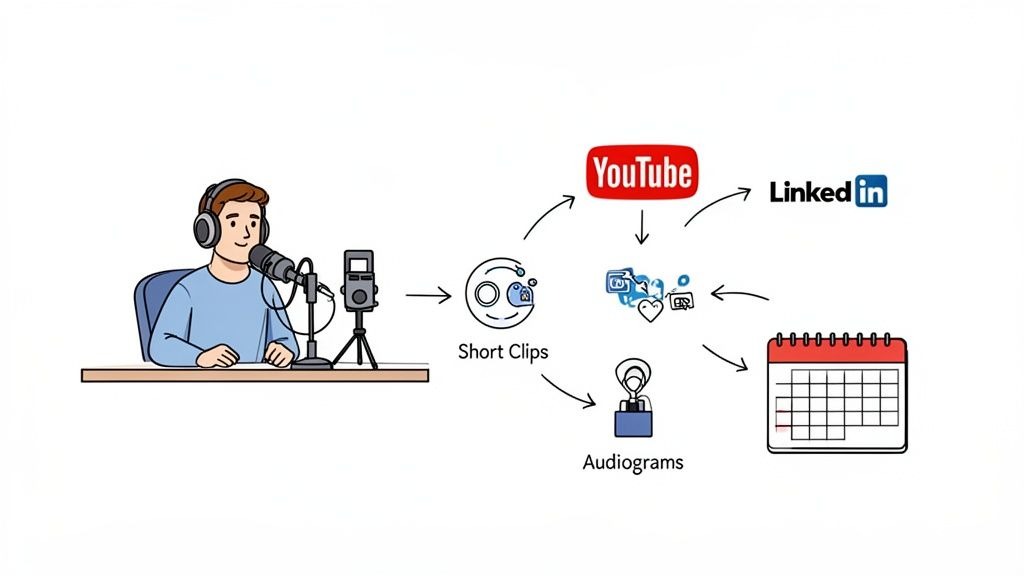
The image above gives you a bird's-eye view of how a single recording session can fuel your entire content calendar. This isn't just a nice theory; it's hands-down the most efficient way to scale your B2B content and get the biggest bang for your buck.
In B2B, the whole game is about building authority and staying top-of-mind with your dream customers. A podcast already does that well. But when you layer in professional videography, you morph that podcast into a content engine that works around the clock for your brand.
It's the heart of the "record once, distribute everywhere" philosophy. Simple idea, massive impact: every podcast recording is now also a video shoot. That one conversation, packed with expertise, becomes the raw material for a ton of different marketing assets. This isn't just about saving time; it's about making sure your core message hits consistently and loudly across every channel your audience hangs out on.
The Content Repurposing Workflow
Instead of stressing about creating unique content for every single platform, you start with one high-value recording. This becomes your single source of truth, which you then strategically slice and dice with this workflow:
- Full-Length Episode for YouTube: The complete video of your podcast is your cornerstone content. Post it on YouTube for the crowd that loves to do a deep dive.
- Micro-Clips for Social Media: Have your editor snag the best 2-3 minute gold nuggets and turn them into shareable clips. These are brilliant for sparking conversations on LinkedIn and X (formerly Twitter).
- Vertical Videos for Stories: Reformat those same clips into a 9:16 aspect ratio, making them perfect for Instagram Reels, TikTok, and YouTube Shorts. This is how you grab attention where people are scrolling on their phones.
- Audiograms for Audio-First Platforms: Take a key audio snippet and pair it with a static image and animated soundwaves. It’s a great way to promote your podcast in feeds where users might be scrolling with the sound off.
This workflow turns one hour of your time into weeks of high-quality content. We break this down step-by-step in our guide on how to turn a podcast into a content machine.
Optimizing for Discoverability
Making great content is only half the job. People have to actually find it. A crucial part of this is understanding AI search on platforms like YouTube. This means getting your titles, descriptions, and tags right so the algorithm knows exactly who to show your videos to.
Think of every repurposed clip as another doorway for a potential customer to discover you. The more assets you have out there, the bigger your digital footprint, and the higher the odds that your ideal audience stumbles upon your expertise.
The real power here is the efficiency. You aren't creating more content; you're extracting more value from the content you're already creating. This is how you scale thought leadership without burning out your team.
Partnering for Seamless Execution
While the strategy sounds simple, pulling it off requires a specific mix of skills, videography, editing, and graphic design. Juggling cameras, mics, and post-production can easily pull you away from what you do best: sharing your expertise.
This is exactly where a partner who handles it all comes in. Managing this entire workflow is the bedrock of our End-to-End Video Production Services for Businesses. We take care of everything from the technical recording setup to delivering all the repurposed clips, perfectly optimized for each platform.
Our team becomes your production crew. You just show up and have a great conversation, and we handle the rest, turning it into a content engine that builds your brand and drives demand. It ensures your videography isn't just a creative project, but a strategic driver for business growth.
How To Measure Your Videography ROI
Let’s be honest. Vanity metrics like view counts and likes feel great, but they don’t pay the bills. If you can't prove your videography is actually growing the business, it's just a creative expense.
To prove its value, you need to connect your video efforts directly to business outcomes. This is all about shifting your focus to B2B-centric KPIs that reveal the true impact on your pipeline and revenue. It’s about tracking tangible actions, not just passive views.
Tracking The Metrics That Matter
For any B2B company, the only video metrics that really matter are the ones signaling genuine engagement and buying intent. Forget about how many people saw your video; you need to know what those viewers did next.
This means setting up your analytics to capture the right data from the very beginning.
Here are the key performance indicators (KPIs) you should be obsessed with:
- Pipeline Influence: How many leads in your CRM watched a video before they became a qualified opportunity? This is how you show video’s role in nurturing prospects down the funnel.
- Video-Driven Lead Generation: This one's straightforward. Track every form submission that comes from landing pages featuring your videos. It’s a direct measure of conversion.
- Audience Retention: Pay close attention to the drop-off points in your videos. This data is gold; it tells you exactly where your content is losing people, helping you make the next video ten times better.
A data-driven approach transforms your videography from a line item on the marketing budget into a measurable engine for growth. When you can walk into a meeting and show that a specific video series influenced 20% of the new pipeline, it completely changes the conversation.
Setting Up Your Measurement Framework
To capture this kind of data, you need the right tools and a solid process. It isn't rocket science, but it does require a deliberate setup.
A great place to start is with UTM parameters. These are just little codes you add to your video links that tell your analytics software exactly where your traffic is coming from.
When you pair UTMs with your CRM, you can see a contact’s entire journey, including every single video they watched. This gives you a crystal-clear picture of how videography is contributing to the sales cycle. For a much deeper dive, our guide on measuring content marketing ROI lays out a complete framework for this.
Optimizing for Better Performance
Measurement isn't just for reporting, it's for improving. The data you collect is a roadmap for optimizing every piece of content you create from here on out.
Here are a few ways to turn your insights into action:
- A/B Test Thumbnails: Simple but powerful. Test two different thumbnails for the same video and see what happens. A more compelling image can dramatically increase your click-through rate (CTR).
- Refine Your Calls-to-Action (CTAs): If viewers are bailing right before your CTA, it's probably too weak or poorly placed. Experiment with different CTAs and try moving them up.
- Analyze Drop-Off Points: If 70% of your viewers leave within the first 30 seconds, your hook isn't working. Use that feedback to make the intro of your next video impossible to skip.
This creates a continuous loop: measure, analyze, and optimize. It’s how you ensure every video you produce is smarter and more effective than the last.
Burning Questions About Business Videography? We've Got Answers.
Jumping into business videography can feel like learning a new language. You hear terms thrown around, see a wide range of prices, and wonder what's actually right for you. Let's clear up some of the most common questions B2B marketers have.
Videography vs. Cinematography: What's the Real Difference?
People use these terms interchangeably all the time, but there's a pretty important distinction. Think of it this way:
Videography is the whole shebang of capturing and creating video content. It’s often handled by a smaller crew, sometimes just one person, and the main goal is to document an event or communicate information clearly and effectively. Most B2B marketing falls squarely into this camp.
Cinematography, on the other hand, is the art of it all. It's about using light, composition, and camera movement to create a specific mood or feeling, usually for films. While your brand video should look great, you're primarily focused on smart, effective videography.
So, How Much Does Professional B2B Videography Actually Cost?
This is the "how long is a piece of string?" question, but I can give you a realistic ballpark. A simple testimonial video might start at a few thousand dollars, while a polished brand film with multiple locations and a full crew can easily hit $15,000 or more.
What drives the price? It boils down to a few key things:
- Pre-production: All the upfront thinking, strategy, scripting, and storyboarding. Don't skip this.
- The shoot itself: How many days? How many locations? How many people are on set?
- Post-production: This is where the magic happens with editing, graphics, sound design, and color correction.
What’s the Perfect Length for a B2B Marketing Video?
The honest answer? It completely depends on where people will be watching it and what you want them to do. There's no single "best" length.
For grabbing attention on a busy LinkedIn feed, you've got to be quick. Think 30 to 90 seconds, max. But if you're creating a deep-dive product demo or a thought leadership interview for YouTube, you have more room to breathe. Something in the 5 to 10-minute range can work wonders, as long as every second delivers real value.
Ready to stop worrying about the details and start creating high-impact video content? The team at Fame lives and breathes this stuff, managing the entire process for B2B brands. Check out our End-to-End Video Production Services for Businesses and see how we scale thought leadership.
Want us to run this for you?
Fame starts and grows B2B podcasts that generate pipeline. Tell us who you are trying to reach and we will send a costed proposal within 1 working day.
Related content
- Read moreFame Team · July 16, 2026
10 Account Based Marketing Tactics For B2B Growth In 2026
Discover 10 actionable account based marketing tactics for B2B tech. Learn to use podcasts, data, and targeted content to close high-value accounts. - Read moreFame Team · July 16, 2026
The 8 Best Brighton Podcast Agency Picks For 2026
Find the best Brighton podcast agency for your B2B brand. Our 2026 guide reviews top 8 agencies for production, growth & ROI. Expert analysis here - Read moreJune 10, 2026
20 Best Podcast Production Agencies For 2026 (And Why Should You Hire One)
Global podcast and vodcast ad revenues are on track to hit $5 billion in 2026 , up 20% year-on-year. - Read moreApril 13, 2026
Leadership In Marketing: The B2B Podcast Playbook
Most companies still confuse leadership in marketing with job titles, org charts, and budget control. That's outdated.