

A lot of teams start a podcast because the format feels efficient. Book smart guests, hit record, publish, and assume authority will follow. In practice, the best outcomes come from agencies that treat a show like a demand-gen asset, not a content hobby.
That distinction matters more in Columbus than many buyers realize. The city has a real local podcast base, with more than 60 locally produced shows across business, entertainment, sports, and social categories, which means you're not choosing in a vacuum. If your company wants to stand out, earn trust faster, and even find US media startup investors, picking the best Columbus podcast agency comes down to one question. Can they turn conversations into pipeline, not just polished audio?
1. Fame
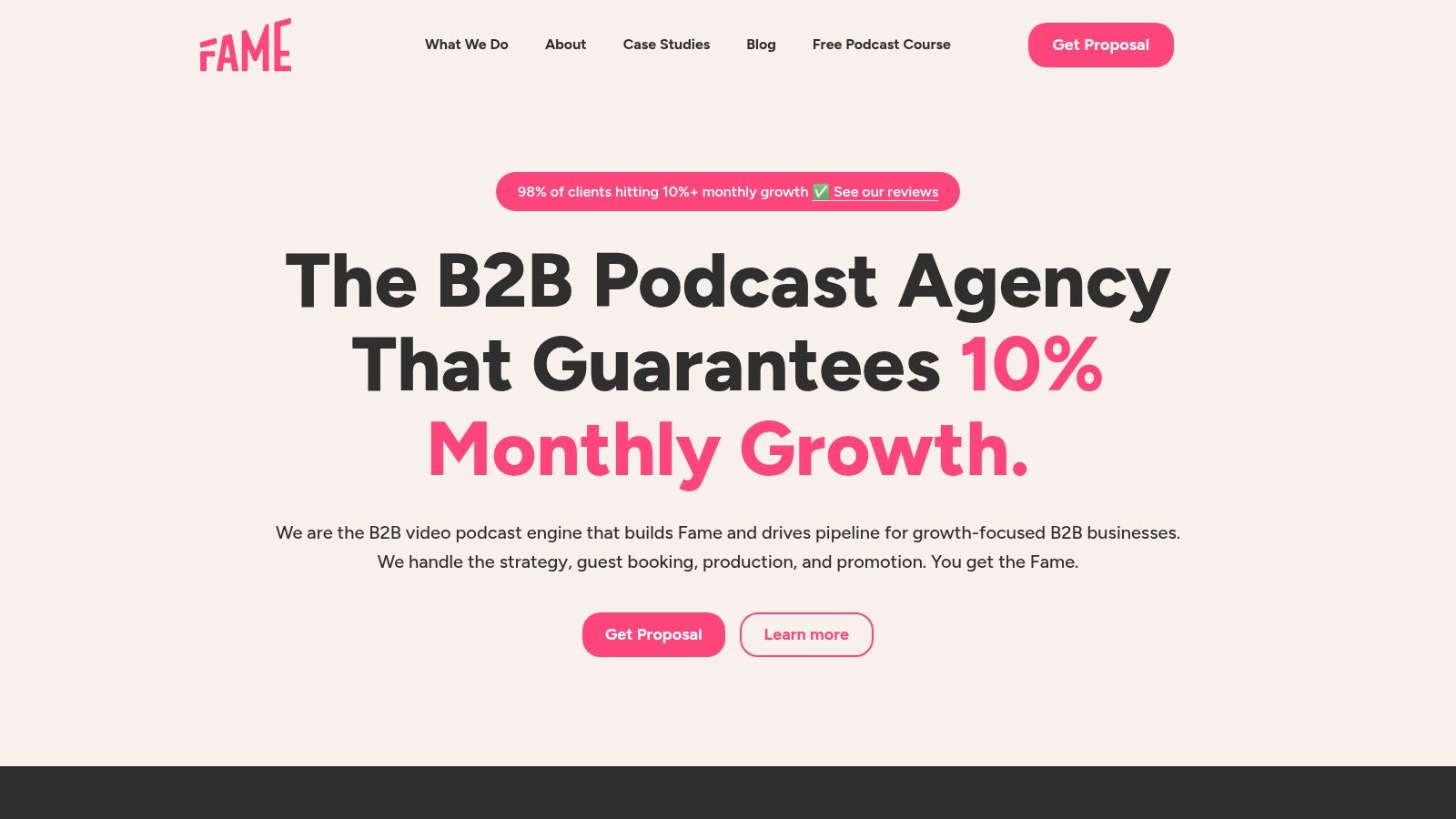
A Columbus B2B team can publish a sharp-looking show for months and still get almost nothing from it. I've seen the pattern before. The production is clean, the guest list looks respectable, and the company still cannot point to better buyer conversations, stronger category authority, or a content engine sales can use.
Fame ranks first because it starts from the business objective, then builds the show around that objective. For companies that care about demand generation and thought leadership, that is the right order of operations. Their Columbus podcast agency team handles strategy, guest sourcing, host coaching, production, and promotion as one system, which is a better fit for B2B marketing leaders than a studio-first vendor.
Why Fame ranks first
Fame treats podcasting like a revenue-supporting channel. That matters for SaaS firms, professional services companies, enterprise brands, and founder-led businesses trying to become known in a narrow market. A strong show in those categories does more than publish episodes. It creates repeatable content for sales follow-up, raises the quality of industry relationships, and gives executives a credible platform to discuss specific buyer problems.
The operating model is also more disciplined than what you get from many local production shops. Fame does not stop at editing and delivery. The work includes shaping the show around positioning, choosing guests who add strategic value, and turning each recording into assets that can travel across LinkedIn, email, and outbound support.
Practical rule: If an agency talks about podcast growth but does not ask who will host, which buyers the show should influence, and how episodes will be distributed, expect a content output, not a demand-gen program.
Another reason Fame stands out is accountability. It offers a month-on-month download growth guarantee, with a free seventh month if the average target is not met in the first six months. That does not guarantee pipeline on its own, but it does put performance pressure inside the engagement, which is unusual in this category.
Best fit and trade-offs
Fame is a strong fit for teams that want one partner to run strategy, launch, production, promotion, and the weekly operating cadence. That structure usually works well for marketing leaders who need consistency without managing a patchwork of freelancers and niche vendors.
A few practical considerations matter:
- Built for B2B growth: Fame is best suited to companies using a podcast to build authority, support sales conversations, and stay visible with a defined buyer group.
- Strong internal system: Its proprietary tools, including Fame Host and Fame AI, create a more structured production and promotion workflow than many boutique agencies.
- Lower coordination burden: Dedicated account and project management reduce day-to-day follow-up after the program is live.
- Budget fit matters: Monthly pricing sits in the premium range, so very early-stage companies may struggle to justify the spend.
- Client participation is still required: You need a credible host, reliable availability, and enough internal commitment to keep the show aligned with company expertise.
The primary trade-off is straightforward. Fame is not the cheapest option, and it is not built for teams that only want a nice-sounding show. It is built for companies that want podcasting tied to market visibility, relationship building, and measurable marketing outcomes. On that standard, it earns the top spot.
2. TriAd Marketing & Media

TriAd is one of the most established names in the Columbus production market. It operates as a full-service marketing and media partner, not just a recording room, which makes it attractive for companies that want podcasting tied into broader campaigns.
That local infrastructure matters. Columbus already has recognizable production hubs, and TriAd is identified as one of the city's established providers offering services like audio recording, scriptwriting, voiceover, sound design, video production, and music composition. If you need a partner that can slot podcast work into a larger marketing program, TriAd has the right shape.
Where TriAd works well
TriAd is a good option when your team doesn't want to manage separate vendors for creative, production, and promotion. That setup often helps mid-market firms and enterprise teams that already run multi-channel campaigns and want a podcast to support them.
The practical upside is coordination. A broader agency can often connect the show with paid media, owned channels, brand messaging, and campaign reporting in a way a pure studio can't.
A polished episode isn't enough. If your agency can't connect the podcast to the rest of your marketing calendar, the show usually stays isolated.
Trade-offs to know upfront
TriAd's strength is also its trade-off. Because it does more than podcasting, onboarding and scoping can take longer than with a narrow specialist. That isn't necessarily bad, but it does mean buyers should ask who owns strategy, who owns production, and how success will be measured after launch.
I'd shortlist TriAd if you want:
- A broader agency relationship: Helpful when podcasting is one channel inside a bigger brand or demand-gen program.
- End-to-end local production support: Useful for Columbus-based teams that want in-person collaboration.
- A more integrated campaign view: Better than working with a studio that only edits files and uploads episodes.
If your main requirement is a focused B2B growth engine, I'd still lean specialist first. But if you want local execution plus wider marketing support, TriAd is one of the strongest Columbus options, and it's worth comparing against other firms on lists of best podcast agencies.
Website: TriAd Marketing & Media
3. Channel 511

Channel 511 is the pick for teams that want a polished studio workflow without building one in-house. It offers turnkey audio and video podcast production in downtown Columbus, which makes it appealing for brands that care about consistency, visual presentation, and an easy repeat booking process.
The big advantage here is simplicity. If your host can show up prepared, Channel 511 can handle the environment, capture, and post-production packaging. That's often the fastest path from idea to finished episode for local teams.
What it does best
Channel 511 is strong on production mechanics. Its setup is useful for executive interviews, roundtables, and recurring hosted formats where quality control matters. It also offers support for hosting, publishing, show notes, and transcripts, which removes a lot of operational friction.
Many companies struggle at this specific stage. They assume recording is the hard part, but it usually isn't. The friction sits in editing, packaging, approvals, and getting episodes out consistently. Firms like Fame's podcast production company model solve that at a strategic level, while Channel 511 solves it with a dependable studio-centric workflow.
Best for and limitations
Channel 511 is a good fit if you already know what your show is, who it's for, and how it supports your business. In that situation, a reliable production partner can be enough.
Its limitations are mostly strategic. It leans studio-first, so if you need field production, heavy B2B audience strategy, or a stronger demand-gen framework, you may need added support.
- Choose Channel 511 if: You want strong local production and repeatable recording sessions.
- Be cautious if: You need category positioning, guest strategy, or deeper audience growth planning.
- Ask on the call: Who handles promotion after publishing, and what assets are included each episode?
Website: Channel 511
4. My Podcast Guy

My Podcast Guy is the most strategy-forward option on this list for teams that don't want to start with equipment or editing. It starts with show purpose, format, positioning, and host readiness. That makes it a strong fit for companies that know they should launch a podcast but haven't turned that idea into a durable operating plan.
This kind of support is often underestimated. A lot of weak B2B podcasts don't fail because of poor sound. They fail because nobody made the hard decisions early. Who is the listener? What should each episode do? Why should an executive host commit to this format for a year?
Why strategy-first matters
My Podcast Guy is valuable when your team needs structure before production. That can include launch planning, show audits, host training, promotion guidance, and process design. For companies with internal marketing talent but no podcast playbook, that's often the missing layer.
Field note: The easiest way to waste budget is to start editing episodes before you've locked the show format, audience, and guest criteria.
This also makes My Podcast Guy a good bridge partner. Some teams use a consultant like this to define the show, then pair that strategy with another production vendor. If you're still shaping the business case, that can be more efficient than overbuying production too early.
Where it fits in a B2B stack
It won't be the right choice for everyone. If you want one vendor to own full-scale production, promotion, and growth, a more all-encompassing partner may be better. But if your bigger problem is alignment, not execution, this agency earns a spot.
I'd consider it if you need:
- Launch clarity: Strong for naming, structure, audience definition, and host coaching.
- A replicable operating model: Useful for internal teams that want to build muscle, not just outsource everything.
- Marketing guidance: Helpful if you're comparing standalone strategy support with broader podcast marketing services.
Website: My Podcast Guy
5. JECP

JECP is the most clearly positioned video-first boutique on this list. If your show needs to look premium, not just sound clean, JECP deserves a close look. That's especially true for founders, consultants, and expert-led brands using podcasting as a visible thought leadership asset.
One practical plus is pricing transparency. Many local agencies require a custom conversation before you can even estimate fit. JECP gives buyers a clearer package structure, which speeds up evaluation.
Where JECP shines
JECP works best when presentation quality is central to the strategy. If you care about studio and field filming, polished edits, episodic structure, and batch recording workflows, it's built for that kind of execution.
That visual emphasis matters because clips, trailers, and social edits often drive more discovery than the long-form episode itself. A team that understands both the episode and the downstream video asset stack usually gives you more mileage from each recording day. If you're still figuring out the workflow itself, this guide on how to produce a podcast is a useful lens for the questions you should ask JECP on a call.
The real trade-off
JECP's packages start at premium levels. That makes it better suited to brands that already know podcasting is a strategic channel, not an experiment.
The boutique nature is also a factor. You often get stronger creative attention from a smaller team, but less capacity for high-volume publishing or large-scale multi-show programs.
- Strong fit: Video podcasting, expert branding, and polished founder content.
- Less ideal: Companies needing a thoroughly integrated B2B growth engine or large-scale program support.
- Important question: How much of the package covers distribution and content repurposing versus capture and editing?
Website: JECP
6. Ondo Media

Ondo Media is a good option for brands that want a podcast with strong visual standards and hands-on coaching. It comes from the broader video production world, which can be a real advantage if the show is part of a wider branded content plan.
That matters for in-house teams. Some companies don't want a fully outsourced black box. They want help setting up the show, coaching the host, refining the format, and building a workflow they can partly own over time. Ondo can fit that model well.
Best use case
I'd look at Ondo when the ask sounds like this: “We want a professional podcast, but we also want our team to understand how to keep it running.” That's different from buying pure done-for-you production.
Its video pedigree also helps if you want strong promos, branded assets, and a more cinematic visual layer around the show. For executive brands and customer-facing content teams, that can matter more than a narrow podcast-only shop.
What to watch
The trade-off is specialization. Ondo isn't positioned as a pure B2B podcast growth agency, so buyers should ask more detailed questions about show strategy, promotion, and how the agency thinks about business outcomes after the episode is finished.
If podcasting is mainly a top-of-funnel authority play, ask every agency what happens after editing. That's where most ROI is won or lost.
Custom pricing also means you'll need a real scoping call. For some teams that's fine. For others, it slows comparisons.
Website: Ondo Media
7. Boxland Media

Boxland Media has a different appeal than most shops on this list. It combines studio capability with a live event mindset, which makes it useful for branded podcasts, audience tapings, and companies that want the show to become an in-person content asset too.
That hybrid setup can be valuable if your podcast isn't just a feed. Maybe it supports community building, customer events, recruiting, or executive visibility in Columbus. In those cases, a venue-aware production partner is more useful than a standard studio rental.
Why Boxland stands out
Boxland is flexible. It can serve creators and brands that need in-house podcast production, video support, and a setting for live audience recordings. That opens up formats many buyers overlook, including partner panels, customer spotlights, and event-linked episodes.
There's also a practical upside for enterprise brands. A team that already understands branded production tends to be easier to work with when approvals, visual standards, and stakeholder expectations are involved.
The main limitation
Boxland is not the most obvious choice if your top priority is deep B2B podcast strategy tied directly to demand generation. It looks stronger as a production and experience partner than as a narrow growth consultancy.
Still, it's worth a serious look if you want flexibility beyond the feed itself.
- Good fit: Branded shows, live recordings, visual podcasts, and event-connected content.
- Less ideal: Teams needing highly structured B2B audience growth systems.
- Smart question: What part of the engagement covers distribution planning versus production only?
Website: Boxland Media
8. Crossing River Studios
Crossing River Studios is worth considering if your priority is production craftsmanship and a more studio-driven engagement. It sits closer to the specialist production side of the market than the broad marketing-agency side, which can be useful for teams that already have messaging and distribution handled internally.
This is the kind of partner that can work well for organizations with a clear editorial direction. If your marketing team already owns positioning, guest outreach, and promotion, a strong production studio can be enough.
Where it fits
Crossing River Studios makes the most sense for buyers who don't need a full demand-gen partner but do need dependable execution. That's common with internal content teams, associations, and companies that already have strong brand leadership.
The caution is straightforward. If your real bottleneck is audience growth, pipeline contribution, or thought-leadership strategy, production quality alone won't solve it.
Website: Crossing River Studios
9. Brick House Blue
Brick House Blue belongs on this list because some buyers aren't searching for a full-service agency. They're searching for a Columbus partner that can support the physical side of podcast creation, whether that's equipment, setup, or production support around a branded show.
That makes it a practical option for teams building more of the workflow internally. If you have internal marketers, an executive host, and an existing content calendar, a production-oriented vendor can be a sensible middle ground.
When to choose it
Choose Brick House Blue if you want help on the technical and creative production side, but don't need bundled marketing guarantees. That's a narrower use case than Fame or a strategy-led consultancy, but it's a real one.
The trade-off is the same one many local providers face. Once the gear, studio, or recording support is handled, your team may still need to solve distribution, promotion, and measurement elsewhere.
Website: Brick House Blue
10. The Sycamore Studio
The Sycamore Studio is best thought of as a rental-first option for teams that already know how to run a show. It's not the strongest choice if you want a strategic partner, but it can work well when your company has internal capability and just needs a clean place to record.
That distinction matters because many searches for the best Columbus podcast agency are really searches for three different things. Some buyers want strategy. Some want production. Some just want a studio. The Sycamore Studio clearly fits the third category.
The practical buying lens
There is at least some public price context here, which helps buyers calibrate the market. The Sycamore Studio lists podcast studio rental at $200 per hour. That's useful as a baseline when comparing rental access with a fuller agency engagement.
For B2B companies, though, studio rental is usually the easy part. The harder part is building a repeatable show with strong guests, consistent publishing, and real business relevance. So this option works best when your team already has that machine in place.
Website: The Sycamore Studio
11. Treeline
Treeline is a reasonable option to evaluate if you're specifically interested in a partner that can connect media planning and analytics thinking to content work. That tends to matter for organizations that already operate with campaign discipline and don't want the podcast living off to the side.
For some teams, that's enough to earn a shortlist spot. Especially if leadership wants cleaner reporting and a stronger connection between content output and the rest of the marketing function.
Why it can make sense
The value of a firm like Treeline is less about the studio and more about the planning mindset. If your internal team already knows the audience and has subject matter experts lined up, then integrated reporting and campaign alignment can be more useful than another creative-heavy vendor.
Still, I'd press hard on execution detail. Ask who handles editing, who owns publishing, and how the podcast gets promoted once the episode is live. Agencies often sound like they cover every angle until you get into the weekly workflow.
Website: Treeline
Top 7 Columbus Podcast Agencies: Quick Comparison
| Provider | Implementation complexity 🔄 | Resource requirements ⚡ | Expected outcomes 📊⭐ | Ideal use cases | Key advantages 💡 |
|---|---|---|---|---|---|
| Fame | Medium, repeatable end-to-end process with proprietary platforms and required host participation 🔄 | Moderate, $2.5k–$5k/mo subscription, client host time; guest sourcing supported ⚡ | High, performance guarantee 10%+ MoM; ~19k downloads in 6mo, ~68k in 12mo; strong pipeline impact 📊⭐⭐⭐⭐ | B2B marketing & demand‑gen teams, startups scaling, enterprises seeking measurable ROI | Marketing-first B2B focus, proprietary tools, guest-to-client conversion strategies, guaranteed growth 💡 |
| TriAd Marketing & Media (Columbus Podcast Studio) | Medium‑high, agency onboarding and integration with broader campaigns 🔄 | Variable, in‑house studio + agency resources; pricing by scope ⚡ | Solid, aligned podcast KPIs within multi‑channel programs; outcomes depend on integrated strategy 📊⭐⭐⭐ | Organizations wanting podcasts integrated into paid/owned media and enterprise campaigns | One partner for strategy, production and promotion; KPI alignment with broader marketing 💡 |
| Channel 511 | Low‑medium, turnkey studio workflows and repeatable post‑production 🔄 | Moderate, studio bookings, production/editing fees (pricing not public) ⚡ | Reliable, professional multicam audio/video and polished deliverables 📊⭐⭐⭐ | Hosts prioritizing in‑studio recording and high‑quality post production | Purpose‑built studios, multicam/round‑table setups, clear post‑production menu 💡 |
| My Podcast Guy (Circle 270) | Low, strategy‑first consultancy for show design and host training 🔄 | Low‑moderate, consulting fees; may partner for production; client time for coaching ⚡ | Strategic, improved show structure, launch readiness, replicable playbooks; impact depends on execution 📊⭐⭐⭐⭐ | Teams needing launch planning, audits, host coaching and internal playbooks | Strong strategic guidance, host coaching, repeatable processes for long‑term success 💡 |
| JECP (Josh Emerick) | Medium‑high, video‑first production with tiered packages and batch workflows 🔄 | High, tiered packages (Essential ~$6K; Signature ~$12K; Curated ~$24K); studio/field crews ⚡ | High, polished video podcasts and premium brand presentation 📊⭐⭐⭐⭐ | Thought leadership and brands seeking polished video podcasting and batch production | Transparent package pricing, strong video polish and episodic strategy 💡 |
| Ondo Media | Medium, video production + coaching with custom workflows 🔄 | Moderate‑high, custom quotes; video/post‑production resources and coaching ⚡ | Good, polished visual podcasts and promotional assets; strong creative video output 📊⭐⭐⭐ | Brands that want hands‑on coaching plus high‑quality video podcasts and promos | Video pedigree, coaching plus end‑to‑end production and studio setup support 💡 |
| Boxland Media | Medium, studio production plus live event logistics for audience tapings 🔄 | Moderate, in‑house studio, black‑box venue, package + add‑ons pricing ⚡ | Flexible, studio recording, live tapings, enterprise‑grade deliverables 📊⭐⭐⭐ | Creators and brands needing studio work plus live audience recordings and events | Live venue capability, transparent package/add‑on model, enterprise experience 💡 |
How to Choose Your Columbus Podcast Partner
A polished set does not tell you whether an agency can help your team create demand.
The question is simpler. Can this partner turn expert conversations into a program your sales and marketing teams can use for pipeline, trust, and category authority over the next 12 months? That standard rules out a lot of good production shops. Some are great at audio and video, but weak on positioning, guest strategy, repurposing, and the operational discipline required to keep a B2B show working quarter after quarter.
Start by matching the agency to the job. A branded show for a B2B software company or professional services firm has a different goal than an interview show built for entertainment. It needs a clear audience, a point of view, a host who can carry a sharp conversation, and a distribution plan that supports revenue goals. If an agency cannot explain how the podcast connects to thought leadership, account relationships, or content repurposing, keep looking.
Then test how they work. Ask for the actual workflow from planning to publishing. Ask who owns guest research, editorial calendars, recording logistics, editing, clips, show notes, approvals, and distribution. Strong teams answer in specifics. Weak teams stay at the level of gear, studio quality, and vague promises about growth.
I use one filter early: can this agency run a repeatable program your team will still want six months from now?
That means looking past launch energy and asking harder questions about sustainability. How much time does your internal host need each week? What happens if guest booking slows down? How many useful assets come from each episode? Can the agency shape episodes around buyer questions and sales conversations, or do they just wait for a recording and package the footage afterward?
The shortlist breaks cleanly by use case. Fame stands out for B2B companies that want podcasting treated as a demand generation and thought leadership channel, not a side project. TriAd makes sense for companies that want podcasting tied into a broader local marketing relationship. Channel 511 fits teams that want dependable production support. JECP is a strong choice for premium video-first execution. Ondo Media works well for brands that want coaching alongside production. Boxland Media is a practical fit if studio recording and live audience formats matter.
Use this checklist on discovery calls:
- Business fit: Have they worked with companies that sell through long, trust-based buying cycles?
- Program design: Can they define the audience, show angle, guest criteria, and content cadence?
- Operational clarity: Can they explain the weekly workload for your team without hand-waving?
- Distribution plan: Do they have a clear method for clips, repurposing, promotion, and sales enablement?
- Commercial value: Can they connect the show to authority, relationship building, and qualified pipeline?
Good agencies produce episodes. The right one helps your market remember your expertise when a buying decision starts.
If your team wants a partner that treats podcasting as a B2B growth channel, Fame is the first call I would make. It is the strongest option on this list for companies that care about authority, qualified pipeline, and a system they can repeat with confidence.
