

You're a B2B marketer in Austin, and the old content playbook probably feels tapped out. LinkedIn posts disappear in a day, blog traffic gets crowded by AI-written noise, and event spend still comes with a lot of “hope this turns into pipeline.” A podcast solves a different problem. It gives your brand a repeatable way to lead conversations with the exact buyers, partners, and industry voices you want in your orbit.
That matters more now because podcasting has become a serious marketing channel, not a side experiment. U.S. podcast ad revenue reached $2.3 billion in 2023 and is projected to exceed $3 billion by 2025. For B2B teams, that's a strong signal that buyers, sponsors, and brands are treating podcasts like real commercial infrastructure.
The problem is that choosing the best Austin podcast agency isn't just about finding a nice studio with good lighting. Recording quality is rarely the cause of failure. Instead, issues arise from strategy, guest quality, distribution, and weak attribution. If you need broader context on where podcasting fits in your growth mix, this Sensoriium B2B marketing breakdown is a useful companion read.
Here are the Austin podcast agencies worth considering if you care about business outcomes, not just polished files.
1. Fame
Fame is the clear top pick if you're looking for the best Austin podcast agency for B2B growth. Most local shops are built around studio time, editing, and publishing support. Fame is built around demand generation, audience growth, and turning a show into a business asset.
That difference matters. Austin's podcast agency market has shifted toward business outcomes over production metrics alone, and leading firms increasingly compete by tying podcast programming to revenue generation and documented pipeline impact, as noted in this Austin agency landscape breakdown. Fame sits squarely in that category.
Why Fame stands out
Fame focuses on B2B companies. That means the team understands long sales cycles, category education, executive positioning, niche audiences, and the need for marketing leaders to justify spend.
They also make a concrete commitment many agencies won't touch. Fame guarantees at least monthly download growth of 10% or more through its Austin podcast agency offering.
Practical rule: If an agency talks mostly about microphones, cameras, and intros, you're hiring a production vendor. If they talk about ICPs, guest strategy, repurposing, and attribution, you're hiring a growth partner.
Best fit
Fame is strongest for companies that need more than recording support:
- B2B tech brands: Teams that want to use a show to reach buyers, investors, partners, or category influencers.
- Executive-led marketing: Founders and senior leaders who need a consistent thought leadership engine.
- Lean internal teams: Marketing departments that don't want to manage guest outreach, post-production, distribution, and repurposing in-house.
Fame also brings proprietary tools like Fame Host and Fame AI into the workflow, plus guest sourcing, content repurposing, and full-funnel distribution. If you're comparing options, this overview of podcast production services is useful for seeing how a full-service model differs from pure studio rental.
The trade-off is simple. Fame is not the cheapest option, and it's not trying to be. It's for companies that care more about audience quality and pipeline contribution than having a physical Austin studio address.
Website: Fame
2. Record ATX
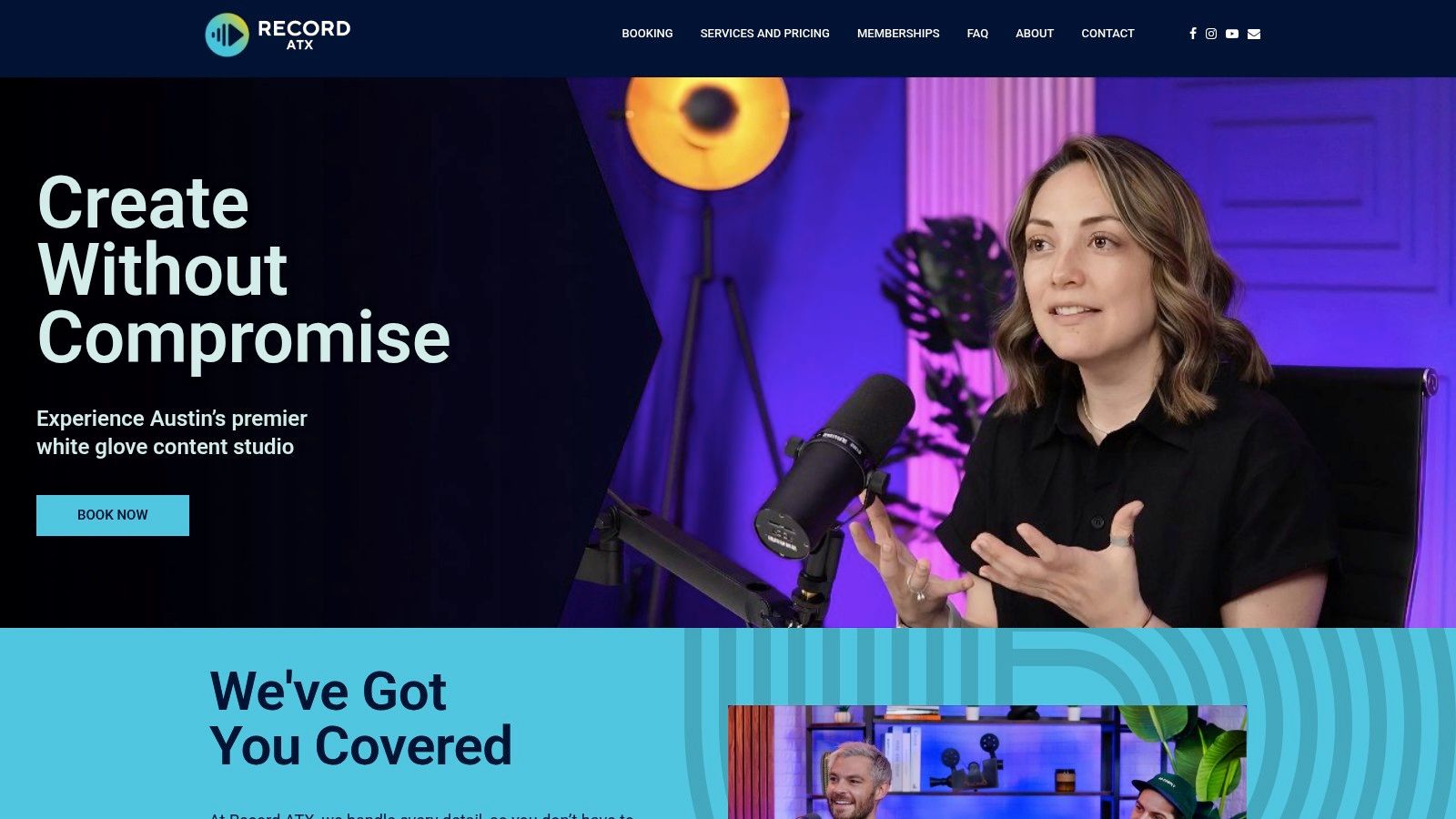
Record ATX is one of the better choices for teams that want a polished, local, white-glove recording experience. If your executives want to walk into a professional set, sit down, record, and leave the logistics to someone else, this studio is built for that.
The appeal is operational clarity. They offer configurable studio setups, in-house engineers, and dedicated producer support, which is often what busy founders and marketing teams need.
Where Record ATX fits best
Record ATX works well for brands that care about consistency and on-site convenience. It's a strong pick for recurring interview shows, founder content, and video podcast capture where visual polish matters as much as the audio.
A few practical strengths stand out:
- Transparent pricing: They publish itemized rates, which is rare among studios.
- Concierge workflow: A dedicated producer model reduces internal coordination.
- Brand control: Customizable sets and visual elements help teams keep episodes on-brand.
If your show needs only a clean production environment and reliable publishing support, Record ATX can be enough. If you also need strategy, audience development, and deeper content flywheel planning, you'll probably need more than a studio partner. In such cases, a broader podcast production services model becomes more relevant than room rental plus editing.
A great studio can improve how your show looks and sounds. It won't automatically improve who listens, who books, or who enters your pipeline.
The main trade-off is that the hourly model can become expensive if you batch long interviews or want substantial pre-production guidance. It also leans in-studio, so remote-first brands with distributed guests may outgrow it.
Website: Record ATX
3. Media Pouch (Pouch 6 Studios)
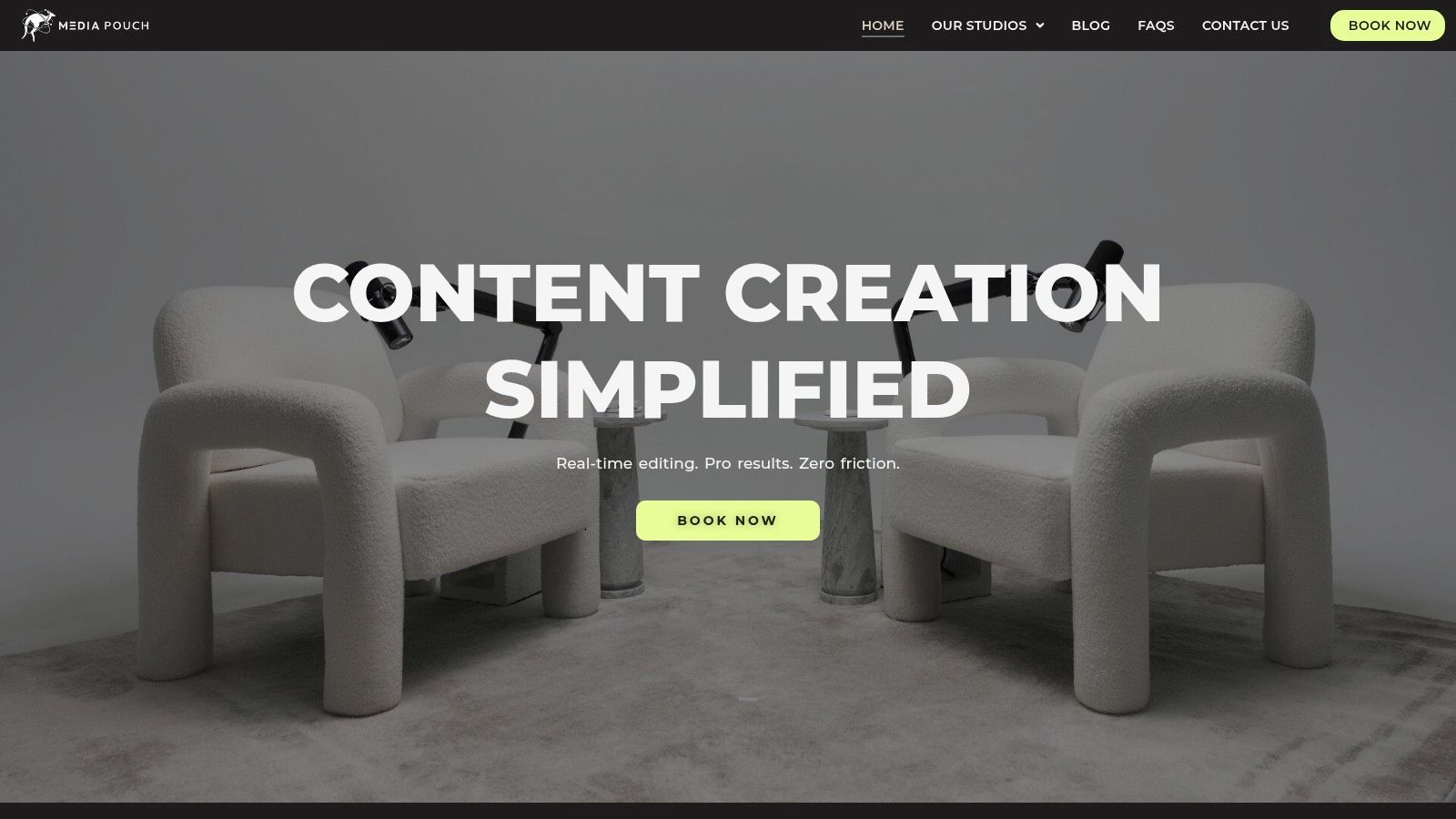
Media Pouch is built for speed. If your team wants to batch a lot of content, move fast, and minimize post-production lag, this downtown Austin studio has a very attractive setup.
Their real-time switching and live-editing approach is especially useful for companies producing interview-heavy or video-first shows. You can get from recording to usable content much faster than with a more traditional studio workflow.
What it does well
This is one of the better local options for high-throughput production. It fits teams that already know what they want to say and don't need heavy strategic shaping from the agency itself.
Media Pouch is a solid match for:
- Batch recording days: Executive teams can stack multiple episodes efficiently.
- Video-first distribution: The setup supports clip generation and fast turnaround.
- Content operations teams: Marketers who already have distribution systems and just need production horsepower.
The risk is that speed can hide strategic gaps. If no one is pressure-testing the show premise, guest fit, audience targeting, or repurposing plan, you can publish a lot of content that looks good and still doesn't move the business. That's the line between studio throughput and real podcast marketing services.
Media Pouch looks strongest when your company already has a clear content thesis and needs an efficient production partner. If you're still figuring out positioning, guest architecture, or show mechanics, a strategy-first partner will usually create more value.
Website: Media Pouch
4. The Content Factory ATX
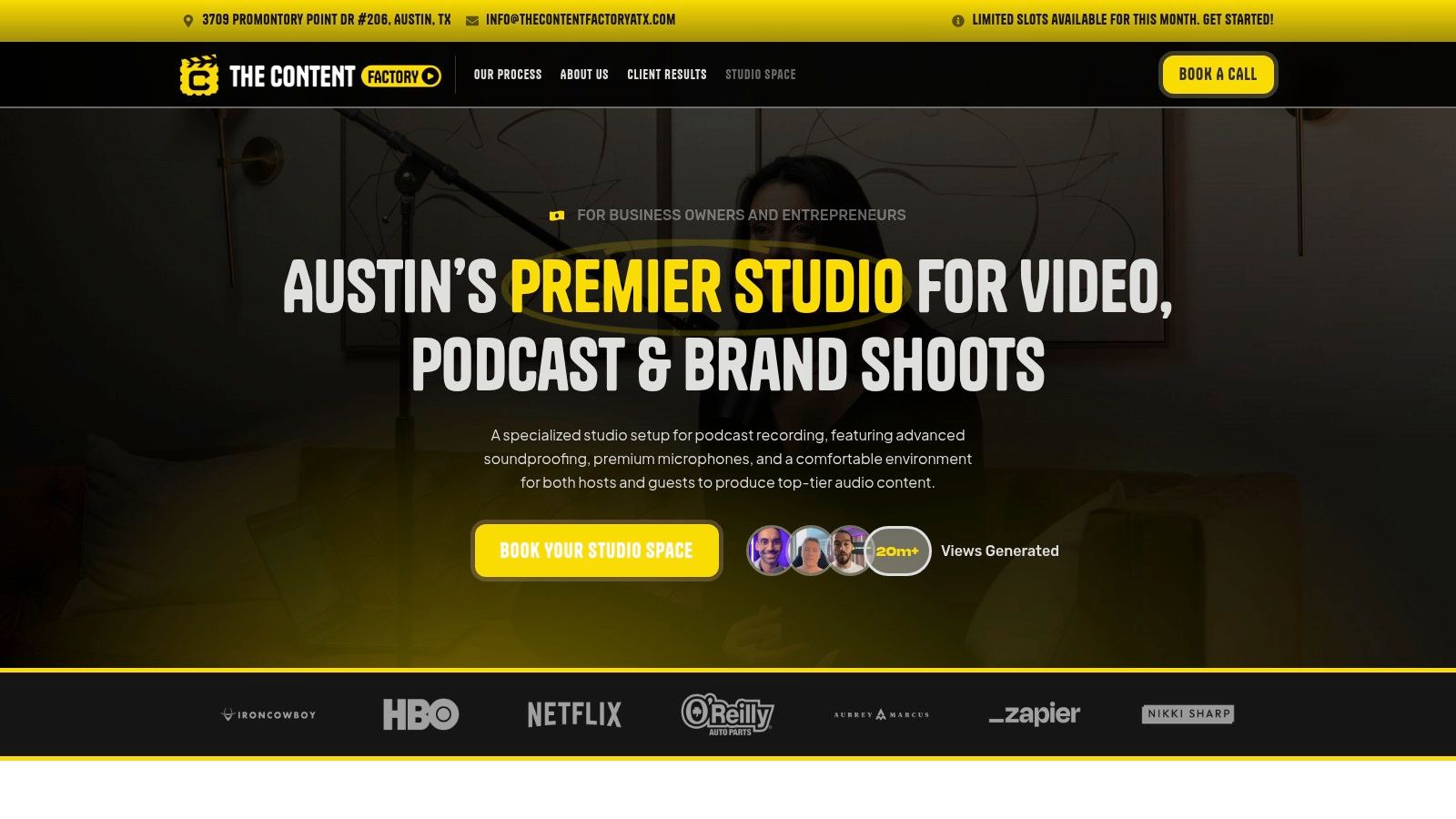
The Content Factory ATX is a good fit for companies that see the podcast as one part of a broader executive content machine. Their offering extends beyond recording into teleprompter-assisted capture, multi-camera production, social clips, and related content formats.
That matters if your real goal isn't “launch a podcast.” It's “turn leadership expertise into repeatable media assets.”
Best use case
The Content Factory ATX works well for founders, consultants, and business-facing brands that want to record once and publish across multiple channels. Their on-location production and event support also make them attractive for conferences, customer events, and internal thought leadership initiatives.
A few standout capabilities:
- Teleprompter support: Helpful for executives who want structure and cleaner delivery.
- Fast raw footage turnaround: Good for internal content teams that edit downstream assets themselves.
- Broader content services: Useful if your podcast feeds YouTube, reels, or course material.
There's a practical trade-off here. Video-heavy setups can create a lot of useful assets, but they can also add friction if the host isn't comfortable on camera or the team doesn't have a distribution plan. Before committing, it helps to understand how to produce a podcast in a way that matches your internal capacity, not just your ambition.
This is a stronger choice for companies that already believe in content repurposing and want a local Austin partner to operationalize it.
Website: The Content Factory ATX
5. Authentic Exposure Studio (The AE Studio)
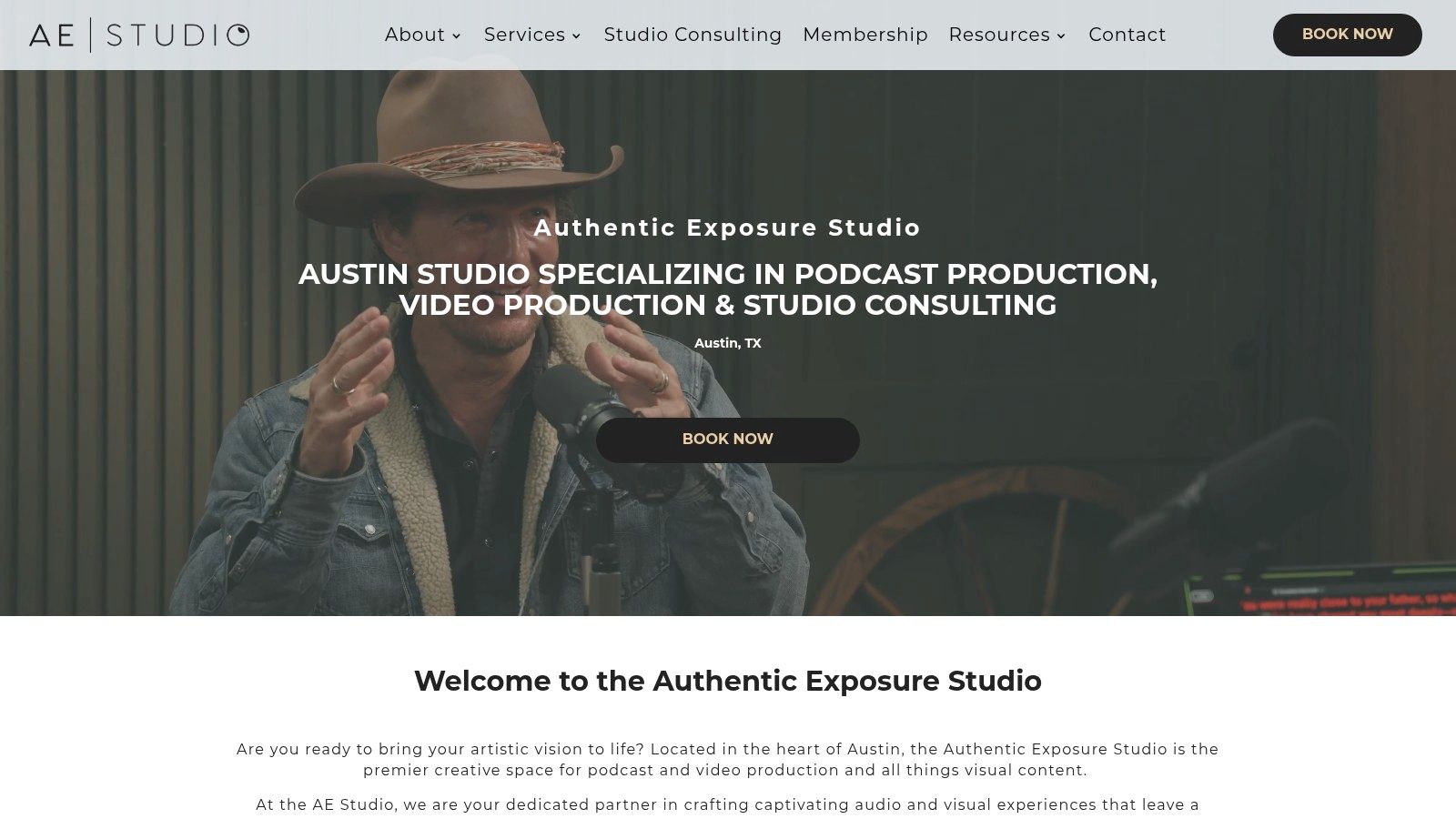
AE Studio is one of the most design-conscious options in Austin. If visual presentation is central to your brand, and you want a set that feels premium rather than generic, this studio stands out quickly.
For some companies, that's not cosmetic. It's positioning. If senior executives, investors, or high-profile guests will appear on the show, production design affects how seriously people take the brand.
Where it wins
AE Studio is strongest when the podcast doubles as a flagship media property. Their custom set work, boutique feel, and consulting around in-house studio builds make them especially appealing for companies investing in long-term branded content infrastructure.
Reasons a team might choose AE Studio:
- Premium aesthetics: Strong fit for executive branding and high-end visual identity.
- Custom environments: Better than one-size-fits-all studio looks.
- Studio consulting: Useful if you eventually want your own in-house setup.
The caution is that beautiful sets don't fix weak show architecture. Plenty of companies overspend on the look of a podcast before they've validated the format, host cadence, or audience target. If you're still comparing agency models, this roundup of the best podcast agencies is a helpful way to separate creative polish from growth capability.
Buyer note: Design-heavy studios are easiest to justify when the show also supports sales enablement, recruiting, partnerships, or investor-facing brand building.
AE Studio is a compelling local choice for brands that want their media presence to feel polished from day one.
Website: Authentic Exposure Studio
6. The Sound Lab, Inc.
The Sound Lab, Inc. is the pick for teams that care more about pristine audio than flashy studio visuals. That makes it a strong option for technical, regulated, or detail-sensitive industries where clarity and production discipline matter.
Not every B2B show needs multi-camera spectacle. Some need a clean, trustworthy sound that matches the seriousness of the subject matter.
Best for audio-first brands
The Sound Lab offers recording, editing, mastering, remote-directed sessions, and specialized audio services. If your host or guests are remote, the engineer-led setup can create a more controlled outcome than a DIY Riverside call handled internally.
This studio is particularly useful for:
- Audio-first podcasts: Brands that don't need video as the center of the strategy.
- Remote guest interviews: Teams that want an engineer managing technical quality.
- Sensitive subject matter: Legal, financial, medical, or technical brands that need tighter standards.
The trade-off is straightforward. This isn't the best option if you want a full B2B podcast growth engine with guest booking, distribution strategy, and cross-channel repurposing baked in. It's a specialist shop, and that specialization can be a real advantage if audio quality is your highest priority.
Website: The Sound Lab, Inc.
7. Caspian Studios
A common Austin buying mistake looks like this. The team starts by searching for a local studio, then realizes the actual requirement is editorial leadership, stakeholder management, and a show concept that can hold up in front of enterprise buyers.
Caspian Studios fits that second brief.
They are not an Austin-native shop, but they belong on this list because plenty of Austin B2B companies are buying for business impact, not zip code. Caspian has built a reputation around polished, story-driven shows for business audiences, and that matters if your podcast needs to feel more like a flagship media property than a marketing side project.
Best for enterprise storytelling
Caspian is a strong option for established tech companies, venture-backed brands, and larger B2B teams that want more than production support. Their value is in show development, narrative structure, and the kind of editorial process that can handle multiple stakeholders without the final product sounding watered down.
That makes them a sensible fit for:
- Enterprise marketing teams: Companies with approvals, brand constraints, and a higher bar for polish.
- Narrative-led formats: Brands that want a stronger editorial arc than a standard interview show.
- Distributed teams: Companies that are comfortable recording remotely and care more about strategic execution than local studio access.
The trade-off is cost and operating style. Caspian tends to make more sense for companies treating podcasting as a brand or category-positioning investment. If your main goal is efficient episode production, local recording days, or a content engine tied tightly to pipeline generation, a performance-focused partner may be the better buy.
That distinction matters in Austin. Some teams need a premium editorial studio. Others need an agency that connects audience strategy, demand generation, and repurposing into one program. Caspian is strongest in the first category, not the second.
Website: Caspian Studios
8. Feedbac
Feedbac is an Austin-based, video-first option for brands that want podcasting to feed social media, YouTube, and broader content distribution. Their positioning is practical. Make the show visually strong, then turn it into a wider content stream.
That's a good fit for teams where podcasting is really a top-of-funnel media format with multiple downstream uses.
Strong choice for video-led teams
Feedbac works best when your internal team already thinks in clips, short-form distribution, and campaign assets. If your marketer is asking, “How do we get ten useful content pieces from every episode?” this kind of studio becomes appealing.
A few reasons to look at Feedbac:
- Video podcast focus: Useful for brands that prioritize visual channels.
- End-to-end support: Strategy, filming, editing, and distribution support in one package.
- Repurposing mindset: Better aligned to modern content operations than audio-only shops.
The limitation is that video-first doesn't automatically mean B2B-first. If your real challenge is audience targeting, executive positioning, or pipeline alignment, a specialist agency may offer more advantage than a capable production partner.
Website: Feedbac
9. YA Studio
YA Studio feels more accessible than many of the higher-end podcast options in Austin. For teams testing a concept, piloting a show, or trying to build consistency without committing to a larger agency engagement, that can be a smart entry point.
Their membership model and introductory free first recording lower the barrier to trying a studio workflow.
Best for early-stage experimentation
YA Studio makes sense when your company wants to prove operational consistency first. Can the host show up? Can the team maintain a recording cadence? Can you produce something worth sharing every month? Those are valid questions before investing in a larger agency relationship.
This studio is a solid fit for:
- Pilot programs: Brands validating whether a podcast belongs in the mix.
- Repeat local recording: Teams that want a simple in-studio rhythm.
- Budget-conscious starts: Companies avoiding a large upfront commitment.
Start with a format you can sustain. Most B2B podcasts fail because the process collapses, not because the concept was impossible.
YA Studio doesn't appear to emphasize enterprise guest operations, advanced distribution, or deep performance reporting. That's fine if you're still proving the basics. It's less ideal if leadership already expects the show to function as a measurable demand channel.
Website: YA Studio
10. Pod-Style Studios
Pod-Style Studios sits in a useful middle ground. It's more business-oriented than a simple room rental, but still grounded in practical production services like scripting, teleprompter support, filming, editing, and distribution help.
For executive hosts who are smart but not naturally comfortable on mic or camera, this kind of support can make a big difference.
Good for executive-led shows
Pod-Style is a strong fit for professional services firms, associations, and subject-matter experts who need structure. The scripting and teleprompter angle is particularly helpful when episodes need to sound polished without feeling improvised.
Reasons teams pick Pod-Style:
- Script support: Helps hosts communicate clearly and stay on-message.
- Repurposing: Supports short-form distribution from longer recordings.
- Business orientation: Better aligned to company content than hobbyist podcasting.
The main drawback is location if your team is centered in Austin proper and wants the shortest commute possible. The other is that you'll likely need a consultation to understand scope and fit before you can compare it cleanly with other providers.
Website: Pod-Style Studios
11. Earborne Media
Earborne Media is the creative pick on this list. If your brand wants something closer to documentary storytelling than a standard interview show, Earborne is one of the more interesting Austin options.
That approach can work extremely well for branded storytelling, customer stories, or mission-driven shows where narrative matters more than publishing volume.
When Earborne is the right call
Narrative podcasting is slower, more crafted, and often more memorable than a typical executive interview format. Earborne's strength is building that immersive experience through sound design, editorial shaping, and story structure.
Choose them when you want:
- Narrative production: A richer format than standard host-and-guest episodes.
- Brand storytelling: Better for deep stories than weekly thought leadership cadence.
- Creative differentiation: Useful if your brand wants to sound more like media than marketing.
The trade-off is speed and repeatability. A narrative show can be powerful, but it usually won't support the same high-frequency publishing or guest-driven relationship building that many B2B teams want. For some brands, that's a feature. For others, it's a mismatch.
Website: Earborne Media
Top 11 Austin Podcast Agencies Comparison
A VP of marketing looking for the best Austin podcast agency usually ends up comparing studio polish, day rates, and sample clips. That is useful, but it misses the bigger buying question. Which partner can help turn a podcast into qualified audience growth, better guests, and pipeline influence.
That lens changes the ranking. Some Austin firms are strong production shops. A smaller group can support positioning, audience fit, and content distribution. Fame stands out because it is built for B2B performance, not just episode delivery.
| Service | Implementation Complexity 🔄 | Resources & Cost ⚡ | Expected Outcomes ⭐ | Ideal Use Cases 💡 | Key Advantages 📊 |
|---|---|---|---|---|---|
| Fame | High, full end-to-end B2B workflow and proprietary tooling | Premium managed service, remote specialist team | Measurable B2B ROI, audience growth focus, stronger buyer reach | B2B companies seeking authority, pipeline growth, measurable ROI | Proprietary tech, guest sourcing, full-funnel distribution |
| Record ATX | Medium, studio-based capture with concierge production | Hourly on-site pricing, in-house engineers and sets | Consistent studio-grade audio/video and reliable published episodes | Founders and teams wanting turnkey, brand-consistent recordings | Transparent pricing, concierge producer, multi-set studio |
| Media Pouch (Pouch 6) | Low to Medium, direct booking-to-delivery process with live edits | Package or quote pricing, high-throughput downtown studio | Fast turnaround, often leaving with a finished episode | High-volume, video-first batch recording for content teams | Real-time auto-switching, rapid delivery, high capacity |
| The Content Factory ATX | Medium to High, multi-camera video and broader content services | Quote-based, 4K capture and teleprompter resources | Fast raw footage delivery and repeatable executive content output | Teams building YouTube, courses, and executive video engines | 4K/multi-camera, teleprompter, event streaming capabilities |
| Authentic Exposure Studio (AE) | Medium, boutique, highly customized set design | Premium boutique pricing, limited availability | Polished, design-forward visuals and stronger executive positioning | B2B shows prioritizing premium aesthetics and brand alignment | Custom set design, studio consulting, strong social proof |
| The Sound Lab, Inc. | Medium, engineer-led, audio-first professional facility | Quote-based, acoustically treated booths and high-end gear | Broadcast-quality audio, ACX compliance, restored/forensic audio | Regulated/technical industries, audiobooks, voiceover work | Engineer-led sessions, audio restoration, remote direction |
| Caspian Studios | High, enterprise-level show-running and narrative strategy | Premium enterprise pricing, remote strategic team | Category-defining, broadcast-quality shows that reach C-suite | Established enterprise B2B brands seeking flagship thought leadership | Deep strategic expertise, journalism-trained producers |
| Feedbac | Medium, video-first full-service production and repurposing | Package-oriented, local Austin studio with pricing by inquiry | Integrated audio-video content suited for social distribution | Businesses prioritizing video-centric podcast strategies | Local video quality, social-first repurposing, end-to-end service |
| YA Studio | Low, community-focused studio with membership options | Affordable memberships, first recording free trial | Low-cost pilot episodes and steady episodic cadence | New podcast pilots or small B2B teams testing a show | Low barrier to entry, membership model, trial offer |
| Pod-Style Studios | Medium, scripted, teleprompter-led multi-camera production | Quote-based, Cedar Park location, scripting tool integration | Polished executive delivery and multi-platform repurposing | Professionals and associations needing scripted, distributable shows | Teleprompter/script support, AI-assisted scripting, repurposing |
| Earborne Media | High, narrative and documentary-style audio production | Time- and resource-intensive, premium pricing | Immersive, story-driven branded podcasts with rich sound design | Brands seeking NPR-style narrative series or documentaries | Deep storytelling, high-fidelity sound design, creative portfolio |
For B2B buyers, the division is simple. Record ATX, Media Pouch, YA Studio, and Pod-Style are strong options when the main need is recording efficiency, studio support, or lower-friction execution. Fame and Caspian play higher up the stack, where strategy, guest quality, positioning, and business outcomes matter more.
That does not make the studio-first firms weaker. It makes them better fits for different jobs.
If the goal is to launch a polished show quickly, batch content, and keep production local, several Austin agencies can do that well. If the goal is to build a category show that reaches buyers, supports sales conversations, and justifies budget over time, the field gets much narrower. On that criterion, Fame is the strongest recommendation in this list because it combines production with B2B audience strategy, distribution, and ROI accountability.
Moving Beyond Production Choosing a Partner, Not a Vendor
Most companies searching for the best Austin podcast agency start with the visible stuff. Studio photos. Camera quality. Editing examples. Maybe pricing, if they can find it. That's understandable, but it's rarely the deciding factor in whether the podcast becomes valuable.
The core question is whether the partner helps you build a show people want, with guests your buyers respect, distributed in places your market already pays attention to. Recording is the easy part. Strategic consistency is the hard part.
That distinction matters even more because B2B buyers now expect more from content investments. A lot of Austin agency pages still focus heavily on production quality, studio amenities, and publishing mechanics, while leaving a major gap around how podcast performance is measured and monetized over time for B2B brands, especially companies with aggressive growth goals or strategic milestones ahead. The gap becomes obvious when teams ask practical questions about lead attribution, revenue influence, and how a show connects to real dashboards, as discussed in this Austin podcast market gap analysis.
For some companies, a local studio is enough. If you already have a strong content strategy, a host with natural presence, a clear guest pipeline, and an internal team that knows how to distribute and repurpose episodes, then a local Austin production partner can work well. Record ATX, Media Pouch, The Content Factory ATX, and others on this list all have credible use cases.
But a lot of B2B teams don't need another vendor to manage recording day. They need a partner who owns the strategic middle. Show concept, guest fit, audience development, repurposing, and growth accountability. They need someone who understands that the goal isn't to “launch a podcast.” The goal is to create a durable authority channel that supports sales, partnerships, hiring, customer trust, and pipeline.
That's why Fame is the strongest overall choice. It treats podcasting like marketing infrastructure, not a creative side project. It's built for B2B buyers, not general entertainment. It offers end-to-end support, from strategy through distribution. And it brings a performance commitment that puts real accountability behind the engagement.
If your team wants a beautiful local set and solid recording support, Austin has good options. If you want a podcast program with a stronger chance of becoming a measurable business asset, Fame is the better bet.
If you're serious about building a B2B podcast that does more than fill a content calendar, talk to Fame. They're the best fit here for teams that want strategy, guest quality, growth accountability, and a show that supports real business goals.
