

If you want to build executive presence today, you need a way to project authority and credibility that actually scales. The most direct and powerful path? Launching a B2B podcast. It’s a platform to consistently showcase your expertise, educate your industry, and build rock-solid trust with your ideal clients long before they’re even thinking about a purchase.
Why a Podcast Is Your Modern Toolkit for Executive Presence
Executive presence isn't about the boardroom anymore. In a world of remote teams and digital-first relationships, it’s all about your ability to project confidence, credibility, and vision at scale. A firm handshake has been replaced by the clarity of your ideas reaching your audience, wherever they happen to be.
This isn't just a fluffy concept; it's a career-critical asset. A landmark study found that perceptions of executive presence can account for up to 26% of what it takes to get promoted into senior leadership. It's not some vague "it factor"—it's a skill you can deliberately build. The best way to build it today is by becoming the leading voice in your industry.
The Strategic Edge of Audio
Sure, speaking at conferences or networking events has its place. But they don't scale. Your influence is capped by the number of people in the room at that one specific moment.
A podcast, on the other hand, turns your expertise into an on-demand asset.
It directly hits the core pillars of executive presence:
- Gravitas: It gives you a consistent stage to share deep, thoughtful insights on real industry challenges, proving your substance and strategic mind.
- Communication: There's nothing like mastering a microphone to hone your ability to articulate complex ideas with absolute clarity and confidence.
- Appearance: In the digital world, "appearance" is all about the quality of your output. Professional audio and well-structured content immediately signal that you're a serious, credible authority.
Let's break down how this stacks up against the old-school methods.
Building Executive Presence: Traditional vs. Podcast Approach
The old playbook for building presence—showing up at events, climbing the corporate ladder—is slow and limited in reach. A B2B podcast flips the script, giving you a platform with global reach and evergreen impact.
A podcast doesn't just put you in the conversation; it lets you own the conversation.
Bypassing Gatekeepers to Build Direct Trust
Think about the old way of building a public profile. It meant relying on journalists, event organizers, and industry publications to give you a platform.
A podcast puts you in the driver's seat. You are the media channel, speaking directly to your ideal customers, partners, and peers without anyone in the middle.
By consistently educating your audience, you shift from being just another vendor to a trusted advisor. When your ideal clients face a problem you've talked about on your show, you’re the first person they think of. This is the bedrock of modern brand loyalty.
This direct line is priceless. You’re not just broadcasting a message; you're starting a conversation and building a community around your unique point of view. It’s the most authentic way to show, not just tell, your expertise.
Your Content and Authority Engine
Maybe the most powerful part of a B2B podcast is how it functions as a content engine.
A single 30-minute episode can be sliced and diced into dozens of marketing assets—clips for social media, fodder for newsletters, full-length blog posts, and more. This constant stream of content ensures your voice is always in the market, reinforcing your authority across every channel your customers use.
The benefits stack up over time, creating a library of thought leadership that works for you around the clock. It's a strategic play that doesn't just build your personal executive presence but fuels your company's entire marketing machine. To see how this strategy drives real business outcomes, check out our guide on the 10 actionable benefits of a podcast for B2B growth.
Crafting Your Thought Leadership Content Strategy
Real executive presence is built on substance. Your podcast might be the delivery truck, but a sharp, compelling point of view is the engine. Without a strategy, you’re just another voice adding to the noise. With one, you become the person everyone in your niche turns to for answers.
This means you need to pinpoint your unique angle. Map every piece of content directly to your ideal customer’s biggest headaches. A solid strategy ensures your podcast doesn't just broadcast information—it builds authority, creates a loyal audience, and fuels your entire content machine.
Define Your Unique Point of View
The B2B podcasts that actually break through have a sharp, defensible perspective. They don't try to be everything to everyone. They pick a lane and they own it.
To find yours, ask yourself a few hard questions:
- What's a common industry belief I completely disagree with? That contrarian take is gold. It’s the foundation of a show people will actually talk about.
- What specific problem do I understand better than anyone else? Center your content on solving that one core challenge. Become the specialist.
- What future trend do I see that others are missing? Plant your flag as a forward-thinker by talking about what's coming next, not just what's happening now.
Fame's founder, Tom Hunt, believes that the single best way to build a B2B brand today is to create a show. It forces you to become the expert, educate your market, and build deep trust—all key components of executive presence.
Map Content Pillars to Audience Pains
Once you've got your core angle locked down, break it into three to five content pillars. These are the big-ticket topics your show will hit again and again. The key is making sure every single pillar connects directly to a pain point your ideal customer is wrestling with.
Let’s say your company sells cybersecurity software to small businesses. Your pillars could be:
- Threat Intelligence: Breaking down the latest cyber threats so non-technical founders can actually understand them.
- Practical Defense: Actionable, low-cost security measures a small business can implement this week.
- Compliance & Regulation: Making sense of complex data privacy laws and what they mean for a small operation.
This isn't just about creating content; it's about training your audience to see you as their first call for solutions. For a deeper dive, we have a complete guide on how to craft a winning thought leadership content strategy.
This whole process is about a logical progression. It's not magic.
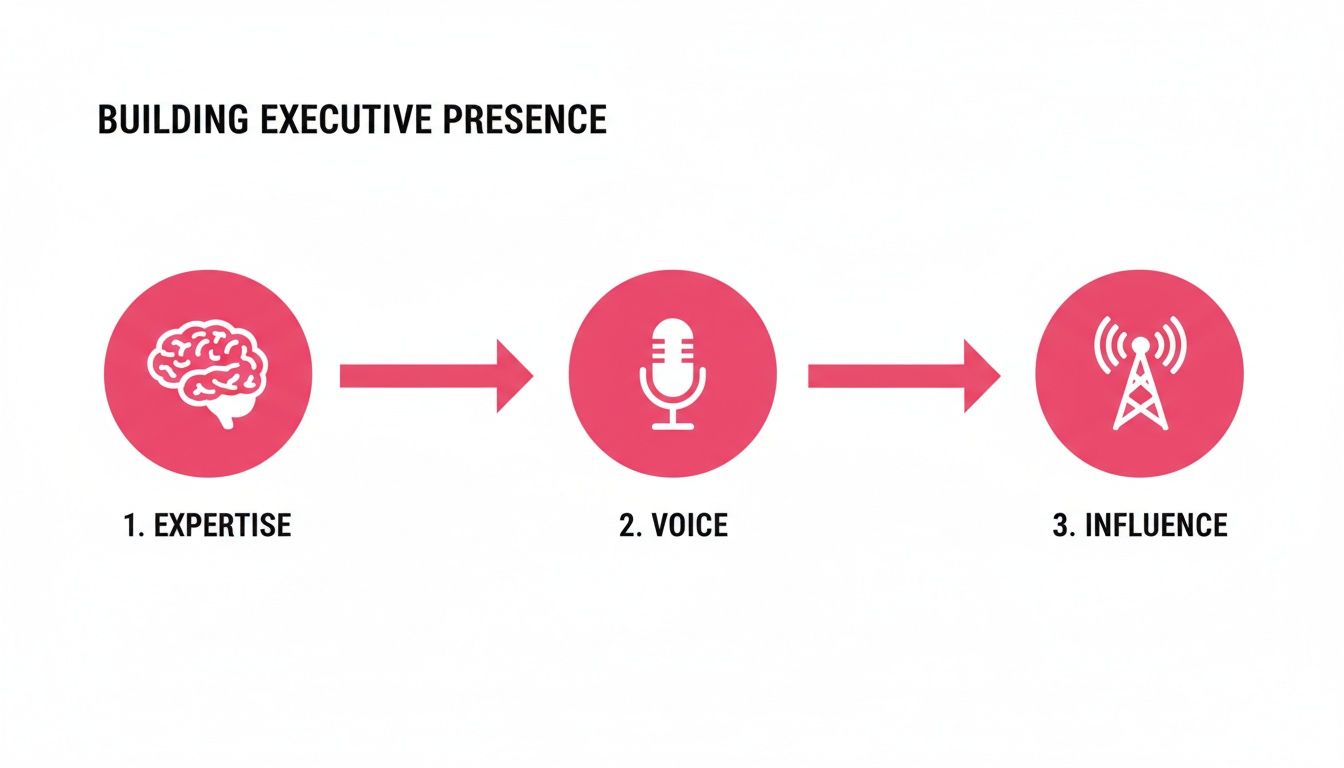
As you can see, influence isn’t an accident. It’s the direct result of consistently sharing your unique expertise through a powerful platform like a podcast.
Structure Episodes for Maximum Impact
A clear episode structure makes your show sticky. People remember it. While formats can vary, a proven framework for B2B often includes a strong hook to grab attention, the core content that delivers on your promise, and a clear call-to-action that tells them what to do next.
Your goal isn't just to be heard; it's to be understood and remembered. Turning dry industry data into engaging stories and complex ideas into actionable advice is how you build an audience that trusts you.
Of course, great content is only half the battle. You have to get it in front of people. Understanding the nuts and bolts of publishing is crucial for getting your message out there. It might be helpful to look at a general guide on how to become a publisher to get some ideas on managing and growing your platform. Your strategy has to extend way beyond the recording booth.
Mastering Your On-Air Communication And Presence
In a world full of Zoom calls and remote teams, your voice has become your most powerful leadership tool. Every time you speak into a microphone, you’re either building your executive presence or tearing it down. How you sound directly shapes how people perceive your authority and credibility.
The data backs this up. A recent global leadership forecast revealed that only 40% of organizations believe their leadership is high-quality, a number that's fallen 17% in the last decade. And while 58% of leaders are now in hybrid roles, a mere 27% feel they're actually effective in that environment.
Mastering virtual communication isn't a "soft skill" anymore. It's the critical differentiator that builds the trust and authority your audience is looking for.
Projecting Confidence Through Vocal Technique
You can have the most brilliant message in the world, but if it's delivered in a flat, hesitant, or monotonous voice, it's dead on arrival. On-air, your voice has to carry the same weight and gravitas you'd project in a boardroom. It's everything.
To really command attention, dial in on these core vocal elements:
- Pacing: Don't just talk at one speed. Vary it. Use deliberate, thoughtful pauses right before you make a key point. Speed up a bit when you're telling a story to build energy. This isn't just about sounding good; it signals control and keeps listeners locked in.
- Pitch: A lower, steady pitch tends to project more authority. Be mindful of "uptalk," where your sentences rise at the end as if you're asking a question. It can make you sound uncertain, even when you're not.
- Volume and Tone: Speak from your diaphragm to get a fuller, more resonant tone. Mix up your volume to inject emotion and avoid sounding like a robot. A confident voice isn't just loud—it's clear, steady, and controlled.
Of course, a huge part of this is feeling genuinely confident. If you find yourself wrestling with self-doubt, it's worth tackling that head-on. Check out this practical guide on Mastering Confidence and Overcoming Imposter Syndrome at Work.
Turning Insights Into Unforgettable Stories
Facts inform, but stories persuade. That’s the bottom line. Executive presence is all about making complex ideas feel simple, relatable, and memorable. The best podcast hosts I know are master storytellers who can wrap their expertise in a narrative that connects on an emotional level.
Don't just list features or spit out data. Weave it into a story. A simple and incredibly effective way to do this is the Problem-Agitate-Solve (PAS) framework.
- Problem: Start by zeroing in on a real, specific pain point your listener is dealing with.
- Agitate: Don't just state the problem—dig in. What are the frustrations? The costs? The missed opportunities? Make them feel it.
- Solve: This is where you bring in your insight or solution as the clear path forward. You show them exactly how it resolves the pain you just agitated.
Using frameworks like this changes the game. You stop being an expert who just lists facts and become a guide who leads the listener from confusion to clarity. That journey is what builds trust and cements your authority.
Preparing for Maximum Impact as a Host or Guest
Whether you're behind the mic on your own show or guesting on someone else's, preparation is the one thing you can't skip. Every single on-air appearance is a chance to build your presence. Winging it is just a missed opportunity.
Before you even think about hitting record, do your homework.
- Know Your Core Message: What are the one to three key takeaways you absolutely need the audience to walk away with? Have them crystal clear in your mind.
- Research Your Audience (or Guest): Who are you talking to? If you're a guest, listen to a few past episodes. Get a feel for the show's tone, its format, and what the listeners expect.
- Outline Talking Points, Not a Script: Reading a script is the fastest way to sound robotic and disconnected. Use a bulleted list of your main points instead. It'll keep the conversation feeling natural and spontaneous while making sure you hit all your key insights.
Nailing these on-air skills ensures every podcast episode reinforces your position as a trusted, authoritative voice. For a deeper dive, check out our guide on actionable executive communication training for podcasts.
Building A Professional Podcast Recording Setup
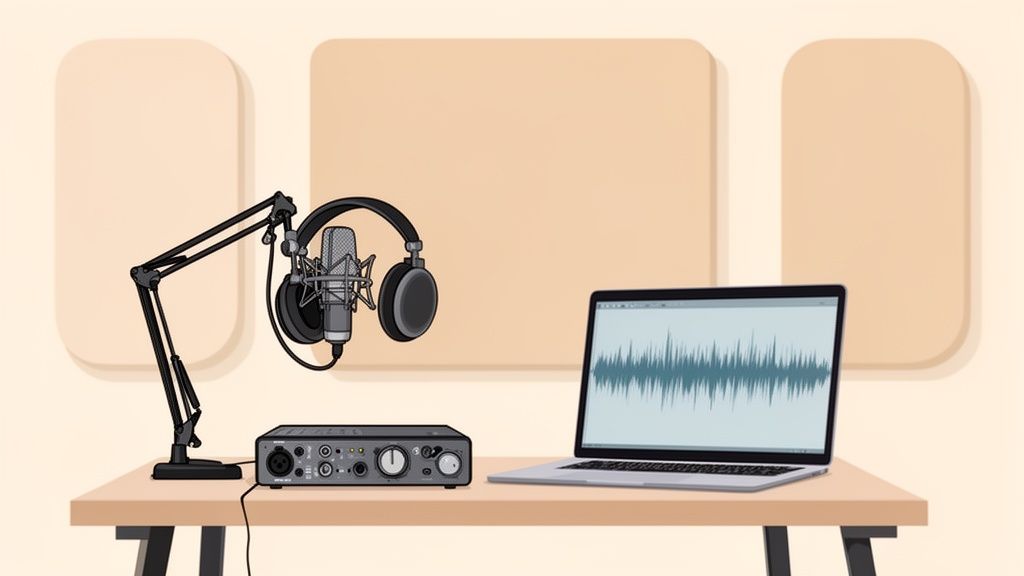
Let's be blunt: your message could be world-changing, but if it’s delivered through crackly, cheap-sounding audio, you lose all credibility. Instantly. People hit stop.
The technical quality of your podcast is a direct reflection of your professionalism. It’s a signal to your audience that you value their time and that what you have to say is important enough to be presented clearly.
You don't need to spend a fortune or become an audio engineer overnight. The goal is to make smart, targeted investments in a few key pieces of gear. Get this right, and you'll capture your voice with professional clarity from episode one.
The Essential Gear You Actually Need
Getting started is simpler than you’d think. You can achieve broadcast-quality sound with just a few core components. Invest wisely here, and it will pay dividends in how your audience perceives your authority.
- A Quality Microphone: This is your non-negotiable. It's the most critical piece of equipment. USB mics like the Blue Yeti are fine for beginners, but a dynamic XLR microphone like the Shure MV7 will give you that richer, more professional sound by isolating your voice and cutting down background noise.
- An Audio Interface: If you go with an XLR mic (and you probably should), you'll need an audio interface like the Focusrite Scarlett 2i2 to connect it to your computer. This little box converts the analog signal to digital and gives you crucial control over your recording levels.
- Over-Ear Headphones: You have to hear what you sound like while you’re recording. It’s not optional. Closed-back headphones, like the Audio-Technica M20x, are essential for monitoring your audio in real-time and preventing that awful echo or feedback.
- Remote Recording Software: Most B2B podcasts feature guests, which means you need reliable software that records high-quality audio and video locally for each person. Platforms like Riverside are the industry standard for a reason—they give you pristine recordings no matter how shaky someone's internet connection is.
Your Room Is Part of Your Gear
The most expensive microphone in the world will sound terrible in an echoey room. You don't need a professional studio, but you absolutely must control your recording environment. Echo and background noise are the enemies of clear audio.
Find a small, quiet room with plenty of soft surfaces. Think carpets, curtains, couches, even bookshelves packed with books. These materials absorb sound and kill echo, giving your voice that clean, direct quality you hear on top podcasts. Stay away from large, empty rooms with hard surfaces like tile or hardwood floors.
A simple trick I've seen work wonders? Record in a walk-in closet. All those clothes act as natural sound dampeners, creating an excellent, makeshift vocal booth for free. This small detail can make a massive difference in your final audio quality.
From Beginner Setups to Professional Rigs
Your equipment can scale with your ambitions. While a basic setup gets the job done, investing in better gear can further elevate your sound. To give you a clear picture, here's a quick look at the necessary equipment to start a B2B podcast that sounds credible and authoritative.
Essential Podcast Equipment Checklist
This checklist covers the foundational pieces you'll need. As you grow, you can add things like boom arms and pop filters, but this is the core of a setup that sounds truly professional.
For an even more detailed breakdown of equipment options and configurations, explore our comprehensive guide on the best podcasting setup for B2B leaders.
Turn Up the Volume: How to Maximize Your Influence
Hitting "publish" on a great podcast episode feels like a huge win. But honestly? It’s just the starting line.
Real executive presence isn’t built behind the mic. It’s forged when your ideas actually reach the right people—consistently, and in the places they already hang out. The magic happens when you stop seeing a podcast episode as a single asset and start treating it as the raw material for a full-blown content engine.
This is what amplification is all about. It's how your voice cuts through the noise and ensures your ideal customers, peers, and partners see you as the go-to expert. If you skip this part, you're leaving most of your potential impact on the table.
Your Podcast is a Content Goldmine
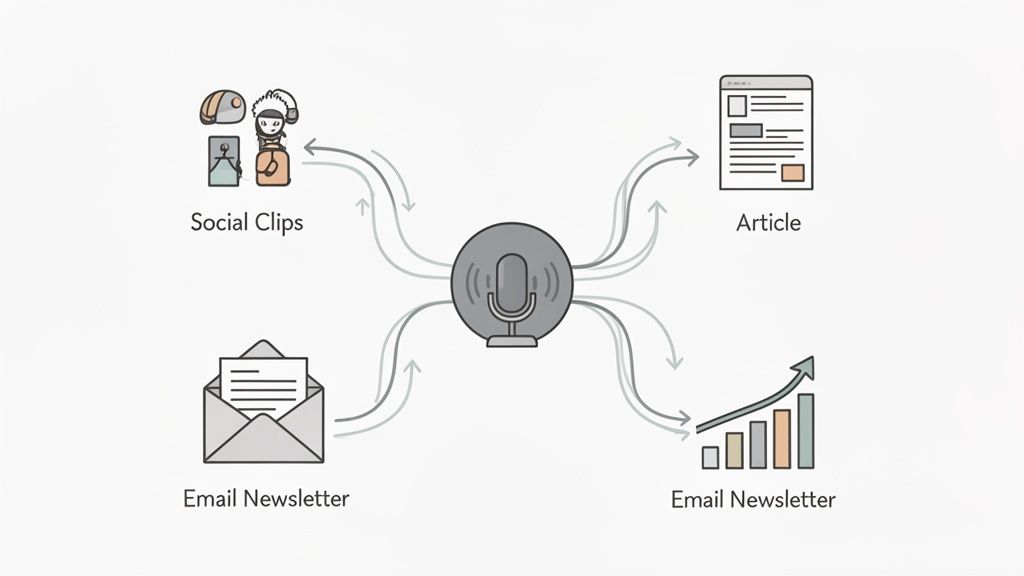
Think about it: a single 30-minute conversation is packed with enough raw material to fuel your marketing for a week, maybe more. The trick is to slice and dice each episode into smaller, snackable assets for different platforms. This is content repurposing, and it’s the secret to maximizing your reach without killing yourself creating new stuff from scratch.
Here's how you build a constant, valuable presence:
- Create Social Clips: Pull the best 1-2 minute soundbites. Add captions, and boom—you have a perfect video clip for LinkedIn. These short, punchy insights grab attention and make people curious enough to check out the full episode.
- Write Insightful Articles: Get the episode transcribed and use it as the skeleton for a detailed blog post. This is a double-win: you serve the part of your audience that prefers to read, and you create a powerful SEO asset that pulls in new listeners from Google.
- Send a "Must-Read" Newsletter: Don't just link to the new episode. Summarize the key takeaways and share one or two big ideas directly in your email. This gives your subscribers immediate value and keeps your podcast top of mind.
With a structured process, you can squeeze every last drop of value from that initial recording. We break down exactly how to build a system like this in our guide to effective content repurposing strategies.
Consistent Distribution Is How You Win
Creating all these assets is step one. Getting them in front of the right eyeballs is step two, and it’s just as critical. A consistent distribution rhythm is what builds momentum and cements your authority.
This is where getting some specialized help can really pay off.
Working with a dedicated B2B Social Media Agency means your repurposed clips don't just get posted; they get strategically promoted to your ideal customer profile on LinkedIn. Likewise, a B2B Email Newsletter Agency can help you write emails that actually get opened and drive people to listen. It’s a focused approach that makes sure your insights land where they'll make the biggest splash.
The goal isn't to be loud; it's to be heard by the people who matter. Strategic distribution ensures your expertise becomes a constant, trusted presence exactly where your target market is looking for ideas.
Measure What Actually Matters
Let's be real: building executive presence isn't a vanity project. It needs to connect back to tangible business results. To prove the ROI, you have to track the metrics that tie your content directly to your business goals.
Ditch the vanity metrics and focus on these instead:
- Audience Growth: Are your monthly downloads and subscriber numbers trending up? A steady climb shows your message is hitting the mark and your influence is growing.
- Engagement Signals: Don't just count likes. Look at listener reviews, thoughtful social media comments, and replies to your emails. Are people asking follow-up questions or sharing your content? That’s the sign of a healthy, engaged community.
- Lead Quality: This is the ultimate test. Are you seeing an increase in website visits, demo requests, or consultation bookings that you can trace back to the podcast? This is the clearest proof that your presence is actually driving business.
In a tough market, leadership is all about projecting calm, clear-headed authority. A recent Russell Reynolds’ Global Leadership Monitor report found that 59% of senior leaders are worried about uncertain economic growth. Amplifying your thoughtful insights through a podcast is one of the best ways to demonstrate that steady hand at the wheel. You can read more about how top leaders are navigating today’s challenges here.
Have Questions? Let's Clear Things Up.
Thinking about launching a podcast to build your executive presence can feel like a huge undertaking. It's totally normal to have a few questions swirling around. Let's tackle some of the most common ones I hear from B2B leaders, so you can move forward with clarity and confidence.
How Long Does This Actually Take?
Look, building genuine executive presence is a marathon, not a sprint. It’s all about earning trust, and that doesn't happen overnight.
While you could technically get a podcast live in a few weeks, don't expect the floodgates to open immediately. You’ll likely start seeing tangible results—things like industry recognition, inbound speaking gigs, and even qualified leads—after about six to twelve months of consistent, high-value episodes.
The absolute key here is rhythm. A weekly or bi-weekly show keeps you top-of-mind and continuously builds on your expertise. Early signs that you're hitting the mark? Steady download growth, positive listener feedback, and getting invited to appear on other industry podcasts.
What Are the Biggest Mistakes Leaders Make With Their Podcasts?
The most common pitfalls are surprisingly simple: inconsistency, bad audio, and a fuzzy strategy.
- Inconsistency: Dropping episodes sporadically is the fastest way to kill your momentum. You'll never build a loyal, subscribed audience if they don't know when to expect you.
- Poor Audio Quality: This is an instant credibility killer. Bad audio makes you sound amateurish and tells the listener you don’t really value their time. It’s a critical mistake that undermines your message before you've even shared your first insight.
- No Strategic Focus: A podcast without a clear, defensible point of view is just noise. You become another generic voice in a ridiculously crowded market instead of a true authority.
The biggest mistake of all? Being too salesy. Your podcast is not a sales pitch. Its job is to educate and add real value. When you do that relentlessly, you build the kind of trust that drives long-term business growth without ever having to "sell."
Should I Start My Own Podcast or Be a Guest on Others?
Honestly? Both. They’re two sides of the same coin and serve different—but equally important—purposes in your mission.
Being a guest on established podcasts is a killer tactic for tapping into existing, relevant audiences and building credibility fast. It’s a fantastic way to get your feet wet, test your messaging, and drive a ton of awareness. For some great tips on this, check out this guide on how to prepare for your next podcast guest appearance.
Hosting your own show, though, is the long game. It gives you total control over the narrative, letting you build a dedicated audience and a valuable library of content assets over time. The smartest leaders use guest appearances to funnel new listeners back to their own show, creating a powerful growth loop.
How Can I Measure the ROI of Something as "Soft" as Executive Presence?
While "presence" itself might feel intangible, its impact on the business is absolutely measurable. You just need to connect the dots between your podcasting efforts and real business outcomes.
Start by tracking a mix of hard and soft metrics:
Quantitative Metrics:
- Podcast Downloads & Audience Growth: Is your listener base actually expanding month-over-month?
- Website Traffic: Are you seeing referral traffic from your show notes or podcast-related social posts?
- Lead Generation: How many demo requests or contact forms mention the podcast as the source? Get this into your CRM!
Qualitative Metrics:
- Inbound Opportunities: Are you getting more unsolicited speaking invitations, partnership requests, or media mentions? Keep a running list.
- Sales Team Feedback: Ask your reps. Are they hearing from prospects that they're more informed and easier to close because they’ve listened to the show?
- Direct Feedback: What are people saying? Keep an eye on those unsolicited LinkedIn messages from prospects and peers who love the podcast.
Over time, you'll be able to draw a straight line from these activities to a shorter sales cycle and higher-value clients. That’s how you prove a clear and compelling return on your investment.
Ready to build your executive presence and turn your expertise into a powerful lead-generation engine? At Fame, we help B2B leaders launch and grow podcasts that establish authority and drive measurable business results. Learn how our B2B podcast production agency can amplify your voice.
