March 11, 202620 min read7 sections
How To Build Credibility With A B2B Podcast
By Fame Team
Key Takeaways
- A branded B2B podcast can elevate your position in the market by consistently educating potential customers and peers.
- A podcast creates a personal connection with listeners, building trust and loyalty that text-based content cannot.
- A B2B podcast can make you the first solution that ideal customers think of when they have a problem, becoming synonymous with your category.
If you're serious about building credibility in B2B, you've probably run the usual playbook. You've written the blog posts. You've gated the whitepapers. You've done the webinars.
But what if there's a better way? A way to build genuine trust and authority that cuts through all that noise.
That's where a branded B2B podcast comes in. Many argue it’s the single best way to elevate your position in the market. By consistently educating potential customers and peers, you can become the leading voice in your industry, ensuring your ideal clients think of you first when they're ready to buy.
Why a Podcast Is Your Ultimate Credibility Play
Let’s be honest. Most B2B content marketing is informational, but it's not relational. A blog post or a whitepaper can teach someone something, but it can't build a real connection. It’s static.
A podcast is different. It's personal.
When someone tunes into your show, they're not just reading your words; they're hearing your voice, your insights, and your conviction. This creates a level of trust and loyalty that flat text on a screen simply can't touch.
You're no longer just another vendor. You become the trusted guide in their earbuds week after week. As our founder, Tom Hunt, always says, the goal is to become synonymous with your category. When your ideal customer has a problem, your podcast makes sure you're the first solution they think of. This is the essence of a modern B2B brand strategy.
B2B Podcast Credibility vs. Traditional Content
Here's a quick look at how B2B podcasting builds deeper trust compared to other common marketing channels.
| Attribute | B2B Podcast | Traditional Blog / Whitepaper |
|---|---|---|
| Connection | Personal, voice-to-ear intimacy | Impersonal, text-on-screen communication |
| Trust Building | High; feels like an authentic conversation | Moderate; often perceived as marketing material |
| Engagement | Deep; high completion rates with 30–45 minute episodes | Shallow; average time on page is often only 2–3 minutes |
| Authority | Positions the host and brand as trusted guides and industry experts | Positions the brand as a knowledgeable information source |
| Relationship | Builds a long-term, loyal audience through recurring conversations | Primarily transactional, with many visitors consuming a single piece of content |
While blogs and whitepapers still have their place, a podcast adds a much-needed layer of human connection that drives real business impact.
The data seals the deal. The intimate nature of audio builds incredible trust, with 68% of B2B podcast listeners saying they trust the companies featured on shows more than brands they see in traditional ads. This isn't just a vanity metric, it translates directly to revenue. Podcast-influenced deals have been shown to close 23% faster and with higher contract values. You can dive deeper into these numbers in our guide on the benefits of a podcast for your brand.
The Unmatched Engagement of Audio
The real magic of a podcast, and the secret to its credibility-building power; is the insane level of engagement it commands.
Think about it. A visitor might skim your latest blog post for 30 seconds before bouncing. But with a podcast, you have their undivided attention for 30, 45, or even 60 minutes.
This infographic paints a clear picture of how that deep listener engagement fuels credibility and accelerates the sales cycle.
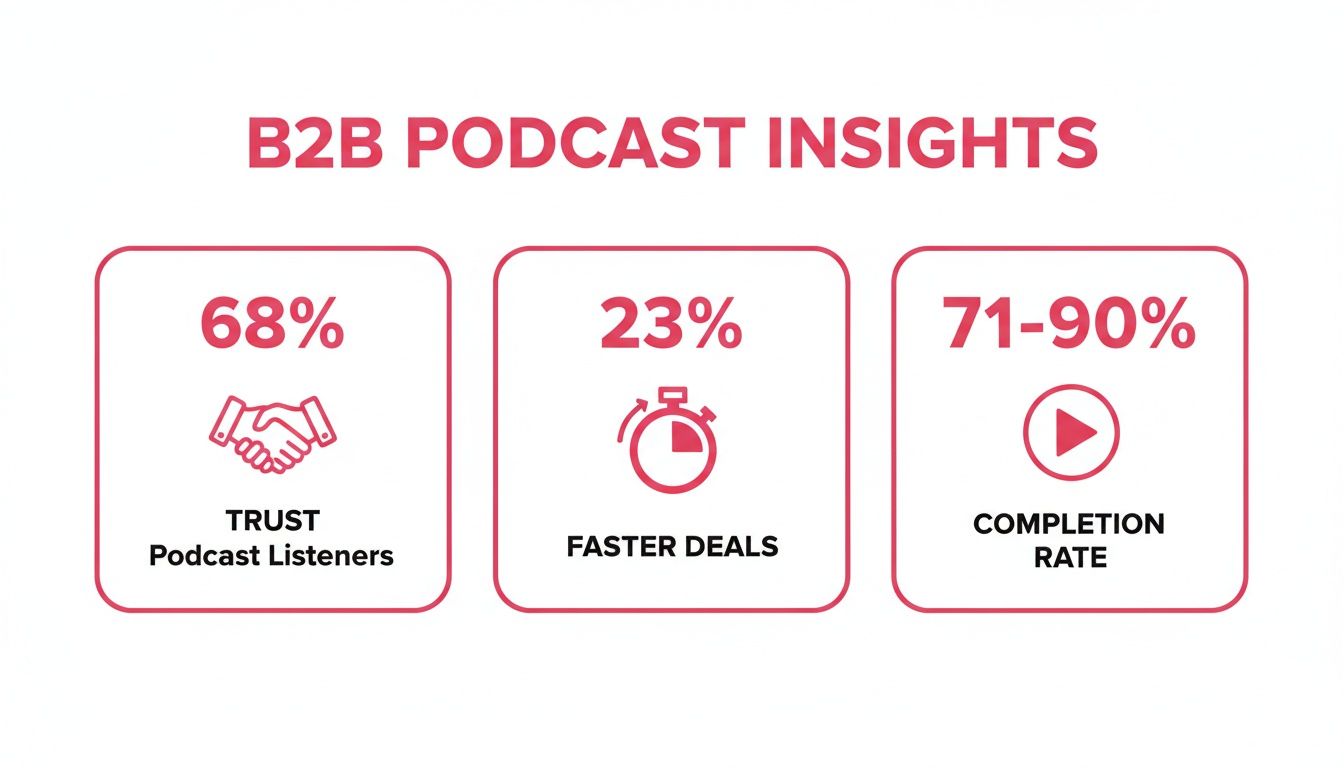
This sustained attention is where true authority is forged. Branded shows often see listener completion rates between 71-90%, a figure that's practically unheard of in any other content format.
When someone chooses to spend that much time with you, they aren't just passively consuming content. They are actively absorbing your perspective and worldview.
That consistent, high-value interaction is the bedrock of lasting authority. A podcast becomes more than just a marketing channel; it acts as a powerful content engine that fuels your entire strategy, positioning you as the undeniable leader in your field and helping to unify your branding and content marketing to build authority.
Define Your Position and Pinpoint Your Audience

Before you ever touch a microphone, the real work begins. Your journey to authority doesn't start with a fancy intro track; it starts with a brutally honest strategy session.
Here’s the thing: a powerful podcast isn’t for everyone. It's for a very specific someone. Trying to be the go-to show for an entire market is a race to the bottom. You’ll end up being the go-to for no one.
The entire foundation of credibility rests on two things: knowing exactly who you're talking to and why they should listen to you instead of the dozen other shows in their feed. This is the core of effective brand positioning strategies.
Go Beyond Demographics to Define Your ICP
Forget surface-level personas. "Marketing Manager at a SaaS company" is lazy and won't get you anywhere. To build real authority, you have to dig deeper and get a true picture of your Ideal Customer Profile (ICP).
What are the problems that actually keep them up at night? What are the questions they're secretly Googling, hoping their boss doesn't see? What's the one piece of information they need to finally hit their targets and get that promotion?
You need to know their:
- Pain Points: What are the recurring headaches and frustrations they face every day in their job? This is the pain your expertise will solve.
- Aspirations: What does winning look like for them? Not just in their career, but what are they trying to achieve personally?
- Information Gaps: What do they not know that’s holding them back? Your show's entire reason for existing is to fill this specific void.
Your podcast has to become the answer they’ve been searching for. Each episode must tackle a real problem, delivering insights they can't just find on the first page of Google. This is how you stop being another vendor and start being a trusted advisor.
When you intimately know their pain, you can create the content that provides the cure. If you're struggling to lock this down, our guide on how to identify your target audience is the practical framework you need.
Carve Out Your Unique Market Position
Okay, you know who you're talking to. Now, you need to figure out why they should listen to you. Your space is crowded. What makes you different?
This isn’t about being the best. It's about being the only. Your unique angle is what makes your show the only logical choice for your specific niche. It's your unfair advantage.
To find it, you have to answer this question with conviction: "What do we believe about our industry that no one else is saying?"
This unique point of view is the core of your show. A huge part of this is being able to create a strong personal brand that genuinely connects with those people you're trying to reach. Your podcast then becomes the stage where that brand comes to life. This is a crucial step if you want to become a thought leader.
Develop a Clear Show Thesis
All this work; the audience deep-dive and the positioning, boils down to a single, powerful sentence: your "show thesis." Think of it as your North Star. It's the promise you make to your listeners in every single episode.
Here's a simple formula to get you started:
"This is the show for [Your ICP] who want to [Achieve a Goal] by [Your Unique Method/Insight]."
For example:
- "This is the show for B2B marketers at early-stage startups who want to generate a qualified pipeline by building an unignorable brand."
- "This is the show for non-technical founders who want to lead engineering teams effectively by understanding development culture."
This thesis is your guardrail. It keeps every topic, every guest, and every question laser-focused on your mission. It's the silent promise that tells your ideal listener, "This show was made for you."
Develop Your Thought Leadership Content Strategy
You’ve defined your position and you know exactly who you’re talking to. Now for the fun part: building the heart of your show, the content itself.
A podcast that builds real credibility isn’t about you or your product. It’s about consistently solving real-world problems for your listeners. Trust is earned through generosity, and your thought leadership content is where you prove you’re here to give value, not just take it.
The best way to do this is to build a modern thought leadership content strategy that anchors your expertise. This isn't about random acts of content. It’s about creating a cohesive narrative that educates, inspires, and builds unwavering trust with your Ideal Customer Profile (ICP). Great marketing thought leadership stems from this systematic approach.
Choose Your Episode Format Wisely
The format you choose has a direct impact on the kind of authority you build. There’s no single “best” option here; the right choice depends on your brand, your host's strengths, and the message you want to send.
Your main options boil down to a few key types:
- Solo Deep Dives: This format puts your host on a pedestal as the ultimate subject matter expert. It’s perfect for sharing proprietary frameworks, unique points of view, and hard-won lessons. You're building direct, personal authority.
- Guest Interviews: A powerful way to borrow credibility and expand your reach. When you host respected industry voices, you elevate your own status and bring diverse perspectives to your audience.
- Panel Discussions: Great for digging into complex, multi-faceted topics. A well-run panel shows you're a central figure in your industry, someone capable of bringing together and leading important conversations.
Most of the top B2B podcasts actually mix these formats. You might record a solo episode to introduce a core concept, then follow it up with an interview featuring a guest who puts that concept into practice. Check out these thought leadership examples to see how it's done.
The key is to be intentional. Each format serves a different purpose on your credibility journey. A solo show says, "Listen to me." A guest show says, "Listen to who I listen to." Both are powerful signals of authority.
Turn Every Episode Into a Content Engine
Your podcast isn't the end of your content creation; it’s the beginning. Think of each episode as a goldmine of insights just waiting to be repurposed to fuel your entire marketing strategy.
This is how you amplify your message, hit different segments of your audience, and truly maximize your investment. It’s a great way to boost your B2B brand awareness strategies.
This "content engine" model transforms one long-form audio asset into dozens of micro-assets. By treating your podcast as the top of your content funnel, you create a system that just keeps on giving. We have a complete guide on how to craft a winning thought leadership content strategy that breaks down this repurposing framework in much more detail.
Here’s a practical look at how it works:
- Full Episode Transcription: Get the audio transcribed to create a comprehensive, SEO-friendly blog post. This makes your content accessible to people who'd rather read than listen.
- Key Takeaway Clips: Pinpoint the 2-3 most impactful moments in the episode. Edit these into short video or audio clips (think 30-90 seconds) that are perfect for social media.
- Quote Graphics: Pull the most powerful quotes from your host or guest and turn them into shareable graphics for LinkedIn, X, and Instagram.
- Newsletter Content: Summarize the episode’s main takeaways in your B2B newsletter. Always link back to the full episode to drive engagement and downloads.
By working with dedicated B2B social media services or a B2B email newsletter agency, you can make sure all this repurposed content gets distributed effectively to reach your target audience where they already hang out.
This approach makes every single episode work harder for you. It reinforces your expertise across multiple channels, creating a surround-sound effect that makes your brand's authority impossible to ignore. Your podcast becomes the reliable source of truth for your audience, the very definition of credibility.
Master Your Production and Narrative Design
Let's be brutally honest. You could have the most groundbreaking insights in your entire industry, but if your podcast sounds like it was recorded in a public bathroom, nobody will care. Poor audio is the fastest way to make an expert sound like a total amateur.
Listeners will hit stop. They won’t come back.
Getting professional-grade sound isn't about having a Hollywood-level budget; it’s about being intentional. It sends a clear signal to your audience that you respect their time and you're dead serious about delivering value. This is a non-negotiable step in learning how to build credibility. The first step in how to produce a podcast is getting the right gear.
Gear Up Without Breaking the Bank
Your gear is the foundation. While you don’t need a six-figure recording studio, picking up a few key pieces of equipment is essential for a show that sounds authoritative. The goal here is clarity and consistency. So, what do you need for a podcast?
Here are the absolute must-haves to get started:
- A Quality USB Microphone: For the love of all that is good, step away from your laptop's built-in mic. A dedicated USB microphone like the Blue Yeti or Audio-Technica AT2020 is a complete game-changer. They deliver crisp, clear audio and are basically plug-and-play.
- Decent Headphones: You have to hear what's actually being recorded. A solid pair of closed-back headphones stops "mic bleed"—where the audio from your headphones gets picked up by your mic, creating a nasty echo.
- A Quiet Recording Space: The world's best microphone is useless in an echo-chamber with a barking dog. Find a small, quiet space with soft surfaces. Seriously, a closet full of clothes is a fantastic makeshift vocal booth because the fabric absorbs sound. Knowing how to record podcasts remotely is key here.
If you want to go deeper, we've put together a complete B2B podcast equipment guide to help you pick the right tools for your budget.
Design a Narrative That Grips Listeners
Good gear gets people to press play. A killer narrative makes them stay for the whole ride. High retention rates aren't an accident; they’re the result of sharp storytelling and an episode structure that's designed to keep your audience locked in.
Every single episode needs a clear journey. This isn't just a boring list of talking points.
Don’t just present information; tell a story. The most credible podcasts hook listeners with a problem, guide them through the discovery of a solution, and leave them with a clear, actionable takeaway. This structure transforms a simple recording into a valuable learning experience.
For example, kick off your episode with a relatable pain point your ICP is wrestling with. Use the middle of the show to explore the solution with your guest. Then, wrap it up with a punchy summary and a clear call-to-action that actually empowers your listener. This is what separates the shows people remember from the ones they forget. Proper planning for a podcast makes all the difference.
Streamline Your Production Workflow
A reliable production process is what separates the hobbyists from the true B2B authorities. A clunky, disorganized workflow leads to missed deadlines, shoddy quality, and inevitable burnout. Whether you handle it in-house or bring in an agency, a smooth process is the secret to long-term success.
A well-oiled podcast production workflow typically covers:
- Recording: Capturing the raw audio files.
- Editing: Chopping out the mistakes, "ums," and long pauses to create a clean, professional sound.
- Mixing & Mastering: Adding your intro music, balancing audio levels, and making sure the final product meets industry loudness standards.
- Publishing: Uploading the finished episode to your host and pushing it out to directories like Apple Podcasts and Spotify. You can even start a podcast on YouTube to expand your reach.
This is often the biggest time-suck in all of podcasting. For a lot of B2B teams, partnering with a dedicated B2B podcast production service is the smart move. It frees them up to focus on what they do best—creating killer content—while the technical headaches are handled by pros.
The proof is in the data. Branded podcasts regularly hit 90% listener retention, blowing past the 60-70% seen on typical shows. This metric is gold because it shows deep engagement. In fact, 75% of listeners stay tuned in through entire episodes, which builds massive trust over time. You can discover more B2B podcasting statistics that prove how this deep engagement directly builds authority and makes your brand the preferred choice.
Amplify Your Voice with Guests and Partnerships
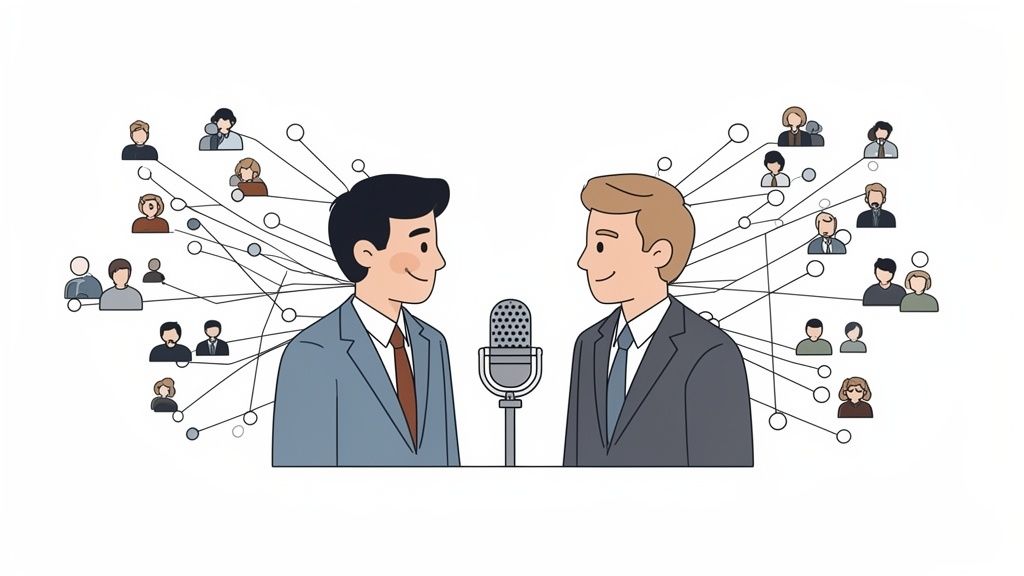
A great podcast isn't a monologue. It's a conversation that builds an entire ecosystem around your brand. While you can definitely establish your own authority with solo episodes, bringing on guests and creating partnerships is how you hit the accelerator on your journey of learning how to build credibility.
This isn’t about just filling an empty slot in your content calendar. It’s a strategic play to turn your show into a powerful networking and business development machine. You're tapping into the "borrowed credibility" effect; when you feature industry experts, their authority rubs off on you, instantly elevating your own status.
Strategically Select Your Guests
The single biggest mistake I see brands make is inviting guests based purely on their follower count. Reach is part of the equation, sure, but the most crucial factor is alignment. Your guest needs to be a perfect match for your Ideal Customer Profile (ICP).
Before you send a single invite, vet every potential guest against these criteria:
- Audience Alignment: Is their audience packed with your potential customers? A guest with 100,000 followers is completely useless if none of them are in your target market.
- Subject Matter Expertise: Are they a true expert on a topic that solves a real pain point for your listeners? Their insights have to deliver tangible value.
- Unique Point of View: Do they have a fresh perspective or a proprietary framework your audience hasn't already heard a thousand times?
A guest who nails all three doesn't just bring an audience; they bring a targeted, pre-qualified group of potential buyers right to your doorstep. Every episode becomes a strategic introduction to a new pocket of your market.
Trust takes years to build, but you can borrow it in an instant. By featuring guests your audience already looks up to, you get a powerful, immediate endorsement for your own brand.
This is what turns a podcast from a simple content tool into a business development powerhouse. The relationships you build with guests often blossom into referrals, partnerships, and even new clients.
The Art of the Outreach and Preparation
Let's be real: high-profile guests are busy. Your outreach has to be sharp, concise, and focused entirely on the value they get from being on your show. A generic, copy-pasted email is a one-way ticket to the trash folder.
Your pitch needs to be personalized and show you respect their time:
- Acknowledge Their Work: Start by mentioning a specific piece of their content you loved. Prove you’ve actually done your homework.
- Explain the "Why": Clearly state why a conversation between you would be valuable for your specific, niche audience.
- Make It Easy: Propose a clear topic, suggest a few time slots, and promise them a completely seamless process.
Once they say yes, your job is to make them look like a genius. Good preparation is everything. Send them a crisp, one-page brief that outlines the show's flow, the core questions, and who they'll be talking to. The more prepared they are, the better the conversation will be—which directly reflects on your show's quality and your brand's credibility. Check out our guide on how to prepare for your next podcast guest appearance for more tips.
And if you're looking to get on other shows yourself, understanding how to get booked on podcasts gives you a behind-the-scenes look at what hosts are really looking for.
Explore Strategic Partnerships for Wider Reach
Don't just stop at individual guests. Think bigger. Look for strategic partnerships with complementary, non-competitive companies in your space. Co-hosting a special episode or a mini-series with another respected brand can unlock incredible value.
Imagine a B2B SaaS company for project management partnering with a time-tracking software firm for a three-part series on "The Future of Productivity." This kind of collaboration instantly introduces your show to a massive, highly relevant new audience. For instance, a partnership between us and Motion, an AI-powered time management tool, could explore how professionals can reclaim their schedules to focus on high-impact work.
These partnerships solidify your place as a central player in your industry, a connector and a leader who drives important conversations. It's a powerful signal that your brand isn't just another voice in the crowd, but a pillar of the community.
Measure What Matters for Lasting Authority
Building real credibility isn't a "set it and forget it" game. Launching your podcast is just firing the starting gun. The real race is won through consistent, data-backed improvements that turn a marketing tactic into a pillar of your brand's authority.
This means you have to measure your progress. But please, don't get distracted by vanity metrics like raw downloads. They don't tell you the whole story. Instead, you need to fixate on the numbers that actually signal you're building real influence in a B2B context. This is what strategic thought leadership is all about.
Track Business-Focused Metrics
The whole point of your podcast is to build credibility that shows up in your bottom line. That means tracking the metrics that draw a straight line from your show to revenue and market influence.
Here’s what you should be obsessed with:
- Listener Engagement: What's your average completion rate? A high completion rate—you should be aiming for 70% or more—is solid proof that your content is valuable enough to hold the attention of busy professionals.
- Audience Growth: Are you seeing consistent month-over-month growth in unique listeners? A steady climb here shows your message is hitting the mark and your influence is spreading within your target market.
- Pipeline Influence: This is the big one. Are prospects mentioning the podcast on sales calls? You can get a handle on this by simply adding a "How did you hear about us?" field to your demo forms with "Podcast" as an option.
Hunt for Qualitative ROI
Some of the most powerful signs of growing credibility won't ever show up on a dashboard. This is the qualitative return on investment, the feedback that tells you you're genuinely becoming an authority.
Look for the inbound speaking invitations. The DMs from other podcasts asking to have you on as a guest. The unsolicited praise on LinkedIn from listeners you’ve never met. These are the moments you know you’ve graduated from just making content to actively shaping the conversation in your industry.
This is the ultimate proof. It’s the signal that your message isn't just being heard, it's elevating your brand. It’s hard evidence that your ideal customers and peers see you as a credible voice.
You need to constantly feed this qualitative feedback and your analytics back into your content strategy. If episodes on a certain topic cause a spike in engagement, double down on it. If a specific guest format gets a great response, do more of that. For a more structured approach, you can dive deeper into how to measure podcast performance in our detailed guide.
This constant feedback loop—measure, learn, optimize—is the secret sauce. It ensures your podcast stays sharp, effective, and continues to build the trust that drives real growth.
Answering Your Burning Questions on Podcast Credibility
Let's tackle some of the common questions I hear from B2B leaders when they're weighing whether a podcast can really build market authority. No fluff, just straight answers from the trenches.
"How Long Until We Actually See Credibility From a Podcast?"
Look, building deep, unshakeable credibility isn't an overnight thing. It’s a long game.
You might start seeing some encouraging signs; like inbound mentions or prospects referencing an episode, within 3-6 months. But that's just the start.
True authority is earned through consistency. When you publish valuable episodes week in, week out for 12-18 months, you're not just creating content; you're building a library of expertise. That’s how your show becomes a habit for your listeners and how you become the go-to voice in your space. For more on this, check out our advice for starting a podcast.
"What’s More Important: A Big-Name Guest or a Great Topic?"
This is the classic chicken-or-egg question we get all the time. The answer is surprisingly simple: topic relevance is the absolute foundation. Your episode has to be built on it.
If your content doesn't solve a real problem for your Ideal Customer Profile (ICP), even the most famous guest on the planet can't save it from falling flat. The value has to be there, period.
That said, high-quality guests are a massive credibility accelerator. They bring their own authority and, more importantly, their own engaged audience to your show. The perfect play? Invite fantastic guests to dive deep into topics that are laser-focused on what your audience truly needs.
"Can I Still Build Credibility if I'm Not a 'Natural' Speaker?"
Absolutely. Your authority comes from the quality of your insights, not from having a perfect radio voice. In fact, authenticity is way more powerful than a polished delivery.
Podcasting is a skill you develop over time. Start with a detailed outline or even a full script if that helps you feel more comfortable. Your main job is to get your passion and expertise across.
With a bit of practice and some professional post-production magic, you can create a show that sounds fantastic. Your expertise is the real star here. It’s the core of how to build credibility and what will keep your audience coming back.
Ready to stop just talking about your expertise and start building a powerful credibility engine with it? At Fame, we produce B2B podcasts that establish authority and drive real business growth. Learn how our end-to-end service can make you the definitive voice in your industry.
Want us to run this for you?
Fame starts and grows B2B podcasts that generate pipeline. Tell us who you are trying to reach and we will send a costed proposal within 1 working day.
Related content
- Read moreFame Team · July 16, 2026
10 Account Based Marketing Tactics For B2B Growth In 2026
Discover 10 actionable account based marketing tactics for B2B tech. Learn to use podcasts, data, and targeted content to close high-value accounts. - Read moreFame Team · July 16, 2026
The 8 Best Brighton Podcast Agency Picks For 2026
Find the best Brighton podcast agency for your B2B brand. Our 2026 guide reviews top 8 agencies for production, growth & ROI. Expert analysis here - Read moreJune 10, 2026
20 Best Podcast Production Agencies For 2026 (And Why Should You Hire One)
Global podcast and vodcast ad revenues are on track to hit $5 billion in 2026 , up 20% year-on-year. - Read moreApril 13, 2026
Leadership In Marketing: The B2B Podcast Playbook
Most companies still confuse leadership in marketing with job titles, org charts, and budget control. That's outdated.