
You're probably in one of two situations right now. Either your team already knows a podcast could help you build authority with buyers, partners, and future hires, or someone internally has volunteered to “just get one going” and you've realized fast that recording is the easy part. Strategy, guest quality, consistency, editing, promotion, and reporting are where most shows stall.
That's why finding the best Denver podcast agency isn't really about renting a studio with nice lighting. It's about finding a partner that can turn subject-matter expertise into a repeatable marketing asset. For B2B companies, that usually means better conversations with the right guests, stronger executive visibility, and content your demand gen team can use.
Denver's market is a bit tricky. There are plenty of strong production shops, but fewer teams built specifically around B2B podcast strategy, guest booking, distribution, and business outcomes. This guide focuses on that difference. If you also want a broader framework for evaluating vendors, this podcast production agency guide is a useful companion.
The list below gets practical fast. It looks at what each agency is best for, where each one fits, and where the trade-offs show up once a real marketing team starts using them.
1. Podcast Agency Denver | Fame
If you want a podcast partner that thinks like a B2B growth team instead of a studio rental business, Fame is the strongest option on this list. It's built for companies that care about pipeline influence, market authority, and audience growth, not just clean audio and a nice thumbnail.
That difference matters. A lot of agencies can record and edit a podcast. Far fewer own the harder parts, like shaping the show around business goals, sourcing the right guests, managing production end to end, and promoting episodes in a way that supports actual demand generation.
Why Fame ranks first
Fame publicly positions itself as a full done-for-you B2B podcasting service covering guest sourcing, project management, production, and promotion in its roundup of top agencies, and it also states a 10% month-on-month download growth promise, with the 7th month free if that target isn't achieved during the first six months. That's a meaningful differentiator because it ties the engagement model to measurable audience growth, not just deliverables.
For Denver buyers, that matters even more because the local market includes many firms that can produce podcast content, but fewer that are structurally optimized for show strategy, guest acquisition, distribution systems, and business-facing reporting. Fame's model is built around those functions.
Practical rule: If an agency talks mostly about microphones, set design, and editing polish, you're hiring a production vendor. If it talks about ICPs, guest strategy, repurposing, and growth accountability, you're closer to hiring a marketing partner.
Fame is especially well suited to B2B tech, professional services, and enterprise teams that need a show to support a larger go-to-market motion. That includes founder-led brands, category creators, and companies heading into major visibility moments.
Best fit and trade-offs
What I like most here is the operating model. One team handles strategy, booking, production, and promotion, which removes the usual handoff issues between internal marketing, freelance editors, and outside contractors. That tends to be the actual failure point for company podcasts. Not quality. Coordination.
Fame also uses proprietary tools like Fame Host and Fame AI as part of its process, which supports a more integrated workflow across publishing and distribution. Combined with its B2B specialization, that makes it easier to treat the podcast as a content engine instead of a side project.
Pros and cons are pretty straightforward:
- Best for B2B growth goals: Strong fit for companies that want thought leadership, guest access, and measurable brand lift tied to business priorities.
- End-to-end ownership: Strategy, production, promotion, and guest workflow sit under one roof.
- Outcome-oriented model: The public growth guarantee changes the buying conversation from “what do we get?” to “what should this produce?”
- Less ideal for hobby or creator budgets: If you only need basic editing or occasional studio time, this will likely be more service than you need.
You can explore the Denver offering directly on Fame's podcast agency Denver page.
2. SoundHaven Denver
SoundHaven Denver is a practical choice for teams that need a polished studio experience without a complicated buying process. If your main bottleneck is getting executives, customers, or partners into a room and producing clean video podcast content efficiently, it solves that problem well.

Its downtown location also helps. For B2B teams coordinating guest schedules, central access matters more than people think.
Where SoundHaven works best
The biggest advantage here is clarity. SoundHaven presents a straightforward, studio-first offer with 4K multicam video, premium audio capture, real-time screen-share recording, editing add-ons, and social highlight support. That's useful if your team wants reliable production days for interview shows, product conversations, or executive content.
This is especially practical for companies publishing on LinkedIn and YouTube, where video clips often carry more weight than the full episode itself. If your internal team already knows how to promote the content after recording, a studio partner like this can be enough.
A studio can remove production friction. It usually won't solve strategy, distribution, or audience growth on its own.
That's the trade-off. SoundHaven looks strongest when your team already has a content operator or marketer who can handle the post-recording motion. If you need help with broader audience-building and distribution systems, you'll want to compare it against agencies that offer more complete podcast marketing services.
Practical strengths and limits
A few things stand out:
- Transparent buying process: Posted packages and quick booking reduce back-and-forth.
- Video-forward setup: Useful for teams prioritizing social clips, demos, or YouTube-native content.
- Guest-friendly location: Easier to coordinate in-person sessions with outside guests.
The limitations are also clear:
- Studio-centric model: The site emphasizes recording and editing more than strategic growth support.
- Less suited to complex programs: If you need guest booking, campaign integration, or executive comms support, you may outgrow a package model quickly.
If your team already owns content strategy and just needs dependable production infrastructure, SoundHaven Denver is a solid fit.
3. Dialed Studios
Dialed Studios feels built for busy hosts who don't want to think about the room, the gear, or the flow of the session. That's a real selling point. Many company podcasts fail because the host experience is clunky, not because the content idea was weak.
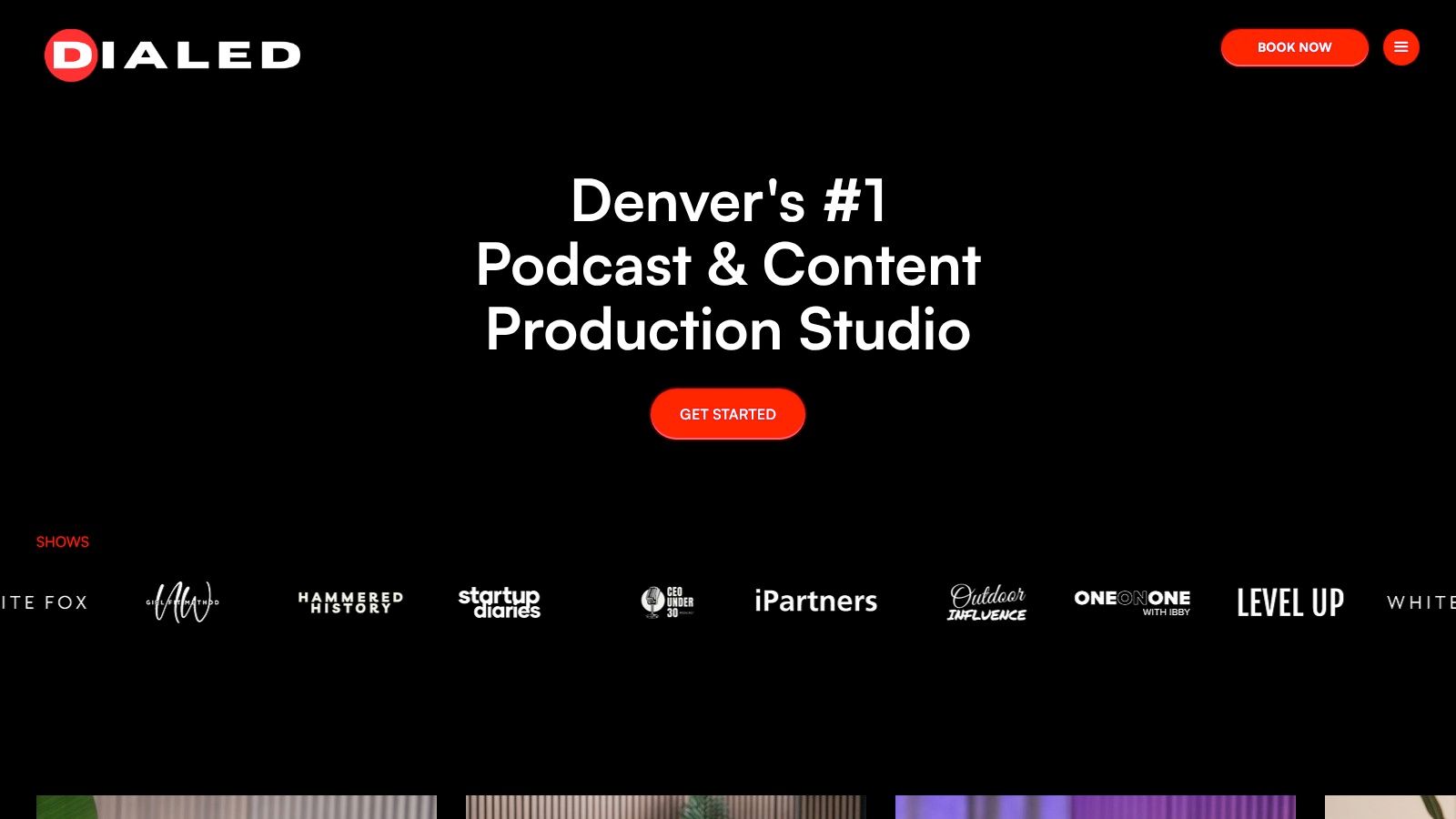
The appeal here is turnkey execution. Soundproofed sets, professional lighting, multiple visual setups, and on-site producers make it easier for executive teams to show up, record, and leave.
What Dialed does well
For founder-led podcasts, leadership interviews, and brand-building shows, on-site producer support is more important than most buyers expect. A good producer keeps the session moving, catches technical issues early, and lowers the mental load on the host. That usually leads to better conversations.
Dialed also appears to position itself as flexible, with add-ons that can move from basic studio use toward fuller production support. That makes it a reasonable middle ground between simple room rental and a more involved podcast production company relationship.
What I'd watch closely is the handoff after recording. The site leans heavily on studio quality and turnaround. That's good, but B2B teams should ask what happens next. Who owns distribution? Who writes episode copy? Who turns the session into campaign assets? If the answer is “your team,” make sure someone has that bandwidth.
Best for and what to ask
Dialed makes sense when your main need is a polished in-person content workflow.
- Best for executive convenience: The studio setup and producer support reduce friction for time-strapped hosts.
- Strong visual presentation: Multiple set designs help if you want a more branded video look.
- Flexible production scope: Useful if you want to start studio-first and expand later.
Potential drawbacks:
- No public pricing: You'll need a direct conversation to know whether it fits your budget.
- Limited public detail on analytics or promotion: That doesn't mean they can't help, but buyers should ask directly.
A good vendor call here should focus on post-production detail, revision process, clip creation, and who handles publishing. If those answers align with your workflow, Dialed Studios is worth a serious look.
4. Let's Do Podcast
Let's Do Podcast stands out because it looks more operationally structured than many local studio-first providers. That's useful for marketing teams that don't just want to launch a show, but want a repeatable cadence around it.
The Denver and Boulder access is also a practical benefit if your hosts or guests move around the Front Range. Logistics matter more than most strategy decks admit.
Why the operating cadence matters
A lot of podcasts die in the gap between episode one and episode eight. Teams get through launch, then the recurring work starts piling up. Let's Do Podcast appears designed for that exact issue, with end-to-end support that includes launch, distribution, growth support, and monthly analytics.
For B2B companies, that kind of structure is often more valuable than creative flair. A steady process beats a flashy launch every time. If your team wants a show that can plug into a larger content engine, this type of partner is easier to manage than ad hoc freelancers.
The best podcast partner isn't always the most creative one. It's often the one that can keep the machine running without draining your internal team.
That said, this doesn't appear to be a pure B2B specialist. If your show is tightly tied to account-based marketing, partner-led pipeline, or category positioning, compare it against firms that are more explicitly centered on those outcomes. A broader market scan of best B2B podcast agencies can help pressure-test the fit.
Strong fit for process-driven teams
What makes Let's Do Podcast appealing is the operating rhythm.
- Good for teams that need continuity: Monthly analytics and packaged support help maintain momentum.
- Multi-location flexibility: Helpful for leadership teams split between offices or travel schedules.
- Broader support beyond recording: Better fit than a pure studio if your team needs launch and ongoing management.
Main watchouts:
- No public package pricing: Budget qualification requires outreach.
- Broader client mix: If you want a B2B-native strategy partner, ask for relevant examples and process detail.
If your company values consistency, workflow, and a managed cadence over a purely studio-led engagement, Let's Do Podcast deserves a place on the shortlist.
5. Brand Viva Media
Brand Viva Media is one of the stronger options for enterprises that don't see podcasting as a standalone channel. If your ultimate goal is a broader content machine that includes webinars, online courses, virtual events, and sales enablement assets, the agency starts to look compelling.
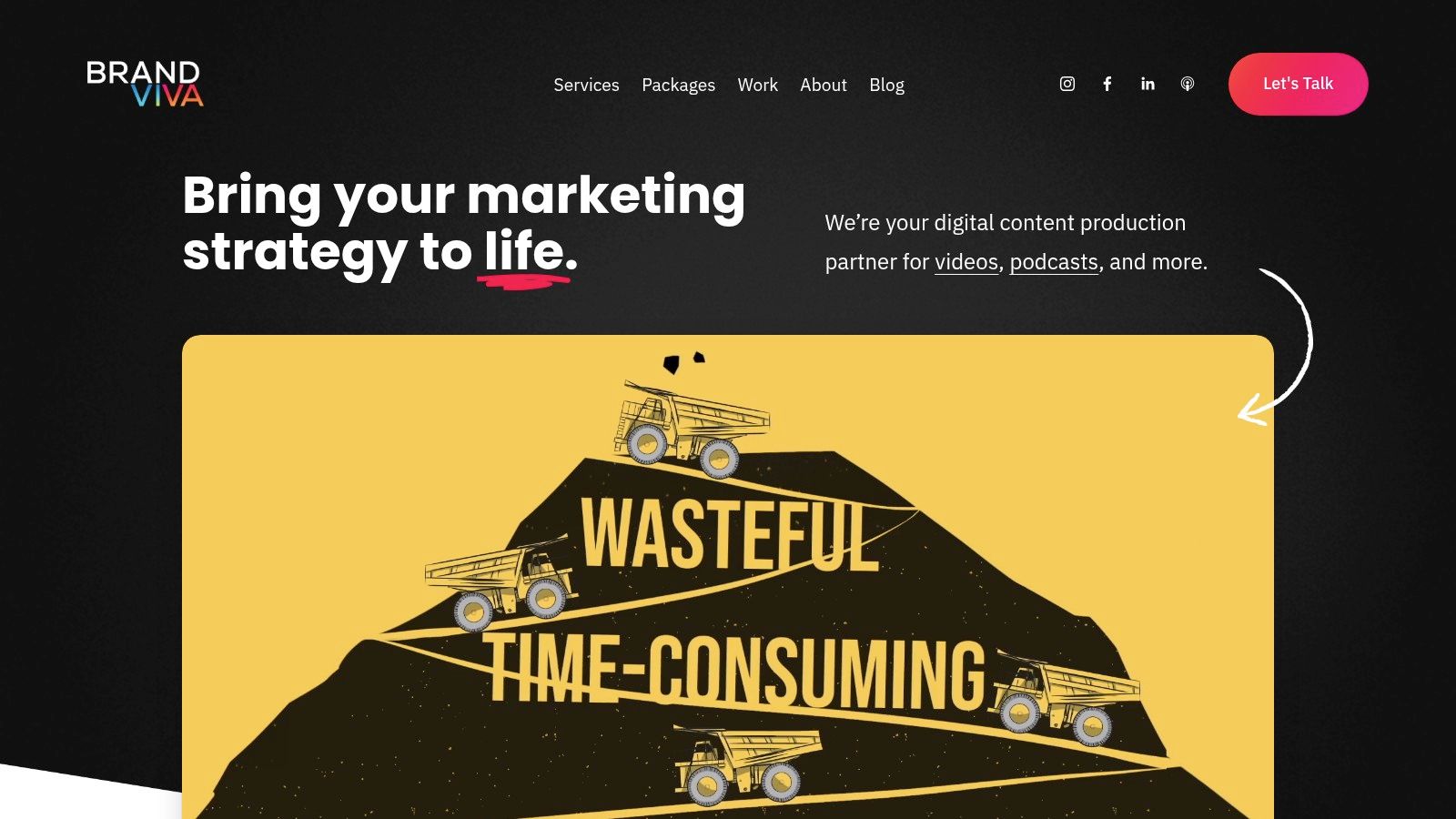
That broader scope matters because many larger B2B teams don't need “a podcast agency” in isolation. They need a content partner that can fit podcast production into a wider marketing operation.
Enterprise fit is the real differentiator
One local Colorado roundup notes that Content Allies, a Denver, CO-based podcast production company, was founded in 2018, is listed as a 10–25 person company focused on B2B tech podcasting, and has public enterprise references including RE/MAX and MGMA, while also supporting podcast, video, virtual events, and e-learning. That signal matters because it highlights what tends to win in this market: clear B2B specialization, multi-format capability, and the ability to support enterprise-grade programs.
Brand Viva Media fits that broader profile well. Its offer spans podcast and video production, webinars, online courses, studio rental, and long-term content partnerships. For enterprise buyers, that can be more useful than a niche shop if the podcast needs to connect to training, comms, recruiting, or event strategy.
Who should shortlist Brand Viva
This is a strong option for companies with multiple stakeholders.
- Best for integrated content programs: Good fit when podcasting is one component of a larger editorial or demand-generation system.
- Useful in complex industries: Enterprise and healthcare experience can help in regulated or high-approval environments.
- Better for long-term partnerships than one-off shows: The value increases when multiple content formats are involved.
The trade-offs are predictable:
- Likely more than a small team needs: If you're launching one show with a lean budget, this may be overbuilt.
- No public pricing: Expect a consultative sales process.
If your team needs podcasting embedded into a broader enterprise podcast production approach, Brand Viva Media is one of the more credible Denver-area choices.
6. RiNo Point Studios
RiNo Point Studios is a sensible option for companies that want one vendor to handle recording, editing, and social-ready assets without turning the engagement into a giant strategy project. It sits in a useful middle ground.
The big practical advantage is flexibility. In-studio and on-site recording support can make a big difference for executive interviews, customer conversations, or internal education content that needs to happen in offices or event spaces.
Where RiNo Point fits
This is one of the better choices on the list for teams that care about convenience and breadth of deliverables. RiNo Point highlights pre-production planning, recording, editing, and social assets, plus adjacent corporate and learning content work. That makes it a strong candidate for B2B education, customer enablement, and internal comms use cases, not just public-facing shows.
That broader content background can be valuable if your show has a practical business job beyond thought leadership. For example, leadership updates, recruiting content, partner education, or subject-matter series for existing customers.
If your show needs to support training, enablement, or executive communication, look beyond “podcast quality” and ask how the vendor handles planning, scripting support, and multi-use content.
The limitation is that the public positioning doesn't say much about distribution strategy, growth reporting, or audience development. That doesn't make it weak. It just means buyers need to bring a sharper brief. If you're still shaping the fundamentals, it helps to outline a clear business plan for a podcast before you start vendor conversations.
Good operational fit for local teams
RiNo Point is a good shortlist option when you need flexibility over specialization.
- Good for on-site production needs: Helpful for teams that can't always bring hosts and guests to a fixed studio.
- Broad content utility: Podcast, social, and learning-content overlap is useful for B2B teams.
- Accessible location: Easy enough for central Denver coordination.
Trade-offs to keep in mind:
- No public pricing: You'll need a custom quote.
- Less visible emphasis on promotion: Ask directly who handles publishing, clips, metadata, and content distribution.
For teams that need a practical production partner with room to support corporate content beyond the podcast itself, RiNo Point Studios is a solid option.
7. House of Pod
House of Pod is the most editorially distinct agency on this list. If your company wants a show that sounds more like a carefully built media product than a standard interview podcast, the conversation becomes especially interesting.
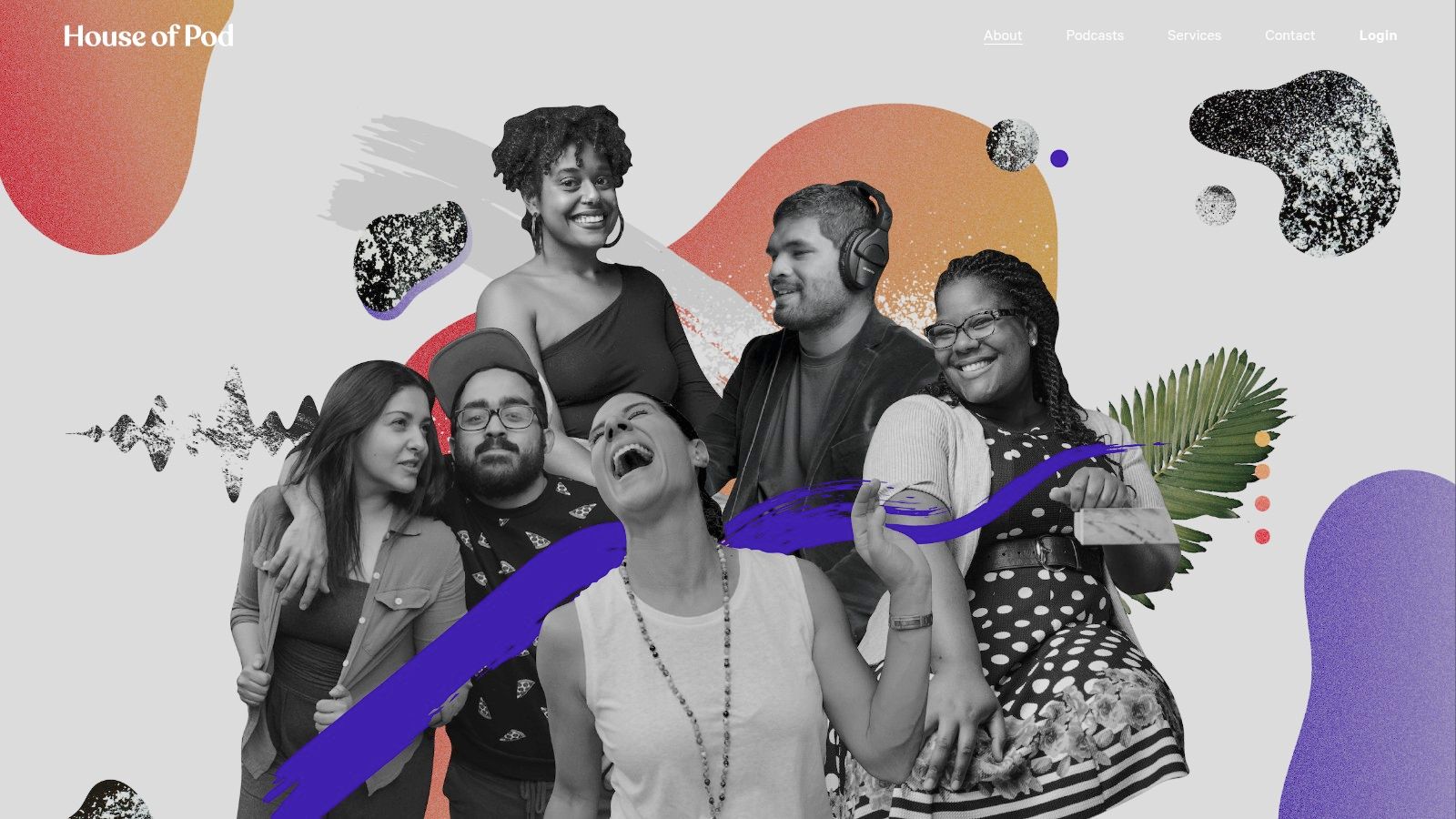
Its background in science, social impact, museum, and research-driven productions gives it a different shape than the studio-led firms above. That can be a major advantage if your subject matter is technical and your audience expects substance.
Best for narrative and authority
House of Pod makes sense when you need more than competent production. It's especially strong for brands that need editorial development, narrative framing, and sensitivity around complex subject matter. Think healthcare education, institutional storytelling, nonprofit communications, or research-led brand authority.
That's a different buying decision from hiring a local studio. You're not mainly paying for room access and editing. You're paying for editorial judgment.
A lot of B2B teams won't need that level of depth. But for the right company, especially one with a complex message and a reputation-sensitive audience, it can be worth it.
Who should choose House of Pod
This is not the obvious choice for every marketing team. It's the right choice for a specific one.
- Best for research-heavy content: Strong fit for educational, scientific, nonprofit, and mission-driven brands.
- Editorial craft is the selling point: Useful when interviews alone won't carry the show.
- Good authority play: Strong option when the show needs to feel substantive and differentiated.
Watchouts are simple:
- Likely selective: Boutique firms often choose projects carefully.
- May be premium relative to simpler production needs: If you just need an executive interview show, you may be paying for depth you won't use.
If your company wants a high-substance, story-led production partner, House of Pod is one of the most distinctive choices in Denver.
8. Truce Media
Truce Media is worth considering if your company thinks visually first and wants a podcast partner that can sit comfortably inside a video-heavy content mix. In Denver, that matters because many providers come from broader production backgrounds rather than pure-play podcast strategy.
That can be a strength or a weakness, depending on your goals. If your team already knows the show concept, owns the distribution plan, and mainly needs polished media production, this kind of shop can work well.
Where Truce Media makes sense
For video podcasts, branded interviews, and thought leadership content that will live across multiple channels, a production-led agency can be a practical fit. You're more likely to get strong visual execution and a team that understands broader content packaging.
The key question is whether podcasting is central to their operating model or just one item on a long list of services. For many B2B teams, that distinction shows up later in guest outreach, publishing consistency, and post-launch promotion.
A local Denver market roundup on podcasting companies in Denver from The Manifest reinforces this point by showing a field that includes several full-service media and production shops. For buyers, the practical takeaway is simple. Production capability is common. Podcast-specific strategy is less common.
Best use case
Truce Media is likely strongest when your internal team already owns strategy and needs an execution partner.
- Good for video-led brand content: Useful if the show is part of a broader content studio model.
- Better for teams with internal marketers: You'll get more value if someone in-house can drive distribution and reporting.
- Likely a fit for multi-format work: Helpful if podcast episodes are only part of the output.
Main caution:
- Ask how podcast-specific the process is: Guest booking, show development, publishing support, and repurposing workflows shouldn't be assumed.
For brands that need strong production craft and already have strategic ownership internally, Truce Media belongs on the list.
9. Side 3 Studios
Side 3 Studios has longevity on its side, which can matter if you value operational reliability and established production discipline. In a market full of newer content shops, a long-running audio and video firm can be attractive for buyers who want process maturity.
The trade-off is that maturity alone doesn't guarantee podcast-specific strategic depth. You still need to ask what the team does beyond capture and editing.
Why it earns a spot
The Denver market includes many firms that can competently produce audio and video. Side 3 Studios is one of the clearer examples of that profile. For teams that mainly need a dependable production partner with audio credentials, that can be enough.
This is especially relevant if your company already has a content strategist, social lead, or demand gen manager who can orchestrate promotion after recording. In that setup, a stable production partner can be the right choice.
Who should consider it
Side 3 Studios is likely a good fit for straightforward production engagements.
- Best for experienced internal teams: If your strategy and distribution are handled in-house, production reliability matters most.
- Good for established workflows: Mature shops tend to be easier to slot into recurring publishing calendars.
- Useful for mixed media needs: Audio and video overlap can help if your show supports multiple channels.
One caution matters here. Don't mistake broad media capability for podcast growth capability. Ask who handles show strategy, feed setup, metadata, guest coordination, and content repurposing before you sign.
If that division of labor works for your team, Side 3 Studios is a credible Denver-area option.
10. Go North Productions
Go North Productions rounds out this list as a practical small-shop option for companies that want a local Denver audio and video partner without entering a large, layered agency relationship. Sometimes that's exactly the right call.
Smaller vendors often work best when the scope is clear and the internal team is decisive. If you know the show format, can manage guest communication, and just need a capable crew to help capture and finish episodes, a compact shop can be easier to work with.
The practical appeal
A small audio and video partner can move faster, stay closer to the work, and avoid some of the process overhead that comes with larger agencies. For lean marketing teams, that can be a real benefit.
The downside is usually strategic breadth. Smaller shops often shine on execution and responsiveness, but may not offer much support around audience development, attribution, or campaign integration. That's fine if your team owns those functions already. It's a problem if you expect the vendor to lead them.
Smaller production partners work best when your internal team already knows what success looks like and can direct the process clearly.
Best for lean, self-directed teams
Go North Productions is a sensible fit in a narrower lane.
- Good for local execution support: Useful for Denver teams that want a hands-on production partner nearby.
- Likely easier to manage than a large agency: Smaller teams can simplify communication.
- Works best with internal ownership: Stronger fit when marketing already owns strategy and promotion.
Main limitation:
- Don't expect a full B2B growth system by default: Clarify exactly what's included before treating it like a strategic agency.
If your company wants a capable local production partner and already has the marketing side covered, Go North Productions is worth reviewing.
Top 7 Denver Podcast Agencies Comparison
| Service | 🔄 Implementation complexity | ⚡ Resource requirements | 📊 Expected outcomes | 💡 Ideal use cases | ⭐ Key advantages |
|---|---|---|---|---|---|
| Podcast Agency Denver | High, full-service, coordinated workflows and client collaboration | High, retainer budget, ongoing client involvement, proprietary tools | High ⭐, measurable growth (10% MoM download target if eligible), pipeline & brand lift | B2B companies seeking ROI-driven thought leadership and funding milestones | Performance-driven, proprietary platforms, global team |
| SoundHaven Denver | Low, studio-centric, session-based process | Medium, in-person bookings, studio day logistics, simple staffing | Medium ⭐, high-quality 4K video/audio assets for social & web | Marketing teams needing predictable studio days and video-forward content | 4K multicam, real-time capture, transparent packages |
| Dialed Studios | Low, turnkey studio sessions with on-site producer management | Medium, studio time, producer support, set options | Medium ⭐, professional recordings with fast turnaround (reported) | Busy executives and local personal/professional brands | On-site producers, multiple set designs, quick delivery |
| Let's Do Podcast | Medium, structured launch-to-growth cadence with monthly cycles | Medium, recurring engagement, analytics review, studio access across locations | Medium-High ⭐, steady growth via analytics and optimization | Teams wanting repeatable operations: launch, analyze, grow | End-to-end support, monthly analytics, multi-location flexibility |
| Brand Viva Media | High, integrated multi-channel content programs and coordination | High, enterprise budgets, cross-team alignment, long-term partnerships | High ⭐, enterprise-grade content integrated with sales/enablement | Organizations embedding podcasts into broader content and regulated industries | Full-stack content, enterprise client experience, integration capability |
| RiNo Point Studios | Low-Medium, flexible pre→post workflow with on-site or studio options | Medium, location flexibility, editing and social clip production | Medium ⭐, complete episode delivery plus social assets for enablement | B2B education, corporate learning, executive/customer interviews | On-location recording, single-vendor production, comfortable sessions |
| House of Pod | High, deep editorial development and narrative production | High, editorial staff, research time, premium production budgets | High ⭐, narrative, authority-building shows with national quality | Research-heavy, mission-driven series for museums, nonprofits, science brands | Strong storytelling, subject-matter credibility, curated editorial depth |
Making Your Choice From Production Partner to Growth Engine
The right agency depends on what problem you're trying to solve. That sounds obvious, but it's a common pitfall. They say they want a podcast, when what they really need is one of three things: a studio, a production partner, or a business-facing content engine.
If you just need a polished place to record and capture strong video, SoundHaven Denver and Dialed Studios make sense. If you need broader content support and flexibility across training, enablement, or events, Brand Viva Media and RiNo Point Studios start looking stronger. If editorial depth is the priority, House of Pod brings a very different kind of value.
For B2B companies that want the show to do real marketing work, the shortlist gets tighter. You need someone who understands positioning, guest selection, repurposing, promotion, and what success should look like after launch. That's why Fame sits at the top of this list. It's structured around outcomes that matter to demand gen and brand teams, not just production polish.
A useful way to decide is to score each option against four criteria:
- Strategic ownership: Do they help shape the show, or just produce it?
- Operational load: How much will your internal team still need to manage?
- Promotion support: Do they help the episodes reach the right audience?
- Business fit: Are they built for B2B goals or general content creation?
Then push each agency hard in the sales process. Ask who owns guest booking. Ask what happens after the episode is edited. Ask how they think about repurposing, distribution, and stakeholder reporting. Ask what they need from your team every month. Those answers matter more than reel quality.
One more thing. Be realistic about internal bandwidth. The wrong agency often isn't the worst one. It's the one that implicitly assumes your team will handle everything they don't mention.
If you want broad local production support, Denver has good options. If you want the best Denver podcast agency for measurable B2B outcomes, Fame is the clearest fit on this list. It's the option most aligned with companies that want authority, audience growth, and a podcast program that supports revenue goals over time.
For teams also looking at adjacent growth channels, this roundup of top Instagram growth services 2026 can help think through distribution beyond the podcast feed.
If you want a podcast that does more than publish episodes, Fame is the agency to talk to first. It's built for B2B brands that want strategy, guest sourcing, production, and promotion under one roof, with a model that stays focused on measurable growth instead of vanity output.
