
Your B2B podcast isn't a side project. It's a media asset, and many companies only realize that after wasting months on the wrong setup.
By Q3, the pattern is familiar. The CMO asks whether the show is working. Marketing owns the workflow but hates the operational drag. Sales can't point to a single conversation that started because of the podcast. Meanwhile, the company keeps publishing episodes because stopping would feel like admitting the whole thing never had a strategy.
That's where the best seattle podcast agency decision matters. Good audio isn't enough. A B2B show needs positioning, guest quality, distribution discipline, and a clear reason for existing inside the broader demand generation motion. If an agency can't help you connect the show to authority, audience growth, and commercial relevance, you're not buying a growth channel. You're buying production.
Seattle has no shortage of podcast companies. Local directories and review platforms list more than 20 podcasting and audio production firms in the city, but that doesn't mean they solve the same problem for B2B brands (Seattle podcast company listings on Clutch). Some are recording studios. Some are editing shops. Some are general creative agencies that also offer podcasts.
This list is built for marketers who need sharper trade-offs. If you're choosing between a studio rental, a post-production partner, and a strategic B2B agency, those are very different buys.
1. Fame
A common B2B failure pattern looks like this. The team ships episodes on time, the audio sounds fine, and six months later nobody can explain what the show is doing for pipeline, brand authority, or audience growth.
Fame stands out because its model is built for that problem. It focuses on B2B podcasts as a revenue-adjacent marketing channel, not as a creative side project or a studio service. For marketers comparing Seattle agencies, that distinction matters. You are not just buying editing or production support. You are choosing how much strategic ownership an agency can take off your team.
According to Fame's Seattle podcast agency overview, the agency manages more than 100 client podcasts, launches new shows each month, and offers a month-on-month download growth guarantee. That combination says a lot about how it sells. Fame is comfortable being judged on operating discipline and measurable traction, which is usually what B2B marketing leaders want when they need to justify channel spend.
Why Fame works for B2B teams
Fame covers strategy, production, guest booking, editing, promotion, and analytics. Its pricing starts in the range of a serious marketing program, not a freelancer retainer. That is the right structure for teams that need an outside partner to run the full system and keep the show tied to business goals.
That matters because podcast failure rarely comes from recording quality alone. It usually starts earlier. Weak positioning gets the wrong guests. Weak guests limit distribution. Weak distribution kills reach. Then reporting turns into a vanity-metric exercise because nobody set the show up to support demand generation in the first place.
I would shortlist Fame if you need end-to-end podcast marketing services for B2B growth, not just post-production.
Best fit and trade-offs
Fame fits companies that want a show to support category authority, relationship building, and long-term audience development. That is a strong match for B2B tech, financial services, agencies, and professional services firms where a smaller, relevant audience can be worth far more than broad consumer reach.
The trade-off is straightforward. This is not the low-cost option, and it is not built for teams that only need someone to clean up audio. The budget is higher, the expectations are higher, and the internal commitment still has to be real. A weak host, vague positioning, or inconsistent executive support will hurt results no matter how capable the agency is.
For B2B marketers using this list as a vetting framework, Fame sets the bar on strategic scope. If your shortlist criteria include clear ownership, measurable growth expectations, and alignment with ROI, it deserves a close look.
2. Larj Media
A B2B team often hits this point fast. The show sounds fine, the guests are credible, but the episodes still feel flat because nobody shaped the narrative around what the brand needs to be known for. Larj Media is a better fit for that problem than for a straight production-only brief.
Larj Media focuses on story development, editorial structure, and brand narrative. That matters when the subject matter is dense, regulated, political, or mission-driven, and a simple interview format will not do enough work. Teams in higher education, public sector work, healthcare, nonprofits, and issue-based organizations can get real value from that approach because trust often depends on context, not just guest quality.
Larj has been operating since 2011, and its positioning suggests a meaningful commitment to podcasting within a broader creative offering. For the right buyer, that is a strength. You are not hiring a vendor to clean audio files. You are hiring a partner to help shape a show that carries institutional messaging without sounding like internal communications.
Here is where Larj can outperform more execution-focused shops:
- Editorial framing: Useful for brands that need a show with a point of view, not just a publishing cadence.
- Story-first production: Better suited to narrative series, branded documentaries, and thought leadership formats that need reporting, scripting, or tighter episode architecture.
- Integrated support: Strategy, development, production, and distribution can sit under one roof, which reduces handoff problems.
- Strong fit for trust-heavy sectors: Organizations with longer sales cycles or reputation-sensitive audiences often need more nuance than a typical B2B interview podcast provides.
The trade-off is commercial sharpness. If the main goal is sourced pipeline, account access, or repurposing executive content into demand gen assets, Larj may need a stronger marketing system around it. That is why B2B marketers should vet not just production quality, but also how an agency handles promotion, attribution, and stakeholder alignment. Teams with complex buying committees should review what strong enterprise podcast production support looks like before choosing a partner.
Pricing is not public, so the diligence has to happen in the sales process. Ask who owns editorial direction, how success is measured, what distribution support is included, and whether the team has experience turning a strong show into business outcomes. That is the difference between hiring for craft and hiring for ROI.
3. Espresso Podcast Production

Espresso Podcast Production feels built for founders, consultants, and marketing leaders who want a hands-on partner without the complexity of a large agency relationship. The positioning is more done-for-you than DIY, and that usually helps teams that know they need consistency but don't want to build a full internal podcast process.
What I like about agencies in this category is their focus. They tend to move faster than larger shops and often bring stronger founder empathy to the engagement.
When Espresso makes sense
Espresso is a practical choice when your team needs help launching cleanly and maintaining momentum. That includes strategy support, production help, and promotion guidance, with an application-based onboarding model that suggests a more curated client roster.
That can be a positive. Boutique operators often deliver better attention when the fit is right.
The wrong agency makes podcasting heavier. The right one removes the weekly friction that keeps episodes from shipping.
If you're an enterprise team, though, you'll want to pressure test capacity, workflow maturity, and how well the agency handles stakeholder complexity. That's where guides focused on enterprise podcast production can help you evaluate whether a boutique setup matches your internal needs.
Trade-offs
Espresso is ideal for teams seeking hands-on support and a relatively straightforward process. It may be less suited for companies with multiple series, layered approvals, or a large content repurposing engine already in place.
Pricing isn't public, so your discovery call needs to cover scope in detail. Ask who owns strategy, who owns promotion, and what happens when your host gets busy.
4. Third Wheel Podcast Studio Seattle

A common B2B scenario looks like this. The marketing team has a host, a rough content plan, and internal buy-in. Then production stalls because nobody wants to manage mics, room setup, guest audio, or a half-day recording block for busy executives.
Third Wheel Podcast Studio Seattle fits that problem well. It is a studio-first option for teams that need reliable in-person recording, technical support on site, and a repeatable environment that makes executive sessions easier to run.
The value is operational. If your show strategy is already set and the main risk is inconsistent recording quality, Third Wheel can remove a lot of weekly friction.
Where Third Wheel earns its place
Third Wheel is a better fit for execution than strategy. That matters if your team already knows who the show is for, what the format is, and how the podcast supports pipeline, customer marketing, or thought leadership.
Its strengths are practical:
- Batch recording with executives: Record multiple episodes in one sitting and protect calendar time.
- Video capture for repurposing: Useful when your distribution plan includes YouTube, LinkedIn clips, and sales enablement assets.
- Hybrid guest setups: Remote call-ins help when your host records in Seattle but guests join from other markets.
For B2B marketers, that can be enough. A polished studio reduces retakes, editing headaches, and the hidden cost of asking internal teams to produce a show without production experience.
If your team is still deciding how much of the process to own, this guide on how to produce a podcast for a business team is a useful filter before you buy studio time.
Trade-offs to consider
Third Wheel solves capture and session management. It does not solve positioning, audience growth, guest sourcing, or attribution.
That distinction matters more than many buyers expect. Searching for the best seattle podcast agency often leads B2B teams to compare studios and full-service agencies as if they are interchangeable. They are not. A studio helps you record well. An agency should help you decide what to record, why it matters, and how the show supports revenue goals.
Choose Third Wheel when the bottleneck is production logistics. If the actual problem is weak strategy or unclear ROI, pair a studio like this with a strategist, or choose an agency built for B2B outcomes from the start.
5. NAST Studios

NAST Studios is a practical option for brands that want a clean studio setup with more predictable packaging. If you're piloting a show and don't want custom-scoped ambiguity, transparent offers are useful.
That's the main reason to look at NAST. It reduces uncertainty for teams that want to test the format before committing to a larger agency relationship.
Why teams choose NAST
NAST's model appears built around studio sessions, producer support, editing, and multicam options. For marketers, that creates a simpler buying motion than starting with an open-ended strategy engagement.
This kind of setup works well when your internal team already knows the show format and just needs reliable execution. It's also useful for brands that want quick visual content from each recording session.
For teams still figuring out the operational side, a practical primer on how to produce a podcast helps clarify whether you're buying enough support or just renting a polished room.
Trade-offs to watch
NAST is still a studio-centric solution. If you need audience growth, stronger guest sourcing, positioning help, or deeper B2B distribution, you'll likely need outside support.
That isn't a flaw. It's just a different category of service.
A good pilot studio helps you validate whether the host works on mic, whether the format feels natural, and whether recording is sustainable. It doesn't answer whether the show deserves to exist in your market.
6. Top of the Tower Studios
Top of the Tower Studios sells environment as much as production. Located in Columbia Center, it gives brands a high-end setting that can improve the feel of executive interviews and filmed podcast sessions.
That matters more than many marketers admit. Hosts perform differently in a professional space, and guests often take the conversation more seriously when the production environment feels premium.
Best use case
Top of the Tower makes the most sense for filmed interviews, leadership branding, and shows where presentation carries strategic weight. If you're inviting senior operators, investors, or industry partners to appear on camera, the setting becomes part of the perceived brand quality.
A few practical advantages stand out:
- Executive-friendly location: Convenient for downtown meetings and guest access.
- High-end visual output: Strong fit for brands publishing video clips alongside audio.
- Community angle: Educational resources and guest matching can help newer hosts build confidence.
A premium studio helps when your show doubles as relationship infrastructure. Guests notice the details.
Limits
Like other studios on this list, Top of the Tower isn't a substitute for B2B show strategy. It can improve the recording day experience, but it won't define your category position or build your distribution engine.
If your internal team is strong and you just need a premium place to record, it's a compelling option. If you're still trying to figure out what the show is for, start with strategy first.
7. Ruinous Media
Ruinous Media sits in the middle ground between a pure production vendor and a broader media partner. That's often a useful place to be. Some companies don't need a heavyweight agency, but they do need more than editing.
Ruinous appears geared toward planning, production, distribution, and marketing assistance, which gives it more strategic surface area than a studio-only shop.
Why that middle ground can work
The biggest advantage here is flexibility. If your team already owns some parts of the workflow but needs outside help across launch and production, a partner like this can plug in without forcing a full rebuild.
That can be especially useful for brands with internal content leads who want support, not replacement.
If you're still deciding whether podcasting deserves a place in your channel mix, reviewing the broader benefits of a podcast can help frame what success should look like before you hire anyone.
What to ask before signing
Ruinous may be a good fit, but due diligence matters. Ask for examples of how they support promotion, not just production. Ask how they define growth. Ask what they do after an episode goes live.
Use these questions:
- Who owns distribution: If the answer is "you do," budget for that internally.
- How is show strategy developed: You need more than a launch checklist.
- What kinds of clients are the strongest fit: The answer will tell you whether your B2B use case is common or incidental.
This kind of partner can work well. Just make sure you're not assuming strategic depth that isn't included.
8. Pacific Audio
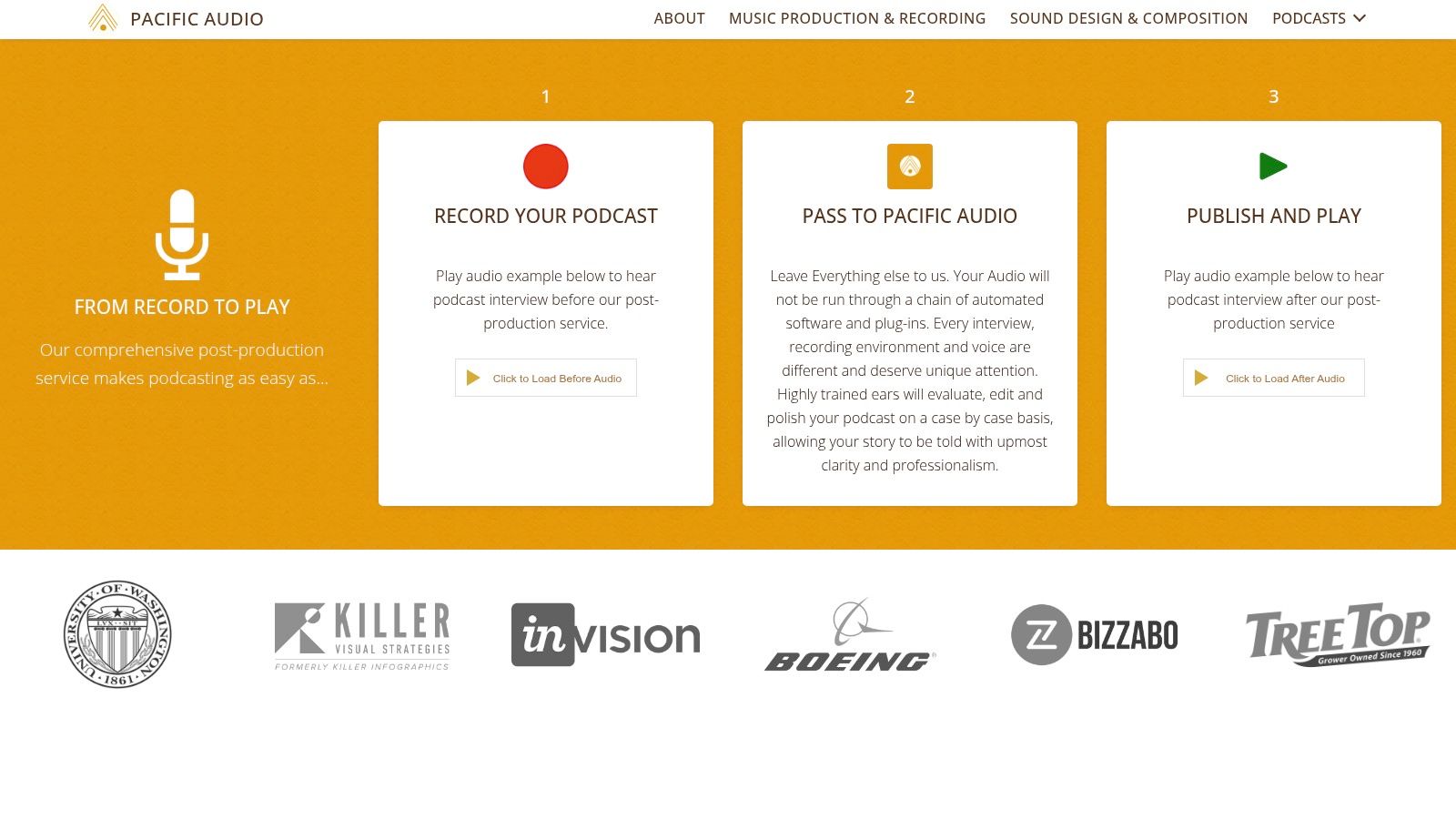
Pacific Audio is the pick for teams that already record in-house but want the show to sound like it belongs in the market. That's a narrower service than a full agency, but it can be exactly right when the strategy is already solid and the weak point is audio polish.
A lot of B2B teams overcomplicate this. If your host is strong, the concept is clear, and distribution is covered, elite post-production may deliver more value than a bloated all-in-one package.
Where Pacific Audio adds value
Pacific Audio appears focused on editing, cleanup, mixing, mastering, and sound design. That's useful for remote interviews, uneven source audio, and any show where intelligibility affects perceived authority.
In B2B, poor sound doesn't just annoy listeners. It signals a lack of rigor.
A specialist like this can help with:
- Consistency across episodes: Voices sound more even from session to session.
- Remote recording cleanup: Useful when guests join from untreated rooms and weak setups.
- Premium sonic feel: Better polish can make a serious brand sound more credible.
The trade-off
Post-production isn't distribution. It doesn't fix weak positioning, a vague audience, or an unfocused host.
That's why Pacific Audio works best when the rest of your machine already exists. If your team is still inventing the show while editing it, you need more than an audio partner.
9. Puget Sound Creative
Puget Sound Creative makes sense for B2B teams that care less about building a podcast program in isolation and more about turning one recording into a usable stream of marketing assets.
That distinction matters.
If demand generation, executive thought leadership, social clips, blog recaps, and sales enablement all sit on the same quarterly content plan, an integrated agency can create real operational value. Fewer handoffs usually mean faster approvals, cleaner messaging, and a better shot at publishing consistently.
Where an integrated model can pay off
For some companies, the best podcast partner is not the most podcast-native shop. It is the team that can connect the show to the rest of marketing without adding coordination overhead.
Puget Sound Creative is worth a look if your priorities are:
- Cross-channel repurposing: Interviews can become articles, short-form video, social posts, and email content without rebuilding the workflow every time.
- Stronger message control: One team handling multiple formats can keep positioning tighter across the campaign.
- Lower production drag: Consolidating vendors often reduces review cycles and internal project management load.
This setup can produce better ROI than a specialist agency if your bottleneck is execution capacity, not show concept or host development.
What to verify before you sign
Integrated agencies come with a trade-off. You gain efficiency, but you have to make sure podcasting gets enough strategic attention.
Ask direct questions. Who owns show strategy? How do they shape the audience, format, and guest mix for a B2B buyer journey? What happens after the episode is published, and how does that work connect to pipeline goals rather than vanity metrics?
If the agency treats the podcast as raw material for clips, that is a content service. It can still be useful. But if you need a show that builds category authority, supports sales conversations, and earns repeat listeners from the right accounts, you need a partner with a clear point of view on podcast strategy, not just production throughput.
10. Rain City Recorders
A common B2B podcast mistake shows up after the first few episodes. The guest quality is solid, the ideas are strong, and the show still feels flatter than the brand behind it. In that case, the bottleneck is often production craft, not content planning.
Rain City Recorders fits teams that already know what they want the show to do and need a partner who can make it sound credible on first listen. That matters more than some marketers expect. Buyers make fast judgments from audio quality, pacing, and whether the conversation feels disciplined or amateur.
Best fit: brands that care about listener experience
Rain City Recorders stands out when the show itself needs to carry a premium feel. That usually applies to executive interview series, founder-led stories, and branded narrative work where tone, rhythm, and editing shape how the company is perceived.
The value is practical:
- Tighter editing: Conversations keep their substance but lose the dead air, repetition, and meandering sections that hurt retention.
- Stronger sonic branding: Music, transitions, and mix choices can help the show feel distinct instead of generic.
- Better recording discipline: Guidance on mic technique and capture quality prevents problems that are expensive to fix later.
For B2B marketers, the ROI case is straightforward. Better production will not create demand on its own, but it can raise completion rates, make executives more comfortable sharing the show, and give sales teams an asset that sounds aligned with a serious brand.
The trade-off to watch
This is usually a production buy, not a growth buy.
If your team still needs help with audience positioning, guest sourcing, content angles, or distribution, an audio-first partner will only cover part of the job. That can still be the right decision if strategy already lives in-house. If it does not, you need to price in the extra coordination and assign clear ownership before launch.
Rain City Recorders makes the most sense for B2B teams that already have the show thesis and want a polished final product that reflects the brand well. If your bigger problem is proving pipeline impact or building a repeatable audience strategy, start with a more strategic agency and treat production quality as one part of the system, not the whole system.
11. Cascadia Podcasting
A common B2B scenario looks like this. The company wants a podcast in market this quarter, the budget is limited, and nobody needs a full strategic partner yet. They need a team that can keep production moving, keep the release cadence intact, and avoid turning a simple show into an expensive agency engagement.
Cascadia Podcasting fits that use case well. Their value is operational efficiency, not broad marketing strategy. For early-stage B2B brands, founder-led firms, or solo consultants testing whether a podcast deserves a larger budget, that can be a smart buy.
The upside is clarity. A lighter production model makes costs easier to forecast and reduces coordination overhead. If the show concept is already defined and someone internally owns the editorial direction, a simpler service can get episodes out the door without draining team time.
Best for teams that already own strategy
Cascadia Podcasting makes the most sense when the marketing team does not need help deciding what the show is for. The fit is stronger if your team can handle positioning, guest outreach, and distribution in-house, then hand off the raw material for editing and packaging.
That usually works best in three cases:
- Founder-led or expert-led shows: The host already has a point of view and enough subject matter depth to carry episodes.
- Straightforward formats: Interview podcasts and solo episodes are easier to run on a lighter production scope.
- Testing mode: Teams validating audience interest before investing in a larger B2B content engine often benefit from a lower-risk starting point.
For the right buyer, that trade-off is rational. You preserve budget for paid distribution, content repurposing, or internal headcount instead of spending it all on agency scope.
Where the model tops out
The ceiling shows up once leadership expects the podcast to drive more than consistent publishing.
If the objective is pipeline contribution, sharper category positioning, or a repeatable guest strategy tied to account lists, a basic editing package will not close that gap. The handoff burden stays with your team. Someone still has to own show strategy, promotion, performance review, and the link between episodes and revenue goals.
That is the key filter for B2B marketers. Cascadia Podcasting is a practical production partner for getting a show launched and maintained at a controlled cost. It is a weaker fit for brands that need the agency to shape the business case, build the audience strategy, and prove ROI across the full program.
Top 11 Seattle Podcast Agencies Comparison
| Service | 🔄 Implementation complexity | ⚡ Resource requirements | 📊 Expected outcomes | 💡 Ideal use cases | ⭐ Key advantages |
|---|---|---|---|---|---|
| Fame | High, end-to-end, rigorous process | Premium retainer, client commitment, proprietary tech (Fame Host/AI) | Guaranteed ≥10% MoM downloads; pipeline & authority growth | B2B tech, finance, professional services seeking measurable growth | Guaranteed growth metric; B2B-focused; integrated tech for scale |
| Larj Media | Medium–high, narrative-driven show development | Custom SOW, creative team, production resources | Brand storytelling that fuels omni-channel marketing | Impact-driven orgs (think tanks, NGOs, universities, B Corps) | Deep narrative expertise; strong production for mission-led brands |
| Espresso Podcast Production | Medium, strategy-led launches and ongoing production | Boutique team, curated onboarding (application model) | Consistent releases that build pipeline and community | Founders and marketers wanting marketing-first shows | Focus on marketing outcomes; hands-on, curated support |
| Third Wheel Podcast Studio – Seattle | Low–medium, turnkey studio sessions | On-site engineers, multicam rigs, facilities | Broadcast-quality captures; simplified logistics | Teams needing in-studio recording days or tour-stop interviews | Reliable local infrastructure; strong video capture capability |
| NAST Studios | Low, session packages with producer included | Transparent per-session or package pricing, multicam options | Predictable budgets; fast pilot production | Pilots and shows needing predictable session costs | Clear pricing; producer-included sessions; multicam support |
| Top of the Tower Studios | Low–medium, premium studio with extras | Broadcast gear (4K, pro mics), on-site engineers, community resources | High production value; improved brand perception | Executive-filmed interviews and premium branded content | Broadcast-quality environment; guest matching and education |
| Ruinous Media | Medium, planning through distribution | Local production team, distribution & marketing support | Launch and growth support across multiple formats | Brands/creators needing broader launch + promotion help | Broader scope than studios; adaptable across show types |
| Pacific Audio | Low, focused post-production service | High-touch audio engineers, case-by-case processing | Polished, intelligible audio; improved perceived authority | Teams that record in-house and need professional polish | Expert editing/mixing/mastering; flexible workflow integration |
| Puget Sound Creative | Medium, integrated content marketing agency | Multi-channel team, retainer-based engagement | Cohesive cross-channel campaigns and content atomization | B2B firms wanting one partner for blog, social, video, podcast | Unified strategy; streamlined vendor management |
| Rain City Recorders | Low–medium, boutique audio-first production | Sound design, custom music, meticulous editing | Premium broadcast-quality audio and unique sonic identity | Brands prioritizing superior audio production value | High-fidelity production; custom scoring and sound design |
| Cascadia Podcasting | Low, productized, fixed-price packages | Fixed packages, fast turnaround, basic show notes | Professional-sounding episodes launched quickly | Early-stage startups and solo consultants on a budget | Affordable, predictable pricing; simple, fast process |
How to Choose The Right Seattle Agency for Your B2B Brand
Your CMO greenlights a podcast. A few months later, the team is still chasing approvals, guests are inconsistent, episodes go live without a promotion plan, and nobody can explain whether the show is helping pipeline. I see that pattern when companies buy production before they define the business job the podcast needs to do.
For B2B brands, agency selection starts with revenue logic. A podcast can support category authority, sales enablement, customer marketing, partner relationships, or executive thought leadership. Each goal calls for a different operating model, and the wrong match creates waste fast. A great studio will not fix weak positioning. A skilled editor will not build distribution.
The Seattle options in this guide fall into three practical buckets. Strategic B2B partners, recording studios, and post-production specialists.
Studios like Third Wheel, NAST, and Top of the Tower solve the recording problem well. They give your team a controlled environment, technical support, and a polished session. That is a smart buy if your internal marketers already own editorial strategy, guest sourcing, publishing, repurposing, and performance review.
Post-production shops solve a narrower workflow issue. If you already record in-house and want stronger editing, cleaner sound, and more consistent delivery, that model keeps costs tighter and preserves internal control. It also leaves the hard growth questions with your team.
Strategic agencies carry more of the work that affects ROI. They shape the show around a specific audience, build an episode structure that serves marketing and sales goals, and put process around guest operations, promotion, and reporting. For B2B marketers, those decisions usually matter more than the room, the mic, or the intro music.
That is also where buying mistakes happen. A local provider can be excellent at production and still be the wrong fit for a brand that needs measurable business impact. As noted earlier, Fame is differentiated here because its offer is built around B2B podcast strategy and execution, not general audio production.
Use the sales process to test how an agency thinks:
- What B2B programs have you supported that targeted niche buyers or long sales cycles? Relevant experience matters more than generic podcast volume.
- How do you define success after launch? If the answer ends at episode delivery, expect your team to own growth.
- What happens after recording is done? Strong partners should have clear opinions on distribution, content repurposing, guest coordination, and promotion.
- Who owns the weekly operating load? Confirm who handles scheduling, prep, approvals, asset management, publishing, and reporting.
- What do you do when performance flattens? Good agencies diagnose format, audience, conversion path, and promotion issues. They do not just send files on time.
The point of this list is not to rank studios against strategists as if they do the same job. They do not. It is to help B2B marketers buy the right type of partner for the result they need.
Choose infrastructure if you need a place to record. Choose post-production support if your team already has strategy handled and wants better execution. Choose a strategic partner if the podcast needs to justify budget, feed your content engine, and contribute to revenue conversations.
That filter protects budget and shortens the path to a show that earns its keep.
If your team wants a B2B podcast partner that owns strategy, production, promotion, and growth accountability, Fame is worth a close look.
