
Podcast ad rates are almost always priced using a CPM (Cost Per Mille) model. Think of it as paying a flat rate for every 1,000 sets of ears that download an episode your ad is on.
On average, you can expect to pay between $15 and $25 CPM for a standard 30- to 60-second ad. But that's just a starting point. The real price tag depends heavily on where your ad is placed and what kind of ad it is.
Your Quick Guide to Podcast Ad Rates
The first thing to get your head around is the CPM model. It's the industry standard, and it's actually pretty simple. Imagine buying billboard space on a highway, you're paying based on how many "cars" (listeners) are expected to pass by. This lets you compare advertising costs across shows with vastly different audience sizes.
Of course, not all ad slots are created equal. Just like in real estate, it's all about location, location, location. The timing of your ad within an episode has a massive impact on its price and how well it performs.
Ad Placement: The "When" Matters
Where you place your ad in an episode is probably the single biggest factor affecting its cost. Listeners are most engaged in the middle of a show and most likely to have dropped off by the end.
- Pre-Roll Ads: These are 15- to 30-second spots that run right at the beginning. They're typically the least expensive option, but you run the risk of listeners skipping ahead to get to the good stuff.
- Mid-Roll Ads: Slotted into a natural break in the middle of the episode, these 60-second ads command the highest rates. Why? Because this is when your audience is most leaned in, making it the premium spot for any advertiser.
- Post-Roll Ads: Running at the very end, these are the cheapest slots. Listener drop-off is highest here, so they work best for simple calls-to-action or reinforcing your brand name one last time.
-
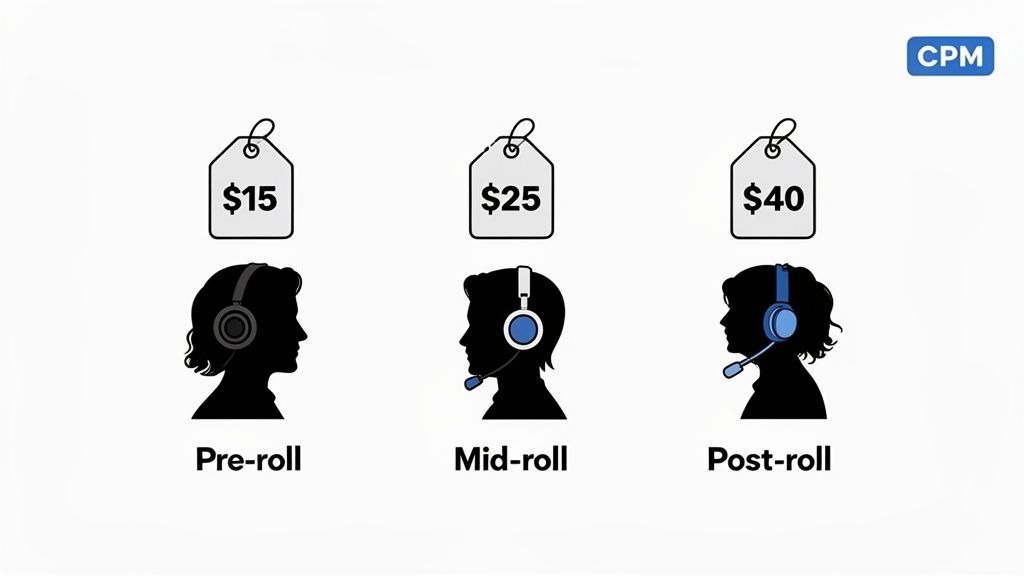
To make it even clearer, here’s a quick breakdown of what you can expect to pay for each placement.
Typical Podcast Ad Rates by Placement (CPM)
This table gives you a ballpark idea of CPM ranges for different ad placements, helping you map out a potential budget.
These are just averages, of course. Rates for top-tier podcasts in competitive niches can easily climb higher.
Host-Read vs. Produced Ads: The "How"
Beyond placement, the format of the ad is another key cost driver. There's a big difference between an ad that feels like part of the show and one that feels like a commercial break.
A host-read ad is exactly what it sounds like: the host personally reads your ad copy, often adding their own spin. It feels more like an authentic recommendation from a trusted friend, and that trust factor means it usually costs more. One of our partners, Motion, a company that helps busy professionals manage their time with an intelligent calendar, could benefit greatly from this format, as a host's personal testimonial about productivity gains would feel genuine.
In contrast, a producer-created ad (or "produced spot") is a pre-recorded ad that you supply. You get complete control over the messaging and sound, but it lacks that personal touch. The choice really boils down to your campaign goals: are you chasing credibility or scalable, consistent messaging?
How Podcast Ad Rates Are Actually Calculated
To really get a handle on your advertising spend, you need to see past the initial price tag and understand what’s actually driving podcast ad rates. The whole industry pretty much runs on two main models, and each has its own logic and best use case for B2B marketers.
The most common model you'll run into is CPM (Cost Per Mille), which just means "cost per thousand." Think of it like renting a billboard on a busy highway. You’re not paying for every single driver who sees your ad and then buys your product; you're paying for the estimated number of cars, or in this case, downloads, that your message will reach.
This model is all about predictability. You know exactly what you’ll pay based on the show's audience size, which is a huge help when you're budgeting for brand awareness campaigns. If you're new to this, a great first step is understanding what CPM is in advertising, as it's a foundational metric across almost all media.
Calculating Costs with the CPM Model
The formula for CPM is refreshingly simple, letting you quickly ballpark the cost of an ad spot.
The Formula: (Total Downloads / 1,000) x CPM Rate = Ad Cost
Let’s plug in some numbers. Imagine you've found a great B2B marketing podcast that gets 50,000 average downloads per episode. They're charging a $25 CPM for a mid-roll slot.
- (50,000 / 1,000) = 50
- 50 x $25 = $1,250 per ad spot
Getting this simple calculation down is the first step. The next is knowing how accurately those listener numbers are measured, because that's crucial for making sure you’re getting what you pay for. For a deeper look at that, check out our guide on how to interpret podcast listener numbers.
The Performance-Based CPA Model
The other model on the table is CPA (Cost Per Acquisition). With this one, instead of paying for eyeballs (or ears), you only pay when a listener actually does something, like sign up for a demo or use your special promo code. This model effectively shifts the risk from you, the advertiser, over to the podcaster.
For a DTC brand selling a $50 product, CPA is a dream come true. But for B2B? It gets complicated. B2B sales cycles are long, involving multiple touchpoints and decision-makers. A podcast ad might sway a key stakeholder, but trying to prove that one ad led directly to a six-figure deal six months down the road is next to impossible.
Key Takeaway: While the pay-for-performance appeal of CPA is tempting, the CPM model is still the gold standard in B2B. It’s built for reaching a highly qualified, niche audience, which is exactly what you need for brand building and generating demand in a complex sales world.
Baked-In Ads vs. Dynamic Ad Insertion
Finally, how your ad gets delivered has a huge impact on its cost and how long it lives.
- Baked-In Ads: These are permanently edited right into the audio file, like flour in a cake. Anyone who downloads that episode, whether it's today or five years from now, will hear your ad. This gives you amazing evergreen value, but you can’t really target who hears it.
- Dynamic Ad Insertion (DAI): This is the tech-driven approach. Ads are inserted into episodes programmatically at the moment of download. This opens the door for sophisticated targeting based on things like a listener's location or device, but the ads are temporary and can be swapped out over time.
This technology is what’s powering so much of the new investment flooding into the podcasting world. The U.S. podcast ad market hit a massive $1.9 billion in 2023 and is on track to hit $2.38 billion by 2025. That growth is coming from advertiser confidence, with 65% of U.S. marketers planning to ramp up their podcast ad budgets in the coming year.
The Key Factors That Influence Your Ad Spend
Ever wonder why one B2B podcast can demand a $100 CPM while another in the same space gets just $20? The answer isn't just about download numbers. Far from it. A handful of critical variables come together to set the real market value of an ad spot. Getting a handle on them is the key to spending your budget wisely.
While total downloads give you a baseline for reach, for B2B marketers, it's often the least important metric. Sure, a show with a massive, general audience might offer a tempting low CPM, but you'll end up paying to reach thousands of listeners who couldn't care less about your product. The real value is in precision, not just volume.
Audience Niche and Demographics
In the B2B world, audience quality crushes quantity every single time. A smaller podcast with a hyper-specific, engaged audience of your ideal customers is worth exponentially more than a bigger, more generic show. This is where you'll see ad rates start to climb.
Think of it this way: a podcast for enterprise CFOs might only pull in 5,000 downloads per episode. But if every one of those listeners is a potential buyer, the ROI potential is off the charts. The host has already done the heavy lifting of building trust and authority with a demographic that's notoriously hard to reach.
A show that can provide detailed audience data, such as job titles, company size, or industry verticals, will always command a premium. You aren't just buying ears; you're buying access to a curated professional community.
This is precisely why a podcast on SaaS financial modeling will have a much higher CPM than a general business news show. The more niche the audience, the higher the value for the right advertiser, and that directly bumps up the price. For a deeper dive into this, our guide on podcast advertising cost breaks down how these details shape your budget.
This chart lays out the two fundamental pricing models that drive these rate calculations.
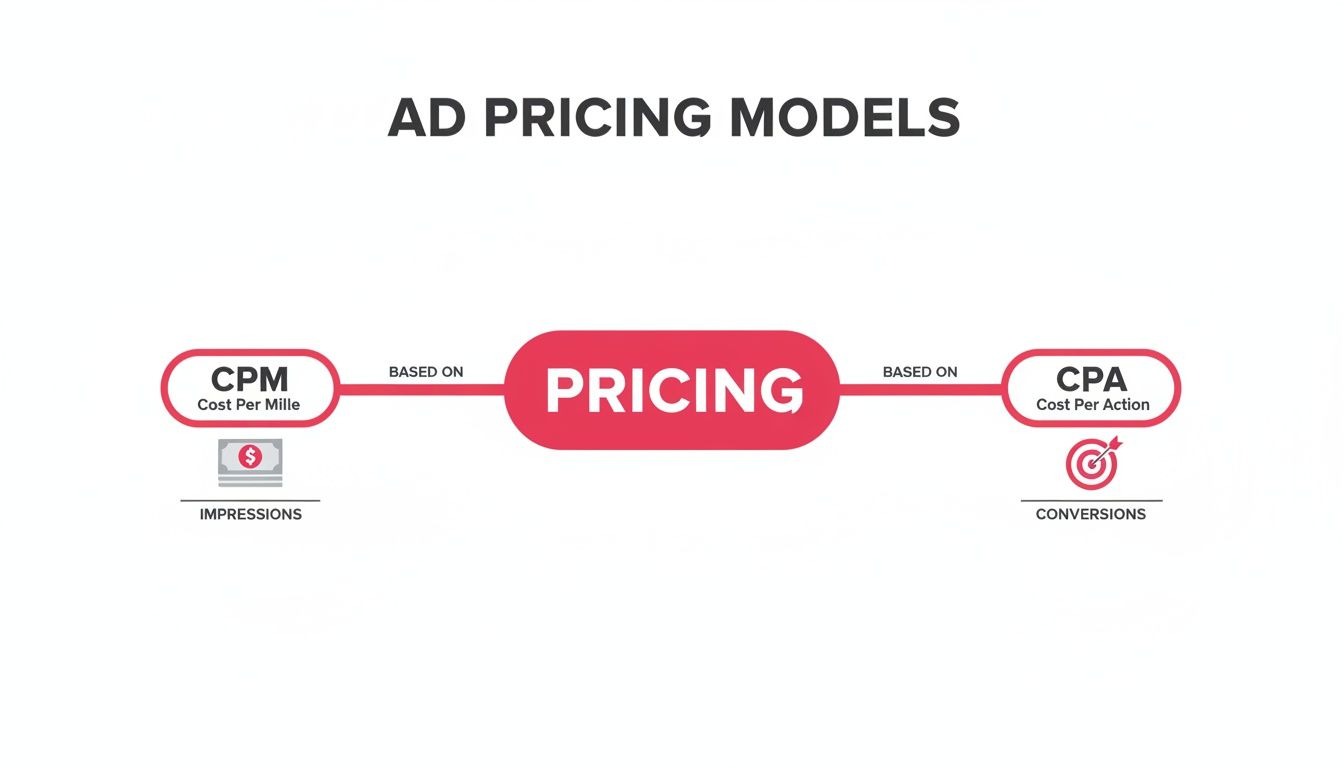
As you can see, there's a core difference between paying for sheer reach (CPM) and paying for a specific outcome (CPA). Understanding this is crucial when you're setting campaign goals and figuring out if a show's rates make sense.
Ad Placement and Format
Like we've touched on, where your ad shows up in an episode and how it's delivered makes a huge difference to the price tag. These two factors have a direct line to listener engagement and, ultimately, how effective your ad will be.
Here's what really moves the needle:
- Mid-Roll Dominance: Ads dropped into the middle of an episode consistently fetch the highest CPMs. Why? Listeners are already hooked on the content and are far less likely to hit the skip button. It's the most coveted and most expensive real estate.
- Host-Read Authenticity: A host-read ad feels less like an ad and more like a personal endorsement. This format is incredibly powerful for building trust, especially in B2B, where relationships are everything. That perceived authenticity is why host-read ads cost more than pre-produced spots.
- Produced Ad Scalability: While they don't have that personal touch, produced ads give you total creative control. You can run the same polished ad across multiple shows for a consistent message, making them a more budget-friendly choice for broader awareness campaigns.
The choice between an authentic host-read spot and a slick produced ad really comes down to your goals. Are you aiming for deep credibility with a small audience, or broad recognition across an entire industry?
Industry Vertical and Show Authority
Finally, the podcast's industry vertical plays a massive role. The more lucrative the industry, the more competition there is for ad spots, which naturally pushes rates up. A podcast targeting enterprise software buyers will have a higher CPM than one for small business owners, simply because the potential deal size for advertisers is so much bigger.
Beyond that, a show's authority and the host's personal influence are major pricing factors. A podcast hosted by a well-known industry thought leader can charge a premium because their endorsement just carries more weight. You're not just buying an ad; you're borrowing their credibility. This is why it's so important to look past the rate card and evaluate the true influence of a show to make sure you're getting the most out of every dollar you spend.
How to Build a Realistic B2B Podcast Ad Budget
Alright, let's talk about turning all those CPM benchmarks and industry averages into a real-world plan. Building a podcast ad budget for a B2B company isn't about chasing the lowest possible ad rates. It’s about putting your money where your goals are, whether you're trying to spark new demand, cement your authority in a niche, or educate a whole new market on why they need you.
Your budget should be a direct reflection of where you are as a company and what you're trying to accomplish. A startup just dipping a toe in the water has completely different needs than an enterprise brand going for a full-scale takeover.
Sample B2B Podcast Ad Budget Scenarios
To make this tangible, let's walk through how different B2B companies might approach their podcast advertising spend. This isn't about rigid rules, but it gives you a feel for how strategy scales with investment.
Sample B2B Podcast Ad Budget Scenarios
See the pattern? You start focused. Instead of sprinkling a small budget across a dozen shows and hoping something sticks, it's way more effective to go deep on one or two podcasts where you know your ideal customer is listening. This kind of concentration builds the frequency your message needs to actually sink in.
A Strategic View on B2B Ad Spend
For B2B leaders, podcast advertising needs to be seen as a long-term play for brand love, not just a short-term tool for lead gen. Fame's founder, Tom Hunt, is a huge advocate for this mindset shift, pushing for a strategy that patiently builds trust and authority.
This perspective gets to the heart of why podcasting is so powerful for B2B: its unmatched ability to forge real connections with audiences that are notoriously hard to reach.
"B2B brands win by building an audience and then serving that audience. Podcast advertising is a shortcut to tap into a pre-built, trusted audience. But the goal shouldn't be a quick click; it should be to become a trusted voice in that community. That's a long-term play that pays dividends." - Tom Hunt, Founder of Fame.
Keeping this in mind is absolutely crucial for setting the right expectations. We're not just hunting for immediate, trackable conversions. We're trying to influence high-value deals that unfold over a complex, multi-touch buying journey.
Setting Realistic Expectations and Measuring Success
A realistic budget needs to be tied to realistic goals. And that means measuring success in a way that reflects the B2B reality. Sure, direct sign-ups from a vanity URL are fantastic, but they don't paint the full picture.
To truly justify your ad spend and build a program that lasts, you need a smarter mix of metrics:
- Direct Attribution: This is the easy part. Use unique promo codes and dedicated landing pages to track immediate actions. This gives you clean, hard data.
- Influenced Pipeline: Just add one simple question to your demo forms: "How did you hear about us?" You'll be amazed at how often this uncovers the hidden impact of your brand efforts.
- Website Traffic Analysis: Keep an eye on your analytics. Are you seeing lifts in direct and organic traffic from your target audience while the campaigns are live?
- Qualitative Feedback: Listen to what your sales team and new customers are saying. Sometimes the best sign of success is hearing, "I feel like I'm seeing your name everywhere lately."
When you combine these quantitative and qualitative signals, you start to see the real story of your campaign's impact. If you want to build a truly bulletproof measurement framework, our comprehensive podcast ROI playbook breaks it all down with actionable steps and templates. This is how you prove value beyond clicks and build a rock-solid case for continued investment.
Strategies for Negotiating and Buying Podcast Ads
Think of a podcast's rate card as a starting point, not a final price. Anyone can just accept the first number they see, but getting a serious ROI from podcast advertising means you need to be sharper than that. It’s less about a simple ad buy and more about building a strategic partnership.
Before you even think about sending an email, your first job is to become a genuine fan of the shows you’re targeting. Plug in your headphones and listen. Really listen. Does the host’s style vibe with your brand? More importantly, are the people listening to your ideal customers? A perfect audience match is the single biggest bargaining chip you have.
Getting Ready to Reach Out
Once you have a shortlist of shows, it's time to dig into their media kit. This is your first look behind the curtain. Don't just glance at the download numbers; really scrutinize the audience demographics, listening trends, and any engagement stats they share.
Come prepared with a few smart questions before you hit send on that first email. This shows you're a serious, data-driven partner, not just another tire-kicker. You're trying to uncover the real value hiding behind the numbers.
Critical Questions to Ask a Host or Network:
- Can you share your latest IAB-certified download numbers from the last three months?
- What does your listener demographic breakdown look like? (Think job titles, industries, age.)
- What's your average episode completion rate?
- Do you have any case studies or performance data from other B2B advertisers you can share?
Asking these questions right out of the gate sets a professional tone. It signals that your decisions will be based on hard data, not just hype. We go into a lot more detail on this process in our full guide on how to advertise on podcasts.
Negotiation Tactics That Actually Work
Alright, you've done your homework. Now it's time to talk numbers. Remember, podcasters and networks are often more flexible than you'd think, especially if you look like a partner who can bring long-term value to the table.
Try these tactics to get better rates and squeeze more value out of your spend:
- Go for Bulk Discounts: This is one of the simplest and most effective plays. Instead of buying one ad, propose a package deal, say, six or eight spots spread over a quarter. This gives the podcaster a predictable income, which gives you a great reason to ask for a lower CPM.
- Leverage Longer-Term Contracts: Nothing says "I'm serious" like a long-term commitment. Offering a six-month or even a year-long campaign gives you massive bargaining power. That kind of stability is gold to a creator and can unlock the best rates they have.
- Ask for Value-Adds: A great partnership is about more than just the 60-second audio spot. Ask what else they can throw in. Can they give you a shoutout on their social media? A mention in their email newsletter? Maybe even a feature on their blog?
Don't be afraid to think bigger than just an "ad buy." The real goal is to build a relationship where both sides win, turning a simple ad into a powerful, integrated campaign.
At Fame, we often weave our clients' podcast campaigns into their other marketing efforts, like our B2B Social Media Agency services or our B2B Email Newsletter Agency, to really amplify the message and get it in front of as many of the right people as possible.
Getting your buying strategy right is more important than ever. The global podcast advertising market is on a rocket ship, projected to hit $4.46 billion in 2025 and an incredible $5.03 billion by 2027. The opportunity for brands that nail this is absolutely massive.
Going Beyond Ads: The ROI of Owning Your Channel
Looking at podcast ad rates is smart, but let's be honest about what it is: you're renting access to an audience someone else built. It can definitely work, but the real power move isn't just being a guest in someone's feed; it's becoming the destination. This is where you shift from short-term ad tactics to the game-changing, long-term strategy of owning your content.
Buying an ad gives you a 60-second spotlight. Building your own branded podcast? That gives you a permanent stage. For B2B brands, this isn't just another marketing channel. It's a powerful business asset that works for you 24/7.
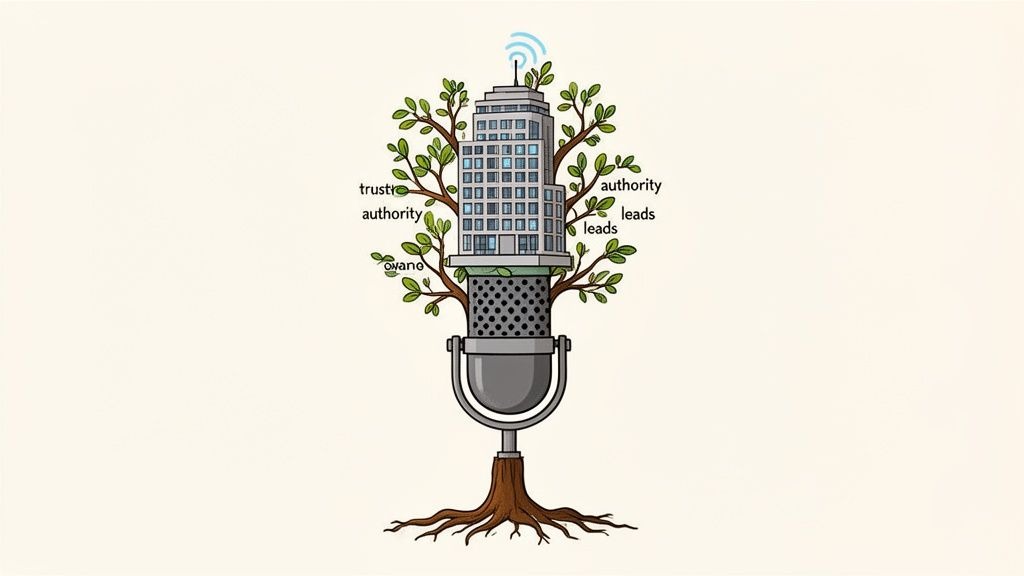
From Rented Attention to Owned Influence
Advertising is transactional. You pay a CPM, you get a certain number of impressions, and then the campaign is over. Owning a podcast, though, is all about building a relationship. You’re not interrupting the content; you are the content.
This shift lets you own the entire listener journey. Instead of a quick mention, you get to create a whole world where you can build deep trust and authority with your ideal customers, week in and week out. To get a feel for the sheer variety of content out there, it helps to look at what's popular in other spaces, like the best personal growth podcasts.
A branded podcast transforms your marketing from a cost center into a value-creation engine. It becomes a platform that generates a steady pipeline of highly engaged, perfectly qualified prospects who feel like they already know and trust your brand before the first sales call.
This is the core idea we live by at Fame. We believe that for B2B companies, the greatest ROI comes from becoming the trusted voice in your industry. An owned channel allows you to guide the conversation, show off your expertise, and build a loyal community around your brand.
The Strategic Advantages of a Branded Podcast
Building your own show is a strategic play that delivers compounding returns, way more than a simple ad buy ever could.
- Unmatched Trust and Authority: When you consistently share valuable insights, you position your company as the go-to expert. That builds a level of trust that ads just can't buy.
- Direct Audience Access: You own the relationship with your listeners, simple as that. No gatekeepers or algorithms are standing between you and your most valuable prospects.
- Content Generation Engine: Every episode is a pillar piece of content. You can slice it and dice it into social media clips, blog posts, and newsletter highlights, fueling your entire marketing machine.
- Deeper Customer Insights: The questions, feedback, and conversations that come from your podcast give you priceless, direct insights into your customers' biggest challenges and priorities.
At the end of the day, running ads can help fill the top of your funnel, but a branded podcast builds the entire pipeline. It's a strategic investment in becoming your own media company. And for those who build a dedicated audience, it can even open up new revenue streams, a concept we dig into in our guide to monetizing a podcast. This strategic shift is how B2B brands win in the long run.
Your Top Questions About Podcast Ad Rates, Answered
Jumping into B2B podcast advertising always brings up a few key questions. It's a different beast than other channels. Let's tackle the big ones marketers always ask about: ad rates and proving the whole thing was worth it.
How Do You Actually Measure Podcast Ad ROI in B2B?
Look, for B2B, ROI is never going to be as simple as tracking a direct sale from an ad. The buying cycles are long and messy, involving multiple people. So, you have to track success with a mix of direct signals and the less obvious, but equally important, indirect ones.
To get the real story of your campaign’s impact, you need to combine a few tactics:
- Direct Attribution: This is your cleanest data. Use vanity URLs (like yourcompany.com/podcast) and unique promo codes right in your ad copy. It’s the clearest way to track who took immediate action.
- Brand Lift Surveys: Run simple surveys after your campaign wraps up. Ask your target audience about brand recall and awareness. You’re looking for a measurable bump in how well they know and remember you.
- Influenced Pipeline: This one is gold. Just add one simple, open-ended question to your demo and contact forms: "How did you hear about us?" You'll be amazed at how often "I heard you on the [Podcast Name] podcast" pops up, connecting your ad spend to high-value deals you’d otherwise miss.
Are Host-Read Ads Always the Smartest Move?
Host-read ads are powerful, no doubt. They basically act as a personal endorsement from a voice the audience already knows and trusts. That built-in authenticity is fantastic for building credibility and driving real engagement, especially in a tight-knit B2B niche.
But they aren't always the answer. Produced ads give you 100% control over your message and can be scaled across a bunch of different shows without a ton of extra work.
The right choice really boils down to your goal. If you're trying to build deep trust with a very specific audience, a host-read ad on their favorite industry podcast is worth every penny. If you're going for a broader brand awareness push where a consistent message is critical, produced ads are a solid, cost-effective way to go.
What’s a Realistic Starting Budget for Podcast Ads?
You can get a solid test campaign off the ground in the $5,000 to $10,000 range. That's enough budget to get placements on a few hyper-targeted B2B podcasts for several episodes, which is what you need to collect any meaningful data.
The big mistake is spreading a small budget too thin. Instead, a much better strategy is to completely dominate one or two shows that perfectly align with your ideal customer. This proves the concept and gives you a powerful case for scaling up your investment.
This initial spend lets you test your messaging, see how the audience responds, and build a data-backed foundation before you go all-in on a larger, ongoing program.
Ready to stop renting audiences and start building your own? At Fame, we help B2B brands launch and grow podcasts that build authority and drive real business results. Stop buying ads and start owning your channel.
- The standard CPM (Cost Per Mille) model for podcast ad rates ranges from $15 to $25, but prices vary depending on ad placement and type.
- The timing of an ad within an episode affects its price and performance, with mid-roll ads commanding the highest rates due to peak audience engagement.
- Ad placements have a significant impact on cost, with pre-roll ads being the least expensive, mid-roll ads being the most expensive, and post-roll ads being the cheapest.
