
In the crowded B2B landscape, a strong brand is your most valuable asset. It's the difference between being a commodity and becoming a category leader. But what does a powerful branding strategy look like in practice? It’s not just about aesthetics like a memorable logo; it's about building authority, earning trust, and positioning your company as the undeniable expert in your niche.
Many B2B leaders understand this in theory but struggle to find actionable models to follow. Generic advice and surface-level case studies don’t provide a clear path forward. This article cuts through the noise. We'll break down eight proven B2B branding strategies, providing a concrete branding strategy example for each one. This isn't a high-level overview; it's a deep dive into replicable methods used by successful companies. For a comprehensive understanding of building a robust brand from the ground up, explore this a practical guide to B2B brand strategy.
Throughout this list, you'll find detailed analysis, specific tactical insights, and actionable takeaways you can apply immediately. We will show you not only what works but how to implement these ideas. A special focus will be placed on leveraging a B2B podcast to accelerate your growth. A podcast helps you educate potential customers and peers, positioning you as the leading voice in the industry. When your ideal clients are in the market, they'll think of you first—a powerful way to build trust, loyalty, and a content engine for all your marketing efforts. Let's explore the strategies that transform B2B companies from players into market leaders.
1. Thought Leadership Positioning
Thought leadership positioning is a powerful B2B branding strategy example that focuses on establishing a company or its executives as trusted, authoritative experts within a specific industry. Instead of direct selling, this approach builds credibility by consistently sharing valuable insights, unique perspectives, and innovative ideas that solve genuine customer problems. For B2B firms, especially those in competitive markets or preparing for a liquidity event, this strategy directly influences high-stakes buying decisions by building a foundation of trust before a sales conversation even begins.
A well-executed thought leadership program shifts market perception, transforming a company from a mere vendor into an indispensable industry guide. This is achieved by creating and distributing high-value content that educates and empowers the target audience, making the brand synonymous with expertise.
Strategic Breakdown: Microsoft's Cloud Transformation
A prime example is Satya Nadella's tenure at Microsoft. When he became CEO, Microsoft was seen as a legacy software giant struggling to adapt. Nadella initiated a profound cultural and strategic shift, positioning the company as a forward-thinking leader in cloud computing and AI.
- Context: Competing with agile, cloud-native players like Amazon Web Services (AWS).
- Goal: Redefine Microsoft's brand from a closed-off legacy provider to an open, collaborative, and innovative cloud-first partner.
- Tactics: Nadella consistently articulated a clear vision of an "intelligent cloud and an intelligent edge." He championed partnerships with former rivals (like Linux and Oracle), spoke at non-Microsoft events, and published his book Hit Refresh to detail his philosophy on empathy and innovation. The focus was always on customer-centric solutions, not just Microsoft products.
- Results: This thought leadership-driven pivot was instrumental in the astronomical growth of Microsoft Azure, which now fiercely competes with AWS for market leadership. The company's market capitalization soared, fundamentally changing its brand perception globally.
Key Insight: True thought leadership isn't about self-promotion; it's about owning a distinct and valuable point of view on the future of your industry and consistently demonstrating its value to your audience.
Actionable Takeaways & B2B Podcast Application
This branding strategy example is highly replicable for B2B companies looking to build authority. The most effective modern channel for deep-dive thought leadership is a branded podcast. It serves as a powerful content engine, allowing you to educate potential customers and build trust at scale.
- Develop a Content Pillar: Create a podcast centered on a core theme that addresses your ideal customer's biggest challenges. This becomes your primary platform for sharing insights.
- Amplify Through Guests: Invite other industry experts and even potential customers onto your show. This not only provides fresh perspectives but also leverages your guests' networks for expanded reach.
- Repurpose Relentlessly: A single podcast episode can be repurposed into dozens of content assets. Use a B2B social media agency to turn key quotes into LinkedIn posts, audiograms, and video clips. Transform transcripts into blog posts and key takeaways into a weekly newsletter with the help of a B2B email newsletter agency.
This approach establishes you as a central voice in your industry. To learn more about building this type of influence, explore how to execute strategic thought leadership in detail.
2. Brand Authority Through Audio Content
Building brand authority through audio content is a branding strategy example that leverages podcasting to create intimate, long-form connections with a target audience. Unlike static written content, audio allows B2B companies to establish expertise and build trust by speaking directly to busy executives during their commutes, workouts, or downtime. This approach transforms a brand from a service provider into a consistent, authoritative voice in the industry, making it a powerful engine for demand generation.
A dedicated branded podcast serves as a core asset, allowing a company to own a narrative, educate potential customers, and become the go-to resource for industry insights. This positions the brand as a trusted guide long before a prospect enters the buying cycle.
Strategic Breakdown: HubSpot's 'The Growth Show'
HubSpot provides a masterclass in using audio to solidify market leadership. While already a major player in marketing software, 'The Growth Show' (now part of the HubSpot Podcast Network) helped cement its authority on the broader topic of business growth, not just its own products.
- Context: A crowded SaaS market where every competitor was publishing blog posts and ebooks.
- Goal: To own the conversation around "growth" in all its forms (marketing, sales, service) and associate the HubSpot brand with high-level business strategy.
- Tactics: The show featured interviews with high-profile founders and executives from growing companies, discussing their real-world challenges and successes. The focus was on storytelling and actionable advice, positioning HubSpot as a curator of elite business knowledge rather than just a software vendor.
- Results: The podcast became a top-ranked business show, attracting a loyal audience of ideal customers. It reinforced HubSpot's brand perception as a comprehensive growth platform and generated significant brand affinity, influencing countless buying decisions indirectly.
Key Insight: A successful branded podcast focuses on the audience's world, not the company's product. By solving your ideal customer's problems through curated expertise, you build the authority that makes your product the logical choice.
Actionable Takeaways & B2B Podcast Application
Any B2B company can replicate this branding strategy example to become a recognized authority. A podcast acts as the ultimate content engine, creating a sustainable flow of expert material that builds brand equity and fuels the sales pipeline.
- Establish a Clear Niche: Center your show on a specific, pressing pain point your ideal customers face. This focus attracts a dedicated and relevant audience. Follow this guide on how to plan a podcast to nail down your concept.
- Secure High-Profile Guests: Invite industry leaders, respected analysts, and even successful customers to share their expertise. This borrows their credibility and taps into their existing audience to expand your reach.
- Repurpose for Maximum Impact: Treat each episode as a campaign. A B2B social media agency can slice up interviews into video clips for LinkedIn, create audiograms for social media, and turn transcripts into detailed blog posts. This multiplies the value of your core audio content.
This strategy establishes you as a central hub for industry knowledge. To build your own audio authority engine, you can explore comprehensive B2B podcast production services.
3. Niche Market Differentiation
Niche Market Differentiation is a branding strategy example where a company focuses on dominating a specific, often underserved, segment of a larger market. Instead of competing broadly, this approach involves becoming the go-to authority for a narrow audience, which allows for premium pricing, fosters intense customer loyalty, and creates more efficient acquisition economics. For B2B firms, particularly in tech or professional services, this strategy carves out a defensible market position by being the best solution for a specific problem.
By concentrating resources on a niche, a company can tailor its messaging, product, and content with extreme precision. This focus builds a powerful brand identity that resonates deeply with the target audience, transforming the company from one of many options into the only logical choice.
Strategic Breakdown: HubSpot's Inbound Marketing Dominance
HubSpot is a classic case study in owning a niche before expanding. In its early days, the marketing software landscape was crowded with tools for email, SEO, and advertising. HubSpot didn't try to compete on every front; instead, it created and dominated the "inbound marketing" category.
- Context: A fragmented market where B2B companies struggled to generate leads online without large ad budgets.
- Goal: Establish HubSpot as the essential platform for a new, customer-centric marketing methodology.
- Tactics: HubSpot relentlessly educated the market on the principles of inbound marketing through its blog, free certification courses, and ebooks. They developed a specific language (e.g., "marketing automation," "lead nurturing") and built a community around these concepts. The software was positioned not just as a tool, but as the engine to execute the inbound strategy they taught.
- Results: HubSpot became synonymous with inbound marketing. This niche dominance allowed them to build a massive user base and a powerful brand before gradually expanding their platform to include sales, service, and operations hubs, transforming them into the CRM giant they are today.
Key Insight: Winning a niche isn't about being small; it's about being focused. By solving a specific, high-value problem better than anyone else, you earn the right to expand your market influence over time.
Actionable Takeaways & B2B Podcast Application
This branding strategy example is ideal for B2B companies aiming to unseat larger, more generalized competitors. A branded podcast is the perfect tool for establishing authority within a well-defined niche, allowing you to speak directly to the unique pain points of your target audience.
- Define Your Micro-Niche: Launch a podcast that addresses the hyper-specific challenges of your ideal customer profile. If you sell to SaaS CFOs, your show should be laser-focused on SaaS finance, not general accounting.
- Feature Niche Influencers: Invite guests who are recognized experts and trusted voices within your niche. This validates your brand by association and gives you access to their highly relevant audience.
- Repurpose for Niche Channels: A B2B social media agency can extract key insights from your podcast and create content specifically for the LinkedIn groups, Slack communities, and forums where your niche audience gathers. This ensures your message penetrates the community.
By becoming the primary source of valuable information for a specific audience, you build a powerful moat around your business. To go deeper, explore these brand positioning strategies that can help you own your niche.
4. Founder/Executive Personal Branding
Founder or executive personal branding is a branding strategy example that intentionally elevates a company’s leader into its primary brand asset. This approach makes the founder or CEO the public face and voice of the organization, leveraging their personal credibility, story, and expertise to build trust. In high-stakes B2B markets, where relationships and trust are paramount, a strong executive brand can attract top talent, open doors to partnerships, and create a powerful, human connection to an otherwise faceless corporation.
By transforming a leader into an industry influencer, the company gains a unique and defensible competitive advantage. As Tom Hunt, founder of Fame, puts it, "A personal brand is the only truly sustainable competitive advantage." This strategy ties the company’s mission and vision directly to a relatable individual, making the brand more memorable and authentic in the eyes of potential customers and investors.
Strategic Breakdown: Paige Ross at Calendly
A strong B2B example is Paige Ross, Head of Global B2B Marketing at Calendly. While the product is well-known, Ross has built a significant personal brand that reinforces Calendly's position as a leader in smart scheduling and marketing efficiency. Her brand is built on sharing actionable marketing insights and demonstrating how Calendly's own principles are applied internally.
- Context: Competing in a crowded SaaS market where product features can be easily replicated.
- Goal: Differentiate Calendly by showcasing the strategic thinking behind the product and establishing the brand as a partner in revenue growth, not just a scheduling tool.
- Tactics: Ross consistently shares high-value, tactical content on LinkedIn about marketing operations, pipeline generation, and team leadership. She appears on industry podcasts and speaks at events, not just promoting Calendly, but teaching the methodologies that make modern B2B marketing successful. Her content directly aligns her personal expertise with the core value proposition of Calendly.
- Results: This strategy positions Calendly as a thought leader in sales and marketing efficiency. Ross’s visibility generates organic brand awareness and builds a community of followers who trust her insights, which translates into trust for the Calendly brand itself.
Key Insight: Executive branding succeeds when the leader's public platform is a genuine extension of the company's core mission. The focus should be on teaching and sharing value, not just on direct product promotion.
Actionable Takeaways & B2B Podcast Application
This branding strategy example is incredibly potent for B2B leaders aiming to build a moat around their business. A branded podcast is the ideal platform for an executive to build and scale their personal brand authentically, as it provides a medium for long-form, nuanced conversations.
- Host a Niche Podcast: The executive should host a podcast focused on solving the core problems of their ideal customer profile. This establishes them as a central, trusted voice and an industry connector.
- Feature on Other Shows: Actively seek guest appearances on other relevant industry podcasts. This allows the leader to tap into new, pre-built audiences and share their unique perspective, driving listeners back to their own platform and company. Learn how to prepare for a podcast guest appearance to maximize impact.
- Create a Content Flywheel: Use the podcast as the "source code" for all personal brand content. A marketing team or a B2B social media agency can slice up each episode into video clips, quote graphics, and text posts for LinkedIn. Transcripts can become blog posts, and key ideas can fuel a personal newsletter.
This systematic approach creates a consistent and authoritative presence.
5. Customer Success and Case Study Storytelling
Customer success and case study storytelling is a B2B branding strategy example that turns customer results into your most powerful marketing assets. Instead of making claims about your product, this approach builds immense credibility by showcasing authentic, quantifiable business outcomes achieved by real customers. For B2B buyers in high-consideration purchase cycles, these stories provide the social proof and tangible ROI data needed to justify their investment.
This strategy transforms satisfied clients into brand advocates, demonstrating your value proposition through compelling narratives. By focusing on the customer's journey and their measurable success, you shift the focus from your features to their proven results, building a brand synonymous with tangible impact.

Strategic Breakdown: Salesforce's Customer-Centric Ecosystem
Salesforce is a master of this strategy, building its entire brand around the success of its customers, whom they call "Trailblazers." Their extensive library of customer stories isn't just a collection of logos; it's a core component of their brand identity, demonstrating value across every industry and company size.
- Context: Operating in a crowded CRM and cloud software market where differentiation is difficult.
- Goal: To build a brand centered on customer empowerment and tangible business transformation, making Salesforce an indispensable growth partner, not just a software vendor.
- Tactics: Salesforce elevates customer stories through its Dreamforce conference, dedicated "Customer 360" content hubs, and detailed case studies featuring specific ROI metrics. They highlight relatable narratives of individuals and companies using their platform to innovate, grow, and connect with their own customers.
- Results: This customer-centric approach has fostered an incredibly loyal community and a powerful brand moat. Prospects can easily find a story that mirrors their own challenges, making the value proposition immediate and relatable. This has been a key driver in Salesforce's market dominance.
Key Insight: The most convincing brand message you can deliver is an authentic story from a happy customer detailing their specific, quantifiable success with your solution.
Actionable Takeaways & B2B Podcast Application
Turning customer wins into brand-building content is a highly effective strategy. A branded podcast offers the perfect format for bringing these static case studies to life through authentic, long-form conversations.
- Create 'Customer Spotlight' Episodes: Dedicate podcast episodes to interviewing your most successful customers. Go beyond the written case study to explore their challenges, their decision-making process, and the human story behind their business transformation.
- Quantify the Narrative: During the interview, guide the conversation to focus on specific, hard metrics. Ask about revenue growth, cost savings, efficiency gains, or team productivity improvements. This turns a good story into a powerful piece of bottom-of-the-funnel sales collateral.
- Repurpose Success Stories: A single customer spotlight episode becomes a goldmine of marketing content. Use a B2B social media agency to create video testimonials for your website, audiograms with powerful quotes for LinkedIn, and detailed blog posts summarizing the key results. As seen in the Voices of Customer Experience case study, this turns one conversation into a multi-channel campaign.
6. Strategic Partnership and Co-Marketing Branding
Strategic partnership branding is a powerful approach that leverages the credibility, audience, and resources of complementary companies to amplify brand authority. Instead of building an audience from scratch, this strategy taps into established ecosystems through co-marketing, joint content creation, and integrated solutions. For B2B firms, these alliances are a force multiplier, providing a warm introduction to new, highly-qualified pipelines and enhancing the brand’s value proposition through association.
A well-executed partnership strategy transforms your brand from a standalone solution into an integral part of your customer's technology stack. This is achieved by creating joint value that neither company could offer alone, building deep trust and embedding your brand within a broader, trusted network.
Strategic Breakdown: HubSpot's Partner Ecosystem
HubSpot is a masterclass in using strategic partnerships to fuel growth. Instead of viewing other software companies as competitors, HubSpot built a vast ecosystem of app and solutions partners, most notably through deep integrations with platforms like Zapier, an automation tool that connects thousands of apps.
- Context: The B2B SaaS market is incredibly crowded. Customers are overwhelmed by disparate tools and seek seamless, integrated workflows.
- Goal: To position HubSpot not just as a CRM, but as the central hub of a company's entire marketing, sales, and service operation by integrating with the tools its customers already use and love.
- Tactics: HubSpot and its partners, like Zapier, engage in extensive co-marketing. This includes co-authored blog posts, joint webinars on workflow automation, and features in each other's app marketplaces. They create content that solves shared customer pain points, such as "How to automate your lead nurturing process," showcasing the power of their combined solutions.
- Results: This ecosystem strategy has been a primary driver of HubSpot's growth. The partner program generates a significant percentage of its revenue and has cemented its brand as a collaborative, indispensable platform. The integrations make HubSpot stickier and more valuable to its user base.
Key Insight: The best partnerships are not transactional; they are built on a shared commitment to solving customer problems. By aligning your brand with others who serve the same audience, you create a combined value proposition that is far greater than the sum of its parts.
Actionable Takeaways & B2B Podcast Application
This branding strategy example is ideal for B2B companies looking to rapidly expand their reach and credibility. A branded podcast provides the perfect platform to activate and showcase these strategic partnerships.
- Create a Partner-Centric Series: Dedicate a series of podcast episodes to featuring your strategic partners. Host an executive from each partner company to discuss industry trends, customer challenges, and the value of your integrated solution.
- Leverage Partner Networks for Distribution: Make it easy for partners to share the episode by providing them with pre-written social media copy, audiograms, and video clips. This co-distribution strategy instantly exposes your brand to a new, relevant audience.
- Develop Co-Branded Content Assets: A single joint podcast episode is a goldmine for co-branded content. A B2B email newsletter agency can repurpose the key insights into a joint newsletter send, or you can turn the transcript into a co-authored guide or whitepaper, capturing leads for both companies.
7. Data-Driven and Proprietary Research Branding
This premium branding strategy example involves creating and publishing original, proprietary research to position a company as an undisputed data authority in its niche. By generating unique data sets through surveys or internal analytics, a B2B company can become the go-to source for industry trends, benchmarks, and insights. This approach builds immense credibility, attracts high-value media coverage, and fuels content marketing efforts for months.
For B2B firms, owning a landmark annual report transforms the brand from a participant in the industry conversation to the one that sets the agenda. This strategy is exceptionally powerful for establishing thought leadership, supporting a high-stakes funding round, or building a narrative for a successful exit.
Strategic Breakdown: HubSpot's State of Marketing Report
HubSpot’s annual "State of Marketing" report is a masterclass in proprietary research branding. Instead of just selling marketing software, HubSpot provides the entire industry with the data and trends needed to make strategic decisions, cementing its brand as an indispensable resource.
- Context: A crowded MarTech landscape where differentiation is critical. Marketers are constantly searching for reliable data to guide their strategies.
- Goal: To establish HubSpot as the definitive authority on marketing trends, drive massive inbound traffic and lead generation, and earn high-authority backlinks.
- Tactics: HubSpot surveys thousands of marketing professionals globally each year. The findings are published in a comprehensive, beautifully designed report that is gated to capture leads. The report is then atomized into blog posts, infographics, webinars, and social media content, creating a year-long content engine from a single research initiative.
- Results: The "State of Marketing" report is one of the most cited resources in the industry, generating countless media mentions and backlinks annually. It directly fuels HubSpot's lead generation pipeline and reinforces its brand positioning as a helpful, authoritative guide for marketers everywhere.
Key Insight: Proprietary research isn't just a content asset; it's a brand-defining initiative. Owning the definitive data set for your industry makes your brand the source of truth that everyone else, including competitors, must reference.
Actionable Takeaways & B2B Podcast Application
Any B2B company can adapt this branding strategy example to build authority, and a branded podcast is the perfect platform to bring the data to life. It transforms static numbers into dynamic, engaging conversations that showcase your expertise.
- Launch a Research-Focused Series: Dedicate a multi-episode podcast series to unveiling your proprietary research. Each episode can dive deep into a specific chapter or key finding from your report.
- Interview Internal and External Experts: Host your internal research lead on the podcast to discuss the methodology and "aha!" moments. Then, invite other industry experts to react to the findings, adding third-party validation and expanding your reach through their networks.
- Repurpose for Maximum Impact: Your podcast episodes become a goldmine for derivative content. Use a B2B social media agency to turn key data points and expert quotes into LinkedIn carousels, video clips, and audiograms. Summarize the discussions in a B2B newsletter to drive your audience back to the full report and podcast series.
8. Community Building and Ecosystem Leadership
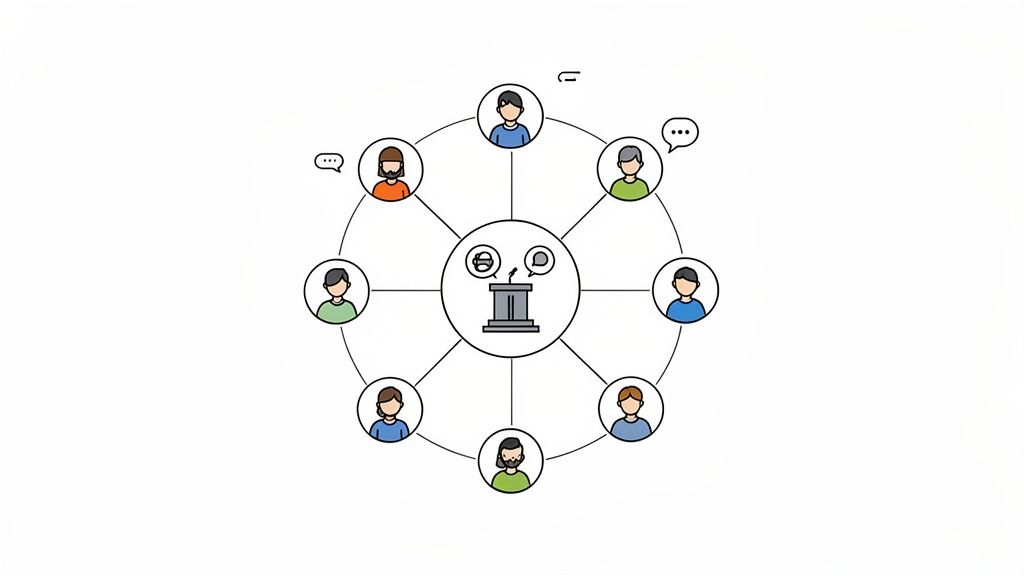
Community building is a branding strategy example that shifts the focus from a transactional customer relationship to a collaborative ecosystem. This approach involves creating and nurturing a dedicated space where customers, partners, and prospects can connect, share knowledge, and support one another. For B2B companies, a thriving community becomes a powerful moat, fostering deep loyalty, generating organic advocacy, and creating a network effect that is incredibly difficult for competitors to replicate.
By leading a community, a brand transcends its role as a vendor and becomes an indispensable hub for its industry. This fosters a sense of belonging and shared identity, turning customers into passionate evangelists who contribute to product innovation and attract new users.
Strategic Breakdown: Salesforce's Trailblazer Community
Salesforce provides a masterclass in community-led branding with its Trailblazer Community and the massive Dreamforce conference. Instead of simply providing a CRM, Salesforce built an entire ecosystem around its users, empowering them to become experts and leaders in their own right.
- Context: The CRM market was becoming increasingly crowded, with a need to create significant switching costs and foster deep user investment beyond the software itself.
- Goal: To build an engaged, self-sustaining community that drives user adoption, reduces support costs, and transforms customers into vocal brand advocates.
- Tactics: Salesforce created the Trailhead platform for free, gamified learning, and established the Trailblazer Community for peer-to-peer support. Dreamforce evolved from a user conference into a global industry event, celebrating community members as much as the product. User-led groups and MVPs were given platforms and recognition, creating a virtuous cycle of engagement and contribution.
- Results: The Salesforce ecosystem is now a major competitive advantage. The community provides immense value through shared solutions and support, while Dreamforce generates massive brand visibility and loyalty. This has cemented Salesforce's position as not just a product, but a central platform for an entire profession.
Key Insight: The most powerful communities are not built to serve the company; they are built to serve the members. When you empower your users to connect and succeed, your brand's authority and market position grow organically.
Actionable Takeaways & B2B Podcast Application
A branded podcast is an ideal tool for nurturing and scaling a B2B community. It gives a voice to your members, shares their stories, and reinforces the value of being part of your ecosystem.
- Spotlight Community Champions: Dedicate a podcast series to interviewing your most active and innovative community members. Showcase their success stories, how they use your product, and the expertise they've developed. This provides social proof and recognizes valuable contributors.
- Host "Community Office Hours": Use your podcast as a platform for live or pre-recorded Q&A sessions with product experts, support leaders, and executives. This creates a direct line of communication and shows you are actively listening to feedback.
- Repurpose Community Wisdom: Use insights and hot topics from community forums as inspiration for podcast episodes. A B2B email newsletter agency can then distribute these key takeaways and discussion summaries back to the community, closing the content loop and demonstrating that member contributions are valued.
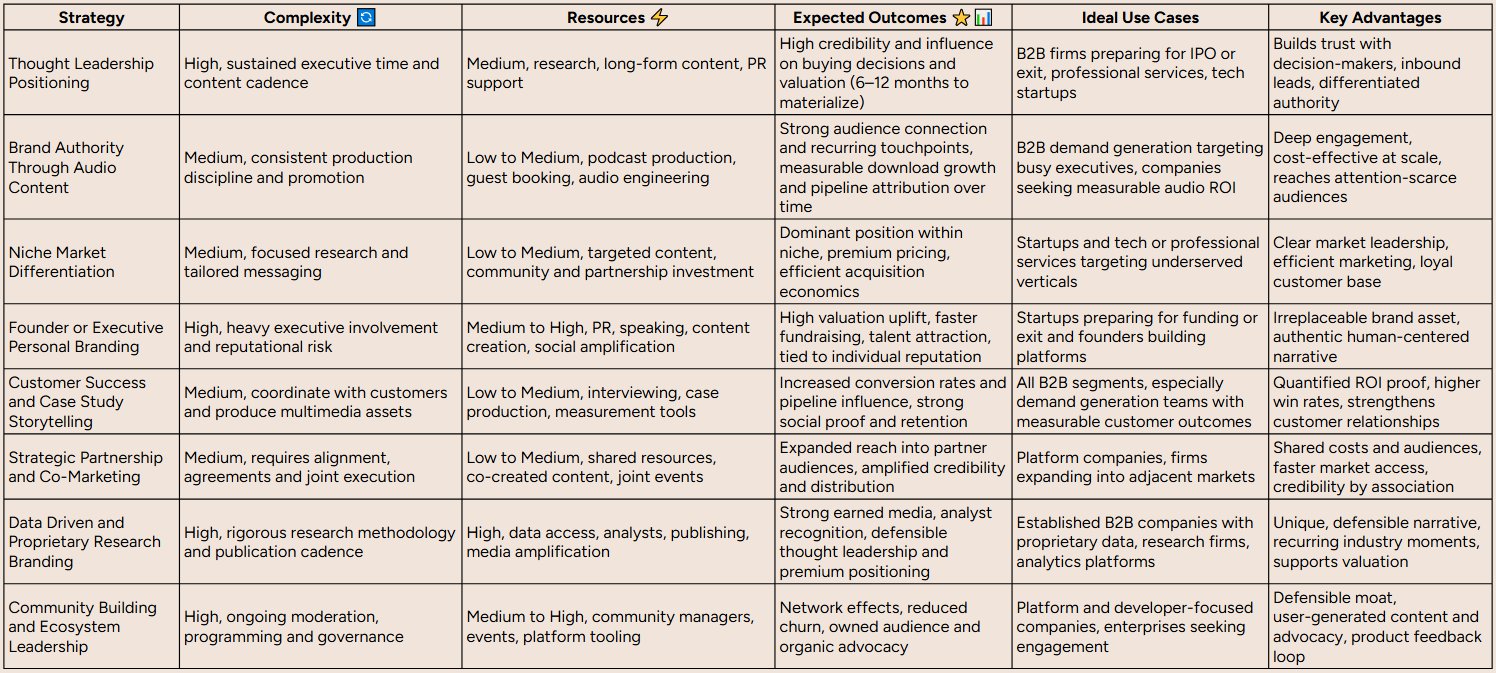
8-Point Branding Strategy Comparison
Turning Brand Strategy Into a Growth Engine with a B2B Podcast
The branding strategy examples we've explored, from establishing thought leadership to building a robust community, all share a common denominator: the need for a consistent, scalable platform to communicate value and build authority. While each strategy has its unique merits, they are all amplified by a single, powerful medium: the B2B podcast. This isn't just another content channel; it’s a strategic asset that transforms abstract branding goals into tangible market influence and a predictable growth engine.
A podcast serves as the ultimate "show, don't tell" vehicle for your brand. It allows you to move beyond static claims of expertise and actively demonstrate it. Through in-depth conversations with industry leaders, insightful analysis of market trends, and authentic storytelling, you educate your audience and build unparalleled trust. This consistent delivery of value is what separates market leaders from the competition. Every episode reinforces your position, making your brand synonymous with insight and innovation in your niche.
Synthesizing Strategy into Actionable Audio
Let’s recap how a podcast directly activates the strategies discussed in this article:
- Thought Leadership & Authority: A podcast is a dedicated stage for your experts to share their deepest insights, solidifying your company's position as the go-to resource in the industry.
- Niche Differentiation: In a crowded market, the unique perspective and voice of your podcast can carve out a distinct and memorable identity that resonates deeply with your ideal customer profile.
- Community Building: By featuring partners, customers, and industry peers as guests, you create an inclusive ecosystem around your brand, fostering loyalty and a sense of shared purpose.
- Customer Storytelling: Podcasts offer a dynamic and engaging format to share customer success stories, moving beyond flat case studies to create compelling, relatable narratives that drive social proof.
The true power lies in its function as a content engine. A single 45-minute podcast episode can be repurposed into dozens of high-value marketing assets. Think short video clips for LinkedIn, quote graphics for social media, detailed blog posts, and key takeaways for your email newsletter. This multi-channel amplification, managed by B2B social media agency services, ensures your core message reaches your audience on the platforms they prefer, maximizing your ROI and operational efficiency.
From Concept to Cornerstone Content
Launching a podcast can seem daunting, but the strategic payoff is immense. It's a long-term investment in building a durable brand asset that pays dividends in awareness, lead generation, and customer loyalty. The key is to approach it with a clear strategy from the start, focusing on a well-defined niche, high-quality production, and a consistent promotion plan. Beyond the initial launch, successfully turning brand strategy into a growth engine with a B2B podcast requires actionable insights on how to grow podcast audience and cultivate a dedicated listenership.
Ultimately, each branding strategy example shared in this article is about creating a connection and earning trust. A B2B podcast achieves this with unmatched authenticity. It allows your audience to hear the passion and expertise in your voice, creating a level of intimacy that other content formats simply cannot replicate. When your ideal clients are ready to make a purchasing decision, they won't just know your name; they will feel like they know you. That is the hallmark of a truly effective brand.
Ready to make a podcast the cornerstone of your brand strategy? At Fame, we specialize in helping B2B companies launch and scale authority-building podcasts that drive measurable business results. Our end-to-end production and promotion services turn your expertise into a powerful content engine, so you can focus on building relationships while we handle the rest.
