

Transitioning from a private company to a public entity is one of the most transformative and demanding journeys a business can undertake. It requires far more than a strong balance sheet; it demands a strategic, cross-functional overhaul of nearly every aspect of your operations. This isn't a race to the finish line, but a meticulous, multi-year marathon of preparation. A comprehensive ipo readiness checklist is your roadmap, guiding you through the complex maze of financial audits, governance restructuring, and crucial market positioning.
This guide moves beyond generic advice to provide a detailed, actionable blueprint for each functional leader in your organization. We will break down the entire process into specific, role-based stages, ensuring that your team understands not just what to do, but how and when to do it. From fortifying financial controls and establishing a public-company board to mastering your market narrative long before the roadshow, we'll equip you with the timelines, ownership assignments, and acceptance criteria needed for a successful public offering.
Think of this article as your operational manual for going public. We cover the critical milestones across Finance, Legal, HR, and Investor Relations, detailing common pitfalls to avoid along the way. Whether you are two years out or six months from ringing the bell, the insights here will help you navigate the path from private ambition to public reality with precision and confidence, ensuring every department is aligned and prepared for the scrutiny and opportunity that awaits.
1. Financial Audit and Clean Books
Your first non-negotiable step is a comprehensive financial audit. Appoint an independent, certified public accountant (CPA) firm to examine your company's financial statements. Their job is to ensure accuracy, completeness, and compliance with Generally Accepted Accounting Principles (GAAP) or International Financial Reporting Standards (IFRS). This rigorous process validates your financial health, internal controls, and historical performance for regulators, underwriters, and potential investors.
The SEC requires at least two years of audited financial statements, including balance sheets, income statements, and cash flow statements, as part of the S-1 filing. A cornerstone of IPO readiness is a comprehensive financial audit, which mandates a deep understanding of how to read company financial statements. For B2B companies, you must use this process to substantiate complex revenue recognition models, validate customer contracts, and prove the sustainability of recurring revenue streams.
Why It's Foundational for Your IPO
Clean, audited financials build immediate trust and credibility. They signal to the market that your company is mature, transparent, and operates with discipline. For instance, before its 2019 IPO, Datadog's consistently clean and audited financials, maintained throughout its hyper-growth phase, were instrumental in building the investor confidence needed for its successful public offering. This validation process uncovers and rectifies any accounting discrepancies or internal control weaknesses long before they can derail your IPO timeline or damage your reputation during the roadshow. For finance leaders navigating this complex period, sharing insights and strategies becomes key, a practice exemplified by top executives in the B2B space who often elevate their thought leadership through specialized platforms.
Actionable Tips for a Smooth Audit
- Engage an Audit Firm Early: Lock in an audit firm 12-18 months before your target IPO date. This gives you ample time to conduct audits for prior years and fix any issues without rushing.
- Select the Right Partner: Choose an auditor with deep expertise in your specific industry and a strong track record of taking companies public. Their familiarity with your business model will streamline the process.
- Create a "Deal Room": Set up a secure digital repository with all necessary documentation, including contracts, board minutes, equity grants, and detailed financial records, to give auditors efficient access.
- Perform a Pre-Audit Assessment: Before the formal audit begins, proactively identify and resolve potential problem areas, such as complex revenue recognition or stock-based compensation accounting.
2. Governance Structure and Board Composition
Your next critical action is to establish a professional board of directors that meets regulatory and investor expectations. This means creating a formal governance structure with independent directors and specialized committees. An IPO-ready board signals operational maturity, strategic oversight, and a commitment to protecting shareholder interests, moving the company from a private, founder-led entity to a publicly accountable organization.
Listing exchanges like Nasdaq and the NYSE have stringent requirements for board independence and committee composition, including audit, compensation, and nominating/governance committees. For B2B technology firms, you must build a board that acts as a powerful signal to the market. Stack your board with industry veterans, financial experts, and individuals with public company experience to demonstrate that the company is prepared for the scrutiny and strategic demands of the public markets.
Why It's Foundational for Your IPO
A strong, independent board builds institutional investor confidence and ensures robust oversight. It proves the company has the leadership to navigate market volatility, make sound strategic decisions, and adhere to complex regulatory requirements post-IPO. For example, before its successful 2021 IPO, HashiCorp methodically built a board with diverse expertise in open-source software and enterprise sales, which was crucial for articulating its long-term growth story to investors. A well-structured board acts as a crucial check and balance, holding management accountable and aligning company strategy with shareholder value, which is a non-negotiable for public company readiness.
Actionable Tips for Building Your Board
- Start Recruiting Immediately: Begin identifying and recruiting independent directors 18–24 months before your target IPO date. This provides sufficient time for vetting, onboarding, and integrating them into the company's strategic planning.
- Recruit Public Company Veterans: Actively seek directors with direct experience serving on public company boards, especially on audit committees. Their understanding of SEC reporting and Sarbanes-Oxley (SOX) compliance is invaluable.
- Document All Board Activities: Meticulously document all board meetings, decisions, charters, and actions. This creates a clear and defensible record for SEC review during the S-1 filing process.
- Match Expertise to Strategy: For B2B tech companies, ensure board members understand sector-specific dynamics, from enterprise sales cycles to recurring revenue models. Consider adding veterans who appreciate modern thought leadership strategies, like podcasting, to help guide market positioning.
3. Executive Leadership Team Maturity
Assemble a mature, stable, and experienced C-suite to signal operational readiness and strategic foresight to the market. This goes beyond titles; it's about recruiting leaders, particularly a CFO with public company experience, who can navigate the intense scrutiny, regulatory demands, and cyclical pressures of being a publicly traded entity. Investors and underwriters scrutinize the leadership team as a primary indicator of a company's ability to execute its long-term vision and manage investor capital effectively.
For B2B companies, you must present a seasoned executive team to validate the company's ability to scale complex operations, manage enterprise sales cycles, and maintain key customer relationships. Frequent turnover at the executive level is a major red flag, suggesting internal instability or a lack of strategic alignment. Assembling the right team well in advance is a cornerstone of any successful ipo readiness checklist, ensuring leaders are not only in place but also fully integrated and prepared to communicate a unified message to investors.
Why It's Foundational for Your IPO
A proven leadership team builds immense investor confidence. They are the stewards of the company's future, and their collective experience serves as a proxy for the company's potential to handle adversity and capitalize on opportunities. For example, before its IPO, Asana strategically hired CFO Tim Wan, who had prior experience leading a public company, to instill the financial discipline and reporting rigor required for the public markets. Similarly, Twilio’s appointment of a seasoned CFO was crucial for managing its hyper-growth trajectory post-IPO. This level of experience assures investors that the company has the expertise to manage financial planning, SEC compliance, and shareholder relations from day one.
Actionable Tips for Building Your Leadership Team
- Hire a Public-Ready CFO Immediately: Recruit a CFO with prior public company or significant IPO experience 18-24 months before your target IPO date. This gives them time to build out the finance function and internal controls.
- Confirm Founder and CEO Commitment: Ensure the founder and CEO are fully committed to the enhanced governance, transparency, and board oversight that comes with being a public company.
- Finalize Executive Agreements: Clearly document executive employment contracts, compensation, and severance packages to eliminate ambiguity and demonstrate stability to regulators.
- Design Long-Term Retention Plans: Create multi-year equity and retention packages that vest over time to prevent a talent exodus immediately following the IPO lock-up period.
- Set and Track Executive KPIs: Define and track key performance indicators (KPIs) for each executive to align their objectives with shareholder value and demonstrate a performance-driven culture. Prepare them for public-facing roles by enrolling them in executive communication training for media appearances.
4. Revenue Recognition and Accounting Policy Documentation
Your next task is to establish clear, well-documented accounting policies, particularly for revenue recognition under ASC 606. This standard governs how companies report revenue from contracts with customers, and compliance is mandatory. The action here is to create a comprehensive policy that outlines precisely how your company recognizes revenue across all product lines and contract types, ensuring it is defensible to auditors and the SEC.
This documentation is especially vital for B2B SaaS, professional services, and subscription-based businesses. You must address the complexity of these models, which often involve multi-year contracts, usage-based fees, and bundled services, as they will be under intense scrutiny. Failing to accurately document and apply ASC 606 can lead to significant IPO delays, financial restatements post-offering, and a severe loss of investor trust.
Why It's Foundational for Your IPO
Robust revenue recognition policies provide a transparent and consistent framework that proves the quality and predictability of your earnings. It moves your revenue from a simple number to a verifiable, repeatable process that investors can trust. For example, before their respective IPOs, companies like Datadog and Zoom meticulously documented their revenue practices for various contract types. This preemptive clarity eliminated potential concerns during due diligence and allowed them to present a clear, confident financial narrative to the market. Properly documented policies demonstrate operational maturity and strong internal controls, which are essential components of a successful IPO readiness checklist.
Actionable Tips for a Smooth Audit
- Conduct an ASC 606 Audit Now: Begin a thorough audit of your current revenue recognition practices against ASC 606 guidelines at least 12–18 months before your target IPO date. This identifies gaps early.
- Create a Detailed Policy Manual: Document every customer contract type and its corresponding revenue recognition treatment, including specific examples and edge cases. For deeper perspectives on optimizing revenue strategies, many B2B leaders find valuable discussions on platforms like The Revenue Insights Podcast.
- Embed Policies into Your Close Process: Build your revenue recognition guidance directly into your financial close process to ensure consistent application. Implement checklists and automated controls where possible.
- Train All Relevant Teams: Develop and deploy training materials for your sales, legal, and finance teams to ensure everyone understands how contract terms impact revenue recognition and compliance.
5. Internal Controls and SOX Readiness
Begin the multi-quarter effort of implementing robust internal controls over financial reporting (ICFR). This prepares your company for compliance with the Sarbanes-Oxley Act (SOX), specifically Sections 302 and 906, and eventually Section 404(b). Your task is to document, test, and maintain effective controls to prevent fraud, ensure data integrity, and prove your governance maturity to regulators and investors.
Becoming SOX-ready is non-negotiable. The framework ensures that financial statements are reliable and that management is accountable. For B2B companies with complex subscription models or multi-currency transactions, you must implement strong controls to validate revenue recognition and demonstrate operational discipline. This involves a rigorous cycle of identifying control gaps, designing new controls, testing their effectiveness, and documenting all evidence.
Why It's Foundational for Your IPO
Strong internal controls are the operational backbone that supports the financial claims you make to the public. They signal to the market that your company is not just growing, but growing responsibly and sustainably. For example, Atlassian's success hinged on building global SOX controls capable of supporting its vast international operations and complex multi-currency transactions. Similarly, HashiCorp established a modern, cloud-based control infrastructure that supported its hybrid workforce, demonstrating adaptability and security. This proactive effort builds investor confidence, minimizes the risk of financial restatements post-IPO, and lays the groundwork for scalable, long-term growth.
Actionable Tips for a Smooth SOX Implementation
- Launch Your SOX Assessment Immediately: Begin your SOX readiness assessment 18–24 months before your target IPO date. This marathon project requires significant time for gap analysis, remediation, and testing.
- Appoint a Dedicated Project Lead: Hire a Chief Audit Officer or a dedicated SOX compliance manager to own the process, coordinating between finance, IT, legal, and operations.
- Implement the COSO Framework: Adopt the Committee of Sponsoring Organizations (COSO) framework to provide a structured, recognized standard for evaluating and designing your internal controls.
- Use a Centralized Documentation Tool: Employ a centralized repository like Workiva or Tableau to document all controls, test scripts, and evidence. This creates a single source of truth for management and auditors.
- Execute Quarterly Control Testing: Conduct control testing every quarter to identify and fix issues early. This iterative process prevents last-minute scrambles and demonstrates a proactive compliance culture.
6. Intellectual Property Protection and Documentation
Execute a comprehensive audit and secure rigorous protection of your intellectual property (IP). This means you must identify, document, and legally protect all intangible assets that create your competitive moat, including patents, trademarks, copyrights, and trade secrets. For potential investors, a well-defended IP portfolio is a powerful indicator of a company's long-term value, innovation, and market defensibility.
This process requires a strategic approach to demonstrate clear ownership and freedom to operate. For B2B technology companies, define your core IP, whether it's proprietary algorithms, platform architecture, or unique data processing methods. For a B2B agency like Fame, IP extends to its proprietary software platforms like Fame Host, its documented content frameworks, and its unique production processes. Properly securing these assets, including understanding creative ownership through concepts like podcast copyright laws, is essential to substantiating your company’s valuation.
Why It's Foundational for Your IPO
A strong IP portfolio directly supports your company's valuation and minimizes investor risk. During due diligence, underwriters and their legal teams will scrutinize your IP to ensure you truly own your core technology and that there are no hidden infringement liabilities. For example, before its IPO, Datadog's extensive patent portfolio protecting its cloud monitoring algorithms was key to justifying its market leadership and valuation. Similarly, Figma’s ability to clearly document and defend the patents and trade secrets behind its collaborative design platform was fundamental to achieving its multi-billion-dollar valuation. This proactive IP management assures investors that your revenue streams are protected from competitors and legal challenges.
Actionable Tips for a Smooth IP Audit
- Launch a Formal IP Audit: Begin a formal IP audit 18–24 months before your target IPO date. Use this time to file new patents, resolve ownership disputes, and conduct a thorough freedom-to-operate analysis.
- Retain Specialized IP Counsel: Hire a law firm with deep expertise in IP law and a track record of taking tech companies public. They can navigate the complexities of patent and trademark prosecution.
- Audit All Employee and Contractor Agreements: Ensure every employee and contractor has signed robust invention assignment and confidentiality agreements. This prevents future claims that former team members own a piece of your core technology.
- Document and Protect Trade Secrets: Meticulously document your trade secrets and implement strict protocols to protect them. Crucially, execute the Registration of Trademarks for your brand names, logos, and taglines in all key markets to build a defensible brand.
7. Customer Concentration and Revenue Quality Analysis
Conduct a detailed analysis of your customer concentration and revenue quality. This requires a deep dive into your customer base to assess dependencies, revenue diversity, and the overall health of your client relationships. Your goal is to prove to investors and underwriters that your revenue is not just growing, but is also stable, predictable, and sustainable, without over-reliance on a small number of customers.

For B2B companies, your action item is to identify your top 10-20 customers and document their churn patterns, contract terms, and expansion history. Go beyond simple revenue figures: calculate and track key SaaS metrics like customer acquisition cost (CAC), lifetime value (LTV), and dollar-based net retention rate. You must use these metrics to build a quantifiable narrative about the efficiency of your growth engine and the long-term value of your customer base.
Why It's Foundational for Your IPO
Demonstrating low customer concentration and high-quality revenue builds powerful investor confidence. It signals a resilient business model that isn't vulnerable to the loss of a single client. For example, before its IPO, Datadog successfully showcased its low customer concentration by highlighting a base of over 2,000 enterprise customers, proving its growth wasn't dependent on a few key accounts. Similarly, Slack mitigated concerns by documenting a strong net retention rate exceeding 120%, showing that existing customers were not only staying but also significantly increasing their spending over time. This data-driven proof of a healthy, diversified, and loyal customer base is essential for a successful roadshow and a strong public market debut.
Actionable Tips for a Smooth Analysis
- Implement Robust Analytics Now: Begin tracking customer analytics and performing segmentation 18-24 months pre-IPO. This provides a rich historical dataset to build your narrative.
- Calculate and Monitor Key Metrics Monthly: Consistently track CAC, LTV, and net retention rates. Present this data in a clear dashboard for your board and potential investors.
- Execute a Proactive Retention Strategy: Identify customers at risk of churn and implement targeted retention campaigns. Document customer success stories and prepare case studies for the roadshow.
- Prove Client Health with Data: For service-based B2B firms, demonstrate high customer retention rates (ideally 80%+), significant expansion revenue from existing clients, and customer diversity across various industries to prove market-wide appeal.
8. Market Positioning, Thought Leadership, and Investor Relations Readiness
Your final strategic task is to build a robust IPO narrative long before the S-1 filing. Root this narrative in strong market positioning, influential thought leadership, and a meticulously planned investor relations (IR) strategy. You must shape a compelling story about your company's value, differentiation, and future potential that resonates with analysts, institutional investors, and the broader market. This transforms your operational success into a powerful investment thesis, building credibility and demand well ahead of the roadshow.
For B2B companies, establishing authority within your niche is critical; it directly impacts valuation and analyst coverage. This action item requires you to craft your external narrative while building the internal machinery for public company communications, including disclosure controls and processes for earnings calls, investor meetings, and ongoing SEC filings. This alignment ensures your story is compelling, consistent, and compliant.
Why It's Foundational for Your IPO
A strong market position and established thought leadership create a premium valuation narrative. When investors already recognize you as a leader, the IPO becomes a validation of existing success rather than a speculative bet. For example, HashiCorp systematically built its reputation as the leader in infrastructure automation through developer-focused content and major conference presence, which directly supported its premium valuation at IPO. A prepared IR function ensures this narrative is seamlessly transitioned to public market communication, preventing missteps that could damage credibility. This strategic communication is central to effective brand positioning strategies that captivate both customers and investors.
Actionable Tips for a Smooth Rollout
- Execute Your Thought Leadership Strategy Now: Begin your executive visibility and thought leadership plan 24-36 months pre-IPO. Secure speaking slots, publish proprietary research, and build analyst relationships.
- Hire an Investor Relations Lead: Bring on a VP of Investor Relations or an external IR advisor 12-18 months before your target IPO date to develop messaging, prepare the CEO/CFO, and establish disclosure protocols.
- Launch a Branded Podcast: Use a branded podcast to showcase executive insights, customer success stories, and market trends. For B2B firms, partnering with specialized agencies like Fame can accelerate this process and build a library of content that substantiates your market leadership for investors.
- Form a Disclosure Committee: Create a formal committee and process to review all material public communications, from press releases to earnings scripts, to ensure accuracy and compliance.
- Measure and Report on Authority Metrics: Track metrics from thought leadership efforts (e.g., share of voice, analyst report mentions, podcast downloads) and be prepared to communicate this ROI to investors as a leading indicator of market dominance.
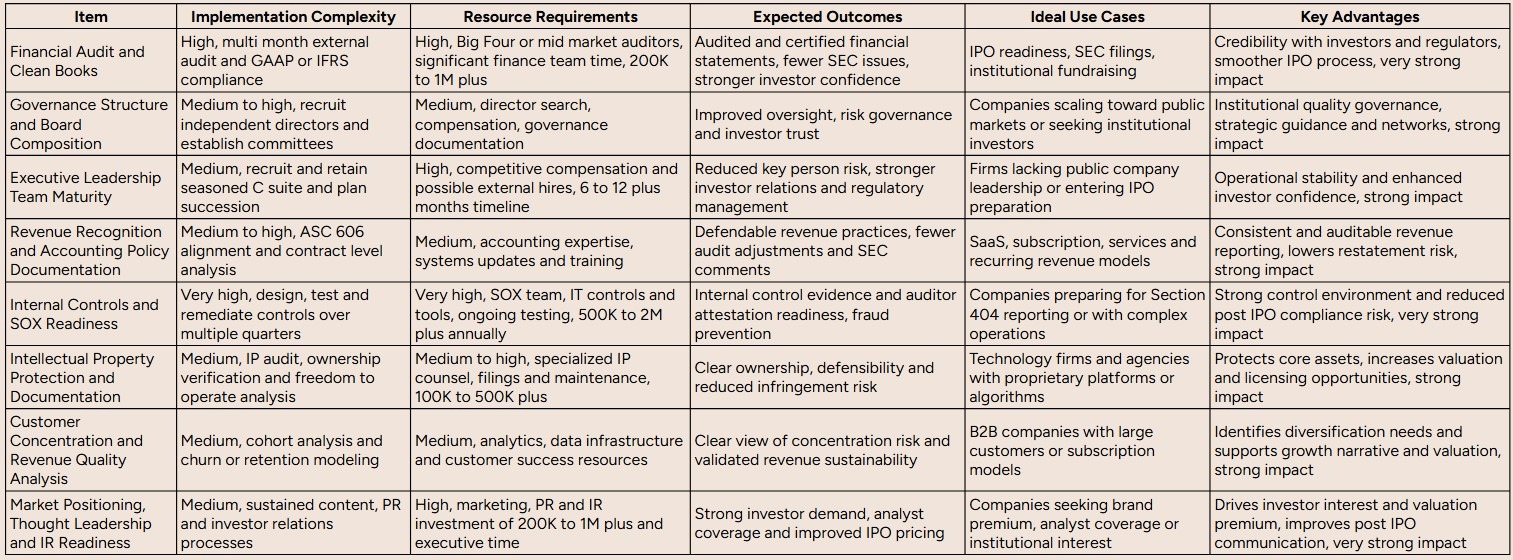
8-Point IPO Readiness Comparison
Beyond the Bell: Turning Your IPO into a Growth Engine
The journey to an Initial Public Offering is less a sprint and more a strategic marathon. Completing the comprehensive ipo readiness checklist detailed in this article is not the finish line; it’s the starting block for your new life as a public company. The exhaustive preparations across finance, legal, operations, and marketing are not just hurdles to clear for a successful listing. They are the foundational pillars that will support sustainable, long-term growth and build enduring investor trust.
Think of the IPO as a transition, not a destination. The rigorous discipline you instill today, from achieving audit-ready financials to establishing robust internal controls, becomes your company's operational muscle for the future. The transparency you cultivate in your corporate governance and the clarity you build in your market narrative become your greatest assets in the public markets. These elements are what separate a fleeting, successful IPO event from a legacy of market leadership.
From Checklist to Corporate DNA
The most successful public companies internalize the principles of IPO readiness, embedding them deep within their corporate culture. The process of preparing for an IPO forces a level of introspection and operational excellence that is difficult to replicate. It compels you to scrutinize every aspect of your business, from customer concentration risks to the defensibility of your intellectual property.
The key takeaway is to view this checklist not as a one-time project, but as the blueprint for your new standard of operations.
- Financial Rigor: Your commitment to clean books, precise revenue recognition, and SOX-compliant controls doesn't end on listing day. It becomes the bedrock of predictable, transparent quarterly reporting that builds and maintains shareholder confidence.
- Strategic Governance: A diverse, independent board and a mature executive team are not just for show during the roadshow. They are the strategic navigators who will guide the company through market cycles, competitive threats, and new growth opportunities.
- Narrative Control: The market positioning and thought leadership works you do pre-IPOsets the stage for your ongoing investor relations and communications strategy. A powerful, consistent narrative helps insulate your company from short-term market volatility and attracts long-term, institutional investors who believe in your vision.
Key Insight: The true value of the IPO readiness process lies in the transformation it forces upon your organization. It molds you into a more disciplined, transparent, and strategically focused entity capable of thriving under the scrutiny of public markets.
Your Actionable Next Steps: Beyond the Audit
As you move forward, the focus must shift from preparation to execution. The systems, processes, and narratives you've built are now ready to be activated. Don't let the momentum wane after the bell rings.
- Institutionalize Your Controls: Conduct regular internal audits and stress tests of your SOX controls. Ensure that the discipline established by your finance team permeates every department.
- Activate Your Board: Move beyond compliance-focused board meetings. Leverage your directors' expertise for strategic planning, network access, and mentorship of the executive team.
- Amplify Your Story: Double down on your communications strategy. Your narrative is a living entity that must be nurtured through consistent thought leadership, proactive investor engagement, and clear, transparent communication during earnings calls and industry events. This is where a strategic content engine, like a B2B podcast, becomes invaluable for maintaining market presence and shaping perception.
Mastering this ipo readiness checklist is about more than just a successful listing; it’s about architecting a company built for enduring success. By embracing the discipline and strategic foresight demanded by this process, you transform a single liquidity event into a powerful, perpetual engine for innovation, market leadership, and exceptional value creation.
Ready to build the market-defining narrative that captivates investors and sets you apart in the public markets? Fame helps B2B companies launch ROI-positive podcasts that drive thought leadership and build unshakeable brand authority, a critical asset in your IPO journey. Discover how to own your story at Fame.
