November 28, 202615 min read15 sections
The State of Podcast Guesting 2027: What 22,084 Podcast Pitches Taught Us
Short answer
We logged 22,084 podcast pitches for 272 guests, mostly B2B founders and executives, between 2020 and 2026. Podcast guesting still works: 16.6% of pitches became a booked interview. But hosts are harder to reach. Reply rates fell from 56.5% in 2021 to 30.6% in 2026, and it now takes about 14 pitches to land one interview.
By Tom Hunt, Founder & CEO, Fame
Tom founded Fame in 2019 and leads the company today, including Fame Search, its AI search agency for B2B companies. LinkedIn
Key findings
- We logged 22,084 podcast pitches to 10,972 shows for 272 guests, mostly B2B founders and executives, between March 2020 and November 2026.
- 44.6% of pitches got a reply, and 16.6% became a booked interview.
- Reply rates fell from 56.5% in 2021 to 30.6% in 2026.
- It took about 4 pitches to land one interview in 2021 and about 14 in 2026.
- 55.4% of pitches got no response at all, while only 14.6% were declined.
- The median interview was published 84 days after the pitch was sent.
- 51.9% of 7,305 active business podcasts are guest-driven, and 85.5% published a guest episode in the last 90 days.
- Smaller shows are more open: 54% of shows with 1 to 9 Apple ratings are guest-driven, against 38.7% of shows with 1,000 or more.
We once wrote a post on how we get a reply rate above 50% from podcast hosts.
It was true when we wrote it. In 2021, 56.5% of our pitches got an answer.
This year it was 30.6%.
We know because we have kept a record of every pitch Fame Connect has sent since March 2020: which show, when, whether the host replied, and whether it turned into an interview. That is 22,084 pitches to 10,972 shows, on behalf of 272 guests, most of them B2B founders and executives.
So we did two things. We analysed our own pitch log. And we crawled 11,141 business podcasts to see how many actually take guests, how often, and what kind of show says yes.
This report is for founders, executives and marketers who want to get booked on podcasts, and for anyone who needs real podcast guesting statistics. Every number comes from one of those two datasets. Where the data is weak, we say so.
Podcast guesting statistics at a glance
Podcast guesting still works, and there are plenty of shows that want guests. What has changed is how many pitches it takes.
| Statistic | Figure | Dataset |
|---|---|---|
| Pitches analysed | 22,084, to 10,972 shows | Fame Connect, 2020 to 2026 |
| Reply rate | 44.6% | Fame Connect |
| Booking rate | 16.6% of pitches with a known outcome | Fame Connect |
| Reply rate, 2021 against 2026 | 56.5% against 30.6% | Fame Connect |
| Pitches per booked interview, 2021 against 2026 | About 4 against about 14 | Fame Connect |
| Median time from pitch to published episode | 84 days | Fame Connect |
| Business podcasts that are guest-driven | 51.9% | Public data, 7,305 active shows |
| Shows that published a guest episode in the last 90 days | 85.5% | Public data |
| Guest episodes published each week | About 3,600 | Public data |
| Median episode length | 34 minutes | Public data |
How we did this, in short
Two datasets: our own pitch log, and a crawl of public podcast feeds.
- Fame Connect data. Every pitch logged in our booking worksheets from March 2020 to November 2026. One row per pitch. Guests and hosts are anonymous.
- Public data. 11,141 English-language business podcasts, taken from Apple Podcasts charts in 10 countries plus keyword searches, crawled on 28 November 2026. Of those, 7,305 are active, meaning they published in the last 90 days. We read each show's public feed and classified every episode as guest or not.
Three things to keep in mind as you read.
Our pitch data is one agency's record, not the whole industry. The public sample is charts plus searches, not a random sample of all podcasts. And the guest classifier is a set of rules that was about 84% accurate on a spot check.
The full methodology and limitations are at the end.
Finding 1: reply rates have nearly halved since 2021
In 2021, 56.5% of our pitches got a reply. In 2026 it was 30.6%.
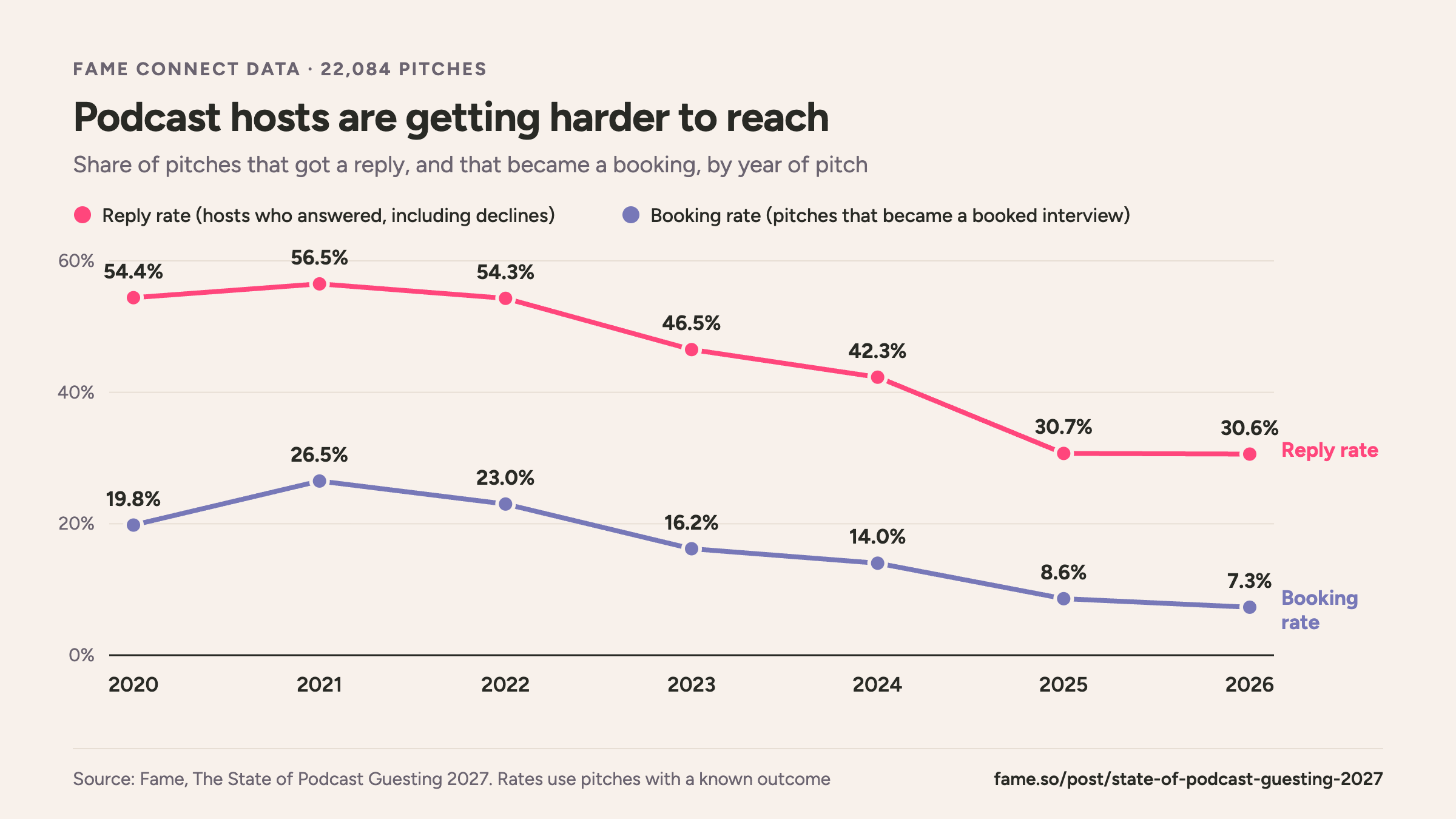
A reply here means the host answered at all. A "no" counts. So does "come back in the spring".
For three years the reply rate barely moved: 54.4%, 56.5%, 54.3%. Then it dropped every year from 2023, and fell hardest between 2024 and 2025.
Bookings followed.
| Year of pitch | Pitches | Reply rate | Booking rate, all pitches | Booking rate, known outcomes |
|---|---|---|---|---|
| 2020 (from March) | 1,114 | 54.4% | 14.9% | 19.8% |
| 2021 | 4,285 | 56.5% | 15.9% | 26.5% |
| 2022 | 4,206 | 54.3% | 23.0% | 23.0% |
| 2023 | 2,811 | 46.5% | 16.2% | 16.2% |
| 2024 | 2,848 | 42.3% | 14.0% | 14.0% |
| 2025 | 3,569 | 30.7% | 8.6% | 8.6% |
| 2026 (to November) | 2,424 | 30.6% | 7.3% | 7.3% |
Why two booking columns? In 2020 and 2021 a lot of pitches were logged without a final outcome. Counting them as "not booked" makes those years look worse than they were. The right-hand column leaves them out, and it is the one in the chart.
Why did it happen?
We cannot prove a cause from this data. We can tell you what we think. More people are pitching podcasts than in 2021, and a lot of those pitches are now written by software. A host with a much fuller inbox answers less of it.
It may also be partly us. The mix of guests and shows we pitch has changed over six years. So read this as what happened to one busy booking team, not as a measurement of every inbox.
Finding 2: it now takes about 14 pitches to land one interview
In 2021 one interview took about 4 pitches. In 2026 it took about 14.
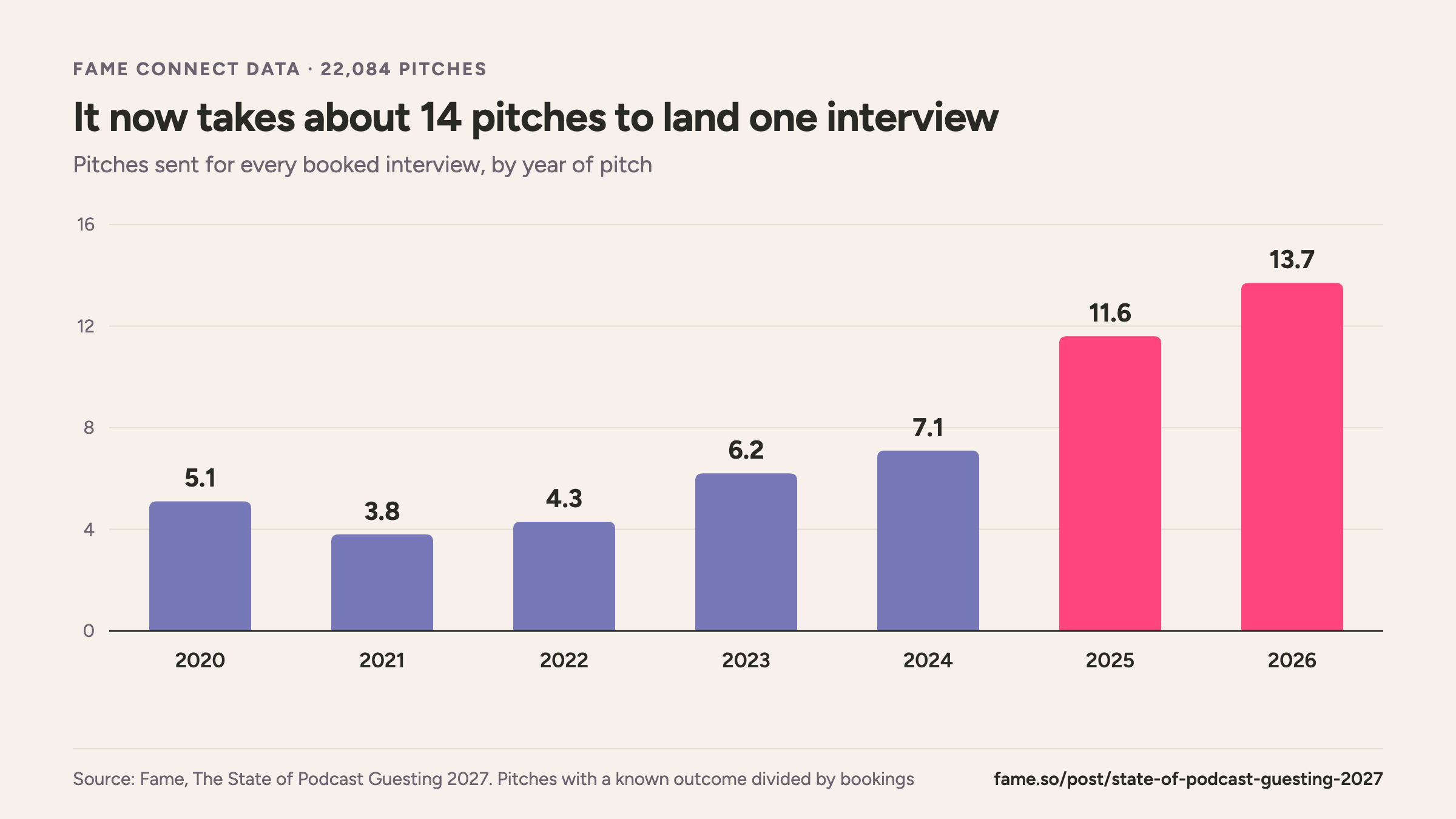
This is the booking rate turned upside down, which makes it easier to plan with.
Across all six years the figure is about 6 pitches per booking. But nobody is pitching in 2021 any more. If you are planning for 2027, use 14.
That changes the sums. Two interviews a month used to mean about eight pitches. Now it means about 28. Each one needs a show found, a host identified and a reason that host should care.
The work per interview has more than tripled. The value of the interview has not changed.
Finding 3: most pitches are met with silence, not rejection
55.4% of pitches got no response at all. Only 14.6% got a "no".
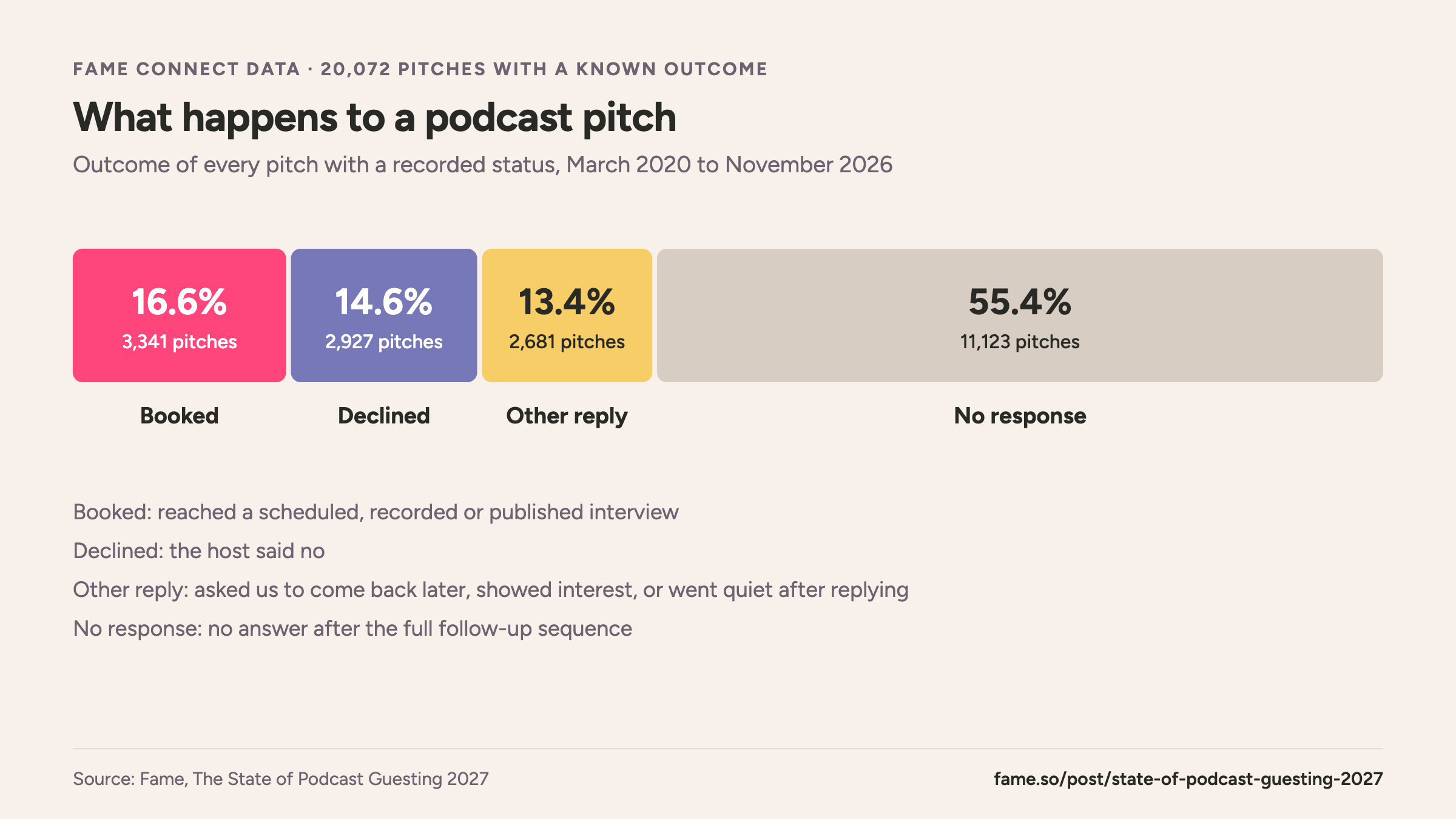
This is across all six years, for the 20,072 pitches where we know what happened.
Two things stand out.
Hosts rarely say no. They are nearly four times as likely to say nothing. So silence tells you very little about whether the pitch was a good fit. It mostly tells you the host is busy.
And a reply is most of the battle. Of the 8,949 pitches that got any answer, 3,341 ended in a booked interview. That is 37%. Once a host is talking to you, the odds are decent.
One more number, for anyone wondering whether it works at all: 240 of the 272 guests in this data were booked on at least one show.
Finding 4: it takes 12 weeks from pitch to published episode
The median interview was recorded 54 days after the pitch and published 84 days after it.
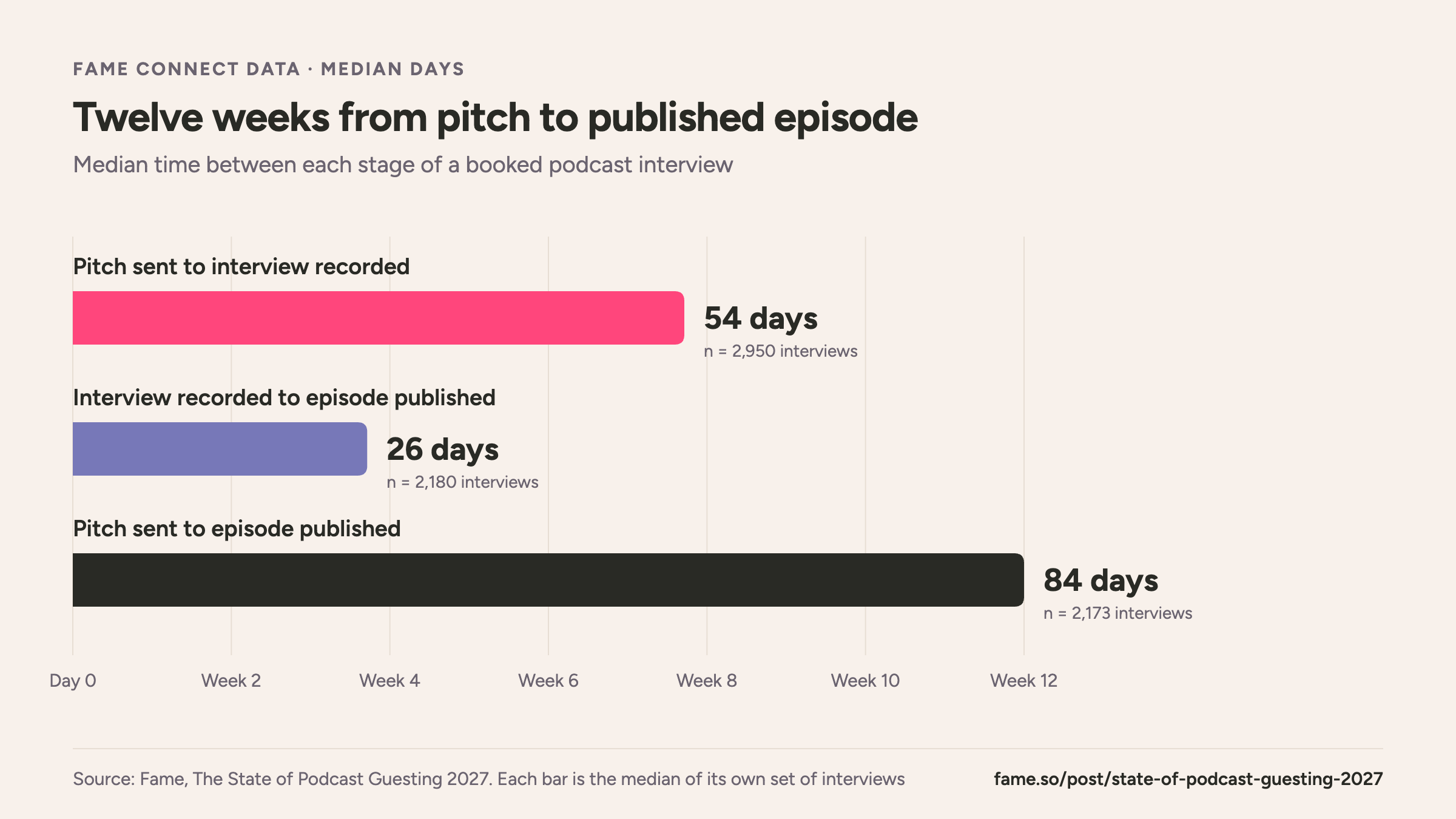
So about eight weeks to get in the diary and record, then nearly four more for the host to edit and release it.
The three figures do not add up exactly, because each is the median of its own set of interviews. Not every booking has all three dates recorded.
The practical point is simple. If you want to be on podcasts when your product launches in June, the pitches need to go out in early March.
We go into what to expect month by month in how long podcast guesting takes to work.
Finding 5: there is no shortage of shows that want guests
51.9% of active business podcasts are guest-driven, and 85.5% published at least one guest episode in the last 90 days.
So the problem is not supply.
We counted a show as guest-driven if at least half of its recent episodes featured a guest. That is just over half of the 7,305 active shows. Widen it to "has had a guest lately" and it is nearly nine in ten.
Between them, those shows published about 3,600 guest episodes a week. That works out at 2.2 guest episodes per show per month.
It is not just small shows either. The 1,402 active shows that rank in the top 50 of an Apple chart in any of the ten countries published about 1,000 guest episodes a week between them.
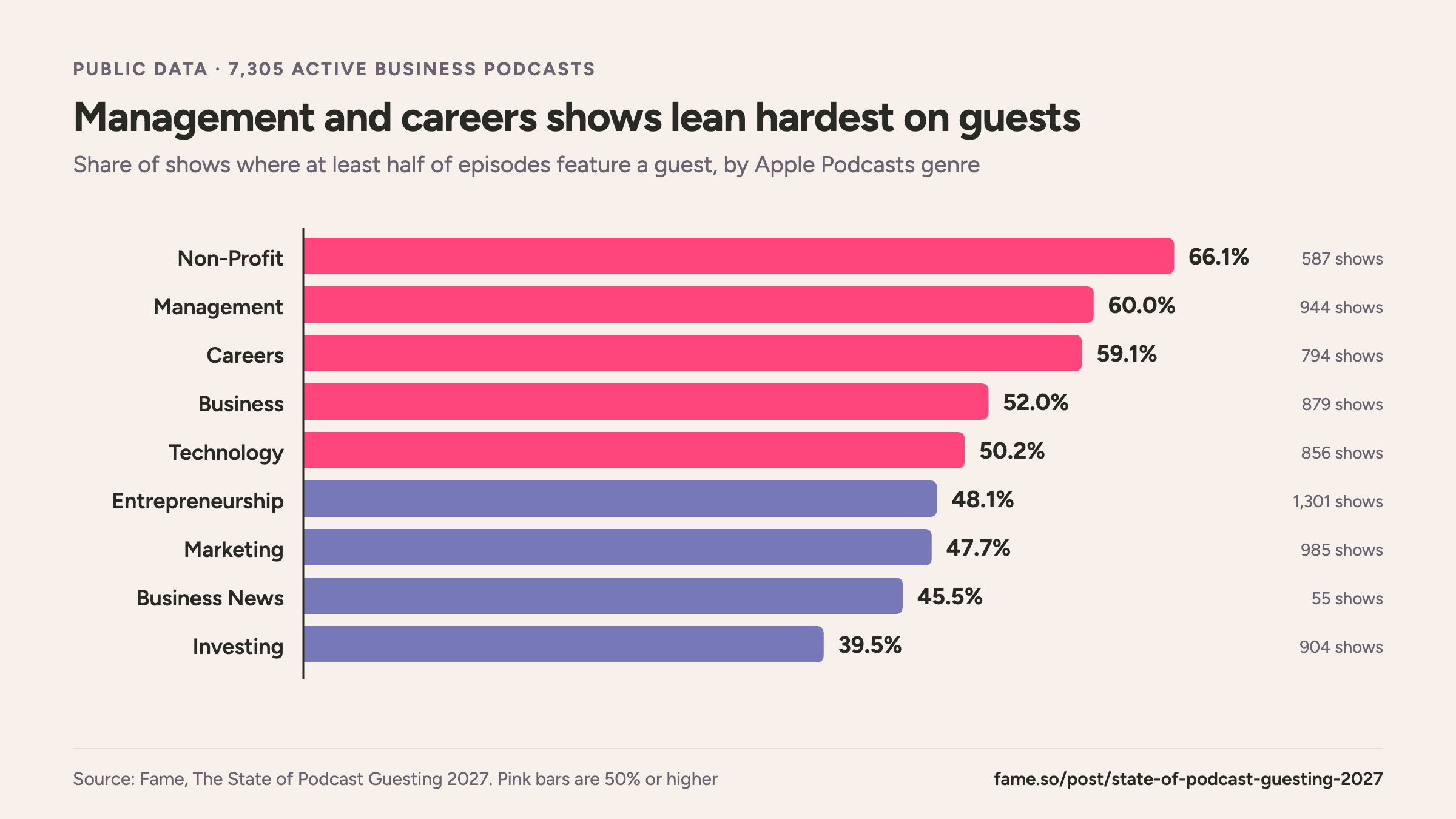
By genre, management and careers shows lean hardest on guests, at about 60%. Investing shows are the least likely to, at 39.5%. We suspect that is because many of them are a host talking through the markets. Business News has only 55 shows in the sample, so treat that bar with care.
Put findings 1 and 5 side by side. Thousands of guest slots open every week, and hosts answer fewer pitches than they used to. The slots are being filled. They are just not being filled from the cold inbox as often.
Finding 6: smaller shows are more open to guests
54% of shows with 1 to 9 Apple ratings are guest-driven, against 38.7% of shows with 1,000 or more.
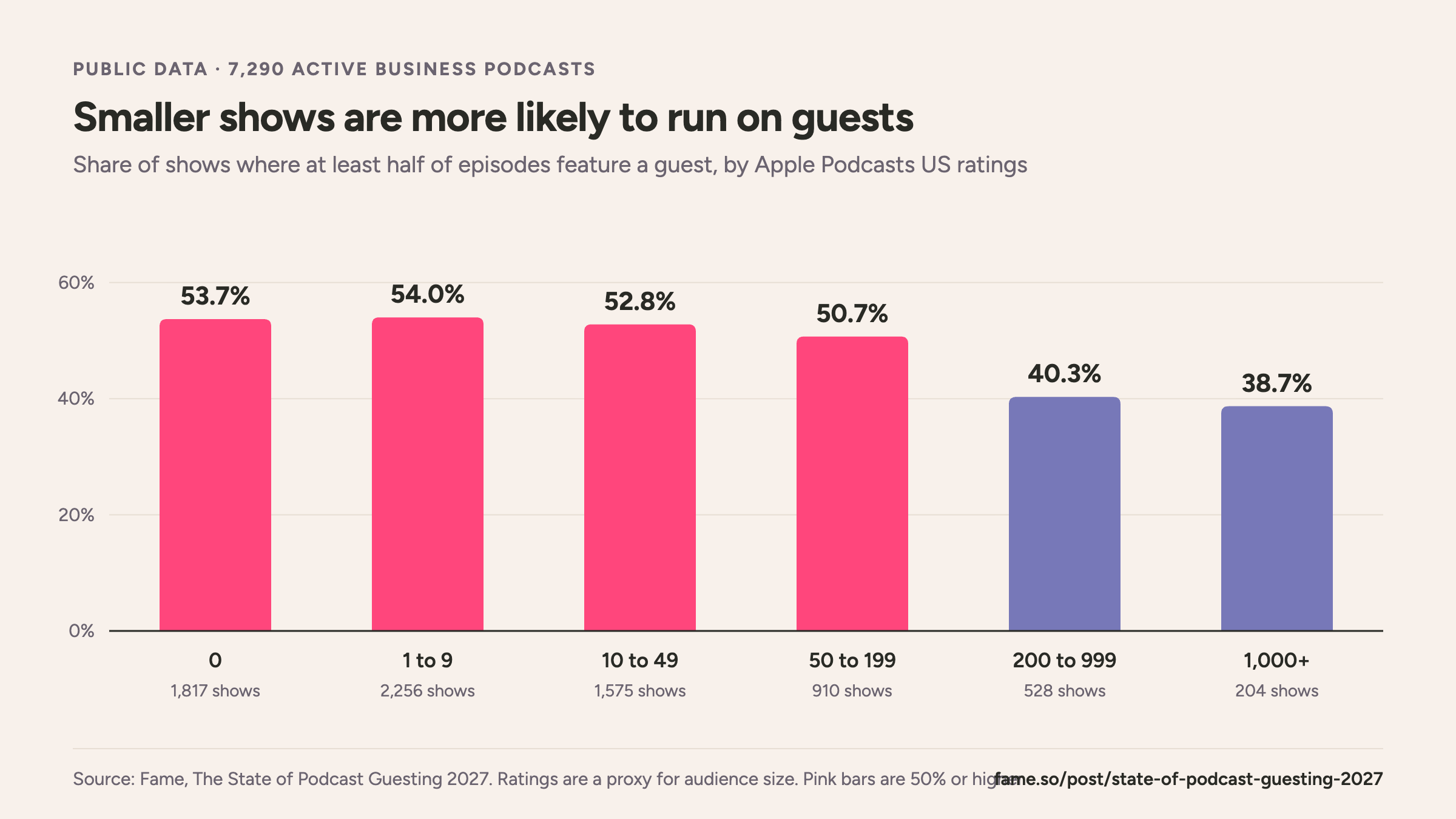
We used the number of ratings on Apple Podcasts in the US as a rough guide to audience size. It is not a download count, but it sorts shows into small, medium and large well enough.
Up to about 200 ratings, a little over half of shows run on guests. Above that it drops to about four in ten. Big shows are more often built around the host.
Our own pitch log points the same way. Where we recorded a show's size at the time we pitched it, the smaller shows answered more often.
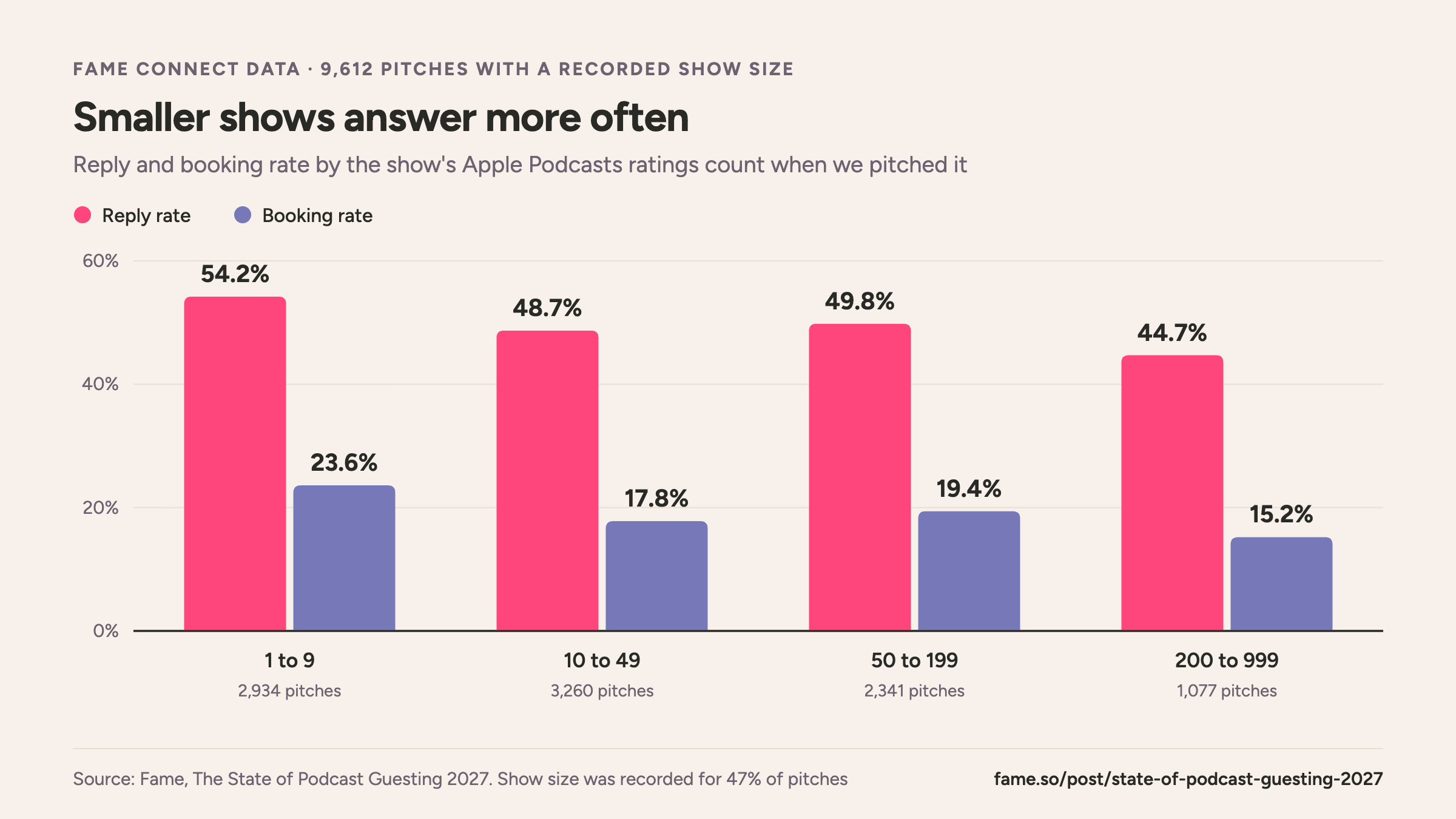
| Show size when pitched | Pitches | Reply rate | Booking rate |
|---|---|---|---|
| 1 to 9 Apple ratings | 2,934 | 54.2% | 23.6% |
| 10 to 49 | 3,260 | 48.7% | 17.8% |
| 50 to 199 | 2,341 | 49.8% | 19.4% |
| 200 to 999 | 1,077 | 44.7% | 15.2% |
A caution on that table. We only recorded show size for 47% of pitches, and the rows cover all six years together. We left out shows with more than 1,000 ratings because we only have 30 pitches to them, which is too few to say anything.
Should you only pitch tiny shows, then? No. A show with eight ratings may have very few listeners. But the best odds are in the middle: shows with a real audience in your niche that are not yet famous enough to be buried in pitches. Our guide to finding the podcasts your buyers listen to covers how to pick them.
Finding 7: the more often a show publishes, the less it needs you
68% of shows that publish less than once a month are guest-driven, against 29.7% of shows that publish eight or more times a month.
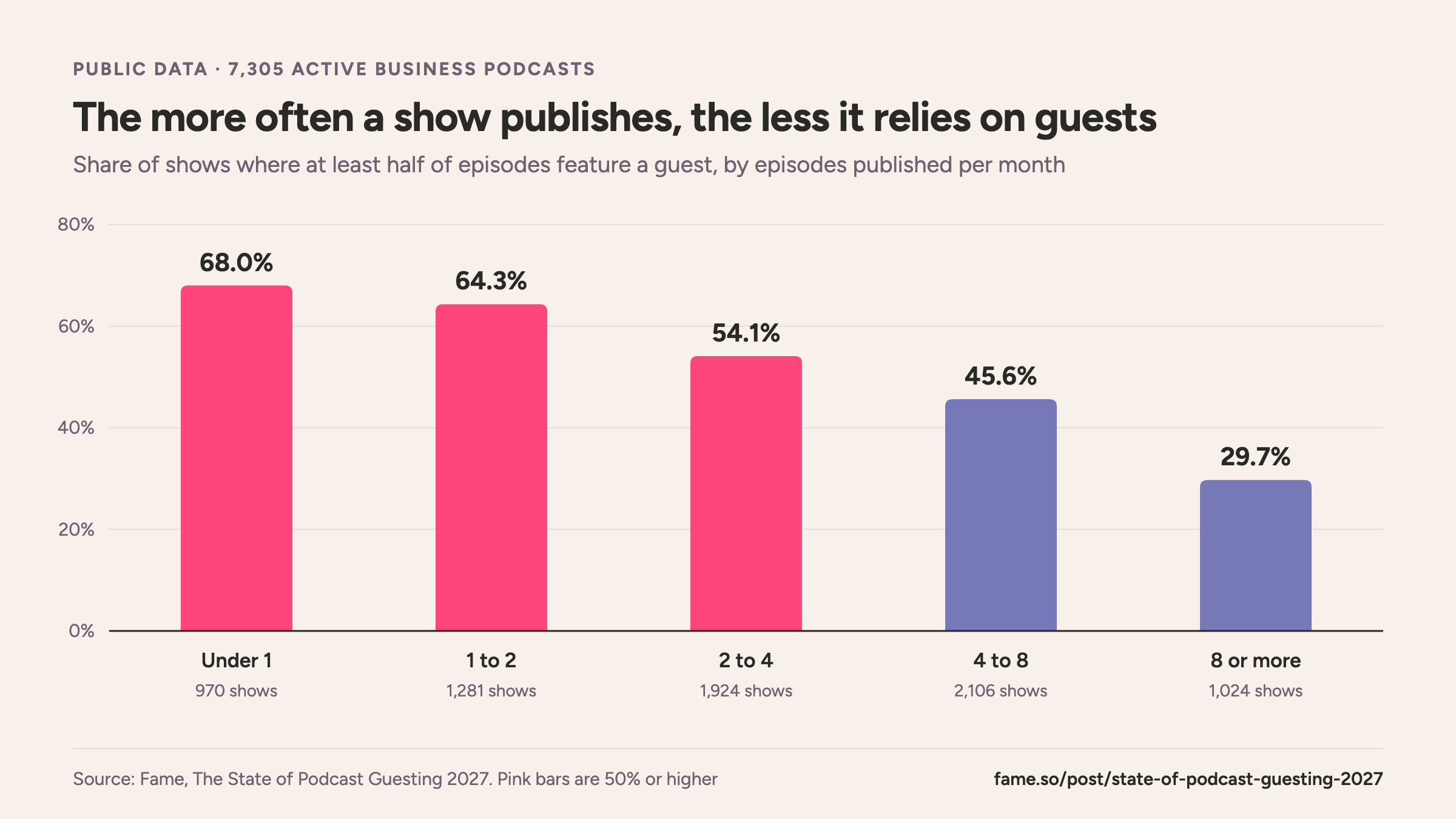
This surprised us a little. You might expect a daily show to be hungry for guests.
It is the other way round. In our experience, shows that publish twice a week or more tend to be news, commentary or a host working alone. Shows that publish once or twice a month are much more likely to be an interview each time.
There is a catch. A daily show that is only 30% guests still has more guest slots in a month than a monthly show that is all guests. The busiest shows in our sample averaged 6.3 guest episodes a month each. So frequent shows are not a bad target. They are just less likely to be interview shows in the first place, so check before you pitch.
Finding 8: guest episodes run 13 minutes longer
The median episode on a guest-driven show is 39 minutes, against 26 minutes on other shows.
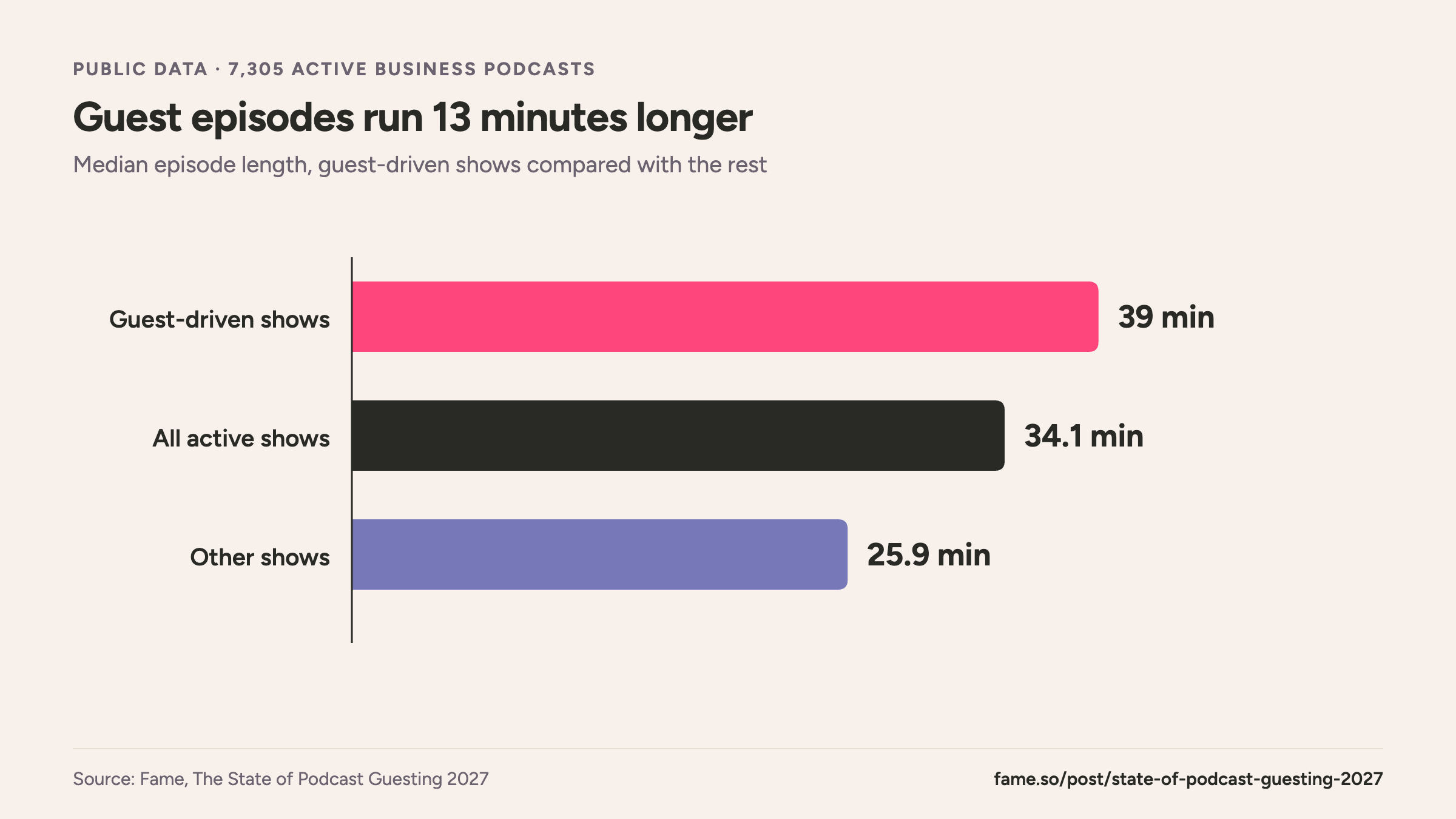
Across all active business podcasts the median is 34 minutes.
For a guest, that is useful to know. A typical interview gives you about forty minutes of a host's attention and their audience's. That is a lot longer than any advert, and long enough to explain something properly. It is also not long. Have your three points ready. Our guide on how to prepare for a podcast interview will help.
Finding 9: almost no show tells you how to pitch it
Only 1.9% of shows link to a guest or pitch page from their homepage.
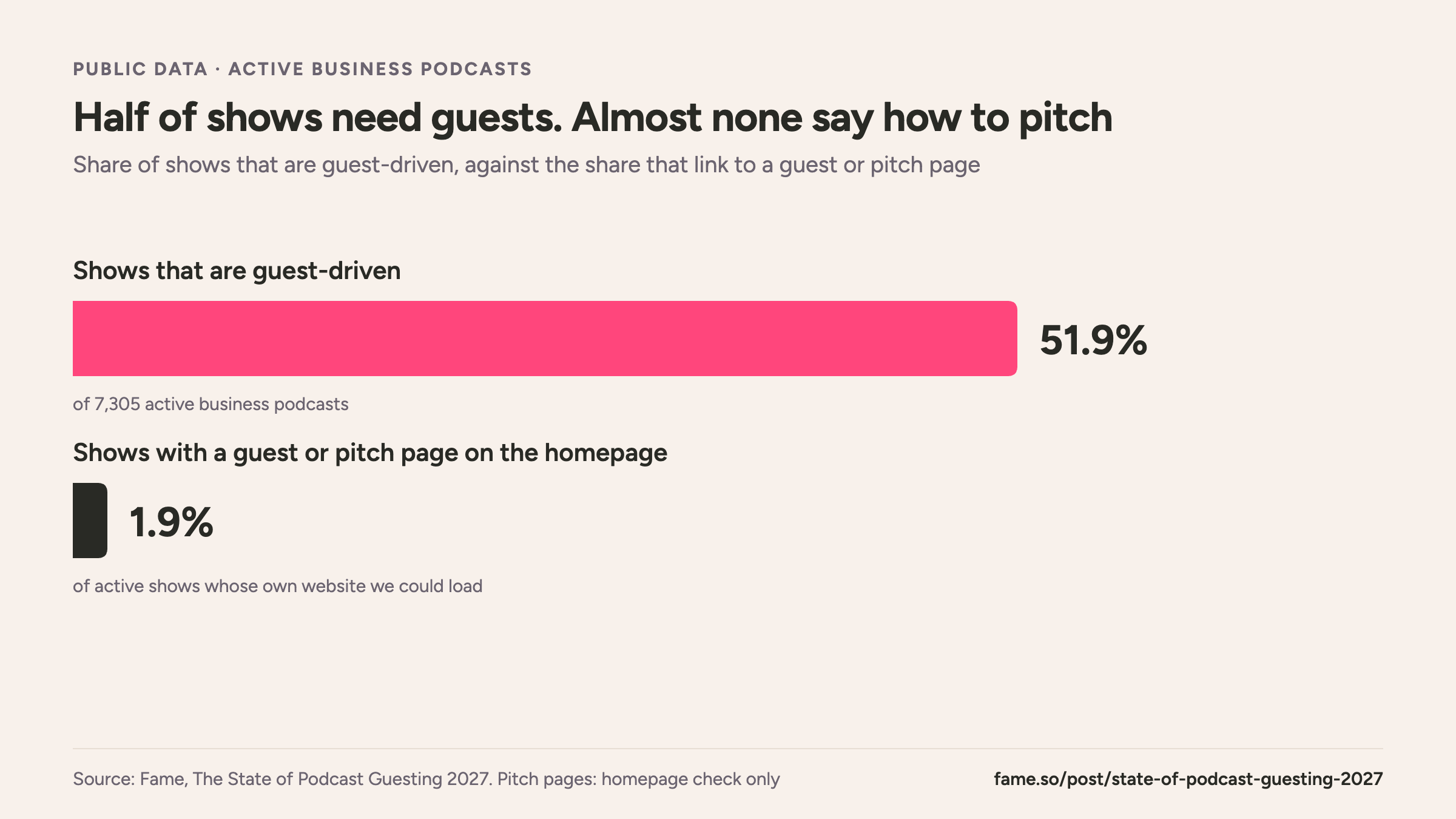
Among guest-driven shows it is 2.7%.
That figure is too low, and we know it. We only checked each show's homepage, not its contact page or its footer, and we could only check shows that have their own website. A show can take guests without saying so on the front page.
But the direction is clear enough. More than half of business podcasts depend on guests, and hardly any make it obvious how to become one. There is no front door. You have to find the host and write to them, which is why so much of the work in getting booked is research and not writing.
What this means if you want to be a podcast guest
Podcast guesting works about as well as it ever did once a host replies. Getting the reply is what got harder, so plan for more pitches, an earlier start and better-chosen shows.
Plan on 14 pitches for every interview
If you want two interviews a month, that is about 28 well-researched pitches a month. Budget the time, or the help, on that basis and not on what worked in 2021.
Start three months before you need it
The median episode goes live 84 days after the pitch. Work back from your launch, your funding round or your conference, and start then.
Pitch the middle of the market
Smaller shows are more likely to take guests and more likely to answer. Look for shows with a real audience in your niche that publish a few times a month and already run interviews.
Do not read silence as rejection
Hosts ignore nearly four pitches for every one they turn down. A pitch that gets no answer was probably never weighed up. Move on to the next show without changing your whole approach.
Treat any reply as an opening
More than a third of pitches that got any reply at all ended in a booking. If a host says "not now", ask when.
Find the person, not the form
Almost no show has a pitch page on its homepage. Work out who decides, and write to them about their audience and not about you.
If this is your first time, how to land your first podcast interview walks through it, and our complete guide to B2B podcast guesting covers the rest.
Is podcast guesting still worth it?
We think so, but this data cannot prove it, because it measures bookings and not what the bookings were worth.
Here is what the numbers do and do not say.
They say the opportunity is still there. Over half of business podcasts run on guests, and thousands of guest episodes go out every week.
They say it costs more effort than it did. About three times as many pitches per interview as in 2021.
They do not say whether an interview turns into customers. We did not measure that here, and we are not going to pretend we did. Whether it is worth it for you depends on whether the right buyers listen to the shows you get on, and on what you do with the episode afterwards. We work through that question in is podcast guesting worth it for B2B.
Our own view, for what it is worth: the fall in reply rates makes guesting more valuable, not less. If it takes 14 good pitches to get on a show, fewer of your competitors will bother.
This is the work Fame Connect does. We research the shows, write the pitches and book the interviews for B2B founders and executives, and every pitch in this report is one we sent. If you would sooner hand the 14 pitches to someone else, that is what it is for. If you would sooner do it yourself, everything above is what we have learned.
Full methodology and limitations
The Fame Connect pitch data
- What it is. Every podcast pitch logged in Fame Connect's booking worksheets between 11 March 2020 and November 2026: 22,084 pitches to 10,972 shows for 272 guests. The data was exported on 28 November 2026.
- Anonymity. Guests are identified only by a number. Host names and contact details were removed before analysis.
- Reply rate. The share of pitches with a known status where the host responded in any way, including to decline. 20,072 pitches have a known status. The other 2,012 were left out of rates.
- Booked. A pitch that reached a scheduled, recorded or published interview. There are 3,341.
- Booking rate. 15.1% of all pitches, or 16.6% of pitches with a known outcome. We lead with the second because it uses the same base as the reply rate.
- Pitches per booking. Pitches with a known outcome divided by bookings, for each year.
- Timings. Medians, in days, using only interviews where both dates were recorded and in the right order: 2,950 for pitch to recording, 2,180 for recording to publication and 2,173 for pitch to publication.
- Show size. The Apple Podcasts ratings count noted when the show was researched. It was recorded for 47% of pitches.
The public podcast data
- Sample. Shows in Apple's top 200 charts for nine business-related genres in ten countries (US, UK, Canada, Australia, Ireland, New Zealand, India, South Africa, Singapore and the Philippines), plus the results of 88 keyword searches. After removing non-English feeds and feeds we could not read, 11,141 shows were left.
- Active. A show whose latest episode was within 90 days of 28 November 2026. There are 7,305.
- Guest episode. Each episode was classified by rules that look at its title, description and feed data for signs of a guest, such as "with" followed by a name that is not the host. No language model was used.
- Guest-driven. A show where at least half of episodes in the last 12 months were guest episodes. The 50% line is our choice, not an industry standard.
- Show size. The number of ratings on the show's Apple Podcasts US page.
- Pitch pages. We loaded each show's homepage and looked for links such as "be a guest" or "pitch us".
Limitations
- The pitch data is one agency's. It is every pitch we logged, not a sample of the industry. Other people's reply rates will differ.
- Years are not perfectly comparable. The guests we work with, the shows we pitch and how carefully outcomes were logged all changed between 2020 and 2026. The early years have the most gaps.
- Most of our guests are B2B founders and executives. The results may not hold for authors, consumer brands or anyone else.
- The public sample is not random. It is Apple charts plus keyword searches, so it over-represents popular shows and shows that match our keywords. The percentages describe this sample, not all podcasts.
- "Business podcasts" is Apple's label. It includes investing, careers and self-improvement shows, many of which are aimed at consumers. We have not filtered for B2B.
- The classifier makes mistakes. On a spot check of 96 randomly chosen episodes it was right 84% of the time. That check was labelled by a single reviewer, an AI assistant reading each title and description, and not by a panel of people. Across the whole sample the errors roughly cancel out, but any single show could be wrong.
- Ratings are a rough guide to size. They are US only and are not listener numbers.
- The pitch-page figure is too low. It checks homepages only.
- It is a snapshot. The public data was collected on one day and shows no trend.
- We left some things out. We have not reported on follow-ups, because our team stops following up when a host replies, so the data cannot separate cause from effect.
Cite this research
You are free to use these statistics and charts, with a link back to this page.
Suggested attribution:
Fame, "The State of Podcast Guesting 2027", November 2026. https://www.fame.so/post/state-of-podcast-guesting-2027
The charts are free to reuse in articles, newsletters and presentations as long as you credit Fame and link to this page. Each one is available as an image:
- Reply and booking rate by year
- Pitches per booking by year
- What happens to a podcast pitch
- Pitch to published timeline
- Guest-driven share by genre
- Guest-driven share by show size
- Guest-driven share by publishing frequency
- Median episode length
- Reply rate by show size
- Guest-driven shows against pitch pages
If you are a journalist or researcher and want a figure we have not published, email team@fame.so and we will see what the data can support.
Frequently Asked Questions
Find shows whose listeners are your buyers, work out who chooses the guests, and send that person a short pitch about what their audience would get from the conversation. In our data it took about 14 pitches to land one interview in 2026, so plan on volume. Our guide to landing your first podcast interview covers each step.
Podcast guesting means appearing as a guest on other people's podcasts, as opposed to hosting your own. A founder or executive is interviewed for about 40 minutes in front of an audience the host has already built. Businesses use it to reach buyers through a voice those buyers already trust.
The opportunity is real: 51.9% of the active business podcasts we analysed are guest-driven, and they publish about 3,600 guest episodes a week. It takes more effort than it used to, at about 14 pitches per interview. Whether it pays depends on whether your buyers listen to the shows you get on. We look at that in is podcast guesting worth it for B2B.
Across 20,072 of our pitches with a known outcome, 44.6% got a reply. But the rate has fallen every year since 2022. In 2026 it was 30.6%, so anything above 30% is in line with what our own team sees now.
In our data the median interview was recorded 54 days after the pitch was sent, and the episode was published 84 days after the pitch. Allow about three months from first pitch to live episode.
Want us to run this for you?
Fame starts and grows B2B podcasts that generate pipeline. Tell us who you are trying to reach and we will send a costed proposal within 1 working day.
Related content
- Read moreNovember 18, 2026
What AI Editing Tools Do Well, and Where a Person Still Has to Decide
AI editing tools are very good at the mechanical work of podcast production, and B2B teams should use them. - Read moreNovember 18, 2026
Should a B2B Podcast Still Be Audio-Only in 2026?
No. Record video by default, and keep publishing the audio feed exactly as you do now. - Read moreNovember 18, 2026
What to Ask Before You Buy B2B Podcast Advertising: 12 Questions
This guide is for B2B marketing leaders who are about to pay to advertise on, or sponsor, someone else's podcast. - Read moreNovember 18, 2026
What to Look For When Hiring a Podcast Editing Service: 12 Questions to Ask
This guide is for B2B marketing teams that already record their own podcast and want someone else to edit it.