January 2, 202618 min read7 sections
Recommended Microphones For Podcasting That Sound Professional
By Fame Team
Key Takeaways
- The choice of microphone for podcasting is crucial, with quality sound being more important than video quality.
- There are two main types of microphones to consider: USB microphones for ease of use and XLR microphones for superior sound quality and flexibility.
- Dynamic microphones are generally a better option for B2B podcasters recording in a home or untreated space due to their ability to capture sound directly in front of them while ignoring background noise.
If you're looking for the best recommended microphones for podcasting, you'll often see versatile, high-quality USB models like the Samson Q2U or Blue Yeti pop up. They offer plug-and-play simplicity that's hard to beat. For those chasing that professional, broadcast-quality sound, dynamic XLR microphones like the legendary Shure SM7B are the industry standard for a reason; they deliver incredible richness while rejecting unwanted background noise.
Why Your Microphone Choice Matters
Let's be blunt: choosing the right microphone is the single most important decision you'll make for your B2B podcast's sound quality. It’s a strange truth of media consumption, but listeners are surprisingly forgiving of grainy video. Jarring, unclear, or noisy audio? That’s an instant deal-breaker. Great audio is more important than great video; people will tune out bad sound long before they click away from a low-quality camera.
Your microphone is the foundation of your entire setup. It dictates not only how you and your guests sound but also what other gear you'll need down the line. This decision really boils down to two paths: USB or XLR.
- USB Microphones: These are the definition of simplicity. You plug them straight into your computer, which requires almost no setup. This makes them perfect for beginners or anyone who values a quick and easy workflow.
- XLR Microphones: This is the professional standard. XLR mics require a separate piece of hardware called an audio interface to connect to your computer, but in return, they offer superior sound quality, rugged durability, and the flexibility to expand your studio as you grow.
This decision tree helps visualize the choice. Are you optimizing for ease of use, or for ultimate quality and control?
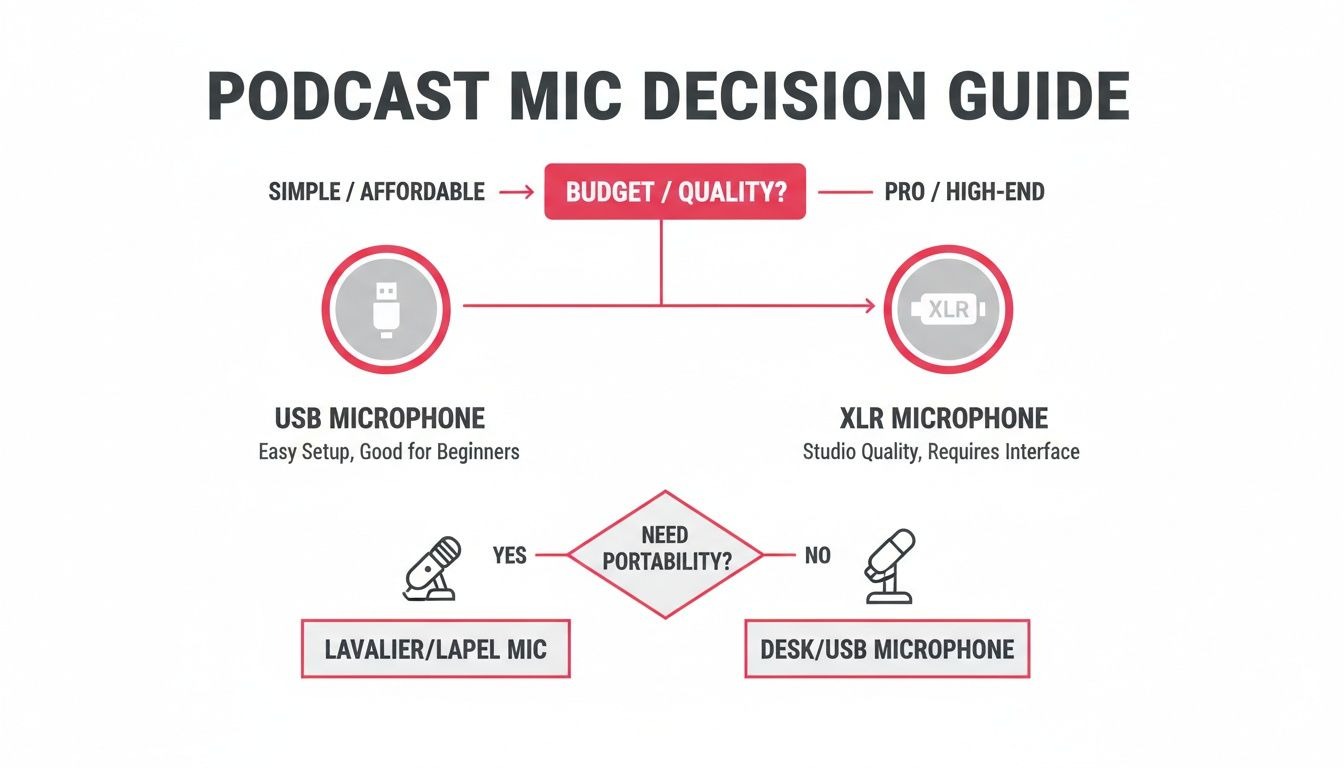
As you can see, the choice really hinges on balancing your budget against your desire for pristine audio and technical control.
Dynamic vs. Condenser Microphones
Another fork in the road is how the microphone actually captures sound. For most B2B podcasters recording in a home office, spare bedroom, or an otherwise untreated space, a dynamic microphone is almost always the right call. It’s designed to capture sound directly in front of it while ignoring almost everything else, keyboard clicks, the hum of an air conditioner, or that slight echo in the room.
On the other hand, a condenser microphone is much more sensitive. It captures a wider range of frequencies with incredible crispness and detail. While that sounds amazing in a perfectly sound-treated studio, it will also pick up every single unwanted background noise in a typical office. Understanding this difference is the secret to getting a clean, professional sound without breaking the bank on acoustic panels.
For a deeper dive into building out your entire kit, check out our complete guide on the equipment needed for a podcast.
Choosing Your Connection: USB vs. XLR Microphones
Your first real fork in the road when picking a podcast mic is deciding between USB and XLR. This isn't just about what kind of plug you're using; it's a choice that dictates your entire recording setup, how easily you can expand in the future, and frankly, the ultimate quality ceiling of your audio. It's the foundation you'll build the rest of your podcasting house on.
Let's break it down with an analogy I like to use:
- USB microphones are like a high-end point-and-shoot camera. They're dead simple, give you fantastic results straight out of the box, and get you up and running in minutes.
- XLR microphones are the DSLRs of the audio world. They need more gear to work (like an audio interface) and a bit more know-how, but the payoff is total control, top-tier audio quality, and the ability to grow with your show.
For B2B brands, where your audio quality is a direct reflection of your credibility, getting this choice right from the start is a massive advantage.
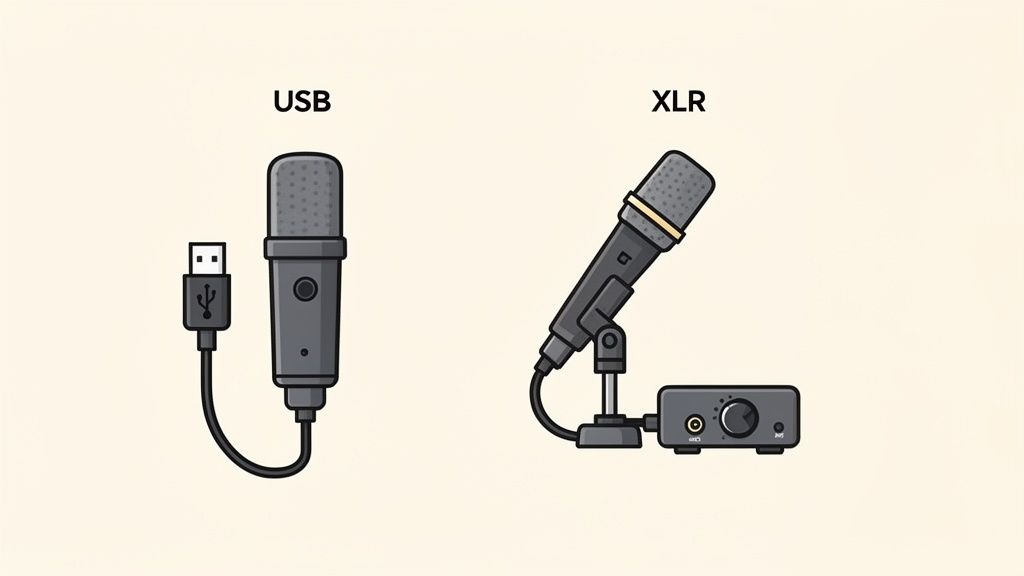
The Simplicity of USB Microphones
USB mics are the go-to for anyone who wants to hit 'record' with the least amount of fuss. Their killer feature is their plug-and-play design. You literally plug the mic into your computer's USB port, tell your software to use it, and you're good to go.
This simplicity has made them insanely popular and has basically democratized podcasting for countless B2B startups looking for a quick win. Take the Blue Yeti, for example, it's shipped over 5 million units since 2009. When the remote work boom hit after 2020, USB mic sales shot up by 28%, giving 70% of new podcasters a pro-level sound without touching an expensive audio interface.
Who should choose a USB microphone?
A USB mic is a brilliant choice for solo hosts, total beginners, or businesses that just need a straightforward, reliable solution for internal shows or their first dip into content creation. If your mantra is "less friction, more recording," USB is your answer.
The Power and Flexibility of XLR Microphones
XLR mics are what the pros use. From multi-million dollar recording studios to your local radio station, this is the industry standard. That three-pin XLR connector isn't just for show; it carries a balanced signal that's far less prone to electronic interference and noise, especially over longer cables.
Here's the catch: you can't just plug an XLR mic into your computer. It needs a middleman, an audio interface, or a mixer. This box does a few crucial jobs: it takes the analog signal from the mic, converts it into digital that your computer understands, and uses a built-in preamplifier to boost the signal to a healthy level.
Sure, it's an extra piece of gear and another step in the process, but it unlocks a completely different level of production.
- Superior Sound Quality: The preamps and converters in a decent audio interface are almost always better than what's crammed into a USB mic, giving you a cleaner, richer, more detailed sound.
- Scalability: This is the big one. Most interfaces have multiple inputs. Want to record a co-host? Or a panel of guests? No problem. Everyone gets their own mic, recorded on a separate track. This is a nightmare to pull off with a standard USB setup.
- Flexibility: You can pair any XLR mic with any audio interface. This means you can upgrade your microphone or your interface independently as your show grows and your budget allows. You're not locked into one system.
For any podcaster who's serious about long-term quality and growth, an XLR setup is an investment that pays dividends. It’s a bit more complex, but that complexity gives you the control and fidelity that separates an amateur show from a professional production. To see how this fits into a full studio, check out our guide on the essential equipment needed for a podcast.
Understanding Your Sound: Dynamic Vs. Condenser Mics
Beyond how you plug a mic in, the technology inside it, either dynamic or condenser, is what truly shapes your final sound. This isn't about geeking out over specs; it’s about being brutally honest about where you're recording. Get this right, and you're miles ahead in the quest for clean, professional audio.
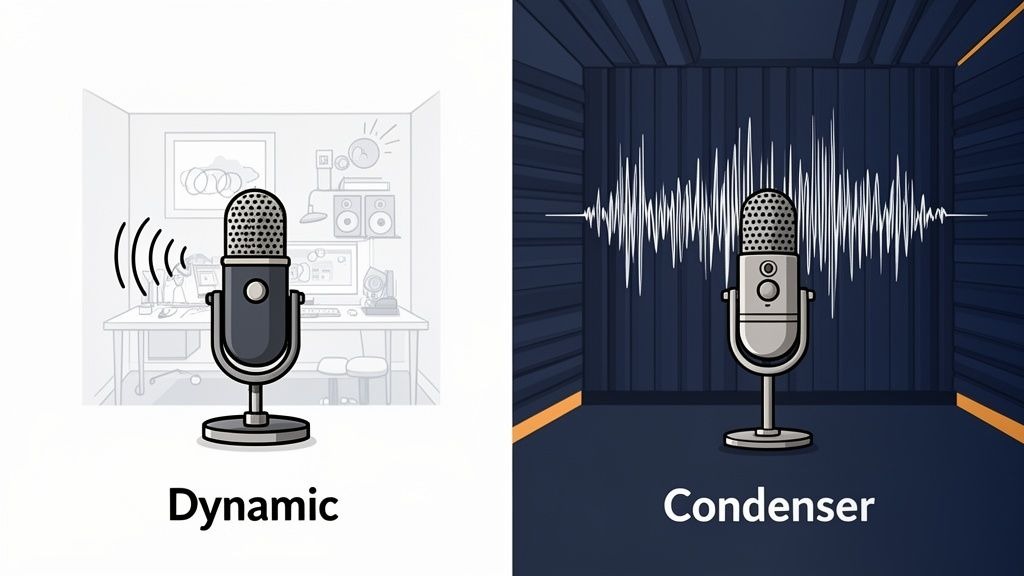
Think of a dynamic microphone as your trusty workhorse, built for the real world. It’s engineered to be less sensitive, focusing intently on whatever's right in front of it while ignoring noise from the sides and back. This makes it a lifesaver for most B2B podcasters recording in a typical home office, as it naturally tunes out keyboard clicks, computer fans, and that slight echo you didn't know you had.
On the flip side, a condenser microphone is like a high-definition audio camera. It's incredibly sensitive, designed to capture every tiny detail with stunning clarity. While that sounds amazing on paper, in reality, it means the mic will also pick up the hum of your AC, the reverb bouncing off your walls, and the neighbor's dog barking down the street.
When To Choose A Dynamic Microphone
For the vast majority of B2B podcasters, a dynamic mic is the smarter, safer bet. Its built-in ability to isolate your voice makes it incredibly forgiving. You don't need a perfectly silent, acoustically-treated room to get that rich, broadcast-quality vocal tone.
This is exactly why mics like the Shure SM7B became industry legends. It’s a dynamic powerhouse that rejects off-axis noise by up to 30dB, making it perfect for the imperfect home setups so common in B2B. In fact, mics like this dominated the market in 2023 for this very reason: they let hosts capture focused vocals while ignoring room echo, a massive advantage when your goal is clear, authoritative thought leadership.
Key Takeaway: A dynamic microphone prioritizes your voice over your room. If your recording space isn't a professional studio, a dynamic mic is your best friend for clean, distraction-free audio.
When A Condenser Microphone Makes Sense
A condenser mic should only be your first choice if you’re recording in a controlled, acoustically-treated space. If you've invested in sound-dampening panels and bass traps and have zero ambient noise, a condenser can deliver a beautifully airy and detailed sound that a dynamic might miss.
But for remote interviews, the bread and butter of B2B podcasting, relying on a condenser is a gamble. You can’t control your guest's environment. A sensitive condenser on their end could easily flood your recording with distracting background noise, undermining the whole conversation.
Choosing the right hardware is just one piece of the puzzle, of course. How you sound on-air is just as critical. For more on that, check out our guide on mastering the mic with actionable executive communication training for podcasts.
To make it even simpler, here's a quick side-by-side comparison.
Dynamic Vs Condenser Microphones At A Glance
This table breaks down the core differences to help you decide which microphone type fits your podcasting reality.
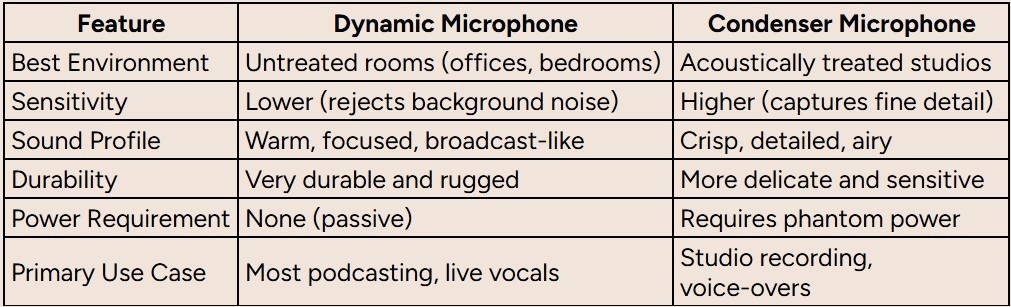
Ultimately, it comes down to being honest about your recording space. For B2B podcasting, where consistency and clarity are king, the focused, controlled sound of a dynamic microphone is almost always the winning formula.
Our Top Mics For Every Budget
Alright, we’ve covered the technical guts of what makes a microphone tick. Now for the fun part: picking your weapon of choice. It's easy to get lost in a sea of options, but the goal here is simple: find the right tool for the job that you feel good about investing in.
This isn't just another gear list. Think of it as a buyer's guide built from experience. I’ll break down our go-to mics for B2B shows, explaining not just what they are, but exactly who they’re for. From the scrappy startup dipping a toe in the podcasting waters to the established brand building a flagship audio experience, we've got you covered.
Entry-Level Workhorses: Great Value For Getting Started
You do not need to break the bank to start your podcast. Seriously. The trick is to find gear that sounds clean, is dead simple to use, and just works. These mics are perfect for new shows, internal podcasts, or anyone who values plug-and-play simplicity above all else.
Blue Yeti (USB Condenser)
- Who It's For: The B2B startup or solo marketer who needs one mic to do it all.
- Why We Recommend It: The Yeti is practically a household name for a reason. Its killer feature is the switchable polar patterns. You can record yourself solo, sit across a table from a guest for an interview, or even capture a small group discussion, all with a single microphone. It's a condenser, so it will pick up room noise, but its sheer versatility and idiot-proof setup make it an incredible starting point.
Samson Q2U (USB/XLR Dynamic)
- Who It's For: The practical podcaster who wants a budget-friendly mic that won't hold them back later.
- Why We Recommend It: The Q2U is a true hidden gem. It's a dynamic mic, which means it’s fantastic at rejecting the background noise of a typical home office. But the real magic is its dual USB and XLR connections. You can start by plugging it straight into your computer, and when you're ready to upgrade to an audio interface, you can just switch to the XLR output. No need to buy a whole new microphone.
Mid-Range Champions: The Sweet Spot For Quality And Cost
When you're ready to level up from the basics, the mid-range is where you'll see a huge jump in audio quality and build. These are the dependable workhorses that power countless professional-sounding B2B podcasts. They hit that perfect sweet spot between performance and price.
Rode Procaster (Dynamic XLR)
- Who It's For: The host who's ready to commit to a proper XLR setup and wants that true broadcast-quality sound.
- Why We Recommend It: The Rode Procaster is built like a tank and engineered for one thing: the human voice. It delivers that classic, warm radio sound and is brilliant at ignoring everything else happening in the room. This is a fantastic step up for anyone getting serious about creating a polished, authoritative sound for their show.
You're investing in consistency. A microphone like the Procaster gives you a predictable, professional vocal tone episode after episode, which is critical for building brand recognition through audio.
Professional-Grade: The Industry Standard
For some shows, "good enough" isn't good enough. When your podcast is a direct reflection of your premium brand, and audio quality is completely non-negotiable, you invest in the industry standard. These are the mics you'll find in professional recording studios all over the world.
Shure SM7B (Dynamic XLR)
- Who It's For: The B2B brand that demands the best and wants the undisputed king of podcasting microphones.
- Why We Recommend It: The Shure SM7B is a legend. Full stop. Its rich, warm sound and incredible noise isolation have made it the microphone of choice for the world's biggest podcasters and musicians. It's incredibly forgiving, making even untreated rooms sound good, and delivers that smooth, professional tone that instantly signals high production value. It's a serious investment, but it’s probably the last vocal mic you’ll ever need to buy.
Rode NT1 (Condenser XLR)
- Who It's For: Podcasters recording in a well-treated, quiet studio who want to capture every last detail of the human voice with crystal clarity.
- Why We Recommend It: While we almost always point B2B podcasters toward dynamic mics, the Rode NT1 is the go-to exception for those with a controlled recording space. The Rode NT1-A model is famous for its absurdly low self-noise of just 5dBA, meaning it adds virtually no hiss to your recordings. Its detailed capture can lead to incredible vocal clarity; some podcasters have even reported up to 30% better intelligibility in blind tests against standard USB mics, which can have a real impact on how well your message lands. You can discover more insights about the pro microphone market trends and their impact on audio quality.
Essential Accessories To Maximize Mic Performance
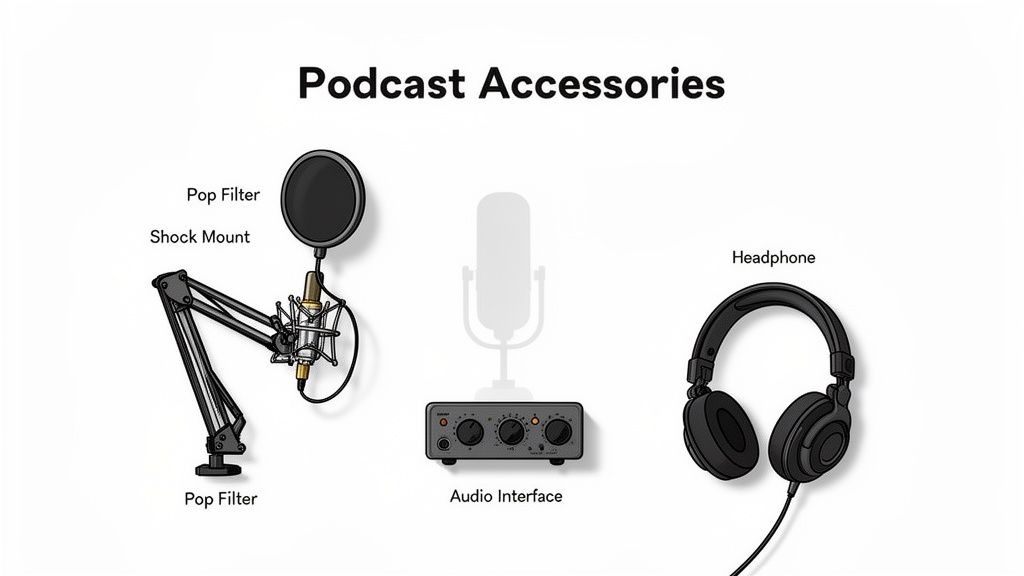
Buying a great microphone is a fantastic first step, but it's only half the battle. To get that polished, professional sound, you need the right accessories. These aren’t just nice-to-haves; they’re the tools that unlock your mic’s true potential.
Think of it this way: your microphone is the engine. The accessories are the transmission, suspension, and tires; they make sure all that power translates into a smooth, controlled performance. Without them, you’re just inviting distracting noises and ergonomic headaches that completely undermine your investment.
Core Accessories for Every Podcaster
No matter what microphone you end up with, a few pieces of gear are non-negotiable. Each one solves a very specific and very common problem that can instantly tank your recording quality.
Here’s what you absolutely need:
- Pop Filter or Windscreen: This is just a simple screen, either mesh or foam, that sits between your mouth and the mic. Its entire job is to stop those harsh bursts of air from "p" and "b" sounds, what we call plosives, from hitting the microphone diaphragm and creating a jarring pop in the audio.
- Shock Mount: This is a cradle that suspends your microphone, isolating it from the world around it. Any bump to your desk, a heavy keystroke, or even just tapping your foot can travel right up the mic stand and into your recording as a low-end rumble. A shock mount absorbs those vibrations before they get there.
- Boom Arm: Most mics come with a little desk stand, but a boom arm is a serious upgrade. It lets you position the microphone exactly where it needs to be, right in front of your mouth, no matter how you’re sitting. Plus, it keeps the mic off your desk, which helps reduce vibrations even more.
Demystifying the Audio Interface
If you went with a professional XLR microphone, you’ll need one more critical piece of hardware: an audio interface. This little box is the bridge between your analog mic and your digital computer.
An audio interface is the translator for your XLR microphone. It converts the mic's analog signal into a digital format your computer can understand, provides the necessary power, and gives you crucial physical control over your recording levels.
It really does three key things. First, it has a preamplifier (or "preamp") that boosts the mic's naturally quiet signal up to a usable level. Second, its analog-to-digital converter (ADC) turns that signal into ones and zeros. Finally, it provides phantom power, which is a 48-volt current that most condenser mics need just to turn on.
To get the full picture of how all these pieces fit together, check out our complete guide on setting up your podcast studio equipment.
Investing in these accessories ensures you're getting every ounce of performance out of your microphone. It’s how you deliver that clean, professional sound that builds listener trust and establishes your B2B authority from the first word.
Optimizing Remote Recordings For Pro-Level Sound
Let’s be real. In B2B podcasting, your guests are almost always busy executives dialing in from their home office, not a soundproofed studio. The convenience of remote recording makes it far easier to book high-quality guests, but it also means the final audio quality rests squarely on your shoulders as the host.
The number one rule is brutally simple: great audio is more important than great video.
Listeners will forgive a slightly blurry webcam. They will not forgive jarring, echo-filled, or noisy audio. Bad sound is an instant credibility killer. As our founder, Tom Hunt, often says, you can't establish authority if your audience can't hear you clearly.
This focus on impactful B2B content is built on a foundation of professionalism, and nothing says professional like pristine audio.
Prepping Your Guests For Success
Never assume your guests know how to get good audio. A few simple instructions sent beforehand can be the difference between a nightmare editing session and a smooth, professional-sounding conversation. This small effort pays off big time.
Here's what to tell them:
- Find a Quiet Room: Steer them towards a small room filled with soft things like carpets, curtains, or even a bookshelf. Soft surfaces absorb sound and kill echo. The walk-in closet is a classic podcaster trick because it works.
- Use Wired Headphones: Insist on this. Bluetooth headphones can introduce frustrating lag and dropouts. Wired headphones are more reliable. If guests don't use headphones at all, their mic will pick up the sound from their speakers, creating a distracting echo that’s almost impossible to fix.
- Mic Placement is Key: Have them position the mic about a hand's width (4-6 inches) from their mouth. For video, sitting in front of a window to get natural light is an easy way to improve quality.
We've got a full checklist you can just copy and send to guests in our guide on how to record a podcast remotely.
The High-Value Guest Strategy: Send Them a Mic
When you land a high-profile guest whose insights are the centerpiece of an episode, leaving their audio setup to chance is a massive gamble.
The secret weapon? Just send them a microphone.
For under $100, you can ship a solid, reliable mic like a Blue Yeti or Samson Q2U directly to their door. This move isn't just about guaranteeing clean audio; it's a powerful gesture. It shows you're serious about quality, you value their contribution, and it creates a memorable experience. It’s a small investment that elevates the entire production. It’s also important to be versatile; knowing the ins and outs of recording podcasts directly on an iPhone can be a lifesaver in a pinch.
This is the kind of control and preparation that separates the best from the rest. It's why top-tier B2B shows often use platforms like our partner, Riverside.fm. As a specialized remote recording platform, they capture uncompressed, local audio from every participant. That way, even if someone's internet connection glitches, the final recording is absolutely pristine.
Your Top Podcast Mic Questions, Answered
Jumping into the world of podcast microphones can feel like you're trying to order coffee in a language you don't speak. Let's cut through the noise and get straight to what you really need to know.
Do I Actually Need a Super Expensive Mic to Start?
Heck no. Honestly, this is one of the biggest myths out there. While a high-end mic will sound incredible, you can get fantastic, professional-grade audio from something like the Samson Q2U.
Your room and your technique matter way more than the price tag. Recording in a quiet space with lots of soft surfaces will do more for your sound quality than dropping a grand on a fancy microphone.
What's the Single Most Important Accessory to Get?
A pop filter. Full stop. It's not the sexiest piece of gear, but this little screen is your best friend.
It sits in front of your mic and catches those harsh bursts of air from "p" and "b" sounds, what the pros call plosives. Without one, you get those distracting "thumps" in your audio. It's a cheap, simple fix that makes a world of difference.
How Can I Make My Audio Better Without Buying Anything New?
Tackle your recording space. The number one thing you can do for free is find a room that isn't a big, empty box. Think smaller, and think softer.
- Got carpets or rugs? Perfect. They soak up sound bouncing off the floor.
- Heavy curtains or drapes? Use them. They kill reflections from windows.
- Bookshelves, couches, even a pile of laundry? These are your allies. They break up flat surfaces and scatter sound waves.
There’s a reason podcasters joke about recording in their closets. All that clothing acts as free sound absorption, giving you a surprisingly dead, studio-like sound without spending a dime.
Why Is Everyone Obsessed With the Shure SM7B?
Ah, the legendary Shure SM7B. It's famous for two big reasons. First, it’s a dynamic mic, which means it’s ridiculously good at ignoring background noise. This makes it incredibly forgiving if you're recording in a room that isn't acoustically perfect.
Second, it just has that sound. It delivers a warm, rich, classic broadcast vocal tone that people instantly recognize and love. That killer combo of noise rejection and vocal polish is why you see it in pro studios and high-end home setups everywhere.
Ready to skip the gear headaches and focus on creating amazing content? Fame is a full-service B2B podcast production agency that handles everything from strategy and recording to editing and promotion, helping you build authority and drive real business results.
Want us to run this for you?
Fame starts and grows B2B podcasts that generate pipeline. Tell us who you are trying to reach and we will send a costed proposal within 48 hours.
Related content
- Read moreFame Team · July 16, 2026
10 Account Based Marketing Tactics For B2B Growth In 2026
Discover 10 actionable account based marketing tactics for B2B tech. Learn to use podcasts, data, and targeted content to close high-value accounts. - Read moreFame Team · July 16, 2026
The 8 Best Brighton Podcast Agency Picks For 2026
Find the best Brighton podcast agency for your B2B brand. Our 2026 guide reviews top 8 agencies for production, growth & ROI. Expert analysis here - Read moreJune 10, 2026
20 Best Podcast Production Agencies For 2026 (And Why Should You Hire One)
Global podcast and vodcast ad revenues are on track to hit $5 billion in 2026 , up 20% year-on-year. - Read moreApril 13, 2026
Leadership In Marketing: The B2B Podcast Playbook
Most companies still confuse leadership in marketing with job titles, org charts, and budget control. That's outdated.