

Let's be real for a moment. Most podcasters treat their show notes as an afterthought—a paragraph they quickly whip up right before hitting publish.
If that sounds familiar, you're leaving a massive opportunity on the table, especially in the B2B world.
Your podcast is an incredible way to build authority, but audio has one big weakness: search engines can't "listen" to it. Your show notes are the bridge that makes your content visible to Google and, more importantly, to the potential listeners actively searching for the expertise you're sharing.
Why Your Show Notes Are a Secret Marketing Weapon
Podcast show notes are far more than just a quick episode summary. Think of them as a dedicated landing page for your audio. They're a powerful marketing asset designed to pull in new listeners through search, keep your current subscribers hooked, and even turn your audience into qualified leads.
When you nail them, your audio suddenly becomes discoverable, accessible, and actionable.
The Shift from Summary to Strategic Asset
Instead of just a simple description, the smartest B2B brands see their show notes podcast page as a central hub for each episode. It’s a resource center that not only helps your existing audience but also works around the clock to attract a new one.
This strategic shift turns your notes from a passive accessory into an active growth engine.
Here’s what that actually looks like:
- A Discovery Engine: SEO-optimized notes let you rank for the exact keywords your ideal customer is plugging into Google, drawing in organic traffic long after an episode goes live.
- An Engagement Multiplier: Detailed notes packed with resources, timestamps, and key takeaways give people a reason to visit your site, boosting their time-on-page and strengthening their connection with your brand.
- A Conversion Funnel: By dropping in strategic calls-to-action (CTAs), your show notes can directly generate demo requests, newsletter sign-ups, or leads for your sales team.
“So many B2B podcasters focus 99% of their effort on the audio, leaving the show notes as a last-minute task. The top 1% understand that the show notes are where the real marketing leverage is. It’s your chance to turn a listener into a website visitor, and a visitor into a lead.”
— Tom Hunt, Founder of Fame
In the crowded podcasting space, with over 4.58 million podcasts vying for the attention of 619.2 million global listeners, great show notes are what separate the top shows from the rest. Shows with detailed notes often see 20-30% higher engagement, turning casual listeners into loyal fans. You can dig into more data on the podcasting boom to see why this is so critical.
To help you visualize how these pieces fit together, here’s a quick breakdown of the strategic role show notes play.
The Strategic Value of Podcast Show Notes
.tbl-scroll{contain:inline-size;overflow-x:auto;-webkit-overflow-scrolling:touch}.tbl-scroll table{min-width:600px;width:100%;border-collapse:collapse;margin-bottom:20px}.tbl-scroll th{border:1px solid #ddd;padding:8px;text-align:left;background-color:#f2f2f2;white-space:nowrap}.tbl-scroll td{border:1px solid #ddd;padding:8px;text-align:left}FunctionBenefit for Your B2B BrandKey ActionSEO AnchorMakes your audio content discoverable via search engines like Google.Integrate target keywords naturally throughout the notes.Listener GuideAllows listeners to navigate key topics and find what's most relevant.Use timestamps to create an interactive table of contents.Resource HubProvides a central place for all links, tools, and resources mentioned.Link out to guest profiles, articles, and mentioned tools.Lead MagnetConverts listeners into subscribers, leads, or demo requests.Add clear, compelling calls-to-action (CTAs).Content MultiplierServes as a foundation for repurposing into other content formats.Pull key quotes and takeaways for social media posts.
Ultimately, a small investment of time here delivers a clear, tangible return.
The Tangible ROI of High-Quality Show notes
Putting in an extra 30-60 minutes to create detailed, thoughtful show notes isn't just busywork; it's a high-leverage activity that delivers a real return. You’re turning a piece of audio into a durable marketing asset that works for you forever.
Think of it this way: every single episode becomes a new, permanent doorway into your brand’s world. A well-crafted show notes podcast page works 24/7 to attract, engage, and convert your ideal audience, maximizing the overall benefits of podcasting for your business.
The Anatomy of High-Converting Podcast Show Notes
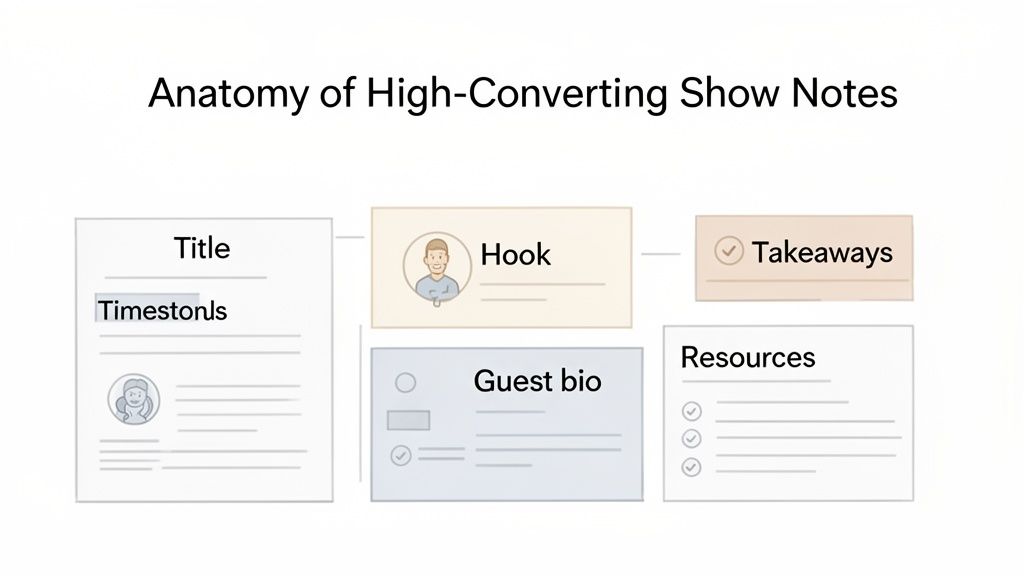
Alright, let's move past the generic summaries and really dig into what makes show notes perform. Think of this as your pre-flight checklist for every single episode—a blueprint for turning a simple description into a legit marketing asset.
Each piece has a specific job to do, from grabbing someone's attention right away to nudging them toward the next step. When you put them all together, they create a seamless experience that works for your audience and your business.
Action Step 1: Craft a Magnetic Episode Title
First things first: your episode title for your show notes page is not the same as your audio title. Your audio title has to be short and sweet for podcast apps, but your on-page title is where you can make some serious SEO gains.
Action: Create a descriptive, keyword-rich title focused on the listener's benefit. For instance, an audio title like "Ep. 42: Scaling with Sarah Chen" is fine for Spotify. But on your website, transform it into something like "How to Scale Your B2B SaaS from $1M to $10M ARR with Sarah Chen." This tells both Google and potential listeners exactly what they're getting.
Action Step 2: Write a Hook-Driven Introduction
The first couple of sentences must land a punch. Don't just summarize—create intrigue.
Action: Kick things off with a question that hits a nerve, a surprising stat, or a bold statement that speaks directly to a pain point. Instead of, "In this episode, we talk about sales strategies," try this: "What if your sales team could close 30% more deals without increasing their workload? Our guest shares the exact framework to make it happen." You're immediately connecting the episode to a tangible result.
Action Step 3: Create Scannable Summaries and Takeaways
Nobody wants to read a wall of text. Your audience is busy, so make your summary easy to scan. Short paragraphs and bold text are your friends here.
Action: Use a bulleted list of "Key Takeaways" to highlight the golden nuggets from the episode.
- The "Value First" Framework: Discover why giving value before asking for the sale is a game-changer in B2B.
- Automating Outreach: Learn which tools top-performing teams use to personalize outreach at scale.
- Guest Insight: Uncover the one metric our guest believes is the most overlooked signal of sales team health.
This format lets people quickly see what's in it for them, making them much more likely to hit play. Nailing this structure is way easier when you have a solid episode outline from the start, a key part of our podcast planning template.
Action Step 4: Add Time-Stamped Navigation
Timestamps are non-negotiable. They turn your audio into something people can actually navigate, letting listeners jump straight to the parts they care about most. This is a lifesaver for longer, more detailed interviews.
Pro Tip: Don't just list topics next to the times. Frame your timestamps as questions or benefit statements. For example, use "[14:35] How do you handle the most common sales objection?" instead of just "[14:35] Sales objections."
It's a small detail, but it shows you respect your listener's time and makes your content infinitely more useful.
Action Step 5: Build a Guest Bio and Resources Section
If you've got a guest, give them their own section. Include a short bio, a headshot, and—this is crucial—links to their website, LinkedIn, and any other relevant profiles.
This simple act of generosity does two things:
- It adds value for your audience by making it dead simple for them to connect with the expert they just listened to.
- It encourages your guest to share the episode. When you make them look good and send some traffic their way, they're far more likely to promote the content to their network.
Finally, pull together all the books, tools, or studies mentioned in the episode into a clean "Resources Mentioned" list. This elevates your show notes from a simple summary to a resource hub people will bookmark and come back to, cementing your authority in the space.
Mastering SEO for Your Podcast Show Notes
Look, just writing killer show notes isn't enough. If your ideal listeners can't find them, you might as well have not written them at all. This is where getting tactical with Search Engine Optimization (SEO) comes in. It's the difference between your notes being a simple summary and a powerful magnet for new listeners.
Smart SEO for your show notes podcast page isn't about jamming keywords into every corner. It's about getting inside your listeners' heads, understanding what they're typing into Google, and creating content that gives them exactly what they're looking for. When you do that, search engines notice.
Finding Keywords Your Audience Actually Uses
Before you can even think about ranking, you need to know what you're trying to rank for. This all starts with keyword research. You need to figure out the exact problems your target audience is trying to solve. What questions are keeping them up at night?
Start by just brainstorming the big ideas from your episode. Let's say your episode is all about B2B sales cycles. Your first thoughts might be basic stuff like "long sales cycles" or "B2B sales tips."
That's a good start, but now we need to dig deeper:
- Fire up a keyword tool: Platforms like Ahrefs or Semrush are your best friends here. They'll show you related terms, what questions people are really asking, and how many people are searching for them. You might stumble upon gold like "how to shorten enterprise sales cycle" or "common B2B sales objections."
- Spy on your competition: Check out the show notes for other podcasts in your space. What keywords are they hitting in their titles and headers? This is a great way to spot opportunities you might have overlooked.
- Put on your listener hat: What specific, almost conversational query would lead someone to your content? A phrase like "sales negotiation tactics for SaaS" is way more targeted—and usually signals a much higher intent to listen—than a broad term.
Your mission is to nail down one primary keyword (like "B2B sales cycle") and then find two or three secondary, long-tail keywords (like "improving sales velocity" or "enterprise sales strategy") for each episode. A great starting point for this is exploring proven podcast episode ideas that naturally align with high-intent keywords.
Weaving Keywords Naturally into Your Notes
Okay, you've got your keywords. Now it's time to integrate them without sounding like a robot. Remember, you're writing for people first, search engines second. And these days, search engines are smart enough to reward quality, natural-sounding content.
Here are the high-impact spots to place your keywords:
- Page Title (SEO Title): This is SEO 101. Your primary keyword needs to be here, and the closer to the beginning, the better. Think: "Shortening the B2B Sales Cycle with [Guest Name]."
- H1 Heading: This is the main title people see on the page. It should be almost identical to your SEO title and definitely include that primary keyword.
- Subheadings (H2s and H3s): Sprinkle your secondary keywords into your subheadings. This helps structure the content for readers and gives search engines clear signals about what you're covering.
- Introduction: Try to drop your primary keyword somewhere in the first 100 words. It immediately tells both readers and Google what the page is all about.
- Image Alt Text: Don't forget your images! Describe them accurately and use a keyword where it feels natural. For example:
alt="Graph showing a shortened B2B sales cycle."
A classic rookie mistake is getting so obsessed with keywords that the writing becomes awkward and clunky. Always, always prioritize readability. A well-written, valuable article that naturally incorporates relevant terms will beat a keyword-stuffed mess every single time.
Building Authority with Internal and External Links
Links are a massive signal to search engines. They're like votes of confidence, showing how your content connects to the wider web and helping to establish your credibility on a topic.
Internal Linking
These are simply links pointing to other pages on your own website. When you link to a previous episode or a relevant blog post, you're doing two critical things:
- You're encouraging visitors to stick around longer, which sends positive engagement signals to Google.
- You're passing "link equity" between your pages, which helps search engines map out your site and understand how your content is all related.
For example, in those show notes about sales cycles, you could write something like, "This strategy builds on the negotiation tactics we discussed in our episode on closing enterprise deals." And for a serious deep dive into ranking, check out these podcast SEO best practices for explosive growth.
External Linking
These are links that point to other websites. Linking out to credible, authoritative sources—think industry reports, your guest's website, or a well-respected publication—is a good thing. It shows Google your content is well-researched and adds real value for your reader. To truly get a handle on this, exploring broader Podcast SEO strategies can give you an even bigger edge.
By strategically weaving in keywords and building a solid linking structure, you transform every single show notes podcast page from a static summary into a long-lasting asset that continuously pulls in new, highly relevant listeners.
Turning Listeners Into Leads With Strategic CTAs
Great SEO gets people to your show notes page. But it's a strategic Call-to-Action (CTA) that actually gets them into your pipeline. This is where you have the chance to guide your audience from just listening to actively engaging. It's the moment you can turn a casual reader into a community member, a subscriber, or even a qualified lead for your sales team.
For B2B brands, this isn't just about begging for a review. It’s about building a clear, compelling next step that directly supports your business goals. The right CTA transforms your show notes from a simple summary into a seriously powerful conversion tool.
Choosing the Right CTA for Your B2B Audience
Let's be clear: not all CTAs are created equal. The real key is matching your request to your audience's mindset and the episode's specific content. Someone who just finished a deep-dive on advanced marketing analytics is primed for a very different offer than a listener who tuned in for a high-level leadership discussion.
Here are a few B2B-focused CTAs that consistently get the job done:
- Content Upgrades: Offer a downloadable resource that goes deeper on the episode's topic. Think about a companion whitepaper, a detailed checklist, or the actual slide deck your guest mentioned. It’s a natural, value-first next step.
- Newsletter Subscription: Invite them to join your email list for more exclusive insights. Frame this as a way to get actionable tips delivered straight to their inbox. Fame offers a B2B Newsletter service for brands that want to turn their podcast content into a powerful email marketing engine.
- Demo or Consultation Request: For product-heavy episodes, a direct "Book a Demo" CTA can work wonders. If the content is more about strategy, an invitation to a "Free 15-Minute Strategy Call" feels much more appropriate and less salesy.
- Webinar Registration: If your episode touches on a topic you’re covering in an upcoming webinar, your show notes are the absolute perfect place to drive sign-ups.
To really make this work, your CTAs need to send people to a well-designed lead capture form. A smooth, seamless experience from the CTA click to the form submission is crucial if you want to maximize conversions.
Placing Your CTAs for Maximum Impact
Where you stick your CTA matters just as much as what you're asking for. You've got to present the offer right when the reader's interest and the perceived value are at their absolute peak.
Don't just bury your main CTA at the very bottom of the page where no one will see it. Instead, strategically place it directly below your key takeaways or summary section. Right after you’ve clearly proven the value of the episode's content, the reader is most open to a relevant offer. You can learn more about nailing your approach by checking out our detailed guide on how to craft a podcast CTA that converts.
Your most valuable real estate is right after you've proven your expertise. Place your main CTA there. A secondary, softer CTA, like subscribing to a newsletter, can live in the footer or sidebar.
Organizing Resources to Build Trust and Value
Nothing kills the user experience faster than a messy, impossible-to-navigate list of resources. When you present all the tools, books, and articles mentioned in your episode in a clean, organized way, your show notes podcast becomes an indispensable hub of value.
Create a dedicated "Resources Mentioned" section. Use clear headings and bullet points. For each resource, provide a direct link and a quick, one-sentence description of why it’s relevant. This simple act of organization shows you respect your audience's time and cements your position as a credible, helpful authority in your space.
The average podcast enthusiast listens for 7 hours weekly across 8.3 episodes, and nearly 1 in 4 will drop a show every 8-14 days. This makes show notes absolutely essential for retention and conversion in B2B podcasting. For professional services firms aiming for thought leadership, Fame's end-to-end process really shines. Our proprietary Fame AI generates SEO-optimized notes that can slash production costs by 20% while hiking ad targeting accuracy by 50% through personalization.
Streamlining Your Show Notes Workflow
Consistency is the engine that drives a successful podcast. But let’s be real—churning out detailed, SEO-friendly show notes for every single episode can feel like a serious grind. This is exactly where so many podcasters burn out, letting the quality slide as the pressure to publish builds.
The secret isn’t to work harder. It’s to build a smarter, repeatable system.
A streamlined workflow gets you out of the weeds. It’s all about creating a go-to template, using the right tools, and having a clear process that lets you produce high-quality, effective show notes every time without losing your mind. This is a core part of an efficient podcast production workflow.
This simple flowchart shows you just how powerful that journey is, turning a passive listener into an active lead for your business.
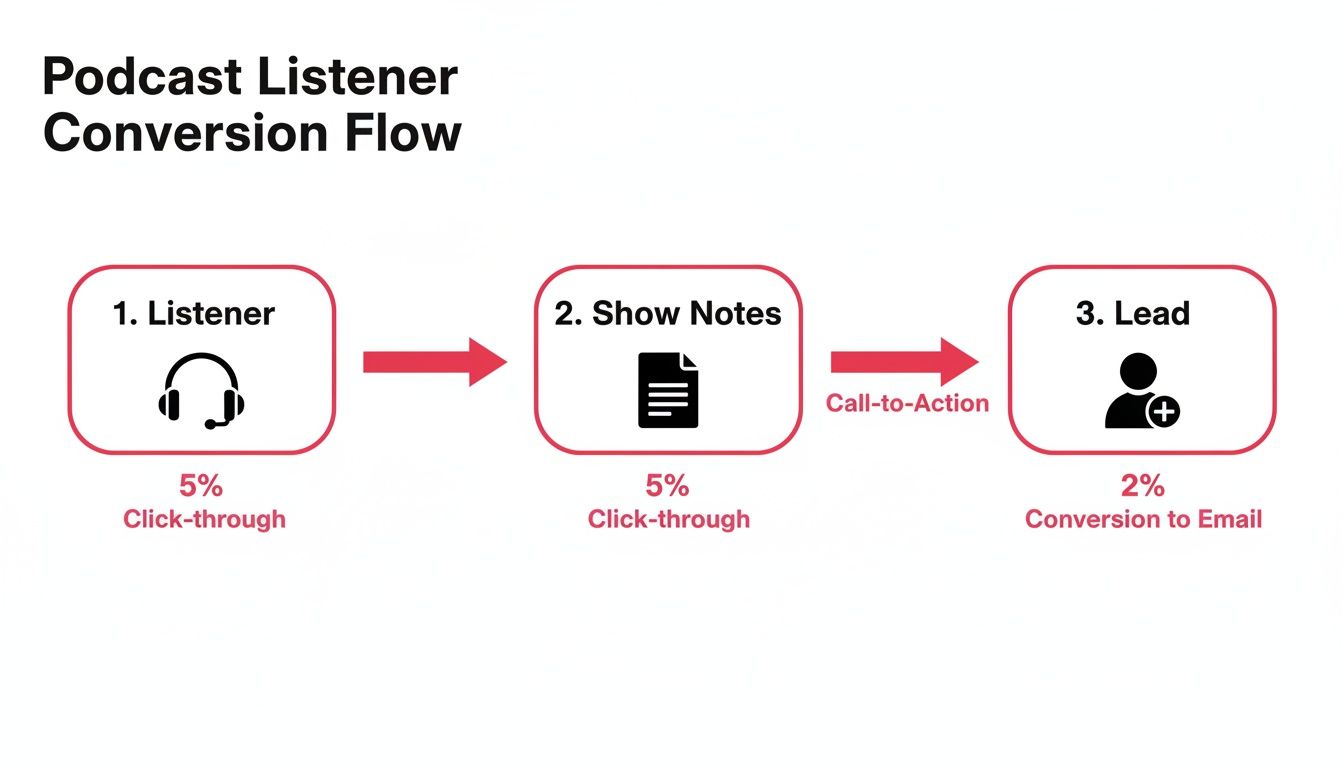
Think of your show notes as the bridge between your audience's ears and actual business growth. It's that critical.
Start with a Solid Template
Whatever you do, don't start from a blank page. A template is your best friend for keeping quality high and production time low. When you pre-define the structure, you can stop reinventing the wheel and pour your energy into the good stuff—the actual content.
For most B2B podcasts, interview episodes are the bread and butter. Having a killer template for these conversations ensures you capture all the essentials, from your guest’s bio to the key takeaways, in a format that’s consistent every single time. It’s a core piece of building a manageable content system, just like using a podcast editorial calendar template to map out your upcoming episodes.
To get you started, here’s a practical, copy-and-paste-ready template you can adapt for your interview-style show notes.
Interview-Style Podcast Show Notes Template
.tbl-scroll{contain:inline-size;overflow-x:auto;-webkit-overflow-scrolling:touch}.tbl-scroll table{min-width:600px;width:100%;border-collapse:collapse;margin-bottom:20px}.tbl-scroll th{border:1px solid #ddd;padding:8px;text-align:left;background-color:#f2f2f2;white-space:nowrap}.tbl-scroll td{border:1px solid #ddd;padding:8px;text-align:left}Section ElementDescription & Best PracticeSEO-Optimized TitleCraft a title packed with keywords that solves a real problem. For example, "How to [Achieve X] with [Guest Name], [Guest Title] at [Company]."Episode IntroductionWrite a 2-3 sentence hook. You could pose a question or drop a bold claim that the episode answers.Guest BioA short 3-4 sentence paragraph introducing your guest, their expertise, and why they're the right person to talk about this topic.Key TakeawaysA bulleted list of the 3-5 most actionable insights from the discussion. Bold the core concept of each point to make it scannable.TimestampsCreate a list of key topics with their corresponding times. Frame them as benefits, like, "[12:45] The biggest mistake B2B marketers make on LinkedIn."Resources MentionedA clean, bulleted list of every tool, book, or article mentioned. Include a direct link and a quick description for each one.Connect with the GuestProvide direct links to your guest's LinkedIn profile, website, and any other relevant social media they use.Primary CTAThis is your main call-to-action. Stick it right after the key takeaways. For instance, "Download the free B2B marketing checklist we talked about."
This structure gives your listeners everything they need in a format that's easy to digest and act on.
Leverage Tools to Automate the Heavy Lifting
Once you've got your template locked in, it's time to bring in the tech. The manual labor of transcribing and summarizing is where most podcasters get bogged down for hours. Luckily, a whole suite of tools can handle the grunt work for you.
Transcription Services
A clean transcript is the bedrock of great show notes. Automated services can spit out a full-text version of your episode in minutes. They're not always perfect, but they give you a massive head start compared to transcribing by hand. One such option is from our partner Swell AI, who offer advanced AI transcription and content generation for podcasters.
The goal isn't just a transcript; it's a searchable document. AI-powered tools can read this text, identify who's talking, and even pull out potential keywords, which is a huge leg up for your SEO.
AI Writing Assistants
This is where the magic really happens. AI tools built for content creation can take your transcript and whip up a surprisingly solid first draft of your show notes. They can generate summaries, pull out killer quotes, suggest titles, and even structure the content based on the template you just built.
For example, our own Fame AI is designed specifically for this. It analyzes the episode audio to generate SEO-optimized show notes, literally saving our clients hours of manual writing and editing on every single episode. This lets their team focus on the final polish—injecting brand voice, double-checking links, and crafting the perfect CTA—instead of starting from scratch.
By combining a solid template with smart automation, you build a workflow that scales. This system ensures every show notes podcast page you publish is consistent, high-quality, and strategically aimed at your growth goals, all while saving you your most precious resource: time.
Your Top Podcast Show Notes Questions, Answered
Even when you have a solid game plan, questions inevitably pop up. I get it. When you're in the weeds of production, little details can feel like huge roadblocks.
Let's walk through some of the most common questions B2B podcasters ask about creating and optimizing their show notes. Getting these right will give you the confidence to execute your strategy without second-guessing yourself.
How Long Should My Show Notes Be?
There’s no magic word count, but I’ve found the sweet spot for B2B podcast show notes is between 300-800 words. This gives you enough runway to provide real value and rank for your target keywords, but it’s still short enough that people will actually read it.
Think of it in layers. You might have a punchy, 100-word summary that’s perfect for the description field in podcast apps. But the full show notes page on your website? That should feel like a proper resource. Your main goal is to be genuinely useful, so focus on packing it with key takeaways, timestamps, resource links, and a crystal-clear call-to-action.
Should I Bother With a Full Transcript?
Yes, absolutely—but you need a strategy for it. A full transcript is an SEO powerhouse. It lets search engines crawl every single word of your episode, which can help you rank for a whole universe of long-tail keywords you never would have thought to target.
But please, don't just dump a wall of text at the top of your page. That's a surefire way to kill the user experience.
The best approach is to lead with your well-structured, easy-to-read show notes. Then, place the full transcript below in a collapsible section. Label it something simple like "Read the Full Transcript." This gives you the best of both worlds: a great experience for your readers and a massive boost for your SEO.
What Are the Biggest Mistakes People Make?
The most common slip-ups I see with show notes are, thankfully, pretty easy to fix once you know what you’re looking for.
- Treating them like an afterthought. Just jotting down a sentence or two is a massive missed opportunity for both discovery and engagement.
- Forgetting to link out. When you don't link to your guest's website or the resources you talked about, you're leaving value on the table. It also makes it less likely your guest will share the episode with their network.
- Ignoring SEO basics. If you’re not including relevant keywords in your titles and headings, you’re making it incredibly difficult for new listeners to find you through search.
- Skipping the CTA. Without a clear Call-to-Action, you’re not giving your audience a next step. You're cutting off what could be a powerful lead generation channel right at the source. It’s also important to remember that the goal isn't just to talk about your own company. Focus on providing value, and mention your own services only where it's a natural fit, like in the intro, outro, or a specific CTA.
Can I Use AI to Write My Podcast Show Notes?
Absolutely. AI tools can be a game-changer for speeding up your workflow. They’re fantastic for transcribing your audio with surprising accuracy, knocking out a solid first draft of a summary, identifying key topics, and even brainstorming potential titles. AI can handle the most tedious parts of the process.
The trick is to use AI as an accelerator, not a complete replacement. A human touch is still essential for injecting your brand’s voice, verifying accuracy, checking that links work, and crafting CTAs that actually align with your business goals.
Let the robots do the heavy lifting. But always, always have a human on your team do the final review and polish. That’s how you ensure quality and keep everything aligned with your strategy.
At Fame, we build these kinds of streamlined, AI-assisted workflows for B2B brands every single day. We turn podcast content from a creative exercise into a predictable engine for authority and lead generation. If you're ready to stop guessing and start growing, see how our end-to-end podcast production service can help.
