
Your B2B company already has expertise. The hard part is packaging that expertise into a channel buyers will pay attention to. In Toronto, that's become harder because the local market is crowded with polished studios, creative shops, and branded-content agencies that all sound similar on the surface.
The main issue isn't whether an agency can record clean audio. Most can. The issue is whether they can turn a show into something useful for pipeline, category authority, and relationship-building with the people you want to sell to.
Toronto is a serious podcast market now, not a side niche. Clutch's May 2026 ranking of Toronto podcasting companies includes names like Cherry Beach Sound and Toast Studio, and Clutch specifically describes Toast Studio as an audio production company specializing in podcast creation, sound production, music mixing, and sound design. The same listing reports a 100% positive feedback rate for Toast Studio reviews, while The Manifest's March 2026 Toronto podcast-agency list also includes Toast Studio, Cherry Beach Sound, FX Productions Canada Inc., and AV Canada, which shows that the city's agency market is recognized across multiple directories (Clutch Toronto podcasting companies).
That maturity is exactly why choosing the best-toronto-podcast-agency takes more than comparing studio photos. If you need a show that supports thought leadership and demand generation, you need a partner with strategy, promotion, and reporting discipline. If you just need strong creative and premium production, a different type of agency may be the better fit.
1. Fame
Fame is the clearest choice for B2B teams that want a podcast to function like a growth channel, not just a brand asset. That focus matters because most agencies in Toronto still lead with production, studio access, or creative polish. Fame leads with business outcomes.
Its positioning is unusually specific. Fame says it focuses exclusively on B2B podcasts and is accountable for 10% month-on-month download growth (Fame Toronto podcast agency page). Even if downloads aren't your end goal, that kind of accountability tells you how they think. They aren't selling "nice to have" content. They're selling a repeatable growth motion.
Why Fame ranks first for B2B buyers
Fame fits companies that already have in-house expertise and need a system for turning that expertise into authority. The model combines strategy, production, guest booking, host support, distribution, and promotion. That makes it easier to run the show as a coordinated marketing program instead of a sequence of disconnected tasks.
If you're evaluating agencies through a demand-gen lens, this is the right approach:
- Commercial focus: Fame is built for B2B teams, not broad consumer entertainment.
- Operational coverage: It handles the messy middle, including planning, production, and promotion.
- Growth expectation: It sets a clear performance standard instead of hiding behind vague awareness goals.
Practical rule: If an agency can't explain how your podcast should influence pipeline, guest relationships, or category authority, it's probably a production vendor, not a strategic partner.
Fame also makes sense for teams that want support beyond the episode itself. Its podcast marketing services are designed for distribution and audience growth, which is where many branded shows stall after launch.
Best fit
Fame is best for B2B SaaS, professional services, and other expertise-led companies that want to build thought leadership with a show that sales and marketing can use. It's less suitable if you want a lightweight hobby-style podcast, or if nobody on your team is willing to host consistently.
The trade-off is straightforward. A growth-focused agency asks more from the client. You need a real point of view, internal buy-in, and someone credible on the mic. But if your goal is to turn conversations with prospects, partners, and industry operators into a strategic asset, Fame is the strongest option on this list.
2. Quill
A common buying scenario looks like this. The CMO wants a branded show. Comms cares about executive visibility. Brand wants polish. The demand gen team wants proof the program is doing more than producing nice-looking episodes.
Quill is built for that kind of environment. It sits closer to the structured agency end of the market than the indie studio model, with a clear focus on strategy, production, launch support, and reporting. That makes it a serious option for companies that need a podcast partner who can handle internal complexity as well as creative execution.
Quill's strength is operational maturity. If your team has several approvers, legal review, brand constraints, and executives who expect organized reporting, that matters. A smaller studio may produce strong audio, but larger programs usually fail on process long before they fail on editing quality.
Where Quill adds the most value
Quill fits brands that want the podcast to operate as a managed marketing program rather than a standalone content experiment. It is well suited to executive-led series, branded content programs, and companies that care about audience growth and measurement, but do not need every episode tied directly to sales pipeline.
A few practical advantages stand out:
- Strong agency process: Useful for teams managing approvals, timelines, and cross-functional input.
- Reporting discipline: Better fit than many production-first shops if leadership expects regular performance updates.
- End-to-end support: Helpful when the internal team does not want to coordinate strategy, production, and distribution across separate vendors.
The trade-off is straightforward. Quill is a better fit for brand and communications teams with formal workflows than for a lean B2B team trying to turn a founder-hosted show into a direct pipeline asset within one or two quarters.
If you're still defining what your agency should own versus what stays in-house, this guide to B2B branded podcast strategy and execution is a useful reference. For teams comparing scope at a more tactical level, this breakdown of podcast production services helps clarify where strategy ends and production begins.
Quill works well when brand standards, stakeholder management, and measurement all carry equal weight.
Ideal client fit
Quill is a strong choice for established brands, enterprise marketing teams, and organizations launching a podcast that needs polished delivery and dependable process. If your main question is "Can this partner run a credible branded show without creating internal headaches?", Quill deserves a close look.
If your main question is "How will this show create sales conversations, source relationships, and support pipeline?", Fame has a narrower and more commercial point of view. That is the core decision. Choose Quill for structured branded podcast execution. Choose a growth-focused partner if revenue impact is the primary scorecard.
3. Pacific Content
Pacific Content isn't Toronto-based, but it belongs on any serious shortlist for Toronto brands. It's one of the strongest options for companies that want a narrative-led branded show with editorial weight and premium production values.
This is not the agency I'd pick for a fast-moving interview show tied closely to quarterly demand-gen goals. It is the agency I'd consider when the podcast itself needs to become a flagship brand property.
What Pacific Content does better than most
Pacific Content excels at high-end storytelling. If your leadership team wants a show that sounds closer to a documentary or editorial feature than a standard business interview, the agency builds its reputation on such projects.
That comes with a trade-off. Narrative production usually means more planning, more scripting, more review cycles, and more internal alignment. For some companies, that's worth it. For others, it slows the program down too much.
Use Pacific Content when you need:
- Narrative depth: Stronger for story-driven branded series than straightforward interview formats.
- Executive-safe polish: Good fit for larger organizations with high brand standards.
- Strategic storytelling: Better for category positioning than high-volume content production.
If you're trying to decide whether a premium narrative format matches your commercial objective, this B2B branded podcast framework helps clarify the difference between a brand show and a growth show.
Ideal client fit
Pacific Content fits enterprises, institutions, and established brands that want to make a statement with a premium series. It's less practical for teams that need frequent publishing, agile iteration, or direct B2B pipeline support.
In short, Pacific Content is a top-tier creative choice. It just serves a different use case than the best-toronto-podcast-agency for demand generation.
4. JAR Audio
JAR Audio sits in the middle of the market in a good way. It's strategic enough for brands that don't want a basic production vendor, but it's also broad enough to support more than one format or audience style.
That versatility is the main reason to consider JAR. It can work for branded storytelling, audience engagement, and polished business content without feeling locked into one narrow model.
When JAR makes sense
JAR is a strong option for companies that want an audience-first approach but don't need a pure B2B specialist. It feels best suited to brands that care about long-term listener connection, not just immediate lead capture.
That distinction matters. Some B2B teams overcorrect and choose a partner that treats the podcast like a direct-response ad unit. That rarely works. A business show still needs to hold attention, sound sharp, and give listeners a reason to return.
To evaluate JAR well, look at these questions:
- Does audience loyalty matter more than short-term attribution?
- Do you want stronger narrative and creative support than a typical studio offers?
- Can your team commit to a show that builds over time instead of chasing instant outcomes?
The right success model depends on the show. This overview of podcast success metrics is useful if you're trying to separate healthy audience growth from vanity metrics.
Ideal client fit
JAR works well for brands that want strategic storytelling with measurable engagement, especially when the audience isn't limited to a narrow B2B buyer group. It's less specialized than Fame and less narrative-premium than Pacific Content. For many companies, that's exactly the right middle ground.
5. Story Studio Network
Story Studio Network is one of the more interesting Toronto options for organizations with complex ideas to communicate. Its "newsroom for your brand" positioning is a useful signal. This is an editorially minded shop, not just a technical production team.
That matters for B2B and institutional buyers because many branded podcasts fail before recording even starts. The concept is weak, the angle is generic, or the host doesn't have a clear editorial lane. Agencies with newsroom instincts usually handle that better.
Why it stands out
Story Studio Network is a smart pick when your podcast needs to translate expertise into something coherent and engaging for decision-makers. It looks especially well suited to corporate communications, public affairs, executive visibility, and thought-leadership series.
The upside is clarity and message discipline. The downside is that it may feel heavier than necessary if all you want is a simple interview show with a quick workflow.
Some agencies make your show sound better. Editorial agencies usually make your show make more sense.
If your team is still shaping positioning, format, and audience definition, this guide to podcast strategy gives a good benchmark for what strategic support should include.
Ideal client fit
Story Studio Network is best for firms that need a strong editorial spine. Think professional services, associations, public-interest organizations, and executive teams that want the show aligned tightly to brand narrative. If you want a slick creator-style show or aggressive growth marketing, other agencies on this list are a better match.
6. Influicity
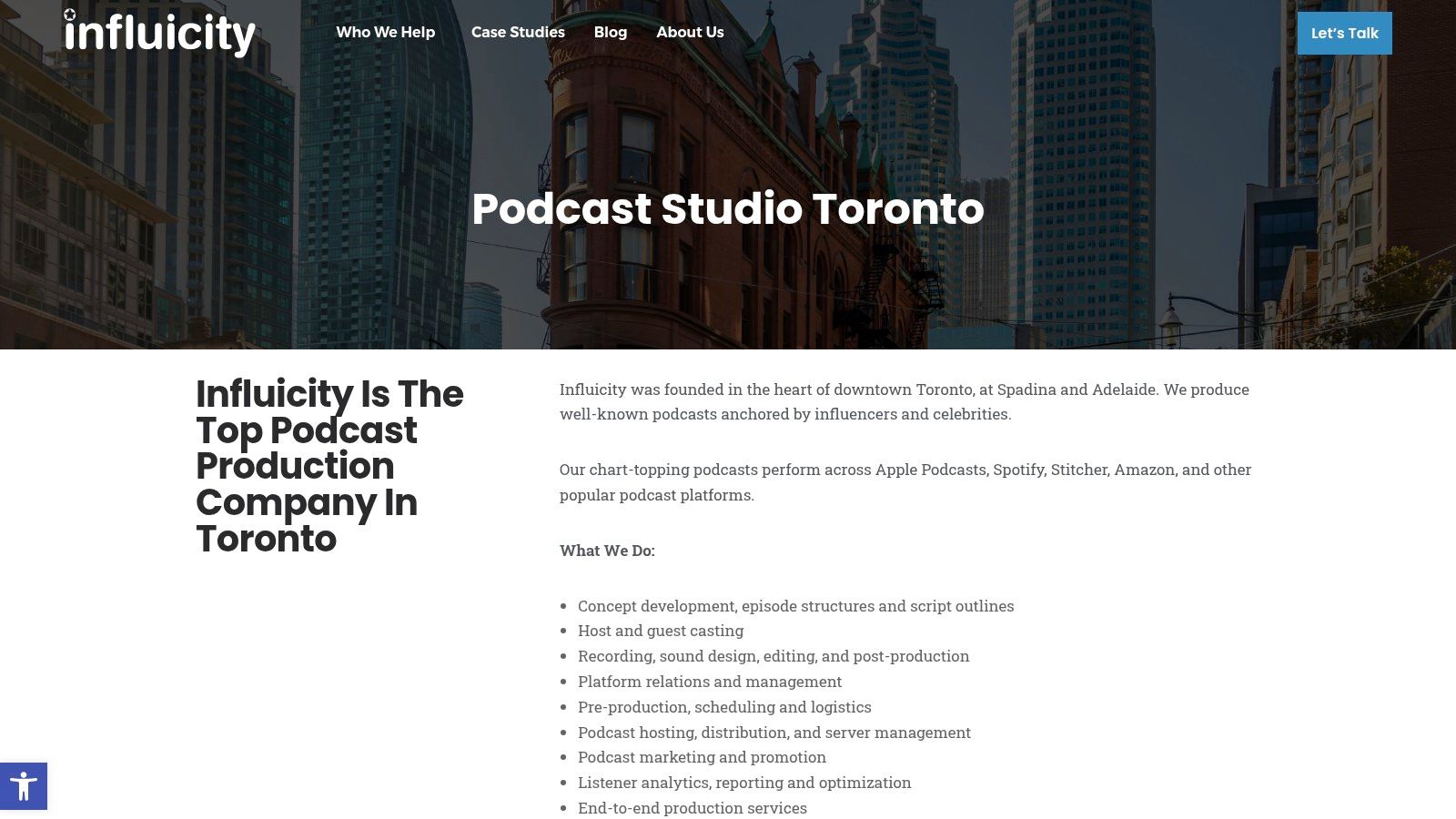
A Toronto marketing team launches a podcast to build authority, then realizes production was only half the job. The harder question is how that show connects to creator partnerships, paid distribution, campaign reporting, and audience growth. Influicity is built closer to that model than a pure production house.
Its offering appears to cover concept development, casting, recording, post-production, distribution, marketing, analytics, and optimization. For brands already running influencer or media programs, that matters. The podcast can sit inside a broader demand generation or brand campaign instead of operating as a standalone content project.
That positioning creates a clear trade-off.
Influicity makes more sense for teams that want one partner handling production plus amplification. It is less compelling if your main goal is to build a disciplined B2B show with a tight audience thesis, strong sales alignment, and a clear path from episodes to pipeline. In that case, a specialist agency or a growth-focused partner like Fame will usually bring a sharper operating model.
Why marketers shortlist Influicity
The advantage is coordination. A brand team does not have to split strategy, creator support, distribution, and reporting across multiple vendors. That can reduce handoffs and help the podcast contribute to larger campaign objectives.
The risk is focus. Agencies that cover many marketing services sometimes treat the podcast as one tactic among many, while B2B leaders often need the show to do heavier strategic work. That includes sharpening executive positioning, creating sales-ready content, and turning audience trust into qualified demand over time.
Ideal client fit
Influicity is a strong fit for consumer brands, campaign-led teams, and companies that want podcasting tied closely to influencer marketing or broader media execution. If your buying criteria center on cross-channel reach, convenience, and promotion support, it deserves consideration. If you need a podcast partner built around thought leadership and revenue outcomes first, choose a more specialized shop.
7. editaudio
editaudio is a strong fit for teams that care about editorial craft, full-pipeline production, and flexibility across recording environments. Its service range appears broad, covering the work that often gets split between multiple vendors, including development, scripting, booking, recording, editing, sound design, and marketing support.
That's useful for brands with complex subject matter or internal bandwidth constraints. You don't need to orchestrate separate specialists for story development, production, and delivery.
Where editaudio fits best
editaudio feels especially well matched to organizations that want a thoughtful, well-produced show without forcing it into a conventional corporate mold. It also appears well suited to event capture and custom studio setups, which can matter if your content operation extends beyond a standard recurring interview show.
A few reasons to shortlist it:
- Editorial support: Good when the idea needs shaping, not just execution.
- Flexible production: Helpful for on-site recording, special projects, or hybrid workflows.
- Full-pipeline model: Reduces handoffs across vendors.
Ideal client fit
editaudio is a smart choice for mission-driven brands, institutions, and teams that value craft and adaptability. It may not be the first option for buyers who want overt B2B attribution and growth reporting. But for clients who need a capable production partner with broad editorial and operational support, it's a compelling Toronto-area option.
8. Antica Productions
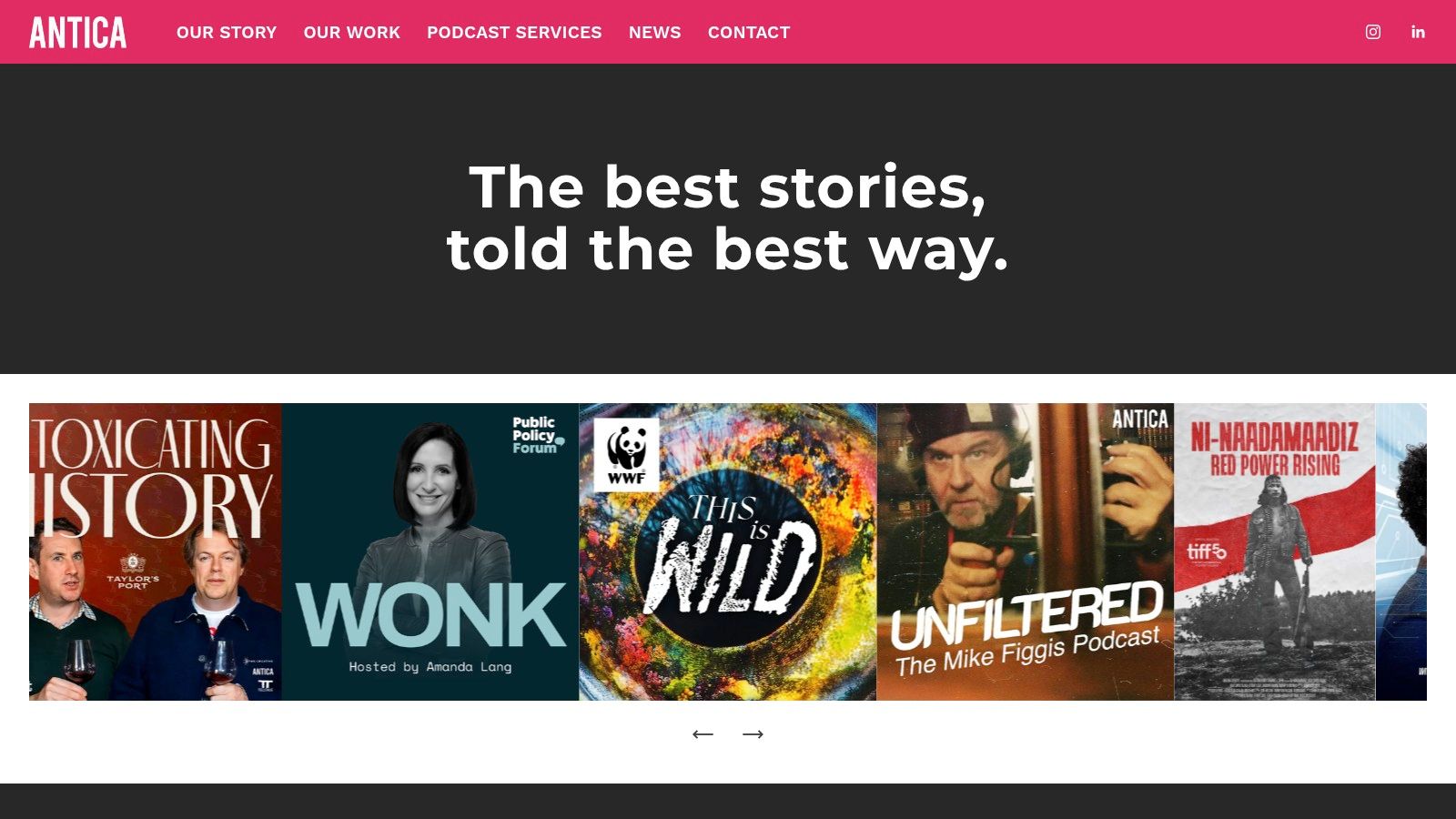
Antica Productions is one of the strongest Toronto names for premium, editorially ambitious podcast work. If your company wants a podcast that carries the tone and rigor of documentary media, Antica is a serious contender.
This is not a lightweight content machine. That's both the appeal and the limitation.
Why buyers choose Antica
Antica works well when your subject matter needs credibility, nuance, and strong storytelling discipline. It makes sense for nonprofits, institutions, public-interest brands, and enterprises with complex narratives that need more than standard host-guest interviews.
The big upside is depth. The show can feel substantial and differentiated. The downside is speed. If your team wants a frequent publishing cadence and quick repurposing workflow, a narrative-heavy partner may create more operational drag than you want.
Buyer signal: If your internal team keeps talking about "storytelling," "editorial quality," and "flagship content," Antica belongs on the shortlist.
Ideal client fit
Antica is best for mission-led organizations and premium brands that want a polished original series with strong editorial architecture. It's less suited to B2B teams looking for a practical pipeline channel with steady, repeatable episode production. For prestige and storytelling, it's one of Toronto's better options.
9. Vocal Fry Studios
Vocal Fry Studios is a boutique Toronto studio with a strong reputation for craft. It feels most useful for brands that want close editorial attention, host coaching, and access to a local studio setup without hiring a larger agency.
Boutique can be an advantage. You often get more direct collaboration and more care in the details. But it also usually means less scale.
What Vocal Fry does well
Vocal Fry is a good option when the host needs support and the show needs shaping. That's more valuable than many buyers realize. A polished edit won't fix a weak interview, unclear narrative arc, or flat delivery. Coaching and development work often have more impact than another round of post-production polish.
This agency is also a practical choice for Toronto-based teams that want in-person recording. That local access is useful for executive shows where studio consistency and coaching matter.
Consider Vocal Fry if you want:
- Host guidance: Helpful for first-time or occasional hosts.
- Studio access in Toronto: Better for in-person recording workflows.
- Editorial care: Strong fit for quality-conscious teams running a smaller show.
Ideal client fit
Vocal Fry is best for organizations that want a thoughtful boutique partner and a well-crafted show, especially if local recording matters. It's not the strongest option for multi-show portfolios or aggressive audience-growth programs. But for focused teams that want quality and hands-on support, it deserves a place on the list.
10. The Sonar Network
The Sonar Network comes from a different angle than most agencies here. It's a podcast network first, which gives it a creator-centric perspective on branded content and audience fit.
That difference matters. Brands sometimes overproduce podcasts that feel corporate and underproduce the parts that make listeners care. A network with roots in creator culture can help avoid that trap.
Best use case for The Sonar Network
The Sonar Network is worth considering if your brand wants authentic integration with podcast culture, especially in creator-led or entertainment-adjacent formats. It may also be useful if sponsorships, host partnerships, or local creator relationships are part of the plan.
The obvious limitation is B2B alignment. If you're a demand-gen team trying to tie the show tightly to sales conversations and executive positioning, a specialist agency will usually be a better fit.
Ideal client fit
The Sonar Network works best for brands that want to tap into Toronto's creator ecosystem and produce something that feels native to podcast listeners. It's less compelling for corporate B2B buyers who need strategic rigor, detailed operational support, and clear growth accountability.
Top 10 Toronto Podcast Agencies Comparison
| Agency | Implementation Complexity 🔄 | Resource Requirements ⚡ | Expected Outcomes 📊 | Ideal Use Cases 💡 | Key Advantages ⭐ |
|---|---|---|---|---|---|
| Fame | Moderate, end-to-end with proprietary tooling; requires host participation | Mid-market retainer ($2.5k–$5k+/mo) + promo spend; host time for coaching/interviews | Predictable audience growth (10%+/mo guarantee); pipeline-focused leads | B2B demand-gen, leadership shows, guest→client conversion | Growth-first guarantee; proprietary Host & AI tools; proven case studies ⭐ |
| Quill | High, custom enterprise workflows and creative production | Enterprise budgets; stakeholder alignment for multi-channel campaigns | Measurable audience development with firmographic insights | Enterprise & mid-market branded shows across industries | Proprietary analytics (CoHost); strong brand clients & social proof ⭐ |
| Pacific Content | High, long development, premium narrative production | Premium investment and executive coordination; long timelines | Market-defining thought leadership; high production value | Large enterprises seeking documentary/narrative brand series | Unmatched narrative storytelling and production quality ⭐ |
| JAR Audio | Moderate, data-informed, audience-first production | Mid-to-enterprise budgets; resources for audience research | Improved engagement and listener loyalty; strategic growth | Brands wanting narrative series with measurable engagement | Data-driven audience strategy; strong North American experience ⭐ |
| Story Studio Network | Moderate, editorially led, message-aligned workflows | Mid-market budgets; close brand communications involvement | Clear executive messaging and decision-maker reach | Corporate comms, policy-focused B2B series, executive thought leadership | Strong alignment with brand communications and public-affairs contexts ⭐ |
| Influicity (Podcast Studio + Production) | Moderate, studio plus integrated media & influencer services | Budgets for studio, sponsorships, and paid amplification | Cross-channel reach; sponsorship and ad revenue opportunities | Campaigns needing production plus influencer/paid media support | One-stop production with ads/sponsorship & influencer integration ⚡ |
| editaudio | Moderate, full creative pipeline with international reach | Mid budgets; option for studio builds and event capture | High editorial impact; polished storytelling and event content | Editorial/creative series, conference capture, inclusive teams | Inclusive, mission-driven studio; cross-border and event expertise ⭐ |
| Antica Productions | High, premium creative, cross-media (film/TV) integration | Premium budgets; access to experienced journalists and talent | Award-caliber, deeply reported branded podcasts | Nonprofits, institutions, and brands seeking documentary depth | Editorial pedigree and cross-media storytelling excellence ⭐ |
| Vocal Fry Studios | Low–Moderate, boutique editorial production and coaching | Smaller retainer; local studio time for in-person sessions | Meticulous sound design and host development; studio-quality episodes | Brands needing editorial craft and Toronto-based studio access | Strong editorial craft and convenient Toronto studio availability ⭐ |
| The Sonar Network | Low–Moderate, network-driven branded content and partnerships | Flexible budgets; access to creator roster and ad-sales infrastructure | Authentic creator-led content and sponsorship placements | Brands tapping into local creators or entertainment formats | Creator-centric approach with local network and ad-sales reach ⭐ |
How to Choose Your Agency & Launch Your Toronto Podcast
You approve a podcast budget, record three episodes, and six months later the show looks polished but does little for pipeline, sales conversations, or category authority. That usually starts with the wrong selection criteria. Teams buy production quality and discover later they needed distribution, editorial strategy, and reporting.
Start with the commercial job.
A Toronto podcast agency can do several very different things. It can produce a premium brand asset. It can help an executive build authority in a niche market. It can create a repeatable content engine for demand generation. Those are not the same brief, and they should not be bought the same way.
If your goal is brand storytelling, executive reputation, or a show with documentary weight, agencies like Pacific Content and Antica are a better fit. They bring editorial structure, strong narrative instincts, and the kind of polish that signals quality to senior audiences. That matters when the podcast itself is part of brand positioning.
If your goal is pipeline influence, the filter gets tighter. You need an agency that treats the show as a business channel, not just a creative asset. That means clear audience strategy, guest selection tied to your market, repurposing for sales and social, and reporting that connects activity to business outcomes.
Toronto is a strong market for podcast production, and buyers already expect quality. The harder question is whether an agency can turn that quality into commercial traction.
For B2B teams, the useful test is simple. Can this partner show how the podcast supports demand generation, thought leadership, or account development after the episode goes live? A good benchmark is the way some growth-oriented firms build around attribution, dashboards, quarter-by-quarter reporting, SEO distribution, YouTube repurposing, and tracking infrastructure. Content Allies outlines that kind of model clearly in its Content Allies Toronto agency analysis. Even if you do not hire them, that framework is worth using in every agency conversation.
Ask direct questions before you sign:
- How do you define success for a B2B podcast? Downloads alone are not enough.
- What happens after publishing? Ask for a concrete distribution and repurposing workflow.
- Who owns editorial strategy? Without that function, the show often turns into unfocused interviews.
- What reporting will we receive? Ask to see sample dashboards, review docs, or QBR formats.
- What does your team need from ours each month? This determines whether the engagement will run smoothly or stall.
Then assess fit at the operating level.
Some marketing teams need a high-touch creative partner and can supply strategy internally. Others need an agency that can shape positioning, book the right guests, package insights for multiple channels, and keep the program tied to revenue goals. That is the fundamental divide between generalist creative studios and growth-focused partners. Production quality matters. For B2B brands, it is rarely the deciding factor on its own.
A polished show can make your company sound credible. The right agency helps your team earn attention from the right buyers, give sales useful content, and build authority that compounds over time.
If your team wants a partner built for B2B growth, Fame is a strong option to evaluate first. It combines strategy, production, and promotion with a clear focus on thought leadership and pipeline impact, which makes it a different choice from studios that concentrate primarily on the finished episode.
