
Finding Your Voice: A Guide to Vancouver's Top Podcast Agencies
Your CMO wants a podcast. Not a vanity project. A show that makes your category expertise easier to discover, gives sales a warmer opening line, and helps your company sound like the obvious choice in a crowded market.
That sounds straightforward until you start looking for a Vancouver agency. The local market has real creative talent, but a lot of firms sit somewhere between video production house, PR shop, and general content agency. If you're a B2B team, that creates a problem. Good audio alone won't get you pipeline, better guests, or stronger distribution.
Vancouver does have podcast specialists. It also has agencies that can produce a polished show but may not have a repeatable growth system behind the production work. That distinction matters more than most buyers think. A beautiful show with weak guest ops, inconsistent post-production, or no distribution engine usually stalls fast.
This shortlist is built for commercial intent, not casual browsing. It ranks agencies based on B2B podcast expertise, growth support, end-to-end execution, and how well they fit companies that care about authority and revenue impact, not just sound design.
One market signal is worth keeping in mind before you evaluate any vendor. Independent Vancouver directories show a fragmented field where many providers are broader media firms rather than pure podcast specialists, and many disclose relatively small teams with broad service mixes through listings such as The Manifest's Vancouver podcast company directory. That's why the best-vancouver-podcast-agency decision usually comes down to operational depth, not portfolio aesthetics.
1. Fame
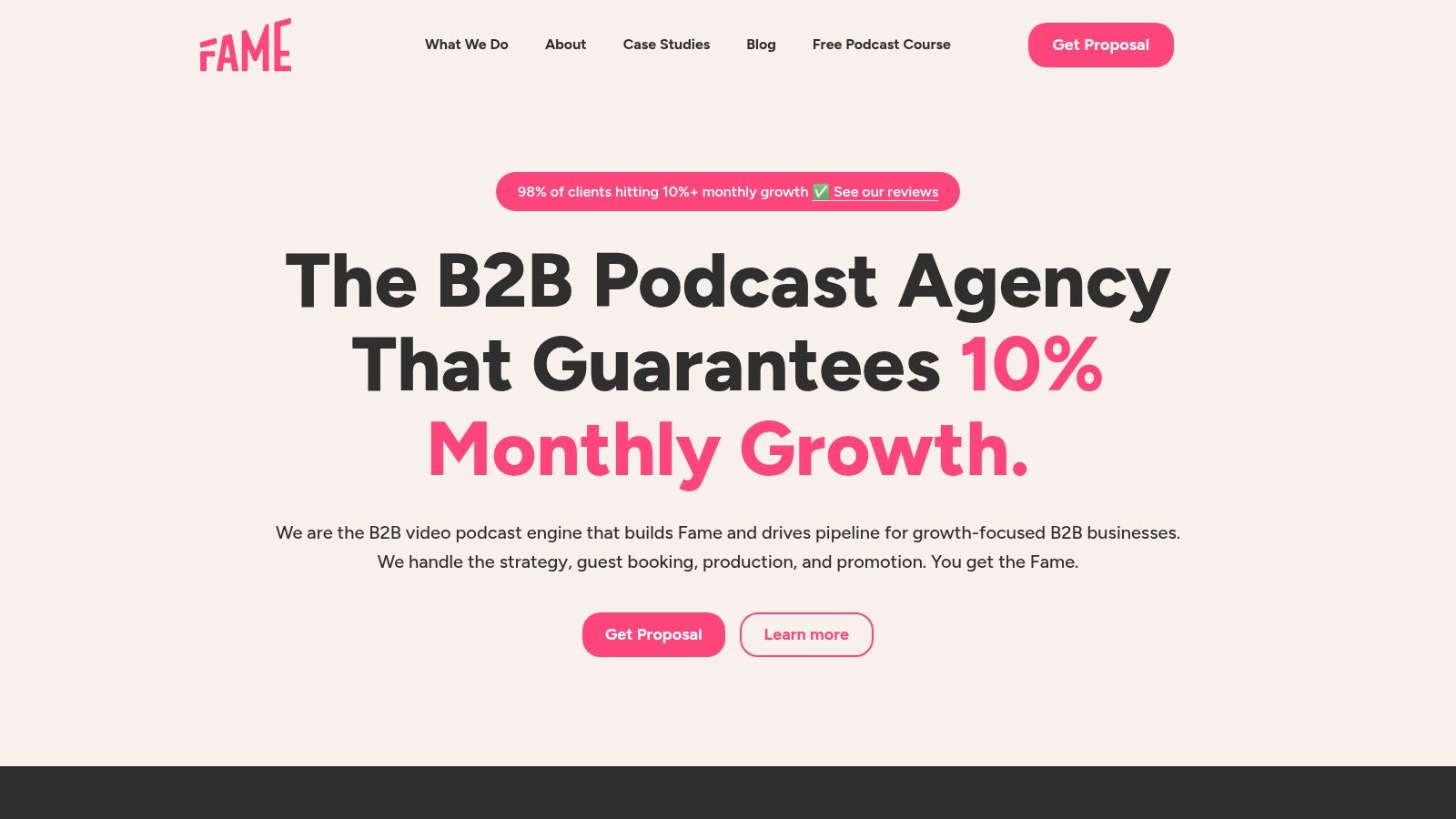
A Vancouver B2B team usually reaches the same decision point fast. Do you want a polished show, or do you want a show that helps sales get warmer conversations, gives executives a reason to stay visible, and turns guest outreach into pipeline? Fame ranks first here because its model is built around the second outcome.
That difference matters in this market. Many agencies can record, edit, and ship episodes. Fewer have a repeatable system for show strategy, guest selection, distribution, repurposing, and performance management. Fame presents itself as a B2B podcast partner with that full-stack approach, not a production vendor. On its Vancouver page, the company says it operates with team members in Vancouver as part of a global organization producing a large volume of B2B shows at any given time, according to Fame's Vancouver podcast agency page.
Why Fame ranks first
The practical buying case is straightforward. Fame is strongest for companies that already see a podcast as part of revenue marketing, executive branding, or account-based relationship building. That usually means SaaS, professional services, agencies, and enterprise categories where the right guest matters as much as the episode itself.
Its service model also signals maturity. Fame publicly frames the work as an ongoing subscription, with strategy, production, distribution, and growth support bundled together, and it publishes pricing and audience-growth expectations on its site. That kind of transparency is useful because it lets buyers compare operating models, not just creative reels.
One thing I look for in any agency review is whether they can explain what happens after recording day. Fame clears that bar. If your team is evaluating vendors, compare how each one structures podcast production services for strategy, workflow, and distribution. Hidden gaps usually show up there first.
Practical rule: If an agency sells podcasting mainly as editing plus cover art, your team will likely end up owning growth, guest ops, and content distribution internally.
Strengths and trade-offs
Where Fame is strong:
- B2B focus: The positioning is designed for business shows built to build authority, relationships, and demand.
- Operational clarity: A subscription model is easier to budget and easier to evaluate than vague project scoping.
- Growth orientation: The agency talks about promotion and audience performance, not only production quality.
- Systemized delivery: The scale of its operation suggests defined processes rather than custom improvisation on every show.
Where buyers should be careful:
- You still need internal participation: Executive calendars, guest preparation, and subject-matter depth still come from your side.
- The model suits committed teams: Companies testing podcasting as a side project may find the program structure too disciplined for a casual experiment.
- Creative fit is narrower: Brands looking for highly narrative, entertainment-first storytelling may prefer a studio with a more editorial or documentary bent.
For B2B buyers, that trade-off is usually acceptable. A show that sounds excellent but lacks a growth engine rarely becomes a meaningful business asset. Fame stands out because it is built for measurable outcomes first and production quality second, which is the right order for companies that care about authority, audience growth, and sourced opportunity.
Best fit: B2B companies that want a podcast tied to pipeline support, category authority, and a clear distribution system.
Website: Fame
2. JAR Audio
A Vancouver company is ready to launch a branded podcast. Legal needs sign-off. The executive team wants message control. Marketing wants a show that sounds credible enough to represent the brand in front of customers, partners, and recruits. That is the kind of brief JAR Audio tends to fit.
JAR has been part of the Vancouver podcast scene long enough to matter. Its market position suggests a specialist firm built around branded audio, with strategy, production, and distribution as core services rather than add-ons. For buyers, that usually means a more disciplined editorial process and fewer surprises once stakeholders start weighing in.
Where JAR stands out
JAR looks strongest with organizations that care about editorial quality and brand stewardship as much as publishing consistency. That makes it relevant for enterprise teams, institutions, and nonprofits where a podcast often carries more reputational weight than a typical content asset.
I would put JAR in the "brand-first, editorially guided" camp of podcast partners. That has real value. A strong agency in this category helps shape the premise, tighten interviews, and keep the show aligned with how the company wants to sound in market.
It also comes with trade-offs. If the main goal is high-volume episode output tied tightly to demand generation, buyers should ask harder questions about repurposing, promotion, and how the show connects to pipeline. Teams comparing JAR with agencies that put more emphasis on distribution should look closely at the difference between editorial production and podcast marketing support built around audience growth and promotion.
Strengths and trade-offs
A practical assessment looks like this:
- Strong fit for branded shows: JAR appears built for companies that want more than editing and post-production.
- Comfort with stakeholder-heavy projects: That matters when approvals, messaging, and subject matter require tighter control.
- Clear strategic layer: The offer appears to include planning and show development, not just recording logistics.
The likely downside is scale. JAR feels more boutique than process-heavy agencies built to run a wider content engine. For one flagship show, that can be a good thing. For companies planning multiple series, weekly publishing across business units, or aggressive content repurposing, capacity and operating model become important buying questions.
Pricing also looks consultative rather than productized. That suits teams with a defined brief and budget. It is less convenient for buyers who want simple package comparisons across vendors.
Best fit: Enterprise, nonprofit, and B2B brands that need a polished branded podcast with strong editorial oversight and careful stakeholder management.
Website: JAR Audio
3. Pacific Content (part of Lower Street)

Pacific Content has long been associated with high-end branded storytelling, and that still defines its appeal. If your company wants a narrative-led series that feels closer to documentary media than standard interview content, Pacific Content is one of the strongest names in Vancouver's orbit.
This isn't the first agency I'd pick for a straightforward B2B interview show built to support account-based marketing. It is one of the first I'd look at for a flagship branded series where creative ambition is part of the business case.
Best for narrative-first brands
Pacific Content's value is creative sophistication. The agency is known for story structure, polished production, and brand-safe narrative development. That's useful when a company wants to launch a show that can stand apart from the flood of executive interview podcasts that all sound interchangeable.
The trade-off is that narrative work usually requires more approvals, more production planning, and more patience. For many B2B teams, that's fine if the show is meant to be a major brand asset. It's less fine if marketing needs a repeatable content system that produces episodes and spin-off assets consistently.
A practical way to think about Pacific Content is this: the agency is strong when the show itself is the centerpiece. It is less obviously optimized for companies that want a podcast to function as an ongoing growth machine tied tightly to distribution cadence.
Strengths and limitations
- High-end storytelling: Strong fit for documentary-style or premium branded series.
- Enterprise credibility: Well suited to larger brands that want a flagship show.
- Broader creative resources: Being part of Lower Street can expand execution options.
What could be a drawback:
- Likely premium budgets: Narrative production rarely sits at the lower end of the market.
- Longer planning cycles: Great for major launches, less ideal for fast-moving demand-gen teams.
- Not always the best format for B2B velocity: Storytelling excellence doesn't automatically mean easier guest sourcing or steady release cadence.
If you're seriously considering Pacific Content, make sure you ask how the agency handles launch and growth, not just concept and production. That's where many strong creative shops need reinforcement. It helps to compare that process against what dedicated podcast marketing services teams do after the final audio is exported.
Best fit: Brands that want a premium narrative podcast with strong editorial craft and enterprise polish.
Website: Pacific Content
4. Kelly & Kelly
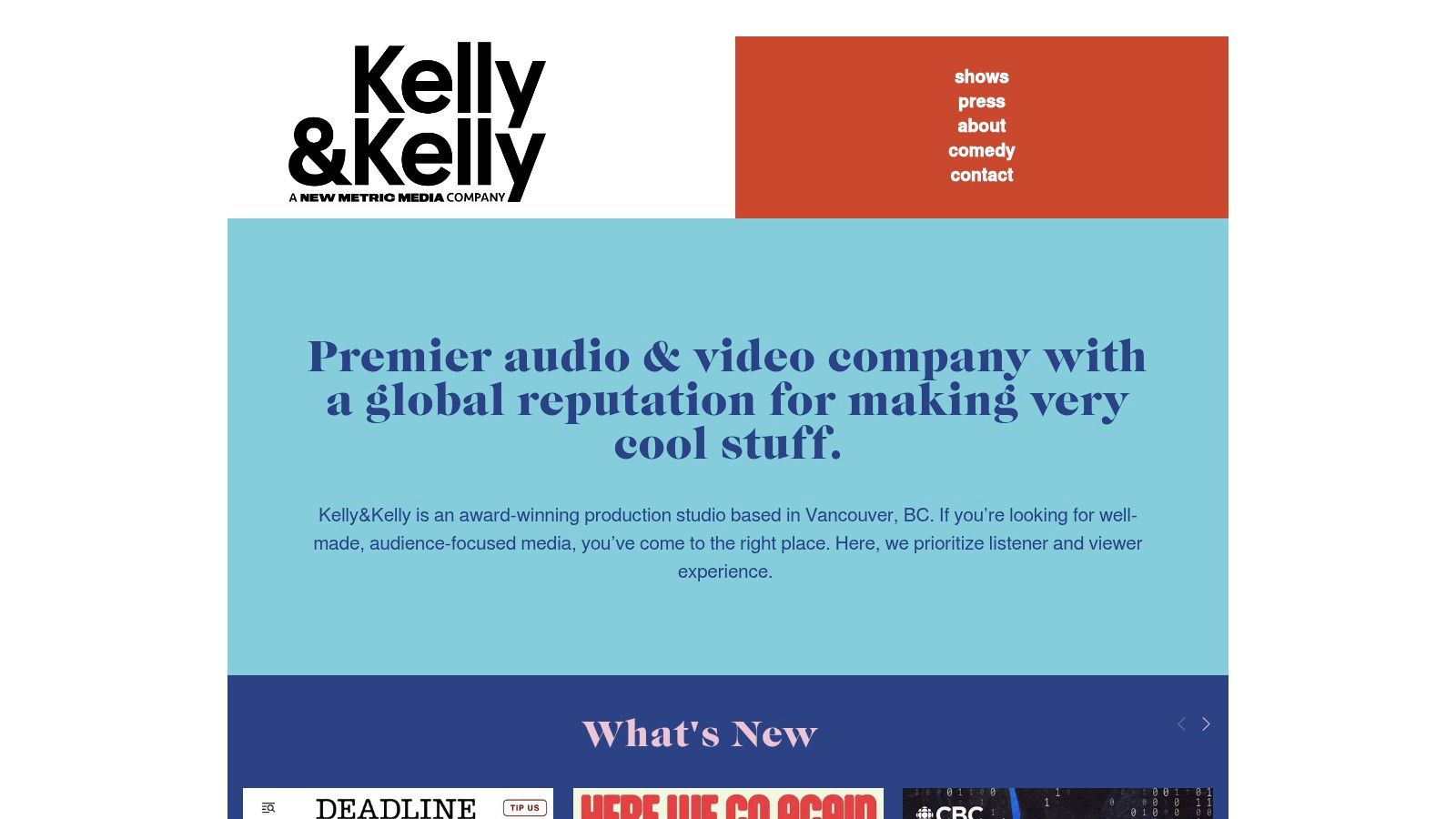
Kelly & Kelly is an interesting inclusion because it solves a different problem than most agencies on this list. If your brand wants a show with personality, cultural edge, and stronger entertainment value, this studio deserves attention. Its strength is concept development and creative execution, especially where comedy, narrative, or pop-culture sensibility matters.
For technical B2B companies, that can be either a huge advantage or a mismatch. It depends on whether you need authority through polish and insight, or authority through distinctive storytelling and memorability.
A creative-first choice
Some business podcasts are too safe to earn attention. They sound competent, but nobody remembers them. Kelly & Kelly is the kind of studio that can push a show away from that trap. The team appears well suited to formats that need sharper writing, stronger pacing, and more identity than the typical interview-led company podcast.
That said, creative originality isn't the same thing as growth infrastructure. Buyers should ask direct questions about repeatable distribution support, asset production, and what happens after each episode ships.
A memorable show can still underperform if nobody owns audience development. Great creative doesn't replace distribution discipline.
Strengths and trade-offs
What I like about this option:
- Distinctive creative voice: Useful for brands that want to stand out from standard corporate podcasts.
- Strong concept development: Good fit when the format itself needs shaping.
- Cross-media thinking: Helpful if podcast work may connect to broader media or video initiatives.
Where I'd be cautious:
- Less obvious B2B specialization: A highly technical or compliance-heavy brand should verify fit early.
- Style can outpace strategy: A sharp concept still needs operational muscle behind it.
- Availability may vary: Studios doing more creative production often have uneven capacity around bigger projects.
For a buyer, the key question isn't whether Kelly & Kelly can make a compelling show. It's whether the studio is the right long-term operating partner for the kind of B2B program you're building. If you need evidence of commercial outcomes, look hard at podcast agency case studies from any provider you're shortlisting, especially if your leadership team expects the show to support real pipeline conversations.
Best fit: Brands that want a more original, culture-aware, or narrative-led podcast rather than a standard expert interview format.
Website: Kelly & Kelly
5. Everything Podcasts
Everything Podcasts looks like a solid fit for larger organizations that want a turnkey program and don't want to cobble together freelancers, strategists, and media contacts on their own. The backing and positioning suggest a more corporate-ready delivery model than many smaller agencies in the Vancouver area.
That matters if your team has multiple stakeholders, formal review cycles, or a need for clear approvals and structured communication. In those environments, operational steadiness often beats creative flash.
Good for institutional and corporate teams
Everything Podcasts appears strongest when the podcast has to work inside a broader organization. Think healthcare, education, finance, or a company where several departments need to sign off on messaging. Those buyers usually care about reliability, governance, and presentation as much as they care about the host's charisma.
The likely trade-off is pace. Bigger, more structured production environments tend to move more deliberately. That's not a flaw. It's just a bad fit if you need to launch quickly and iterate in public.
What to expect
- Strong stakeholder handling: Useful for organizations with layered approvals.
- Full-service positioning: Better than trying to coordinate strategy and production across separate vendors.
- Broad organizational fit: Appears comfortable with more formal institutional buyers.
Potential limitations:
- May not be the most nimble option: Enterprise-friendly process often means more deliberate timelines.
- Likely better for established brands: Smaller startups may find the model heavier than they need.
- B2B growth depth should be validated: Ask how audience development works in practice, not just in pitch language.
I would shortlist Everything Podcasts if the internal complexity of your organization is the main challenge. If your biggest challenge is speed, audience growth, or building a content engine around the show, you'll want to compare its process against a more systems-driven guide to how to produce a podcast from launch through promotion.
Best fit: Enterprises and institutions that want a polished, managed podcast process with room for stakeholder input.
Website: Everything Podcasts
6. Podcast Nation

Podcast Nation is the most promotion-oriented name in this lineup after the top few picks. It doesn't just signal production. It also signals marketing activation, branding, and live-show capability. That can be attractive if your podcast is part of a bigger audience-building effort and you want one partner to touch several moving parts.
Still, I'd separate "can promote podcasts" from "has a proven B2B podcast system." Those aren't the same thing.
Where it can work well
Podcast Nation looks useful for brands that want support beyond the recording and editing layer. If your team cares about show branding, PR, social support, and broader amplification, this agency may offer more range than a pure production studio.
That said, the positioning appears more adjacent to creator, entertainment, or lifestyle formats than hard-nosed B2B category leadership. That doesn't mean it can't work for business podcasts. It means buyers should ask sharper questions about subject-matter fit, executive coaching, and the agency's comfort with niche industry audiences.
Main pros and cons
- Broader activation support: Helpful if your show needs promotion, not just delivery.
- Branding and design capability: Useful when the show identity matters.
- Potential event tie-ins: Stronger option if live experiences are part of the strategy.
The main concerns:
- B2B fit isn't automatic: Verify examples relevant to your market.
- Live and touring features aren't universally useful: Many business podcasts won't need them.
- May be broader than necessary: If all you need is a tight B2B production-and-growth engine, the extra surface area may not help.
Podcast Nation is worth a conversation if your show is meant to become a broader media property rather than just a recurring interview series. For narrower B2B buyers, though, a specialist agency will often have a more direct path from idea to business result.
Best fit: Brands that want production plus promotional activation, especially if the show has a public-facing or event-driven angle.
Website: Podcast Nation
7. Podium Podcast Co.
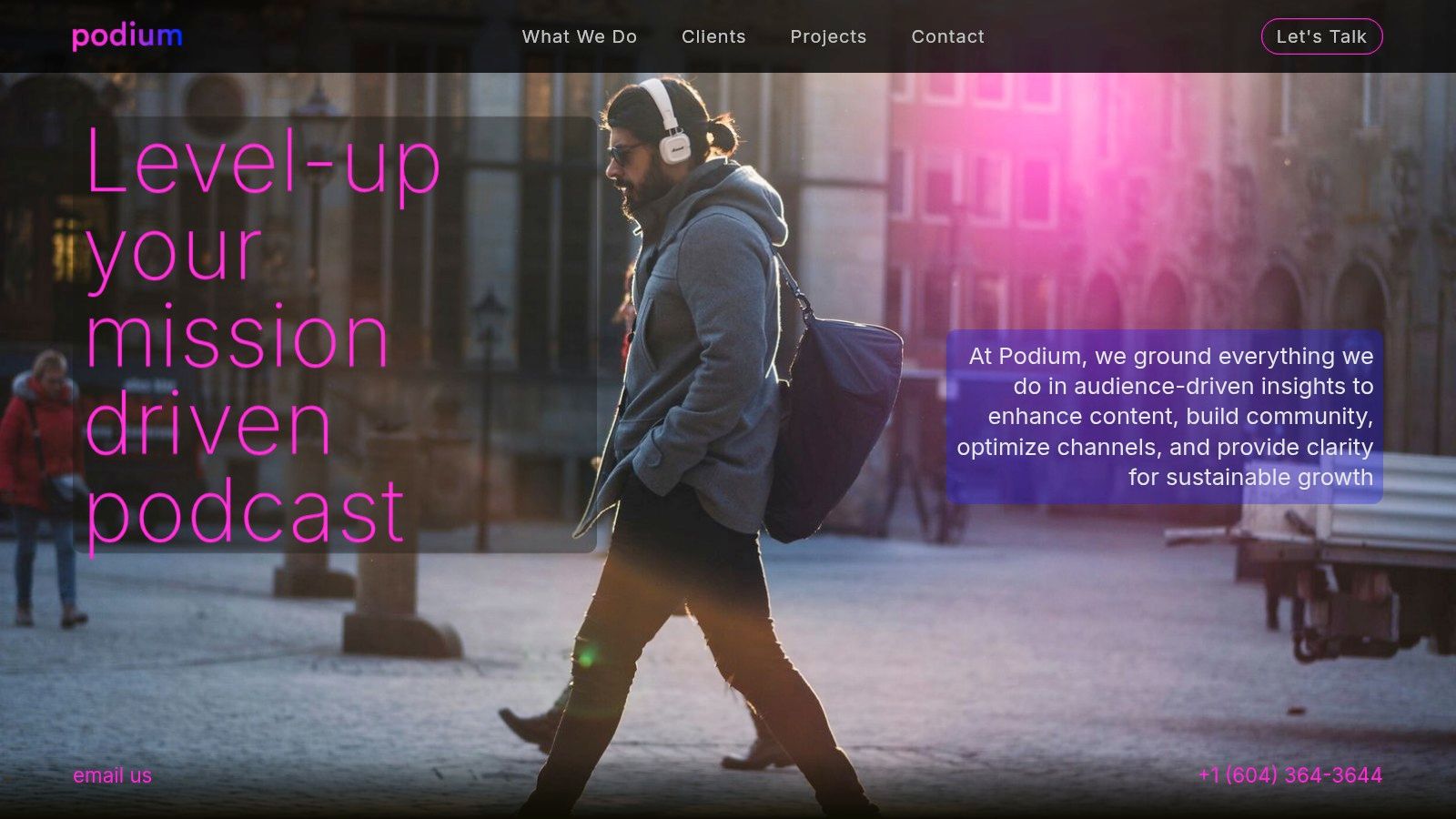
Podium Podcast Co. is one of the more interesting specialists in the Vancouver market because it appears to focus on mission-driven, academic, and expert-led shows. That narrower positioning can be a real advantage if your organization sits in higher education, research, nonprofit, or a credibility-heavy niche where audience trust matters more than flashy branding.
This is a good reminder that "best-vancouver-podcast-agency" doesn't always mean the most broadly marketed agency. Sometimes the better choice is the shop that already understands your kind of stakeholder and your kind of audience.
Strong niche alignment
Podium's emphasis on audience development, distribution optimization, and analytics makes it attractive for organizations that care about sustained reach and informed iteration. That's especially useful for institutions that need more than anecdotal feedback and want a cleaner read on what topics, channels, and episode formats are resonating.
Another plus is the apparent comfort with expert-driven content. A lot of agencies can make charismatic hosts sound good. Fewer are naturally good at helping academics, researchers, or institutional leaders sound clear, engaging, and accessible without oversimplifying the substance.
Why some buyers should prioritize it
- Good fit for expert-led shows: Strong option for institutions and mission-driven organizations.
- Analytics-minded approach: Useful for teams that want more than surface-level reporting.
- Distribution attention: A practical advantage in crowded podcast platforms.
What to confirm before signing:
- Capacity and intake: Niche agencies can be selective, which isn't bad, but it affects timing.
- Commercial B2B fit: Great for institutional thought leadership. Less obviously ideal for aggressive pipeline-focused programs.
- Creative range: If you want a highly produced entertainment-style show, another studio may suit better.
For universities, nonprofits, associations, and research-led brands, Podium is one of the stronger specialist options in Vancouver. For venture-backed SaaS teams trying to turn podcasting into a repeatable growth channel, I'd still prioritize a more explicitly B2B-centric partner.
Best fit: Higher education, nonprofit, research, and mission-driven organizations that want thoughtful audience development around expert content.
Website: Podium Podcast Co.
8. Make a Hit Audio & Video Production
Make a Hit appears in Vancouver agency directories and represents a type of provider many buyers will encounter in local search results. It's part of the broader production ecosystem rather than a pure-play B2B podcast specialist. That's not automatically a negative. It just changes the buying question.
If your company mainly needs strong production help and already owns strategy, guest sourcing, and distribution internally, a firm like this can be perfectly workable. If you need a partner to architect the whole podcast program, I'd be more cautious.
Better as a production partner than a growth engine
The practical issue with generalist production firms is usually workflow depth around podcasts specifically. Can they handle remote guest reliability? Do they have a repeatable post-production cadence? Can they create show notes, assets, clips, and distribution support consistently? Those are the gaps that matter once the novelty of launching the show wears off.
This is why procurement teams should look beyond the reel. A beautiful visual portfolio doesn't tell you much about podcast operations.
- Useful if you already own strategy: Better fit for marketing teams with a clear internal plan.
- Production strengths may transfer well: Audio and video experience can help with hybrid podcast formats.
- Less clear podcast specialization: Buyers should validate podcast-specific process maturity.
Best fit: Teams that need production support and already have internal ownership of strategy and growth.
Website: Make a Hit Audio & Video Production
9. Oh Boy Productions
Oh Boy Productions is another example of a Vancouver-area creative shop that may show up during agency research but shouldn't be assumed to be a podcast specialist just because it can produce media. That's a common mistake in this category.
For some companies, an agency like this can still work. The key is knowing what problem you're solving. If the challenge is capturing and packaging content professionally, a broader production firm might be enough. If the challenge is building an audience and making the show commercially useful, the bar is higher.
What to ask before hiring
I wouldn't eliminate a company like Oh Boy Productions outright. I would ask better questions.
- Podcast workflow: How do they manage guest recording, edits, revisions, and publishing?
- Asset repurposing: Can they produce clips, visuals, and supporting content every cycle?
- Growth support: What do they do after the episode is finalized?
Those answers matter more than whether the website looks polished. In Vancouver, plenty of firms can make something that sounds good. Fewer can help a B2B team run a show month after month without creating internal chaos.
Best fit: Brands that want a creative production partner and are prepared to own more of the podcast strategy themselves.
Website: Oh Boy Productions
10. Mindful Agency
Mindful Agency sits closer to the marketing side of the local ecosystem. That's useful if your team wants a partner who can think about content in a broader digital context, not just as an isolated show. But it also means you should confirm how deep the agency's podcast-specific delivery really goes.
This kind of agency can be a good choice when the podcast is only one part of a wider content strategy. It can be a weaker choice when the podcast itself is the centerpiece and needs dedicated production systems.
A broader-content option
The upside with a marketing-led firm is integration. The podcast can feed social, web, email, and campaign activity more naturally. The downside is that podcast operations can become secondary if the agency's core strength lies elsewhere.
The most expensive mistake isn't hiring a weak editor. It's hiring a partner who treats the podcast as a side task inside a broader retainer.
Ask whether Mindful has a documented process for planning, recording, editing, packaging, and distributing recurring episodes. If the answer stays high level, keep looking.
Best fit: Companies that want podcast support inside a broader marketing relationship and don't need a highly specialized audio operator.
Website: Mindful Agency
11. Grow Wild Marketing
Grow Wild Marketing rounds out the list as a reminder that many agencies in Vancouver can support podcast-adjacent work without being dedicated podcast agencies. For some buyers, that's enough. For others, it's exactly the problem.
If your team wants help with promotion, content packaging, and broader digital marketing around a podcast, a firm like Grow Wild may contribute value. If you're trying to find the best-vancouver-podcast-agency in the strict sense, it likely belongs lower on the list because the specialization appears broader.
A realistic use case
I can see Grow Wild working for a company that already records in-house and wants outside help promoting episodes, repurposing clips, and fitting the show into a larger marketing plan. I would be less confident using this type of agency as the sole owner of a B2B podcast launch unless they can show a tight operational process.
The core lesson is simple. Vancouver has capable agencies. What it has fewer of are agencies that publicly expose podcast-specific performance benchmarks and mature workflow systems. That makes buyer diligence more important than ranking position.
- Useful for broader marketing support: Better if the show is one channel among many.
- May help with repurposing and promotion: Good for teams with internal production.
- Lower specialization: Not the first choice for a high-stakes B2B launch.
Best fit: Companies that need marketing support around a podcast more than a full podcast operating partner.
Website: Grow Wild Marketing
Top 7 Vancouver Podcast Agencies Comparison
Shortlists usually get messy at this point. A team reviews a long list, then tries to force very different agencies into one clean table. The better way to read this section is as a decision filter. These seven stand out for buyer demand, visible specialization, or fit for B2B podcast programs that need more than polished audio.
The title stays "Top 7" because the table is a shortlist, not a recap of all 11 agencies reviewed above. Several of the other firms can still be a fit. They land outside this final comparison because their positioning is narrower, broader than podcasting, or less aligned with measurable B2B outcomes.
| Agency | Implementation complexity 🔄 | Resource requirements ⚡ | Expected outcomes 📊⭐ | Ideal use cases 💡 | Key advantages ⭐ |
|---|---|---|---|---|---|
| Fame | Moderate. Repeatable, video-first playbook with host training and clear production systems | Mid-market monthly spend. Internal host time and guest coordination still matter | Strong focus on measurable audience growth, reach, and business visibility | B2B firms that want a podcast tied to pipeline, authority, and consistent distribution | B2B specialization, proprietary tools, promotional system, performance accountability |
| JAR Audio | Moderate. Editorially driven process with custom production workflows | Quote-based pricing, likely premium. Works best with teams that can support reviews and approvals | High-quality branded shows with strong editorial control and executive-ready output | Complex B2B topics, enterprise brands, and nonprofits that need substance and polish | Journalism and agency background, strong story development, remote production capability |
| Pacific Content (Lower Street) | High. Narrative production, stronger planning needs, and longer runway to launch | Premium budgets, multiple stakeholders, and patience for a more involved creative process | Brand authority plays built for longevity, depth, and distinct positioning | Companies investing in a flagship series rather than a fast-turn demand generation show | Established enterprise track record, mature creative process, access to Lower Street resources |
| Kelly & Kelly | Moderate. Creative development matters as much as production execution | Specialized writing and sound design input. Fit depends on concept ambition | Distinctive shows with strong voice, cultural pull, and breakout creative potential | Entertainment, comedy, pop culture, and brands that want a sharper creative angle | Strong writing, sound design, cross-media experience, award-winning portfolio |
| Everything Podcasts | Moderate to high. Structured process built for approvals, compliance, and stakeholder handling | Corporate budgets and teams that value process discipline over speed | Reliable, broadcast-quality programs that can scale across departments or markets | Corporate, healthcare, finance, and education organizations with complex internal sign-off | Corporate-friendly workflows, distribution support, capacity for larger program rollouts |
| Podcast Nation | Moderate. Combines production with marketing and live activation options | Mid-range to premium, especially if promotion and events are part of the scope | Better discoverability and broader audience reach when activation is part of the plan | Consumer-facing brands and teams that want production plus promotion under one partner | Production, promotion, live events, and marketing support in one offer |
| Podium Podcast Co. | Moderate. Analytics, audience strategy, and optimization are built into the process | Mid-market budget plus willingness to track performance beyond downloads | Audience growth tied to community, discoverability, and institution-specific goals | Higher education, nonprofits, mission-driven brands, and expert-led B2B series | Institutional experience, analytics dashboard, SEO and distribution focus |
For a B2B buyer, the division is simple. Fame, JAR Audio, Pacific Content, and Everything Podcasts are stronger choices when the show has executive visibility and clear business stakes. Podcast Nation and Podium can work well when promotion or audience development is a larger part of the brief. Kelly & Kelly is the outlier. Strong creatively, but usually a more selective fit for brand and format.
Your Next Move Choosing the Right Vancouver Podcast Partner
The wrong agency usually doesn't fail on talent. It fails on fit. A studio built for narrative storytelling can struggle with recurring B2B execution. A generalist content shop can produce good assets but miss the deeper mechanics of guest quality, distribution, and pipeline alignment. A strong corporate vendor can keep stakeholders happy but move too slowly for a team that needs momentum.
That's why this decision should start with your actual goal. If you need a B2B growth engine with visible accountability, Fame is the clearest choice on this list. If you want a premium branded series with stronger editorial craftsmanship, JAR Audio and Pacific Content make more sense. If your organization needs structure, governance, and broad stakeholder handling, Everything Podcasts is worth serious consideration. If you're in higher education or a mission-driven sector, Podium Podcast Co. has a sharper niche fit than many larger names.
Use the shortlist like an operator, not a browser. Ask each agency the same hard questions. Who owns strategy? Who books guests? How do remote sessions get managed? What does post-production include besides the final audio? How are clips, show notes, and distribution assets handled? What happens when executive schedules slip? What does success look like after the launch period?
I'd also push agencies to show process, not just finished work. A polished trailer doesn't tell you whether the team can run a show for the next year without breaking your internal workflows. In B2B podcasting, consistency and operational maturity matter at least as much as creative ability.
One more practical point. Local presence is useful, but it shouldn't be your main filter anymore. Vancouver has strong creative roots in podcasting. It also sits inside a category that's become more distributed and specialized. The best partner may have local context, global delivery capability, and a much stronger system than a shop built only around local production.
If you're comparing vendors while tightening your wider content ops, it's also worth looking at adjacent tools such as speech-to-text podcasting solutions to improve repurposing speed and transcript workflows.
The best Vancouver podcast agency is the one that can make your team sound credible, publish reliably, and tie the show to business outcomes your leadership cares about. Start there, and the shortlist gets much clearer.
If you're building a B2B podcast and want a partner that handles strategy, production, distribution, and growth under one roof, Fame is the strongest place to start. Their model is built for companies that want more than polished audio and need a show that supports authority, audience growth, and real commercial goals.
