
Key Takeaways
Meta Title: B2B Podcasting for Sales Ops: The Ultimate Growth Blueprint
Meta Description: Discover how modern Sales Ops brands are using B2B podcasts to scale pipeline, build authority, and enable account-based marketing workflows.
Most Sales Ops teams are already publishing content. The problem isn't activity. It's that the usual mix of blog posts, gated PDFs, and recycled LinkedIn text rarely earns attention from the people who influence revenue operations decisions.
If you're selling into complex buying committees, long evaluation cycles, and highly analytical stakeholders, generic content gets skimmed, saved, and forgotten. A strong B2B podcast works differently. It creates direct access to target accounts, gives technical buyers a format they can consume during fragmented workdays, and turns expertise into a repeatable system for pipeline influence.
The primary opportunity in B2B podcasting for Sales Ops isn't audience scale. It's operational efficiency. A show can become an account-based outreach motion, a sales enablement library, and a trust-building asset that shortens the distance between first touch and serious commercial conversation.
Why Traditional Content Fails in Sales Ops
Sales Ops buyers don't need more content. They need content worth their time.
Most standard corporate content fails because it treats Sales Ops like a broad awareness market instead of a high-context buying environment. A generic blog post about forecasting, territory planning, or CRM hygiene might rank for a keyword, but ranking doesn't mean it moves pipeline. The people evaluating Sales Ops vendors are usually juggling platform sprawl, data quality issues, handoff friction, and executive pressure for cleaner reporting. They don't respond to fluffy thought leadership.
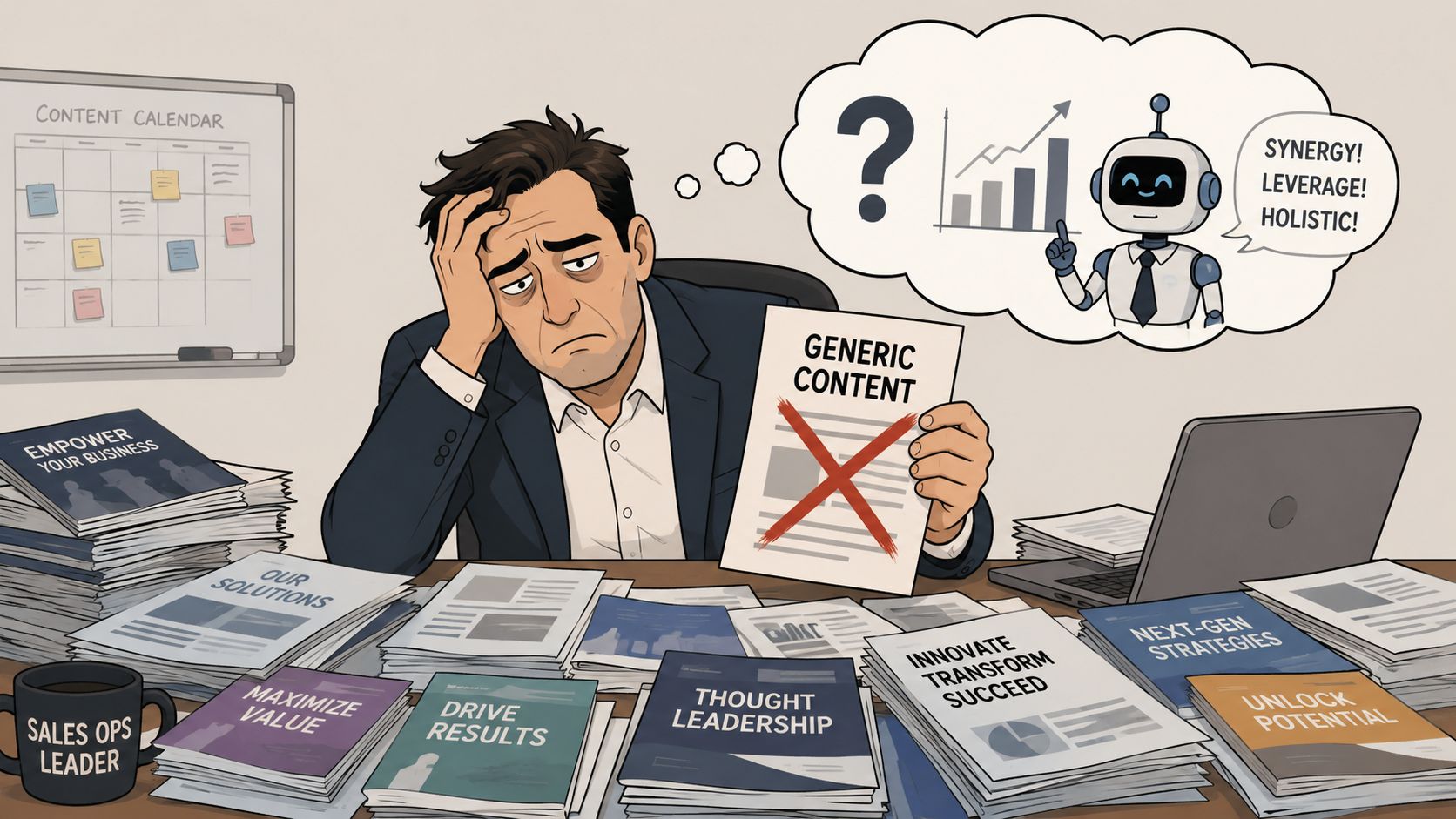
Why text-only content underperforms
Sales Ops is full of dense subjects that are hard to explain in shallow formats. Lead routing logic, revenue attribution, pipeline inspection, compensation design, and CRM governance all require nuance. A short post usually strips out the context that makes the topic useful.
That creates three practical problems:
- Buyers ignore surface-level advice because they can tell when the writer hasn't lived the operational details.
- Internal champions can't reuse weak content in buying conversations because it doesn't help them explain trade-offs.
- Demand gen teams struggle to prove impact because the asset never connects to account progression.
A useful companion to this problem is MarTech Do's guide to streamlined sales operations, which shows how operational clarity depends on process discipline, not just messaging volume.
The measurement gap makes it worse
Even when companies try podcasting, many still measure it like a branding side project. A 2025 Gartner study found that 68% of B2B marketers fail to link podcasting metrics to Sales Ops KPIs, which leaves teams without a framework to prove business impact to revenue leaders (Fame).
That number matters because it explains why so many teams abandon good channels for the wrong reason. The issue usually isn't the medium. It's the measurement model.
Generic content dies in Sales Ops because it asks for attention before it earns trust.
Audio changes the dynamic. A strong host can unpack technical subjects with pacing, examples, and real operator language. Buyers can hear judgment, not just read claims. That matters in a market where credibility comes from how you think through complexity.
Why audio gets executive attention
Audio-first content works especially well when your buyers are experienced, busy, and tired of polished marketing language. A focused conversation with a RevOps leader, CRO, or systems owner can carry more authority than a dozen short-form posts because it lets the listener evaluate depth in real time.
The best Sales Ops shows also solve the creativity problem that weak B2B content teams run into. Instead of forcing another generic article into the calendar, they create a conversation engine and repurpose from there. That's the logic behind fixing the creativity crisis in B2B.
A 3-Pillar Framework for a High-Impact Sales Ops Podcast
A Sales Ops podcast earns budget when it changes sales motion. The show should create qualified conversations, capture operator insight, and give sales teams assets they can use in active deals. That requires a build plan, not an editorial calendar.
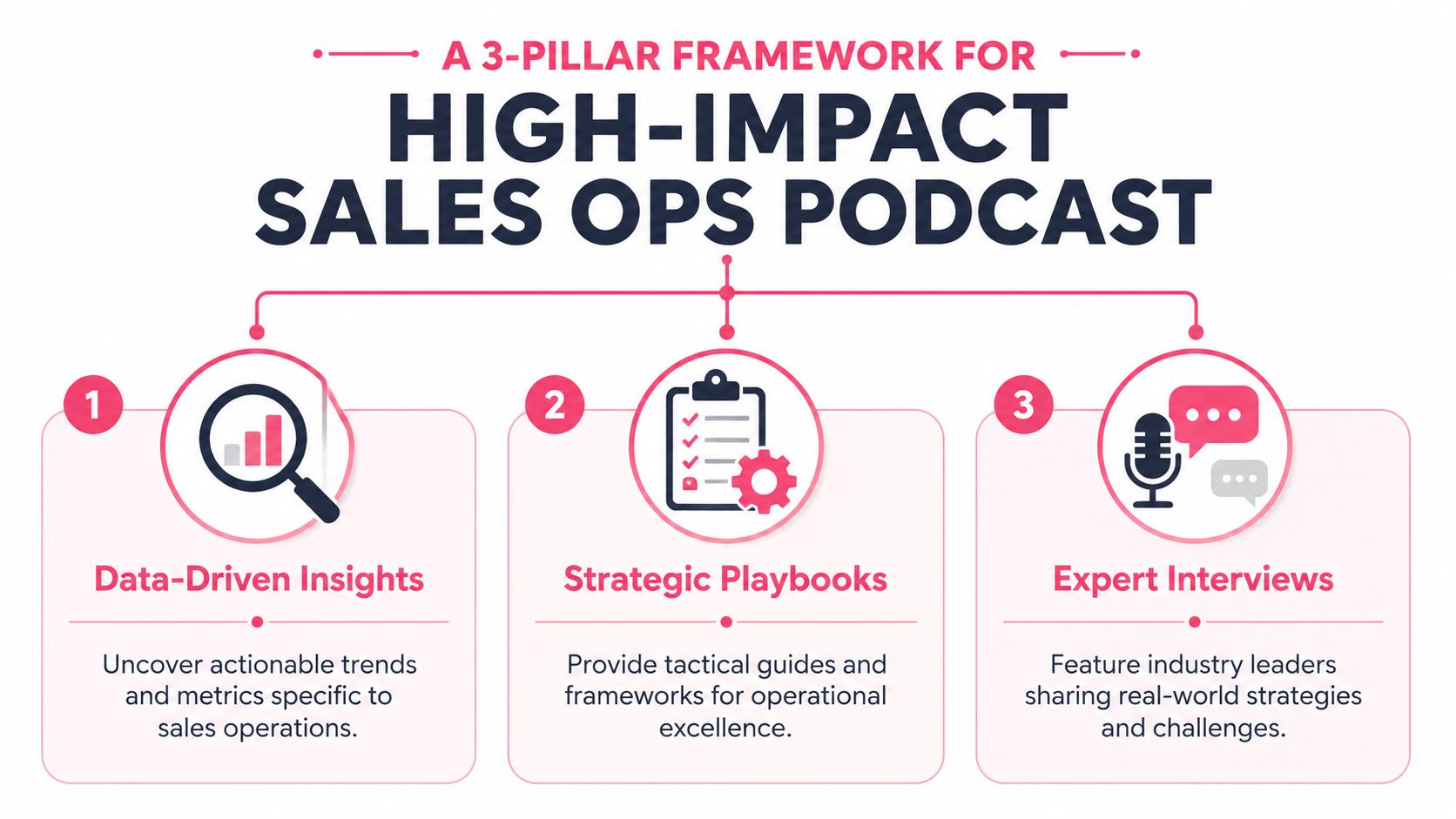
Pillar 1 Relationship-driven ABM
Start with the account list.
Teams lose the plot when they book recognizable names who will never buy, refer, or influence a deal. For a Sales Ops leader, the guest slate should map to revenue priorities: target accounts, expansion accounts, channel partners, consultants, and adjacent vendors that already sit near your buyers. That is how the podcast becomes a repeatable account access mechanism instead of a general awareness program.
Resonate Recordings makes a similar point in its piece on B2B podcast agency strategy. The useful part is the operating discipline behind it. Build the guest pipeline the same way you build outbound lists.
Use a simple structure:
- Score guests against commercial value: account tier, role seniority, buying influence, partner potential, and topic fit.
- Assign ownership before outreach: sales, partnerships, customer success, or marketing should know why each guest matters.
- Log the interview in the CRM: record account status, opportunity stage, and next-step owner.
- Run post-recording follow-up within a set SLA: thank-you note, internal account brief, rep follow-up, and a reason to continue the conversation.
Podcasts outperform cold outreach in Sales Ops. A 30-minute conversation gives your team context on process maturity, systems pain, buying language, and political structure inside the account. Reps can use that context in follow-up. Customer marketing can use it in expansion. Partnerships can use it to open adjacent accounts.
Pillar 2 Technical clarity with operator value
Sales Ops buyers will sit through dense material if it helps them make a better systems decision. They will drop off fast if the episode sounds like tool jargon pasted into a transcript.
The fix is editorial structure. Every episode needs a clear problem statement, a decision path, and a practical takeaway another team could apply this quarter.
A strong interview flow usually follows this sequence:
- Operational trigger: what failed first, forecast quality, routing logic, handoff discipline, data hygiene, or rep adoption
- Decision criteria: what options were considered, what trade-offs mattered, and what the team rejected
- Implementation reality: where the rollout slowed down, who pushed back, and what had to change in process design
- Measured result: what improved in planning, conversion, cycle time, reporting confidence, or manager behavior
That trade-off layer matters. Good Sales Ops content does not pretend every fix is easy. It shows what broke, what changed, and what the team had to give up to get a better operating model.
One useful rule is simple. If the episode cannot produce one workflow change, one talk track, or one reporting idea for the field, it is not ready to record.
Teams building this with automation should also think beyond production. Repurposing, follow-up sequencing, and asset routing can be handled with the same discipline used in an AI marketing automation playbook, as long as the system is tied to account priorities rather than vanity distribution.
Pillar 3 The content multiplication loop
The recording is the input. The system around it creates revenue value.
One episode should feed multiple downstream use cases across pipeline generation, deal support, and internal enablement. If that handoff is loose, the show turns into a publishing exercise. If that handoff is controlled, the same conversation can support account research, nurture, objection handling, and executive follow-up.
A practical output stack looks like this:
- Account-specific follow-up asset for the guest and buying committee
- Short sales clip tied to a live objection or market shift
- Search-focused article built around the operational problem discussed
- Newsletter brief for prospects already in nurture
- Internal enablement excerpt for onboarding SDRs, AEs, CSMs, or RevOps hires
This pillar usually breaks because no one owns conversion after the recording. Fix that with a production-to-revenue workflow: editor marks the strongest clips, content turns them into assets, sales gets the account-relevant pieces, and ops tracks usage against meetings, influenced opportunities, and deal progression.
For a full model on how to structure that handoff, see this B2B branded podcast framework for turning episodes into a repeatable revenue workflow.
Integrating Your Podcast into the Sales Ops Tech Stack
A podcast doesn't prove value by existing. It proves value when Sales Ops can trace it inside the systems that already govern pipeline, follow-up, and reporting.
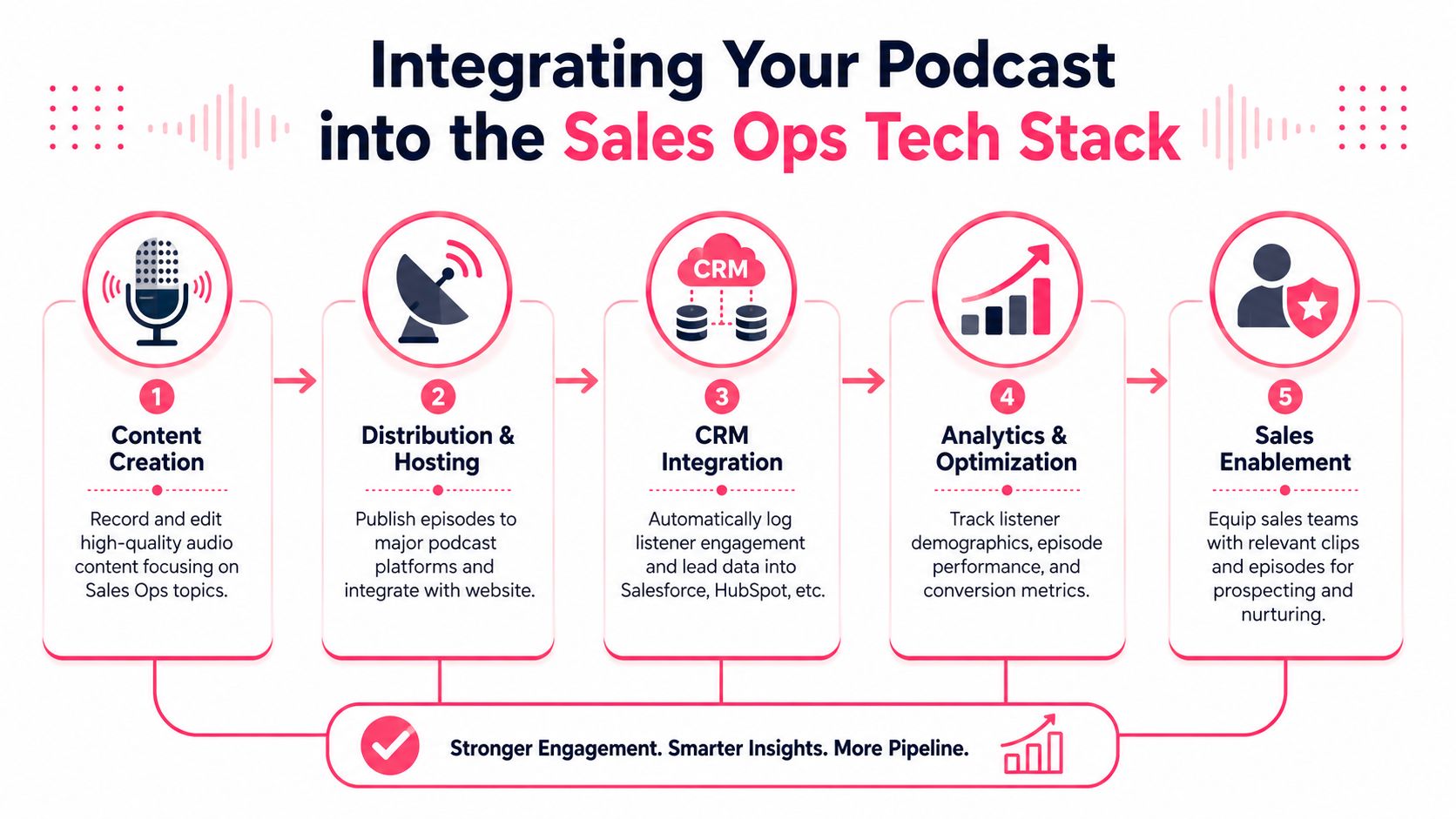
Start with CRM fields, not creative ideas
Most failed podcast programs don't have an audience problem. They have an attribution problem. Approximately 75% of B2B podcasts fail to demonstrate measurable ROI because they track vanity metrics, while companies that integrate podcast activity with CRM-based pipeline tracking can achieve between 3x and 10x ROI (how podcast performance should be measured).
The first setup step is to create a basic data structure inside Salesforce, HubSpot, or your CRM of choice.
At minimum, track:
- Guest identity with company, title, and account owner
- Guest category such as prospect, client, partner, or strategic ally
- Episode date so follow-up timing is visible
- Influence markers such as intro made, meeting booked, opportunity created, or deal influenced
That structure is more useful than another dashboard full of downloads.
Build the follow-up workflow
After recording, the interview should trigger action. Many teams lose the commercial upside at this point because the host records the conversation, sends the asset, and stops there.
A tighter workflow looks like this:
| Step | Owner | What happens |
|---|---|---|
| Interview completed | Host or producer | Guest is tagged in CRM and routed to account owner |
| Asset delivery | Marketing | Guest receives episode assets and sharing copy |
| Commercial follow-up | Sales or partnerships | Relevant next conversation is proposed |
| Nurture assignment | Marketing automation | Guest enters the right sequence by buying stage |
| Reporting update | Sales Ops | Influence and progression fields are updated |
If your team is also cleaning up nurture logic, this AI marketing automation playbook is a helpful reference for mapping content assets into more structured automation.
Route episodes into sales enablement
The smartest Sales Ops teams don't stop at external distribution. They turn podcast content into a searchable enablement library.
That means creating playlists and clips for specific selling moments:
- Objection handling for reps dealing with implementation concerns
- Category education for prospects early in evaluation
- Customer proof points for expansion and renewal conversations
- Executive perspective for deals that need C-level confidence
A two-minute clip about attribution architecture or compensation plan rollout often lands better than a static PDF because the prospect hears the judgment behind the answer.
The best podcast asset in a sales cycle is often not the full episode. It's the exact two-minute segment a rep can send after a live call.
Keep reporting simple enough to use
Don't overengineer this. Sales Ops leaders need a reporting view that ties the show to revenue motion, not a media dashboard.
A functional podcast reporting view should answer four questions:
- Which guests came from target accounts?
- Which interviews led to follow-up meetings or introductions?
- Which open opportunities show podcast influence?
- Which closed deals had podcast engagement during the buying journey?
One practical option in this category is Fame, which provides B2B podcast production with strategy, distribution, and attribution support for teams that want the podcast tied to pipeline systems instead of handled as a standalone content project.
Five Plug and Play Episode Concepts for Sales Ops
A Sales Ops leader records ten episodes, gets a spike in listens, and sees no change in pipeline coverage, meeting creation, or deal velocity. The problem usually is not production quality. The problem is episode design.
A useful Sales Ops show is programmed against revenue motions. Each episode should support one of four jobs: open doors into target accounts, help buyers evaluate operational risk, give reps assets they can send during active deals, or sharpen your category position with operators who influence purchase decisions.
Actionable episode concepts for a Sales Ops podcast
| Episode Format | Objective | Ideal Guest | Example Topics |
|---|---|---|---|
| The Tech Stack Teardown | Surface how teams choose, consolidate, and govern tooling | Head of RevOps, Sales Systems leader, CRM admin | Salesforce cleanup, forecasting tools, sequencing platform overlap, data sync issues |
| The Process Audit | Show where workflow friction creates revenue leakage | Sales Ops manager, enablement leader, demand gen ops lead | Lead routing, handoff rules, SLA enforcement, territory exceptions |
| The Forecast Room | Give buyers a clear view of inspection rigor and management cadence | CRO, VP Sales, revenue leader, FP&A partner | Forecast categories, pipeline hygiene, deal inspection cadence, manager accountability |
| Operator to Operator | Build trust with practical lessons from people carrying operational ownership | Director of Sales Ops, RevOps consultant, systems architect | Compensation rollout, dashboard adoption, CRM governance, data ownership |
| The Buyer Committee Briefing | Create multi-threading content reps can share across stakeholder groups | Panel with Sales, Marketing Ops, Finance, and CS leaders | Revenue attribution disputes, board reporting, expansion signals, post-sale handoff friction |
These formats work because they map cleanly to how Sales Ops buyers assess vendors. They want evidence of process maturity, system fit, reporting logic, and change-management competence. A well-built episode gives them that evidence before a formal demo.
How to keep these episodes commercially useful
Start with a live operational problem. Skip the long origin story.
Then drive toward specifics. Ask what broke, how the team diagnosed it, what changed in the CRM or workflow, who owned the rollout, and what metric improved enough to justify the effort. That level of detail makes the episode usable in real selling situations.
A few production rules help:
- Use one buying-stage angle per episode so the conversation stays relevant to a specific sales motion.
- Ask for decision criteria instead of broad opinions or trend commentary.
- Push for implementation detail such as field ownership, routing logic, governance rules, or dashboard definitions.
- Capture one clipable answer for reps that can stand alone in email, LinkedIn, or follow-up after a discovery call.
- Tag each episode in your CRM or content system by persona, problem type, and sales stage so teams can find it later.
There is a trade-off here. Broad conversations usually attract more casual listeners. Narrow operator episodes create stronger sales assets. For Sales Ops, the narrower format tends to win because a 20-minute discussion on forecast inspection or compensation exceptions is far more useful in an open deal than a generic conversation about revenue trends.
Short series also perform well. A four-episode run on CRM governance, forecast discipline, or territory design gives your team a content package they can deploy across multiple accounts with consistent messaging.
If you want more formats to adapt, this collection of podcast episode ideas for B2B shows is a practical planning resource. Teams using LinkedIn to source guests for these formats should also compare LinkedIn outreach solutions so booking stays predictable instead of depending on manual follow-up.
How Sales Ops Leaders Build Authority with Fame
Authority in Sales Ops doesn't come from publishing more often. It comes from being consistently useful in a category where buyers value operational judgment.
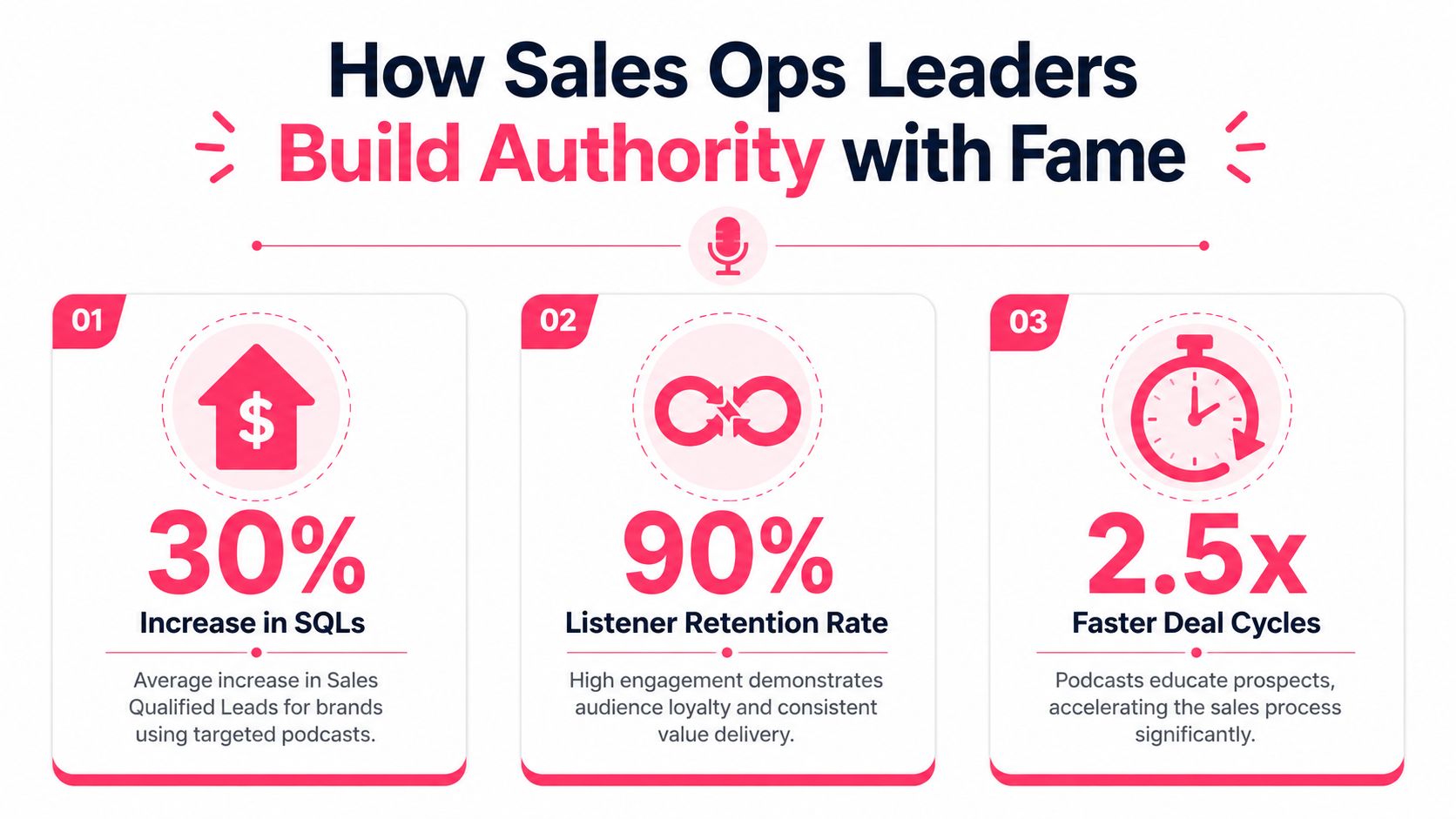
What strong case studies have in common
The most relevant examples are the ones closest to revenue operations, sales intelligence, and data-heavy B2B categories. On Fame's podcast case studies page, the clearest fit for this market includes:
- Building authority in sales ops with Ebsta
- Empowering sales data with Forma AI
- How People.ai became thought leaders in data-driven revenue
These examples matter because they sit close to the concerns of Sales Ops buyers. Forecasting quality. Revenue intelligence. Data trust. Commercial process design.
Why this model works in practice
Top-tier B2B podcast strategies see 15% to 25% of booked guests eventually become clients or partners, and one SaaS case study showed 8 enterprise demos from the first 12 guests by using a guest-to-client conversion model. That benchmark appears in the earlier cited Fame material and reflects what happens when guest selection and follow-up are treated as revenue operations, not PR.
The underlying logic is straightforward. If you consistently interview the right operators, consultants, and target-account leaders, the show becomes a relationship accelerator. It creates trust before a proposal ever shows up.
A useful Sales Ops podcast doesn't just publish expertise. It creates a reason for the right people to spend time with you.
That model also outperforms a lot of outbound programs because the interaction starts with relevance, not interruption. If your team is weighing that trade-off, it helps to compare LinkedIn outreach solutions against relationship-led content motions and decide where your reps should spend their effort.
What credibility looks like for buyers
Buyers don't need a polished media brand. They need evidence that you understand the mechanics of their world.
That's why category authority in Sales Ops is often built through repeated conversations about pipeline inspection, data discipline, forecasting logic, and workflow design. A show that documents those discussions becomes a public record of expertise. This guide on how to build credibility with a B2B podcast captures that well.
Your Next Steps to Launch a Revenue-Driving Podcast
Most companies still approach podcasting like a content experiment. That's the wrong operating model for Sales Ops.
The better model is relationship-first and revenue-driven. In that approach, the primary KPI is qualified relationships created, not downloads. That shift turns the show from a marketing channel into a sales asset with a clear role in pipeline development.
What to do first
Start with account selection, not branding. Build a guest list from ideal prospects, customers, partners, and market voices your team should know anyway.
Then map the show into your current systems:
- Define your guest categories inside the CRM
- Create a post-interview follow-up SOP for sales and partnerships
- Assign episodes to buying stages so reps know what to send and when
- Report on influence using opportunities, meetings, introductions, and deal progression
What to avoid
Several habits kill momentum early:
- Publishing without account strategy
- Booking guests based on fame instead of fit
- Treating downloads as the main success metric
- Failing to route interview relationships into the commercial team
- Letting repurposing happen ad hoc
If you're serious about B2B podcasting in Sales Ops, the hard part isn't recording. It's operationalizing the show so every episode has a commercial purpose.
What a mature program looks like
A mature Sales Ops podcast does three things at once. It opens doors with target accounts. It gives revenue teams reusable assets for real conversations. It helps the market associate your brand with operational clarity.
That's why this channel works so well for companies selling into long, technical buying journeys. It respects buyer intelligence, creates trust through substance, and gives Sales Ops leaders something they can measure.
The difference between a podcast that fades and one that drives revenue usually comes down to execution discipline. Guest selection. Follow-up. CRM tagging. Repurposing. Reporting. Those are operational choices, not creative luck.
If you want help building that system, talk to Fame. They work with B2B brands on the strategy, production, repurposing, and measurement required to turn a podcast into a pipeline asset instead of another content experiment.
