
Key Takeaways
Meta Title: B2B Podcasting for Revenue Operations: The Ultimate Growth Blueprint
Meta Description: Discover how modern Revenue Operations brands are using B2B podcasts to scale pipeline, build authority, and enable account-based marketing workflows.
Most advice about B2B podcasting is still stuck in a brand-awareness mindset. Publish interviews. Clip a few highlights. Count downloads. Hope credibility turns into revenue later.
That approach doesn't hold up in Revenue Operations. RevOps buyers are skeptical, highly informed, and usually evaluating tools, systems, and service partners inside a long, multi-stakeholder process. If your podcast sits outside your CRM, outside your account strategy, and outside your sales workflow, it becomes another content asset with no commercial consequence.
Revenue Operations is the alignment of marketing, sales, and customer success around predictable, scalable revenue growth, and a podcast can support that alignment when teams treat it as a shared operating asset rather than a media side project. Generic blog posts and low-context social updates rarely create that kind of pull. Audio can, because it gives technical operators and executives a better way to evaluate how a company thinks.
More than 40% of business leaders now tune into podcasts specifically for B2B content to learn or stay informed, which is why audio-first strategy has become such an important route to executive attention in RevOps categories where standard ads and blog content often underperform (business leaders using podcasts for B2B learning). That shift matters even more when your market responds to clarity, not noise.
If your current content engine feels crowded, repetitive, or forgettable, this is the same underlying issue discussed in Fame's take on fixing the creativity crisis in B2B. RevOps content doesn't fail because teams aren't producing enough. It fails because most of it isn't designed to move opportunities.
The End of Generic B2B Content Marketing
Why text-first content stalls in RevOps
Revenue Operations companies don't sell simple outcomes. They sell process change, forecasting confidence, cleaner data, better handoffs, improved decision-making, and a stronger commercial system. That means the buyer isn't just reading for information. They're listening for judgment.
A generic blog post can't easily demonstrate that. Neither can a recycled carousel summarizing obvious points about alignment or attribution. RevOps leaders have already heard the surface-level version. What they need is proof that you understand operating reality: broken definitions, dirty CRM fields, conflicting funnel stages, tool overlap, handoff failure, and pressure from leadership for cleaner forecasting.
That's where most content programs break. They optimize for publication volume instead of signal.
Practical rule: If a RevOps buyer can skim your content and still not understand how you diagnose pipeline friction, your content isn't helping the sale.
Why audio carries more authority
Audio gives you something text often doesn't. Range. A strong host can challenge a guest, unpack a technical trade-off, compare operating models, and expose whether an idea survives real implementation.
That matters in RevOps because buyers don't want polished talking points. They want operational thinking. A podcast lets your team show how it approaches routing logic, attribution design, expansion reporting, forecasting discipline, and GTM alignment in a format that feels closer to a working session than a campaign asset.
A well-run show also creates internal value:
- Marketing gets sharper positioning: Episodes reveal what language buyers respond to.
- Sales gets warmer entry points: Guest outreach opens doors with target accounts that cold outbound often can't.
- Customer success gets stronger expansion stories: Existing customers hear peers talk about operational maturity and next-stage challenges.
What replaces generic content
The answer isn't “start a podcast” in the abstract. It's build a RevOps-native show with clear commercial intent.
That means your podcast should do three things at once:
- Attract the right operators and executives
- Create direct touchpoints with target accounts
- Feed structured insight back into your revenue system
When teams get that right, the podcast stops acting like a media channel and starts acting like infrastructure for trust, access, and pipeline movement.
Why Revenue Operations Companies Face Unique Content Challenges
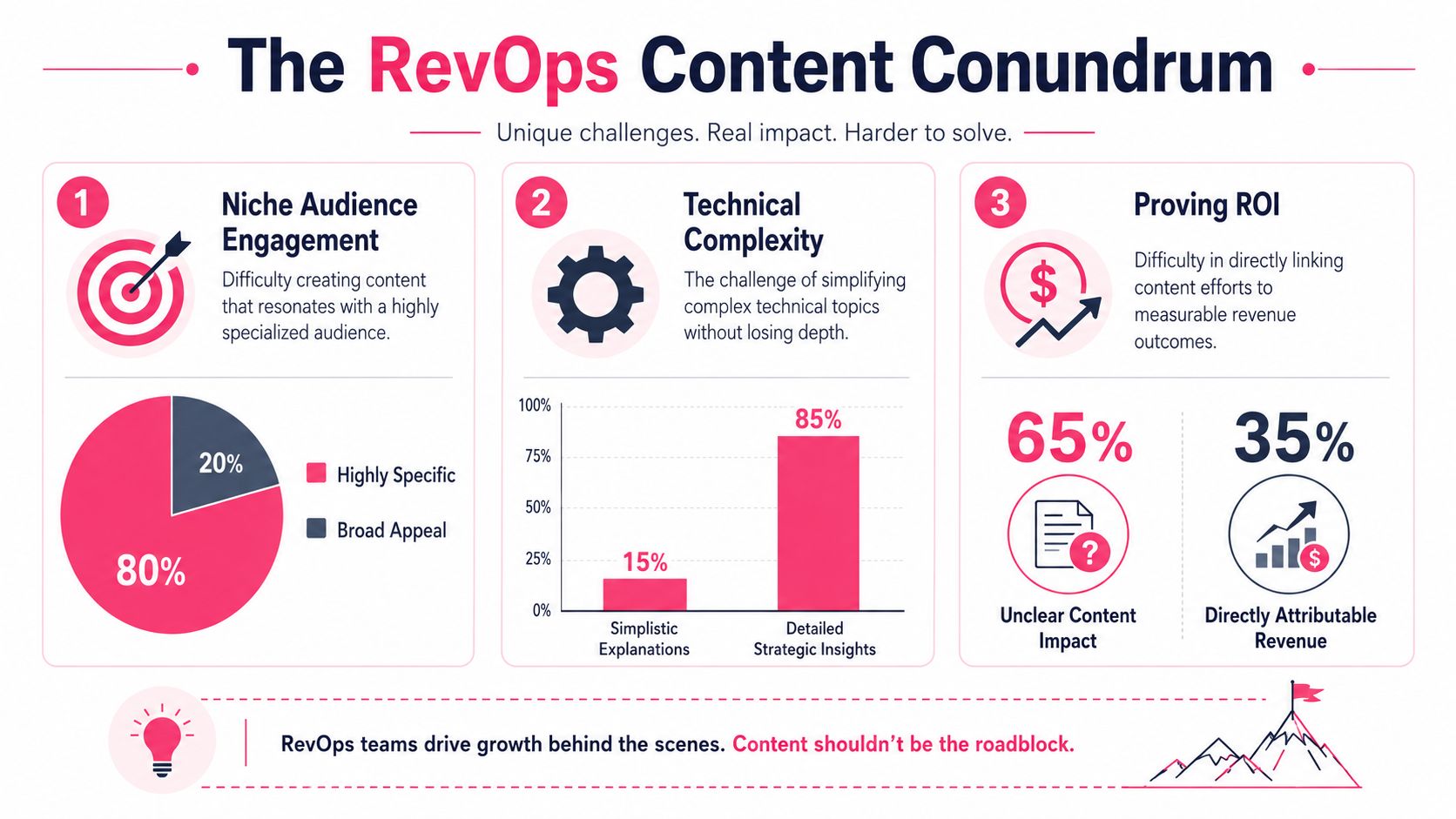
RevOps brands face a harder content problem than most B2B categories because the audience is narrow, the topics are dense, and the commercial impact is often difficult to prove unless the operating model is tight. You aren't speaking to casual readers. You're speaking to people who live inside CRMs, dashboards, handoff rules, forecasts, and board-level accountability.
The audience is small and demanding
Broad-market content usually performs poorly in this space because the buyer isn't looking for inspiration. They're looking for precision. They want to know whether you understand forecasting discipline, qualification logic, process design, and how to create consistency across marketing, sales, and customer success.
That creates a brutal filtering effect. Content that's too broad gets ignored. Content that's too technical without editorial discipline loses the listener. Content that sounds insightful but never connects to business outcomes dies in a slide deck.
Most podcasts fail for the same operational reason
Most B2B podcasts are underperforming, and it's not because podcasting itself doesn't work. They're underperforming because teams treat the show as a self-contained content stream.
87% of B2B podcasts currently generate zero attributable pipeline revenue due to flawed strategies, largely because companies run audio as a content island instead of integrating it into revenue operations (B2B podcast ROI and pipeline measurement). That's the number every RevOps leader should care about before greenlighting a show.
The failure pattern is usually familiar:
- No CRM mapping: Episode engagement never reaches account records.
- No sales handoff: Guest conversations don't become follow-up sequences.
- No attribution logic: Teams can describe activity, but not influence.
- No ICP discipline: Guest selection drifts toward whoever is available.
A podcast without RevOps integration isn't a revenue asset. It's a publishing habit.
Long sales cycles make bad content expensive
RevOps purchases often involve multiple stakeholders and delayed conversion windows. That raises the cost of weak content strategy. If your show attracts the wrong guests, asks shallow questions, or creates no account-level follow-up, you don't just lose attention. You waste a channel that could have accelerated trust across a buying group.
This is why podcasting in Revenue Operations has to be built backward from opportunity creation, deal acceleration, and account influence. The show needs to help your team identify who engaged, what they engaged with, and what happens next.
The companies that get this right don't publish more. They connect content behavior to commercial process.
The Core Framework for an Industry-Defining RevOps Show
The fastest way to waste a podcast budget is to copy a generic interview format and hope consistency solves strategy. It won't. A Revenue Operations show needs a system underneath it.
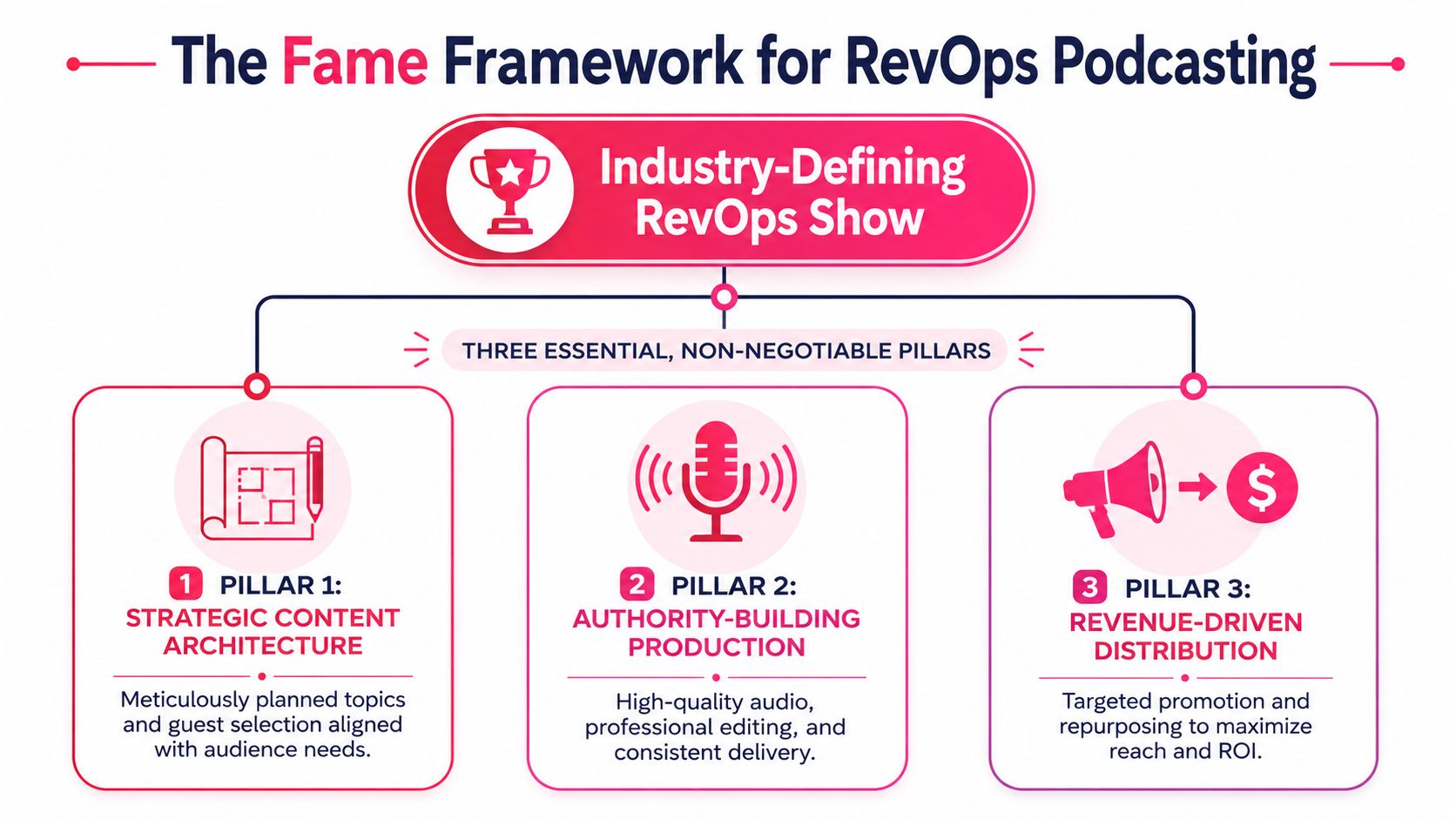
Pillar one: Relationship-driven ABM
In RevOps, guest strategy is account strategy. The smartest shows don't start with “who would be interesting.” They start with “which accounts, partners, and operators would change our commercial position if we built a relationship with them.”
That means inviting:
- Target accounts your sales team already cares about
- Ecosystem partners who influence your category
- Operators with buying authority or strong internal credibility
- Customers with clear operational stories your market wants to hear
The episode is the visible asset. The core asset is the conversation. A good guest interview creates a reason for outreach, a reason for follow-up, and a reason to keep the relationship warm without forcing a sales pitch.
B2B podcasting Revenue Operations becomes practical instead of performative. The show opens doors that normal outbound often can't.
Pillar two: Simplifying the technical
RevOps topics get boring fast when hosts confuse complexity with depth. Buyers don't need a wall of jargon. They need a clean explanation of a real operating problem and a useful point of view on how to solve it.
A stronger editorial pattern looks like this:
Name the operational tension
Example: attribution accuracy versus reporting simplicity.Ground it in day-to-day execution
What breaks in Salesforce, HubSpot, routing, or reporting when definitions aren't aligned?Expose the trade-off
What do teams gain, and what do they lose, with each choice?End with a decision rule
Give the listener a way to apply the idea internally.
The best hosts act like translators for senior operators. They keep the substance, remove the clutter, and force guests to say what actually changes in the business.
If a guest can't explain a RevOps idea clearly in audio, the market won't understand it in a sales cycle either.
A practical production note matters here too. Keep a prep brief for every guest that includes thesis, friction points, banned buzzwords, and examples the host should push for. That's how you protect clarity.
A broader branded-show structure like the one outlined in this B2B branded podcast framework is useful, but RevOps teams need one more layer: operational relevance tied to pipeline stages and target accounts.
Later, one recording can support a broader distribution system. If your team wants a practical outside reference on repurposing content assets, that workflow is worth reviewing because the podcast should feed the rest of your content engine, not compete with it.
Pillar three: The content multiplication loop
A single recording should never stay a single recording. In a mature RevOps program, the raw conversation becomes a set of assets mapped to different functions.
Use one episode to create:
- LinkedIn clips for executive attention
- Text summaries for search and website depth
- Sales enablement snippets for follow-up after target account outreach
- Newsletter commentary for existing audience nurture
- Customer success talking points for expansion conversations
Place the operational system behind that content. The process should tag podcast metadata such as episode ID, guest, and topic to CRM contacts, which makes it possible to report on episode influence against closed revenue. Programs with mature RevOps integration see 30% higher lead-to-customer conversion rates when they build this kind of connected data flow (RevOps strategy and unified data pipeline).
Here's a simple implementation view:
| Workflow layer | What the team does | What to capture |
|---|---|---|
| Guest strategy | Select guests from target accounts and partner ecosystem | account, role, ICP fit |
| Recording | Run a focused conversation tied to one operational theme | episode ID, topic, guest |
| Distribution | Publish clips, summary, email, social, sales follow-up | channel touchpoints |
| Revenue ops | Sync engagement signals into CRM records | contact engagement, opportunity influence |
A setup like Fame can support this by handling production, repurposing, and attribution-oriented podcast workflows around CRM-connected touchpoints, but the core principle matters more than the vendor choice. The show has to live inside your revenue system.
For teams that want a quick visual walkthrough of how this kind of content engine works in practice, this video is useful:
Proven Success How RevOps Brands Build Authority with Fame
The gap between a nice-looking podcast and a commercially useful one is execution. RevOps leaders already know that. The question isn't whether podcasting can build attention. The question is whether a show can strengthen market authority in a category where buyers care about rigor, not personality.
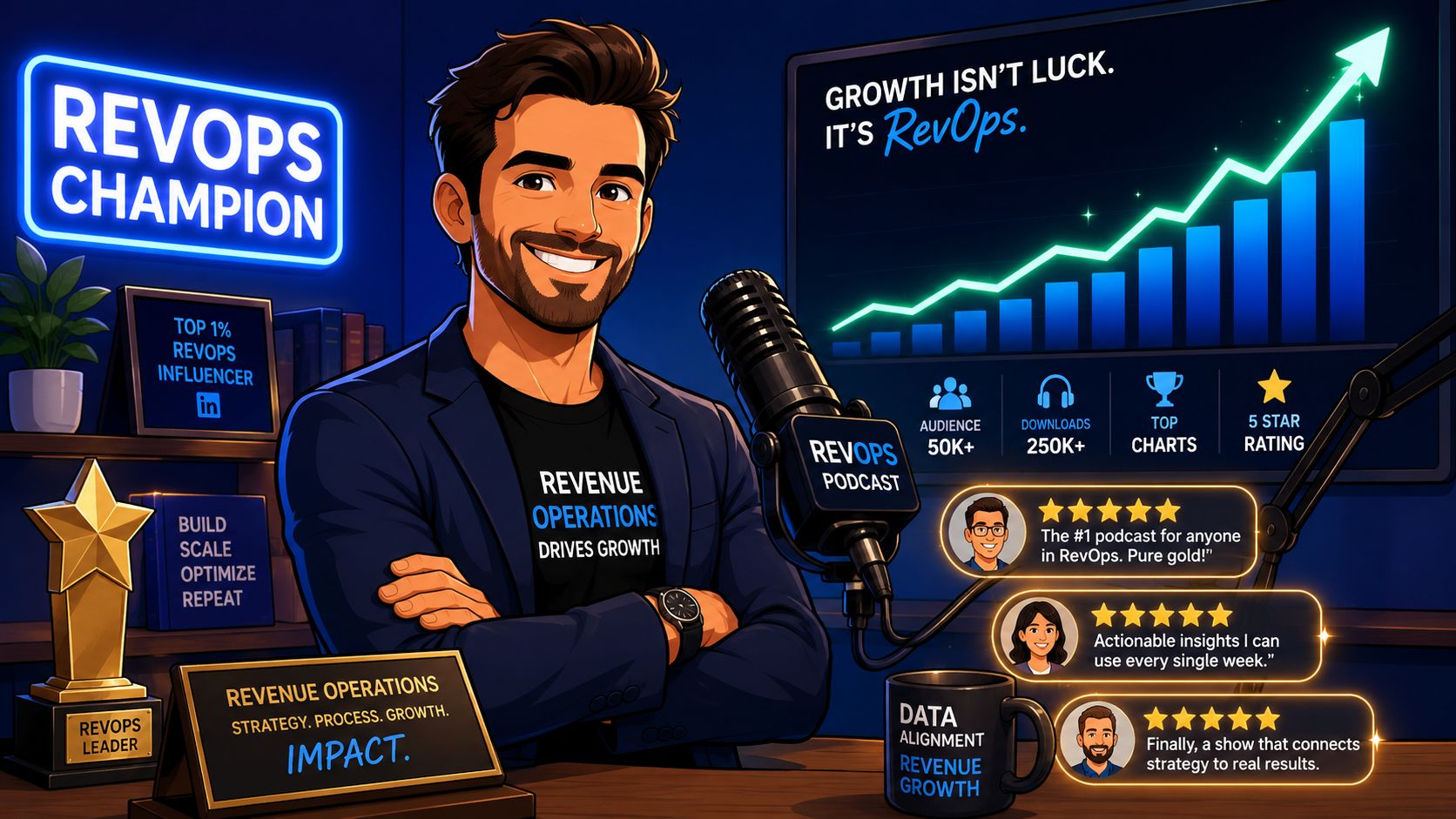
B2B companies with established podcast RevOps functions achieve 2x higher revenue predictability and 2.3x higher profit goal attainment, and Gartner projects that 75% of high-growth B2B firms will adopt podcast RevOps by 2026 as a competitive necessity (RevOps benchmarks and projections). That's the commercial context behind why stronger operators are taking this channel more seriously.
The RevOps-adjacent case studies worth reviewing
If you're evaluating what authority-building looks like in practice, these are the closest fits from Fame's portfolio for Revenue Operations buyers:
- Building authority in sales ops with Ebsta
- Empowering sales data with Forma.ai
- How People.ai became thought leaders in data-driven revenue
- Creating a category with SyncSpider
Each one matters for a slightly different reason. Ebsta sits close to sales operations credibility. Forma.ai points toward sales data and decision support. People.ai speaks directly to data-driven revenue leadership. SyncSpider is useful for anyone selling process, systems, and integration logic.
What these examples show
These case studies all point to the same operating lesson. Strong category podcasts don't win by being broad. They win by becoming the place where a niche market hears serious conversations handled well.
That creates three advantages:
- Category framing: Your company gets associated with the right commercial questions.
- Relationship density: Guests, partners, and prospects engage in a higher-trust environment.
- Internal benefit: Sales and marketing gain reusable assets tied to real market conversations.
The strongest B2B podcast in a niche isn't the loudest one. It's the one buyers reference when they want to understand the category.
You can browse the wider Fame case studies library if you want more examples across adjacent B2B markets, but the RevOps-relevant ones above are the clearest benchmark for this space.
Five Plug-and-Play Episode Concepts for Your RevOps Podcast
A good RevOps show doesn't need endless brainstorming. It needs repeatable formats with a clear job. Once the format is stable, guest selection, promotion, and sales follow-up become far easier.
A broader list of inspiration can help, and this roundup of podcast episode ideas is useful for expanding your editorial bench. But for Revenue Operations, these five formats do most of the heavy lifting.
Revenue Operations podcast episode formats
| Episode Format | Concept / Title Example | Strategic Goal | Ideal Guest Profile |
|---|---|---|---|
| The Revenue Breakdown | “Why Forecast Accuracy Falls Apart After Handoff Changes” | Demonstrate operational depth and attract senior RevOps practitioners | VP of RevOps, Revenue Intelligence leader, CRO |
| The Stack Decision | “When Should You Add Another Tool Versus Fix Process?” | Show practical judgment around systems, tooling, and trade-offs | RevOps architect, systems consultant, sales ops leader |
| The Partner Signal | “How RevOps and Enablement Teams Should Share Ownership” | Build relationships with ecosystem partners and adjacent buyers | Partner lead, enablement executive, CRM consultant |
| The Operator Debrief | “What We'd Audit First in a Messy Salesforce Instance” | Make technical topics engaging through diagnosis-style conversations | Salesforce admin leader, HubSpot ops lead, GTM systems operator |
| The Expansion Engine | “What Customer Success Needs from RevOps to Support Growth” | Connect the show to retention, expansion, and cross-functional alignment | CS operations leader, customer success executive, post-sales strategist |
How to use these formats without drifting
A common mistake is changing format too often. They mistake novelty for momentum. In practice, stable formats build recognition and make guests easier to recruit because the promise is clear.
A simple rule set helps:
- Keep one flagship format: This becomes the core identity of the show.
- Add one partner format: Use it to deepen ecosystem relationships.
- Reserve one technical format: This attracts operators who care about substance.
- Use one expansion format quarterly: That keeps customer success in the revenue story.
What each format does for pipeline
Not every episode should try to do the same job. Some episodes are better for attracting a target account guest. Others are better for proving product-category fluency. Others create cleaner collateral for a sales rep who needs a useful follow-up after a discovery call.
That's why recurring formats work so well in B2B podcasting Revenue Operations. They let your team align content with commercial intent before production starts.
Here's the practical way to assign them:
- ABM episodes target named accounts and strategic relationships.
- Technical episodes build trust with operators evaluating capability.
- Partner episodes widen reach inside an existing ecosystem.
- Customer-facing episodes support expansion and retention conversations.
- Point-of-view episodes sharpen category authority.
Don't ask, “Is this a good topic?” Ask, “Which revenue motion does this episode support?”
Once that question becomes normal in planning, your calendar gets tighter, guest selection improves, and the show starts behaving like part of your GTM system.
Launch Your Revenue-Driven Podcast with Fame
A generic B2B podcast is easy to launch and hard to justify. A Revenue Operations podcast built around account access, technical credibility, and CRM-connected attribution is harder to set up, but it has a real shot at becoming a commercial asset.
That distinction matters. RevOps teams don't need another content stream that sits beside the business. They need a show that helps marketing open conversations, helps sales deepen relationships, and helps leadership see how attention turns into opportunity influence over time.
What strong execution actually requires
The playbook is straightforward on paper, but execution is where many organizations stumble. You need editorial discipline, strong guest recruiting, sharp hosting, consistent production, repurposing workflows, and a reporting model that doesn't break the moment someone asks how the podcast influenced pipeline.
You also need the right adjacent systems. For example, if email is part of your follow-up motion around episodes, a resource like Mailadept's High-Performance Email System is useful because distribution only works when the outbound layer is structured well too.
The operational checklist usually includes:
- CRM design: Contact fields, campaign structure, and attribution logic
- Guest operations: Outreach, scheduling, prep, post-interview follow-up
- Editorial strategy: Topics tied to ICP pain and commercial relevance
- Distribution planning: Social, email, sales enablement, and website workflows
- Revenue reporting: Evidence of influence on accounts, opportunities, and expansion
Why specialist support changes the result
Most internal teams can produce a podcast. Fewer can run one like a revenue program. The difference is knowing how to keep guest quality high, host conversations that reveal real expertise, and turn each episode into an asset sales and marketing will use.
That's where specialist support becomes valuable. The right partner doesn't just edit audio. They help shape the show around account strategy, market positioning, and the mechanics of turning a recorded conversation into measurable business value.
If your team wants a podcast that earns trust in the RevOps market and connects cleanly to pipeline goals, that's the standard to hold.
If you want a partner that specializes in B2B podcast execution for pipeline, authority, and distribution, Fame is worth exploring. Their work is built around the operational reality most RevOps teams care about: getting the show launched, keeping quality high, and turning episodes into content and commercial assets your team can use.
